Happy Valentine's Day

From Kristine and Victoria, all our love accompanied by virtual hugs and kisses to all our faithful readers.  Be our Valentines…all year long.

Click here for last minute London Valentine’s Day shopping ideas.
Click here for “no expense spared” gifts from the likes of Lulu Guiness and Birkin.
Looking for a unique Valentine’s Day experience? Check out offers from the London Eye, complete with champers and chocs.
More romantic and/or historic London experiences can be found here.
And lastly, check out London’s most expensive Valentine’s Day package here, courtesy of the Athenaeum Hotel.
S.W.A.K.

Advertisements from La Belle Assemblee, 1816

We generally think of La Belle Assemblee, the regency-era magazine, in regard to its fashion plates. It also carred many articles about leading personalities, world events and history, interesting occurances, and as below, some fascinating advertisements in a special section.  Here are some excerpts (pictures added by this blogger);

BELL’S MONTHLY COMPENDIUM OF ADVERTISEMENTS FOR DECEMBER, 1816

THE PANTHEON FAMILY LINEN WARE HOUSE

Pantheon, London, 1816

   T. Craig begs to solicit the Nobility and Families to inspect his STOCK OF LINEN DRAPERY WHICH (without using the words “Bankrupt Stock,” – Bought for Cash !! –“ “Selling off” – “Irish Linen Company,” etc. words which are too well know to deserve any thing but contempt) will be sold at the following prices, and let the world judge for themselves:–

Irish Linen very stout ………………………………………….        1          0

Ditto Superfine ……………………………………………….         2          6

One hundred elegant Cobourg Striped Dresses, each       ……        5          6

Union Cambrics (ten Handkerchiefs each piece)………………      9          6

India Nankeens, seven yards long (the Company’s best), per piece  7          6

Merino Twilled Stuffs ………………………………………….      1          6

 Observe!! It is sometimes necessary for Ladies to bring the Advertisement with them; it will be a guide for themselves, and will at all times shew whether the Advertisement is genuine or fictitious.
  78, Oxford street, near the Pantheon

THE VERDIGONIAN ODORIFEROUS AND ABSTERSIVE TOOTH PASTE

Price 2s. 9d. and 7s. per  pot,

 Communicates the most refined and delicate fragrance to the breath, renders the teeth beautifully white, fastens those which are loose, and preserves them from decay to the latest period of life.  It is peculiarly adapted to use of Children; and employed by the fair sex in particular, it will fully accomplish the description of the poet,–

  “Her breath was sweeter than the morning gale,
  “Stoln from the rose of violet’s dewy leaves,
  “Her ivory teeth appeared in even rows,
  “Thro’ lips of living coral.”

Tooth brushes for using the Tooth Paste, 4s. 6d. per Set.

(Verdigonian: after Monsieur Verdigon whose “Celebrated Medicines are approved and recommended by all the Medical Halls in Europe”; Odoriferous: bears or diffuses scent; Abstersive:  having the quality of cleansing or purging)

TREBLE DISTILLED LAVENDER WATER

Under the August Patronage of his Royal Highness the Prince Regent; their Royal Highnesses the Princesses Augusta, Elizabeth, Sophia, and Mary; her Imperial Highness the Grand Duchess of Russia; Princes of Wirtemberg; their Graces the Duchesses of Devonshire and Wellington; his Grace the Duke of Marlborough; the Right Hon. the Countesses of Waldegrave, Darnley, and Liverpool; the Right Hon. Viscountess Powerscourt; Lady E. Bentinck; the Baroness de Montesquieu; the Hon. Mrs. Hope; The Hon. Mrs. Stapleton; Ladies Hatton, Bourne and Ball; and by the Nobility and Gentry in general.

 Manufactured by HENRY CHRISTIAN, Chemist, &c., Canterbury, the only and sole inventor (and with whom no other person is connected), of whom it may be had wholesale, retail, and for exportation; also in London of Mr. Johnston, 15, Mr. Berry, 17, Greek-street, Soho; Overton , 51, and Gattie and Pierce, 57, New Bond-street; Newbery and Sons, 45, and Prosser and Co., 20,  St. Paul’s Churchyard, Barclay and Sons, 95, Fleet-market; Leuchars, Haymarket; Wass, 12, Cheapside; and of all the respectable Perfumers, Stationers, &c., in Great Britain and Ireland.

TO THE FEMALE SEX

             The weak corporeal frame of the female sex, and the extreme sensibility of their minds, expose them to a variety of diseases, which require the assistance of an experienced
practitioner; while, on the other hand, the modest and engaging delicacy of the British Ladies renders them, in general, averse to exposing their more private ailments to the cognizance of the usual medial attendant on their families.

            To avoid this frequently unpleasant circumstance, the Ladies are assured that Dr. FISHER may be consulted by them, with the utmost confidence in his integrity, and in his long experience in female complaints of every kind, whether arising from natural weakness of constitution, from brooding over the unhappiness of life, from the unfortunate results of error of  fashionable gaiety, or from any accidental cause; and in other cases, where, although health is enjoyed, yet the parties feel a certain addition wanting to their happiness, this defect may almost always be removed by persevering in his mode of treatment.

            Dr. FISHER is at home from ten till two, and from seven till nine every day (Sundays excepted), but in many cases a letter detailing the symptoms, and inclosing a remittance for advice and medicine, will render personal communication unnecessary, and the remedies will be forward by any conveyance that is pointed out, so that the utmost degree of secrecy may be preserved.
    N. 27, Cross-street, Hatton-Garden
END OF ADVERTISEMENTS

I am not so sure I want to share my secrets with Dr. Fisher — how about you???? 


Regency Reflections: Ashton on 1812, Part II

John Ashton, in Social England Under the Regency, told of the convoluted eforts of the Prince Regent to reward his assistant, Colonel McMahon, and how various others in government circles tried to thwart the PR’s wishes. From Chapter 6, 1812:

But, be his (McMahon’s) origin whatever it might have been, he was a tool well fitted for the use of his august master, who, it must be owned, endeavoured to repay him; but, also, at the public expense. In 1811 General Fox died, and at his death, the office of Paymaster of the Widows’ Pensions became vacant. It was a perfect sinecure, the duties being done by others, and the salary attached to the office was over £2,000 per annum. The Commissioners of 1783, and of 1808, both reported and recommended the abolition of the Paymaster and Deputy-Paymaster of Widows’ Pensions, as being unnecessary, the one having very little to do, the other, nothing at all. The office of Paymaster had, in particular, been recommended to be done away with, on the demise of General Fox; but it was given to Colonel McMahon.
             On January 9, 1812, on a Motion for Supply, Mr. Creevey spoke decidedly against this appointment, and moved as an Amendment, ‘That the House would, to-morrow se’nnight resolve itself into a Committee of Supply, in order to give an opportunity, in the interim, for the consideration which he had suggested,’ namely, that they would take into their earliest consideration, the various offices of emolument recently granted by the Crown to several of their members. This amendment was lost.
Thomas Creevey (1768-1838), MP
 
            On the 22nd of February, the question of the Army Estimates being on, Mr. Bankes moved as an Amendment, ‘That the amount of the sum expected to be paid to the Paymaster of Widows’ Pensions, being 12d. in the pound on the said Pensions (£2,790 1s) be deducted from the said sum.’ This amendment was lost by a majority of sixteen.

            But on the next night, Mr. Bankes brought the matter up again, and moved the virtual abolition of the office by omitting the sum necessary to pay it–and this was carried by a majority of three.

            There was consternation among the Regent’s party at the temerity of the House in thus thwarting the Royal wishes, and, of course, the recalcitrated Commons must be taught a lesson, so McMahon was appointed Keeper of the Privy Purse, and Private Secretary to the Prince Regent; and in the caricature of ‘The Privy Purse and Political Beggars’ we find McMahon installed in his new position. Sheridan says, ‘Dear, good worthy Countryman, thou Pine Apple of Erin! consider I was burnt out,* not a penny in my purse, my credit very low–do–dear Mac, for the love of St. Patrick, give me a handful.’ Buckingham: ‘I have not above a Hundred Thousand a year, these hard times. Pray remember the Poor!’ Temple: ‘With my wife’s fortune and my own I have not above Forty Thousand a year. Pray remember the Poor! Grenville: ‘I have not above Fifty Thousand a year, a slender pittance. Pray remember the Poor!’ Mac Mahon replies: ‘Paws Off! no Blarney will do with me! I’m up to all your Gammon! and so is my dear Master. I’m cosy at last, in spite of all your speeches and paragraphs, and you may all go to the Devil, your Master!!!’

            And doubtless, he thought he was cosy, but the Commons would not stand the job, and on the 23rd of March, his appointment was brought before Parliament, and the Hon. J.W. Ward asked whether it was a fact, and, if so, what salary was he to have? Mr. Perceval, as Chancellor of the Exchequer, admitted the appointment, and pointed out that Colonel Taylor had occupied the same position towards the King for many years, and the same salary that was given to that gentleman had been continued to Colonel McMahon. Mr. Whitbread pointed out that Colonel Taylor’s appointment was owing to the infirmities of the King, and that previously there had been no such post.

McMahon, by Lawrence, Vancouver Art Gallery
            On the 14th of April, Mr. C.W. Wynn, in the House of Commons, moved for the Production of the Appointment of Colonel McMahon to the new Office of Private Secretary to his Royal Highness the Prince Regent. A very long discussion took place, and on a division, the motion was negatived by a majority of seventy-six. But the Ministry felt that the House was decidedly against them, and the appointment was not persisted in–McMahon afterwards became a pensioner on the Privy Purse.
Note from Victoria: Sir John McMahon (c.1754-1817), formerly a colonel in the foot guards, was a Privy Counselor from 1812 to his death in 1817. He was made a baronet by the Prince Regent.  Several of his bothers also occupied important government positions in England and Ireland.  In Georgette Heyer’s  1935 novel, Regency Buck, he is a minor character in Brighton and facilitates Judith’s first invitation to the Royal Pavilion.
I guess this is a sneaky way to insert one of my favorite authors, Georgette Heyer.   Regency Buck was the first of her many Regency-set novels; her research was brilliant and her accuracy meticulous, setting a high standard for the rest of us authors. 

Regency Reflections: Ashton on 1812, Part I

The following is an excerpt from John Ashton’s Social England Under the Regency, which can be found in digital formats at numerous sites.

Regency a la Mode, British Museum
from Chapter 6, 1812:
            Judging by the barometer of public opinion, the satirical prints, the topic of conversation in the commencement of this year, was the Prince Regent. Occupying the exalted position that he did, he naturally was the observed of all, and his foibles and peccadilloes were made the laughing stock or were censured of all. And the Caricaturists did not spare him. Take this illustration as a sample; it is called ‘1812, or Regency a la Mode,’ where we see our ‘fat friend,’ as Brummell called him, having his stays laced, and, during that operation, occupying himself by rouging his cheeks.
             He would allow very little of his doings to be known by the public, and the movements of Royalty, as we know it in the Court Circular, were recorded in the baldest manner possible, except on one occasion, when the Regent sprained his ancle, and there was a very long and elaborate report thereon.
Prince Regent, by Sir Thomas Lawrence
            Morning Chronicle, Saturday, November 16, 1811:–‘The Prince Regent.–His Royal Highness, we are concerned to state, was not well enough to come to town yesterday. At the Party given by the Duchess of York at Oatlands, on Wednesday evening, the Duchess made arrangements for a Ball. The Prince Regent agreed to lead off the dance with his daughter, the Princess Charlotte, for his partner. Whilst his Royal Highness was leading the Princess briskly along, his right foot came in contact with the leg of a chair or sofa, which gave his leg a twist, and sprained his ancle. His Royal Highness took but little notice of it that night, but in the morning he found it worse than he expected, etc., etc.

            Whatever was the matter with him, he did not leave Oatlands till the 9th of December, or nearly a month after the Ball. Nobody believed in the royal sprain, but the story that did gain credence, and was made the most of by the Caricaturist and Satirist, was that the Regent, at that Ball, grossly insulted Lady Yarmouth, for which he was most heartily, and soundly, thrashed by her husband, Lord Yarmouth, and hence the royal indisposition. Walcot, as ‘Peter Pindar, Esqre,’ wrote one of his most scathing odes, and that is saying something, entitled, ‘The R______l Sprain, or A Kick from Yar_____h to WA_______s, being particulars of an expedition to Oat______nds, and the Sprained Ancle.’
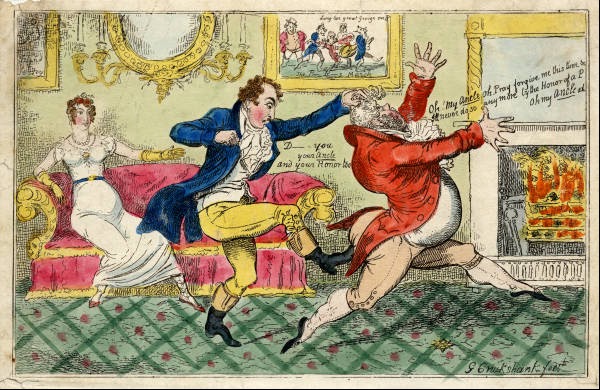
A Kick from Yarmouth to Wales
            There were several Caricatures, all with the same tendency. One was ‘A Kick from Yarmouth to Wales, December, 1811, which shows Lord Yarmouth holding the Regent by his coat collar and vigorously kicking him behind, the Regent yelling and trying to get away, Lady Yarmouth sitting on a sofa looking on. There is attached to this, a poetical effusion of fourteen verses, to be sung to the tune of ‘The Love-sick Frog.’ The first verse runs thus:
“A Prince he would a raking go.
Heigh ho! said Rowly.
Whether his people would have him or no;
With a rowly-powly, gammon and spinach,
Heigh Ho! said Anthony Rowly.”
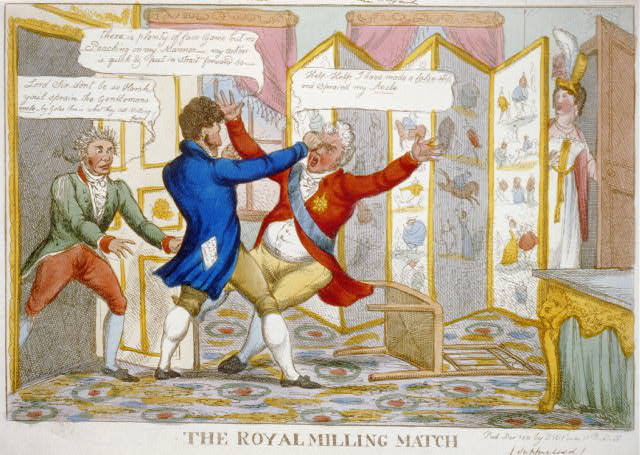
            Then there was ‘The Royal Milling Match,” published December 1811, in which depicted Lord Yarmouth, who, by a paper sticking out of his coat po
cket, was ‘Late a pupil of the Champion of England,’ ‘fibbing merrily’ on the royal countenance; at the same time exclaiming, ‘There is plenty of fair game, but no poaching on my Mannor. My action is quick, and put in strait forward–so!’ The Regent calls out, ‘Help, help, I have made a false step, and sprained my Ancle.’ A servant coming in says to Lord Yarmouth ‘Lord, Sir, don’t be so harsh, you’ll sprain the gentleman’s ancle. By goles, this is what they call Milling indeed!’ Lady Yarmouth views the scene from behind a screen.
            The most amusing one I have seen, is given in the accompanying illustration (below), which is by Geo.Cruikshank, published January, 1812. It is called ‘Princely Agility: or the Sprained Ancle.’ The doctor at the foot of the bed (probably meant for Halford) is fomenting the foot, which seems its normal size, and says to the attendant, ‘Take the waistcoat away, or we shall make the town talk.’ The Princess Charlotte is examining the foot, and exclaims,’Bless me, how it swelled!’ Lady Jersey, who is administering to the invalid prince, is inattentive to her duties; whilse the Regent with ‘two lovely black eyes,’ is calling to Colonel McMahon, ‘Oh! my Ancle, Oh!–bring me my Wig–Oh! my Ancle! Take care of my Whiskers, Mac! Oh, Oh, Oh, Oh, o-o-o-oh-o!’ Sir John Douglas is feeling his pulse saying, ‘Out a way, Mon, you are always exposing yourself.’ John Bull is coming in at the door, but is pushed back by Adams with ‘Indeed, Bull, ’tis only a sprained ancle.’ But John Bull says, ‘John Bull is not to be fobbed off so easily, Master Lawyer.’
           George Cruikshank was not very particular as to his likenesses, as we may see by his ideal Colonel McMahon, who was a servant worthy of his master, to whom he was most useful.
            Walcott ‘Pindarised’ him in an Ode, ‘Mac the First,’ in which he makes him say:
‘Once a boy, in ragged dress,
Who would little Mac caress?
When in the streets, starv’d and sad,
I was a common errand lad.’

More about the Prince Regent and Col. McMahon, soon at this site.
The Wellington Connection: The Koh-i-noor Diamond

The Koh-I-Noor diamond on view at the Great Exhibition

From Harper’s Magazine, Volume 32

The great diamonds of the world are as famous as the great mountains or rivers. Who has not read of the Koh-i-noor, the “Mountain of Light,” which has been stolen from sovereign by sovereign for near a thousand years, its last proprietor—by title, at least, semi-felonious—being her Gracious Majesty Queen Victoria? Every body knows that the Koh-inoor first belonged to the god Krischnu. From him—poor, helpless god!—it was stolen by a wild Delhi chief, who wore it in his hat; from him by Ala-ed-Din ; from him, in 1526,-by Baber of the Moguls. To Aurnnzebe it occurred that the Koh-i-noor, like other diamonds, would be the better for some polishing and cutting. Unhappily, the diamond-cutter who received it in charge was unskillful. From 793 carats the blockhead cut it down to 186. Aurunzebe was for cutting him down on the same scale, beginning with his head; and really, in the interest of art, one can not but deplore the fellow’s escape. It should have weighed at least 400 carats, and been worth  $500,000,000. As it is, it would not fetch more than the value of a couple of stout cities. A mere pebble. Nadir Shah stole it when his turn came; from his descendants it was wrenched by Achmet Shah; from his son it was extorted by Runjeet Singh ; and from his people it was ” conveyed” by British troops, who loyally presented it to their Queen, who showed it to her people at the Great Exhibition of 1851. Her Majesty was not satisfied with its brilliancy, and had it cut again, this time by the great diamond-cutter, Costar, of Amsterdam, who reduced it to 106 carats.
The cutting marked an epoch. Costar and his men came over from Amsterdam for the purpose, and were installed at the Queen’s jeweler’s work-shop. A steam-engine was erected to do the work, and it was the Duke of Wellington himself who set the machinery in motion, and made the first cut. All England, through representatives in the press, was a breathless spectator of the thrilling scene. A single slip of the cutter’s hand might have done a mischief not to be measured save by hundreds of thousands of pounds. A moment’s inattention might have cost a million. Happily the operators’ nerves were steady, and their thoughts concentrated on their work, so that no accident occurred. Long and loud were the controversies, to which the cutting gave rise—one party claiming that these Dutch Jews were ruining the finest jewel in England, others maintaining that without a new cutting the Koh-i-noor was comparatively valueless.
Whichever was right, Costar carried his point, and connoisseurs and the trade are now generally agreed that the cutting was beneficial. It is now a perfect brilliant, with duly proportioned table, facets, and culet. Its previous shape . . . was irregular—neither rose nor brilliant.

The stone was soon after mounted in a brooch which Queen Victoria often wore and, after her death, it was set in Queen Alexandra’s crown. It was afterwards used in the crown of Queen Mary and, today, appears in the crown of Queen Elizabeth II, as seen above.