More excerpts from Captain Gronow's Reminiscences

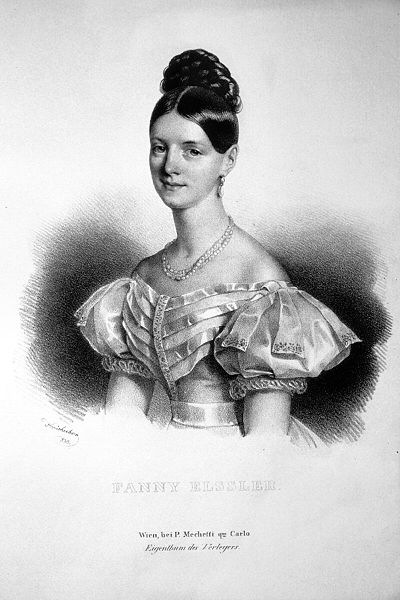
Captain Gronow knew and admired the Austrian dancer Fanny Elssler (1810-1884). Here, from his Reminiscences, is his commentary on her:

FANNY ELSSLER

In 1822 I saw this beautiful person for the first time.  She was originally one of the figurantes at the opera at Vienna, and was at this time about fourteen years of age, and of delicate and graceful proportions.  Her hair was auburn, her eyes blue and large, and her face wore an expression of great tenderness. Some years after the Duke of Reichstadt, the son of the great Napoleon, was captivated with her beauty; in a word, he became her acknowledged admirer, while her marvellous acting and dancing drew around her all the great men of the German court.  The year following she went to Naples, where a brother of the King fell desperately in love with her.  Mademoiselle Elssler went soon afterwards to Paris, where her wit electrified all the fashionable world, and her dancing and acting in the Diable Boiteux made the fortune of the entrepreneur. In London her success was not so striking; but her cachucha will long be remembered, as one of the most exquisite exhibitions of female grace and power ever seen at her Majesty’s Theatre, and in expressiveness, her pantomimic powers were unrivalled.
Fanny Elssler, 1836

The Wellington Connection: Waterloo Chairs

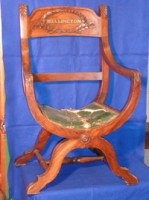
Discovered during a routine valuation morning at the Chipping Norton branch of Tayler and Fletcher, Auctioneer and Valuer Stephen Sheppard could not believe his eyes when a photograph of The Duke of Wellington Chair appeared before him.

This fine regency period elm cross frame chair proudly proclaimed the name ‘Wellington’ in bold brass lettering to the top rail and carried a metal plate inscribed with the following inscription ‘This chair is formed from a tree which grew on the plains of Waterloo, and under which the Duke of Wellington stood during a great portion of the day on which he achieved the most glorious of his many Victories. The wood was given to me by J G Children Esq., of The B. Museum, who purchased the entire tree of its proprietor E.V.U.’

Field Marshal Arthur Wellesley, 1st Duke of Wellington, KG, GCB, GCH, PC, FRS (1 May 1769 – 14 September 1852), was a British soldier and statesman, a native of Ireland, from the Anglo-Irish Ascendancy and one of the leading military and political figures of the nineteenth century. He is often referred to as the ‘Duke of Wellington,’ even after his death and there have been subsequent Dukes of Wellington.

Wellington rose to prominence as a general during the Peninsular campaign of the Napoleonic Wars, and was promoted to the rank of field marshal after leading the allied forces to victory against the French at the Battle of Victorian in 1813. Following Napoleon’s exile in 1814, he served as the ambassador to France and was granted a dukedom. During the Hundred Days war in 1815, he commanded the allied army which, with a Prussian army under Blücher, defeated Napoleon at the Battle of Waterloo. Wellesley’s battle record is exemplary, ultimately participating in some 60 battles throughout his military career; he was also twice prime minister under the Tory party and remained Commander-in-Chief of the British Army until his death.

Following further research, it was discovered that The Gentleman’s Magazine of 1836 carried a contemporary review of Dykes Tour in Belgium – Kay’s Caffraria, which states “As to accuracy of fact – Mr Dyke mentions that the elm tree on the plain of Waterloo, under which Lord Wellington stood, “was purchased of a farmer, by a mercenary Goth from England, who hacked and twisted it into tooth picks and snuff boxes”. Now the fact is, that this said mercenary Goth was John George Children, Esq. of the British Museum, the learned and scientific translator of Berzelius, who did not cut it into tooth picks or snuff boxes, but formed it into a massive and handsome chair, in which he reposes, and which he does not sell.” Could this be the very chair mentioned in the magazine article of 1836?  The Wellington Chair is estimated at £5,000-£8,000 and measures 97cm high x 61cm wide. Provenance: Purchased at a country house sale in Oxfordshire during the 1950’s thence by descent to the private vendor.

This fine piece of furniture is only one small part of a much larger auction sale that will include ceramics, glassware, metalware and bronzes, silverware, jewellery, clocks watches and barometers, collectables and bijouterie, paintings and pictures, mirrors and books, soft furnishings, textiles and hand knotted oriental rugs and carpets and viewing for this particular auction sale at the Pittville Pump Room, Cheltenham, is on Wednesday the 29th February from 8am-7pm and also on the morning of the sale from 7.30am until the start of sale at 10am. 01451 821666 www.taylerandfletcher.co.uk

Review of Eliza O'Neil at Covent Garden

Fom La Belle Assemblee, May, 1815

Covent Garden

A new afterpiece, entitled The Fortune of War, was on Wednesday, May 17, performed at this Theatre; it is, without question, one of the most humourous farces of the day. It is the production of Mr Kenny, to whose fertile and whimsical genius the public are indebted for several pieces of acknowledged merit.

Covent Garden, c. 1815
            The plot, which comprises a far greater number of ludicrous incidents and whimsical situations than we have recently seen in any effort of the same description is remarkable for its complexity.

Covent Garden, c. 1815

            The afterpiece met with almost unprecedented success. It was loudly applauded throughout, and was announced for repetition, amidst the exclamations of the audience.

            Miss O’Neil’s performance of the character of Euphrosia, in the Grecian Daughter, may be ranked amongst her most successful efforts. The play, in many senses, is heavy and declamatory, and wants that spirit and variety of action, without which tragedy never fails to be insipid. In some senses, however, the character of Euphrosia shines forth with great strength and dignity, and rescues this piece from that oblivion into which it would otherwise have fallen. Miss O’Neil was peculiarly successful in the scene with Evander; she threw a surprising pathos and an heroic affection into this scene which we never saw surpassed. In the scene in which she stabs Dionysius she was most eminently happy; she here rose to the highest energy and sublimity of tragic acting, and gave us a lively image of Mrs. Siddons in her best days. Young’s Evander was a chaste and powerful performance.

Today’s Royal Opera House, Covent Garden

Our Love Affair with Country Life

Intriguing concept?  Well, have to admit we are talking about a magazine here.  Country Life is a weekly slick publication in the UK to which a few privileged Americans (like Kristine) have subscriptions.

February 1, 2012 issue

The website is here. It give a wonderful summary of what is in the magazine — but to be honest, holding a heavy copy in your hands and turning the glossy pages provides a particular thrill.  You will find lots of information and pictures on the website, but give me a fresh issue, a cup of tea, and a hassock on which to rest my feet.  Picture a perfectly contented person, dreaming of that perfect house…or ideal estate…or a London pied a terre.  And every week, a new source for those dreams.

I assume that the lavish property ads give the magazine its primary income as well as its fantasy factor for those of us who spend hours pretending…would I prefer a townhouse…or an estate on the coast…or in the Yorkshire Dales?   A recent issue concentrating on the Cotswolds  absolutely gave me palpitations.  I simply couldn’t choose which one  I would focus my dayreams on. I had to read it over and over.

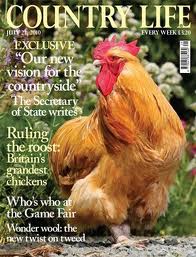
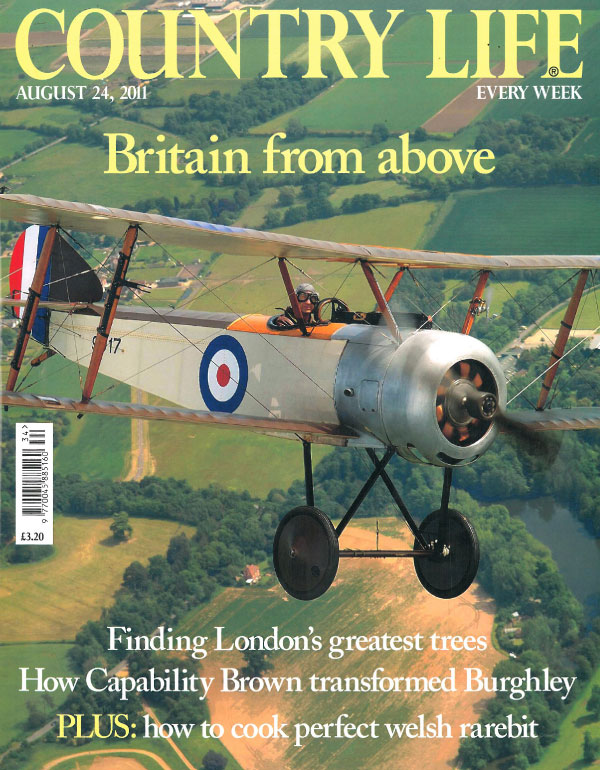
The covers are wonderful, from the Queen to the noble hen above. Or the antique airplane (a Sopwith Camel, c. 1917, I think)  below.

Not only are there  wonderful property ads — you will also find art and antiques, clothing and jewelry, all for the upper crust crowd.  But, as I say, we can dream.

The magazine’s editorial content is devoted to all the topics that might interest a country gentleman or gentlewoman.  They are sometimes unabashedly involved in political issues, taking a rather traditional approach in defending the interests of the countryside in issues such as land use, development, and agricultural and coastline policies. 

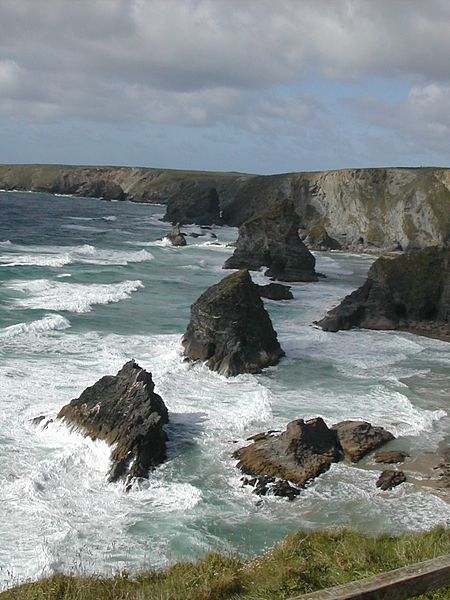
Cornish Coast, NT

Other articles describe notable gardens and give hints on growing various kinds of plants, both decorative and edible.  Or raising dogs, especially sporting and working dogs. Hunting and fishing are often discussed, as is fox-hunting.

Every issue carries a picture of a lovely young lady, sometimes about to be married, other times in business.  This has been a feature for many years.   I remember reading an Alexander McCall Smith story about a young lady who had been the “girl of the week” and was embarrassed to admit it to her university friends.

Among my favorite features are the stories of stately homes, their preservation and their presentation to the public.  It is not hard to imagine what a financial burden these piles are for the families who own them; that is why so many are English Heritage or National Trust.

After I finish my reveries (delusions?) about property, I usually flip to the back page to look at the wonderful cartoon in Tottering -by-Gently, the work of Annie Hurst.  For more views, click here.

Among my other regular favoites are the columns of the Country Mouse and the Town Mouse, for random observations on life, always amusing and/or thought-provoking.
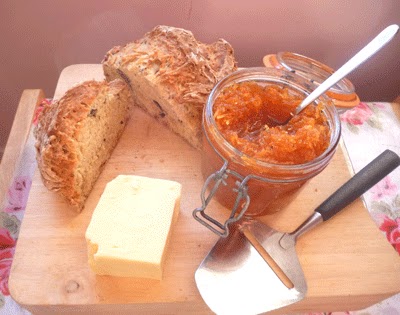
They even have recipes and restaurant reviews. Below, a suggestion for your next Tea Party.
carrot relish recipe

 Whatever your favorite magazine feature, you will be entertained and amused by Country Life.  We love to read the magazine in an aspirational mood — for almost everything here is beyond our reach, however much we admire it.  It’s delicious for wishing!! 

Kristine h
ere, who just finished reading the issue above – the piece on coaching inns was marvelous. My subscription to Country Life is an annual gift that I make to myself and I look forward to its arrival each week. Like Victoria, my favourite bits of the magazine are the real estate ads at the front, some of which I’ve posted here on the blog. Stately home articles, historic tidbits, recipes, gardening, architectural stories and, of course, the husbandry of various animals all make for a weird yet satisfying combination. Where else would find such articles as “Why the English love their chimneys” and “The quintessential gourmet experience in London” in the same issue?
Victoria – I’ve a new batch of Country Life issues to give you when next we meet.

New London Hotels

It’s always fun to hear about new hotels in our favourite city and today we bring you word of three new properties. The Corinthia London (above) recently opened its doors in Whithall Place within the former home of the Hotel Metropole, which itself opened for the first time in 1885. Currently, the hotel assures guests that it will offer “uncompromising standards of luxury within a 21st century grand hotel.” The hotel will have 294 lavishly decorated rooms, a restored Victorian ballroom,  two restaurants, and the Bassoon Bar. There is also an expansive ESPA Life spa on property. Rooms average about $500.00 a night, but a drink in the bar and a fabulous massage will be much less expensive.

Located in Mayfair, The Dorchester Collection’s ninth hotel, 45 Park Lane, boasts interiors by New York designer Thierry Despont, as well as Wolfgang Puck’s American style steak restaurant, CUT. The hotel strives to cater to the well being of their guests and offers bicycles, yoga mats, a fitness center and a Bath Menu, where guests can select from a range of aromatherapy oils, candles and herbal teas. 45 Park Lane will also house a collection of constantly evolving contemporary art and an in-house cinema. 

Looking forward to Fall of 2012, The Wellesley townhouse hotel in Knightsbridge (above) is laying claim to being London’s first ‘6-star’ property. Located just off Hyde Park next to the Lanesborough,  the 36-bedroom townhouse hotel is currently undergoing a £36 million pound renovation. The six-floor hotel will include London’s largest hotel suite with four bedrooms, a private lift, views over Hyde Park and The Cigar Terraces, which will boast the UK’s largest bespoke humidor. The MD of developer Arab Investments, Khalid Affara says: “This will be to a better standard than all the 5 star hotels in London. It will be like the first-class compartment of a plane.”