Court and Fashionable Life

From The Court Journal, Volume 7, 1835 
Court and Fashionable Life

The Duke of Cumberland is expected in town in a few days, from his residence near Berlin. The statement that some of the luggage, and of the domestic establishment, of his Royal Highness arrived in town on Wednesday is incorrect.
Interior, Belvoir Castle
The Duke of Wellington after celebrating the birth-day of his old friend, the Earl of Westmoreland at Apthorpe, will join the festivity at Belvoir Castle on Monday, where the natal day of the Duke of Rutland will be commemorated with distinguished honours by a large tenantry, in addition to the visitors from London.
The Right Hon. J. C. Herries left town yesterday for Hardwick to attend his Election. Lord Granville Somerset, Sir Henry Hardinge, and Mr Ross, have also left town to attend their Elections.
— Lord Rosslyn has removed from Chapel street to a house in Grosvenor place.
— Lord Haddington is expected to leave town this day for Ireland, to enter on the responsible duties of his high office as Lord Lieutenant. Sir Henry Hardinge, Secretary for Ireland, is not expected to go to Ireland till after his Election.
The Brazilian Minister will leave town in the course of a few days for Lisbon, to pay a complimentary visit to the Queen of Portugal on her recent marriage.
The Commissioners for the Reduction of the National Debt held a Meeting yesterday at the Treasury. Sir Robert Feel was present, as Chancellor of the Exchequer. The Governor and Deputy-Governor of the Bank also attended.
The Marquess and Marchioness of Wellesley, since his Lordship’s return from the Government of Ireland, have been staying at the Clarendon, where they will remain until they can procure a town residence. The Marchioness will, in a few days, resume her duties at the Court at Brighton, as one of the Ladies in Waiting on the Queen.
The Earl of Eldon has been for some time on a visit to his venerable brother, Lord Stowell, at his seat, Early Court, in Berkshire. The mansion of the Noble Earl, in Hamilton place, Piccadilly, has been recently adorned and beautified, preparatory to his Lordship’s return, which is expected in a few days. Lord Stowell’s health and strength, we regret to state, continue to decline.

Ravensworth Castle
The Countess of Mulgrave has been paying a lengthened visit to her father, at Ravensworth Castle, in the county of Durham. From thence she returned to join Lord Mulgrave at the Clajrendon Hotel, in Bond street. The Earl and Countess are now at Brighton, where, with their family, they will remain for a short period.
The Right Hon. Henry Ellis is preparing to leave England on a special mission to Persia. His suite will include Mr Sheridan, as private Secretary, brother of the accomplished Mrs Norton, and son of the late Mr Thomas Sheridan.
The Dowager Marchioness of Salisbury recently gave a magnificent banquet at her house, in Arlington street, to more than twenty distinguished personages, among whom were the Duke of Wellington, Lord and Lady Maryborough, Lord Cowley, the Earl and Countess of Jersey, and Sir John and Lady Anne Beckett. The Dowager Marchioness is now at Hatfield participating the festivities of Christmas, which are annually sustained there by the Marquess and Marchioness of Salisbury, in great splendour.
The Marquess of Hertford and his numerous suite intend to return to London, from Naples, early in the spring. It is reported that a high diplomatic situation has been offered to the Noble Marquess by his friend Sir Robert Peel.
Woburn Abbey
The festivities at Woburn Abbey have been splendidly sustained during the Christmas holidays. The Duchess of Bedford, the presiding star, has congregated around her all the leading nobility of the county of Bedford, in addition to her numerous relations, including Lady Gcorgiana Russell, and the Marquess and Marchioness of Tavistock and their children.
The Earl and Countess of Albemarle are returned to the Stud House, at Hampton Court, from Paris, where those distinguished persons were called, in consequence of the death of their near relation, Sir William Keppcl, who has left the bulk of his fortune to the Noble Earl. It is doubtful if the Duke of Dorset, the successor of Lord Albemarle as Master of the Horse, will remove to the Stud House, notwithstanding it has for some years been the official residence.
The Earl Fitzwilliam
and his delightful family have left Wentworth House, in Yorkshire, for another of his Lordship’s seats, Milton, in Northamptonshire, where they intend to remain until the meeting of Parliament.
The Duke of Rutland is now at Belvoir Castle superintending preparations for a grand banquet, to be given at that princely residence, on Monday, in honour of the Noble Duke’s birth-day. The Earl and Countess of Lonsdale are expected there from Cottesmore, and the Marquess and Marchioness of Exeter from Burleigh. The Duke of Wellington will likewise be present. Lord Forester, Sir F. Trench, General Upton, and the Hon. William Howard, are already arrived at the Castle. There will be a splendid ball and supper in the evening, to which all the rank and fashion of the county of Rutland are invited.
— Hatfield House festivities were this year deprived of the presence of the Duke of Wellington in consequence of various important engagements at the Foreign Office. The Earl of Aberdeen, Lord Rosslyn, the Dowager Marchioness of Salisbury, and many distinguished foreigners, constituted a portion of the noble guests that were invited.
The “Princely Palace” of Alnwick Castle greeted the return of the Duke of Northumberland from the South, who was accompanied by his only brother, Lord Prudhoe, with warm and affectionate rejoicing. The amiable Duchess and her distinguished visitors have been sustaining “old English hospitality” in a style worthy the House of Percy, and commensurate with the large and princely fortune of its noble owner. The Duke and Duchess of Northumberland are expected in London, about the period that the Duchess of Kent and the Princess Victoria return from St Leonard’s.
The Marquess and Marchioness of Londonderry and family are passing the Christmas holidays, at Stockton-on-Tees, with much festivity. The noble Marquess is expected in town early next month, preparatory to making arrangements for his departure for St Petersburgh, as Ambassador to the Russian Court.

Walking Around London

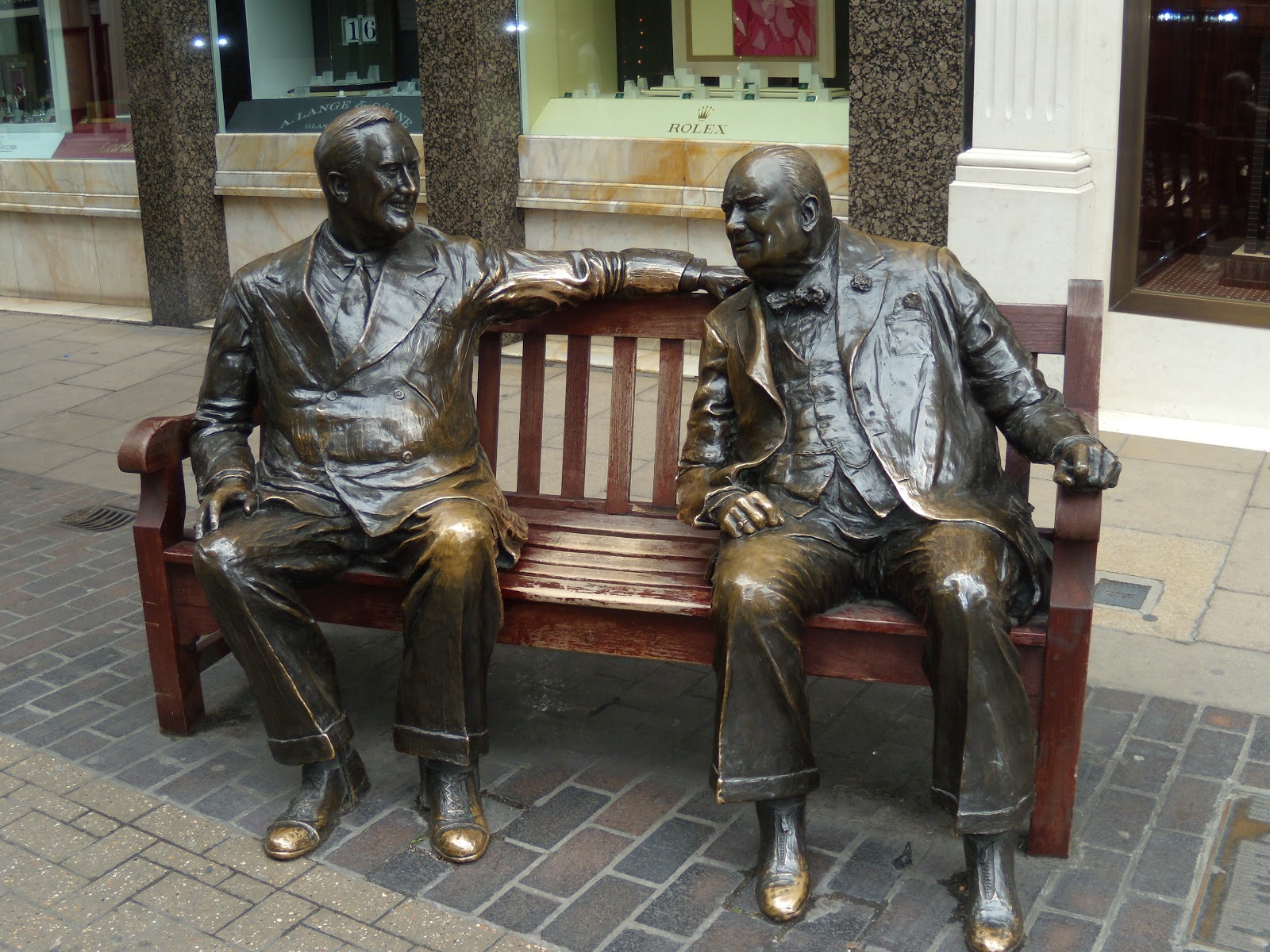
Roosevelt and Churchill on Bond Street, since 1995

Victoria here, trying to sort out pictures from my last few trips to London, in an attempt not to feel too sorry for myself because I am not crossing the pond this spring. I found a few shots I thought I’d share, as I don’t think I have posted them before. The sculpture above is frequently photographed with tourists perched on the knees of the men.  The bronze figures of U.S. President Franklin D. Roosevelt and Prime Minister Winston S. Churchill were sculpted by Lawrence Holofcener.  They are located where Old Bond Street becomes New Bond Street in Mayfair.

Charing Cross
This Victorian recreation of the Eleanor Cross  was erected in 1865 near the location of the original placed there by King Edward I in the 13th century.  It was one of twelve crosses which marked the resting places of the body of his wife, Eleanor of Castile, who died in 1290. She was carried to London for burial in Westminster Abbey over a nearly-two-week period.  The Charing Cross stands in front of the railway station of the same name, just off Trafalgar Square.  The original position of the Eleanor Cross is now marked by an equestrian statue of King Charles I looking down Whitehall past the site of his beheading.

Not far away is this house, built by Robert Adam, and lived in by several prominent Londoners. Its address is 1-3 Robert Street, in part of the Adam Brothers’ development of Adelphi Terrace.

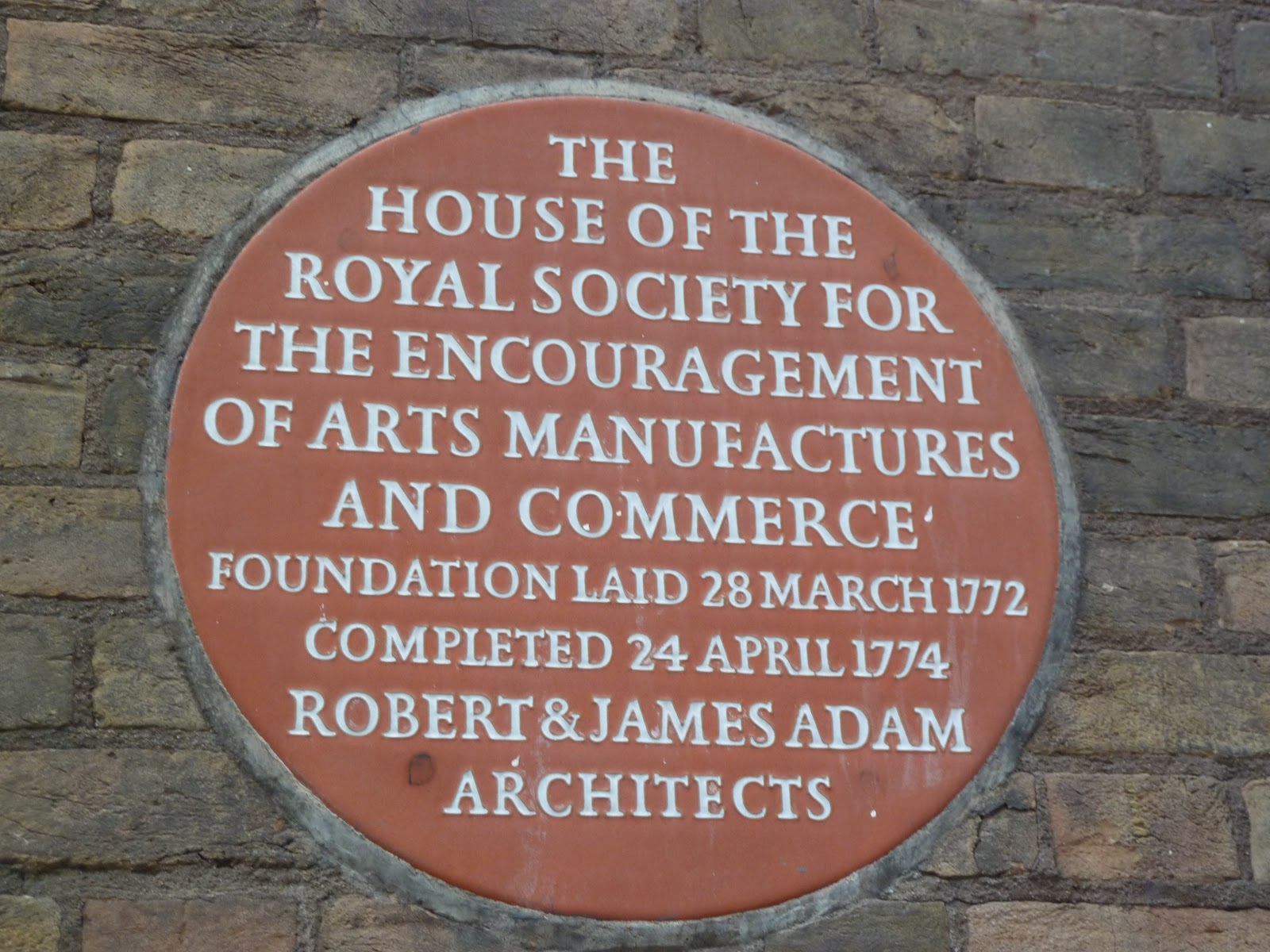
Nearby and also part of the same neighborhood is the home of the RSA, Usually called the Royal Society of Arts.  There website is here.  The building, designed by the Adams, is classically beautiful.

Below is the plaque placed on the building.  The RSA is still an active part of British intellectual and scientific life with more than 27,000 fellows and frequent programs, many open to the public. Various other societies, such as the Royal Academy of Arts, is an 18th century spin-off (or whatever they called them in those days).

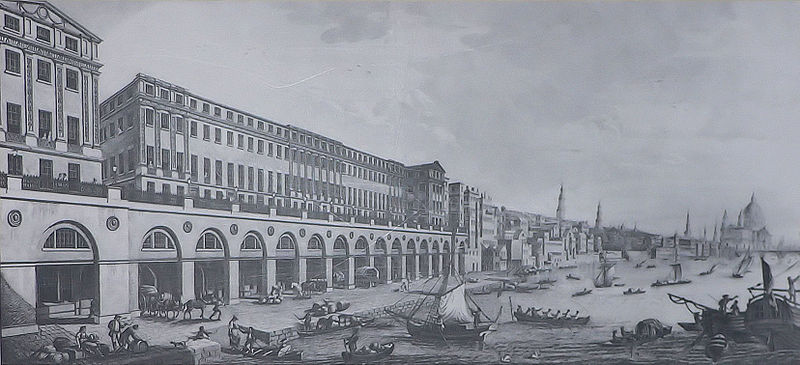
I had not explored this area of London before, between The Strand and the River, sort of between Charing Cross station and the Savoy Hotel.   The Adams Brothers  built a number of buildings here, culminating in their Adelphi Terrace, an ambitious plan for numerous terrace houses above wharves along the Thames.   For various reasons, the development never reached full success and in the 1930’s most of it was demolished to build a large gray (and rather grim) semi-Art Deco building for offices, etc. now known as the New Adelphi Building.    A good account, accompanied by a map of the district, can be found here.  The drawing below shows what the Adelphi Terrace looked like in its heyday.

Returning to walk down the Strand, I often stopped near my hotel (The Strand Palace, nicely refurbished) for refreshment at The Wellington, named after our Favorite Duke.  Located at 351 The Strand, it is a popular spot for drinks, dinner, and post-theatre entertainment.

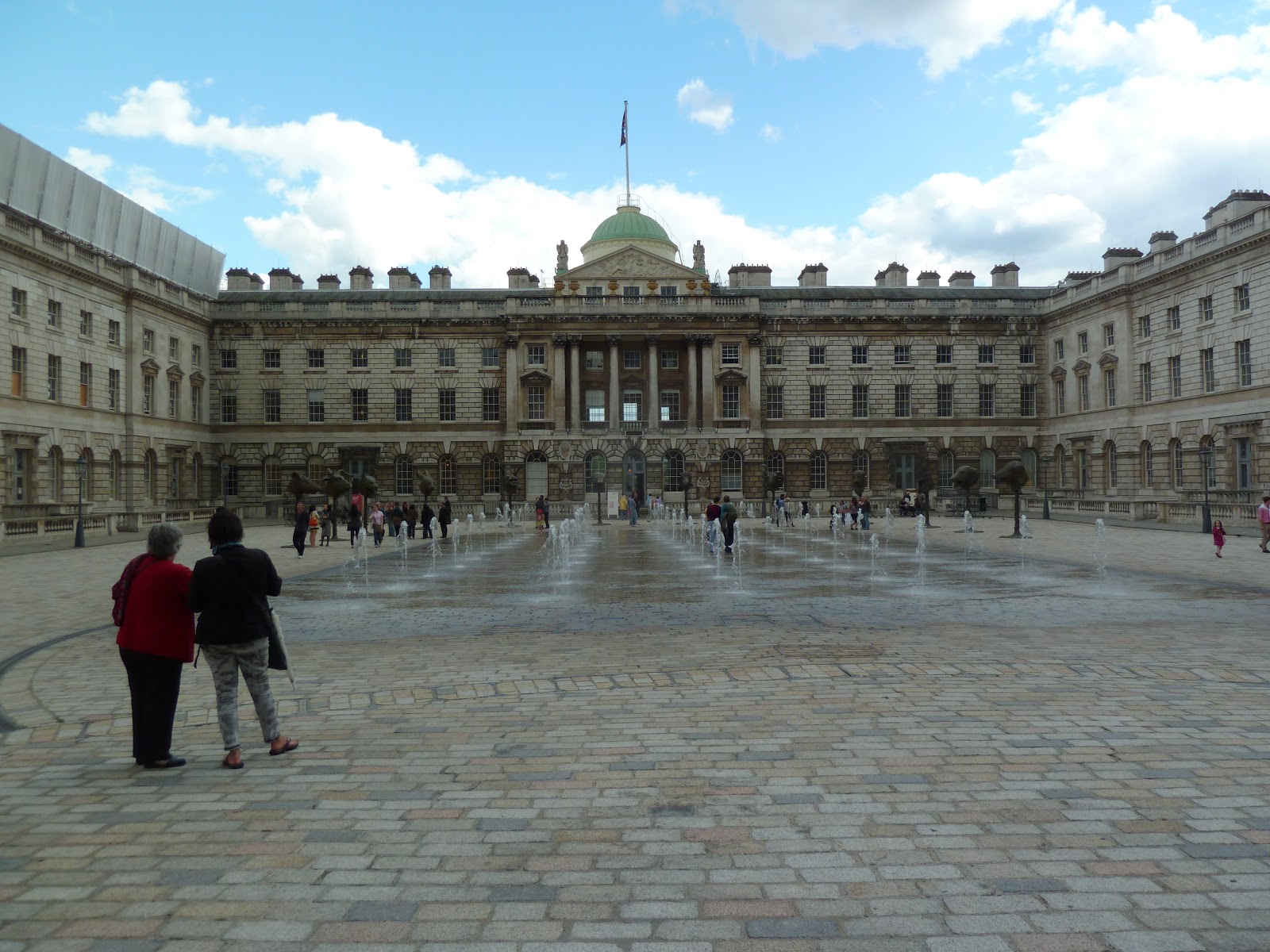
Continuing eastward I came to Somerset House, a building with an interesting history and a continuing role in contemporary London. In the courtyard below was an installation by the celebrated Chinese Artist Ai Weiwei, who was threatened with imprisonment in his home country for his dissident activities.  Hard to distinguish in the pictures is Circle of Animals/Zodiac Heads which has also been shown in New York City. The installation recreates 18th century figures near Beijing which were damaged by the British and French during the Opium Wars. Ai’s message accompanies the artwork: “Without freedom of speech there is no modern world, just a barbaric one.”

Somerset House
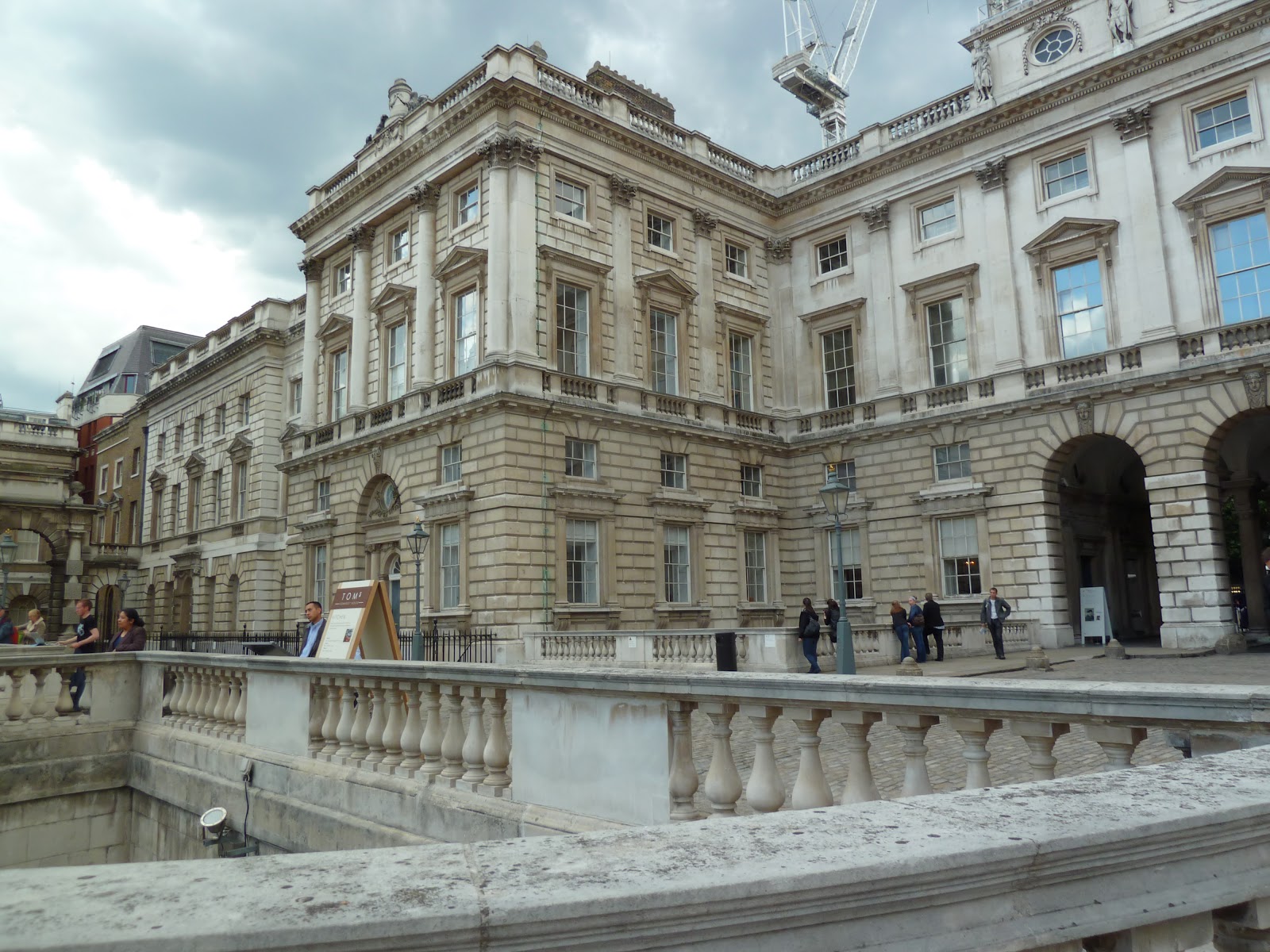
The present Somerset House was begun in 1776 to designs by architect Sir William Chambers in a neo-classic style.  Originally on the bank of the Thames, it was altered and expanded in the Victorian era with the construction of the embankment and several new wings.
In the 16th century, the north bank of the Thames was lined with the mansions of nobles, and on this site a great house had been constructed for Edward Seymour (c. 1500-1552), 1st Duke of Somerset, the Lord Protector during the reign of Edward VI (1537-1553).  As uncle of Edward VII (Somerset was brother of Jane Seymour ([.1508-1537]),  Somerset tried to impose his will upon an unruly group of courtiers fighting over the spoils of the kingdom after Henry VIII died in 1547.  Edmund Seymour ended up on the losing side of court intrigues and lost his head.  Somerset House, his mansion, was used to house several queens during the Stuart period, being remodeled over and over again.
Acknowledging the need for a fine public building in London, on the continental model, the government of George III had the old buildings demolished for the huge new structure to house government agencies and offices, learned societies, and parts of the Admiralty; before the river bank was altered in the 19th century, large arched watergates allowed barges and small vessels direct access from the river.
Damage from WWII was repaired in the 1950’s, and various restorations and remodeling continue to the present. For 150 years, until about 2005, the Registrar General of Births, Death, and Marriages in Somerset House was the place one had to go to obtain these records for England and Wales. Also familiar to UK residents might have been the Inland Revenue offices, from 1849 to 2009, now moved to Bush House.

Entrance to the Courtauld Gallery, Somerset House

The Exhibition Room at Somerset House by Thomas Rowlandson and Augustus Charles Pugin (1800). This room is now part of the Courtauld Gallery.
In the 1990’s, The Courtauld Institute of Art and the Courtauld Gallery moved into the section formerly given to the Royal Academy.  The website is here.  Their very fine collection, particularly strong in 19th century works, can be viewed today in the same setting as the one in which our ancestors viewed the annual Summer Exhibition.


Above is the staircase to the galleries today. You will be glad to hear that a lift will let you avoid climbing up — or down — all those steps.  Or running into the situation pictured below.

Rowlandson, The Stare Case, The British Museum
.

The RA  and its exhibitions are now located in Burlington House, Piccadilly.

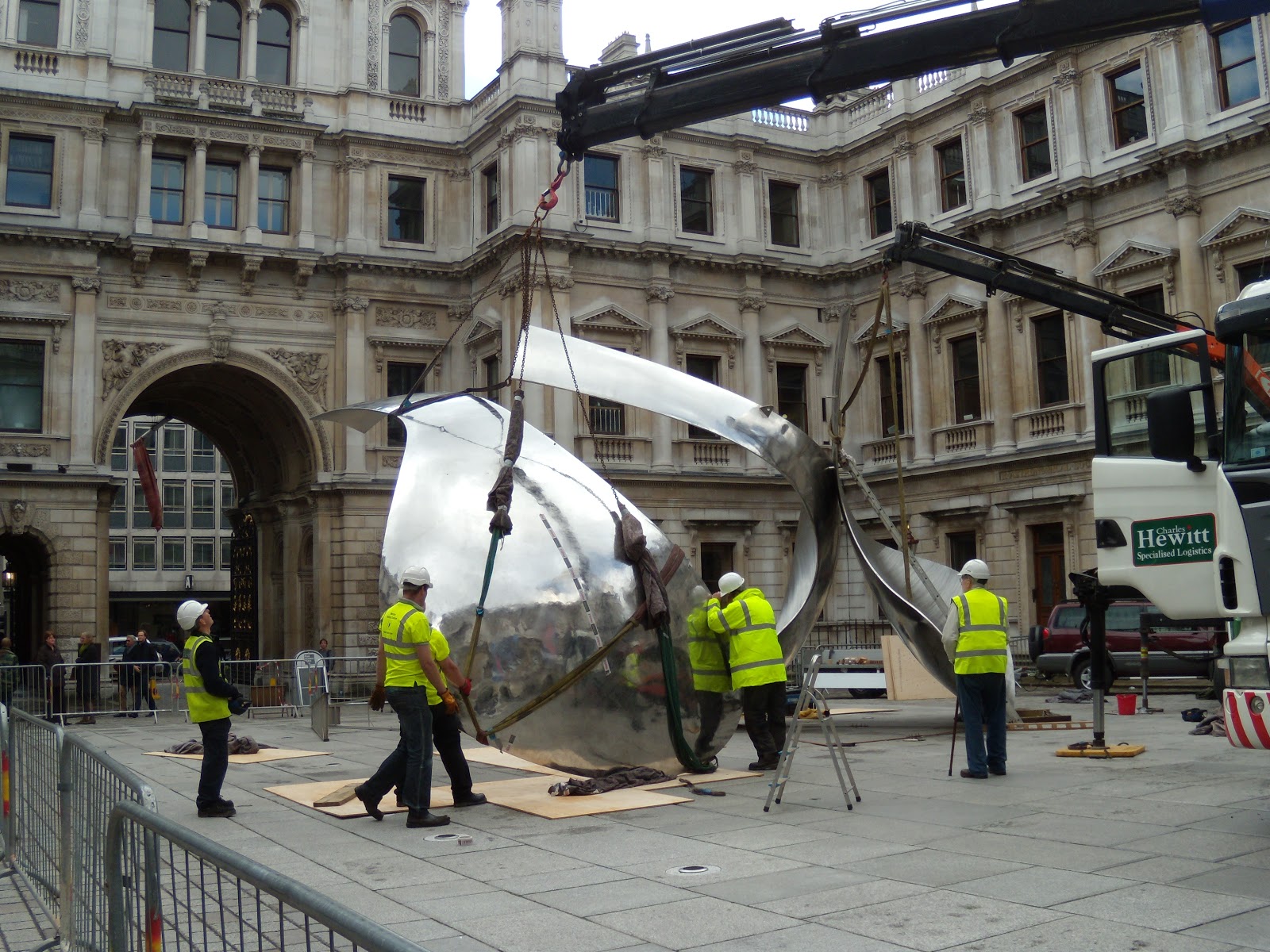
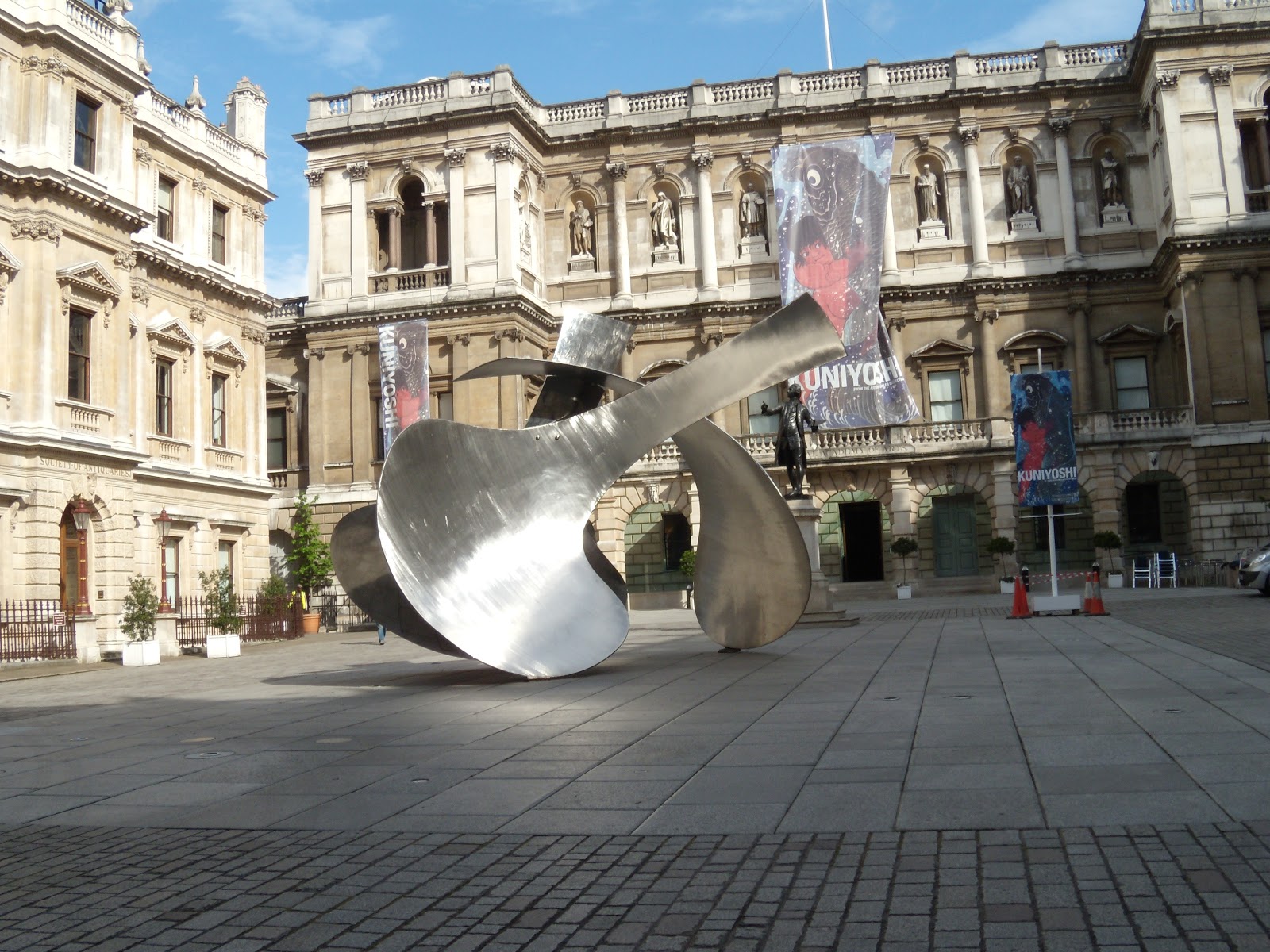
Above, workers install a large sculpture in the courtyard of the Royal Academy in 2009.  Below, it is completely assembled.
Triton III, by Bryan Kneale, RA, b. 1930

Other recent changes at Somerset House include an open terrace for cafes, art installations, concerts, and displays of dancing fountains; in the winter, this area is a public ice rink, where once civil servants parked their cars. Other public areas show the building’s history and the state barge belonging to the Lord Mayor.

In the view below, the facade of Somerset House is seen on the right and in the distance, the church is St. Mary-le-Strand, which now sits in a traffic island with the street flowing around it.

Another period view of The Strand, with St. Mary-le-Strand 

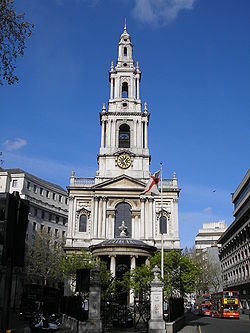
Unfortunately, all my photos of the church appeared to be more of buses, lorries, and autos than the facade, so the one below is borrowed.

The interior of the church is baroque, reflecting the study trip of the architect James Gibbs (1682-1754) to Italy.  Gibbs designed churches (e.g. St. Martin-in-the-Fields), hospital and university buildings (Radcliffe Camera, Oxford) and country houses throughout his career.
Just east of St. Mary-le-Strand, The Strand becomes Fleet Street, a stretch less known for art museums and churches than press magnates.
Soon, I will share with you some snaps I took while walking around St. James, London.

On The Shelf – A Yank Back to England

A Yank Back to England: The Prodigal Tourist Returns by Denis Lipman – The cover blurb for this book reads, “Denis Lipman left London’s East End for Washington, DC more than 20 years ago, but made an annual pilgrimage year after year to visit aging parents, a pair of cantankerous, real-life Cockneys. He endured the visits as best he could. Enter an American wife. Not content with a grin-and-bear-it attitude, she declares that since the trip to England was inevitable, then it was to be enjoyed: see things, go places! Against his will, our expat becomes a tourist in his homeland and discovers it’s not so bad after all, certainly better than remembered! Here is a travel memoir more carbolic than bucolic. Discover a place where the sun doesn’t always shine, where going to the loo can be an adventure, and where canned beans on toast is a cornerstone of cuisine. Taste the real East End and tour with a colorful group as they rent cottages, host outrageous relatives, meet the locals and discover the English countryside.”

This is a delightful account of Lipman’s almost annual trips back to England with his American wife Frances in order to visit his parents, Lew and Jessie. Most visits start at the old family home in Dagenham, an area firmly rooted in London’s East End.  From here, David and Frances, his parents, and assorted aunts, uncles and cousins take off for parts unknown, usually a rented cottage in a picturesque (and often difficult to find) corner of England. Part memoir and part travelogue, A Yank Back to England tells the sometimes painfully honest tale of tiny tourist villages, seaside resorts, British food and assorted pubs, aging parents, the frailty and strengths of those we love, the reality of childhood memories and the glories of life, love and England.

At the end of A Yank Back to England, you’ll be reluctant to close the book. I continue to hope that Lipman will pick up the memoir where he left off. In the meantime, you’ll find Denis Lipman’s blog here.

Reviews:
“Here is England seen entire, from inside out, from bottom to top, as Denis Lipman returns from America to his working class family home in blighted Dagenham. From there he, his young American wife, and his cockney Mum and Dad embark on a series of funny, touching, madcap and even surreal adventures as they visit celebrated landmarks and holiday spots in England as well as a good many pubs. The result is an absolutely wonderful book, not only about going home again but also about love and family and tradition and the passage of the years.” –Michael Dirda, Pulitzer Prize-winning literary critic (Washington Post) and author of the memoir An Open Book

“A perceptive, engaging and informative take on contemporary England as seen through the eyes of a fellow expatriate who writes with humor and affeciton. The case of characters has an almost Dickensian vivacity.” Michael York, actor.

The Raglan Collection

On 4 April 2012, Christie’s Auction House in London offered The Raglan Collection: Waterloo, Wellington and The Crimea at the South Kensington saleroom, 85 Old Brompton Road. This private collection from Cefntilla Court, Monmouthshire – the ancestral home of the Barons Raglan since 1855 – included important historical medals, arms and armour, militaria, pictures, furniture, silver, books, Indian weapons and works of art, as well as a selection of enthnographic art. The collection is being sold by order of the Executors of Fitzroy John Somerset, 5th Baron Raglan (great-great-grandson of the 1st Baron Raglan). The collection comprises over 300 lots and was expected to realize in excess of £750,000.

Prior to the sale, Amelia Elborne, Specialist and Head of Sale commented, “FitzRoy Somerset, 1st Baron Raglan, was one of the most well-known British soldiers of the early 19th century. His career spanned service at the right hand of Britain’s greatest soldier, the first Duke of Wellington for almost 40 years, during the Peninsular War, at Waterloo, and as Private Secretary, through to his command of British forces in The Crimean War – Raglan’s legacy is of foremost importance. This fascinating collection chronicles Lord Raglan’s role in some of the most famous battles in British history, as well as featuring more personal items stemming from his relationship with ‘the Iron Duke’ and the family he created with his wife, Lady Emily Wellesley-Pole, Wellington’s favourite niece. The collection comes to auction from Cefntilla Court, the Monmouthshire home which was given by a group of admirers to the son of Lord Raglan after the Field Marshal’s death in June 1855 – before what would eventually be victory in The Crimea. The selection on offer has been collected by the 1st Baron Raglan as well as by his descendants – almost all military men themselves – including the 3rd Baron Raglan, a politician and governor of the Isle of Man, and the 4th Baron Raglan, an anthropologist and collector.”

Highlights from The Collection
Commissioned into the army at the age of fifteen, Lord FitzRoy Somerset  became the Duke of Wellington’s Aide-de-camp in 1808, at the age of twenty, as Captain. Somerset proved himself in battle, bearing the dispatches after  Talavera (1809) and receiving a wound at Busaco (1810). He played a  distinguished role in the bloody storming of Badajoz in 1812 and fought at the battles of Salamanca (1812), Vitoria (1813) and Toulouse (1814), after which he was made KCB. He was awarded the Peninsular Gold Medal (with clasps for Badajoz and Salamanca) illustrated right and the Peninsular Gold Cross (with five clasps) illustrated far right. These latter medals were instituted by the Prince Regent on behalf of his ailing father, George III, to reward senior officers for their service in the Peninsula. For his first battle the recipient would be awarded a gold medal, for his second and third two clasps, and thereafter the exquisite gold cross (with clasps). In total, only 165 crosses and
clasps were ever awarded.

A magnificent gold and diamond-hilted sword presented to General Don Alava by the city of Vitoria in gratitude, who then gave it to his great friend and comrade-in-arms, Lord FitzRoy Somerset. It is believed that Alava holds the distinction of being the only person to have been present at both Trafalgar and Waterloo – one as opposition and the other as an ally to the British. Estimate: £30,000-50,000. Photo: Christie’s Images Ltd 2012

The medals are included in the highly important and exceptionally rare group of honorary awards and medals awarded to Field Marshal Lord Raglan (estimate: £250,000-350,000). The field marshal’s baton that Raglan was awarded after his victory at Inkerman in the Crimea (a rank that had been created for Raglan’s mentor Wellington after his success at Vitoria) is also included in the lot. Designed by the Prince Regent, and presented by Queen Victoria, the deep red velvet baton is decorated with small gold lions, and the base is engraved: “From Her Majesty Alexandrina Victoria Queen of the United Kingdom of Great Britain and Ireland to Field Marshal The Lord Raglan G.C.B. 1855‟, with maker’s mark WN for William Neal, hallmarks for 18 carat gold, London and 1854; it is surmounted by a figure of St. George slaying the dragon. Somerset’s Waterloo Medal, issued in 1816-17 and the first award given by the British government to all soldiers present at a battle, as well as his Crimea Medal with four clasps are also included in the lot. The lot comprises a total of twelve awards and medals, and is accompanied by a letter signed by Frederick, Duke of York as commander-in-chief to Lord FitzRoy Somerset, Horse Guards, 21 September 1813.
As Wellington’s right-hand-man for almost forty years, the collection includes a number of lots related to the first Duke of Wellington, including a mahogany armchair by Holland and Sons, used by Wellington in his office at Horse Guards (estimate: £4,000-6,000). Somerset married Lady Emily Wellesley-Pole, the daughter of Wellington’s brother William Wellesley-Pole later third Earl of Mornington, and Wellington’s favourite neice. Wellington gave many personal treasures to Emily, including a diamond-set gold bracelet containing a lock of his hair (estimate: £1,500-2,000), and a heavy Indian gold ring which he had purportedly taken from Tipu Sultan, after the Battle of Seringapatam in 1799 (estimate: £10,000-15,000).

It is the great-grandson of Baron Raglan who is putting the collection up for auction. The collection comes from the family house of Cefntilla Court in Monmouthshire, Wales, which has been the seat of the Barony since 1855. Meanwhile it has emerged that Lord Raglan’s heir has put Cefntilla Court (above) on the market at a guide price of £2 million. The chairwoman of a Gwent civic society has called for a “tragic” sale of war memorabilia from the home of Lord Raglan to be stopped. Ms Morse said Usk Civic Society, which Lord Raglan served as president of from 1973 until he died in 2010, was shocked by the sales: “We are pretty sure that he would have wanted it all kept together.” She said that the house was given to the son of the first Lord Raglan, FitzRoy Somerset, in recognition of his father’s achievements as a soldier and to be with the family for perpetuity.

UPDATE: The Sale ha
s been postponed, with a Christie’s spokesperson saying this week: “The auction has been postponed pending resolution of a legal claim filed by a family member.” Bettina Harden, of the Raglan Rescue campaign to keep the best parts of the collection together and in this country, said: “The battle may have been won, but now the war begins.” The injunction will be reviewed in May. If it is not extended, this allows campaigners only a short time in which to raise the necessary funds. The collection has been valued at £750,000 and the house at £2 million.

We’ll bring you updates on the debate as they are received.

Centenary of the Titanic Sinking

The White Star ocean liner RMS Titanic sank in the North Atlantic on April 15, 1912, after striking an iceberg. Though the ship had been touted as “unsinkable,” more than 1,500 lives were lost in the disaster.  Every man, woman and child in the U.S. and U.K. probably knows this story.

The story has been told and retold in so many formats that it is almost impossible to ignore. And you are no doubt aware of all the re-telling underway for this centennial observance.  Soon we will all be watching (or enduring) another Julian Fellowes creation, much hyped after the success of his Downtown Abbey series.

a photo of an old book just like the one my grandmother owned
I first learned about the Titanic from a book published in 1912 that I found on Mimi’s (my grandmother) bookshelf.  She remembered hearing about the disaster as a young married woman and gave the book to me when she eventually moved into a care center. I read every word over and over, studied the pictures and  imagined what happened on the doomed ship.  Nevertheless, I am an enthusiastic boater, sailor, cruiser and all things aquatic.  Who’da thunk it?
I loved the pictures especially, black and white artists’ renderings of the interior of the vessel as well as the lifeboats, the icy waters and the ship slipping below the surface while the orchestra played Nearer My God to Thee.  It stirred the heart of a little girl — and still stirs the heart of a considerably older and more experienced me!
Grand Staircase in First Class
The movie set, 1997
Probably all of us remember the movie Titanic, staring Kate Winslet and Leonardo DiCaprio, in 1997.  A version in 3-D is in movie theatres now — or will be soon.

But it did not make anything like the impression on me that the film A Night to Remember (1958) made.  I think I lost sleep for weeks.  Maybe it had something to do with my age — then and now!!
Ceremonies are already underway in Belfast where the ship was built.  And there will be many other observances on the anniversary.
The Memorial in Belfast
Since soon after the wreck was discovered,  exhibitions of materials from the ship have been traveling around the world.  I admit to having seen it twice and will probably go again someday.  When we entered, they gave us cards with the names of passe
ngers. At the conclusion of the exhibition we learned whether “we” survived or were among the lost.  The first time, I survived, but not the second time I visited.

Titanic artifacts
One of the most compelling stories for me as a child was the fate of the skipper, Captain Edward J. Smith, who, in the naval tradition, went down with his ship.  He was one of the 1,500+ who died that night; his remains were never recovered.

RMS Titanic Captain E. J. Smith

I suppose I will not be able to resist watching the new Titanic mini-series when it is shown in the U.S.  But given my disappointment with the cliched characters and trite plot of Downton Abbey, I predict similar disappointment — the early reviews use terms such as “hectic” to describe it.
However, I will continue to treasure the vision I have of the doomed ship — acquired so long ago they are indelible!  Many thanks to Mimi for giving me the book!!