Copenhagen was the name of the horse the Duke of Wellington rode at the Battle of Waterloo. Born in 1808, Copenhagen was a chestnut stallion of 15 hands and was sired by Meteor, who was second in the Derby of 1786. Copenhagen was a failed race horse who’d won only one minor race at Newmarket in 13 outings. He was then shipped off to Spain during the Peninsular War and it was here that he was purchased by Wellington in 1813.
When not in a battle situation Copenhagen was tetchy and difficult and totally unimpressed with situation or status. His cantankerous temperament gave many a groom a bad moment and even nearly gave the Duke himself a severe injury. He had dismounted after the final battle of Waterloo and moved to the rear and patted Copenhagen on the rump in thanks for a fine day s work. The horse responded with a savage kick, just missing the General who had already just missed death many times that day.
But Copenhagen was a superb battle horse. Unflinching amidst gunfire he repeatedly exhibited great stamina and fortitude. On one occasion he carried the General Duke into a square of infantrymen under cannon fire, both remaining perfectly composed. Later the Duke said of him: “There may have been many faster horses, no doubt many handsomer, but for bottom and endurance I never saw his fellow.” Wellington and Copenhagen were commemorated on the field of Waterloo by Sir Thomas Lawrence in 1818. A compliment indeed from an experienced horseman who loved mounted sports at home and had a string of eight chargers for battle.
Copenhagen had been a surprise foal. His dam was Lady Catherine, who was by John Bull, a thoroughbred, and out of a mare by the Rutland Arabian. Lady Catherine was the only halfbred broodmare to be accepted into the General Stud Book (UK’s Thoroughbred register). Her owner had taken Lady Catherine on the British military expedition to Denmark in 1807 not knowing she was in foal. At that time the Duke of Wellington was in charge of a division in the force that occupied the city of Copenhagen and seized the Danish fleet. Once home the mare produced a strong chestnut foal who was named in honor of the Copenhagen siege. The colt was by the famous Meteor who was a son of the even more famous Eclipse, the legendary race horse of the 18th century.
In The Life of Field Marshal the Duke of Wellington: In two volumes …, Volume 2 by J. H. Stocqueler we are told that Copenhagen derived his name from the city in which he was foaled, his dam having been taken ont there in the expedition of 1807, by Field-Marshal Grosvenor. . . In the hands of General Grosvenor Copenhagen did not remain long, for he was sold by him to the Marquis of Londonderry, then Adjutant-General to the Peninsular army, who sent him with other horses to Lisbon, in 1813. On the memorable day of Waterloo, though the great captain had been on his back for eighteen hours, yet Copenhagen gave little signs of his being beaten, for on the Duke’s patting him on the quarters as he dismounted after the battle, the game little horse struck out as playfully as if he had only had an hour’s ride in the Park. For endurance of fatigue, indeed, he was more than usually remarkable; and for the duty he had to fulfil as proportionately valuable. However hard the day, Copenhagen never refused his corn, though he eat it after a very unusual manner with horses, lying down. Copenhagen, whose colour was a full rich chesnut, was a small horse, standing scarcely more than 15 hands high; he possessed, however, great muscular power. His general appearance denoted his Arabian blood, which his enduring qualities served further to identify. Though not much suited, from his size, for crossing the country, the Duke did oceasionally ride him to hounds.
Bell’s Life in London gives a different account of the pedigree of the horse. That journal —the highest authority in such matters—says :—”The horse was bred in the year 1808 by the late Field-Marshal Grosvenor; his sire was the famous little racer Meteor, son of Eelipse. Meteor hardly exceeded 14 hands; he was, however, very strong and handsome, with a remarkably good constitution and legs, which enabled him to stand the wear and tear of training for seven years. Meteor was just a little short of the first class or form of racehorses, running well at all weights and distances. His illustrious progeny, Copenhagen, appears to have inherited the stoutness of his sire in no slight degree, although very unsuccessful as a race-horse upon the turf. His dam was a mare whose name was given in the ‘ Stud-book’ as Lady Catherine, by John Bull, a very large, strong bone, the winner of the Derby Stakes in 1792; who, as well as Meteor, was in the stud of Lord Grosvenor, the grandfather of the present Marquis of Westminster. By those who are versed in the mysteries of the ‘ Equine Peerage,’ Lady Catherine was always considered to be entitled to the ‘bend sinister.’ In fact, she was not quite thoroughbred. The newspapers have informed us that the Duke’s charger was named in consequence of his having been foaled in Copenhagen, which we must beg leave to doubt; for, even supposing Field-Marshal Grosvenor to have visited the Danish capital in 1808, either in a military or a civil capacity, which does not anywhere appear to be the case, it is hardly possible that he would have taken a broodmare as a part of his travelling establishment. At that time it was a very common circumstance to name race-horses after some illustrious event happening during the war. Thus we have the names of Albuera, Waterloo, Smolensko, St. Vincent, and many others. For a similar reason Copenhagen most probably reccived that title. At the time Copenhagen was foaled, Meteor was twenty-five years old. Copenhagen was taller than his sire, being very nearly, if not quite, 15 hands, but neither so strong nor so handsome.”
Wellington himself told Croker, “He was not named from my having ridden him at Copenhagen; his dam was a blood mare which Tom Grosvenor had in the expedition to Copenhagen, and he called her foal by that name, so that he must have been foaled after 1806. Grosvenor sold him to Charles Stuart, now Londonderry, of whom, when he left the Peninsula, I bought him, and rode him throughout the rest of the war, and mounted no other horse at Waterloo.”
Speaking of this horse in 1833, Wellington is recorded to have told the following anecdote. He had commenced by saying that although no doubt many horses were faster and many handsomer, yet “for bottom and endurance I never saw his fellow.” ” I’ll give you a proof of it,” he goes on to say : “On the 17th” (morning after Quatre Bras) I had a horse shot under me; few knew it, But it was so. I got on Copenhagen’s back. Neither he nor I were still for many minutes together. I never drew bit, and he never had a morsel in his mouth, till eight p.m., when Fitzroy Somerset came to tell me dinner was ready in the little neighbouring village of Waterloo. The poor beast I saw myself, stabled and fed. I told my groom to give him no hay, but, after a few godowns of chilled water, as much corn and beans as he had a mind for. . . . Somerset and I despatched a hasty meal, and as soon as we had done I sent off Somerset on an errand. This I did, I confess, on purpose that I might get him out of the way; for I knew that if he had the slightest inkling of what I was up to he would have done his best to dissuade me from my purpose, and want to accompany me.
“The fact was, I wanted to see Blucher (right), that I might learn from his own lips at what hour it was probable he would he able to join forces with us next day. Therefore, the moment Fitzroy’s back was turned I ordered Copenhagen to be resaddled, and told my man to get his own horse and accompany me to Wavre, where I had reason to believe old ‘ Forwards’ was encamped. Now, Wavre being some twelve miles from Waterloo, I was not a little disgusted, on getting there, to find that the old fellow’s tent was two miles still farther off. However, I saw him, got the information I wanted from him, and made my way homewards. Bad, however, was the best; for, by Jove, it was so dark that I fell into a deepish dyke by the roadside; and if it had not been for my orderly’s assistance, I doubt if I ever should have got out. Thank God, there was no harm done either to horse or to man! Well, on reaching headquarters, and thinking how bravely my old horse had carried me all day, I could not help going up to his head to tell him so by a few caresses. But, hang me, if when I was giving him a slap of approbation on his hindquarters, he did not fling out one of his hind-legs with as much vigour as if he had been in the stable for a couple of days! Remember, gentlemen, he had been out, with me on his back, for upwards of ten hours (during the day), and had then carried me eight-and-twenty miles besides. I call that bottom! Eh?”
The names of Copenhagen and the Duke became synonymous and even in retirement from war they remained together. Wellington became Prime Minister of Britain in 1828 and rode Copenhagen up Downing Street to No.10 to take up his new position of leadership.
More on Copenhagen in retirement in Part Two . . . . coming soon.
This is the first of a series of Waterloo related posts we’ll be running in honour of the upcoming anniversary of the Battle on June 18th. We hope these posts will demonstrate how the Battle affected those in all walks of life, including the British ex-pats who, like Fanny Burney, were resident in Brussels at the time of the Battle.
A version of this post appeared in the Burney Letter, Vol. 21, No. 1, a publication of The Burney Society, Spring 2015; by Victoria Hinshaw.
Frances Burney, Madame d’Arblay
“Upon reflection, I will write no account of these great events, which have been detailed so many hundred times, and so many hundred ways, as I have nothing new to offer upon them; I will simply write the narrative of my own history at that awful period.”
With this modest declaration, Frances Burney, Madame D’Arblay, describes her famous account of Brussels during time leading up to, during, and after the Battle of Waterloo in 1815. In vivid terms, she chronicles the tension and anxiety felt by the helpless people waiting for their fate to be decided.
Frances Burney, 1782
General Alexandre d’Arblay (1748-1818), Burney’s beloved husband, even at the age of 66, served King Louis XVIII in his personal Guard. The d’Arblays occupied a residence in Paris, and had an active life there. But when Napoleon escaped from Elba in March 1815 and headed for Paris, assembling a powerful army as he came, Louis fled. He had been restored to the throne for just over a year and now abandoned Paris and crossed Belgian border to the relative safety of the United Netherlands. d’Arblay had to accompany the King, but he insisted his wife should accompany their friend the Princess d’Heinin into Belgium as well, not a simple task it turned out. Many British families lived in Brussels at the time, having taken advantage of the Peace of 1814 to enjoy a stay on the continent, which they had been unable to visit during the Napoleonic Wars. Like most of the world, they were shocked when Napoleon Bonaparte suddenly returned to France; Paris was about 160 miles from Brussels.
Once she reached Brussels, Madame d’Arblay found many friends among the French evacuees and the ex-pat English as well. When her husband was able to join her for several weeks, she was blissful. They even got to travel a bit and sightsee at the Palace of Lachen: “my dearest friend (the General, her husband) indulged in one morning’s recreation, which proved as agreeable as anything at such a period could be to a mind oppressed like mine. He determined that we should visit the Palais de Lachen, which had been the dwelling assigned as the palace for the Empress Josephine by Bonaparte at the time of his divorce. My dearest husband drove me in his cabriolet, and the three gentlemen whom he invited to be of the party accompanied us on horseback. The drive, the day, the road, the views, our new horses-all were delightful, and procured me a short relaxation from the foresight of evil.
Joséphine de Beauharnais Bonaparte
“The Palace of Lachen was at this moment wholly uninhabited, and shown to us by some common servant. It is situated in a delicious park d’Anglaise, and with a taste, a polish, and an elegance that clears it from the charge of frippery or gaudiness, though its ornaments and embellishments are all of the liveliest gaiety. There is in some of the apartments some Gobelin tapestry, of which there are here and there parts and details so exquisitely worked that I could have ‘hung over them enamoured.”
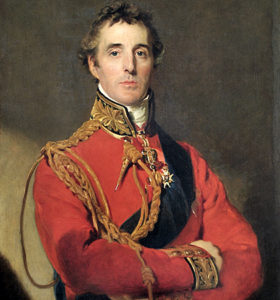
“Arthur Wellesley, 1st Duke of Wellington” c.1815 by Sir Thomas Lawrence
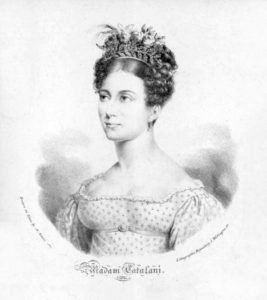
While together, the couple also had the opportunity of attending a concert at which they observed the Duke of Wellington, Commander of the Allied Armies. “Our last entertainment here was a concert in the public and fine room appropriated for music or dancing. The celebrated Madame Catalani had a benefit, at which the Queen of the Netherlands was present, not, however, in state, though not incognita; and the king of warriors, Marshal Lord Wellington, surrounded by his staff and all the officers and first persons here, whether Belgians, Prussians, Hanoverians, or English.
Madame Angelica Catalani
I looked at Lord Wellington watchfully, and was charmed with every turn of his countenance, with his noble and singular physiognomy and his eagle eye. He was gay even to sportiveness all the evening, conversing with the officers around him. He never was seated, not even a moment, though I saw seats vacated to offer to him frequently. He seemed enthusiastically charmed with Catalani, ardently applauding whatsoever she sung, except the “Rule Britannia”; and there, with sagacious reserve, he listened in utter Silence. Who ordered it I know not, but he felt it was injudicious in every country but our own to give out a chorus of ‘Rule, Britannia! Britannia, rule the waves!’ “And when an encore began to be vociferated from his officers, he instantly crushed it by a commanding air of disapprobation, and thus offered me an opportunity of seeing how magnificently he could quit his convivial familiarity for imperious dominion when occasion might call for the transformation.”
General Alexandre d’Arbly
The d’Arblay’s idyll ended when the General was sent off to Luxembourg to recruit soldiers for the royal cause. Frances was left alone to worry and share the concerns of her friends, some bordering on hysteria, as tension steadily increased in the next few weeks. Everyone knew the battle was approaching.
“May 13, 1815. My best friend left me to begin his campaign; left me, by melancholy chance, upon his birthday (67th). I could not that day see a human being — I could but consecrate it to thoughts of him who had just quitted me yet who from me never was, never can be, mentally absent, and to our poor Alexander (their son), thus inevitably, yet severely cast upon himself.”
For the month following his departure, she visited with friends, strolled in the park, attended church, and observed everything with her keen eye for detail. She also spent many hours alone, writing and worrying about her son, not doing as well at Cambridge as his parents expected, and particularly about her husband. One of Burney’s most fascinating observations was her view of the Belgian people, for the most part stoic and phlegmatic. As she observed, they had been traded back and forth between warring factions for centuries, spending most of the last decade as part of Napoleon’s Empire. How indeed could they get excited about another change in status? They seemed placidly to accept their fate, to Frances’s incredulity and sometimes consternation. “But even in the midst of the unconcerned populace, tensions rose as the streets were crowded with military vehicles horses and soldiers everywhere.”
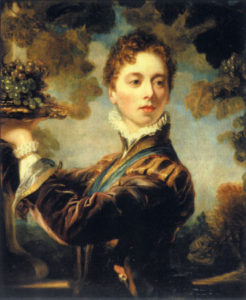
Lady Caroline Lamb by Thomas Phillips
She had a near-encounter with the notorious Lady Caroline Lamb*, whose affair with Byron had shocked London. Burney writes, “… I just missed meeting the famous Lady Caroline Lamb … whom I saw crossing the Place Royale,… dressed, Or rather not dressed, so as to excite universal attention, and authorise every boldness of staring, from the general to the lowest soldier, among the military groups then constantly parading the Place, — for she had one shoulder, half her back, and all her throat and neck, displayed as if at the call of some statuary for modelling a heathen goddess. A slight scarf hung over the other shoulder, and the rest of the attire was of accordant lightness. As her ladyship had not then written, and was not, therefore, considered as one apart, from being known as an eccentric authoress, this conduct and demeanour excited something beyond surprise, and in an English lady provoked censure, if not derision, upon the whole English nation.”
Aside from amusement at Burney’s disapproval of the attire, it is interesting to speculate about whether she thought of herself as an ‘eccentric author’ and thus ‘beyond surprise.’ This was a time of considerable unease for her. “During this melancholy period when leisure, till now a delight, became a burthen to me, I could not call my faculties into any species of intellectual service; all was sunk, was annihilated in the overpowering predominance of anxiety for the coming event.”
We take up Burney’s account of Brussels again on the day of the Battle of Quatre Bras. “I was again awakened at about five o’clock in the morning Friday, 16th June, by the sound of a bugle in the March aux Bois: I started up and opened the window. But I only perceived some straggling soldiers, hurrying in different directions, and saw lights gleaming from so many of the chambers in the neighbourhood: all again was soon still, and my own dwelling in profound silence, and therefore I concluded there had been some disturbance in exchanging sentinels at the various posts, which was already appeased: and I retired once more to my pillow, and remained till my usual hour… ”
Continuing, she writes, “my ears were alarmed by the sound of military music, and my eyes equally struck with the sight of a body of troops marching to its measured time. But I soon found that what I had supposed to be an occasionally passing troop, was a complete corps; infantry, cavalry artillery, bag and baggage, with all its officers in full uniform, and that uniform was black…. I learned it was the army of Brunswick. How much deeper yet had been my heartache had I foreknown that nearly all those brave men, thus marching on in gallant though dark array, with their valiant royal chief at their head, the nephew** of my own king, George III., were amongst the first destined victims to this dreadful contest, and that neither the chief, nor the greater part of his warlike associates, would within a few short hours, breathe again the vital air!”
Frederick William, Duke of Brunswick-Wolfenbuttel
“What a day of confusion and alarm did we all spend on the 17th!…That day, and June 18th, I passed in hearing the cannon! Good heaven! what indescribable horror to be so near the field of slaughter! such I call it, for the preparation to the ear by the tremendous sound was soon followed by its fullest effect, in the view of the wounded, the bleeding martyrs to the formidable contention that was soon to terminate the history of the war. And hardly more afflicting was this disabled return from the battle, than the sight of the continually pouring forth ready-armed and vigorous victims that marched past my windows to meet similar destruction.”
Burney writes that they had received “Many offers of escort out of Brussels were discussed and several attempted but none were successful. The military had confiscated all vehicles and barges destined for the roads and canals to Antwerp or Ostend.” Amidst reports on her conversations with those trying to escape, she wrote: “I found upon again going my rounds for information, that though news was arriving incessantly from the scene of action, and with details always varying, Bonaparte was always advancing…Yet no clamour, no wrangling, nor even debate was intermixed with either question or answer; curiosity, though incessant, was serene; the faces were all monotony, though the tidings were all variety. I could attribute this only to the length of time during which the inhabitants had been habituated to change both of masters and measures, and to their finding that, upon an average, they neither lost nor gained by such successive revolutions…No love of liberty buoyed up resistance; no views of independence brightened their imagination; and they bore even suspense with the calm of apparent philosophy, and an exterior of placid indifference.”
These are just a few of her observations, but I have attempted to choose the most relevant ones. At last, we come to the day of the main battle.”But what a day was the next — June 18 — the greatest, perhaps, in its result, in the annals of Great Britain!…” Despite the streets full of people, “when every other hour changed the current of expectation, no one could be inquisitive without the risk of passing for a spy, nor communicative without the hazard of being suspected as a traitor.” Her friend Mr. Boyd “…feared all was lost-that Bonaparte was advancing-that his point was decidedly Brussels-and that the Duke of Wellington had sent orders that all the magazines, the artillery, and the warlike stores of every description, and all the wounded, the maimed, and the sick, should be immediately removed to Antwerp. For this purpose he had issued directions that every barge, every boat should be seized.
“The dearth of any positive news from the field of battle, even in the heart of Brussels, at this crisis, when everything that was dear and valuable to either party was at stake, was at one instant nearly distracting in its torturing suspense to the wrung nerves, and at another insensibly blunted them into a kind of amalgamation with the Belgic philosophy. At certain houses, as well as at public offices, news, I doubt not, arrived; but no means were taken to — promulgate it — no gazettes, as in London, no bulletins, as in Paris, were cried about the streets; we were all left at once to our conjectures and our destinies. What a dreadful day did I pass! dreadful in the midst of its glory! for it was not during those operations that sent details partially to our ears that we could judge of the positive state of affairs, or build upon any permanency of success. Yet here I soon recovered from all alarm for personal safety, and lost the horrible apprehension of being in the midst of a city that was taken, sword in hand, by an enemy — an apprehension that, while it lasted, robbed me of breath, chilled my blood, and gave me a shuddering ague that even now in fancy returns as I seek to commit it to paper.”
Eventually Burney heard an account from a witness to the battle; “Mr. Saumarez’s narration was all triumphant and his account of the Duke of Wellington might almost have seemed an exaggerated panegyric if it had painted some warrior in a chivalresque romance. . . . I could not but be proud of this account: independent from its glory; my revived imagination hung the blessed laurels of peace. But though Hope was all alive, Ease and Serenity were not her companions: Mr. Saumarez could not disguise that there was still much to do, and consequently to apprehend; and he had never, he said, amongst the many he had viewed, seen a field of battle in such excessive disorder. Military carriages of all sorts, and multitudes of groups unemployed, occupied spaces that ought to have been left for manoeuvring or observation. I attribute this to the various nations who bore arms on that great day in their own manner; though the towering generalissimo of all cleared the ground, and dispersed what was unnecessary at every moment that was not absorbed by the fight.”
As she returned to her lodging, “Three or four shocking sights intervened during my passage, of officers of high rank, either English or Belge, and either dying or dead, extended upon biers, carried by soldiers. The view of their gay and costly attire, with the conviction of their suffering, or fatal state, joined to the profound silence of their bearers and attendants, was truly saddening; and if my reflections were morally dejecting, what, oh what were my personal feelings and fears, in the utter uncertainty whether this victory were more than a passing triumph!”
Though confident of victory, no one knew at the moment that for all practical purposes, Napoleon’s reign was over and peace would soon be restored to Europe.
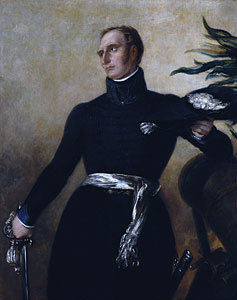
William II (1792–1849), King of Holland, when Prince of Orange
“It was not till Tuesday, the 20th, I had certain and satisfactory assurances how complete was the victory. At the house of Madame de Maurville I heard confirmed and detailed the matchless triumph of the matchless Wellington, interspersed with descriptions of scenes of slaughter on the field of battle to freeze the blood, and tales of woe amongst mourning survivors in Brussels to rend the heart. While listening with speechless avidity to these relations, we were joined by M. de la Tour du Pin, who is a cousin of Madame de Maurville, and who said the Duke of Wellington had galloped to Brussels from Wavre to see the Prince of Orange and inquire in person after his wounds. Prince Blucher was in close pursuit of Bonaparte, who was totally defeated, his baggage all taken, even his private equipage and personals, and who was a fugitive himself, and in disguise! The duke considered the battle to be so decisive, that while Prince Blucher was posting after the remnant of the Bonapartian army, he determined to follow himself as convoy to Louis XVIII.”
Even so, the ordeal of Brussels and its inhabitants was not finished. Burney writes, “the duke now ordered that the hospitals, invalids, magazines, etc., should all be stationed at Brussels, which he regarded as saved from invasion and completely secure. It is not near the scene of battle that war, even with victory, wears an aspect of felicity-no, not even in the midst of its highest resplendence of glory…For more than a week from this time I never approached my window but to witness sights of wretchedness. Maimed, wounded, bleeding, mutilated, tortured victims of this exterminating contest passed by every minute: the fainting, the sick, the dying and the dead, on brancards, in carts, in waggons, succeeded one another without intermission. There seemed to be a whole and a large army of disabled or lifeless soldiers! All that was intermingled with them bore an aspect of still more poignant horror; for the Bonapartian Prisoners who were now poured into the city by hundreds.
“Everybody was wandering from home; all Brussels seemed living in the streets. The danger to the city, which had imprisoned all its inhabitants except the rabble or the military, once completely passed, the pride of feeling and showing their freedom seemed to stimulate their curiosity in seeking details on what had passed and was passing. But neither the pride nor the joy of victory was anywhere of an exulting nature.” She heard stories from participants, but nothing could quell her horror. “I met at the embassy an old English officer who gave me most interesting and curious information, assuring me that in the carriage of Bonaparte, which had been seized, there were proclamations ready printed, and even dated from the palace of Lachen, announcing the downfall of the Allies and the triumph of Bonaparte ! But no satisfaction could make me hear without deadly dismay and shuddering his description of the field of battle. Piles of dead! — Heaps, masses, hills of dead bestrewed the plains.
“Thousands, I believe I may say without exaggeration, were employed voluntarily at this time in Brussels in dressing wounds and attending the sick beds of the wounded. Humanity could be carried no further; for not alone the Belgians and English were thus nursed and assisted, nor yet the Allies, but the prisoners also; and this, notwithstanding the greatest apprehensions being prevalent that the sufferers, from their multitude, would bring pestilence into the heart of the city.”
Frances Burney, Madame d’Arbly, remained in Brussels for almost a month after the battle. She learned that the wars were over on June 26. “We were all at work more or less in making lint. For me, I was about amongst the wounded half the day, the British, s’entend! The rising in France for the honour of the nation now, and for its safety in independence hereafter, was brilliant and delightful. On the following Sunday I had the gratification of hearing, at the Protestant chapel, the Te Deum for the grand victory, in presence of the King and Queen of the Low Countries — or Holland, and of the Dowager Princess of Orange, and the young warrior her grandson. This prince looked so ill, so meagre, so weak, from his half-cured wounds, that to appear on this occasion seemed another, and perhaps not less dangerous effort of heroism, added to those which had so recently distinguished him in the field.”
These are only a portion of Frances Burney’s memoirs of the period. They were chosen from the on-line version of the Diary and Letters of Madame d’Arblay edited by her Niece Charlotte Barrett, Volume IV, available on Google Books. Also used was Fanny Burney: Selected letters and Journals edited by Joyce Hemlow, published in 1986. A postscript to her time in Belgium was Madame d‘Arblay’s audacious journey to reach her husband in July, 1815. While still in the King’s service, he had been injured by the kick of a horse, a wound to his leg from which he never fully recovered. Alone and without complete papers and passports, she set out from Brussels, determined to get to him. Traveling conditions in the region were disrupted and confusing, but she was intrepid and eventually, she was reunited with “her best friend.” Over the next few weeks, while she nursed him, they assembled their belongings in Paris, secured his release from the King’s service, and returned to England.
*Lady Caroline Lamb (1785-1828) was the daughter of the 3rd Earl of Bessborough and his wife Harriet/Henrietta; niece of Georgiana, Duchess of Devonshire; wife of Frederick Lamb, future Lord Melbourne and future Prime Minister. Lady Caroline‘s brother Frederick Ponsonby of the 12thLight Dragoons, was severely wounded in the Battle of Waterloo. She published her first novel, a roman a clef about Byron, in 1816.
**Frederick William, Duke of Brunswick-Wolfenbuttel (1771-16 June 1815), known as The Black Duke, was also the brother of the Prince Regent’s wife Caroline of Brunswick; he died at the Battle of Quatre Bras.
Frances Burney (1752-1840) wrote four novels, many plays, and her renowned Journals, currently being re-issued. For more information on Fanny and her family, visit the website of The Burney Centre at McGill University, Montreal, here.
” A person, my dear, will probably come and speak to us; and if he enters into conversation, be careful to give him a favourable impression of you, for,” and she sunk her voice to a whisper, ‘he is the celebrated Mr. Brummell.”
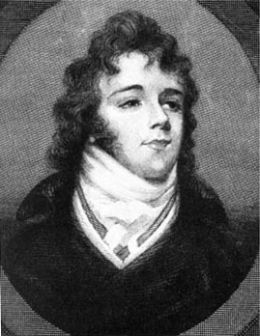
Life of Beau Brummell by Captain Jesse
Born on 7 June, 1778, Beau Brummell endures as a style icon, a matchless wit and an enigma. Was Brummell a caring friend, as experienced by Frederica, Duchess of York, or a sarcastic louse, as portrayed in the following passage from The Cornhill Magazine –
“Brummell’s rise to social autocracy is the more astounding that he had no sort of family to boast of, and that in his day the fashionable drawingrooms and clubs were jealously closed to upstarts and parvenus. Making every allowance for matchless assurance and extraordinary opportunities turned to excellent account, there must have been much in a man who not only became the ami intime of the Prince of Wales, but secured the attachment of a host of friends who stood by him staunchly when in extremity of adversity. Thackeray knew the world well, and he was right when he said that the world is really very good-natured. For whatever the qualities of Brummell, he had no heart to recommend him; he had nothing of that genuine touch of nature which wins affection irresistibly, and makes all mankind akin. He was frivolous, selfindulgent, and ostentatiously selfish. He could attach himself to the dogs who were helplessly dependent; he could pet a mouse and make friends with a cockatoo; but he was cursed with the superficial wit which loved to wound, and he seldom missed an opportunity of saying some bitter thing. If the smart rankled, so much the better. He swaggered cruelly on the strength of his social ascendency, though, to do him simple justice, he spared the strong as little as the weak. Perhaps there never was a less lovable character than that of the dandy who luxuriated for years on disinterested charity and never altogether exhausted it, although he offered his benefactors the most irritating provocation.”
Perhaps in the end Brummell was just like the rest of us – a complex person who could be, and was, many things to many people. Certainly, the Duchess of York and her brother-in-law, the Prince of Wales, had different views on him. However, one view that seems to be universal is that Brummell was the quintessential dandy – or was he? William Pitt Lennox declared that it was a libel to call Brummell a “Dandy,” since he differed entirely from all that species. “Of all my acquaintances, he was the quietest, plainest, and most unpretending dresser,” Pitt wrote. “Those who remember him in his palmy days will bear testimony to the truth of this assertion; it was the total absence of all peculiarity, and a rigid adherence to the strictest rules of propriety in costume, which gained for him the homage due to his undisputed taste. He eschewed colours, trinkets, and gew-gaws; his clothes were exquisitely made, and, above all, adapted to his person; he put them on well too, but for all this there was no striving for effect—there was an unusual absence of study in his appearance.”
A favorite parlor game played by myself, Victoria Hinshaw and Jo Manning is not Scrabble, Trivial Pursuit or even the Oijua Board. No, our favorite game, especially when we are with new people whose opinions we haven’t heard before, always begins with the same question, “Beau Brummell: Straight, gay, bisexual or A-sexual?” I promise you, coupled with a few glasses of port, a cozy chair and the right people, this question can keep you entertained for hours. Granted, you have to have a group of people with the same mind set, people who have actually heard of Beau Brummell and who know the facts surrounding him, but this is not as difficult as it might seem. Two centuries after his death Brummell is still being written about, as both fact and fiction, not to mention the many films which have portrayed his fascinating, fashionable and foible filled life.
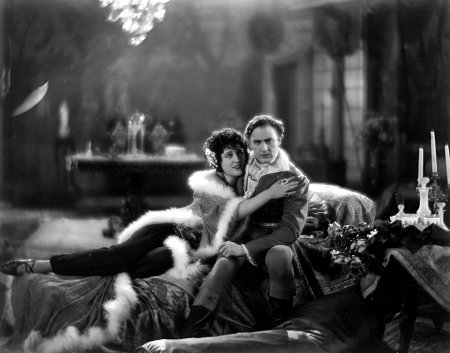
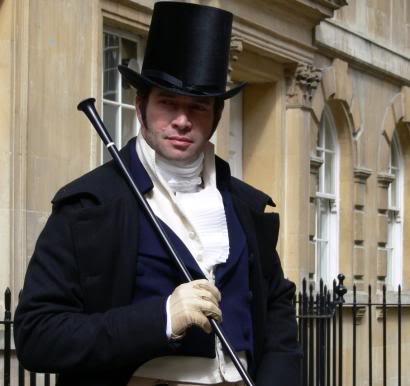
Whether portrayed by John Barrymore, Stewart Granger or
James Purefoy, the Brummell flair always manages to come through.
In fact, the Brummell flair is still so powerful, his name still so instantly associated with all things exquisite and fashionable that Brummell, who would be 232 years old today, continues to have his name bandied about in order to sell all manner of goods, including after shave, ties, shirts, suits, watches, razors, early 20th century hand soap dispensers and a Cincinnati office building.
Not to mention a show poodle, which, when you think of it, is infinitely more fitting than a soap dispenser. By the way, there have also been many horses named Beau Brummell – one of them has a race video on YouTube.
No . . . I’m not kidding.
I must say I’ve never heard of Brummell’s having been musicially inclined, though I could be wrong.
And how about . . . . . . .
I’m telling you, I couldn’t make this stuff up . . . . . .
Brummell would be gratified to learn that he can still draw a crowd, as evidenced by this photo of his statue in Jermyn Street.
Brummell was one of the most talked about men of his day and I like to think that, wherever he is now, it amuses him to no end that his name still holds some cachet. And I think it makes him guffaw outright to know that while everyone still recognizes his name – nay uses his name in order to sell all manner of goods – the number of George IV branded items is rather limited. The Duke of York even has more pubs named after him than Prinny does. It’s a shame really – My Fat Friend’s Place would have made a much better name for a restaurant, what?
“The desperate act of a woman who rushed from the rails on to the course as the horses swept round Tattenham Corner, apparently from some mad notion that she could spoil the race, will impress the general public even more, perhaps, than the disqualification of the winner. She did not interfere with the race, but she nearly killed a jockey as well as herself, and she brought down a valuable horse. She seems to have run right in front of Anmer, which JONES was riding for the KING. It was impossible to avoid her. She was ridden down, the horse turned a complete somersault and fell upon his rider. That the horse was the KING’S was doubtless an accident: it would need almost miraculous skill or fortune to single out any particular animal as they passed a particular point. Some of the spectators close to the woman supposed that she was under the impression that the horses had all gone by and that she was merely attempting to cross the course. The evidence, however, is strong that her action was deliberate, and that it was planned and executed in the supposed interests of the suffragist movement.
“Whether she intended to commit suicide, or was simply reckless, it is hard to surmise. She very nearly took JONES’S life and her own. Had Anmer brought down the other horses which were close behind him, a scene might have followed of which it is horrible even to think, and nobody could have maintained, had it occurred, that it was not a natural consequence of what she did. She is said to be a person well known in the suffragist movement, to have had a card of a suffragist association upon her, and to have had the so-called “Suffragist colours” tied around her waist. It is further alleged that just after she had run out in front of the horses, holding her hands above her head, a placard with the words “Votes for Women” was raised by some person in the crowd. The circumstances are not, of course, conclusive, but they are, to say the least, suggestive.
“The case will, of course, become the subject of investigation by the police, and we may possibly learn from the offender herself what exactly she intended to do and how she fancied that it could assist the suffragist cause. A deed of the kind, we need hardly say, is not likely to increase the popularity of any cause with the ordinary public. Reckless fanaticism is not regarded by them as a qualification for the franchise. They are disposed to look upon manifestations of that temper with contempt and with disgust. When these manifestations are attended by indifference to human life, they begin to suspect that they are not altogether sane. They say that persons who want only destroy property and endanger innocent lives must be either desperately wicked or entirely unbalanced. Where women are concerned, the natural gallantry of the public always inclines them to take a favourable view, and accordingly they are gradually coming to the conclusion that many of the militant suffragists are not entirely responsible for their acts. The growth of that belief will not improve the prospects of woman suffrage. The bulk of the suffragist party, and the abler of its leaders, are doubtless conscious of this truth. They seem, however, to be quite unable to lay the spirit which some of them have helped to raise, and to prevent the perpetration of crimes, the utter inanity of which as a means of political propaganda is even more striking than their wickedness. We are much mistaken if yesterday’s exhibition does not do more hurt to the cause of woman suffrage than years of agitation can undo. The militant school will long have reason to remember Aboyeur’s Derby.”
A video explaining the history of this particular race and footage of the accident itself can be viewed here.
Emily never regained consciousness and died from her injuries on June 8th at Epsom Cottage Hospital. Doubts remain as to her exact intentions on the fateful day, some saying it was suicide, others disputing that theory as she had a return train ticket in her pocket.
On June 13, 5,000 women marched in Davison’s funeral procession. Video of the event can be seen here.
The King’s jockey, Herbert Jones (b. 1880), was known as ‘Diamond’ Jones after winning the racing triple crown in 1900 when he rode the future King Edward VII’s horse, ‘Diamond Jubilee.’ Jones suffered a mild concussion in the accident and recovered. He died in his kitchen of gas inhalation in 1951.
The horse involved in the incident, Anmer, went on to race again, always placing and never winning and one presumes he went on to a peaceful retirement.
Sarah Biffen (1784-1850) was born without arms or legs, a condition known as phocomelia, and survived infancy only by the intervention of a clergyman who protected her. In her family she was known as a pixie child, and she was even feared by some in her West Country village.
Self portrait by Sarah Biffen, painted in 1830, holding the brush in her teeth.
At age 12, Sarah became a phenomenon at circuses and fairs, displayed painting or sewing with her teeth and was known as “The Limbless Wonder.” A few years later, the Earl of Morton arranged for her to study with William Craig, a Royal Academician who was also drawing master to Princess Charlotte of Wales.
She became a professional miniaturist and did work for George IV, William IV, and Queen Victoria. She is mentioned in novels by William Makepeace Thackeray and Charles Dickens, and her paintings were accepted for exhibition by the Royal Academy. She received a silver medal from the Society of Arts in 1821.
This is a miniature of Edward, Duke of Kent (1767-1820), a waterclour on ivory, painted by Sarah Biffen in 1839 and purchased by the Duke’s daughter, Queen Victoria. It is part of the Royal Collection.
Sarah married William S. Wright in 1824, but the marriage was unsuccessful. After she moved to Liverpool, her work gradually went out of fashion and her ability to paint faded as well. Obviously the incredible muscle control in her mouth and neck would have been reduced as she aged. She was supported in her last years by a pension from the Queen and funds donated by her friends and colleagues.
In the words of the National Gallery of Scotland’s description of her self-portrait, “This remarkable self-portrait reveals something of Sarah’s dignity and strong character, as well as showing the determination and skill of a woman who rose from being a side-show exhibit to a celebrated royal portrait painter.”
_by_Thomas_Lawrence.jpg)

 “The fact was, I wanted to see Blucher (right), that I might learn from his own lips at what hour it was probable he would he able to join forces with us next day. Therefore, the moment Fitzroy’s back was turned I ordered Copenhagen to be resaddled, and told my man to get his own horse and accompany me to Wavre, where I had reason to believe old ‘ Forwards’ was encamped. Now, Wavre being some twelve miles from Waterloo, I was not a little disgusted, on getting there, to find that the old fellow’s tent was two miles still farther off. However, I saw him, got the information I wanted from him, and made my way homewards. Bad, however, was the best; for, by Jove, it was so dark that I fell into a deepish dyke by the roadside; and if it had not been for my orderly’s assistance, I doubt if I ever should have got out. Thank God, there was no harm done either to horse or to man! Well, on reaching headquarters, and thinking how bravely my old horse had carried me all day, I could not help going up to his head to tell him so by a few caresses. But, hang me, if when I was giving him a slap of approbation on his hindquarters, he did not fling out one of his hind-legs with as much vigour as if he had been in the stable for a couple of days! Remember, gentlemen, he had been out, with me on his back, for upwards of ten hours (during the day), and had then carried me eight-and-twenty miles besides. I call that bottom! Eh?”