SO YOU WANT TO BE A BARE-KNUCKLES BRAWLER

Guest post by author Regina Scott

Welcome back to the boxing square! If you missed part one of this series, you can find it here.

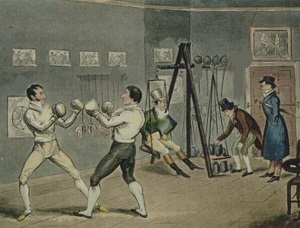
So, let’s say a gentleman became so enamored of boxing that he wanted to participate in the sport. Professional boxers were not sons of the aristocracy, but that didn’t stop the aristocracy from aping them. One of the most famous boxers of the day, Gentleman Jackson, one-time champion of England, taught boxing from his salon at No. 13 Bond Street three times a week (alternating with Angelo’s fencing school, which used the same space). Gentlemen as well known as Lord Byron came to learn from the best.

Jackson taught the “scientific style” of boxing, which included nimble footwork and the correct judging of the distance required to strike the opponent. He also advised adopting a posture of a slightly bent body, head and shoulders forward, and knees slightly bent and at ease with fists well up. He taught that fighting with the entire body (scrapping or brawling) was ineffective against the power of a well-trained fist, proving his point by having his students attempt to attack him and fending them off with fists alone.

Gentleman Jackson’s Boxing Saloon (from Life in London by Pierce Egan, circa 1820)

Between sessions at being soundly beaten by the Gentleman, an aristocratic fellow might practice at home, punching at air or sparring with a friend or family member. Punching bags were not invented until later, but that doesn’t mean some resourceful individuals didn’t figure out a way to create a practice bag on their own.

And what if a lady was enamored of the bare-chested boxers, er I mean the sport of boxing? Proper ladies were not supposed to attend boxing matches. The display of skin combined with the brutalism of the events and the unsavory crowds were deemed too much for the fair sex. Some still came in disguise or inside closed carriages, which could ring the square. Some went so far as to take boxing lessons at home. The practice was thought to provide excellent exercise.

Even if a gentleman didn’t choose to tutor under Jackson or one of the other teachers at the time, he would be sure to attend the matches. These matches were frowned upon by the magistrates. I gather it was like the saying today about hockey—I went to a boxing match and a fight broke out. One of the reasons for locating the matches just outside London on a work day was that the “riff-raff” couldn’t spare time away from work to get there, and tickets might be charged for admission.

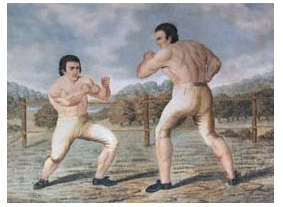
Round Prizefight between Tom Johnson, Champion of England, and Isaac Perrins, 1789 (artist unknown)

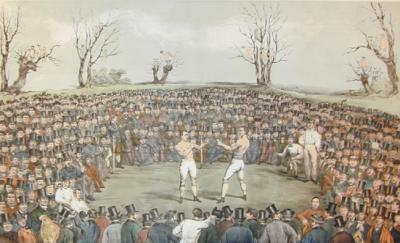
The match itself was markedly different from what we know today. They were often held in open fields. An eight-foot square was generally roped off on the ground with stakes at each corner, although some of the larger fights were held on a raised plank floor. Each fighter had a kneeman and a bottle man, who also kept time on the rounds and breaks. The former knelt with one knee up for the boxer to sit on between rounds. The latter provided water for the boxer to drink, a sponge to wipe him down, and an orange for a quick burst of energy. Brandy was supposed to be used only for emergencies. A pair of umpires, usually former fighters themselves, kept the two boxers apart and agreed on how to deal with questionable practices like holding a man’s hair to keep him in place to be hit. A referee was only used if the two umpires could not agree.

Thomas Sayers and John C. Heenan Fight for the Championship, 1860, by Jem Ward

The bouts consisted of rounds; each round lasted until at least one of the men was knocked down or thrown off his feet. A fight could run up to 50 rounds, although one before the Regency (1789) was said to hit 62 rounds. If you do the math like I did, that means someone could be hit hard enough to fall down as many as 50 times in one fight. And breaks between the rounds (after someone fell) were only 30 seconds. This was not a sport for the squeamish!

Ready to take up your tutelage at the feet of the master? Come back for the next installment, when we learn more about the Gentleman himself.

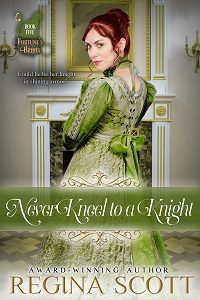
Regina Scott is the award-winning author of more than 40 works of sweet historical romance, several of which feature Regency gentlemen who box. In Never Kneel to a Knight, a boxer being knighted for saving the prince’s life must prove to a Society lady who is miles out of his league that their love is meant to be.

You’ll find more on Regina online at her website,  on her blog, or on Facebook.

ALBERT COTTAGE – ISLE OF WIGHT

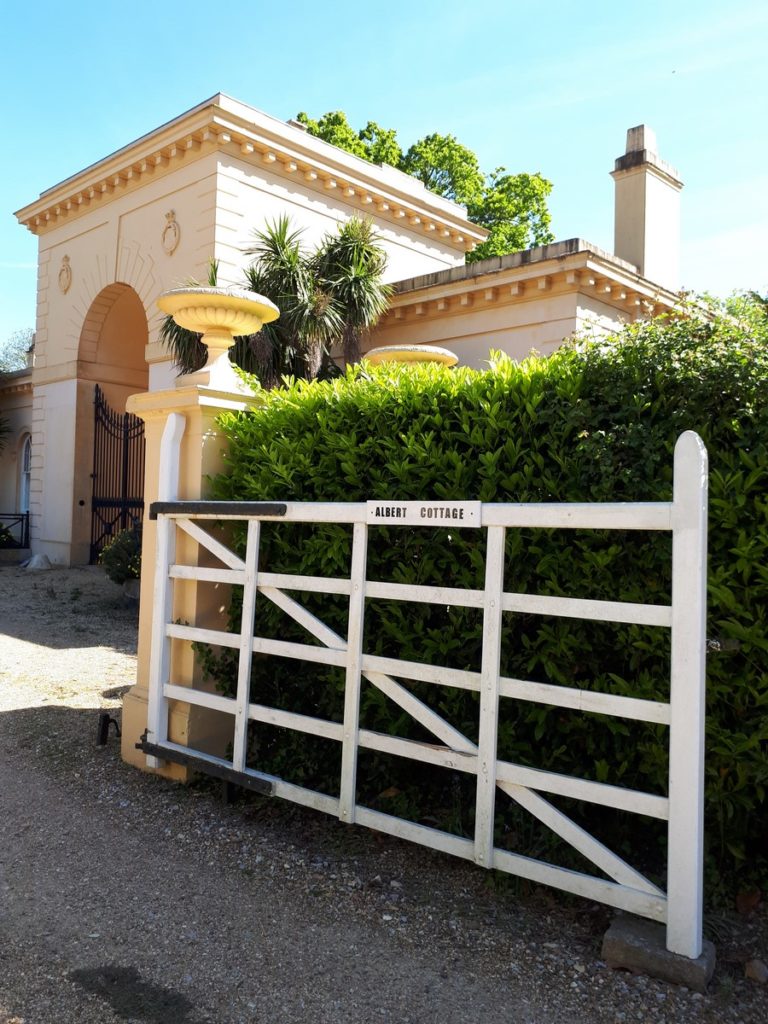
Leaving the Castle Hotel, Ryde, Victoria and I headed to East Cowes and our next hotel, Albert Cottage,  once home to Princess Beatrice, Queen Victoria’s younger daughter. The hotel is set in two acres of beautiful gardens backing onto Osborne House, Queen Victoria’s favourite holiday residence. Directly next to the hotel stands the entrance gate to Osborne House, above, still reserved for the use of the current Royals. The public entrance to Osborne House is further on down the street.
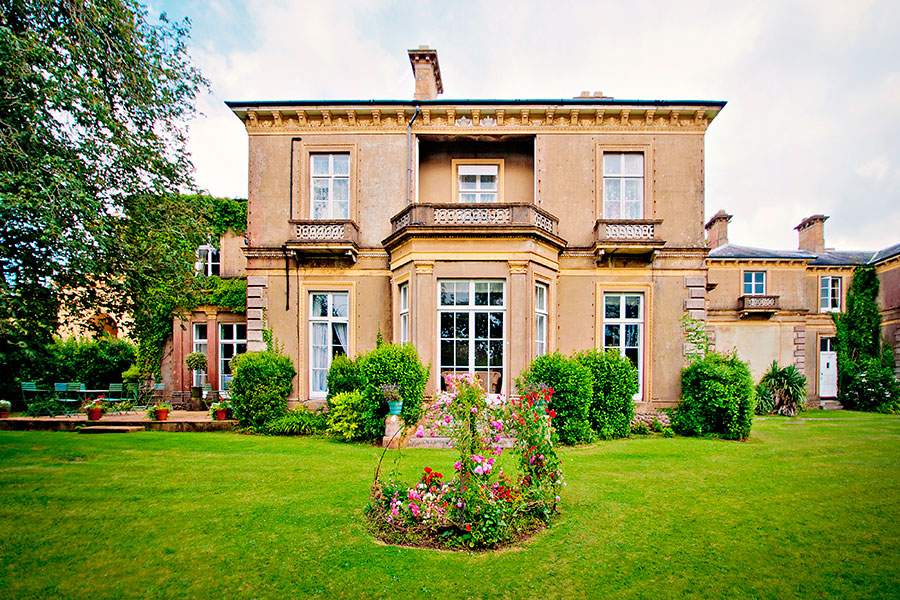
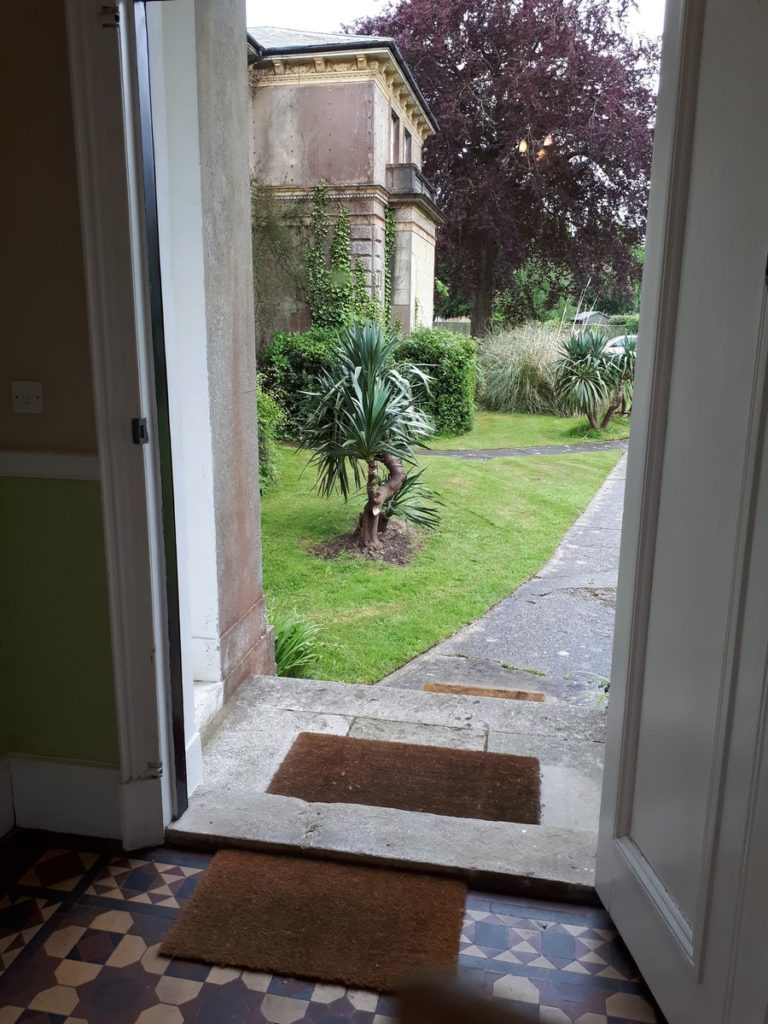
The Albert Cottage Hotel

From the hotel website – “Built  in the 1840s, probably by Thomas Cubitt – the then leading master builder in London – ‘Albert Cottage’ was bought in 1852 by Prince Albert to be part of a Botanic Garden development of the Osborne House Estate, and was used together with the adjacent Osborne Cottage by Royal guests. In 1899 a covered corridor was constructed to link the two properties and allow easy movement between them without guests having to brave any inclement weather.”

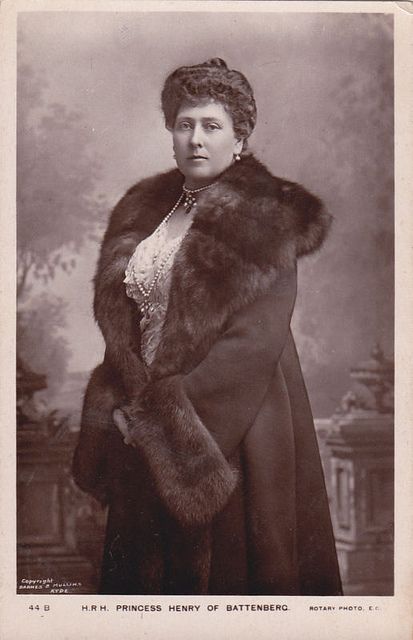
Princess Beatrice

“This corridor now links the main Hotel and Consort Restaurant & Bar area. When Queen Victoria died in 1901, her successor Edward VII kept both cottages for the use of Victoria’s youngest daughter, Princess Beatrice. In 1913 the Princess moved to Carisbrooke Castle and Albert Cottage was sold to Sir Richard Burbidge, philanthropist Managing Director of Harrods. It was again sold in 1924 to The Hon. Elizabeth Storr, widow of Major L.P. Storr DSO, a war hero killed in action in France in 1918. After later neglect it was turned into a hotel in 1999 and now further developed by current owners HTP Apprenticeship College.”

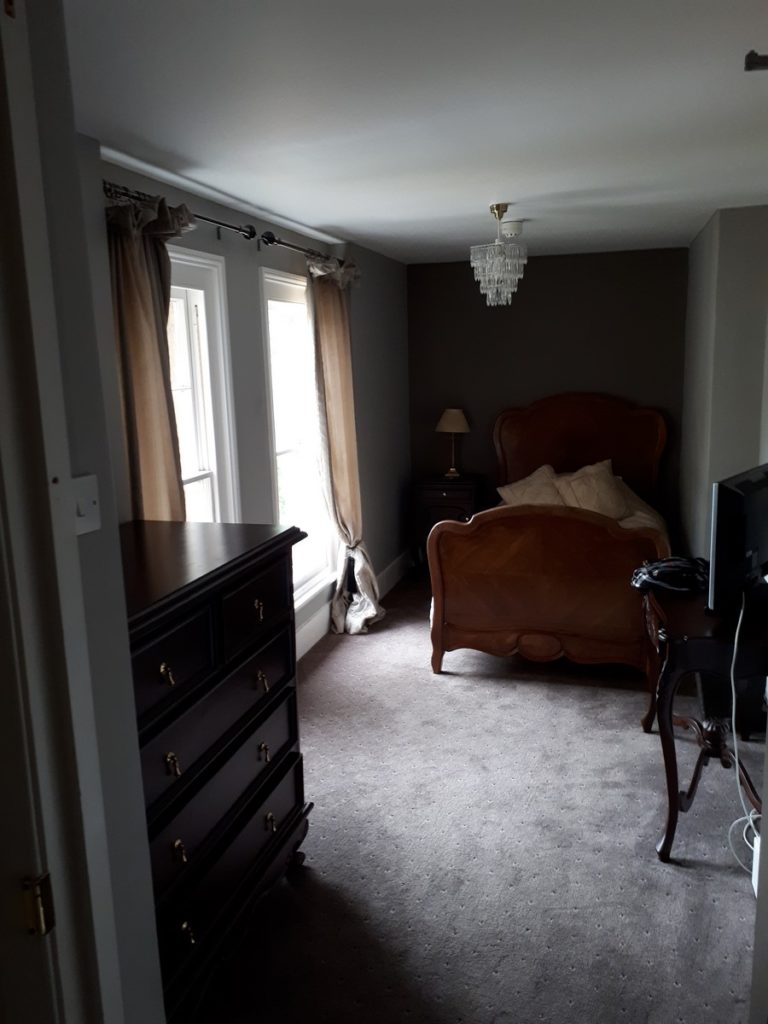
Upon check-in, Vicky and I were given a two bedroom suite. Vicky’s bedroom looked lovely from the doorway . . . .
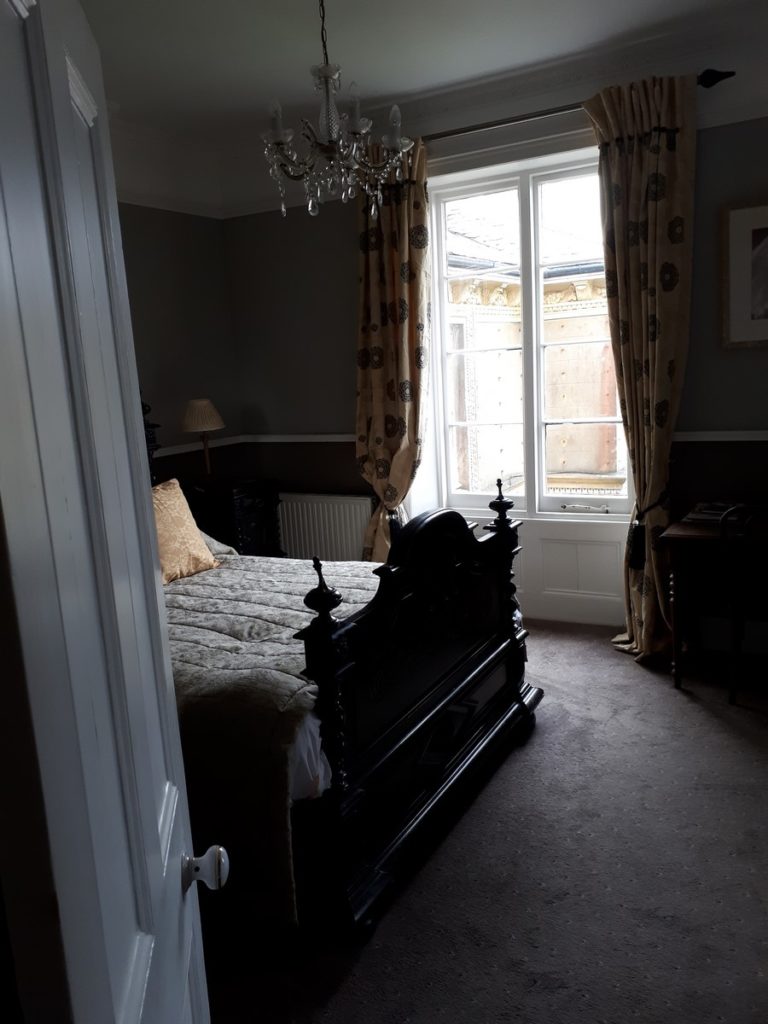
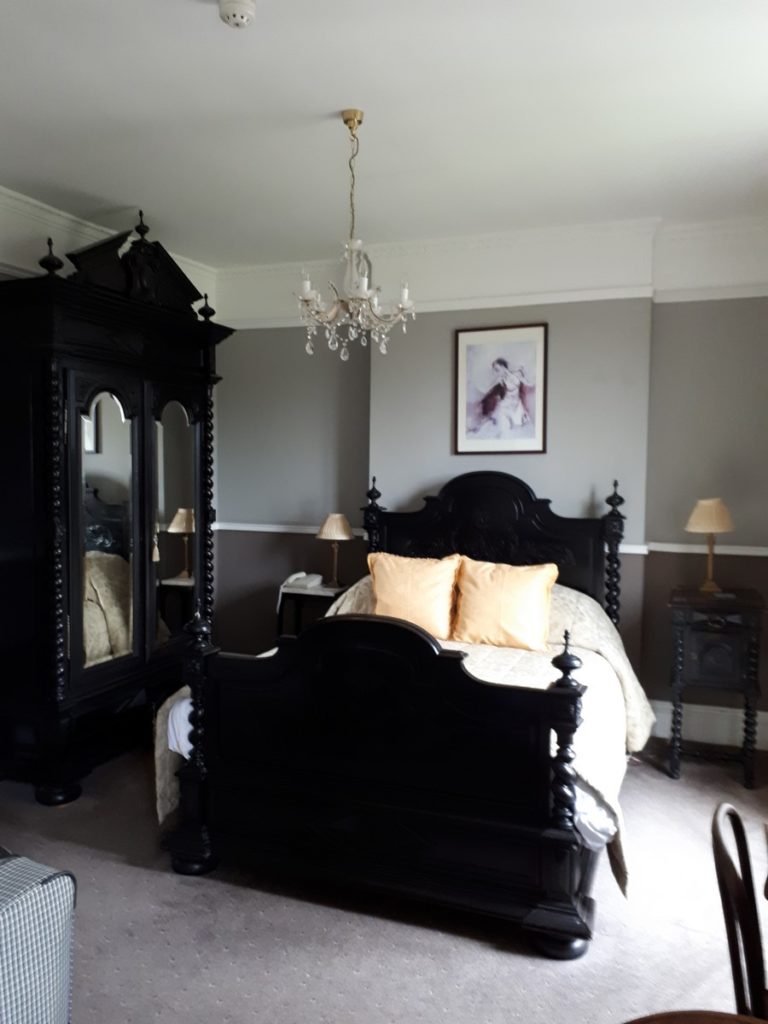
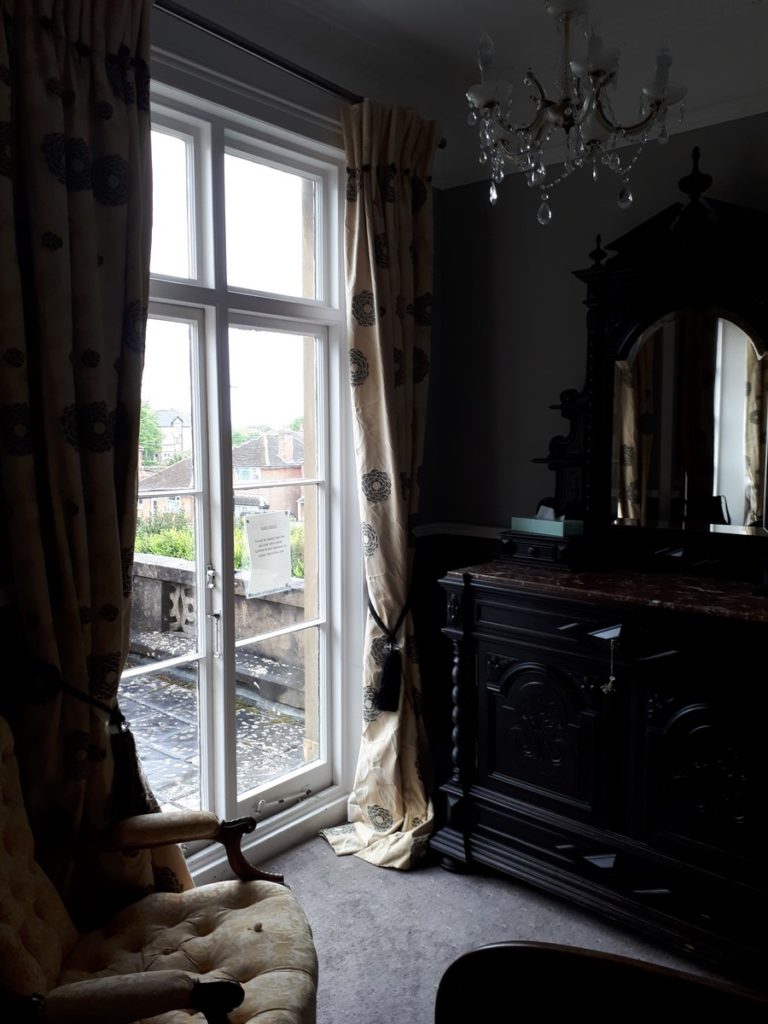
And enormous from within. It even offered a sitting area with balcony.

My bedroom was just as lovely, and afforded me views of the Gate. A nice touch – our bathroom shower included instructions.
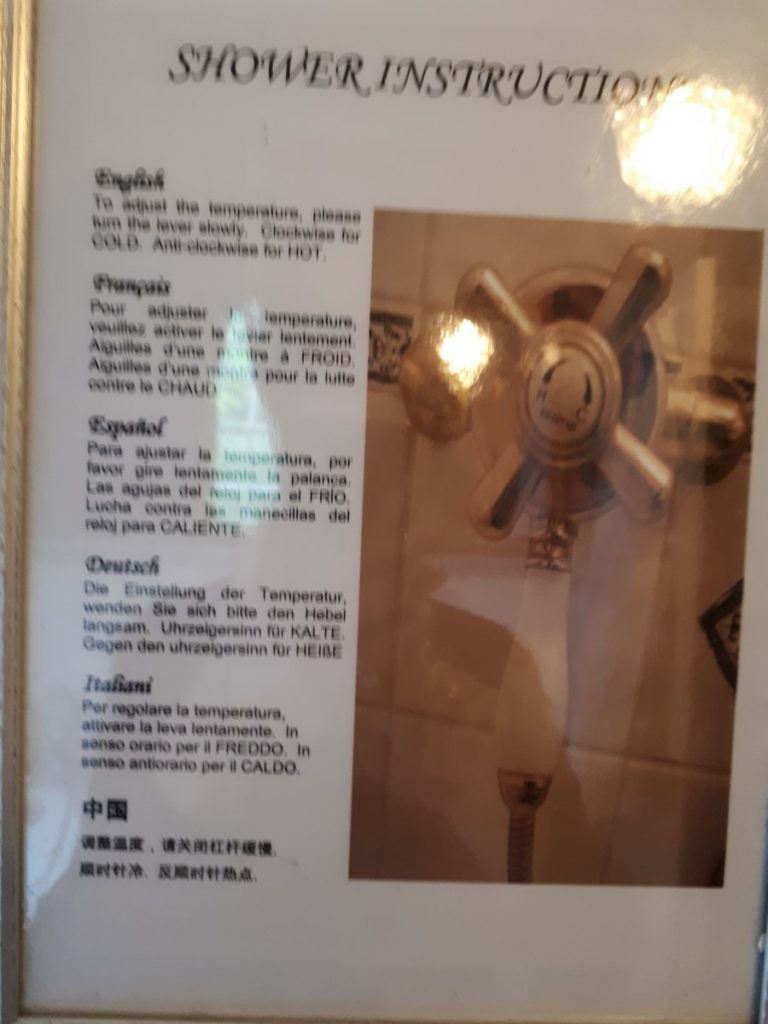
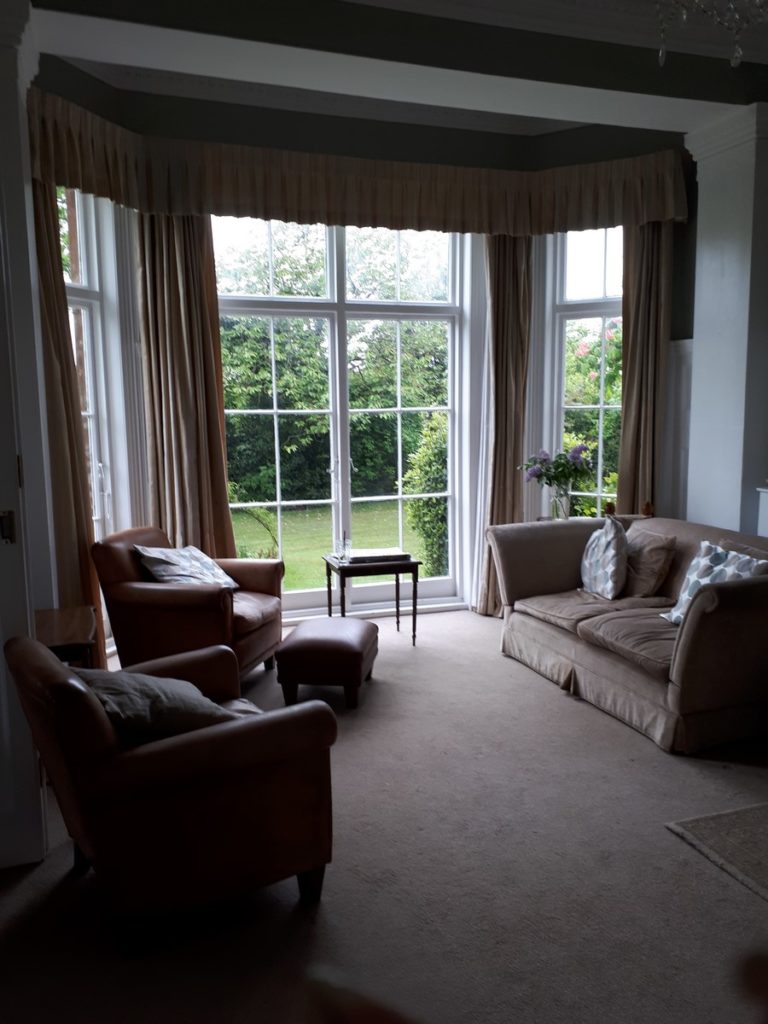
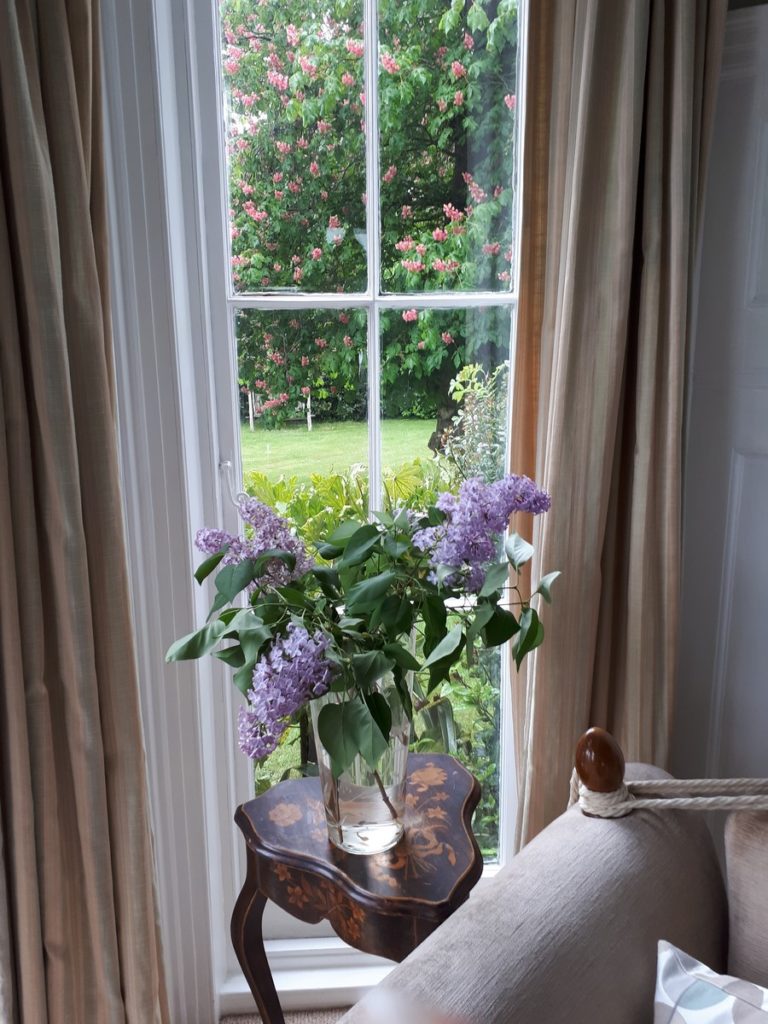
We had the cozy drawing room to ourselves and enjoyed the expansive garden views.

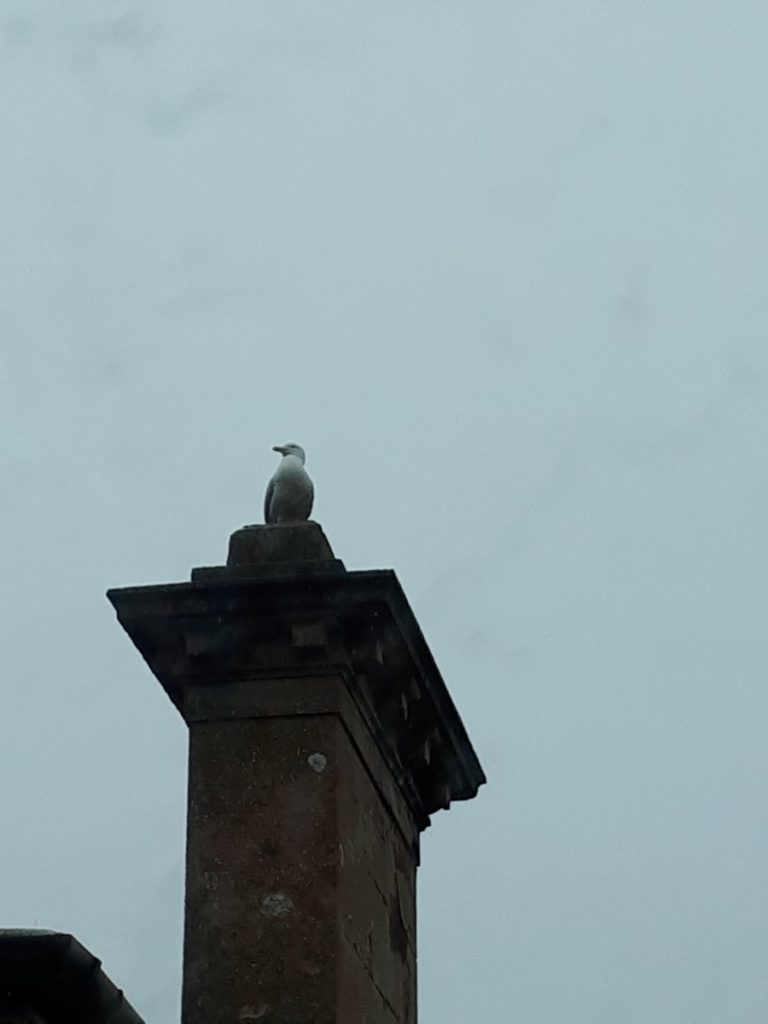
Some of the other guests were a bit stand-offish, below, but the staff were lovely.

In the afternoon, we made our way to Osborne House for the first of our two day visit to the property. Returning to the hotel that evening, we dined in the Prince Consort Restaurant.

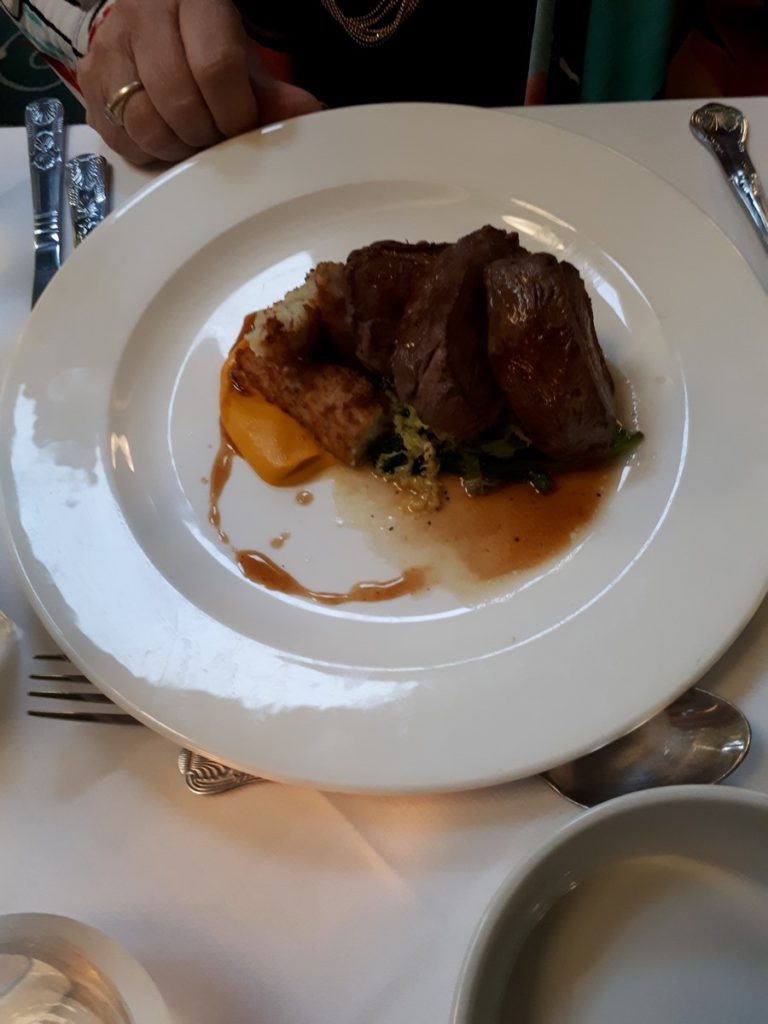
Vicky chose the lamb.

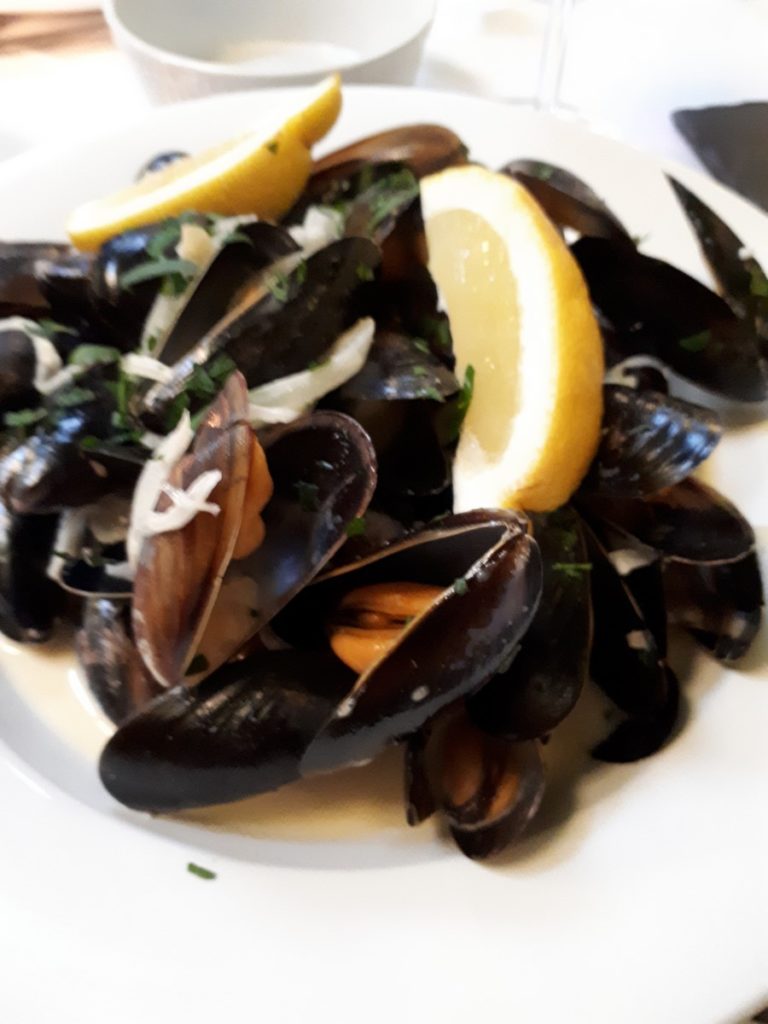
I opted for mussels.

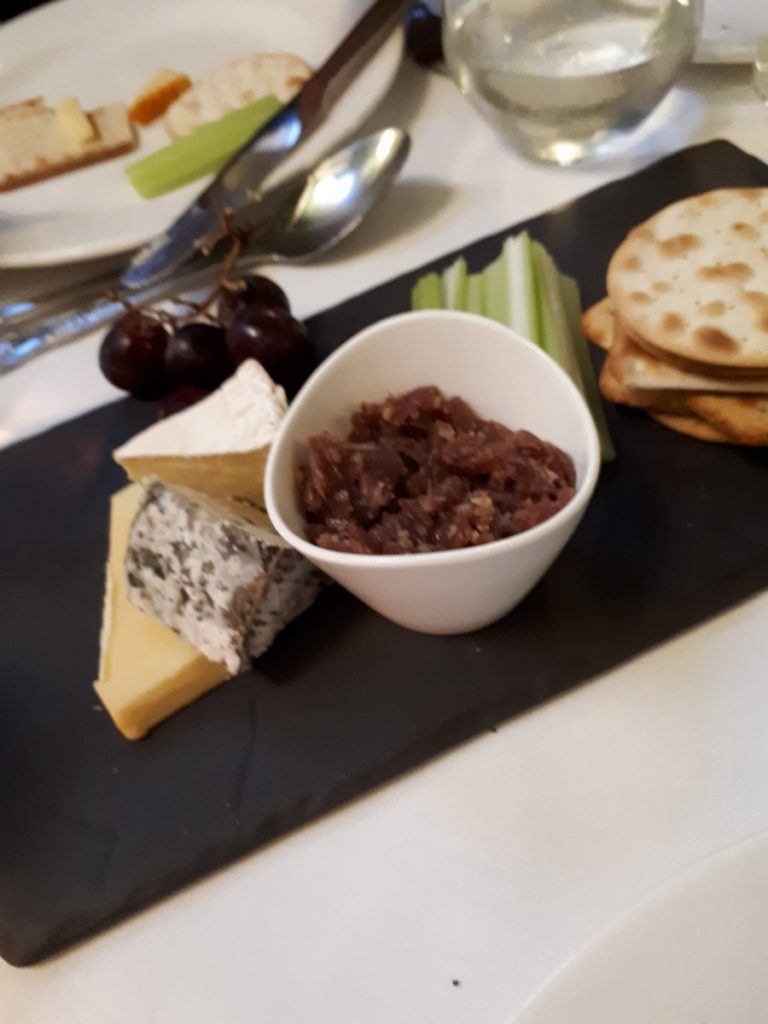
And we split the cheese board for dessert.

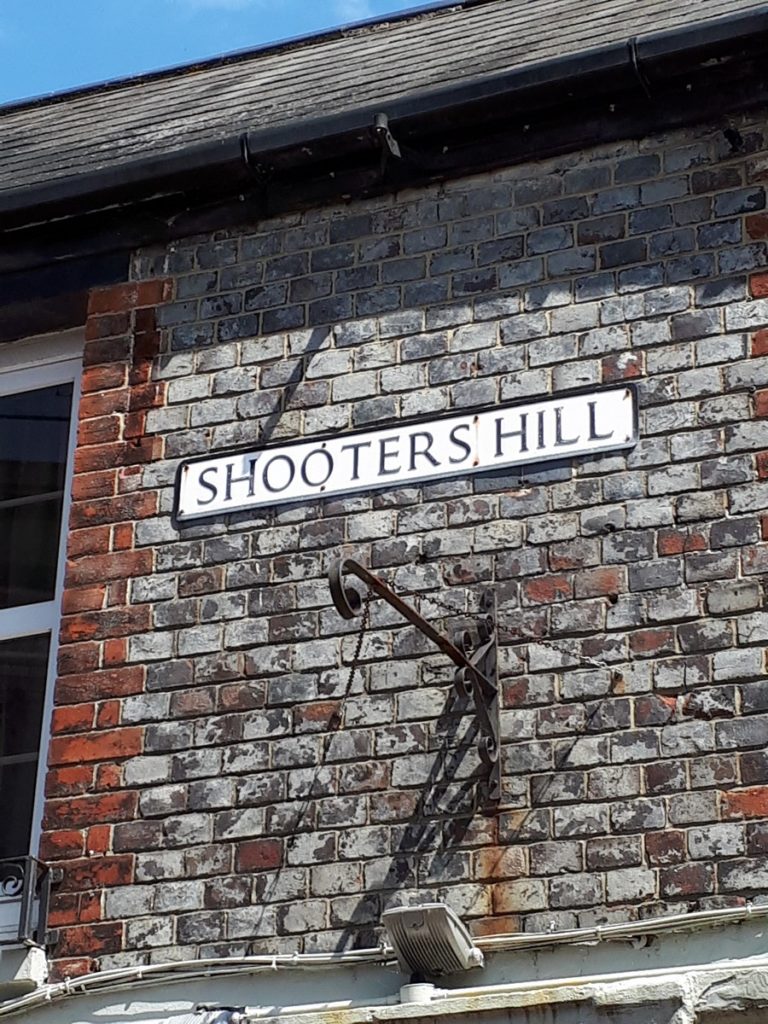
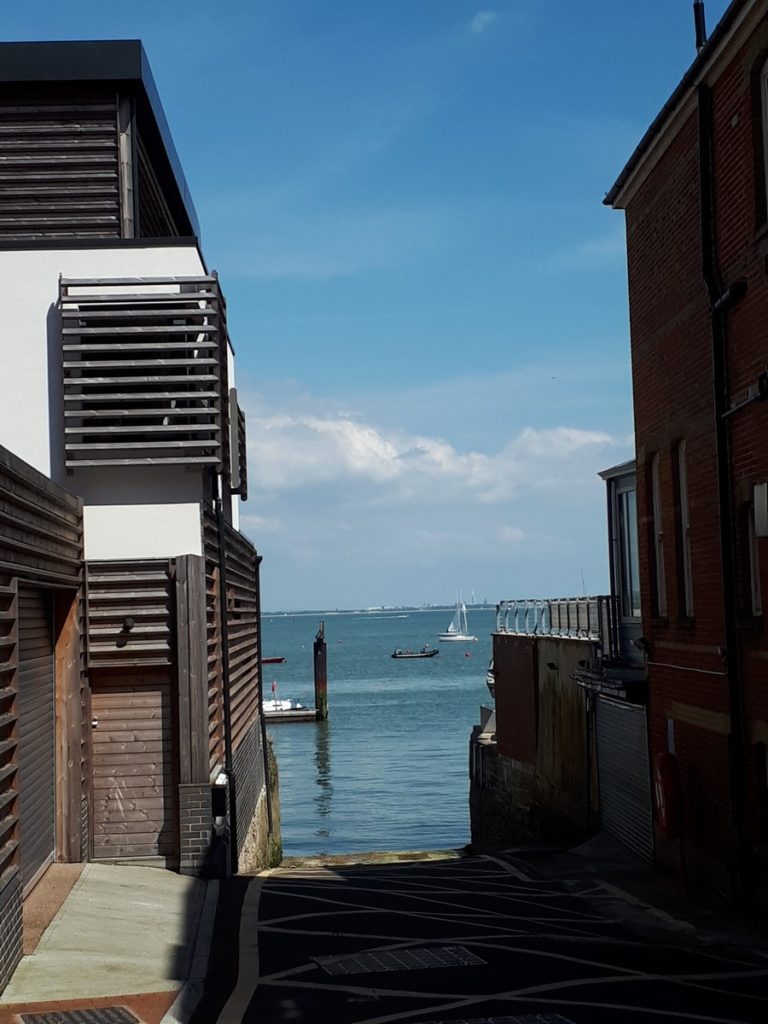
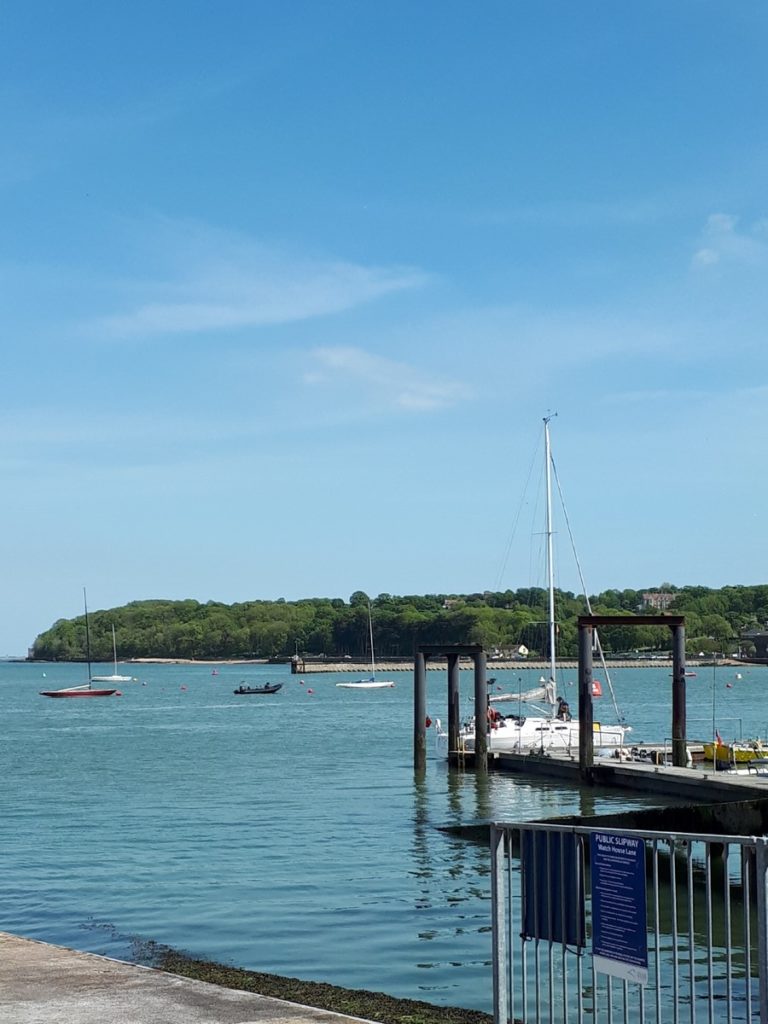
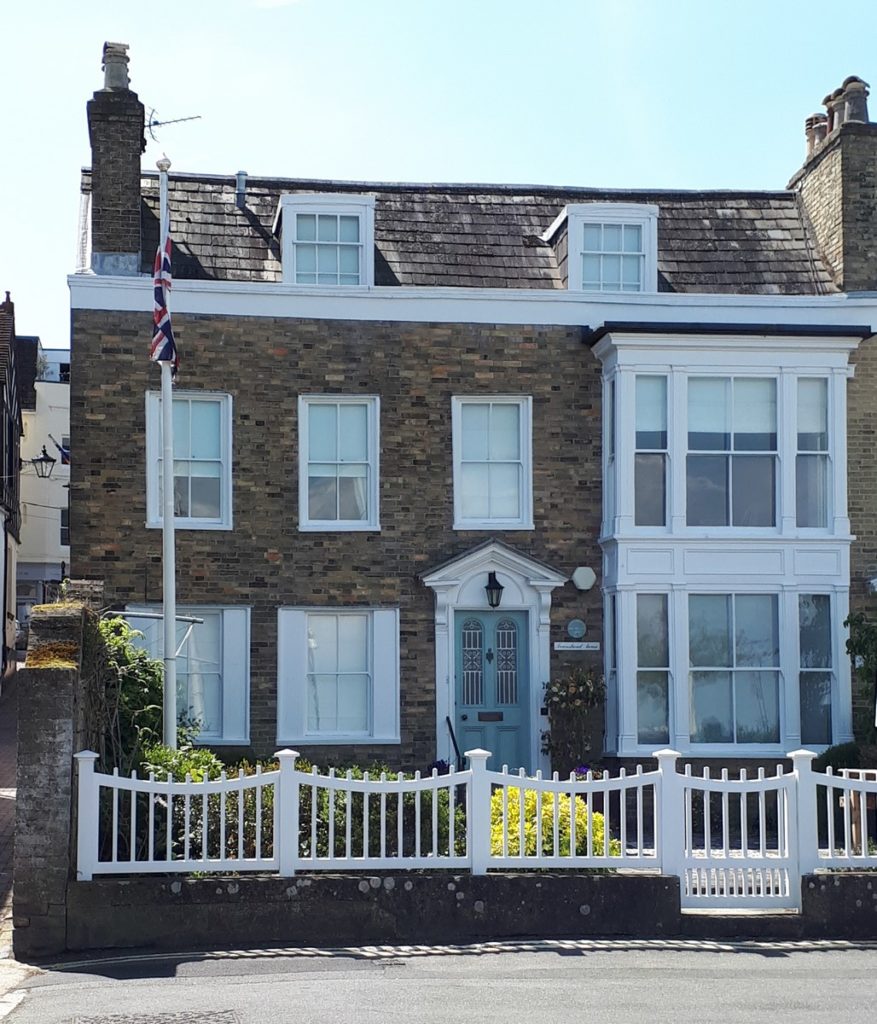
Once we had completed our tour of Osborne House, the gardens, beach and Swiss Cottage, Vicky and I headed to the historic town of Cowes and began our sightseeing in Shooters Hill.

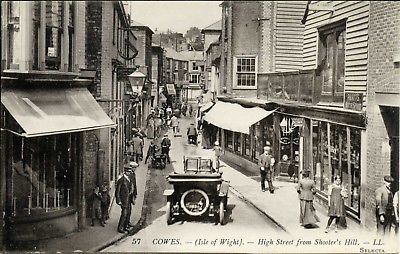
Shooters Hill, PicClick UK

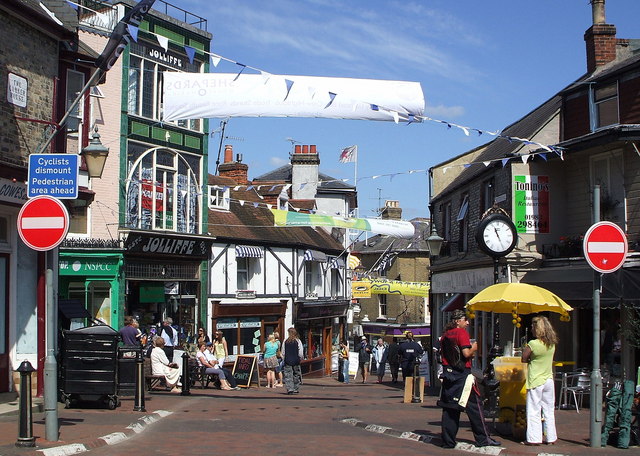
As the postcard above illustrates, Shooters Hill has been attracting visitors for quite some time, although today it has mostly been pedestrianized.

Shooters Hill today © Copyright Gillian Thomas

Once more, we were blessed with blue skies and fine weather.

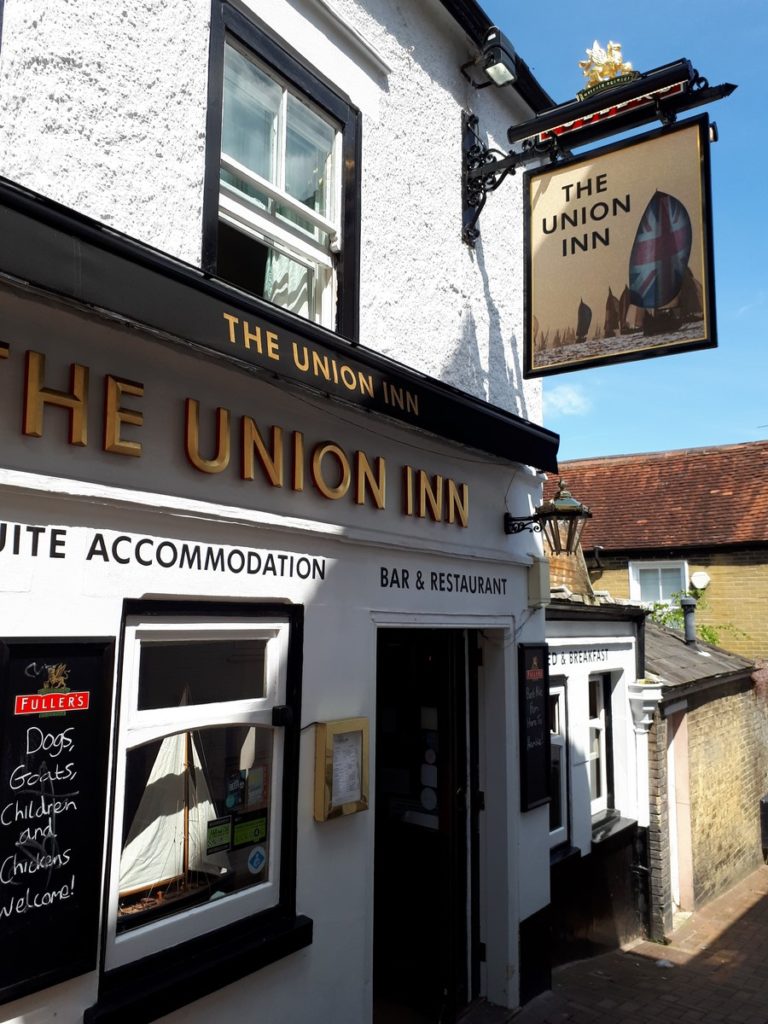
We spent a leisurely few hours admiring the seafront and nosing around in the wide selection of shops. Eventually, we made our way to the Union Inn, which had been recommended to us by our cab driver as the place to eat in Cowes.

From the Island Eye website: “The Union Inn was possibly built after the act of union between England and Scotland, which took place in the year 1707. The pub was a firm favourite of the navy press gang, who used the pub to enlist many young men into their services when the fleet was at Portsmouth.”

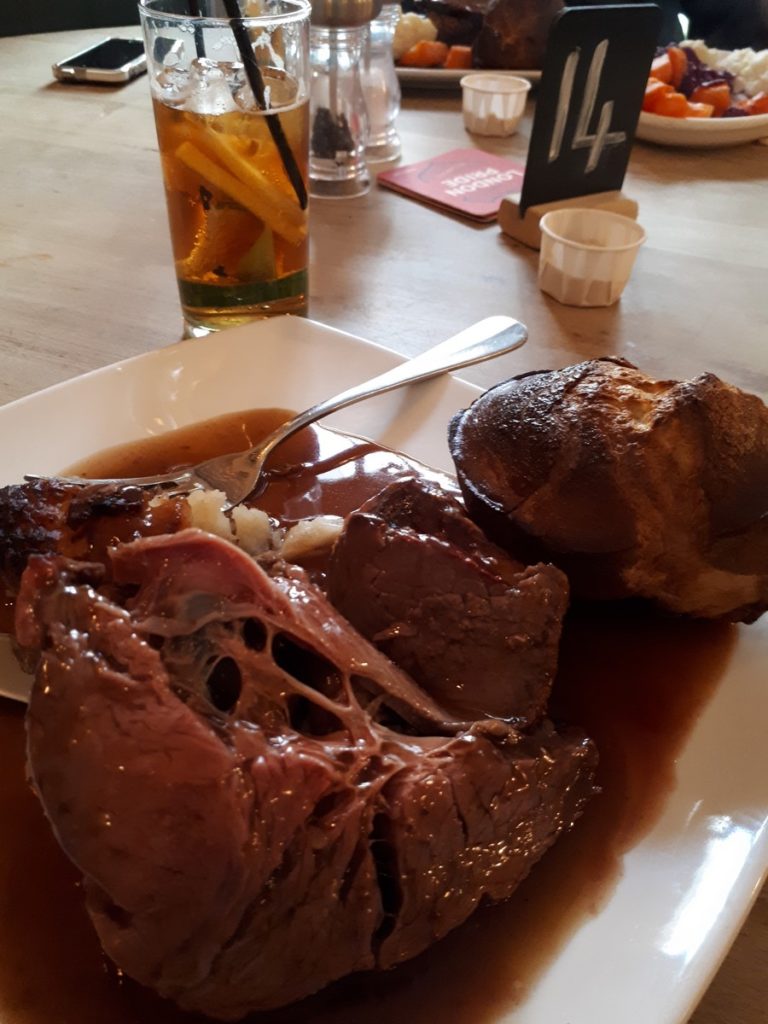
As luck would have it, it was a Sunday. And by now, you should know what that means.
More delicious adventures coming soon!

Would you like to experience travel in England first-hand?
Visit our website for a list of upcoming Number One London Tours.
During our upcoming Scottish Retreat in September, we’ll be starting and ending our adventure in Edinburgh – an opportunity for visits to Edinburgh Castle, above, Holyrood Palace and a stroll up (or down) the Royal Mile.

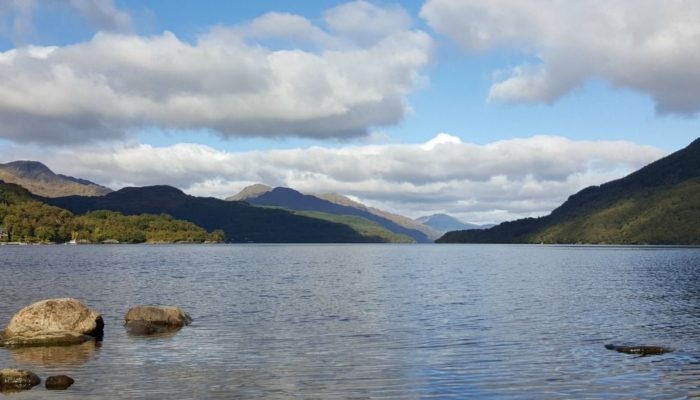
Our week will include a mix of days out and days in, allowing you to experience life in a country house and to explore the rich Scottish history in the area. Day trips will include visits to castles and stately homes, museums, charming time capsule villages and a once in a lifetime Land Rover Highland Safari with your own private ghillie. The Scottish Retreat will offer you the opportunity to see the most of Scotland, literally from its lofty peaks to shining lochs – we’ll be cruising legendary Loch Lomond, too!

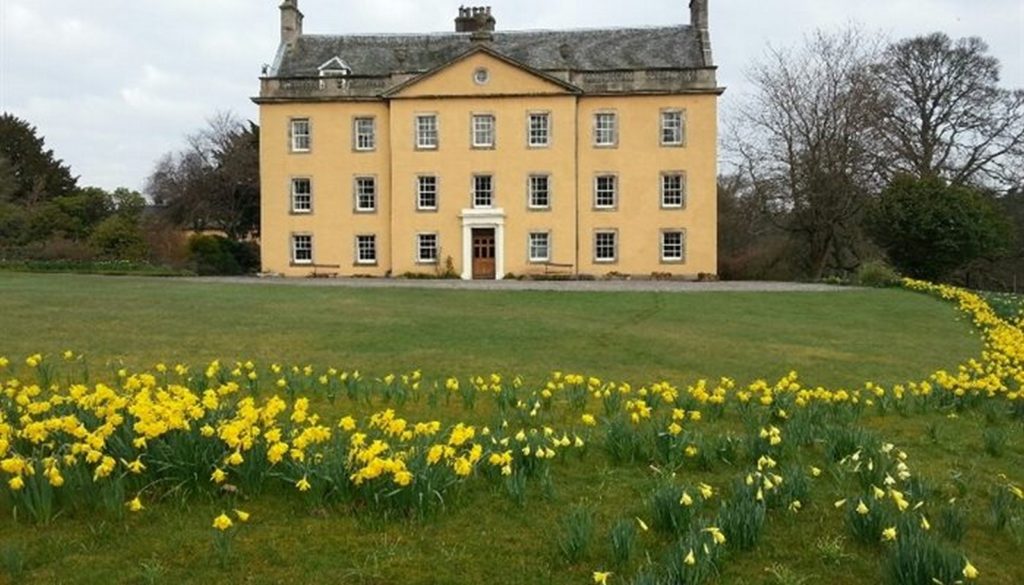
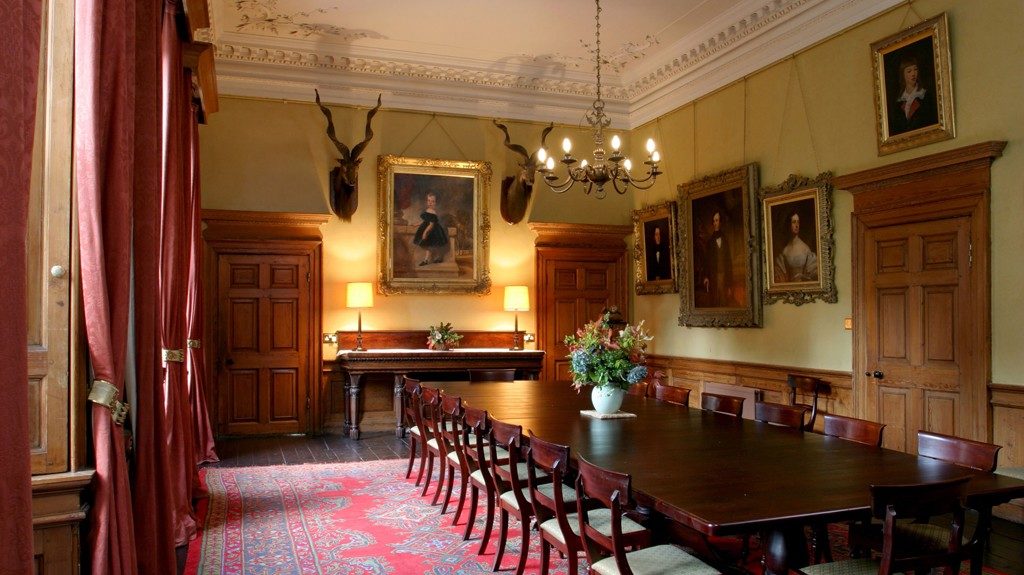
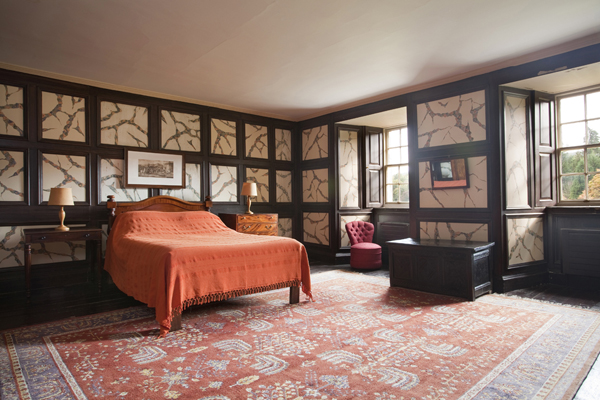
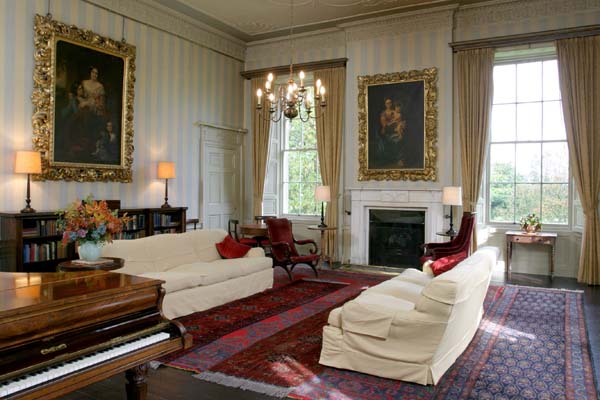
We’ll be staying at historic Gargunnock House, a classic example of the gentleman’s shooting box, complete with open fires, flagstone floors, period details, spiraling staircases and Georgian furnishings.

Being a period property, Gargunnock House has a limited number of bedrooms and there are only 5 spaces left on the tour.
Visit our website for dates and complete itinerary.


Travels with Victoria: WILTON HOUSE – Part Two

By Victoria Hinshaw

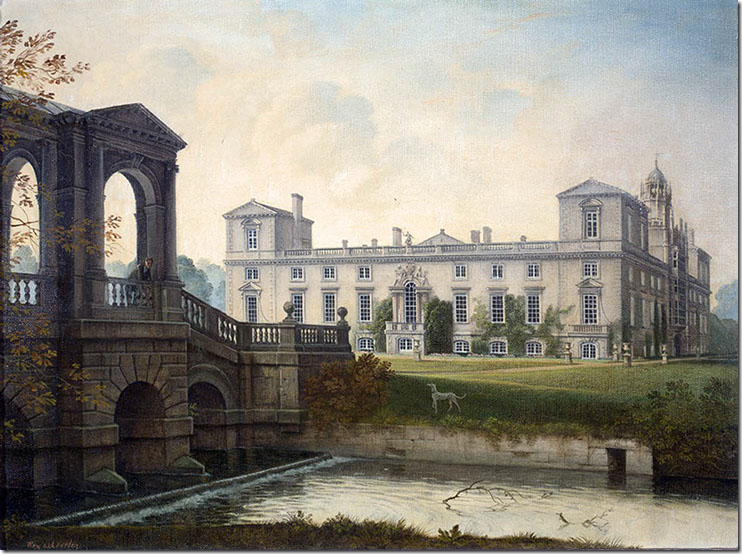
Wilton House, by Rex Whistler

The view above is a 1935 painting of Wilton House by Rex Whistler (1905-1944).  Wilton House, near Salisbury in Wiltshire is renowned for its architecture, interiors, treasured artworks, and all the elegancies associated with the most distinguished of Britain’s stately homes. And, like some of the others, it is frequently the scene of major filming for cinema and television. The South Façade is the location of the State Apartments created by James Wyatt in the early 19th century, replacing the 17th century arrangement of rooms by Architect Inigo Jones (1573-1665) and his assistant Isaac de Caux and later altered by Webb.

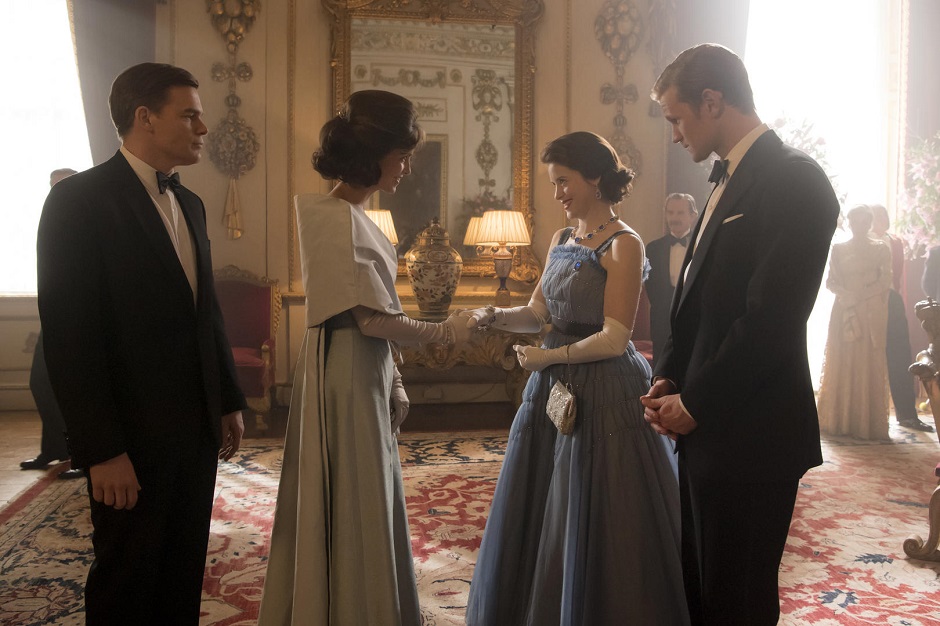
The Crown: (L to R) JFK, Jackie, Elizabeth, Philip – The Kennedys and Windsors meet.

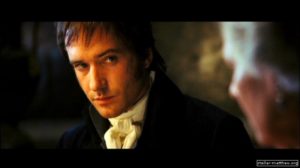
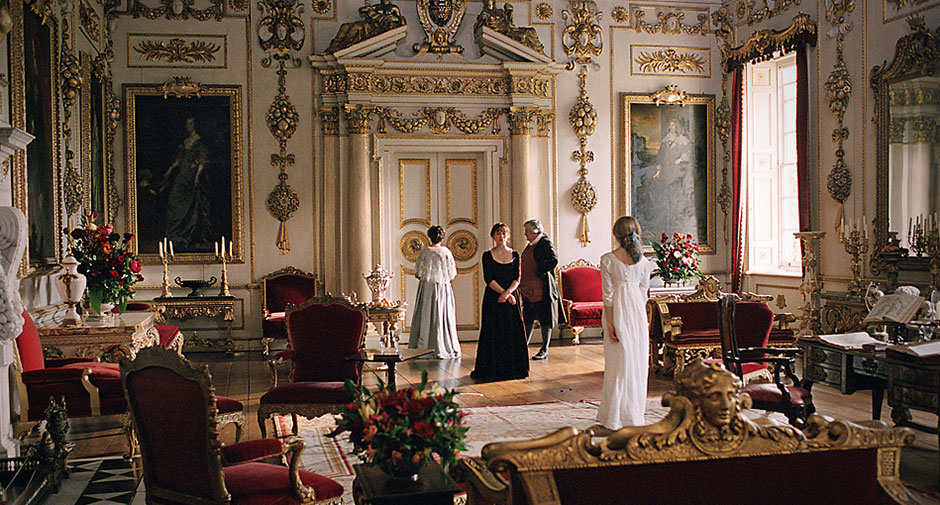
Above, Wilton’s Double Cube Room plays Buckingham Palace in episodes of The Crown on Netflix. Below, it doubles for Pemberley in the 2005 version of Pride and Prejudice.

Pride and Prejudice, 2005

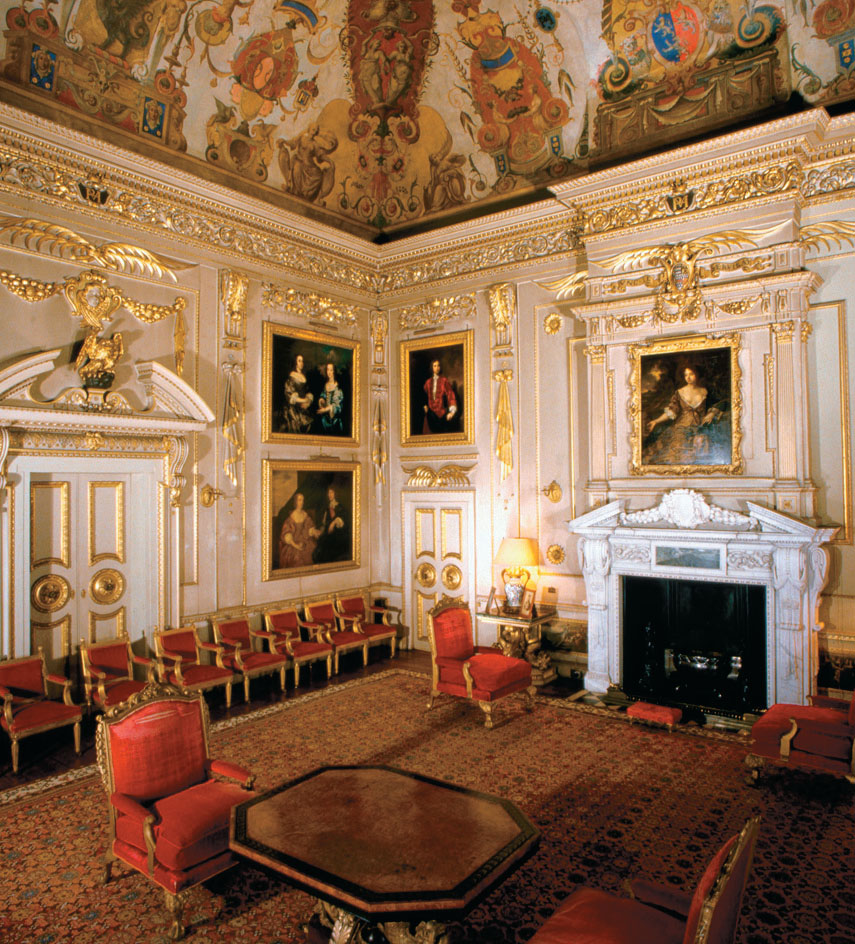
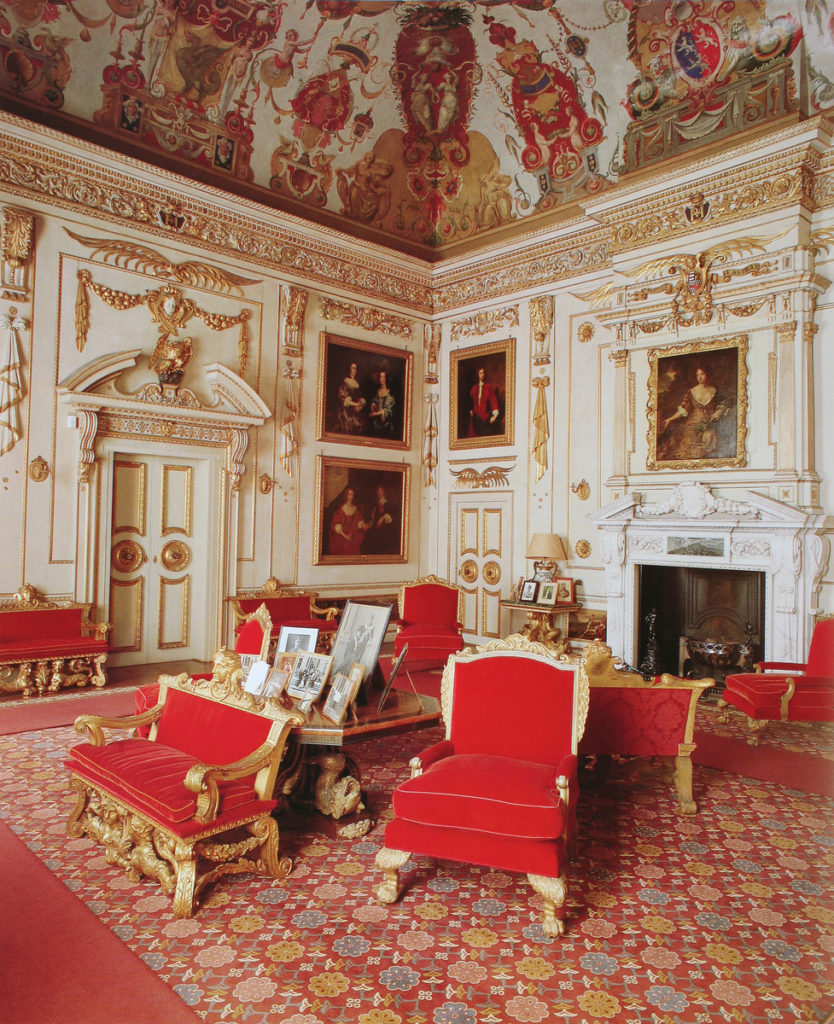
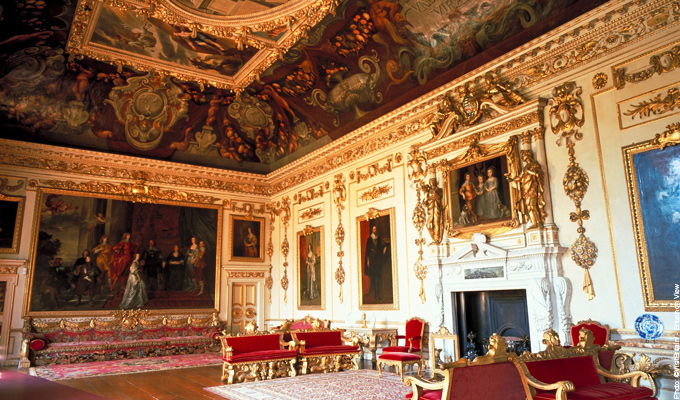
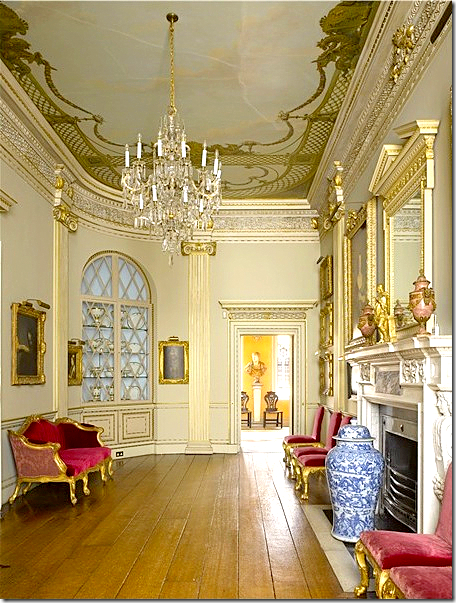
Although there is dispute over how much of the south wing of Wilton House can be attributed to Inigo Jones (1573-1652), we know that the Double Cube Room and the Single Cube Room along with the other state rooms were finished by John Webb (1611-1672) in the mid-17th century. Various changes have been made over the years, but the earls and countesses have maintained most of the magnificence designed by Jones and Webb. Below, two views of The Single Cube Room, 30x30x30 feet in dimension, a perfect cube.

Single Cube Room

The Double- and Single-Cube Rooms were part of the State Rooms in which the monarch was to visit and mingle with Lord Pembroke, his family, friends, and retainers. The Single Cube Room, below, was the first of the State Rooms and led into the Double Cube. The furniture is by Chippendale, added in the 18th century. Above, the Single Cube Room, 30 x 30 x 30 feet.

Single Cube Room

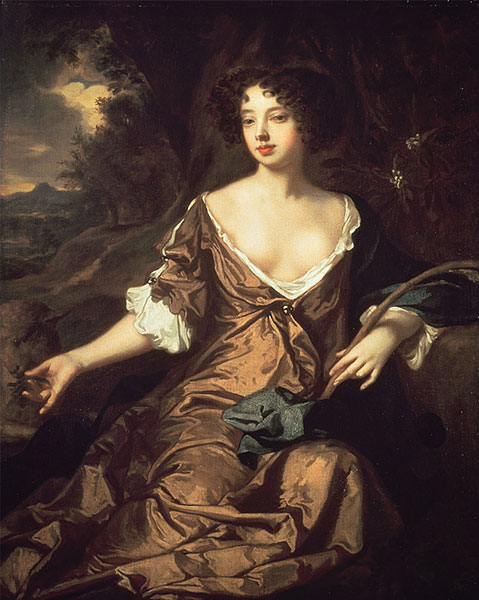
The portrait over the fireplace is Henriette de Querouaille, Countess of Pembroke, wife of Philip, 7th Earl, and sister of Louise, mistress of Charles II and mother of the 1st Duke of Richmond. The portrait was painted by Sir Peter Lely (1618-1680).

Sir Peter Lely, artist

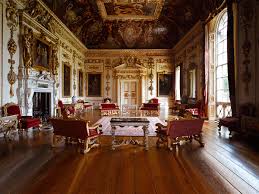
The Double Cube Room, below, is the size of two 30-foot cubes, a technique Inigo Jones used in several buildings. Much of the furniture in the two rooms is by William Kent or Thomas Chippendale.

Double Cube Room

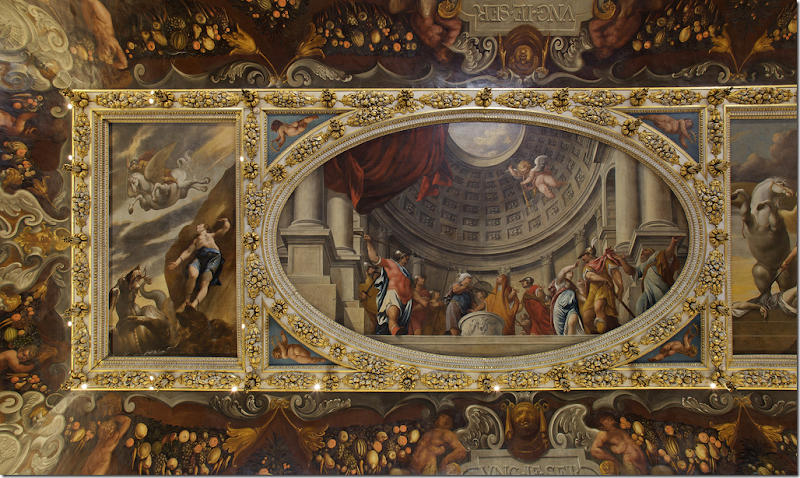
The Double Cube Room, originally called The King’s Great Room, is sixty feet long by thirty feet wide and thirty feet high. The magnificence of the room defies description! The ceiling decoration is clearly in the baroque style.

The central ceiling panels show three views of the legend of Perseus painted by Emmanuel de Critz. The twelve-foot coving was decorated with swags, urns, and putti by Edward Pierce, a frequent collaborator with Architect Inigo Jones. They are dated c.1653

Double Cube Room

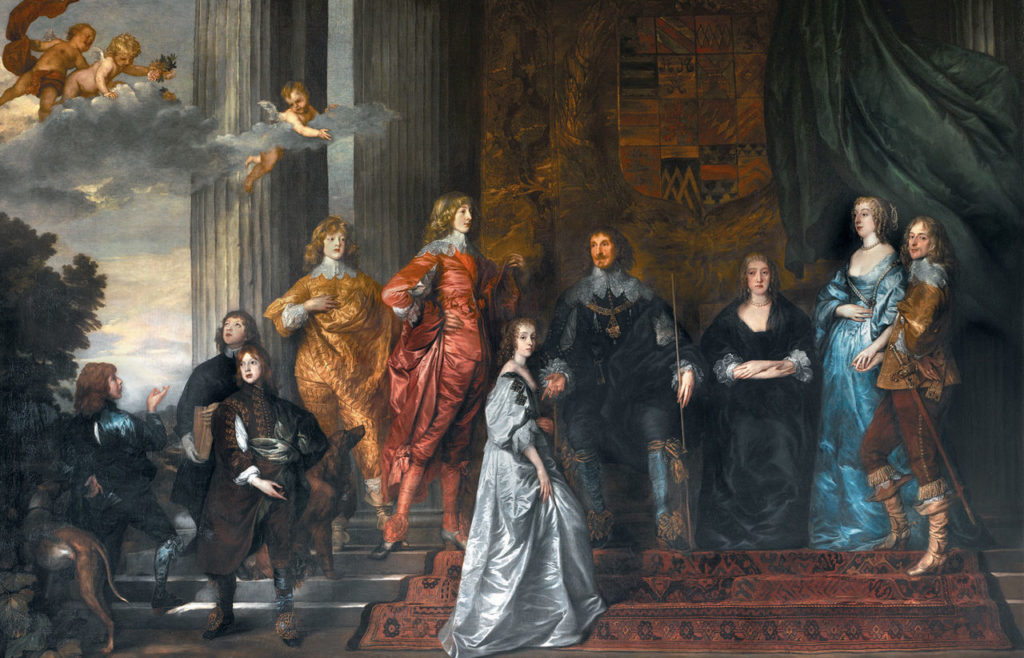
Below, the painting for which the room was designed, the magnificent family portrait, c. 1635, by Anthony Van Dyck of the 4th Earl of Pembroke and his family which hangs at one end of the Double Cube Rooms. At 17 feet wide, it is the largest portrait by Van Dyck (1599-1641) in England. Numerous other portraits by Van Dyck and his studio adorn the walls.

Van Dyck

The State Rooms served as Allied headquarters during World War II; the D-Day landing in Normandy was planned here.

Below, the Great Ante Room, added in the 18th century, is sometimes thought of as James Wyatt’s homage to Inigo Jones.

Great Ante Room

The King’s Bed Chamber and King’s Closet were redecorated in the 18th c. for the visit of George III and Queen Charlotte in 1778. Many priceless masterworks hang on the walls.

The house is replete with great works of art in multiple media. Many members of the Herbert family, the Earls of Pembroke, were avid collectors.

Rembrandt

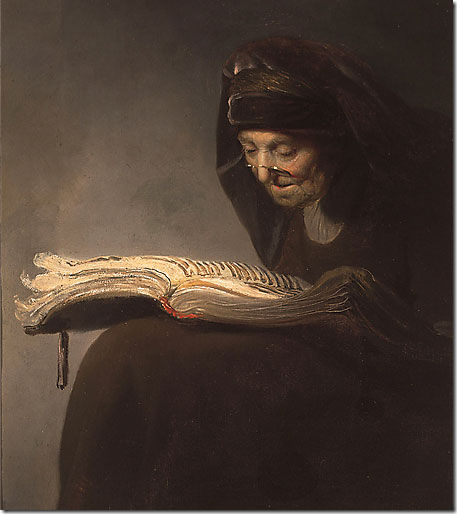
Above,  Mother Reading, c. 1629, by  Rembrandt van Rijn  (1606-1669), is one of the most famous paintings in the collection of Wilton House.

Shakespeare

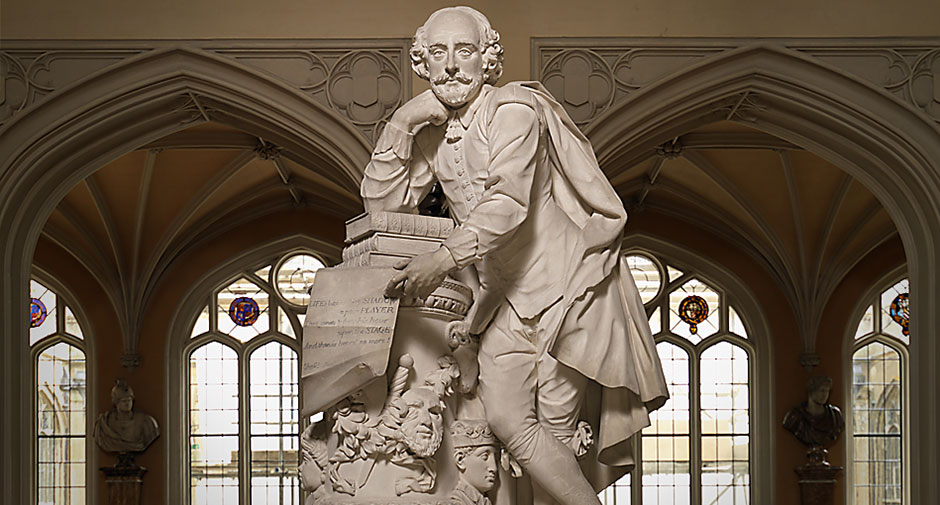
At the currently-used entrance on the North Front, visitors arrive in the Front Hall designed by James Wyatt in 1809. Who better to greet us than The Bard himself. According to the Guidebook, the statue “recalls the 2nd Earl’s and his wife Mary Sidney’s patronage of literary men and of Shakespeare above all.”

Smoking Room

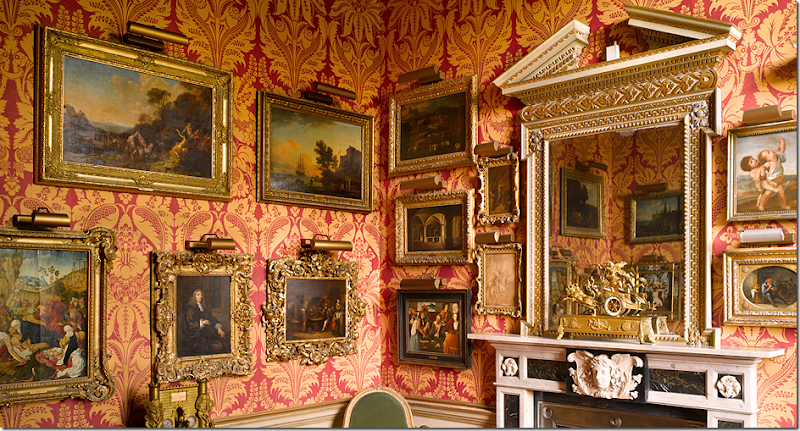
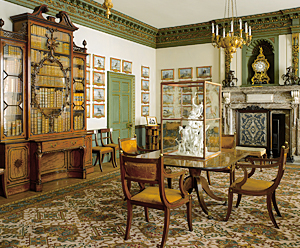
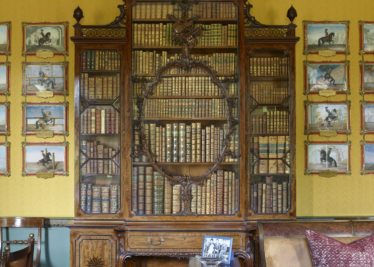
Numerous other rooms, more than one could count, are worthy of attention. I particularly liked the Large Smoking Room, redecorated by the current Lady Pembroke in 2017. The picture above was taken before the new color scheme was installed. Below is the yellow moiréed silk now on the walls. The huge bookcase, from the workshops of Chippendale, is a temptation I could hardly survive. What is tucked away inside? Imagine how much work you could get done here — once you had examined the art and furniture and gazed out the windows for a month or two!

Chippendale Bookcase
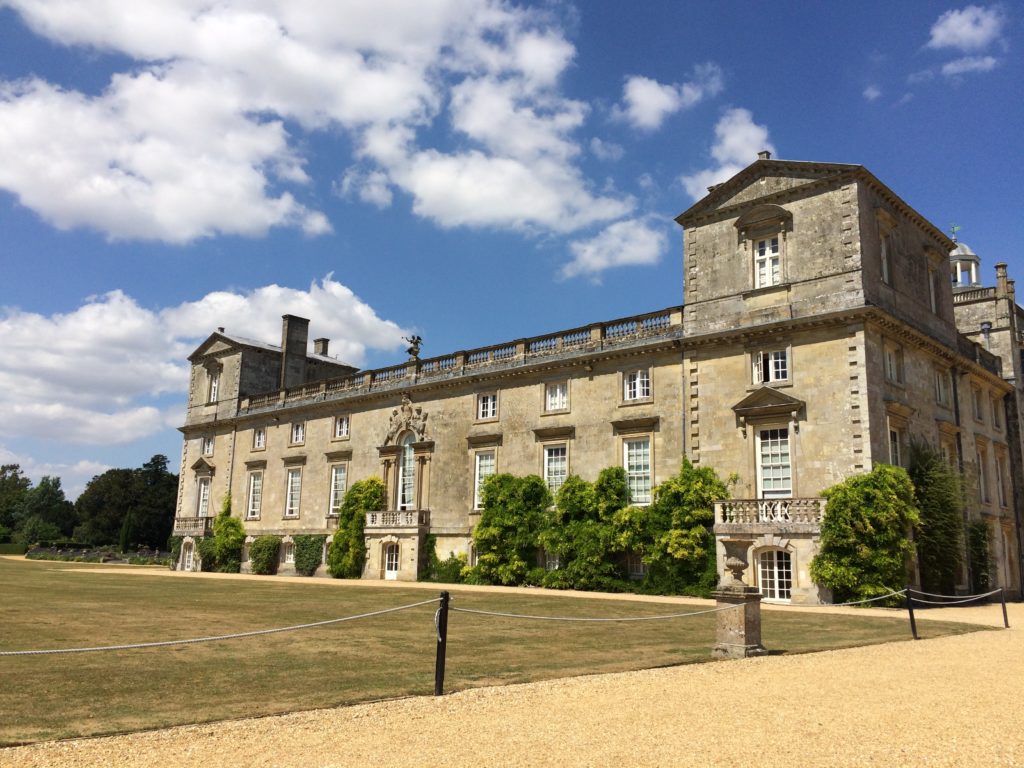
South Front

I have visited Wilton House several times, but I will never get enough of this wonderful house and grounds…on the edge of the city of Salisbury in Wiltshire.

If you’d like to see some of England’s stately homes in person, visit our Number One London Tours site to see all of our upcoming country house tours and their itineraries. 


OFF TO CHICHESTER

Our last Wellington archive was located at the Public Record Office in Chichester, West Sussex, where Vicky and I had rented the cozy cottage above.

The cottage was full of charming period details, including the period staircase. You’ll understand why we left our bags on the ground floor for the duration of our stay.

But there was plenty of room outside, as the town of Chichester was literally on our doorstep and the George and Dragon Inn, above, literally around the corner. We both agreed that it looked like the perfect place in which to have lunch.

   Vicky opted for the pie of the day.

And I ordered the ploughman’s lunch. We both had a Pimm’s.

After lunch, we decided that it would be a good idea to explore the historic town and so we set off down the High Street.

The Dolphin Hotel has been a local landmark since 1910, when two neighbouring inns, the Dolphin (1649) and the Anchor (1768) were combined.

Eventually, we arrived at Chichester Cathedral. Construction on the Cathedral was begun in 1075 and it was completed and consecrated in 1108.

As evident in the photos above, the Cathedral contains much of architectural and artistic interest, but what brought us up short was the monument below –

William Huskisson! Who knew?

And nearby, the memorial to his wife, Eliza Emily.

Also a memorial to Sir George Murray, whose Blue Plaque we saw on the High Street earlier.

Next morning, after a cozy night’s sleep, Vicky and I took about twenty steps outside our cottage door to The Exclusive Cake Shop & Vintage Tea Room, where we indulged in scones, a latte (Vicky) and a marshmallow laden hot chocolate (me). Afterwards it was off to the archives for a day of Wellington research.


Would you like to experience travel in England first-hand?
Visit our website for a list of upcoming Number One London Tours.