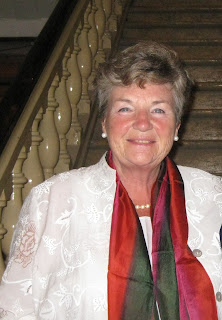
A Jane Digby Post by Guest Blogger Mary S. Lovell


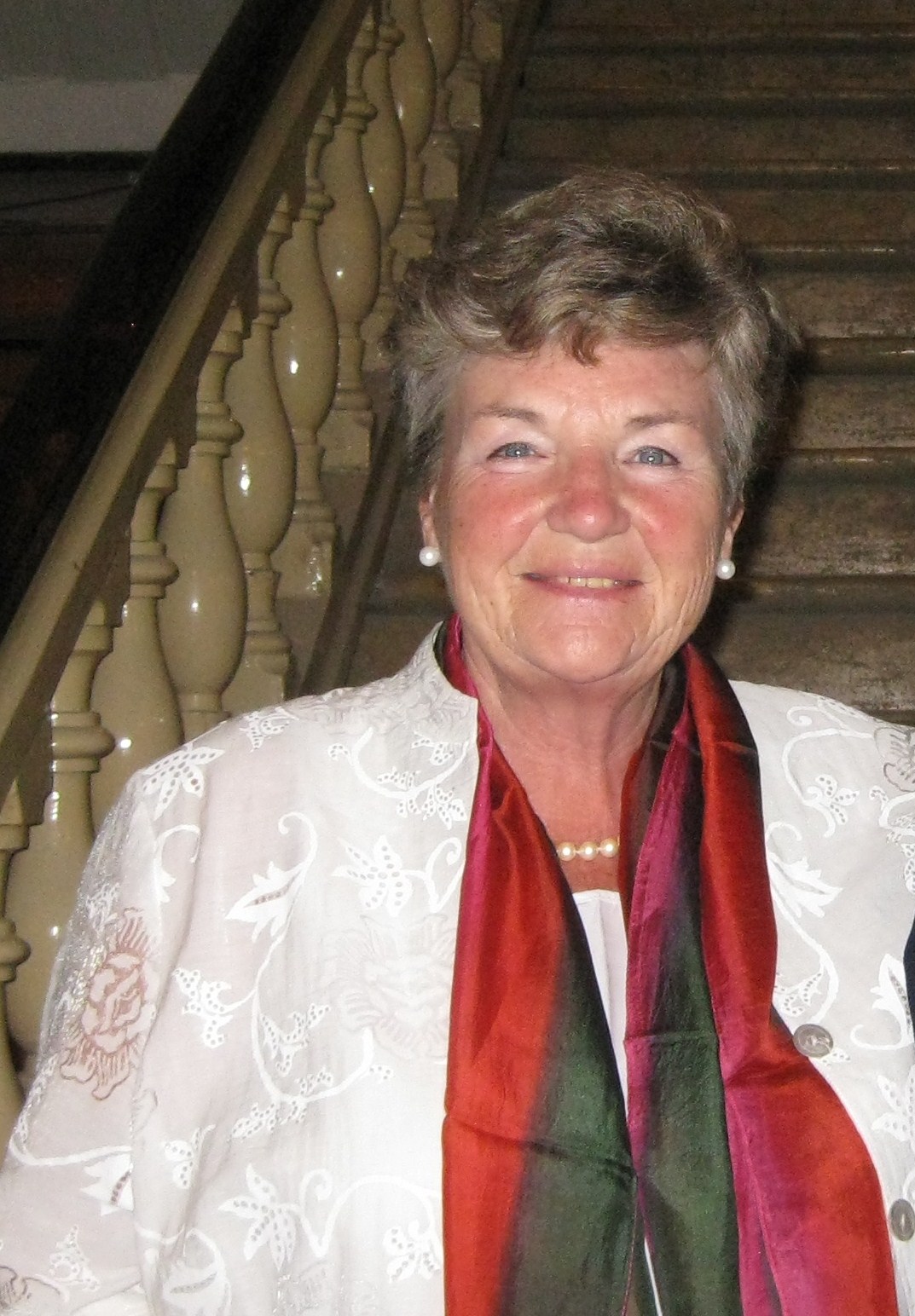
Author Mary S. Lovell


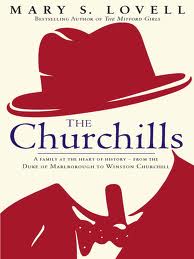
Recently, Victoria did a post on Jane Digby, the 19th century English adventuress, about which author Mary S. Lovell, Jane’s biographer, sent us an email. We were delighted that Mary had found us via this blog. Mary is the author of many notable biographies: Bess of Hardwick, Beryl Markham, the Mitford Sisters, and Amelia Earhart. Her latest book, The Churchills: A Family at the Heart of History, will be released this month in the UK and in May in the US. You can read an in-depth review of the book that appeared in The Guardian here.


You can visit Mary’s website here for news and information about all of her biographies. We were thrilled when Mary agreed to do a guest post for us on her own travels to Syria and along Jane’s own path.
 

Mary writes:

I was fascinated to see your website marking Jane Digby’s birthday last week, in which you also refer to the current situation in Syria.

When I began researching my biography of Jane in 1992 I went to Syria to track down her grave, and her house in Damascus (which I had been told had been demolished). The same source insisted that her diaries had been burned, but when some diligent research had turned those up intact, I decided I wanted to see the site of the demolished house for myself. It wasn’t easy in those days to visit Syria; it was a closed country and tourism was unknown, so I had to describe myself as an amateur archaeologist to obtain a visa. I not only found the grave, but – with the help of my fantastic young guide and interpreter, Hussein Hinnawi – located what survived of Jane’s house as well. It was then divided into flats the main part lived in by an old man whose parents bought it from Jane’s stepson in the ‘30s.


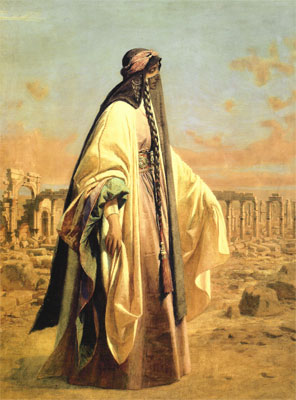
Lady Jane Digby El Mezrab
By Carl Haag 1862
copyright Tareq Rajab Museum

That first visit, soon after the Russians pulled out, was enough to make me fall in love with Syria and its friendly, courteous and hospitable people, its amazing historical sites, and – during my annual visits there ever since – I have seen it grow and change out of all recognition. It is the only country in the Middle East, now, that has any remaining traces of the fabulous Arabian Nights.

Until last year 2010, I led small groups to Syria every spring in Jane’s adventurous footsteps, and often we had small adventures of our own. I have now given up leading groups, on the basis that it is as much as I can do to look after myself, but I still make a point of maintaining Jane’s grave. The launch of my new book (The Churchills) in April 2011 means I shall have to travel to Syria later this year, in October in fact, which means I shall be spending my 70th birthday there, in an old palace converted into a lovely hotel, a short walk from the biblical ‘Street called Straight’, and from Jane’s old home.

Jane’s grave (see picture above), which is visited by large numbers of UK tourists now, is in the tiny Protestant Cemetery on the Airport Road. It is kept locked so if you go there you will have to find the Supervisor’s house and give him a tip (baksheesh) of a few dollars to open the gate for you.

You might like to know that several friends of mine are visiting Syria at present and all report no signs of unrest despite what is on TV news. There is clearly a problem there, but if you are sensible and stick to the main areas of interest to visitors I see no reason why you should not still travel there. It would not prevent me.

Although I have written a number of books since my Digby biography, Jane Digby remains my favourite subject for sheer daring and romanticism.

With best wishes from Mary S Lovell

The Art Needlepoint Company Offers Cruise on the Queen Mary 2

The Art Needlepoint Company was founded on the simple idea that art, like good design, should be available to everyone. Their canvasses represent a large variety of artists from nearly all centuries and genres. With a myriad of thread and stitch choices, stitchers can unleash their creativity to make each canvas their own.

Now, stitchers can come together on the Company’s first cruise aboard the Queen Mary 2 sailing from NYC on July 27th 2011 on a six day crossing – a time for unwinding and relaxation and when the weather is most often ideal to travel across the pond. Lorna Bateman, one of England’s better known embroidery and needlepoint instructors will be onboard and there will be technique instruction every day with chances beyond class time to stitch together and learn from one another. A variety of topics will be covered. The cruise vacation will culminate at the Royal School of Needlework in London and for those who wish to stay on for an extra few days, there is a planned a tour of the tapestries at the Victoria and Albert Museum.

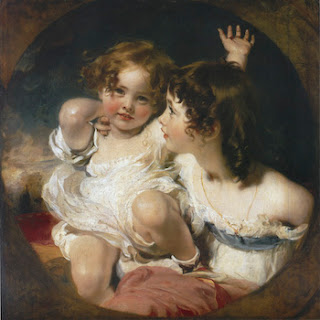
The Calmady Children by Sir Thomas Lawrence

During the cruise, stitchers will learn how to stitch a face, enliven an abstract image with a variety of stitches or give dimension to a landscape by shading with thread. We’ll teach them how to select a masterpiece canvas to match their skill level or learn how and why to select fiber best suited for particular canvases. The Art Needlepoint Company’s cruises and retreats have an educational component to them; both an art history education or cultural review of a particular destination (cruise) as well as an educational component of needlepoint focused on stitches and ways to interpret paintings with threads.

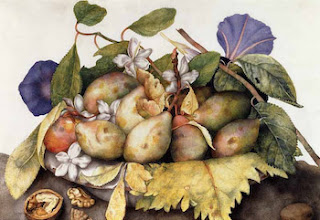
Plums, Walnuts and Jasmine

The QM2 is a trip of a lifetime. The Queen Mary has many beautiful attributes as well as a wide variety of activities available on board for people to do in addition to needlepoint. The ship sets the tone for the experience. It is a gorgeous vessel and we hope that everyone who joins us completes or near to completes a gorgeous canvas! If any one would like more details on what canvases are offered or course syllabus they are welcome to phone or email us. A second cruise is planned for December on The Ruby Princess which travels the Eastern Caribbean – Princess’ private island, St. Martin, St. Thomas, Grand Turk.

In the works for 2011 are several one-two or three day retreats for those who want to share that needlepoint community experience but prefer a shorter, land-based adventure. As Doreen Finkle explains, “To replicate the cruise experience on land, all of our retreats will be based at spas and luxury hotels around the country. For both the cruises and retreats, particpants are welcome to bring a canvas from home. However, we will have a special selection of canvases, keyed to either the cruise or retreat theme, which participants can view and select at the Art Needlepoint site.

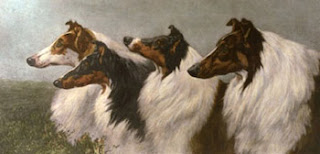
Collies

“This year we are planning a retreat in Raleigh NC . This will be a retreat in the fall. We will have one day at the Raleigh Museum of Art with a specially developed tour of the American painters collection and modern paintings with another day of classes. The canvases we would like people to bring with them to class will be either a portrait (American painter) a landscape (American painter) or a modern canvas. We will discuss how to stitch faces and skin so that they are realistic, as well as other technique points. There will always be a one on one opportunity to ask for specific assistance on whatever the individual requests.

“We also have a retreat planned for the late summer in Boston. We will gather together at the Colonnade Hotel, which is in walking distance to the MFA, Boston where we will have a private specially developed tour of their magnificent newly built Art of the Americas wing. Our class format will follow the day after the tour and will focus on portraits and landscapes. We will talk about techniques for creating light and dark with different threads, as well as rendering realistic faces and skin. There will always be a one on one opportunity to ask for specific assistance on whatever the individual requests.”

For further cruise details, contact Doreen at the Art Needlepoint Company, or by telephone (978) 226-8271.

Followers of Number One London will receive a 10% discount on any canvases or kits purchased.
Use code “London” when placing your order!

Julian Fellowes Writes Titanic Screenplay for ITV

According to The Daily Telegraph, Julian Fellowes has been tapped to write a screenplay about the Titanic disaster to be aired by ITV to mark the centenary of the ship’s sinking. Fellowes, who also penned Downton Abbey, Gosford Park and The Young Victoria, explained that he wants to approach the subject in a different way from James Cameron’s 1997 movie.
He also suggested that he wants to portray the British people on board the ship in a more sympathetic light.
“Far be it for me to buck a Hollywood tradition, but I think that those generalisations [about British people] are not as interesting as real life,” Fellowes said. “Obviously, the special effects of the Cameron version can’t be rivalled on television, but what we can offer, and what we are hoping to offer, is a much more human version of the story.”
He added: “Ours is more a tale of the people on board told from the perspective of the different classes and the crew. We are using real characters and fictional characters, but we develop the real as much as the fictional.”

Perhaps Fellowes’s remarks were prompted by David Warner, who played the villainous manservant in the 1997 Titanic film, who complained that English actors were typecast as the baddies. “There wasn’t a single good character in Titanic who was English, and this is typical,” said the actor.
“Americans who have travelled and who have English friends know we are not necessarily all baddies, but I think that seeing us being so incessantly nasty on screen has a drip, drip, drip effect on the rest of them.”
He added that, with one or two exceptions, heroic English figures were almost always played by non-English actors. “Even Hornblower was played by Gregory Peck. Daniel Craig is a rare English Bond – normally one can expect an Irishman, a Scotsman or even an Australian.”

Warner’s comments echoed those of Dame Helen Mirren. She felt the need to tell an audience in Los Angeles in April: “We’re not the snooty, stuck-up, malevolent, malignant creatures as we’re so often portrayed.”
Dame Helen insisted: “We’re actually kind of cool and hip.”

The latest Titanic adaptation will feature actors Linus Roache and Geraldine Somerville heading a cast that also includes Celia Imrie, Toby Jones and Perdita Weeks. It begins filming in Hungary later this month, made by Bafta-winning producer Nigel Stafford Clark, whose successes have included Bleak House and Warriors.

In Memoriam: The Titanic

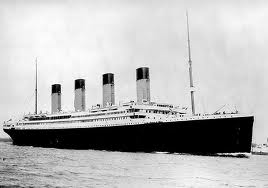
On this, the 99th anniversary of the sinking of the luxury liner Titanic, we have yet another book out on the disaster, but one that promises to be more logical than lurid in it’s approach to the already well churned material surrounding the tragedy.

The latest book is Titanic: Nine Hours to Hell – The Survivor’s Story by W.B. Bartlett. The publishers blurb for the book call it: “A major new history of the disaster that weaves into the narrative the first-hand accounts of those who survived. It was twenty minutes to midnight on Sunday 14 April, when Jack Thayer felt the Titanic lurch to port, a motion followed by the slightest of shocks. Seven-year old Eva Hart barely noticed anything was wrong. For Stoker Fred Barrett, shovelling coal down below, it was somewhat different; the side of the ship where he was working caved in. For the next nine hours, Jack, Eva and Fred faced death and survived. They lived, along with just over 700 others picked up by 08.30 the next morning. Over 1600 people did not. This is the story told through the eyes of Jack, Eva, Fred and over a hundred others of those who survived and either wrote their experiences down or appeared before the major inquiries held subsequently. Drawing extensively on their collective evidence, this book weaves the narrative of the events that occurred in those nine fateful hours. The stories of some are discussed in detail, such as Colonel Gracie, a first-class survivor, and Lawrence Beesley, a schoolteacher, who both wrote lengthy accounts of their experiences. No less fascinating are the accounts of those who gave gripping evidence to the inquiries, people like the controversial Lady Lucille Duff-Gordon, steward John Hart who was responsible for saving the lives of the majority of the third-class passengers who lived, or Charles Joughin, the baker, who owed his survival to whisky. This is their story, and those of a fateful night, when the largest ship ever built sank without completing one successful voyage.”

David Randall, of The Independent, said in his review of the book, “. . . The centenary of the sinking of the Titanic looms, and, with it, the prospect of book after book marking the anniversary. This is, even for mild obsessives of the saga such as myself, not altogether to be welcomed. Our shelves already overflow with volumes about the ship, and we have long since discovered that new books on the subject are liable to be written to prosecute ever more arcane theories. So it was with some foreboding that I opened Mr. Bartlett’s offering. What cock-eyed “revelation” would he be peddling?

“Er, none. Instead, we have here quite the best and most level-headed telling of the whole story I have ever read. What makes it so is not just that Bartlett can, unlike the authors of many Titanic books, actually write; but that he brings to the controversies which still surround the sinking a judicial sense of what constitutes conclusive evidence, and what does not. He makes plain that the recollections of survivors are so varied (and often conflicting) that some of the more bitter controversies (such as the role of the SS Californian, five miles away or 19, depending on whom you believe) are only kept going by taking the word of some and ignoring the testimony of all the rest.”

The Omnipotent Magician: Lancelot 'Capability' Brown 1716-1783 by Jane Brown

Victoria, here. UK magzines, newspapers and blogs have covered the recent publication of a new biography of Lancelot Brown by renowned garden historian and biographer Jane Brown.  John Phibbs in his Country Life review assures us that they are not related. But they certainly could be, for they share a remarkable knowledge of gardens and gardening.  Ms. Brown will be making an appearance at Hay-on-Wye, among other festivals and meetings.  Alas, I will not be able to see her in person.  But I intend to send for the book, which can be ordered in $$ through Amazon.com or direct in pounds from many booksellers.

I looked in vain for an author’s website. Judging from the number of books she has written, I assume she has little time for websites, blogs or social media.  Can’t say I blame her.  One can spend (waste?) hours on Facebook, though I must say I enjoy (almost) every moment I spend writing blog posts.  Below, since I haven’t read it yet, the description of the book from the publisher:

Capability Brown, by Nathaniel Dance
ca.1769   National Portrait Gallery

“Lancelot Brown changed the face of eighteenth-century England, designing country estates and mansions, moving hills and making flowing lakes and serpentine rivers, a magical world of green. This English landscape style spread across Europe and the world. At home, it proved so pleasing that Brown’s influence spread into the lowland landscape at large, and into landscape painting. He stands behind our vision, and fantasy, of rural England.

In this vivid, lively biography, based on detailed research, Jane Brown paints an unforgettable picture of the man, his work, his happy domestic life, and his crowded world. She follows the life of the jovial yet elusive Mr Brown, from his childhood and apprenticeship in rural Northumberland, through his formative years at Stowe, the most famous garden of the day. His innovative ideas, and his affable and generous nature, led to a meteoric rise to a Royal Appointment in 1764 and his clients and friends ranged from statesmen like the elder Pitt to artists and actors like David Garrick. Riding constantly across England, Brown never ceased working until he collapsed and died in February 1783 after visiting one of his oldest clients. He was a practical man but also a visionary, always willing to try something new. As this delightful, and beautifully illustrated biography shows, Brown filled England with enchantment – follies, cascades, lakes, bridges, ornaments, monuments, meadows and woods – creating views that still delight us today.”


I have visited many of the country houses for which Brown created landscapes and though I love to look at them, I always feel my photographs are inadequate to show the sweep and grandeur of the landscape.  It always looks so natural.  Which is, of course, the point.  As some of his contemporaries observed, Brown improved on what God had left a little undone. Though he came from a modest background, Brown advised kings and princes and dukes on how to arrange their estates. And in large part, his vision has remained intact at some of the UK’s most visited gardens, such as Stourhead, Blenheim and Stowe.

Ms. Brown has also written about some gardens we may see only very rarely. From its origins as a mulberry garden in the time of Samuel Pepys, this volume tells the illustrated story of the largest private garden in London, which, from time to time, is open to selected audiences and even concert-attendees.  Hundreds of photos are included of the garden at all times of the year, by photographer Christopher Simon Sykes.

In The Pursuit of Paradise Gardening, published in 2000, Ms. Brown takes the broadest possible approach. ‘The most enchanting, erudite and thought-provoking book on the subject to be published for many years’ wrote Amanda Craig, in  the Independent on Sunday when it first came out.  Ruth Gorb, in the Guardian, wrote ‘Be warned. This is a rich brew, not to be taken in one gulp. Gardening in this book encompasses science and history, philosophy and art, literature and the military, politics and sex… it is all tremendous fun.’

Jane Brown  writes about contemporary gardens too. This 2001 volume has been widely praised.
< div style="clear: both; text-align: center;">

Tales of the Rose Tree: Ravishing Rhododendrons And Their Travels Around the World, out in 2009, tells the story of how cultivation of these magnificent plants, which have more than a thousand variations, have spread around the globe.  Anyone who has had the privilege of walking through a garden filled with rhododenrons in full bloom will be eager to find out more about this adaptable favorite.

Above is one of snaps I took at Bowood in Wiltshire of their extensive rhodenron gardens in May 2009. It was a perfect fairyland and we wandered for hours.

Finally, before I run out of enthusiastic adjectives to describe the wonderful books of Jane Brown, I will mention her biographies of Vita Sackville-West as a gardener and her enchanting garden at Sissinghurst.  I can see I have a lot of reading to do…and pictures to enjoy.  Jane Brown’s booklist is longer than I have presented, but I will leave further discoveries to your personal search for now.