Wedding Central

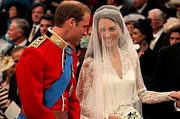
The Duke and Duchess of Cambridge!


Parents host pre-wedding gala at Mandarin Oriental
This is what happiness looks like
(OMG, I’m actually tearing up already)

The Ceremony – minute by minute

The full guest list

Today’s last minute rehearsals in pictures and

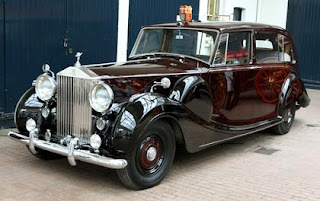
The coach that will carry Wills and Kate after the wedding

Ceremony to include music by composer Paul Mealor

Listen to selections from the wedding music

Recessional music revealed – take a listen


A peek inside Kate’s suite at The Goring

An essential guide to the RW

Chelsy Davy to wear TWO Ferretti’s

Ellie Goulding to perform at reception

Details about the Royal after party at the Palace

Dame Edna gives Piers Morgan some Royal insights

Download Will and Kate masks here

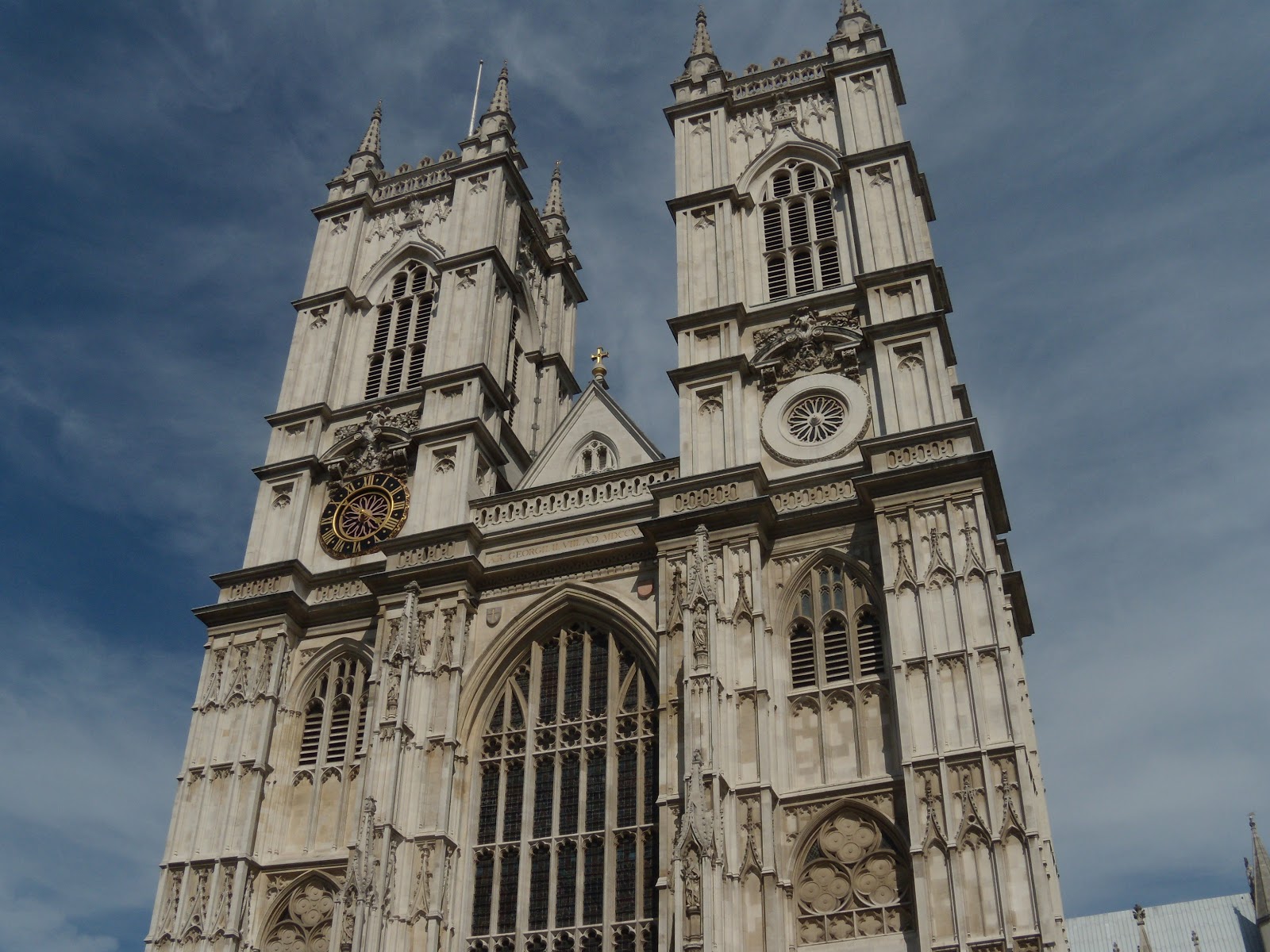
Westminster Abbey, Royal Connections

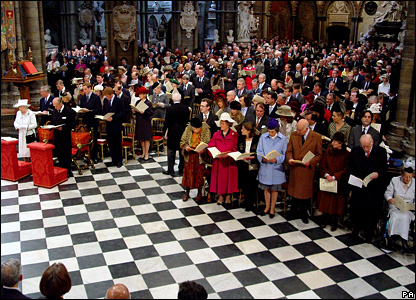
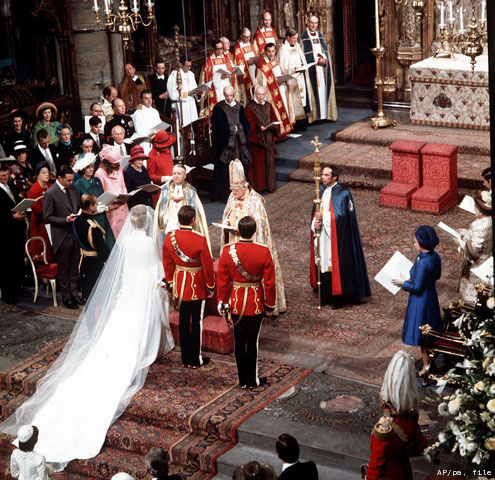
Westminster Abbey was founded in 960 and is the tallest medieval church in the country, reaching 102ft at the highest point of the nave; and its facade is the tallest of any English church, at 225ft. As the site of coronations since William the Conqueror in 1066, Westminster Abbey is closely associated with royalty throughout history.  According to the Abbey’s website, it has also been the venue for fifteen royal weddings, about to be sixteen.  And since we love nothing more than tickling our “Fun with Wills and Kate” itch, here are some spectacular pictures of royal weddings at the Abbey from the past.
On November 20, 1947, Princess Elizabeth (later Queen Elizabeth II) married Prince Philip of Greece, who was made Duke of Edinburgh. They were the tenth royal couple to marry at the Abbey. Their wedding was broadcast by radio to the world. Rationing was still in effect and wartime austerity continued, so the wedding was a time for great national celebration.


In 2007, Queen Elizabeth and Prince Philip celebrated their 60th wedding anniversary at a special ceremony in the Abbey.  She is the first ever English monarch to achieve a diamond wedding celebration. in 2012, the Queen will observe her Diamond Jubilee, the 60th anniversary of her accession to the throne.

The Queen’s sister Princess Margaret Rose (1930-2002) wed Anthony Armstrong-Jones in the Abbey on May 6, 1960.  After two children, their marriage ended in divorce in 1978.

The Queen’s only daughter, Anne, Princess Royal, married  Captain Mark Phillips in Westminster Abbey on November 14, 1973.  They have two children.


After divorcing Phillips in 1992, Anne married Timothy Laurence, in Scotland on December 12, 1992.

Prince Andrew married Sarah Ferguson on July 1986, They became the duke and duchess of York. They have two daughters, but separated in 1992 and divorced four years later.


We are awaiting the big day on Friday, April 29, for the next royal wedding at Westminster Abbey.

This Friday, the Abbey’s 10 bells will ring out as William and Kate leave the royal wedding service. Westminster Abbey’s bells only give a full peal on important royal or national occasions. It was sounded on the day of the Queen Mother’s 100th birthday – August 4 2001 – and rung half muffled less than a year later after her funeral on April 9 2002. The 50th anniversary of the Second World War milestone V-E Day was commemorated by the bells in May 1995. Note: A full peal features a minimum of 5,000 different changes (or sequences) and lasts more than three hours.
Watch an interview with the royal florists, who will be creating an Avenue of Trees within the Abbey and using flowers from Windsor Great Park.
Read the latest story on how florists are currently transforming the Abbey into a Fairytale Forest.

Partying with Jane Austen

Yesterday I wrote about Jane Austen in London correcting proofs for Sense and Sensibility. She wrote her letter of April 25, 1811, to her sister Cassandra who was staying at Godmersham in Kent, their brother Edward’s estate.  Jane reports on the musical party given by her hosts in Sloane Street, her brother Henry and his wife Eliza, the former Comtesse de Feuillide. 
“Our party went off extremely well. There were many solicitudes, alarms, and vexations, beforehand, of course, but at last everything was quite right. The rooms were dressed up with flowers, and looked very pretty. A glass for the mantlepiece was lent by the man who is making their own. Mr. Egerton and Mr. Walter came at half-past five, and the festivities began with a pair of very fine soals.
Yes, Mr. Walter — for he postponed his leaving London on purpose — which did not give much pleasure at the time, any more than the circumstance from which it rose — his calling on Sunday and being asked by Henry to take the family dinner on that day, which he did; but it is all smoothed over now, and she likes him very well….”
Sloane Street today is a busy thoroughfare but in Jane Austen’s day, it was on the edge of town, a newly developed residential  area.  In her letter to her sister Cassandra of April 18 , 1811, she mentioned that she and her sister-in-law Eliza would “walk to London” to buy decorations for Eliza’s musical party. On April 25, she went on:
“At half-past seven arrived the musicians in two hackney coaches, and by eight the lordly company began to appear. Among the earliest were George and Mary Cooke, and I spent the greater part of the evening very pleasantly with them. The drawing-room being soon hotter than we liked, we placed ourselves in the connecting passage, which was comparatively cool, and gave us all the advantage of the music at a pleasant distance, as well as that of the first view of every new comer.
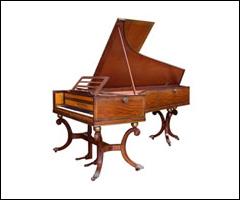
Finchcocks Musical Museum Collection

I was quite surrounded by acquaintance, especially gentlemen; and what with Mr. Hampson, Mr. Seymour, Mr. W. Knatchbull, Mr. Guillemarde, Mr. Cure, a Captain Simpson, brother to the Captain Simpson, besides Mr. Walter and Mr. Egerton, in addition to the Cookes, and Miss Beckford, and Miss Middleton, I had quite as much upon my hands as I could do.
Poor Miss B. has been suffering again from her old complaint, and looks thinner than ever. She certainly goes to Cheltenham the beginning of June. We were all delight and cordiality of course. Miss M. seems very happy, but has not beauty enough to figure in London.

Including everybody we were sixty-six — which was considerably more than Eliza had expected, and quite enough to fill the back drawing-room and leave a few to be scattered about in the other and in the passage.

Finchcocks Musical Museum concert

The music was extremely good. It opened (tell Fanny) with “Prike pe Parp pin praise pof Prapela”*; and of the other glees I remember, “In peace love tunes,” “Rosabelle,” “The Red Cross Knight,” and “Poor Insect.” Between the songs were lessons on the harp, or harp and pianoforte together; and the harp-player was Wiepart, whose name seems famous, though new to me. There was one female singer, a short Miss Davis, all in blue, bringing up for the public line, whose voice was said to be very fine indeed; and all the performers gave great satisfaction by doing what they were paid for, and giving themselves no airs. No amateur could be persuaded to do anything.
The house was not clear till after twelve. If you wish to hear more of it, you must put your questions, but I seem rather to have exhausted than spared the subject….

* Jane Austen and her niece Fanny, according to Deirdre Le Faye, had a nonsense vocabulary formed by putting the letter P in front of every word. The chorus words are actually, “Stike the Harp in Praise of Bragela.”
More information on the songs mentioned can be found in the notes to Letter 71 in LaFaye’s Jane Austen’s Letters. In the Biogrphical Index, there is material on several of the people mentioned, some old  friends of the Austen family.
Now you know what music to have at your next Jane Austen Musical Evening.  To see more about Finchcocks Musical Museum, click here.

Jane Austen: Sense and Sensibility

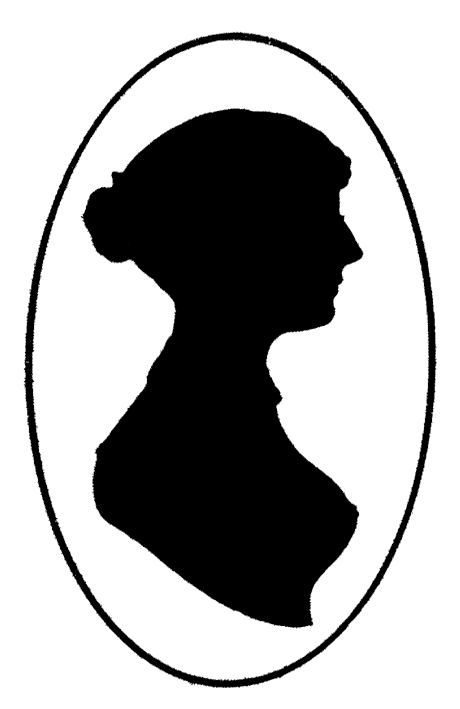
Jane Austen (1775-1817) wrote to her sister Cassandra on Thursday, April 25, 1811, from Sloane Street, London, where she was staying with her brother Henry and his wife Eliza, the former Comtesse de Feuillide. Jane was in London to correct proof pages for the publication of her first novel, Sense and Sensibility. Cassandra was at their brother Edward’s estate at Godmersham, Kent.

Jane writes to her sister Cassandra of an assortment of subjects. Then she writes:
      “No, indeed, I am never to busy to think of S. and S. I can no more forget it than a mother can forget her sucking child; and I am much obliged to you for your inquiries. I have had two sheets to correct, but the last only brings us to Willoughby’s first appearance.  Mrs. K. regrets in the most flattering manner that she must wait till May, but I have scarcely a hope of its being out in June. Henry does not neglect it; he has hurried the printer, and says he will see him again to-day. It will not stand still during his absence, it will be sent to Eliza.

 “The Incomes remain as they were, but I will get them altered if I can. I am very much gratified by Mrs. K’s interest in it; and whatever may be the event of it as to my credit with her, sincerely wish her curiosity could be satisfied sooner than is now probable. I think she will like my Elinor, but cannot build on anything else…”

The Mrs. K. referred to in Austen’s letter was Mrs. Catherine Knight, nee. Knatchbull. She and her husband Thomas “adopted” Jane’s brother Edward and treated him as their own son, sending him on a grand tour of Europe and leaving him their property. Indeed a few years after her husband died in 1794, Mrs. Knight passed on the two estates of Godmersham in Kent and Chawton in Hampshire to Edward.  Godmersham is today in private hands, but the Chawton property now is the home of the Chawton House Library and the Jane Austen House Museum, both well worth visiting on your next jaunt to Hampshire.  The picture to the left is a portrait of Catherine Knatchbull Knight  about the time of her marriage in 1779.
For a closer look at the relationship of Jane Austen and Mrs. Knight, take a look at AustenBlog’s comments.

Jane’s suspicion that the novel would not be available even in June was prescient.


Sense and Sensibility was finally published 30 October, 1811.

In the Garden With Kristine

Yesterday, I had just come in from a few sweaty hours out in the garden to find a new post on Margaret Evans Porter’s blog, Periodic Pearls, showing her latest snowfall photos – just after she’d done some spring planting. Here in Southwest Florida (otherwise known as “the Sauna”) it’s already reaching 90 during the day. My garden is glorious and blooming and I thought I’d share some of my own snaps with you. I do not do this to boast, but rather to showcase the garden before everything that blooms and flowers withers away in the Zone 10 heat. Honestly, it’s enough to make Lawrence of Arabia faint.

Yes, that’s English lavender, doing quite well . . . . so far. Mexican petunia’s grow against the fence. All of the rocks you see were unearthed by moi whilst planting. There’s no real soil here, just lots of sandy dirt and many, many rocks. Sigh.

The Impatiens began as potted plants and now propagate themselves willy-nilly throughout my garden, back and front. I am not complaining.

Succulents, needless to say, do well in our climate
When I first began the garden, I’d bring home pots of lovely plants that would have suited an English garden, only to have them burned to a crisp. This year, I’ve admitted defeat and have given over the garden to tropical flowers.
These Daisy’s began as weeds. I finally stopped fighting them
 and now the bees have a new home.
Pentas + sun + poor soil = success
The Plumbago is in bloom
Even the roses are doing well
These are old English Heirloom Roses that I received through the post three years ago. Until this year, it looked like a rather sickly, snakey single shoot. Now, however, it’s gone crazy and is climbing the fence, blooming and throwing out many thick shoots at its base. I can’t tell you the exact name of the rose, as I threw the tag out in disgust last year. Patience is not one of my virtues.

A kind friend gave me two Frangipani’s two years ago. He cut branches from his trees and told me to just stick them in the ground and they’d grow. One is yellow, the other pink. The pink, above, has never flowered, but it’s gotten taller and has leaves. For a long time, both looked like nothing more than naked stalks stuck in the ground. My husband and son called them my “phallic symbols.” However, she who laughs last laughs best – the yellow Frangipani has not only gotten taller, it’s flowering.

Their fragrance is delicious – ripe nectarines.

Happy Easter!