 |
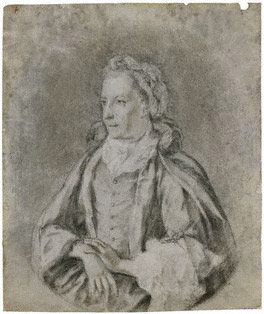
| Copyright National Portrait Gallery |
Elizabeth Vesey was the daughter of Sir Thomas Vesey, Bishop of Ossory. She first married William Handcock and then Agmondisham Vesey, M.P., Accountant-General of Ireland. She was one of the Bluestocking Circle, along with Mrs. Elizabeth Montagu, Elizabeth Carter and Fanny Burney. The following excerpt refers to the botanist Benjamin Stillingfleet (1702-71), who was welcomed at one of Elizabeth Montagu’s salons even though he had arrived absent-mindedly wearing the blue woollen stockings normally worn by working men, instead of the more formal white silk, hence another theory on how the term “blue stocking” was coined.
From Mrs. Montagu by R. Huchon
. . . . Stillingfleet had taken refuge in the cultivation of his garden, which gave him health, and in the study of botany and harmony, which procured him some pleasure. He was often seen at Bath or about town, doubtless stooping in his gait and plunged in his mildly pessimistic thoughts. His accomplishments as a scholar and a wit made him a favourite with Mrs Montagu and the other learned ladies. One day, about 1750, he was at Bath, and received an invitation to “a literary meeting at Mrs Vesey’s.” He “declined to accept it,” Mme d’Arblay informs us, “from not being, he said, in the habit of displaying a proper equipment for an evening assembly. ‘Pho, pho” cried Mrs Vesey, with her wellknown, yet always original simplicity, while she looked inquisitively at him and his accoutrement, “don’t mind dress! Come in your blue stockings!” With which words, humorously repeating them as he entered the apartment of the chosen coterie, Mr Stillingfleet claimed permission to appear according to order. And those words ever after were fixed in playful stigma upon Mrs Vesey’s associations.” It seems a confirmation of this account that, on 13th November 1756, a friend of Mrs Montagu’s should write to her that “Monsey,” the physician of Chelsea Hospital, “swears he will make out some story of you and Stillingfleet before you are much older; you shall not keep blew stockings at Sandleford for nothing.” And Mrs Montagu herself, in the following March, having mentioned Stillingfleet in a letter to Monsey, said of him: “I assure you our old philosopher is so much a man of pleasure, he has left off his old friends and his blue stockings, and is at operas and other gay assemblies every night.” Stillingfleet and his “blue stockings” there-fore became interchangeable terms among his acquaintances. As Boswell observes : “Such was the excellence of his conversation, that his absence was felt as so great a loss that it used to be said: We can do nothing without the blue stockings; and thus by degrees the title was established.” Wherever Stillingfleet appeared, there were the Blue Stockings. By a very natural process, the name extended from Mrs Vesey’s parties to those of Mrs Montagu and others. It even crossed the Channel at the end of the century.
 |
| Benjamin Stillingfleet |
Since the institution and its ” title” in all probability originated with Mrs Vesey, it would be unjust to pass her over in silence. She formed a strong contrast with Mrs . Montagu in her disposition and manners. She seemed “of imagination all compact,” and her friends had affectionately nicknamed her “the Sylph,” for, like an “etherial” being, she lived and thought “in a world of her own.” In her actual work-a-day life she was none too happy. Fondly attached to her second husband, Agmondesham Vesey, of Lucan, near Dublin, “for many years a member of the Irish House of Commons and Comptroller and Accountant-General for Ireland,” she had not succeeded in fixing his affections. “He has many amiable qualities,” Mrs Carter said in 1774, “and would have many more if he formed his standard of action from his own mind, for I am inclined to think he is not vicious so much from inclination as from the example of the world. If it was a fashionable thing for wits and scholars and lord – lieutenants and other distinguished personages to be true to their wives, probably our friend would not have found him an unfaithful husband.” This disappointment had doubtless enhanced Mrs Vesey’s flightiness and her dissatisfaction with the things of this world: “She scarcely ever enjoys any one object,” Mrs Carter wrote to Mrs Montagu, “from the apprehension that something better may possibly be found in another. It is really astonishing to see how this restless pursuit counteracts all the feelings of her amiable and affectionate heart. There are few things, I believe, that she loves like you and me; yet, when she is with us, she finds that you and I, not being absolute divinities, have no power of bestowing perfect happiness, and so from us she flies away, to try if it is to be met with at an assembly or an opera.”1 Ever ingenious at difficulties and little distresses, she lived in “a perpetual forecast of disappointment.” One day she fancied that she was losing her senses, or else she felt her memory going and her power of expressing herself decreasing. The joys of friendship were spoilt for her by the bitter thought of their transitoriness. “Is it reasonable,” Mrs Carter exclaimed on reading her complaints, “to wish to reject the possession of any real good, merely because it may happen not to be a perpetuity?” She had “a mind formed for doubt,” she said of herself, and her bias towards scepticism, though undecided, alarmed her pious friends by its intermittent recurrence.
. . . . Her fears were so great of the horror, as it was styled, of a circle, from the ceremony and awe which it produced, that she pushed all the small sofas, as well as chairs, pell mell about the apartments, so as not to leave even a zigzag path of communication free from impediment: and her greatest delight was to place the seats back to back, so that those who occupied them could perceive no more of their nearest neighbour than if the parties had been sent into different rooms: an arrangement that could only be eluded by such a twisting of the neck as to threaten the interlocutors with a spasmodic affection.
But what most contributed to render the scenes of her social circle nearly dramatic in comic effect, was her deafness. . . . She had commonly two or three or more ear-trumpets hanging to her wrists, or slung about her neck, or tost upon the chimney-piece or table. The instant that any earnestness of countenance or animation of gesture struck her eye, she darted forward trumpet in hand to inquire what was going on, but almost always arrived at the speaker at the moment that he was become, in his turn, the hearer. And after quietly listening some minutes, she would gently utter her disappointment by crying: ‘ Well, I really thought you were talking of something.’ A
nd then, though a whole group would hold it fitting to flock around her, and recount what had been said, if a smile caught her roving eye from any opposite direction, the fear of losing something more entertaining would make her beg not to trouble them, and again rush on the gayer talkers. But as a laugh is excited more commonly by sportive nonsense than by wit, she usually gleaned nothing from her change of place and hastened therefore back to ask for the rest of what she had interrupted. But generally finding that set dispersing or dispersed, she would look around her with a forlorn surprise and cry: “I can’t conceive why it is that nobody talks to-night. I can’t catch a word.” Yet with all these peculiarities Mrs Vesey was eminently amiable, candid, gentle and even sensible, but she had an ardour to know whatever was going forward and to see whoever was named, that kept her curiosity constantly in a panic, and almost dangerously increased the singular wanderings of her imagination.
Mrs. Vesey died in 1789.