Report from Fort Worth: The JASNA AGM 2011

Victoria here, back from five wonderful days at the Annual General Meeting of the Jane Austen Society of North America, held this year in Ft. Worth, Texas.  Many thanks to all the wonderful volunteers who organized the meeting, led by Dr. Cheryl Kinney and Rosalie Sternberg. 

The topic was, of course, Sense & Sensibility, marking the 200th anniversary of Jane Austen’s first published novel.  The festivities started on Thursday with a few special presentations, including mine on “The Sensible Regency Wedding.”

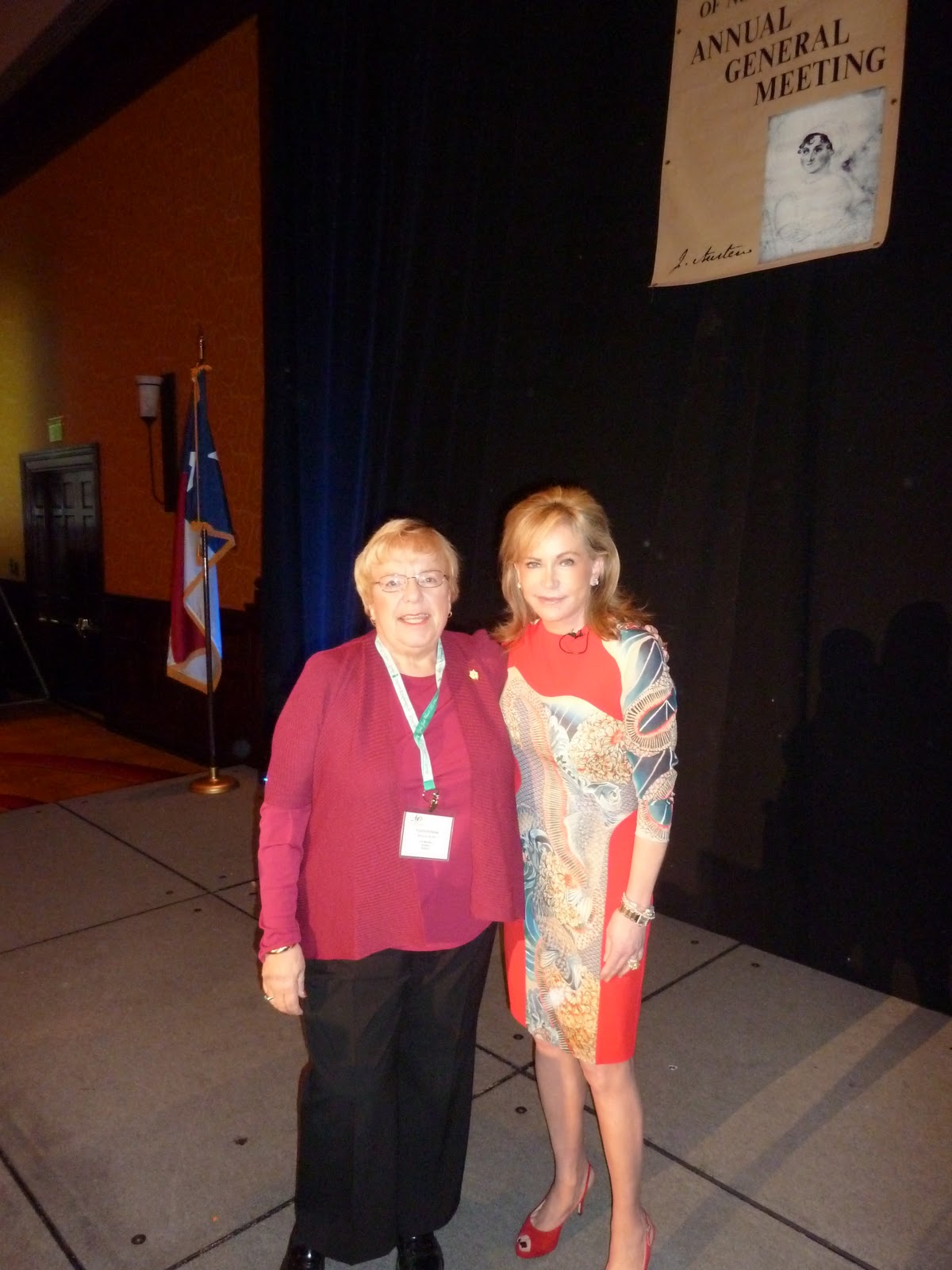
Above, I am posing on the stage with Jinger Heath who spoke on “Regency Cosmetics and Esthetics: A Look to Die For” immediately preceding my talk on Thursday night, October 13. Jinger told the audience about some of the dreadful facial concoctions used by regency-era women to whiten their skin, substances containing lead and other poisons. She also told us how some of their formulas — such as rosewater and various oils — were quite beneficial.

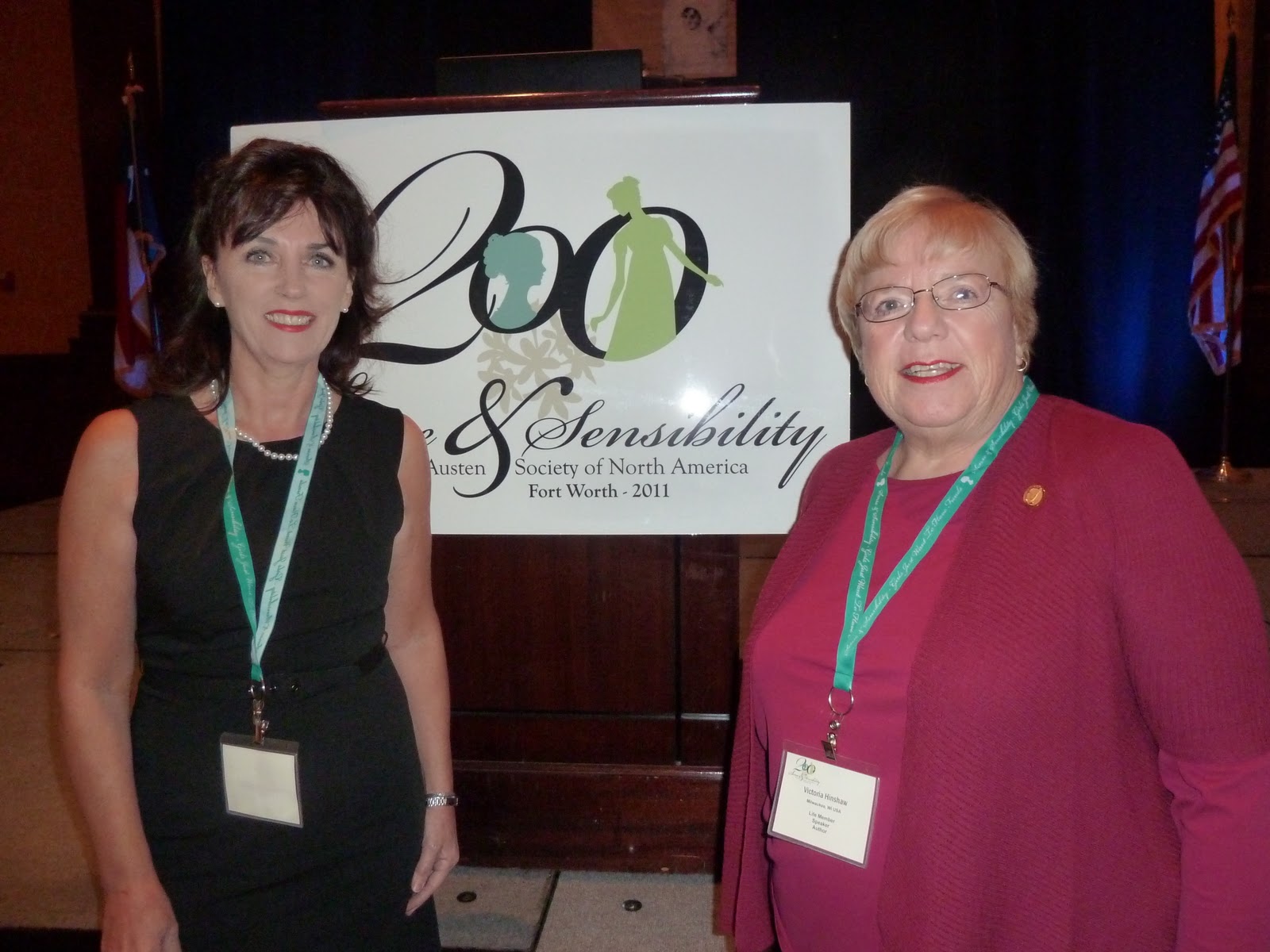
Kathy Yank (left, above) introduced me. Using power point, I talked about the usual simplicity and low-key nature of regency weddings, using particularly the examples of Jane Austen’s niece Anna’s wedding to Ben Lefroy in 1814, as described by Anna’s half-sister Caroline Austen, and Annabella Milbanke’s wedding to Lord Byron in 1815, the latter recounted by John Cam Houbhouse (later Lord Broughton).

I also talked about royal weddings (and one non-wedding of the Prince of Wales to Maria Fitzherbert), including the ceremony that united Princess Charlotte of Wales to Prince Leopold of Saxe-Coburg. I covered a number of other topics, like courtship, the weddings in Jane Austen’s family and in her novels, the laws governing marriage, the ceremony itself, and so on.  I concluded by speculating on whether Jane Austen yearned for a wedding of her own.

Musing on the remark made by Charlotte Lucas in Pride and Prejudice, “Happiness in marriage is entirely a matter of chance,” I asked: “Was Jane Austen’s happiness a result of chance? Happiness in her literary success was the result of talent, wit, hard labor, and perseverance. Jane Austen’s satisfaction with her accomplishments left nothing to chance.” 

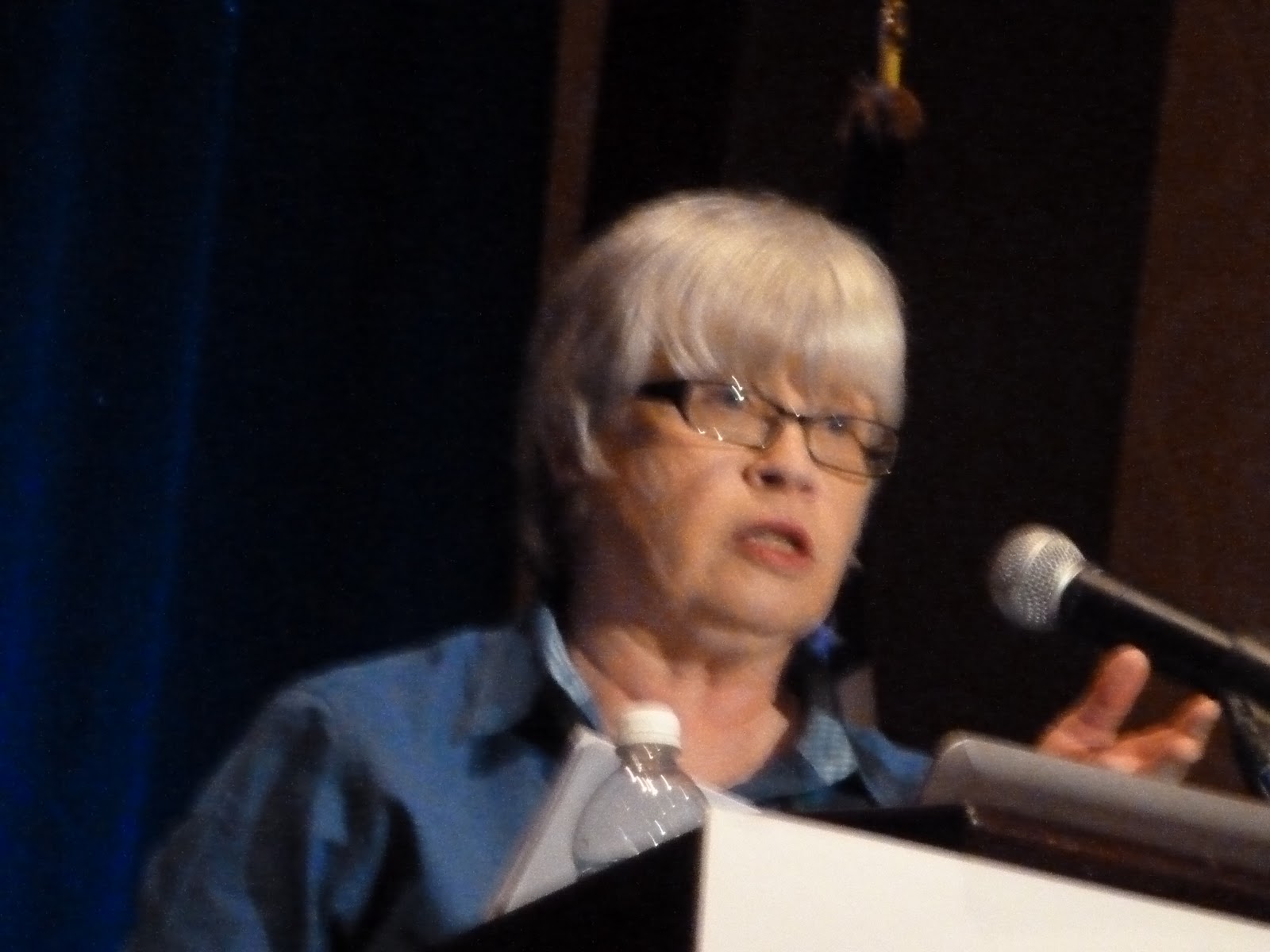
On Friday, Dr. Elisabeth Lenckos (above) of Chicago led us in an examination of whether our dispositions are more like Elinor’s or Marianne’s. I seemed to hear about a 50-50 split among those sitting near me.

 Dr. Joan Ray presented the North American Scholar Lecture at the opening plenary session. She analyzed “Sense & Sensibility as Austen’s Problem Novel,” citing various difficulties readers, particularly her students, have with the characters and plot.  Perhaps most obvious among these problems is whether or not Marianne will find happiness as the wife of Col. Brandon.  Dr. Ray, in her charming and humorous manner, convinced us by reading from the text some perhaps-overlooked aspects of Marianne’s and the Colonel’s behavior and opinions  that emphasized the empathetic nature of their personalities. Their essential compatibility, she assured us, would bring them happiness.

As always at JASNA AGMs, it is difficult to chose among the wonderful break-out sessions offered by dozens of well-spoken presenters with a variety of  intriguing topics.

My good friend Elizabeth Philosophos Cooper of Madison talked about “Jane Austen, Publisher: Writing Herself Into Money and Longing for More.” Liz documented the publication process for each of Austen’s novels, from early unsuccessful attempts through her various methods of reaching publication to the actual funds she received for some of her work, some during her lifetime, and more after her death.

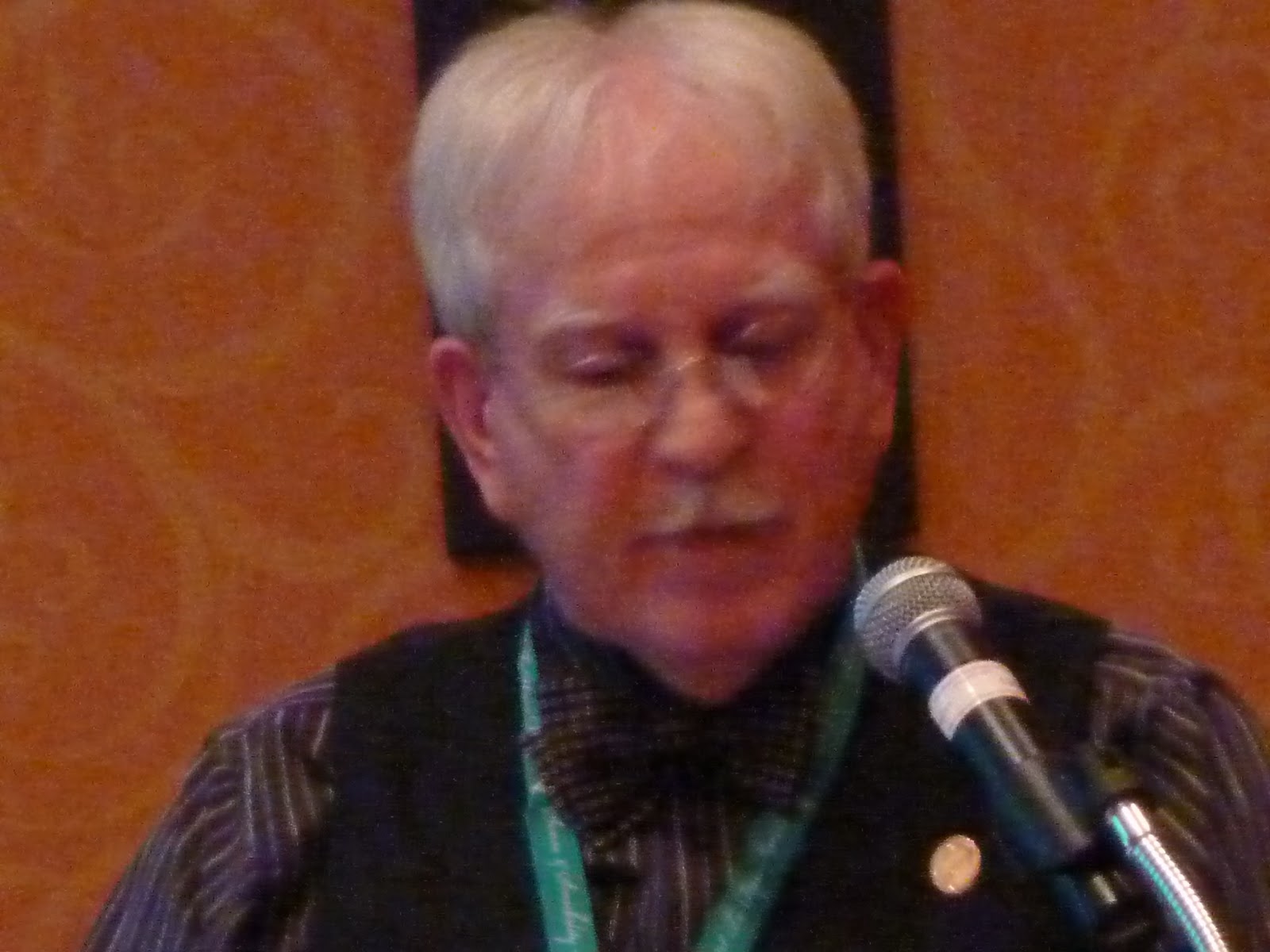
Jeffrey Nigro, Chicago Regional Coordinator, spoke on “The Iconography of Sensibility,” illustrating how artists and poets extoll
ed the beauty and drama of the emotional expressionism of the era.

William Phillips, also of Chicago, counted down from the least egregious of the nasties to the worst of the examples in Sense & Sensibility in his talk “Meaner than a Texas Pole-cat: Present day Perspectives on Austen’s Largest Cast of Nasties.” It wasn’t easy to chose the worst among some of the revolting people in S&S, like John and Fanny Dashwood, Mrs. Ferrars and her son Robert — but of course the nastiest of all was the vindictive and sly Lucy Steele.

I will report further on the activities at Fort Worth — from an exciting book launch, to the brilliant ball, to the outstanding talks by Andrew Davies and Deirdre Le Faye — in my next posts.

Stay tuned for much, much more.

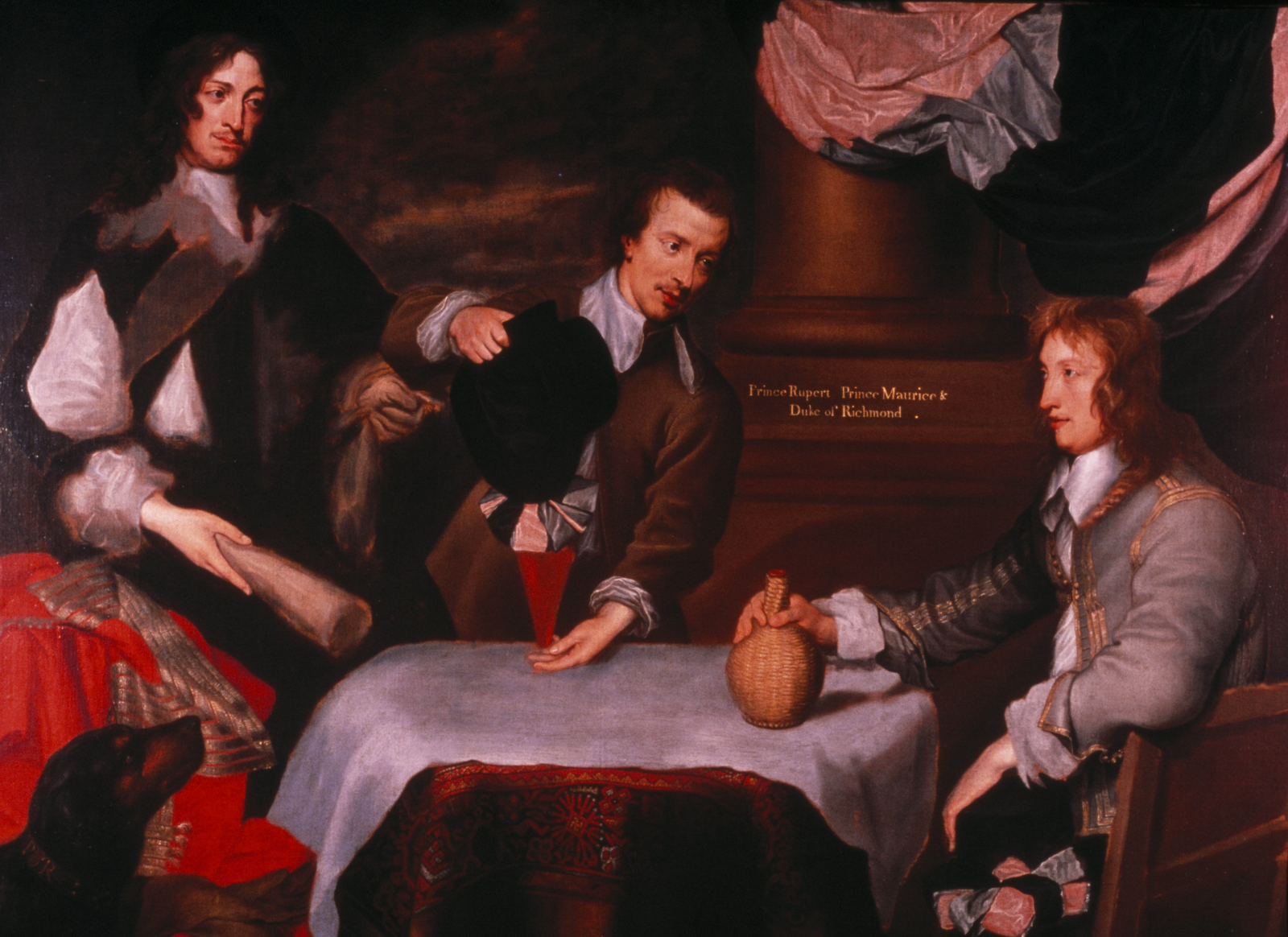
The Dobson Painting at Ashdown House by Guest Blogger Nicola Cornick

On the third landing at Ashdown House hangs a splendid group portrait of three prominent cavaliers. The artist is William Dobson, court painter to King Charles I, and the picture was painted in about 1644, during the English Civil War, when Charles’ court was based in Oxford. The names that are painted onto the picture are those of Prince Rupert of the Rhine, his brother Prince Maurice and the Duke of Richmond. This is the first mystery about the painting – the names of the sitters were added at a later date and two of them are incorrect. Whilst Prince Rupert is definitely the focal point of this painting, his comrades are Colonel Murray and Colonel Russell. A second mystery is why the painting is unfinished. The detail on Prince Rupert’s clothes has not been completed and there is no glass containing the red wine. We can speculate that perhaps the person who originally commissioned the painting never returned from the wars to pay for it.

It is entirely appropriate that this portrait should hang at Ashdown, a hunting lodge built circa 1662 for William, First Earl of Craven. Craven was a lifelong supporter of the Royalist cause and an ardent admirer of Prince Rupert’s mother, the beautiful and charismatic Elizabeth, Queen of Bohemia, the Winter Queen. It was Elizabeth who bequeathed to William Craven the splendid portrait collection that hangs in Ashdown House today. Craven and Rupert were friends and comrades in arms during the 30 Years War that ravaged Europe during the early years of the 17th century. Craven was also the executor or Rupert’s will and guardian to his illegitimate daughter Rupertina.

Elizabeth, Queen of Bohemia

The Dobson Picture, as we call it, is packed full of symbols of loyalty. It portrays Prince Rupert as the saviour of the Royalist cause. His colours, the pink, the grey and the black, swathe the pillar of strength in the back of the picture. The same colours are on the cockade that is being dipped into the red wine, which will be raised in loyal toast to the King. The crossed gloves symbolise politics and the monarchy. The picture also contains the ultimate symbol of loyalty – a dog with Prince Rupert’s initials monogrammed onto its collar. It is gazing up at Rupert with devotion.

Rupert was renowned for his love of animals, a curious and rather endearing trait in a man also known for his ferocity in battle. In this he was said to take after his mother who preferred “her dogs, her hunting and her monkeys” to her children, apparently in that order. Her preference for her pets may explain why Elizabeth of Bohemia was estranged from all of her children at one time or another. There is a story that relates that when Elizabeth and her family were forced to flee Bohemia after the Battle of the White Mountain in 1620, the butler was going through the palace to make sure that nothing valuable had been left behind and found Rupert, three years old at the time, abandoned in the nursery. He picked the child up and hurried after Elizabeth’s carriage, only to discover that she had made sure that her pet monkey Jacko was safely installed inside!

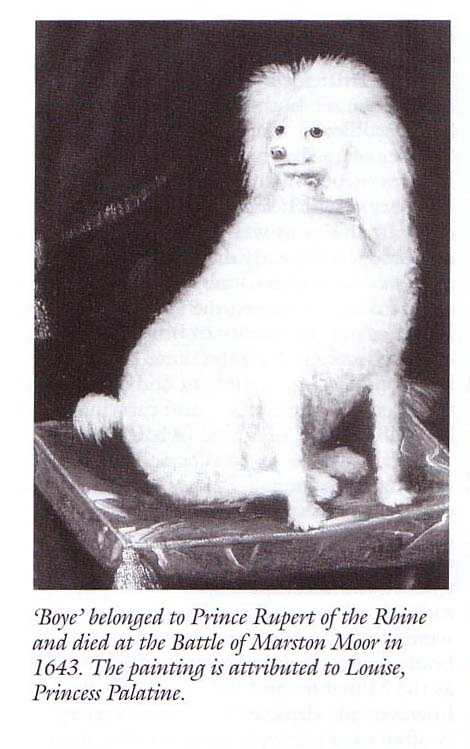
Prince Rupert’s most famous dog was a Standard Poodle called Boy who ran with his cavalry. Boy was a particular target for the Roundheads, who became obsessed with the idea that he was Rupert’s familiar and attributed to him various magic powers, including that he was fluent in various languages, that he was invulnerable in battle and that he could put a spell on the enemy. Boy began to feature in Roundhead propaganda. A pamphlet of 1643 “Observations upon Prince Rupert’s Dogge called Boy” reported that Boy sat beside Rupert in meetings of the King’s Council and that Charles I allowed him to sit on the throne. Boy attended church services and was the toast of the Royalists after various victories. The Roundheads tried both poison and prayer to destroy “this Popish, profane dog, more than halfe a divill, a kind of spirit.” Although the dog was a white poodle they portrayed him as black in the pictures in order to associate him more closely with the devil.

Perhaps inevitably, Boy fell prey to a Roundhead bullet at the Battle of Marston Moor and proved not to be invulnerable after all. The Puritans claimed in another pamphlet “A Dog’s Elegy or Rupert’s Tears” that Boy had been killed by a valiant soldier who had skill in necromancy. The verse ran: “Lament poor cavaliers, cry, howl and yelp, For the great losse of your malignant whelp.” Poor Boy! In an age of superstition it is easy to see how men might attribute magic powers to such a creature and also why the enemy might use Boy as a symbol of the Royalist cause. In the same way it is easy to see how Boy was a talisman and mascot to the Royalists who mourned his loss very deeply. He went down in the army records as the first official British Army Dog, which seems a fitting tribute to a loyal pet.

Ashdown House

Ashdown House is currently undergoing a major conservation project that will see the repair of the roof, balustrade and cupola, the restoration of the white chalk walls to their original dazzling glory and the renovation of the interior. “Hard Hat Tours” up the scaffolding will be offered from April 2012 to see the conservation in action. The progress of the project and much more information on the history of the house can be found online at www.ashdownhouse.blogspot.com

The Trouble With Horses

From The Creevey Papers

October 23rd. (1837) —Since August 30th, nearly two months, I have written not a line, for I have had nothing to record of public or general interest, and have felt an invincible repugnance to write about myself or my own proceedings. Having nothing else to talk of, however, I shall write my own history of the last seven weeks, which is very interesting to me inasmuch as it has been very profitable. Having asked George Bentinck to try my horse ‘Mango’ before Doncaster, we went down together one night to Winchester race-course and saw him tried. He won the trial and we resolved to back him. This we accomplished more successfully than we expected, and ten days after he won the St. Leger, and I won about 9,000Z. upon it, the first great piece of good fortune that ever happened to me. Since Doncaster, I have continued (up to this time) to win at Newmarket, so that my affairs are in a flourishing condition, but, notwithstanding these successes, I am dissatisfied and disquieted in my mind, and my life is spent in the alternations of excitement from the amusement and speculation of the turf and of remorse and shame at the pursuit itself. One day I resolve to extricate myself entirely from the whole concern, to sell all my horses, and pursue other occupations and objects of interest, and then these resolutions wax faint, and I again find myself buying fresh animals, entering into fresh speculations, and just as deeply engaged as ever. It is the force of habit, a still unconquered propensity to the sport, and a nervous apprehension that if I do give it up, I may find no subject of equal interest.

Speaking of Bridget Jones

Tis the season for Bridget Jones what with Bridget Jones: The Musical set to hit the West End in 2012 and Christmas being right around the corner. Yes, Christmas. You know you’ll be watching Bridget Jones’s Diary during the holidays just to see those awful holiday sweaters again. Well, we can’t wait. You probably can’t wait, either, so here’s the movie trailer to get you into the spirit of things. Click here to watch.

Visiting Corsham Court with Victoria

Corsham Court is near Chippenham in Wiltshire.  The website is here.

Corsham Court, which I photographed in 2009 on a visit to Hampshire and Wiltshire, was a Royal manor in the time of Saxon Kings. The core of the present house was built in the late 16th century by Thomas Smyth. In the 1740’s, the estate was purchased by a member of the Methuen family and eventually altered to house Sir Paul Methuen’s excellent collection of paintings.  Almost two centuries later, more fine pictures were added when the family inherited the collection of a relative who had resided in Italy where he acquired many old masters.  The initial impression of the house exterior reminded me of a previous visit to the Biltmore estate in Asheville, North Carolina.

Biltmore Estate, Asheville, North Carolina

Biltmore, the home of George Vanderbilt in North Carolina, opened in 1895, the creation of architect William Morris Hunt; he based his designs on the style of three 16th C French chateaux.

A closer look at the entrance of Corsham Court.

At Corsham Court, the Elizabethan house was altered significantly several times.  In 1798, architect John Nash followed in Capability Brown’s footsteps (see below) but could not keep up!  Sadly, Nash’s work was poorly executed and needed significant repair within a few decades.  So in the 1840’s, parts of the house  were rebuilt again, giving it the look it now has by architect Thomas Bellamy. I find both the Court and Biltmore rather forbidding in appearance.  However, the interior of Corsham Court could not be more different from Biltmore.  I felt Biltmore was dark, dreary, and altogether uninviting as a place to live (to visit, quite fascinating). 

An angled view of one wing. 

 Corsham Court is lovely, beginning with a handsome hall, that I would call a combination of neo-classic and baroque, as interpreted by Bellamy in the Victorian Age.

The Picture Gallery, a triple cube room, 72 feet long, was designed by Lancelot Capability Brown in the 1760’s.  Brown is renowned for his hundreds of landscape garden designs, but he is also responsible for a number of country houses, some fully, others remodeling projects.


Brilliant works by Van Dyke, Strozzi, Dolci, Reni, del Sarto, Rosa, and others fill the walls in the state rooms – an astonishing collection, mostly still owned by the Methuen family. According to the Blue Guide to English Country Houses, “The pictures themselves, still hung much as they were in the 18C, many of them in their original frames, offer an almost unparalleled insight into 18C artistic taste.” 
 From the house guide book, “In 1765 Morris & Young of Spitalfields supplied 700 yards at 13 s. 6d. a yard, and four years later a further 478 1/2 yards at 14 s. the latter amount for covering the furniture. As time went by, the damask on the chairs got worn, and so sections were cut from behind the paintings to patch them.”
Among the most renowned paintings in the collection is Van Dyke’s Betrayal of Christ, above, now actually owned by the City of Brisol Art Gallery.

Lady Boston, nee Christiana Methuen by George Romney

I love to look at the family portraits as well as the Old Masters since knowing the stories of the families who lived in the great stately homes is a big part of the fun. Christian Methuen died in 1832.

The Cabinet Room
Almost as renowned as the art collections at Corsham Court are the gardens, some dating from the days of Capability Brown and others developed in the last decades.

I had my usual luck with peacocks.  Despite my begging, they just weren’t interested in display!

In fact, this fellow just stalked away with a haughty expression. “Don’t bother me,” he seemed to say.

This charming structure leads to the bathhouse, originally designed by Brown but altered by others to its present neo-Gothic look.

Below is another view which shows the now-empty plunge bath, once a popular feature of country houses — and probably useful too.

It must have been lovely on a warm day to soak in the bath and gaze out on the beautiful garden blooms.
Corsham Court is as great country house, well worth visiting.
For a detailed history of the house:
More information on the collections and reproductions of the paintings can be seen here: