Originally posted on February 12, 2011, ahead of the other wedding of the decade, that of William and Katherine.
As I write this, there is no word on the designer Kate Middleton has chosen to create her wedding gown, though I have heard many breathless accounts of who is and who is not in the running. So let’s indulge our royal wedding mania by looking at some of the gowns worn in the past.
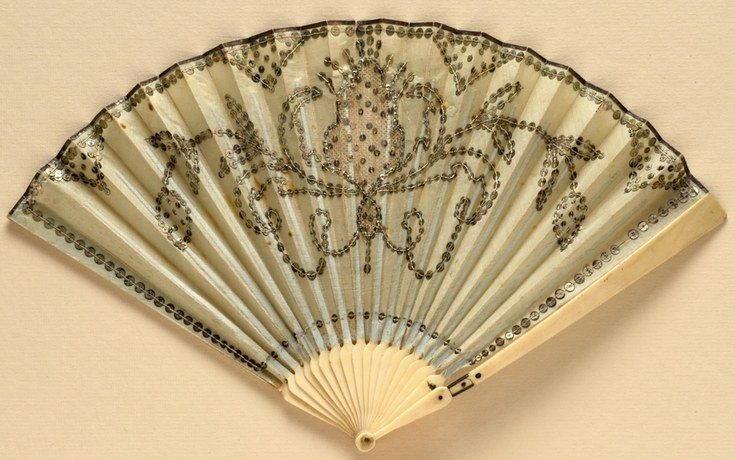
Above is the dress worn by Princess Charlotte of Wales at her May 2, 1816, wedding to Prince Leopold of Saxe-Coburg, as exhibited in the Museum of London here.
The Lady’s Magazine of May, 1816, described the gown: White silk net embroidered in silver strip with a spotted ground and borders. The wedding dress, composed of a most magnificent silver lama on net, over a rich silver tissue slip, with a superb border of silver lama embroidery at the bottom, forming shells and bouquets above the border; a most elegant fullness tastefully designed, in festoons of rich silver lama, and finished with a very brilliant rollio of lama; the body and sleeves to correspond, trimmed with a most beautiful point Brussels lace, in a peculiar elegant style.
The manteau of rich silver tissue lined with white satin, trimmed round with a most superb silver lama border, in shells to correspond with the dress, and fastened in front with a most brilliant and costly ornament of diamonds. The whole dress surpassed all conception in the brilliancy and richness of its effects. Head dress, a wreath of rose buds and leaves, composed of the most superb brilliants.” At right, an engraving of Charlotte and Leopold at their wedding in Carlton House.
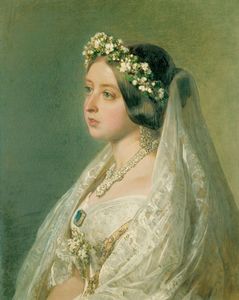
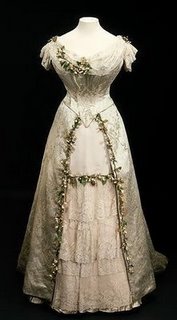
The portrait of Queen Victoria, at left, is by Winterhalter. It shows a rather wistful young bride at the time of her wedding to Prince Albert of Saxe-Coburg (nephew of the above-mentioned Leopold) on February 10, 1840 in the Chapel Royal of St. James Palace.
It was this gown and veil that supposedly has inspired generations of brides ever since to wear white for their ceremonies, though many brides had previously dressed in fashionable white as well as in a variety of other hues.
At right, an image of Queen Victoria’s dress on a mannequin in the collection of Kensington Palace.
Left, the wedding gown of Alexandra of Denmark, who married Victoria’s son, eventually King Edward VII, on March 10, 1863 in St. George’s Chapel at Windsor Castle. She was Princess of Wales for almost forty years before becoming Queen in 1901. After her husband’s death in 1910, she was known as the Queen Mother until she died in 1925.
Like Charlotte’s mother, Caroline, Princess of Wales, and like the first wife of the present Prince of Wales, Diana (see below), Alexandra had to endure the infidelity of her husband. But unlike the other two, she stuck with him to the end. We’ve all heard the possibly-apocryphal story about how Alexandra invited one of his mistresses, Alice Keppel, to comfort Edward VII on his deathbed.
Princess Mary of Teck wed Prince George, Duke of York on 6 July, 1893 in the Chapel Royal of St. James Palace. She had been engaged to Prince Albert Victor, eldest son of the Prince of Wales in 1891, but Albert Victor died in the great influenza epidemic of 1891-92. Mary and George fell in love and were married with the approval of Queen Victoria as well as Edward and Alexandra, Prince and Princess of Wales. George succeeded his father as George V in 1910. Queen Mary, who was a godchild of Queen Victoria, had five sons and one daughter.
Her eldest son, known to all as David, was more than a disappointment. After inheriting the throne as Eward VIII in 1936, he abdicated less than a year later to marry Wallis Simpson.
After her husband’s death, Queen Mary chose to be addressed as Her Majesty, Queen Mary, rather than as Queen Mother. She was very supportive of her second son, who became King George VI after his brother’s departure from the throne. According to several sources, she was the first dowager queen of Great Britain to ever attended the coronation ceremony of her husband’s successor.
As Duke of York, the second son of George V and Mary grew up in the shadow of his dashing older brother. He married Lady Elizabeth Bowes-Lyon on 26 April 1923 in Westminster Abbey. At the time of the wedding, it was not expected that “Bertie” would take the throne. Lady Elizabeth’s gown, perhaps for that reason, was not as elaborate as some of her predecessors. It was certainly in the style of the day, a rather loose gown, slightly less than floor length. Below is the dress on a mannequin in a Kensington Palace exhibition of several years ago, along with a detail of the veil and bodice.
On 20 November, 1947, Princess Elizabeth (later Queen Elizabeth II) married Prince Philip of Greece (later Duke of Edinburgh) in Westminster Abbey. The designer was Norman Hartnell and the fabric is silk spun at Lullingstone Castle in Kent. She wore a diamond and pearl tiara and a filmy veil. The long train was decorated with traditional symbols, such as Tudor roses and wheat. All the details of the royal romance, the wedding, the gown and the ceremony were eagerly read around the world. It is said the happy event was like a tonic to the war-weary Britons still enduring shortages of goods and rationing.
The Gown on a mannequin
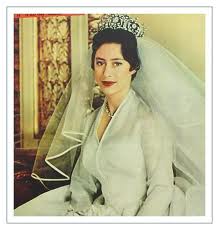
Princess Margaret, second daughter of King George VI, married Antony Armstrong-Jones (later Earl of Snowdon) on May 6, 1960, at Westminster Abbey. Television cameras covered the event and the broadcast was seen worldwide. Like her sister, Margaret chose Norman Hartnell to design her bridal gown.The couple had two children: David, Viscount Linley in 1961 and Lady Sarah Armstrong-Jones in 1964. The Snowdons were divorced in 1978 and Princess Margaret died in 2002.
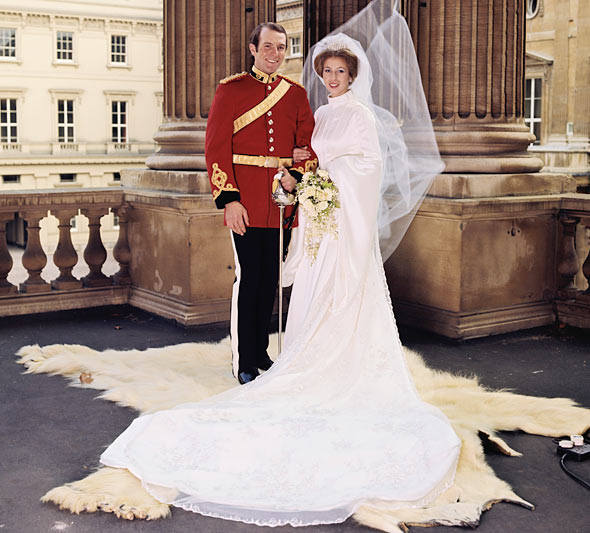
14 November 1973 – Anne, Princess Royal, married Captain Mark Phillips in Westminster Abbey. Born in 1950, she is Queen Elizabeth II’s only daughter.Anne and Phillips have two children, Peter Phillips born in 1977 and Zara Phillips born in 1981. After divorcing Phillips in 1992, Anne married Timothy Laurence, in Scotland on December 12, 1992.
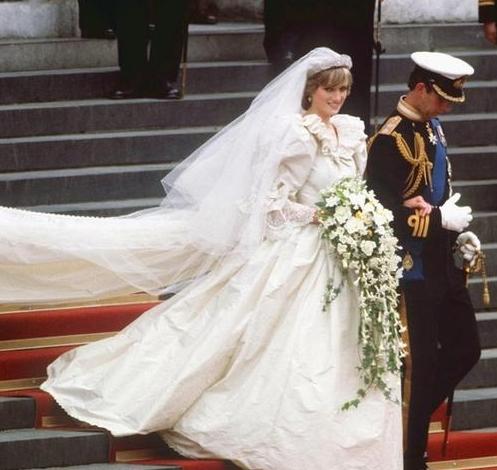
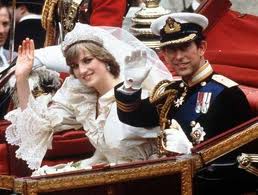
On 29 July 1981, Lady Diana Spencer and Charles, Prince of Wales, were married in St Paul’s Cathedral. Her dress was controversial — and still is. The designers, David and Elizabeth Emmanuel, immediately shot to the top echelon of British fashion. Like many of Diana’s fashions, the gown (or a replica) travels around the world for popular exhibition.
Charles and Diana had two sons, Prince William, born in 1982, and Prince Harry, born in 1984, before separating in the late 1980s, the Prince living in Highgrove and the Princess at Kensington Palace. Formal separation came in 1992 and the marriage of Charles and Diana ended in divorce on 28 August 1996. On 31 August 1997, a year after the Prince and Princess divorced, Diana died in a car crash in Paris.
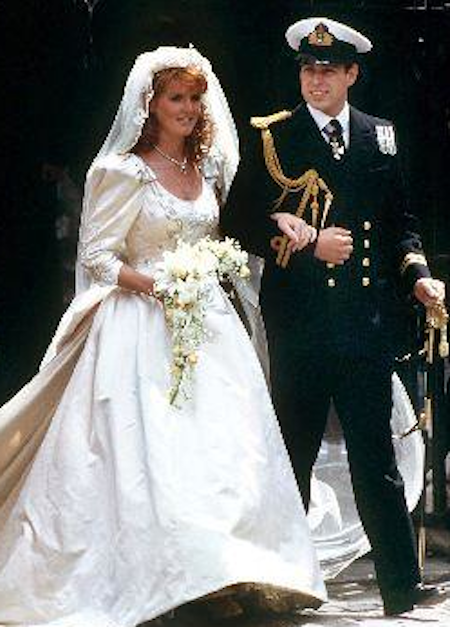
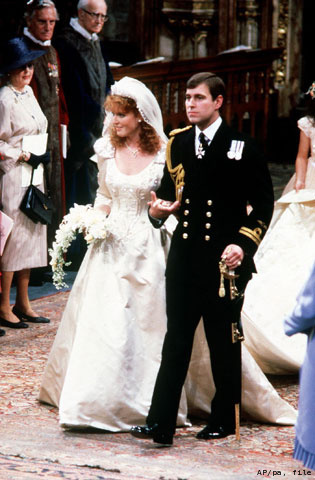
Sarah Ferguson and Prince Andrew, the Duke of York, married at Westminster Abbey on 23 July 1986. The Duke and Duchess of York had two children during their marriage: Princess Beatrice of York (born 1988) and Princess Eugenie of York (born 1990). They separated in 1992 and divorced in 1996, though they are often together for vacations and family events.
Of all the gowns shown above, I think I like Sarah’s best, as designed by Lindka Cierach. It is beautiful, flattering to her and has no gimmicks. Princess Elizabeth’s was lovely too, but I like Sarah’s veil better. All in all this one is the winner in the gown category, if perhaps not in the list of “most suitable royal brides.”
If like us, you can’t get enough of this wedding stuff, here is a wonderful exhibition from the Royal Collection you will enjoy.
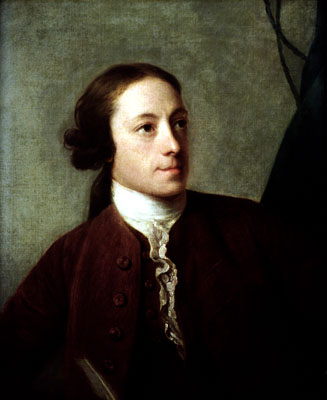
On the 8th of February, 1750, an earthquake was felt in London, followed exactly a month afterwards by a second and severer one, when the bells of the church clocks struck against the chiming-hammers, dogs howled, and fish jumped high out of the water. Horace Walpole, in a letter to Sir Horace Mann, draws a lively picture of the effect created by the event, and we cannot do better than borrow his narration:
“. . . . . as far as earthquakes go towards lowering the price of wonderful commodities, to be sure we are over-stocked. We have had a second, much more violent than the first; and you must not be surprised if, by next post, you hear of a burning mountain springing up in Smithfield. In the night between Wednesday and Thursday last, the earth had a shivering fit between one and two; but so slight that, if no more had followed, I don’t believe it would have been noticed. I had been awake, and had scarce dozed again,—on a sudden I felt my bolster lift my head. I thought somebody was getting from under my bed, but soon found it was a strong earthquake that lasted nearly half a minute, with a violent vibration and great roaring. I got up and found people running into the streets, but saw no mischief done. There has been some; two old houses flung down, several chimnies, and much earthenware. The bells rang in several houses. Admiral Knowles, who has lived long in Jamaica, and felt seven there, says this was more violent than any of them. The wise say, that if we have not rain soon we shall certainly have more. Several people are going out of town, for it has nowhere reached above ten miles from London: they say they are not frightened, but that it is such fine weather, “Lord, one can’t help going into the country!” The only visible effect it has had was in the Ridotto, at which, being the following morning, there were but 400 people. “A parson who came into White’s the morning after earthquake the first, and heard bets laid on whether it was an earthquake or the blowing up of powder mills, went away exceedingly scandalised, and said, “I protest they are such an impious set of people, that I believe, if the last trumpet was to sound, they would bet puppet-show against judgment!” The excitement grew intense: following the example of Bishops Seeker and Sherlock, the clergy showered down sermons and exhortations, and a country quack sold pills “as good against an earthquake.” (Walpole himself advised anyone who would listen to “take bark”). A crazy Life-guardsman predicted a third and more fatal earthquake at the end of four weeks after the second, and a frantic terror prevailed among all classes as the time drew near.”
Horace Walpole
On the evening preceding the 5th of April, the roads out of London were crowded with vehicles, spite of an advertisement in the papers threatening the publication “of an exact list of all the nobility and gentry who have left or shall leave this place through fear of another earthquake.” “Earth-quake gowns “—warm gowns to wear while sitting out of doors all night—were in great request with women. Many people sat in coaches all night in Hyde Park, passing away the time with the aid of cards and candles; and Walpole asks his correspondent, ‘What will you think of Lady Catherine Pelham, Lady Frances Arundel, and Lord and Lady Galway, who go this evening to an inn ten miles out of town, where they are to play brag till four o’clock in the morning, and then come back, I suppose, to look for the bones of their husbands and families under the rubbish?’
On the 18th of March in the same year an earthquake was felt at Portsmouth, Southampton, and the Isle of Wight. In April, Cheshire, Flintshire, and Yorkshire were startled in like manner: this was followed by an earthquake in Dorsetshire in May, by another in Somersetshire in July, and in Lincoln-shire in August, the catalogue being completed on the 30th. of September by an earthquake ex-tending through the counties of Suffolk, Leicester, and Northampton.
N.B. The feared third London earthquake did not occur.
Here’s your opportunity to live like a Georgian – or a Regency – lady for an entire week during Number One London’s Georgian Tour in April 2018 as we visit London and Bath.
The Georgian Tour will include many of the periods’ most beloved sites, while affording you the opportunity for hands-on research of architecture, fashion, stately homes, interiors and gardens.
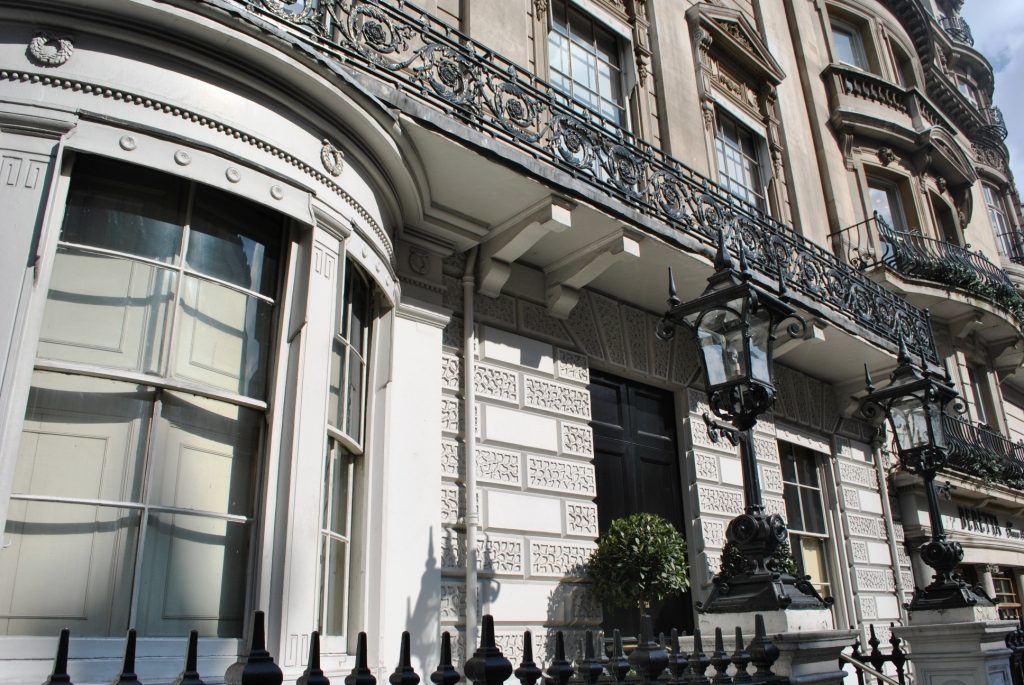
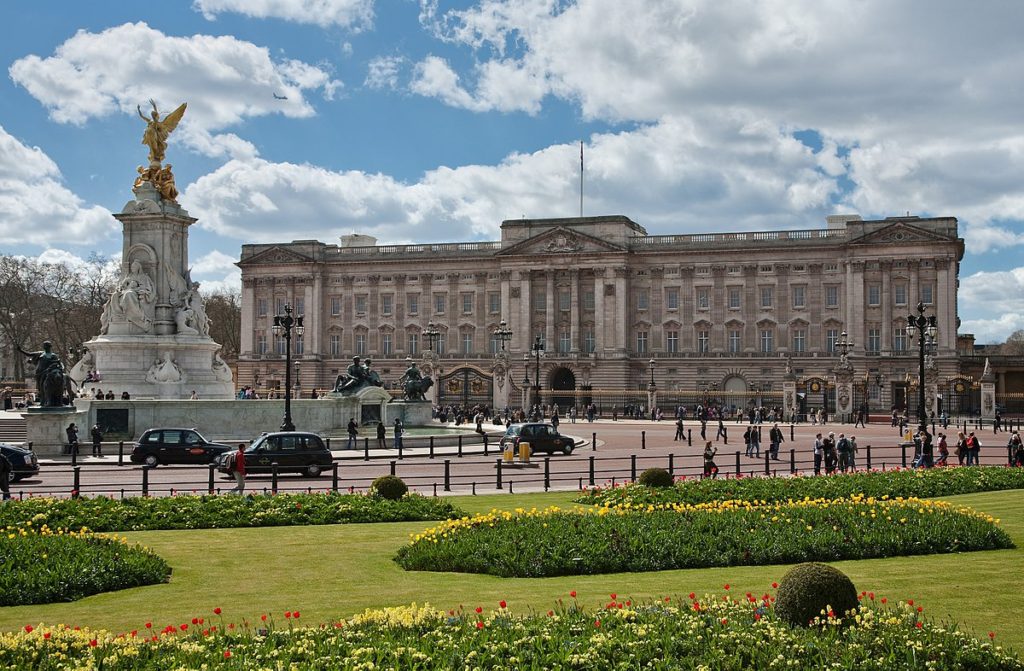
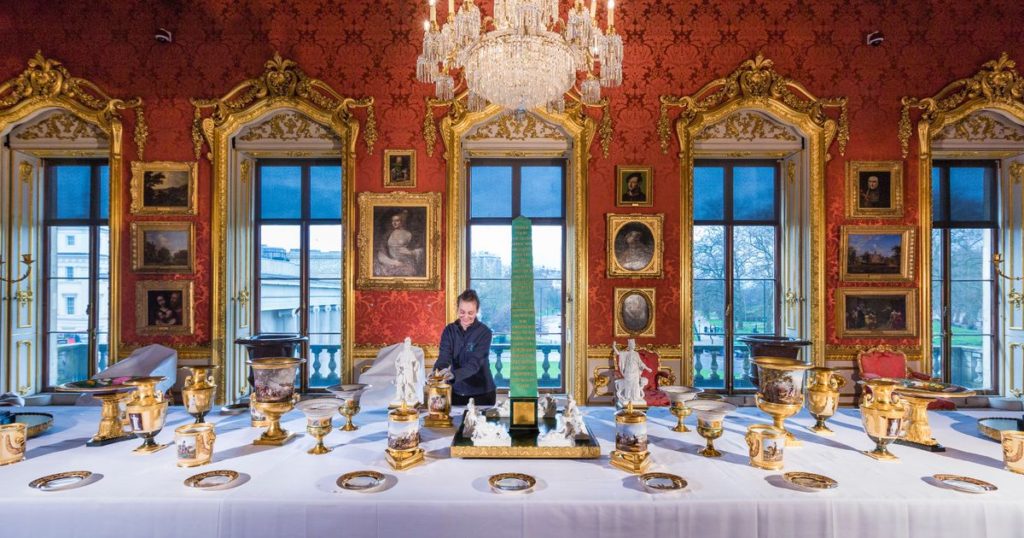
The fully escorted Tour includes our signature “St. James’s Walk,” during which you’ll stroll past iconic sites such as White’s Club, Buckingham Palace, Spencer House, Almack’s and Apsley House, while learning about the history of each and exploring many of London’s “hidden” landmarks.
The famous Bow Window at White’s Club.Buckingham PalaceThe Waterloo Chamber, Apsley House
Traveling on to Bath, we’ll enjoy the private use of a period townhouse located in the most historic section of the City, within walking distance to local landmarks.
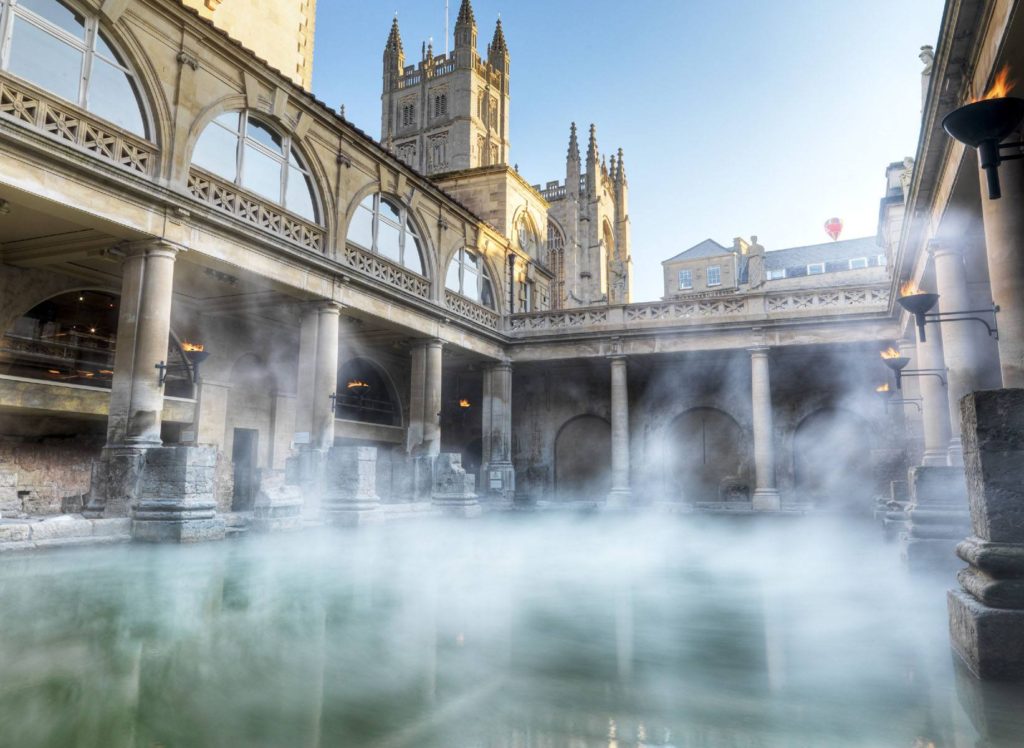
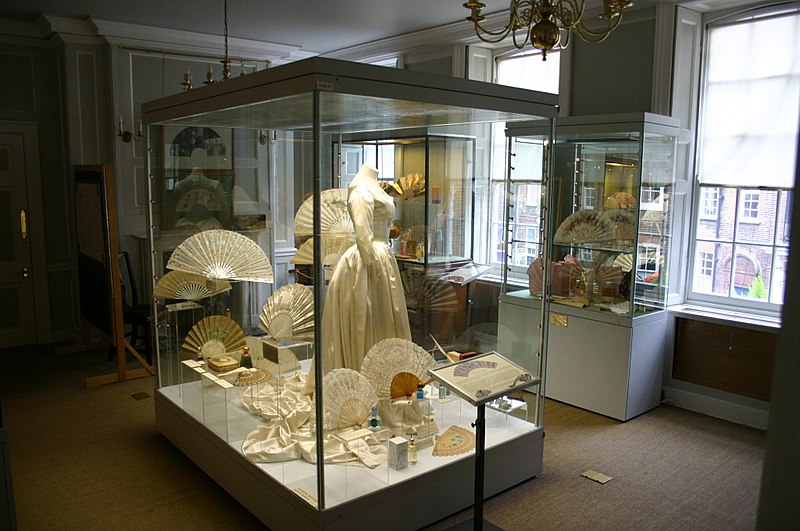
Over the next few days, we’ll visit the Roman Baths, the Jane Austen Centre, the museum at No. 1 Royal Crescent and the Fashion Museum and Pump Rooms.
The Roman Baths
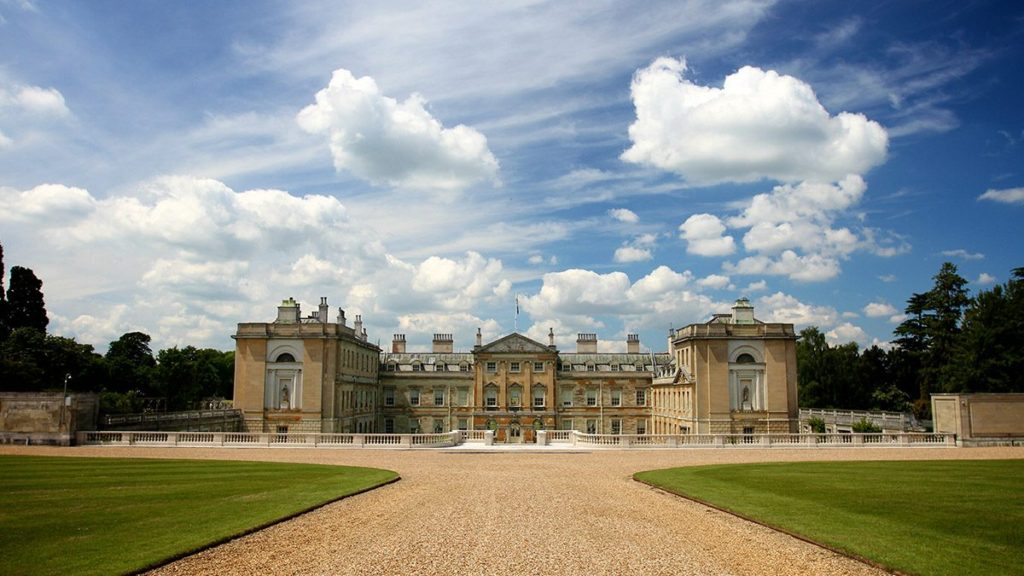
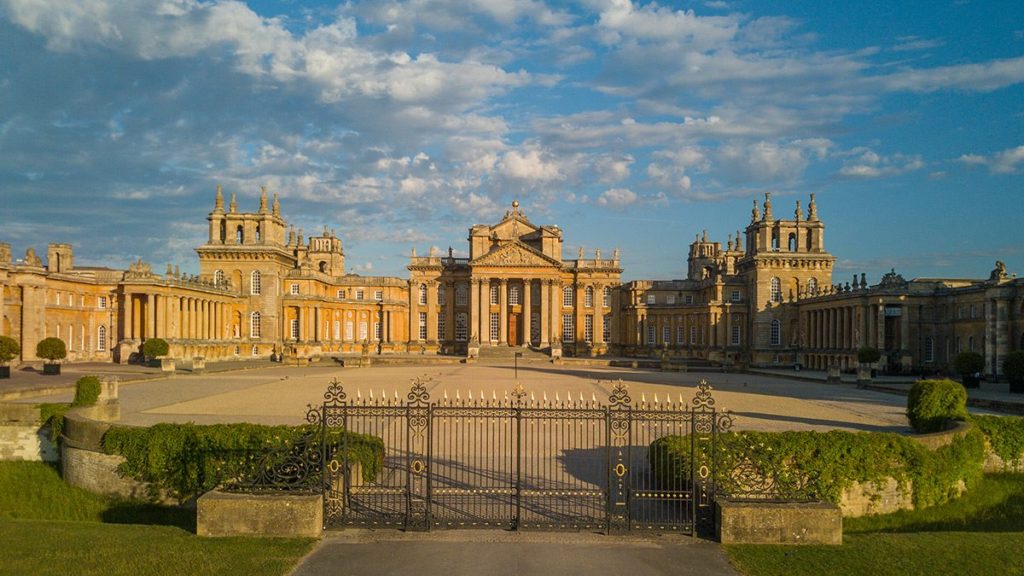
As if this were’t itinerary enough, we’ll also be visiting two of England’s most stunning Stately Homes – Woburn Abbey and Blenheim Palace.
Woburn AbbeyBlenheim Palace
Whether you’re an author, history buff or a savvy tourist, you won’t want to miss out on this fully escorted, small group tour!
The March 1867 issue of The Gentleman’s Magazine carried an obituary for Sarah Sophia Fane Child-Villiers, Dowager Countess of Jersey:
January 26 – At 38 Berkeley Square, suddenly by the rupture of a blood vessel, aged 81, Sarah Sophia, Dowager Countess of Jersey.
Her ladyship was the eldest and only surviving child of John, 10th Earl of Westmorland, by Anne, only daughter and heir of Mr. Robert Child. She was born March 4, 1785 and in May 1804 she married George, Viscount Villiers, who in the following year succeeded his father, the 5th Earl of Jersey, and by whom she had a family of four sons and three daughters. Her eldest son, George Augustus Frederick, died three weeks after the death of his father in 1859; and was the father of Victor, 7th Earl; Augustus John died at Rome in 1847; Frederick married to Lady Elizabeth, daughter of the 8th Earl of Athlonel (title extinct); Francis John died in May 1862; Lady Sarah, married to Prince Nicholas Esterhazy, son of his Excellency the late Prince, many years an ambassador to the Court of St. James’s, from Austria, died at Torquay in November 1853; Lady Clementia died unmarried in December 1858, and Lady Adela, wife of Lieut. Colonel Charles Ibbetson, who died suddenly in September 1860.
Osterley Park, Greater London
The late Countess, on the death of her maternal grandfather, Mr. Robert Child, the banker, by his will succeeded to his large property, both real and personal. Owing to her mother having eloped with the Earl of Westmorland, Mr. Child carried out his determination that not a shilling of his property should go to the male heirs of the earldom, and he bequeathed his large and valuable property to the county of Middlesex and his interest in the old banking house at Temple Bar to the Countess. The deceased Lady Jersey was kind and charitable to the poor, but studiously avoided publicity in doing good to those beneath her. Many indigent families will regret her death, as well as an extensive circle of friends.
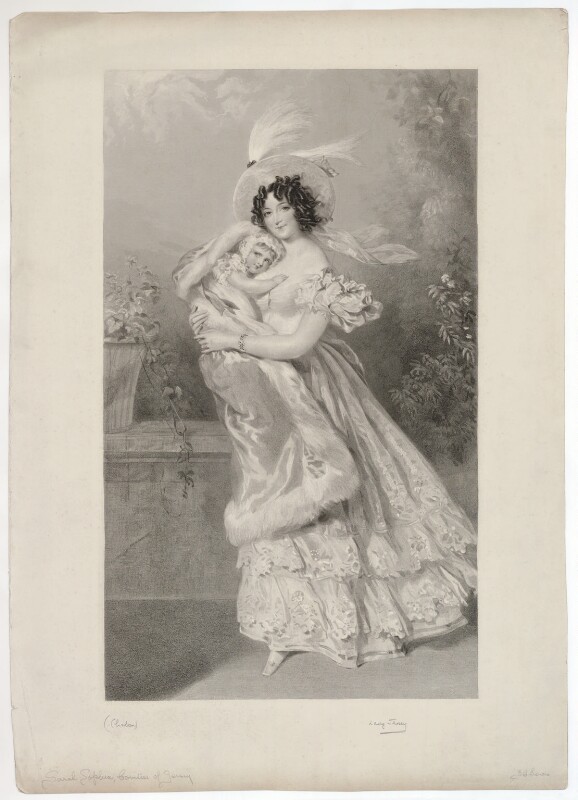
Lady Jersey, National Portrait Gallery
by Frederick Christian Lewis Sr, after Alfred Edward Chalon
stipple engraving, published 1839
The Countess of Jersey was for many years one of the leading ladies patronesses of “Almacks” and with Viscountess Palmerston shared the greatest influence; indeed she had for more than half a century occupied the highest position in London society. She was a woman of extraordinary abilities and no female member of the aristocracy could surpass her in her knowledge of European politics. For nearly fifty years her saloons were nightly open to receive the distinguished foreign diplomatists of the day and the prominent political character of the Tory and Conservative party. The Countess’s “at homes” were however, unlike those of Devonshire and Holland houses, exclusively confined to a distinct political faction. Lord Brougham was a great personal friend of the deceased lady, and Viscount Palmerston was among her occasional visitors, even while in office. Lady Jersey was connected by marriage with the late Viscount Ponsonby, the late Marquis of Anglesey; the Earl of Bessborough and a large number of friends of opposite politics.
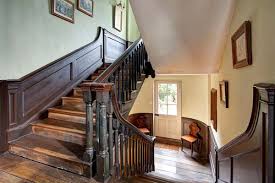
Entrance Hall, NT
It was not until the death of her husband in October 1859, that Lady Jersey retired into comparative seclusion.—That is to say, sought only the society of her most intimate friends. The Countess was honoured by the personal regard of the late Emperor Nicholas, the late Kings of Hanover, Prussia, Holland, Belgium, and of George IV when Prince Regent.
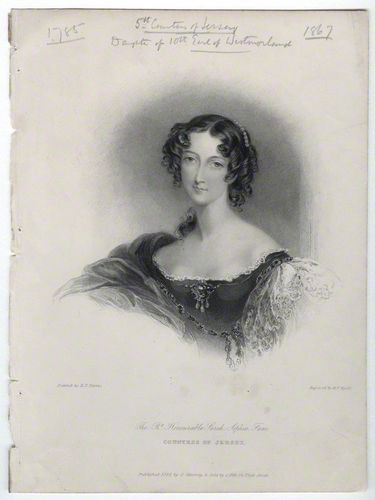
Lady Jersey, National Portrait Gallery
by Henry Thomas Ryall, published by John Murray, sold by Charles Tilt,
after Edmund Thomas Parris stipple engraving, published 1833
The interment of the deceased took place in the family vault of the parish church of Middleton Stoney, Oxon on the 2d of February, the body of the Countess having been brought to Middleton Park on the day previous. The funeral procession was preceded by the principal tenancy of the estates.
Note from Victoria: The Jersey estate at Middleton, Oxfordshire, was the family’s principal country home after its purchase in 1737, though the property had been a manor since the 13th century. The house built there in the 1750’s and used by Sarah, Lady Jersey, for extensive entertaining, was pulled down in 1934 and replaced a few years later with a modern house designed by Sir Edward Lutyens, now made into flats. The former Middleton Park grounds are now mostly a public park. The village of Middleton Stoney boasts one public house, the Jersey Arms.
This post was originally published here on June 11, 2011
This April, Number One London Tours will be hosting the 1815: London to Waterloo Tour, offering an unprecedented opportunity to experience life during these times, from Fashionable London to the Battlefield at Waterloo, we will be visiting sites related to both worlds and to both countries, meeting many of the people involved in the Battle and it’s aftermath on both sides of the Channel. One of these people will be the Honourable Katherine Arden, who has left this first hand and heartfelt record of life in Brussels before and after the Battle. She attended the Duchess of Richmond’s Ball and was on the ground, as it were, in the days following the Battle.
The following letter was written by the Hon. Katherine Arden, daughter of the first Lord Alvanley (Richard, 1744-1804) and sister of William Arden, 2nd Lord Alvanley (1789-1849) , the famous dandy who squandered his fortune and died unmarried; the title went to their younger brother. With her mother and sister, she was resident in Brussels at the time of the great battle, and took an active part in nursing the wounded. The letter is addressed to her aunt, Miss Bootle Wilbraham, afterwards, Mrs. Barnes. It is franked from Windsor to Ormskirk in Lancashire by Miss Arden’s uncle, Mr. E. Bootle Wilbraham (afterwards Lord Skelmersdale), July 17, 1815. The letter was later published in the Cornhill Magazine in 1891.
Brussels, Sunday 9th (July)
My Dearest Aunt, I can assure you most truly that I did not require reminding, to fulfill the promise I made you of writing, and every day since our return from Antwerp I have settled for the purpose, but what with visiting the sick, and making bandages and lint, I can assure you my time has been pretty well occupied. As my patients are, thank goodness, most of them now convalescent, I think the best way I can reward my dear Aunt’s patience, is by giving her a long account of our hopes, fears, and feelings from the time the troops were ordered to march down to the present moment. (If you are tired with my long account, remember you expressed a wish in Mama’s letter to hear all our proceedings.)
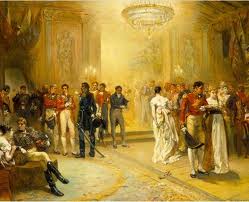
On Thursday the 15th of June, we went to the great ball that the Duchess of Richmond gave, and which we expected to see from Generals down to Ensigns, all the military men, who with their regiments had been for some time quartered from 18 to 30 miles from this town, and consequently so much nearer the frontiers; nor were we disappointed, with the exception of 3 generals, every officer high in the army was to be there seen.
Though for nearly ten weeks we had been daily expecting the arrival of the French troops on the Frontiers, and had rather been wondering at their delay, yet when on our arrival at the ball, we were told that the troops had ordered to march at 3 in the morning, and that every officer must join his regiment by that time, as the French were advancing, you cannot possibly picture to yourself the dismay and consternation that appeared in every face.
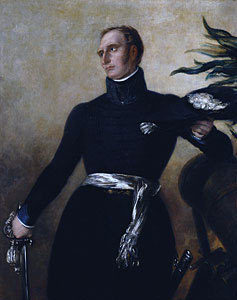
Charles Lennox, 4th Duke of Richmond by Hoppner
Those who had brothers and sons to be engaged, openly gave way to their grief, as the last parting of many took place at this most terrible ball; others (and thank Heaven ranked amongst that number, for in the midst of my greatest fears, I still felt thankfulness, was my prominent feeling that my beloved Dick (her brother) was not here), who had no near relation, yet felt that amongst the many many friends we all had there, it was impossible that all should escape, and that the next time we might hear of them, they might be numbered with the dead; in fact, my dear Aunt, I cannot describe to you my mingled feelings, you will, however, I am sure, understand them, and I feel quite inadequate to express them.
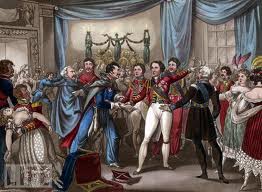
We staid at the ball as short a time as we could but long enough to see express after express arrive to the Duke of Wellington, to hear of Aides de Camp arriving breathless with news, and to see, what was much more extraordiniary than all, the Duke’s equanimity a little discomposed. We took a mournful farewell of some of our best friends, and returned home to anything but repose.
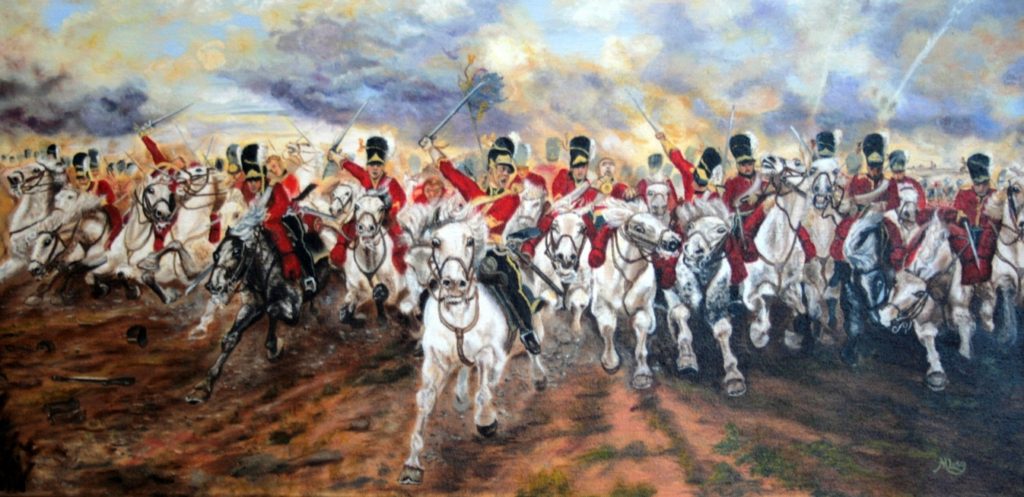
The morning (Friday June 16) dawned most lovelily, and before seven o’clock we had seen 12,000 Brunswickers, Scotch, and English pass before our windows, of whom one third before night were mingled with the dust. Mama took a farewell of the Duke as he passed by, but Fanny and myself, at last wearied out, had before he went, retired to bed. The first person that we saw in the morning brought us the news, that the advanced guard of the French had in the night come on as far as Genappe, 18 miles off, and had had several skirmishes with the Prussians.
This intelligence, as you may suppose, did not tend to compose us, but still everything went on in quiet calmness, when (Gracious heavens, never never shall I forget it), at three o’clock a loud cannonading commenced, which upon the ramparts was heard nearly as plain as we do the Tower guns in London; it went on without intermission till 8 o’clock, when it was thought to appear more distant, and therefore hopes were entertained that the French had retreated; nothing certain was known, but it was reported that the Prussians had been principally attacked, and were rather giving way when the Highlanders and the regiments who had marched from here in the morning joined them, and compleately repulsed the French.
So far the news was good, but still the English had fought, and what our loss was, nobody knew; however, we bore up pretty well till above twelve o’clock, a gentleman (Mr. Leigh, of Lyme in Cheshire) came from off the field of battle, where he had been looking on, with the intelligence that there had been a dreadful battle, the Duke of Brunswick was killed, and that the Brigade of 1st Guards and the Highlanders were literally cut to pieces. I will not attempt to say what we felt, for it would be quite vain.
The Duke of Brunswick, killed at Quatre Bras
I must only tell you that that Regiment of Guards contained all our greatest friends, independent of our having to regret them as Englishmen. The next morning by six o’clock, Saturday 17th numbers of Belgians and others of our brave Allies came flying into the town, with the report that the French were at their heels, but this intelligence occasioned but a temporary fright, as a bulletin was published officially saying that we had gained a great victory, and the French were retreating (neither of which was true). About ten o’clock the real horrors of war began to appear, and though we were spared hearing cannonading, yet the sights that we saw were infinitely more frightful than anything we had heard the day before. I mean the sight of wounded.
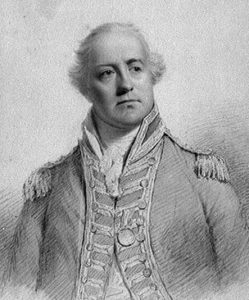
Sir James Gambier, 1st Baron Gambier
I must tell you before I proceed, that Sir James Gambier (the Consul General to the Paysbas, who is the best man that ever was) came to us about eight o’clock, and told us that there really had been a severe engagement, but that we had the advantage, that though the Guards had suffered most dreadfully, yet that their loss was not quite so great as had been reported, but that the Highlanders were literally nearly annihilated, after having performed prodigies of valor; and very good proof had we how dreadfully they had suffered, by the numbers who were brought in here, literally cut to pieces. Our house being unfortunately near the gate where they were brought in, most of them passed our door; their wounds were none of them drest, and barely bound up, the wagons were piled up to a degree almost incredible, and numbers for whom there was no room, were obliged, faint and bleeding, to follow on foot; their heads being what had most suffered, having been engaged with cavalry, were often so much bound up, that they were unable to see, and therefore held by the wagons in order to know their road. Everybody, as you may suppose, pressed forward, anxious to be of some service to the poor wounded Hero’s but the people had orders that those who could go on should proceed to Antwerp, to make room for those who were to follow (dreadful idea), and therefore we could be of no further use to them than giving them refreshments as they passed.
In the middle of the day, we heard further particulars of the last night’s battle, and if all danger had been removed far from us, which Heaven knows was very far from being so, we still should have felt nervous at the danger that had nearly befallen us. Conceive it having been run so near, that the French were within ten minutes of getting possession of the road to Brussels, which had they once gained, in all probability they would have reached the town in three hours.
Providence, however, ordered it otherwise, and the Guards, who had marched from Enghien 27 miles off, arrived at the lucky moment, and got possession of the road. They were shortly afterwards joined by the Highlanders, who some of them fought with their knapsacks on, having marched 20 miles and accordingly were enabled to keep their ground against the French.
The conduct of the English soldiers on that day was perfect, and would have been sufficient to have immortalized them, without the addition of the Sunday’s battle, after which the Duke of Wellington said he should never feel sufficiently grateful to the Guards for their conduct on both days, which from the Duke means more than it would from anybody else.
Napoleon Bonaparte
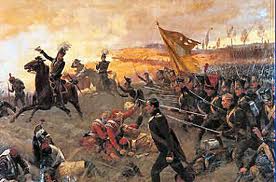
Our Hero, Wellington, who had been deceived with the intelligence given him (for it is said that Bony had bribed most of his outposts), and had no idea that the French were so near, nor advancing in such force, was so distressed when he discovered the truth, that as usual totally regardless of his personal safety, he was exposing himself in the most dreadful way (I am speaking of the Friday’s business at Quatre Bras, so named from four roads meeting), and already a party of French horse, having marked him out, were rushing on him with the greatest violence, when the Highlanders, who saw his danger, and it is said he never was in so great before, rushed between him and the French, and with the lives of hundreds, saved his still more precious one. On coming off the field, the Duke told some whom he met with, that their conduct had been noble and he should make a good report of them; of the 92nd regiment, out of seven hundred men, but one hundred and fifty remain to share the glory.
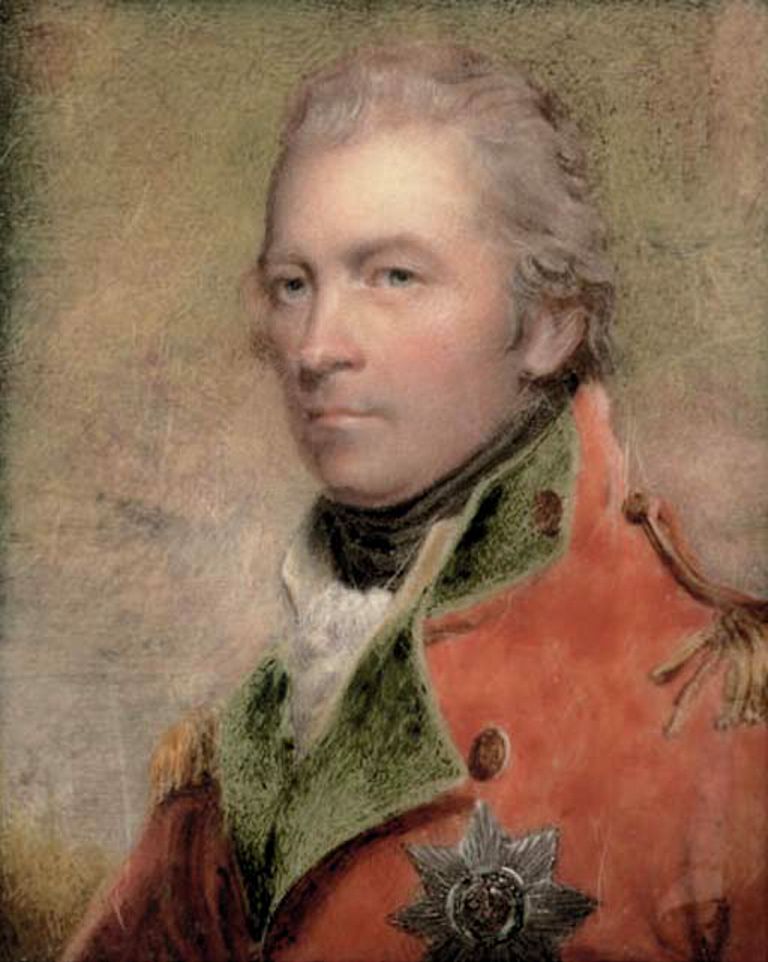
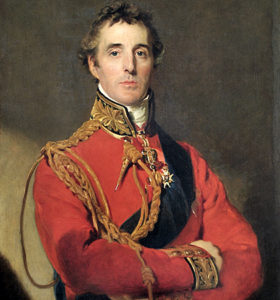
Arthur Wellesley, 1st Duke of Wellington c.1815 by Sir Thomas Lawrence
But to resume my narrative. We remained the whole of Saturday, in great suspense, to know that the armies were about, and whether the French were really retreating as had been reported; about four o’clock in the day, we were dreadfully undeceived, by being told from very good authority that instead of the enemy it was Lord Wellington who had retreated, and who with his whole army were within ten miles of the town; the reason given for his doing so, was that the Prussians had been attacked on the Friday evening whilst they were quietly cooking, and that having lost a tremendous number of men, Blucher had judged it prudent to retire, which being the case, he had left Lord Wellington’s left flank so exposed, that it was impossible for him to remain where he was, and that he had therefore retreated to a strong position near Waterloo, whilst our cavalry were engaged in playing before them, to hide, as much as possible, their retreat from the French.
It was likewise added, that it was to be hoped that the Prussians would rejoin the English, as at that present time, the armies were near nine miles asunder, and that orders had been issued by the Duke for all baggage to be sent from the army through this town, and for the wounded, if possible, to be moved from it. All this looked so like retreating on the town, that we were told we must have horses ready, and everything prepared to go at an instant’s notice, which accordingly we commenced doing, and from that hour 4 o’clock till eight in the morning (Sunday June 18) when we were fairly in Antwerp, were, I hope, the most harassing 16 hours I ever passed, or ever shall.
From that time the baggage wagons passed in such quick succession, that they formed cavalcades through the town, as not only those who were ordered to go, but those who desired to stay with the army, passed through, a general panic having seized all the officers’ servants, by which means many have lost all they had, and everybody is minus something.
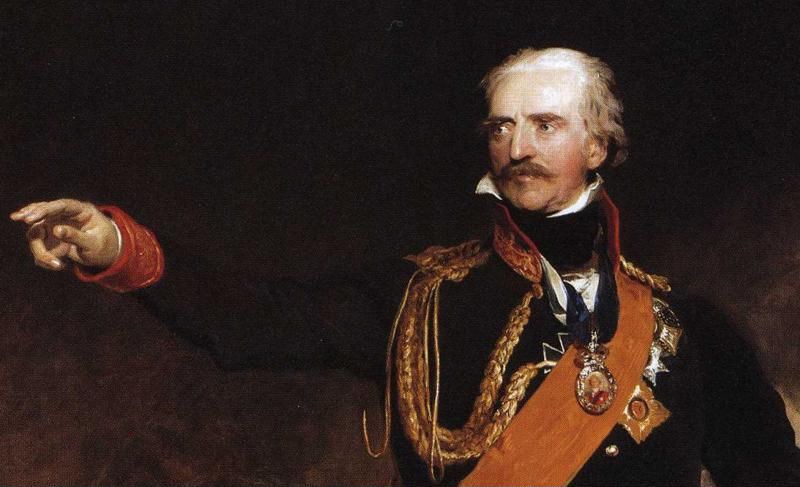
Field Marshall Gebhard Leberecht von Blücher
About every half-hour a man was heard scampering down the street calling out that the French were coming; some, indeed said they were at the gates, and though we knew that that could not be true, yet it was impossible to know how much foundation there was for saying so. About seven o’clock (Saturday June 17) our friend Sir James Gambier arrived to say that he hoped our things were nearly packed up, as though it was not necessary to go immediately, yet that he begged our things might be put to the carriage as we might be obliged to start at an instant’s notice, for it was known that the Prussians were not joined, and if Buonaparte were to attack that night, there was no knowing what the event might be. (We have since heard, that if he had done so, the tide of affairs would in all probability have turned completely for him instead of being as it is now).
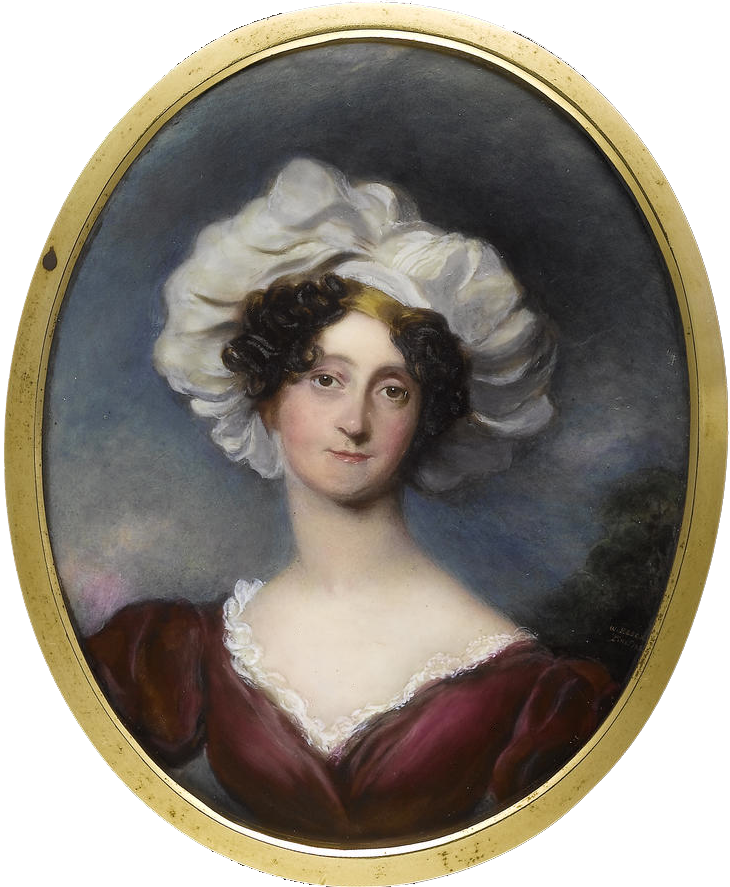
Lady Charlotte Greville
After Sir James went, we went out to see what our friends intended doing; we found that some were gone, others going, and all were prepared for the worst. We accordingly agreed, that at the time Lady Charlotte Greville went, we would accompany her, as everybody told us if we waited for the worst we could never get away; and as we knew for certain that Buonaparte had promised his soldiers after he had drawn 20,000,000 francs from the town, that they should have three days pillage of it, which, as the enraged French soldiery are not the most kind hearted possible, and as the English could expect no mercy for them, we though it madness to put ourselves in such danger, and accordingly everything was got ready. To increase the horror and noise, about ten o’clock, a most horrible storm of wind and rain came on, which lasted without intermission till three o’clock, when the wind abated, but the rain continued at intervals, the whole of Sunday, to which the whole of our poor soldiers were exposed with the additional hardship of having very little to eat, as they had been so continually changing their place for the last two days, that the officers have since told us, that for nearly eight and forty hours, they had barely two pounds of bread to eat; luckily, the Sunday morning, after the dreadful night they passed, the common men had a double supply of spirits, which enabled them to fight as they did.
The baggage wagons and fuyards [fugitives] continued passing, without intermission, and what with being deafened with the noise, and worn out with anxiety, we were in a terrible state of fatigue, when at half past two (Sunday the 18th) Lady Charlotte sent to say the Mayor of the town had sent to advise all the English to quit the town, and that she was waiting for us. We accordingly joined her, and though we were very much impeded by the road being blocked up with wagons in which were numbers of the wounded, lying exposed to all the inclemency of the weather, and were several times in danger of being overturned, yet providentially we arrived safe at Antwerp about eight o’clock (Note: The distance from Brussels to Antwerp by road is about twenty-seven miles). We found the greatest difficulty in getting a hole to put our heads in, but at last succeeded: Lady Charlotte proceeded on the Hague immediately, but we remained to wait the event. We were told by many people that the rain would prevent them fighting, which gave us ease for the time, and though we spent the day in great suspense, yet we were saved the dreadful indescribable anxiety of those who remained here; never can I be sufficiently thankful that we left this place. For the first time for three nights, Fanny and myself were enabled to sleep, and the next morning, Monday (the 19th) we were awoke, with the delightful news, that a decisive victory had been obtained, and that the French were retreating in disorder. The account of killed and wounded which we then heard made us shudder; how much more dreadful was it, when the whole list was made out! There are 724 English officers killed and wounded, and nearly 11,000 common men, without Hanoverians.
The conduct of the English infantry in the battle of Sunday was something so extraordinary, that Cambaceres, Buonaparte’s A.D.C. who was taken, said Buonaparte himself had said that it was useless to fight against such troops, nothing could make them give way. They were formed into hollow squares, upon which the French cavalry, particularly the Cuirassiers, who wear complete armour, poured down, but without any avail, not one of their squares were ever broken, though perhaps from being six or eight lines deep, they came at last to only one.
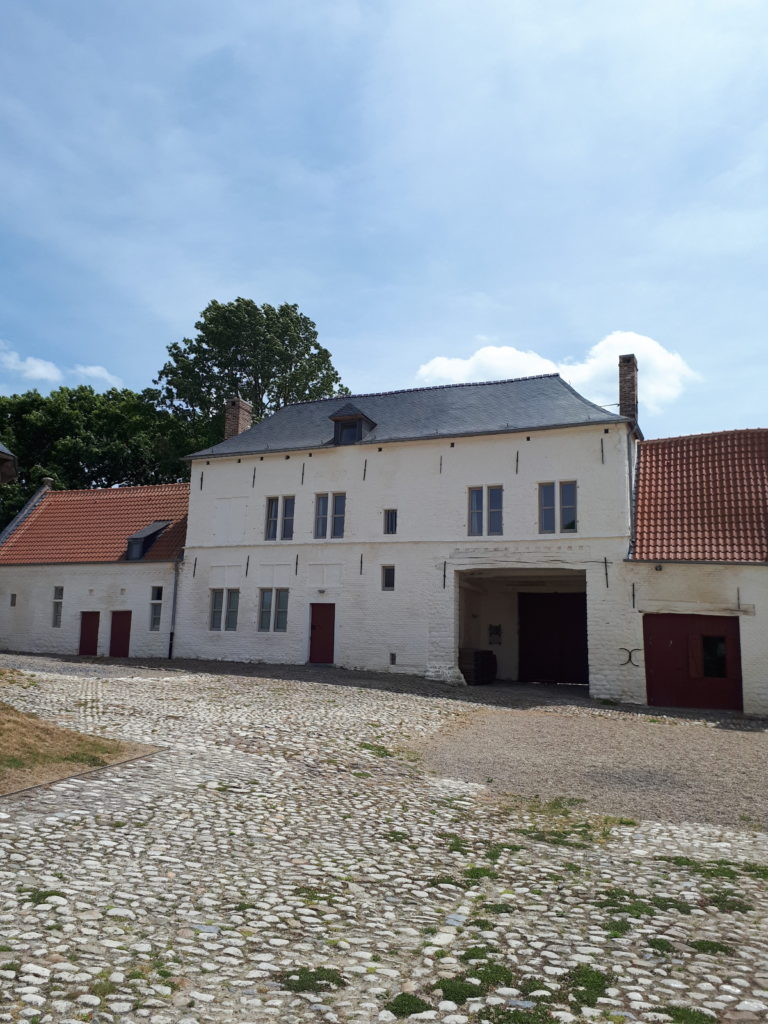
Hougoumont, pre-renovation
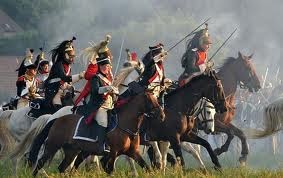
There is a little wood and a farm-house in the midst of the field of battle, which is called Hougemont, and which it was necessary for the English to maintain possession of: 500 of the Guards under Lord Saltoun and Co. Macdonnell were put into it, to defend it, and though they were attacked by above 10,000 French, and the Farm-house was set fire to, and burnt to the ground, yet our Invincible countrymen still maintained possession of it, and finally repulsed the enemy. Do not you feel, while you hear these accounts, that your national pride increases every instant, and that you feel more thankful than ever that you are English born and bred? I have that sort of enthusiasm about me, that I almost feel inclined to shake hands with every soldier I meet walking in the streets. The light cavalry, I am sorry to say, for the first time in their lives, did not behave like Englishmen; the 7th Hussars and 23rd dragoons refused to advance when they were ordered, and poor Lord Uxbridge, who is as brave as a lion, and doats upon his regiment (the 7th) went up to Lord Wellington in the midst of the engagement, and said in the bitterness of his heart, My cavalry have deserted me! The heavy dragoons behaved admirably, and the horse Guards and Blue’s who though they have been in Spain, were never before personally engaged, performed prodigies.—The Duke of Wellington has since said, that he never exerted himself in his life as he did on that day, but that notwithstanding, the battle was lost three times; he exposed himself in every part of the line, often threw himself into the squares when they were about to be attacked, and did what it is said he never had done before, talked to the soldiers, and told them to stand firm; in fact, I believe without his having behaved as he did, the English would never have stood their ground so long, till the arrival of 30,000 fresh Prussians under Bulow finished the day, for as soon as the French saw them, they ran.
Hougoumont today
The conduct of the French cavalry is represented as having been most beautiful, and nothing could have withstood them but our soldiers. The day after the battle, when the Duke had leisure to consider the loss he had sustained in both officers and men, he was most deeply affected, and Mrs. Pole, who breakfasted with him said the tears were running down upon his plate the whole time. How much more noble the Hero appears when possessed of so much feeling!
You ask how we like the Duke, and whether he is haughty? To men, I believe he is, very often, but all his personal staff are extremely attached to him, and towards women his manners excessively agreeable and very gallant; we like him vastly. We went a few days since to see the field of battle, and everything offensive was removed, a most interesting visit; we went with an A.D.C. of Gen. Cooke, (who poor man, the General, has lost his arm), and who explained to us all about the battle.—I am quite ashamed, my dear Aunt, to think how much I have written; pray forgive me. END
If you’d like to experience Waterloo first hand, to travel through history with us as we return to the year 1815, please click the link below to be taken to the Tour website.




 Princess Mary of Teck wed Prince George, Duke of York on 6 July, 1893 in the Chapel Royal of St. James Palace. She had been engaged to Prince Albert Victor, eldest son of the Prince of Wales in 1891, but Albert Victor died in the great influenza epidemic of 1891-92. Mary and George fell in love and were married with the approval of Queen Victoria as well as Edward and Alexandra, Prince and Princess of Wales. George succeeded his father as George V in 1910. Queen Mary, who was a godchild of Queen Victoria, had five sons and one daughter.


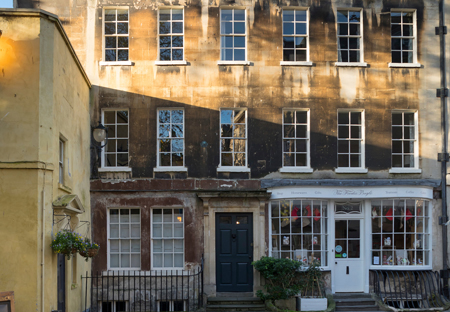 Traveling on to Bath, we’ll enjoy the private use of a period townhouse located in the most historic section of the City, within walking distance to local landmarks.