ROYAL WEDDING UPDATE

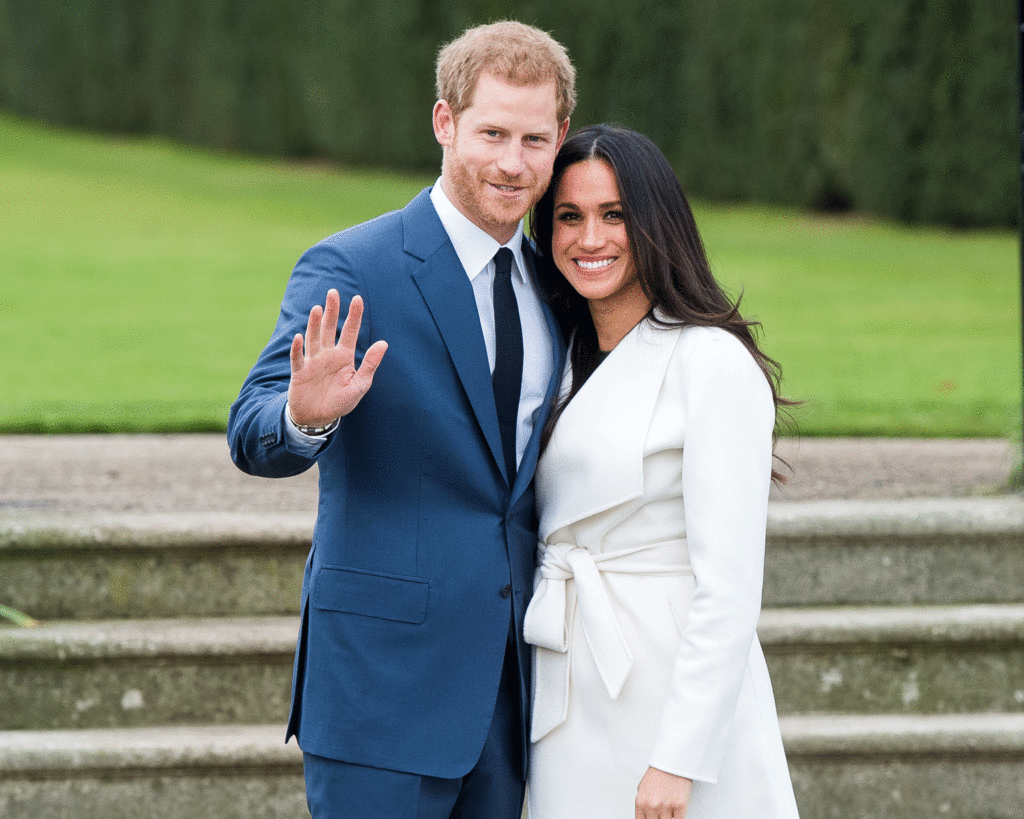
Just a little over two months to go until this year’s most anticipated wedding day arrives, so here’s a round-up of some of the news and a bit of the speculation surrounding the royal nuptials –

Here’s the lowdown on Harry’s childhood friend, Violet von Westenholz who, it’s finally been revealed, was the matchmaker who actually introduced Harry to Meghan

Meghan has finally chosen a designer for her wedding dress – but who is it?!

Entertainment Tonight further speculates about the dress and ceremony and offers up some Will & Kate news while they’re at it.


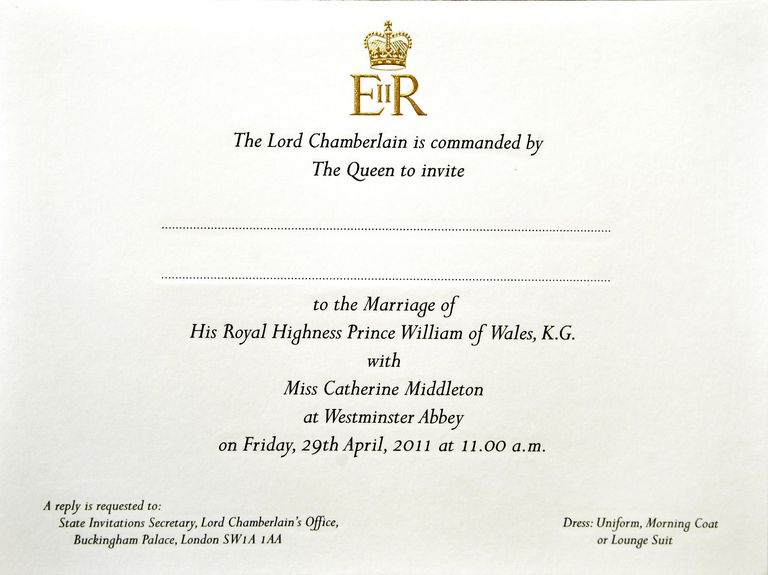
Town and Country Magazine ponders the royal wedding invites

Speaking of which, it seems that Sarah Ferguson, Duchess of York, won’t be getting one.

Hello Magazine explains the seating plan for the church service. 
It’s been rumoured that the Spice Girls may make their comeback at the wedding reception. Two days ago, Mel B fueled those rumours during an appearance on “The Real,” but the world awaits definitive confirmation.

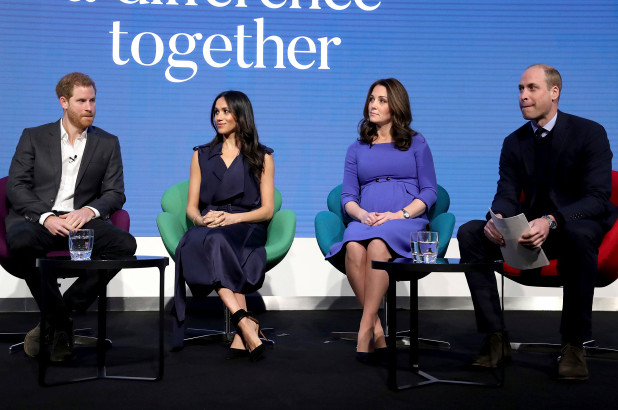
And on Wednesday, William and Kate and Harry and Meghan made their first joint appearance together on behalf of The Royal Foundation.

Breaking just a few hours ago, Harry and Meghan have announced that they will invite 2,640 members of the public inside the Castle grounds in order to watch the carriage procession. 

And finally, learn why Meghan won’t be wearing the crown jewels until after the wedding. 

Are you as excited as we are?!


THE NAME OF THE ROOM – WHERE PRECISELY IS THE NECESSARY?

by Louisa Cornell

Having covered the all-important drawing room and the equally vital kitchen areas of your average Regency era English country house, I thought it imperative we visit… The Necessary. Anyone who has read their British history knows this era was on the cusp of modernity in many areas. Plumbing was one of them. Sort of. For those who write and even those who read Regency era romance I offer a brief primer on where your hero or heroine might go… to Go.

The Water Closet or WC – Nicest of our options.

By way of introduction, there was actually a flushing toilet in Britain as early as 1591. John Harington, godson of Queen Elizabeth I, invented and installed the first water closet in his own home. He called his new invention Ajax and even wrote a book describing how it was built and how it functioned. A pan had an opening at its bottom closed by a leather faced valve. A system of handles, levers and weight poured the water from the cistern and opened the valve.

It didn’t really catch on, but by 1775 Alexander Cummings took a patent for his flushing closet which was very similar to Ajax. The main drawback in Ajax was the water seepage through the primitive valve. In 1777, Samuel Prosser used a ball valve to stop the seepage of water from the tank. This was the prototype for the water closets seen in some Regency era stately homes and London townhouses.

Some of the problems with this facility were –

  1. There tended to be only one in each house. Large house, one water closet, cold dark nights. Take a good candle, warm slippers, and do not wait until the last minute!
  2. Only in the wealthiest and most modern-thinking houses would the water closet be found on the floor with the family bedchambers. So, marry really well or… See Number 1 above.
  3. The most logical location for the water closet would be on the ground floor at the back of the house where water was already being pumped inside aka the kitchens. Which means one ran the risk of running into or even tripping over sleeping servants on your way to the water closet.
  4. Negotiating a wooden toilet seat, in the dark, in homes where rat catchers were employed to keep the vermin population in check. Do not skimp on paying either the rat catcher or the estate carpenter. Just saying.

The advantages were –

  1. One didn’t have to leave the house.
  2. The maid didn’t have to empty it every time it was used.
  3. Some of them worked well enough to completely eliminate the smell and possibility of disease from the house.

The Chamber Pot – Great for your Heroine, Not so great for her maid!

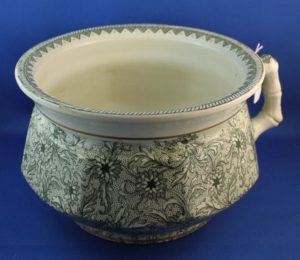
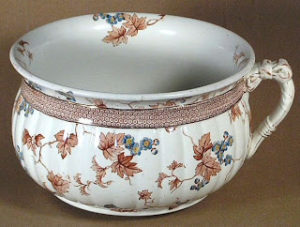
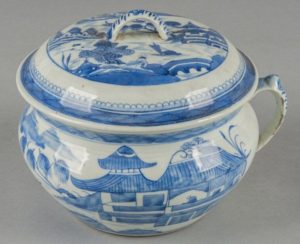
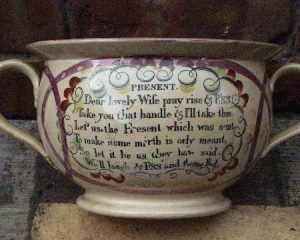
A chamber pot was a bowl or container and could be as fancy or as basic as the owner deemed necessary. Some resembled black iron cook pots with a lid. Others were beautifully decorated porcelain vessels, often matching the decor of the bedchamber or the pitcher and bowl on the bedchamber washstand. It is safe to say a chamber pot might be found in every bedchamber in every stately home and town house in England during the Regency era. I daresay even servants had chamber pots in their bedchambers. Why wouldn’t they? They certainly had enough experience emptying them.

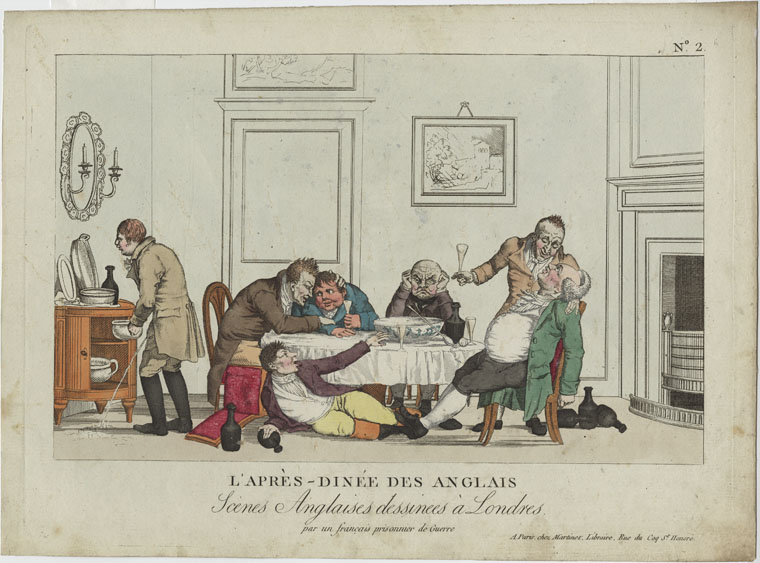
As the name denotes, a chamber pot might be found in any sort of chamber. The French were horrified to discover that British men kept a chamber pot in the dining room so as not to interrupt their after dinner brandy and cigars with a trip to the privy or water closet. Yes, you heard me correctly. A chamber pot. In the dining room. It might be stored behind a screen or even in a cabinet of the sideboard. And apparently gentlemen had no compunction about pulling the chamber pot out and using it whilst their fellow gentlemen watched. Frat boys have been around considerably longer than we knew.

For the ladies, during most social events a withdrawing room was designated. This was not a permanent fixture in a home, although some particularly busy homes might make it so. Perhaps a small parlor or a room not in constant use by the family would be set up with a screen and a chamber pot, chairs or comfortable divans for ladies to rest away from the party, a wash stand equipped with a pitcher of water and a bowl in which to wash one’s hands and face, along with towels and face cloths. A full length mirror and the talents of a maid who could repair a torn hem or flounce might also be offered. A vanity with cosmetics and a maid who excelled at dressing hair might be included. Of course there would be a maid whose job it was to empty the chamber pot and clean it so the next lady might use it. As far as all extant sources state, using the chamber pot was not a spectator sport for the ladies. Of course, ladies had the advantage of not having to remove any clothing in order to use the chamber pot. During the Regency era ladies did not wear the sort of confining panties or drawers we do today. Only loose women wore drawers, which means French women did it first. Wicked girls!

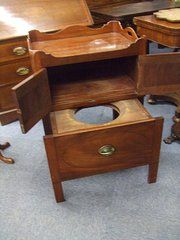
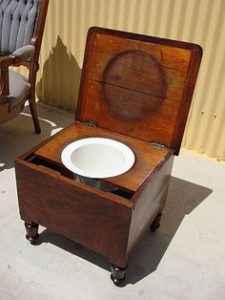
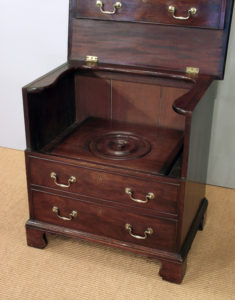
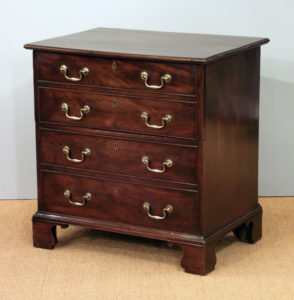
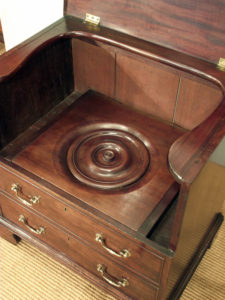
When in the actual bedchamber, chamber pots might be kept under the bed, behind a screen or even hidden in a sort of cabinet. They might be installed in a sort of toilet chair in a dressing room as well. No matter where they were stored, it was the duty of a maid to empty said chamber pot and return it clean to be used again.


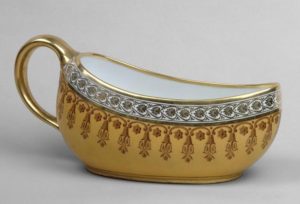
Ladies were even afforded a more portable option for when they traveled to venues at which a withdrawing room might not be made available – the bourdaloue.

For an informative and fun article on the bourdaloue please check out this link.

There were advantages and disadvantages to the use of a chamber pot.

Advantages –

  1. One did not have to leave the room, let alone the house at night to use it.
  2. One might use it without alerting the entire house, let alone a ballroom full of guests one was using it.
  3. A maid emptied it outside of the house, thus ridding the house of any smell or possibility of disease.

Disadvantages –

1. It might be in one’s chamber a while before it was emptied.

2. Maneuvering to use it might be problematic.

3. If one was a maid or footman working in one of these homes… do I really need to explain that disadvantage?

The Privy – You Might Be a Regency Redneck If… Oh! Wrong Post!

By the early 19th century, before the advent of sewer systems, each London house and most country houses would have what was called a ‘cesspool,’ a pit about four feet wide and six feet deep, above which the home’s privy was located. Liquid waste would be absorbed back into the soil at the bottom of the hole, but solid waste had to removed by the night soil man, who would come around at night (opening a cesspool during the day was illegal, as the smell was considered to be too horrifying) and climb down into the cesspool to shovel out the accumulated muck. Rest assured these cesspools probably accumulated their fair share of other household rubbish as well. More than one murder was discovered when someone bent to the task of removing solid waste from the cesspool. Shudder.

The privy was a fixed out house with no water supply or drain and usually located some distance away from the house. A fixed wooden seat with a rounded hole was placed directly over the cesspit. Occasionally privies were attached to the side of a building, projecting out from a top floor, or reached through on outdoor entry on the ground floor of a service wing. These were sometimes called garderobes, a leftover term from the medieval period. More often than not they were placed at some distance from the main house at the far end of a garden or yard.

The advantages to this arrangement were… let me think. Surely there was…

  1. The privy was away from the house.
  2. More often than not the owners paid for the services of the night soil man, thus the servants did not have to empty it. At least in the city. In the country, it is a safe bet there was some poor servant assigned to this task.

The disadvantages were –

  1. It was away from the house. Long walk, no matter the weather or the time of night. Much more likely to encounter the sort of animals who prefer to occupy a privy.
  2. Do we really need to list all of the disadvantages of using a privy?

There you have it. The name of the room we call a bathroom or restroom, or at least the various places and things one might use to accomplish the same purpose. Everyone who is perfectly happy to read or write about the Regency era, but has some reservations about actually living during the era, please raise your hand. You’re excused.

MORE ROYAL WEDDING GOWNS

by Victoria Hinshaw

Originally posted in February, 2011

This is really just a collection of pretty wedding pictures and  gorgeous dresses.  But, since it’s on our minds, these days, why not?  Some of these brides are related to the U.K. royals, others from European families. At right is Crown Princess Victoria of Sweden with her husband, Daniel   Wrestling.  They were married in Stockholm in June, 2010.

The dress is elegantly simple and looks perfect on Princess Victoria. Only the tiara — though it looks more like a crown — is elaborately decorated.

Crown Princess Victoria Ingrid Alice Désirée was in 1977.  She will become Queen of Sweden upon the death of her father, King Carl XIV Gustav. through her father, Victoria is related to the British royals and actually occupies a position in the line of U.K. royal succession.  Now known as HRH Prince Daniel, Duke of Vastergotland, Victoria’s husband is her former personal trainer and ran a company owning several gyms.

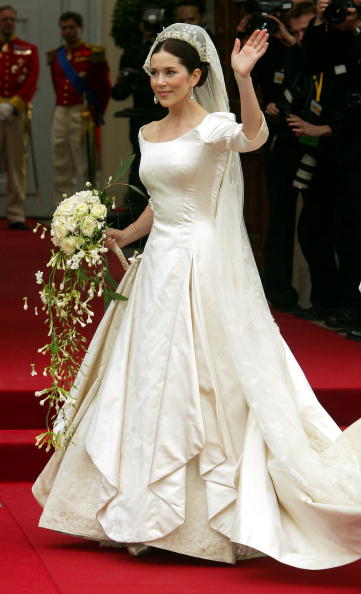
Another Scandinavian royal wedding was in Copenhagen Denmark on May 14, 2005, when HRH Crown Prince Frederik married Mary Donaldson, an Australian.  They recently had twins, in January, 2011, a boy and a girl. Their older siblings are Prince Christian, born in 2005, and Princess Isabella, born in 2007.

Crown Princess Mary made a beautiful bride and her dress was picture perfect.  The overskirt draping makes graceful detailing near the hem, rather an unusual but pleasing feature.


Hollywood royalty was united with royalty from the tiny but rich principality of Monaco when film star Grace Kelly married Prince Rainer in 1956.

The very nigh neckline of the gown amused many observers who were well aware of Kelly’s reputation for behaving entirely contrary to her look of a perfectly-proper ice queen.  Princess Grace, mother of three royal children, died in a car crash in 1982. The Prince died in 2005.


David Armstrong-Jones, Viscount Linley, married Hon. Serena Stanhope in October of 1993 at St. Margaret’s, Westminster. He runs a thriving furniture business with a showroom in Pimlico which is quite fun to visit.  Fashion observers noted how the gown, by Bruce  Bobbins, resembled the neckline design of  Princess Margaret’s gown from 1960. The Viscount is Margaret’s eldest child. The Linleys have two children, Charles, born 1999, and Margarita, born 2002.


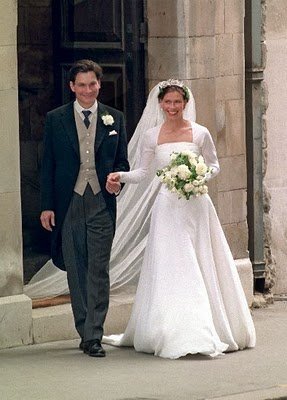
The very next year, Princess Margaret’s daughter Lady Sarah Armstrong-Jones married  actor Daniel Chatto at St Stephen Walbrook in the City of London on July 14,  1994. Her gown by Jasper Conran is elegantly traditional, though the venue for the ceremony was unusual for a member of the royal family.  The Chattos have two sons, born in 1996 and 1999.

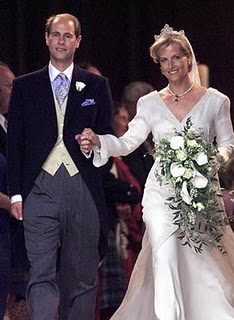
The last of Queen Elizabeth II’s sons to wed was Prince Edward. He married Sophie Rhys-Jones in 1999 at St. George’s Chapel, Windsor Castle, below.  They are titled the Earl and Countess of Wessex. The gown was designed by Samantha Shaw. The Wessexes have two children, Lady Louise, born 2003, and James, Viscount Severn, born in 2007.
 

The Queen’s eldest grandchild, Peter Phillips, married Canadian Autumn Kelly at St. George’s Chapel, Windsor Castle, on May 17, 2008.  The strapless dress was certainly au courant with its lace shrug, or bolero, if you wish. It was designed by Sassi Holford, one of the leading bridal gown providers in Britain.    The tiara worn by Autumn was the “something borrowed” — from Anne, Princess Royal,  Autumn’s new mother-in-law.

The Queen’s first great grandchild was born to Autumn and Peter on December 29, 2010, named Savannah.

Lady Rose Windsor, daughter of the Duke of Gloucester (cousin of Queen Elizabeth II), was married to George Gilman, on July 19, 2008 at the Queen’s Chapel, St. James Palace.  The gown is lovely and the tiara one loaned from the royal collection, but finding the name of the dress designer was impossible — all the press reports focused on what Kate Middleton was wearing.
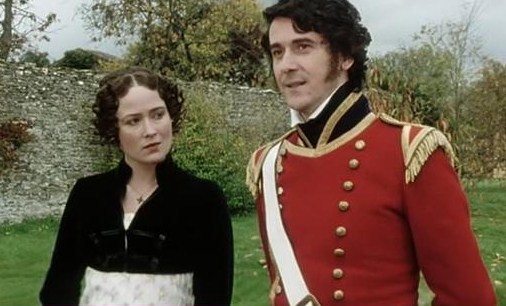
 

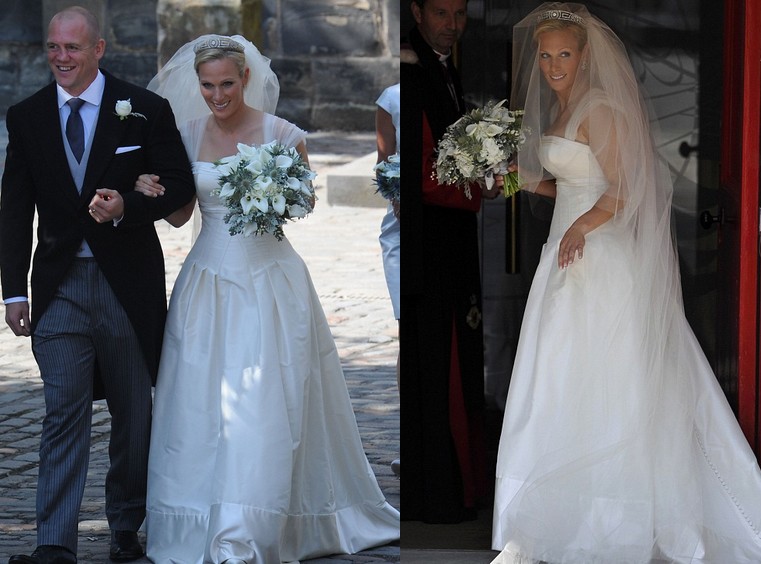
In addition to the wedding of Kate and Prince William, 2011 also saw the wedding of Zara Phillips, daughter of Anne, Princess Royal, and rugby star Mike Tindall on July 30.

A GARMENT BY ANY OTHER NAME

by Kristine Hughes Patrone

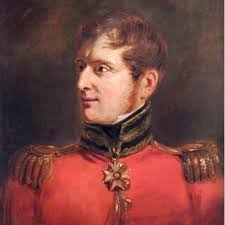
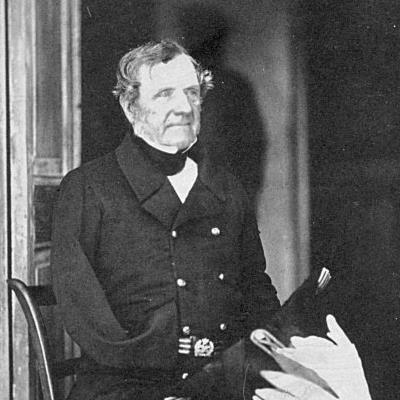
Recently, an article about the Raglan Sleeve brought home to me just how many garments and styles are named for people or places related to British History. Of course I’d been aware of the Raglan Sleeve prior to the article, but as I always think of Raglan as he was – FitzRoy Somerset, the Duke of Wellington’s ADC, private secretary and nephew-in-law (below) – I hadn’t readily connected the dots.


Fitzroy James Henry Somerset, later known as 1st Baron Raglan (below), was with Wellington at the Battle of Waterloo as a 23 year old aide-de-camp and suffered an injury caused by a musket ball that necessitated the amputation of his right arm. As the field surgeon was disposing of the limb, Raglan is purported to have cried out, “I say, bring me back my arm!” Those nearby thought he was delirious, until he explained  that the ring his wife had given him was still on the finger. She might be alright with his losing an arm, but she’d never forgive his losing the ring.

FitzRoy Somerset afterwards taught himself to write with his left hand and continued his military service and his work with Wellington. He also went on to wear a signature overcoat adapted with the sleeves set into a wide, loose armhole by the Aquascutum firm, with both sleeves continuing in one piece up to the neck, less defined shoulder seams and a more deconstructed appearance.
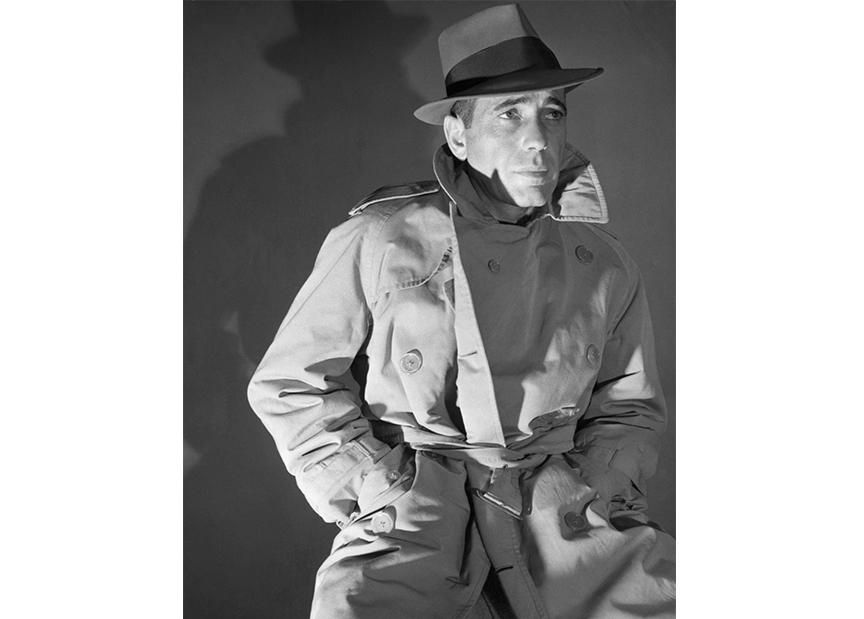
 

The Raglan coat remains a popular men’s style, while the Raglan sleeve is now a permanent part of our fashion lexicon thanks to the baseball t-shirt.


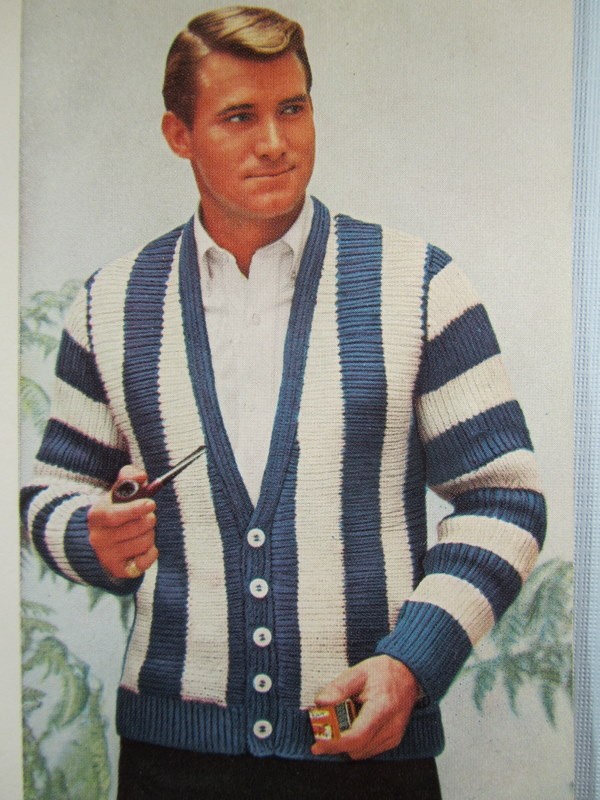
The cardigan sweater was named after James Brudenell, 7th Earl of Cardigan, who led the Charge of the Light Brigade at the Battle of Balaclava during the Crimean War. Fashion lore tells us it was modelled after the knitted wool waistcoat typically worn by British officers.

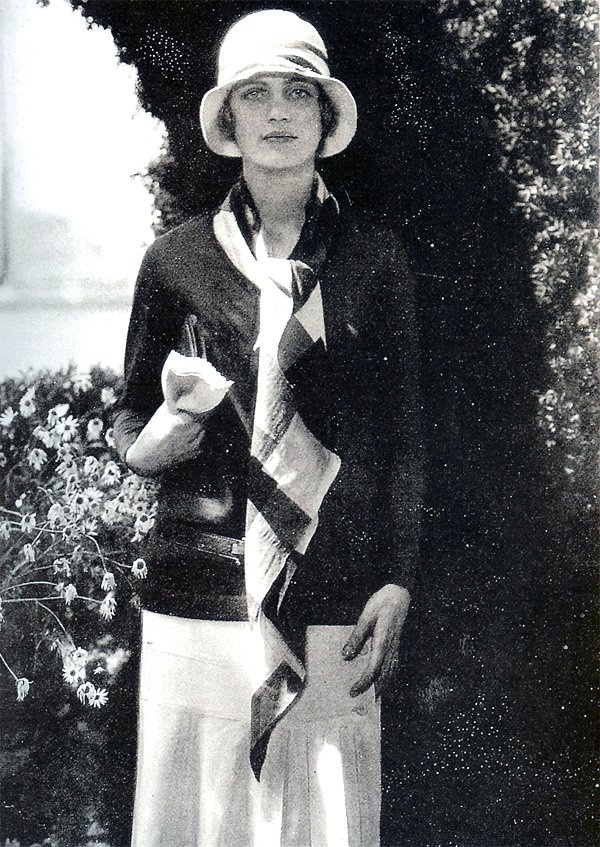
The Cardigan sweater remains a staple of men’s wear, while Coco Chanel is credited with popularizing the feminine version of the look.


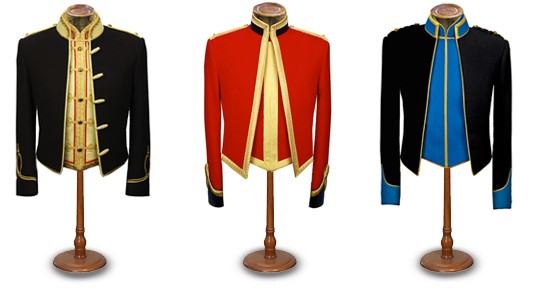
The Spencer coat dates from the 1790’s when, legend has it, George Spencer, 2nd Earl Spencer, got too close to an open fire and burnt the tails of his coat, prompting him to order his tailor to make him a jacket sans tails. The Spencer is a shorter, double breasted, waist-length coat, alternately called a mess jacket, as the style was taken up by officers in the British army, as seen below.


Fans of period dramas will recognize the Spencer as being a popular ladies’ garment during the Regency era.


The Macintosh, or Mackintosh, raincoat was invented by Scotsman Charles Macintosh as a waterproof coat made from an early rubberized fabric and first made it’s appearance in 1824.

The “mack” has nowadays evolved into the trench coat, but to be considered a true Mack, the coat should be made from waterproof material.

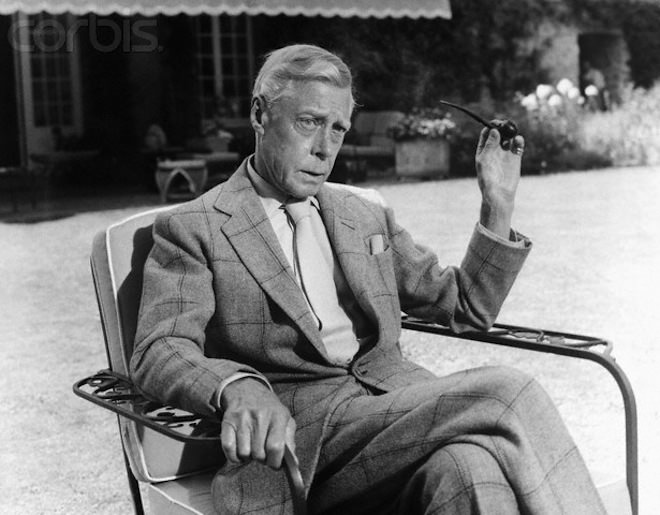
The Duke of Windsor did not invent the Windsor knot, or tie. That’s right. It was his father, King George V, who favoured wide tie knots and had his tailor cut his ties from a wider cloth, so that the knot would be wider than the traditional four-in-hand knot style that was preferred at the time.


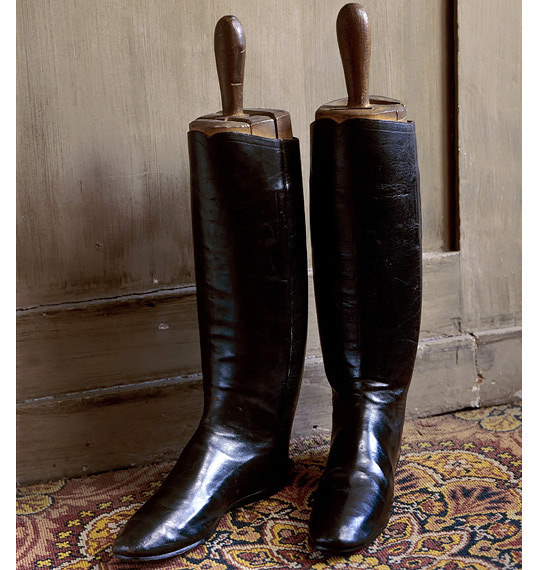
Wellington boots were “invented” by the Duke of Wellington, who directed his bootmaker, Lobb, to cut down traditional leather Hessian boots in order to make them more comfortable when riding on horseback for long periods of time. Today, Wellington boots are more often made of rubber and are indispensable for outdoor wear.


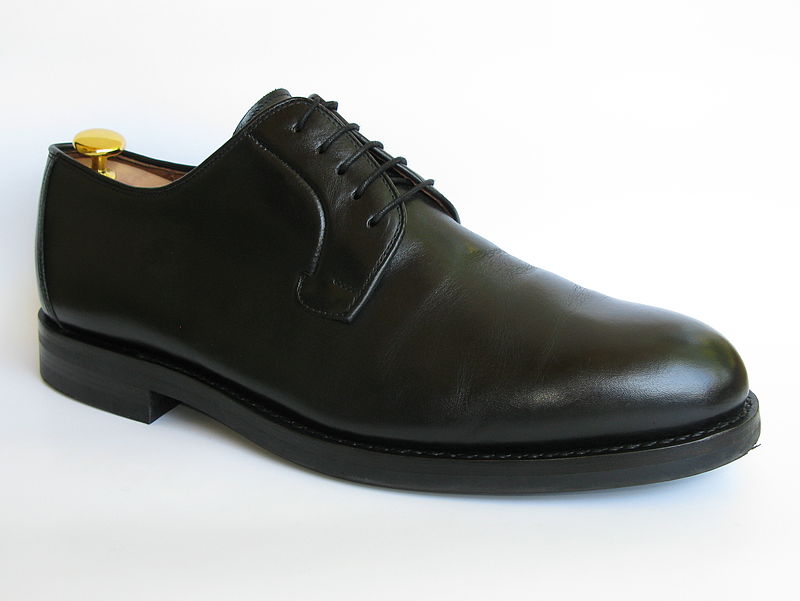
The Blücher is a type of oxford (closed shoe) in which the tongue and vamp (the front part of the shoe) are cut in one. The Blücher is named after the 18th century Prussian field marshal Gebhard Leberecht von Blücher, who commissioned a boot with side pieces lapped over the front in an effort to provide his troops with improved footwear.

The Blücher shoe.

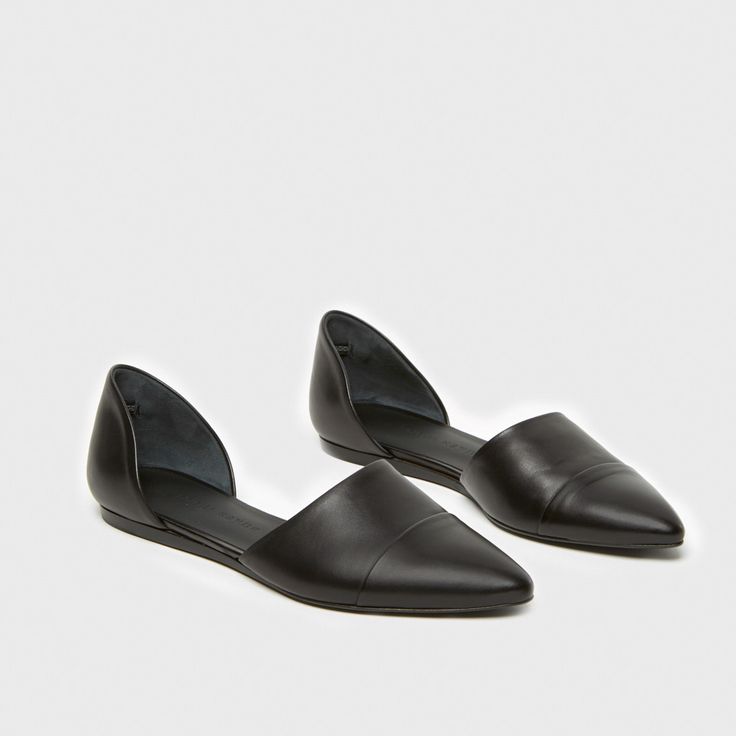
The d’Orsay shoe or slipper refers to any shoe that has a closed heel and toe but which is cut down to the sole at the sides. It can be made with a heel of any type and any style of vamp (front). The style is one of several fashions named after the Count d’Orsay, a fashionable dandy living Paris in the mid-1800s, who went on to marry Lady Blessington.

Today, the term “d’Orsay shoe” is used to describe any women’s shoe that exposes the arch of the foot.

Can you think of any other fashion terms named after persons from history? If so, please share them with us with a comment.

ROYAL WEDDING GOWNS

by Victoria Hinshaw

Originally posted on February 12, 2011, ahead of the other wedding of the decade, that of William and Katherine.

As I write this, there is no word on the designer Kate Middleton has chosen to create her wedding gown, though I have heard many breathless accounts of who is and who is not in the running.  So let’s indulge our royal wedding mania by looking at some of the gowns worn in the past.

Above is the dress worn by Princess Charlotte of Wales at her May 2, 1816, wedding to Prince Leopold of Saxe-Coburg, as exhibited in the Museum of London here.

The Lady’s Magazine of May, 1816, described the gown: White silk net embroidered in silver strip with a spotted ground and borders. The wedding dress, composed of a most magnificent silver lama on net, over a rich silver tissue slip, with a superb border of silver lama embroidery at the bottom, forming shells and bouquets above the border; a most elegant fullness tastefully designed, in festoons of rich silver lama, and finished with a very brilliant rollio of lama; the body and sleeves to correspond, trimmed with a most beautiful point Brussels lace, in a peculiar elegant style.
The manteau of rich silver tissue lined with white satin, trimmed round with a most superb silver lama border, in shells to correspond with the dress, and fastened in front with a most brilliant and costly ornament of diamonds. The whole dress surpassed all conception in the brilliancy and richness of its effects. Head dress, a wreath of rose buds and leaves, composed of the most superb brilliants.”  At right, an engraving of Charlotte and Leopold at their wedding in Carlton House. 
 

The portrait of Queen Victoria, at left, is by Winterhalter. It shows a rather wistful young bride at the time of her wedding to Prince Albert of Saxe-Coburg (nephew of the above-mentioned Leopold) on February 10, 1840 in the Chapel Royal of St. James Palace.
It was this gown and veil that supposedly has inspired generations of brides ever since to wear white for their ceremonies, though many brides had previously dressed in fashionable white as well as in a variety of other hues.

At right, an image of Queen Victoria’s dress on a mannequin in the collection of Kensington Palace. 

Left, the wedding gown of Alexandra of Denmark, who married Victoria’s son, eventually King Edward VII, on March 10, 1863 in St. George’s Chapel at Windsor Castle. She was Princess of Wales for almost forty years before becoming Queen in 1901. After her husband’s death in 1910, she was known as the Queen Mother until she died in 1925.

Like Charlotte’s mother, Caroline, Princess of Wales, and like the first wife of the present Prince of Wales, Diana (see below), Alexandra had to endure the infidelity of her husband.  But unlike the other two, she stuck with him to the end. We’ve all heard the possibly-apocryphal story about how Alexandra invited one of his mistresses, Alice Keppel, to comfort Edward VII on his deathbed.


Princess Mary of Teck wed Prince George, Duke of York on 6 July, 1893 in the Chapel Royal of St. James Palace. She had been engaged to Prince Albert Victor, eldest son of the Prince of Wales in 1891, but Albert Victor died in the great influenza epidemic of 1891-92.  Mary and George fell in love and were married with the approval of Queen Victoria as well as Edward and Alexandra, Prince and Princess of Wales.  George succeeded his father as George V in 1910.  Queen Mary, who was a godchild of Queen Victoria, had five sons and one daughter.
Her eldest son, known to all as David, was more than a disappointment. After inheriting the throne as Eward VIII in 1936, he abdicated less than a year later to marry Wallis Simpson.


After her husband’s death, Queen Mary chose to be addressed as Her Majesty, Queen Mary, rather than as Queen Mother.  She was very supportive of her second son, who became King George VI after his brother’s departure from the throne. According to several sources, she was the first dowager queen of Great Britain to ever attended the coronation ceremony of her husband’s successor.


As Duke of York, the second son of George V and Mary grew up in the  shadow of his dashing older brother.  He married Lady Elizabeth Bowes-Lyon  on 26 April 1923 in Westminster Abbey. At the time of the wedding, it was not expected that “Bertie” would take the throne. Lady Elizabeth’s gown, perhaps for that reason, was not as elaborate as some of her predecessors. It was certainly in the style of the day, a rather loose gown,  slightly less than floor length.  Below is the dress on a mannequin in a Kensington Palace exhibition of several years ago, along with a detail of the veil and bodice.

On 20 November, 1947,  Princess Elizabeth (later Queen Elizabeth II) married Prince Philip of Greece (later Duke of Edinburgh) in Westminster Abbey. The designer was Norman Hartnell and the fabric is silk spun at Lullingstone Castle in Kent. She wore a diamond and pearl tiara and a filmy veil. The long train was decorated with traditional symbols, such as Tudor roses and wheat.  All the details of the royal romance, the wedding, the gown and the ceremony were eagerly read around the world. It is said the happy event was like a tonic to the war-weary Britons still enduring shortages of goods and rationing.


The Gown on a mannequin


Princess Margaret, second daughter of King George VI, married Antony Armstrong-Jones (later Earl of Snowdon) on  May 6, 1960, at Westminster Abbey. Television cameras covered the event and the broadcast was seen worldwide. Like her sister, Margaret chose Norman Hartnell to design her bridal gown.The couple had two children: David, Viscount Linley in 1961 and Lady Sarah Armstrong-Jones in 1964. The Snowdons were divorced in 1978 and Princess Margaret died in 2002.

14 November 1973  – Anne, Princess Royal, married Captain Mark Phillips in Westminster Abbey. Born in 1950, she is Queen Elizabeth II’s only daughter.  Anne and Phillips have two children, Peter Phillips born in 1977 and Zara Phillips born in 1981. After divorcing Phillips in 1992, Anne married Timothy Laurence, in Scotland on December 12, 1992.


On 29 July 1981, Lady Diana Spencer and Charles, Prince of Wales, were married in St Paul’s Cathedral. Her dress was controversial — and still is. The designers, David and Elizabeth Emmanuel, immediately shot to the top echelon of British fashion. Like many of Diana’s fashions, the gown (or a replica) travels around the world for popular exhibition.


Charles and Diana had two sons, Prince William, born in 1982, and Prince Harry, born in 1984, before separating
 in the late 1980s, the Prince living in Highgrove and the Princess at Kensington Palace.  Formal separation came in 1992 and the marriage of Charles and Diana ended in divorce on 28 August 1996. On 31 August 1997, a year after the Prince and Princess divorced, Diana died in a car crash in Paris.

Sarah Ferguson and Prince Andrew, the Duke of York, married at Westminster Abbey on 23 July 1986. The Duke and Duchess of York had two children during their marriage: Princess Beatrice of York (born 1988) and Princess Eugenie of York (born 1990). They separated in 1992 and divorced in 1996, though they are often together for vacations and family events. 


Of all the gowns shown above, I think I like Sarah’s best, as designed by Lindka Cierach.  It is beautiful, flattering to her and has no gimmicks.  Princess Elizabeth’s was lovely too, but I like Sarah’s veil better.  All in all this one is the winner in the gown category, if perhaps not in the list of “most suitable royal brides.”


If like us, you can’t get enough of this wedding stuff, here is a wonderful exhibition from the Royal Collection you will enjoy.