BOXED IN AT ROYAL ALBERT HALL

by Kristine Hughes Patrone


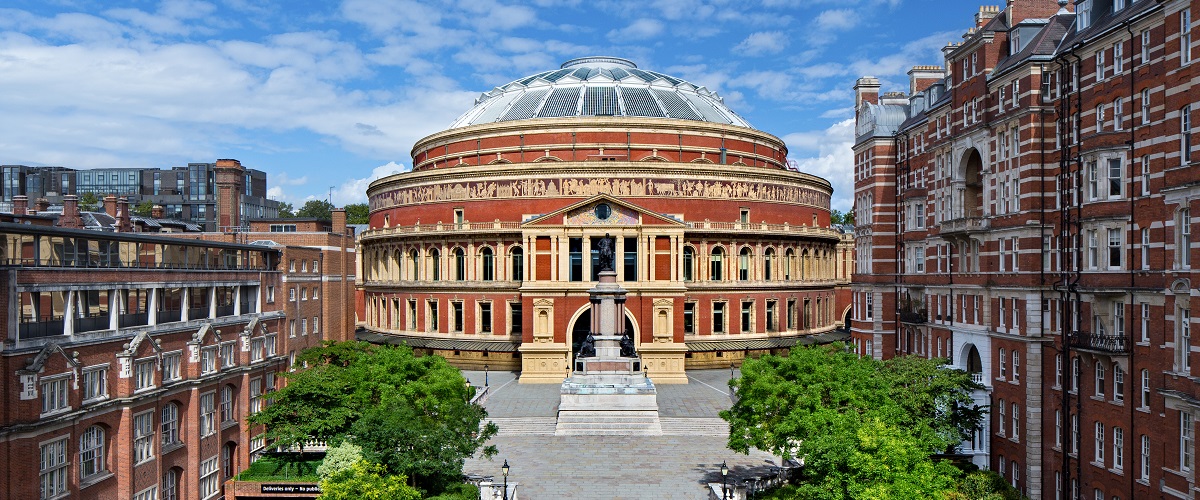
“Opposite the Albert Memorial is the Royal Albert Hall, an immense oval brick building in Italian renaissance style, ornamented with a terra cotta frieze, executed by Minton & Co., and designed by eminent English artists. The exterior measurement of the Hall is 272 by 238 ft, and the interior 219 ft by 185 ft.  The total cost of the building was £200,000, of which £100,000 was raised by public subscription, £50,000 was given out of the profits of the Great Exhibition of 1851, and the remainder was raised by the sale of the private boxes.”  From Paterson’s Guide Book to the United Kingdom, 1885

Last year, Number One London Tours was invited to attend the Visit Britain travel expo in Brighton, where I was fortunate enough to meet travel and site managers from a wide variety of outlets in Britain. One of these was the guest services representative from London’s Royal Albert Hall, who told me that the private boxes were owned by individuals, many of whom had ancestors who had been the first to purchase the boxes, which at the time came with a 999 year lease. More often than not, the leases were left to the next generation via a will and the private boxes very rarely came up for sale. Intrigued, I decided to investigate this further.

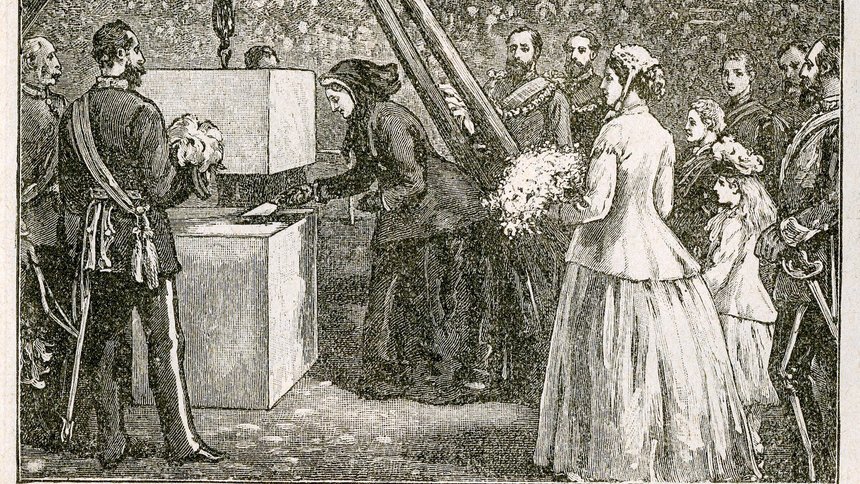
Queen Victoria lays the foundation stone at the Royal Albert Hall. 7,000 people gathered under a purpose-built marquee to watch HM Queen Victoria lay the Hall’s red Aberdeen granite foundation stone, which today can be found underneath K stalls, row 11, seat 87 in the main auditorium.

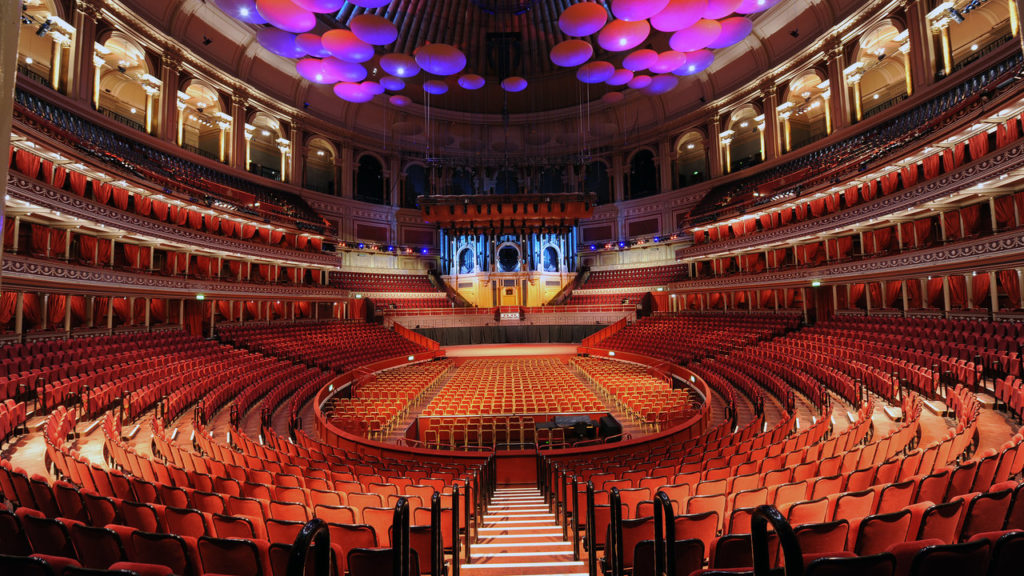
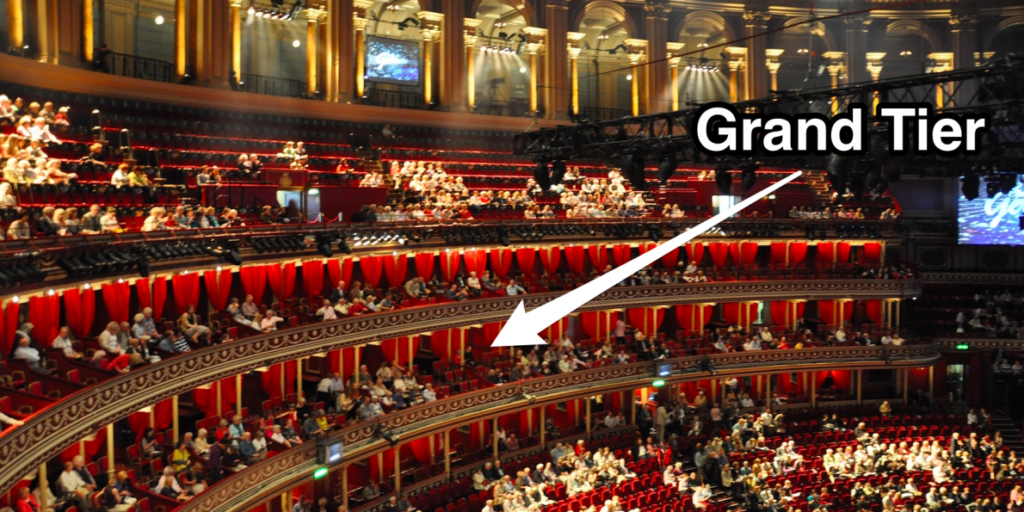
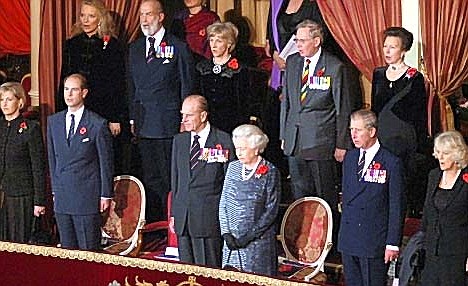
In the 1860s, 1,200 of the Hall’s 5,500 seats were sold to private individuals for £100 each to finance the Hall’s construction, each seat having a 999 year lease and allowing access to most of its music, sporting and other events, subject to an annual service charge. Queen Victoria prudently snapped up 20, and the Queen’s Box, located on the Grand Tier, is still in the possession of the monarchy. The first Victorian box owners were also allowed to decorate their boxes as they saw fit, putting their personal touches to the space by the use of paint, fabrics, carpeting, plaster-work and mirrors.

Today there are around 1,300 seats – in boxes and the stalls – privately owned by individuals and companies. Members receive tickets for roughly 200 nights of the year, with a third of the annual 330 performances being ‘exclusive’, and sold separately by the Hall.

So, how much would a box fetch on the open market? Harrods Estates say that the last box of this size sold privately for £248,000, and 18 months ago another sold for £230,000 (it was bought as a wedding anniversary present). A larger, 10-seat box on the grand-tier was on the market for £300,000 in 1995, and another had an asking price of £375,000 in 2001. But keep in mind, for that price, you also get a lot of history.

Gore House, Kensington

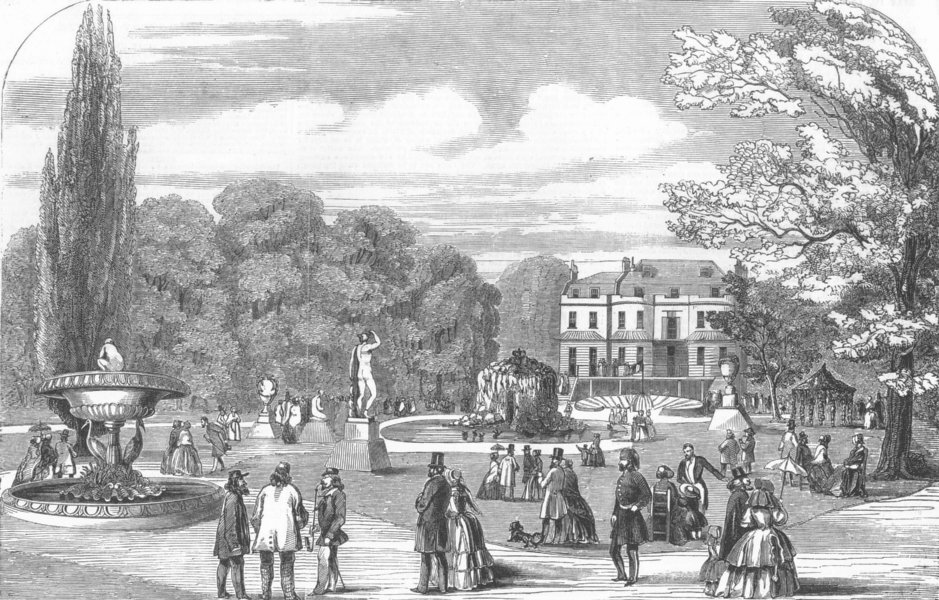
The Royal Albert Hall was built on what was once the Gore estate, at the centre of which stood Gore House. The three acre estate was occupied by political reformer William Wilberforce between 1808-1828 and subsequently occupied between 1836-1849 by the Countess of Blessington and Count D’Orsay.

After the couple left for Paris in May 1851, the house was opened as the ‘Universal Symposium of All Nations’, a restaurant run by the first celebrity chef, Alexis Soyer, who planned to cater for the Great Exhibition in Hyde Park. After the Exhibition and following the advice of Prince Albert, Gore House and its grounds were bought by the Exhibition’s Royal Commission to create the cultural quarter known as Albertopolis, a complex of public Victorian buildings developed to house exhibits from the Great Exhibition and to further the study of art, science and industry.


But let us leave both the good Queen Victoria and good works behind us now and return to the filthy subject of money. The following is from an article in The Telegraph dated 9 January 2017:

“Members of the public with deep pockets are being offered a once in a decade chance to buy a box at the Royal Albert Hall next to the Queen for £2.5 million. Nicholas Shaw, sales manager of Harrods Estates Kensington, said he thought the box would be sold to “true lovers of the arts”. He said: “This Grand Tier box at the Royal Albert Hall is a real generational purchase, and is the first of its kind that is available to buy for almost a decade. The box is ideal for entertaining, with its twelve seats, and provides enviable views over the main stage and auditorium.”

“Richard Lyttelton, who was president of the Royal Albert Hall from 2010 to 2011, owns four seats but has never sold of them to third parties, choosing instead to return them to the box office for sale at face value. In 2011, a five-seat box on the second tier was put up for sale for £550,000. A ten-seat box on the Grand Tier was offered three years earlier for £1.2 million.”

A Royal Albert Hall spokesman said: “The seats are private property as set out in the royal charter which established the hall in 1861. As such the hall is not able to intervene as the seat holders’ rights are enshrined in law.”

BONING WELLINGTON BOOTS


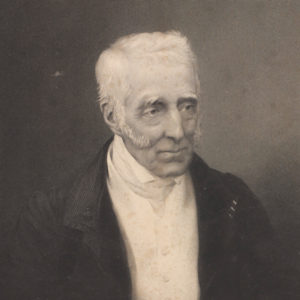
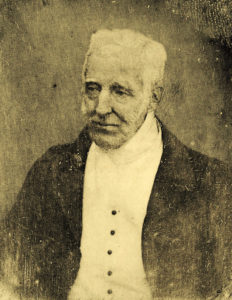
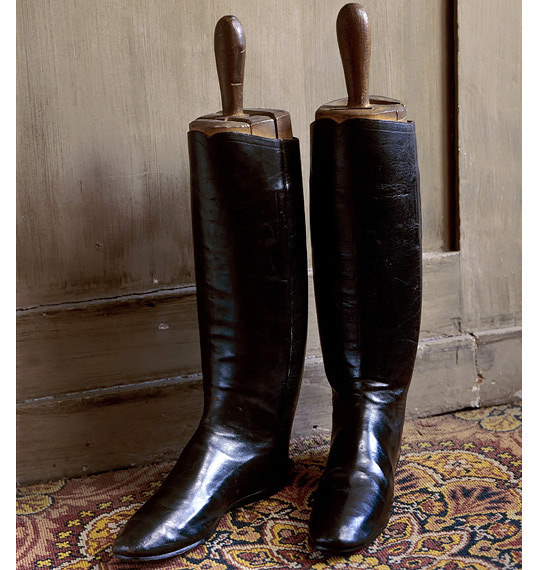
The Duke of Wellington was 75 when the image above was taken in 1844 by Antoine Claudet, court photographer to Queen Victoria and Emperor Napoleon III. By this time, the Duke’s lumbago, which he had periodically suffered from for decades, was a constant bane, as was the rheumatism in his neck, which caused him to favour one shoulder, giving him a slightly stiff appearance. In addition, a botched ear operation, performed after he’d suffered hearing loss from a canon charge, resulted in his being deaf in one ear. This hearing loss progressed and made his life a misery in later years. Still, if there was one thing sure to set off Wellington’s anger, it was people making him solicitous offers of help or assistance, however kindly they were meant. Wellington would explode and tell anyone who would listen that he remained perfectly capable of taking care of himself, thank you very much, and that he indeed did take care of himself on a daily basis. In one such recorded outburst, Wellington said that he shaved himself daily, bathed himself daily, was perfectly capable of brushing his own hair and, by God, he’d still be boning his own boots if he still had the strength!

Wellington’s Wellington boots

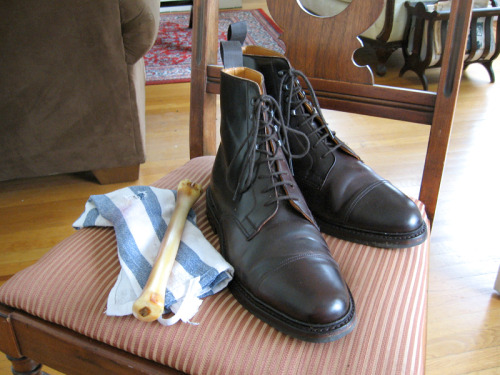
Boning his boots? I’ve been at this research malarkey for thirty years and had never heard the term. What in the world? Turns out that boning boots was a method of treating and shining boot leather using a, er, bone.


According to the Top Horse website, “in days gone by, a technique called ‘boning’ was used to give leather boots a mirror finish. This was done by taking the rib bone from a lamb (hence the term), boiling off the flesh and using that to work the polish into the leather.”

Deer bones were also used, as you’ll see in this video which explains the process.

Let’s be honest, not many of us are willing to go to this extreme, unless we’re serving at Horse Guards or riding with the Belvoir Hunt, so here’s a simpler method, again according to Top Horse and written by Claire Uren:

What you will need:

• Kiwi Parade Gloss, black for top boots and brown for jodhpur boots. The Kiwi Parade Gloss ($5.50) is best, other polishes don’t work as well for this technique.

• A bowl of hot water

• An old, soft towel (one that has gone through fabric softener and a tumble drier is ideal)

• Hair dryer

• Methylated spirits

• Elbow grease!

The true secret to a great shine is to fill the pores in the leather which creates a smooth ‘mirror’ surface.

Step 1

Get plenty of Kiwi Parade Gloss on your old towel, dip in the hot water and work into your boots.

Step 2

Take the first boot and using the rest of the old towel, polish both boots until your arms ache….this is where the elbow grease comes in!

Step 3

Repeat step one but DON’T polish the boots.

The Queen
The Queen’s Guards have boot polishing down to a fine art


Step 4

Take your hair dryer and using the highest heat setting on the lowest speed, apply heat to the boot so the polish melts into the pores of the leather. If you watch closely you’ll see that the polish where the heat is applied becomes becomes very shiny. You can even repair scuffs or scratches by adding a little extra Parade Gloss and being careful how you melt it.

Step 5

Polish both boots again as much as your arms can stand it…the more the better!

Step 6

Time to ride in your shiny boots!. Some polish may flake off where the leather creases, but just buff with a soft cloth.

The next time you go to polish your boots, clean them with methylated spirits first. This will make the leather appear milky and foggy looking but this is normal. Then repeat the above steps and you’ll be amazed at how much better the boots will look after the second go.

Ready made boot shines are okay, but the Parade Gloss method is more satisfying and is also low maintenance.

Of course, this will only work with leather top boots, don’t try it on your rubber ones! You can shine them up with the help of furniture polish such as Mr Sheen.

If anyone compliments you on your beautifully shiny riding boots, tell them you learned how to do it at Top Horse!

(Please note: This technique is not advised for children to attempt.)


THE LONDON POST OFFICE 1850 – Part Three

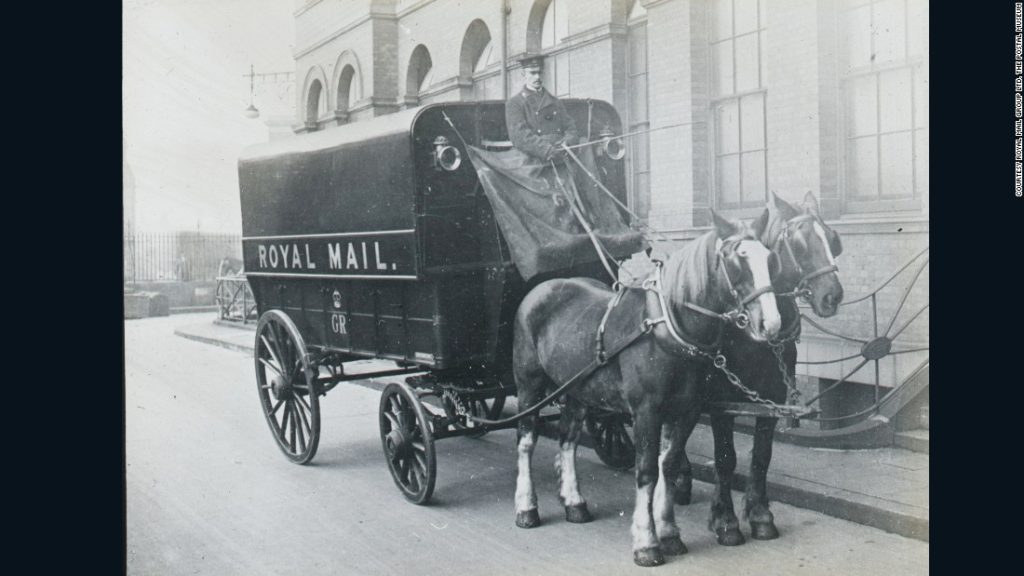
In this series, we turn to the words of Mr. Charles Dickens which appeared in the March 30, 1850 edition of the publication he edited, Household Words. The following article is chock full of details about how the Post Office operated in Victorian London and also about the mail and other items it processed on a daily basis.

The piece follows the progress of two gentlemen who make a visit to the Post Office and Part Three continues –

The friends were informed that 70,000,000 newspapers pass through all the post-offices every year. Upwards of 80,000,000 newspaper stamps are distributed annually from the Stamp office; but, most of the London papers are conveyed into the country by early trains. On the other hand, frequently the same paper passes through the post several times, which accounts for the small excess of 10,000,000 stamps issued over papers posted. In weight, 187 tons of paper and print pass up and down the ingenious ” lift” every week, and thence to the uttermost corners of the earth—from Blackfriars to Botany Bay, from the Strand to Chusan.

The system of stamping, sorting, and arranging, is precisely similar to that in the District Branch; and, by his recently acquired knowledge of it, the person who posted the coloured letters was able to trace them through every stage, till they were tied up ready to be ” bagged,” and sent away.

In an opposite side of the enormous apartment, a good space and a few officials are devoted to repairing the carelessness of the public, which is, in amount and extent, scarcely credible. Upon an average, 300 letters per day pass through the General Post-office totally unfastened; chiefly in consequence of the use of what stationers are pleased to call ” adhesive” envelopes. Many are virgin ones, without either seal or direction; and not a few contain money. In Sir Francis Freeling’s time, the sum of 5000 pounds in Bank-notes was found in a ” blank.” It was not till after some trouble that the sender was traced, and the cash restored to him. Not long since, an humble post-mistress of an obscure Welsh post-town, unable to decipher the address on a letter, perceived, on examining it, the folds of several Bank-notes protruding from a torn edge of the envelope. She securely re-enclosed it to the secretary of the Post-office in St. Martin’s-le-Grand; who found the contents to be 1500 pounds, and the superscription too much even for the hieroglyphic powers of the “blind clerk.” Eventually the enclosures found their true destination.


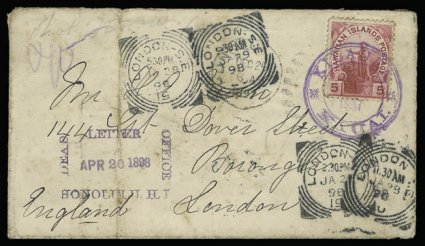
It is estimated that there lies, from time to time, in the Dead-Letter-office, undergoing the process of finding owners, some 11,0007. annually, in cash alone. In July, 1847, for instance—only a two months’ accumulation— ,the post-haste of 4658 letters, all containing property, was arrested by the bad superscriptions of the writers. They were consigned—after a searching inquest upon each by that efficient coroner, the ” blind clerk”—to the Post-office Morgue. There were Banknotes of the value of 10107., and money-orders for 4077. 12s. But most of these ill-directed letters contained coin in small sums, amounting to 3107. 9s. 7d. On the 17th of July, 1847, there were lying in the Dead-Letter-office bills of exchange for the immense sum of 40,4107. 5s. 7d.

“I assure you,” said a gentleman high in this department, ” it is scarcely possible to take up a handful of letters without finding one with coin in it, despite the facilities afforded by the money-order system. All this is very distressing to us. The temptation it throws in the way of sorters, carriers, and other humble employes is greater than they ought to be subjected to. Seventy men have been discharged for dishonesty from the District-office alone during the past two years.”

“But the public do use the Money-Order-office extensively?”

This question was startlingly answered by reference to a Parliamentary return, which showed that there were issued in England and Wales alone, during the year which ended on the 5th of January, 1849, 3,468,823 Post-office orders for sums amounting to the enormous aggregate of 6,861,803 pounds.

 It was approaching eight o’clock, and the “Miller and his Men” above stairs were delivering their sacks from the mouth of the ever-revolving mill at an incessant rate. These, filled nearly to choking with newspapers, were dragged to the tables, which the brass label fastened to the corner of each bag marked as its own, to have the letters inserted. Our friends rushed to where they saw “Edinburgh” painted up on the walls, and there they beheld their yellow, green, and red letters in separate packets, though destined for the same place; just as they had come in at first from Fleet-street. The bundles were popped in a trice into the Edinburgh bag, which was sealed and sent away. Exactly the same thing was happening to every bundle of letters, and to every bag on the premises.
The clock now struck eight, and the two visitors looked round in astonishment. Had they been guests at the ball in ” Cinderella,” when that clock struck they would not have been more astonished; for hardly less rapidly did the fancy dresses of the postmen disappear, and the lights grow dim. This is the most striking peculiarity of the extraordinary establishment. Everything is done on military principles to minute time. The drill and subdivision of duties are so perfect that the alternations throughout the day are high pressure and sudden collapse. At five minutes before eight the enormous offices were glaring with light and crowded with men; at ten minutes after eight the glass slipper had fallen off, and there was hardly a light or a living being visible.

“Perhaps, however,” it was remarked, as our friends were leaving the building, ” an invisible individual is now stealthily watching behind the ground glass screen. Only the other day he detected from it a sorter secreting 140 sovereigns.”

It is a deplorable thing that such a place of observation should be necessary; but it is hardly less deplorable—and this should be most earnestly impressed upon the reader—that the public, now possessed of such conveniences for remitting money, by means of Post-office Orders and Registered Letters, should lightly throw temptation in the way of these clerks by enclosing actual coin. No man can say that, plac
ed in such circumstances from day to day, he could be steadfast. Many may hope they would be, and believe it; but none can be sure. It is in the power, however, of-every conscientious and reflecting mind to make quite sure that it has no part in this class of crimes. The prevention for this one great source of misery is made easy to the public hand, and it is the public’s bounden duty to adopt it. They who do not, cannot be blameless.

Such is the substance of information obtained by our friends before they took leave of the mighty heart of the postal system of this country.

The End

THE LONDON POST OFFICE 1850 – Part Two

In this series, we turn to the words of Mr. Charles Dickens which appeared in the March 30, 1850 edition of the publication he edited, Household Words. The following article is chock full of details about how the Post Office operated in Victorian London and also about the mail and other items it processed on a daily basis.

The piece follows the progress of two gentlemen who make a visit to the Post Office and Part Two continues –

” Is it possible?” exclaimed one of the visitors, regarding the piles of epistles on the numerous tables “that this mass of letters can be arranged and sent away to their respective addresses in time to receive the next collection, which will arrive in less than an hour?”

“Quite,” replied an obliging informant; ” I’ll tell you how we do it. We have divided London into seventeen sections. There they are, you perceive.” He then pointed to the tables with pigeon-holes numbered from one to seventeen; one marked “blind,” with a nineteenth labelled “general.” It was explained that the proper arrangement of the letters in these compartments constitutes the first sorting. They are then sorted into subdivisions; then into districts, and finally handed over to the letter-carriers, who, in another room, arrange them for their own convenience into ” walks.” As the visitors looked round they perceived their coloured envelopes—which were all addressed to Scotland, suddenly emerge from a chaotic heap, and lodged in the division marked ” general,” as magically as a conjuror causes any card you may choose to fly out of the whole pack. “These letters,” remarked the expositor, “being for the country, will be presently passed into the Inland-office through a tunnel under the hall. ” The ‘ blind’ letters have superscriptions which the sorters cannot decipher, and are sent to the ‘ blind’ table, where a gentleman presides, to whom, from the extreme sharpness of his vision, we give the lucus a non lucendo name of the ‘ blind clerk.’ You will have a specimen of his powers presently.”

While this dialogue was going on there was a general abatement of the noise of stamping and shuffling letters; and, when the visitors looked round, the place had relapsed into its former tranquillity. It was scarcely credible that from 30,000 to 40,000 letters had been received, stamped, counted, sorted, and sent away in so short a time. “A judicious division of labour,” remarked one of our friends, “must work these miracles.”

“Yes, sir,” was the reply of an official. “There are from 1200 to 1700 of us to do the work of the district post alone. When it was removed from Gerrard-street to this building there was not a quarter of that number. For instance—then, three carriers sufficed for the Paddington district; but, by the despatch you have just seen completed, we have sent off 2000 letters to that single locality by the hands of twenty-five carriers.”

” The increase is attributable to the penny system?” interrogated one of our inquiring friends.

” Entirely.”

The questioner then referred to a Parliamentary paper of which he had obtained possession. It showed him the history of general postal increase since the era of dear distance rates. In 1839—under the old system—the number of letters which passed through the post was 76 millions. In 1840 came the uniform penny, and for that year the number was 162 millions, or an increase of 93 millions, equal to 123 per cent. That was the grand start; afterwards the rate of increase subsided from 36 per cent. in 1841, to 16 per cent. in 1842 and 1843. In 1845, and the three following years, the increase was respectively, 39, 37, and 30 per cent. Then succeeded a sudden drop; perhaps the culminating point in the rate of increase had been attained. The Post-office is, however, a thermometer of commerce: during the depressing year 1848, the number of letters increased no more than 9 per cent. But last year 337,500,000 epistles passed through the office, being an augmentation of 8,500,000 upon the preceding year, or 11 per cent, of progressive increase. Another Parliamentary document shows, that, although the business is now four and a half times more than it was in 1839, the expense of doing it has only doubled. In the former year the cost of the establishment was not quite 690,000/.; in 1849 it was about 1,400,000/.
While one visitor was poring over these documents, the other deliberately watched the coloured envelopes. They were, with about 2000 other General Post letters, put into boxes and taken to the tunnel to be conveyed into the Inlandoffice upon a horizontal band worked by a wheel. The two friends now took leave of the District Department to follow the objects of their pursuit.

It was a quarter before six o’clock when they crossed the Hall—six being the latest hour at which newspapers can be posted without fee.
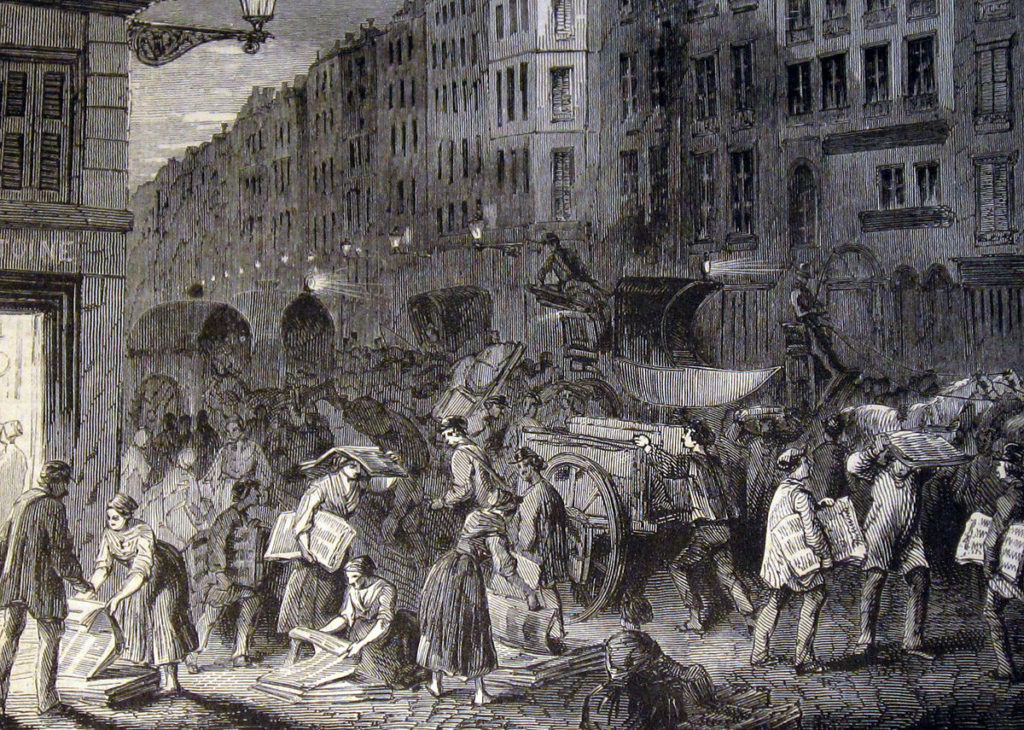
It was then just drizzling newspapers. The great window of that department being thrown open, the first black fringe of a thunder-cloud of newspapers impending over the Post office was discharging itself fitfully—now in large drops, now in little; now in sudden plumps, now stopping altogether. By degrees it began to rain hard; by fast degrees the storm came on harder and harder, until it blew, rained, hailed, snowed, newspapers. A fountain of newspapers played in at the window. Water-spouts of newspapers broke from enormous sacks, and engulphed the men inside. A prodigious main of newspapers, at the Newspaper River Head, seemed to be turned on, threatening destruction to the miserable Post-office. The Post-office was so full already, that the window foamed at the mouth with newspapers. Newspapers flew out like froth, and were tumbled in again by the bystanders. All the boys in London seemed to have gone mad, and to be besieging the Post-office with newspapers. Now and then there was a girl; now and then a woman; now and then a weak old man: but as the minute hand of the clock crept near to six, such a torrent of boys, and such a torrent of newspapers came tumbling in together pell-mell, head over heels, one above another, that the giddy head looking on chiefly wondered why the boys springing over one another’s heads, and flying the garter into the Post-office with the enthusiasm of the corps of acrobats at M. Franconi’s, didn’t post themselves nightly, along with the newspapers, and get delivered all over the world.

Suddenly it struck six. Shut, Sesame! Perfectly still weather. Nobody there. No token of the late storm—Not a soul, too late!

But what a chaos within! Men up to their knees in newspapers on great platforms; men gardening among newspapers with rakes; men digging and delving among newspapers as if a new description of rock had been blasted into those fragments ; men going up and down a gigantic trap—an ascending and descending-room worked by a steam-engine—still taking with them nothing but newspapers. All the history of the time, all the chronicled births, deaths, and marriages, all the crimes, all the accidents, all the vanities, all the changes, all the realities, of all the civilised earth, heaped up, parcelled out, carried about, knocked down, cut, shuffled, dealt, played, gathered up again, and passed from hand to hand, in an apparently interminable and hopeless confusion, but really in a system of admirable order, certainty, and simplicity, pursued six nights every week, all through the rolling year. Which of us, after this, shall find fault with the rather more extensive system of good and evil, when we don’t quite understand it at a glance; or set the stars right in their spheres?

Part Three Coming Soon!
THE LONDON POST OFFICE 1850 – Part One

In this series, we turn to the words of Mr. Charles Dickens which appeared in the March 30, 1850 edition of the publication he edited, Household Words. The following article is chock full of details about how the Post Office operated in Victorian London and also about the mail and other items it processed on a daily basis.

The piece follows the progress of two gentlemen who make a visit to the Post Office –


Great National Post-Office in St. Martin’s-le-Grand

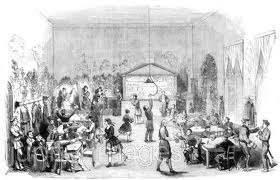
Most people are aware that the Great National Post-office in St. Martin’s-le-Grand is divided into halves by a passage, whose sides are perforated with what is called the ” Window Department.” Here huge slits gape for letters, whole sashes yawn for newspapers, or wooden panes open for clerks to frame their large faces, like giant visages in the slides of a Magic Lantern; and to answer inquiries, or receive unstamped paid letters. The southern side is devoted to the London District Post, and the northern to what still continues to be called the “Inland Department,” although foreign, colonial, and other outlandish correspondence now passes through it. It was with the London District Branch that the two gentlemen first appeared to have business.

Having been led through a maze of offices and passages more or less dark, they found themselves—like knights-errant in a fairy tale—” in an enormous hall, illumined by myriads of lights.” Without being exactly transformed into statues, or stricken fast asleep, the occupants of this hall (whose name was Legion) appeared to be in an enchanted state of idleness. Among a wilderness of long tables, and of desks not unlike those on which buttermen perform their active parts of legerdemain in making ” pats”—only these desks were covered with black cloth—they were reading books, talking together, wandering about, lying down, or drinking coffee—apparently quite unused to doing any work, and not at all expectant of ever having anything to do, but die.

In a few minutes, and without any preparation, a great stir began at one end of this hall, and a long train of private performers, in the highest state of excitement, poured in, getting up, on an immense scale, the first scene in the ” Miller and his Men.” Each had a sack on his back; each bent under its weight; and the bare sight of these sacks, as if by magic, changed all the readers, all the talkers, all the wanderers, all the liers-down, all the coffee-drinkers, into a colony of human ants.

For the sacks were great sheepskin bags of letters tumbling in from the receiving-houses. Anon they looked like whole flocks suddenly struck all of a heap, ready for slaughter; for a ruthless individual stood at a table, with sleeves tucked up and knife in hand, who rapidly cut their throats, dived into their insides, abstracted their contents, and finally skinned them. “For every letter we leave behind,” said the bagopener, in answer to an inquiry, ” we are fined half-a-crown. That’s why we turn them inside out.”

The mysterious visitors closely scrutinised the letters that were disgorged. These were from all parts of London to all parts of London and to the provinces and to the far-off quarters of the globe. An acute postman might guess the broad tenor of their contents by their covers:—business letters are in big envelopes, official letters in long ones, and lawyers’ letters in none at all; the tinted and lace-bordered mean Valentines, the black-bordered tell of grief, and the radiant with white enamel announce marriage. When the despatch of the Fleet-street receiving-house appeared the visitors tracked it, and the operations of the clerk who separated the three bundles of which it consisted were closely followed. With the prying curiosity which now only began to show itself, one of the intruders took a copy of the bill which accompanied the letters. It set forth in three lines that there were so many ” Stamped,” so many ” Prepaid,” and so many ” Unpaid.”

The clerk counted the stamped letters like lightning, and a flash of red gleaming past showed the inquirers that one of their epistles was safe. Suddenly the motion was stopped; the official had instinctively detected that one letter was insufficiently adorned with the Queen’s profile, and he weighed and taxed it double in a twinkling. Having proved the number of stamped letters to be exactly as per account rendered, he went on checking off the prepaid, turning up the sender’s green missive in the process. He then dealt with the unpaid, amongst which the lookers-on perceived their yellow one. The cash column was computed and cast in a single thought, and a short-hand mark, signifying ” quite correct,” dismissed the Fleet-street bill upon a file, for the leisurely scrutiny of the Receiver-General’s office. All the other letters, and all the other bills of all the other receiving-houses, were going through the same routine at all the other tables; and these performances are repeated ten times in every day, all the year round, Sundays excepted.

” You perceived,” said one of the two friends, “that in the rapid process of counting our stamped letter gleamed past like a meteor, whilst our money-paid and unpaid epistles remained long enough under observation for a careful reading of the superscriptions.”

“That delay,” said an intelligent official, “is occasioned because the latter are unstamped. Such letters cause a great complication of trouble, wholly avoided by the use of Queen’s heads. Every officer through whose hands they pass—from the receiving-house-keeper to the carriers who deliver them at their destinations—has to give and take a cash account of each. If the public would put stamps on all letters, it would save us, and therefore itself, some thousands a year.”

” What are the proportions of the stamped to the prepaid and unpaid letters which pass through all the post-offices during the year?”

” We can tell within a very near approximation to correctness: 337,500,000 passed through the post-offices of the United Kingdom during last year, and to every 100 of them about 50 had stamps; 46 were prepaid with pennies; and only 4 were committed to the box unpaid.”

While one of the visitors was receiving this information, the other had followed his variegated letters to the next process; which was that of stamping on the sealed face, in red ink, the date and hour of despatch. The letters are ranged in a long row, like a pack of cards thrown across a table, and so fast does the stamper’s hand move, that he can mark 6000 in an hour. While defacing the Queen’s heads on the other side, he counts as he thumps, till he enumerates fifty, when he dodges his stamp on one side to put his black mark on a piece of plain paper. All these memoranda are afterwards collected by the president, who reckoning fifty letters to every black mark, gets a near approximation to the number that have passed through the office.


Part Two Coming Soon!