Research Adventures of a Regency Romance Author

AND HER FEARLESS, INTREPID ENABLERS / SIDEKICKS

Louisa Cornell

A Visit to Horny-I-Am

Many of my fellow historical romance authors undertake numerous research trips to the UK in groups, alone, or with family members reluctantly dragged from stately home to museum to pub. I will admit to more than a little envy at those authors who go multiple times a year or even once a year. There, I said it! However, on the other side of that envy is my knowledge and appreciation for the trips I have been privileged to take and the marvelous company I have enjoyed on these trips. I would not trade a single moment of those trips for all the visits other authors have taken combined. Because I owe those trips and the adventures that came of them to a select group of friends whom I can never repay in a dozen lifetimes.

Now those other authors induce more envy in me because their research trips appear to be so perfect, so poetic, and so free of incidents involving the police, the fire brigade, museum alarms, or other singular episodes. Not that I would know anything about those sorts of things.

Who me?


Today’s adventure involves a visit to Longleat House in Wiltshire. Now whilst I have fond memories of the glories of this gorgeous home and the amazing grounds for which I will create a later post, this particular post chronicles a simple trip to the local pub for lunch. Or rather, what should have been a simple trip to the pub.

CAUTION!!

Should a docent at a stately home tell  you that the local is just up the drive, past the gates be prepared for a five mile hike past sheep fields and some lovely English countryside at a bare minimum.

I am all for a stroll through the English countryside. But not after having walked up and down miles of stately home corridors trying my best to see each and everything in said stately home. There are gold medal long distance runners who would need a nap after touring Longleat.

However, we innocent Yanks took the docent at his word and began the stroll up the drive to a place “Just past the gates.” which remained out of sight for the next hour of our walk. Another important tip? When a licensed sea captain of a mature age who has seen and sailed it all tells  you that it is going to rain? Believe her!  (You did warn us, Andrea K. Stein!)

As we began our trek “just past the gates” what had been a few sprinkles became a steady deluge. By the end of the first mile we were soaked to the skin. I looked to our intrepid leader, Kristine Hughes, and discovered an interesting bit of physics. A House of Lords baseball cap creates a fascinating waterfall before the face of the wearer.


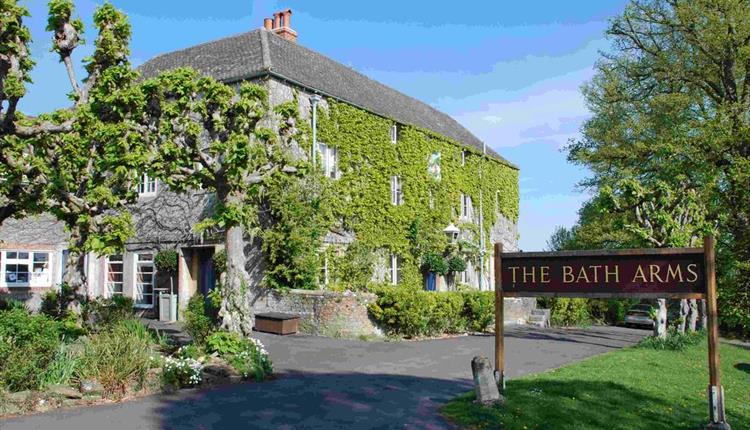
Eventually we arrived at our destination The Bath Arms.

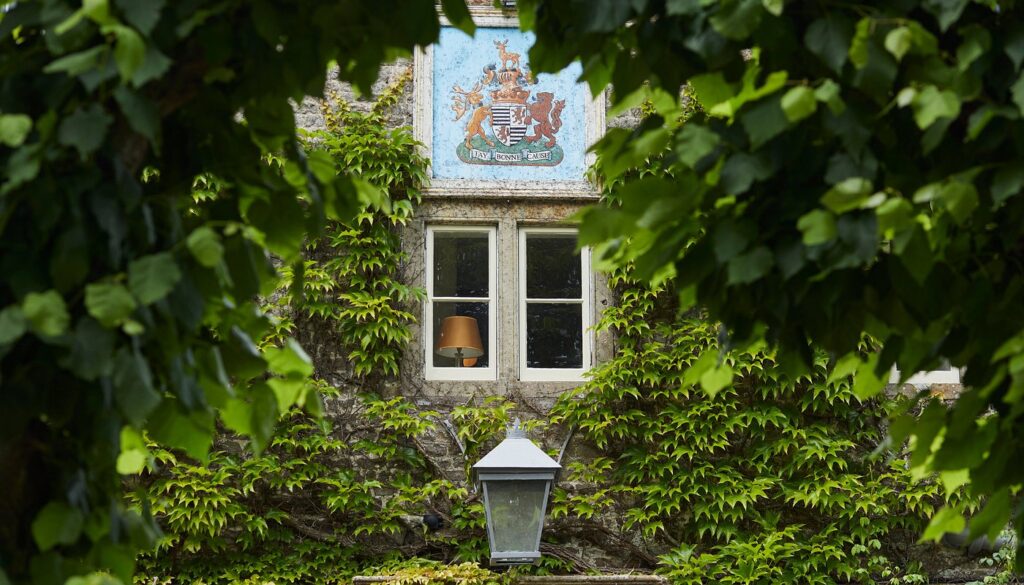
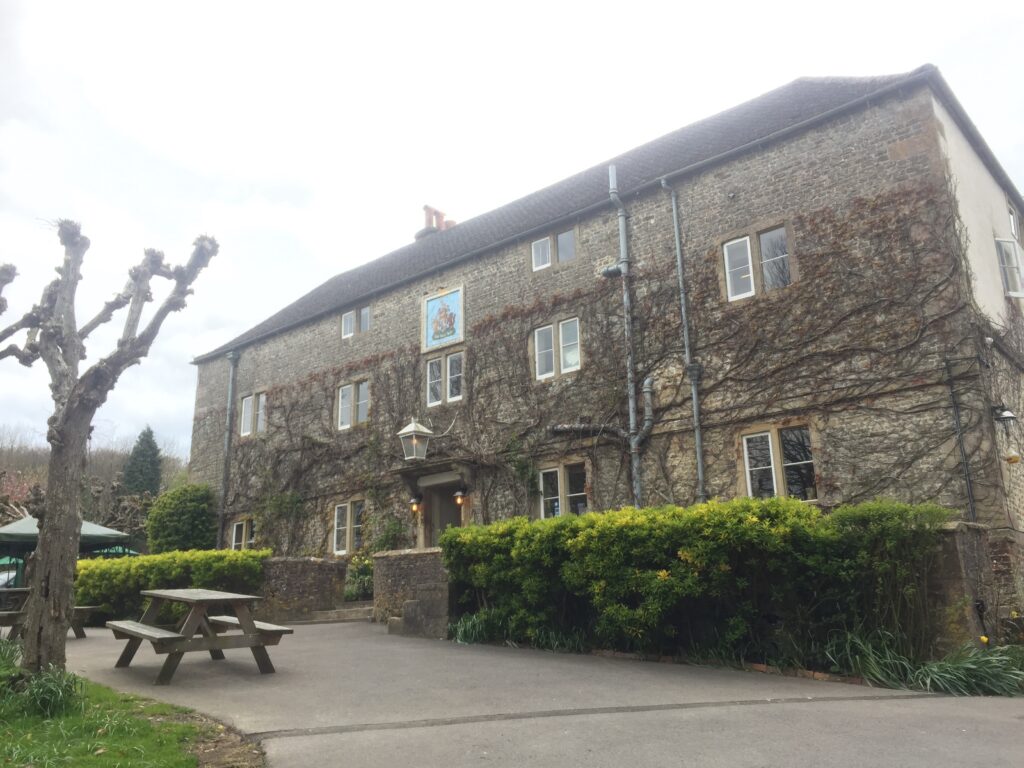
The Bath Arms   Notice the mounting block visible just under the sign.


Established in 1736, the Bath Arms was a coaching inn. For us it was a refuge from the rain and a place to sit and dry out our clothes by the fireplace.

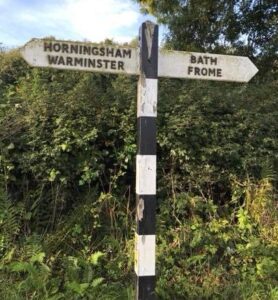
One last adventure was in discovering the name of the village where our refuge was situated. When we asked, the young barmaid announced what sounded like “Horny-i-am.” To which our intrepid leader replied “I can’t help you with that but I’d love a rum and coke!”

As interesting as that name sounded we were soon corrected and informed we were, in fact, in Horningsham.

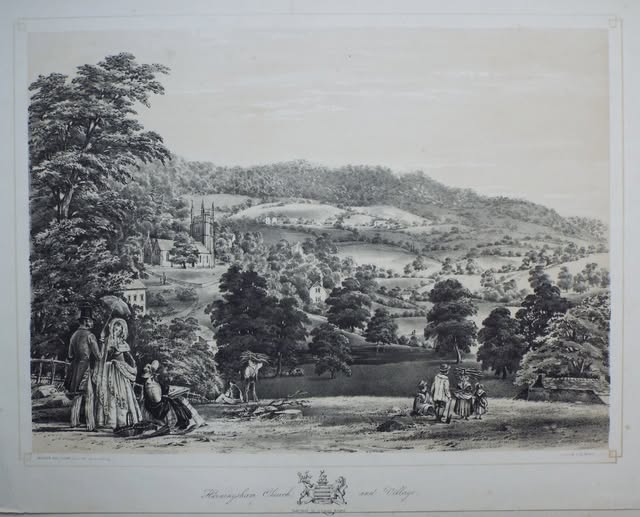
The Bath Arms is in Horningsham, a small village with population of around 300 forming part of the Longleat Estate. The name ‘Horninges-Ham’ means ‘Horning’s Homestead’ in Old English.

Entries in the Domesday Book describe Horningsham as very small, being occupied by one cottager and four small holders. The Parish of Horningsham changed hands many times before the Thynne’s purchased it for the second time in 1716.

Horningsham

The Vernon families owned Horningsham during the 12th century and were founders of the village church. The Stantors then owned it for the next 200 years before selling it to Sir John Thynne c. 1550. Sir John Thynne increased the size of the Parish by buying more land. His descendant Thomas Thynne, the 1st Marquess of Bath was very interested in forestry and engaged Capability Brown to plant large plantations throughout his 900 acres of land.

The village pub was built in the 17th century. It became a public house with rooms in 1732 when it was then known as the New Inn. It later changed to the Lord Weymouth Arms and then the Marquess of Bath Arms in 1850. At the turn of the century there were 4 pubs in the village and The Bath Arms is the last remaining one.

Lessons Learned?

1. Just past the gates is a British term meaning anywhere from a mile to five miles up the road.

2. When a sea captain tells you it looks like rain expect a deluge that would send Noah scrambling for his hammer and saw.

3.  A House of Lords baseball cap serves as an excellent personal awning.

4.  English rain will soak you down to your drawers in a matter of  minutes.

5.  Village names pronounced by natives of said village can create quite a bit of confusion!

6.  Sitting before the fire in a pub with friends can cure a great  many ills no matter where your native land is.

7.  Friends who managed to reach the pub before the deluge will make fun of you and bandy about words like drowned rat.

8.  In spite of the trouble, a trip to a 200 plus year old pub can afford you your first sighting of a mounting block in the wild !

9.  Imagining a romance novel hero or heroine arriving at said pub after walking five miles in the rain can end up being the beginning of an excellent story.

10. Even years after one’s Longleat misadventures, the story can still make one smile!


Stay tuned for more Adventures of a Regency Romance Author!

HISTORIC PUB CRAWL – The Prospect of Whitby

ONE OF THE MOST HAUNTED PUBS IN LONDON

WITH GOOD REASON!


THE PROSPECT OF WHITBY

WAPPING / TOWER HAMLETS                                                                   

57 Wapping Wall, London

LOUISA CORNELL


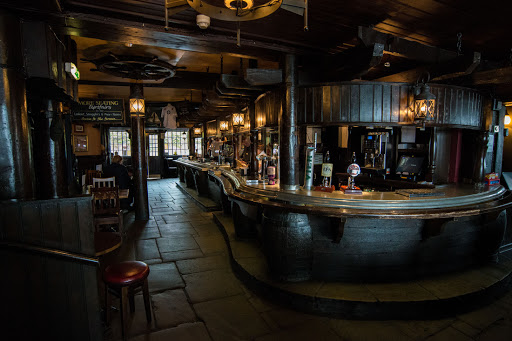
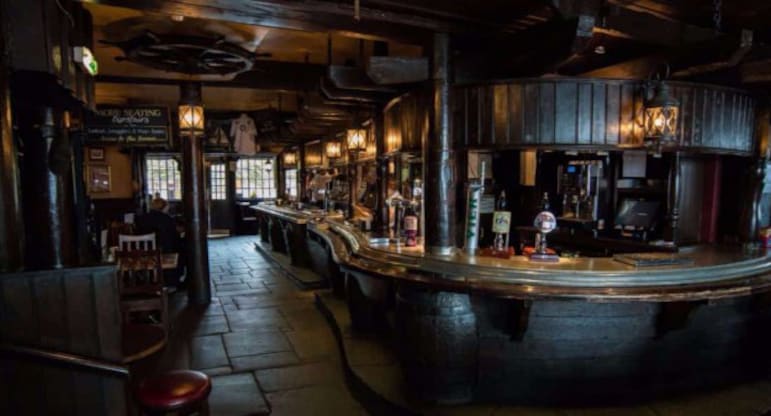
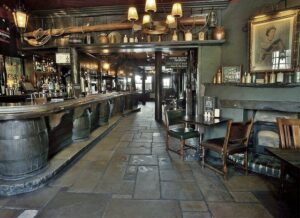
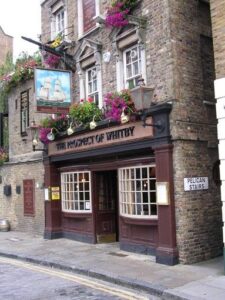
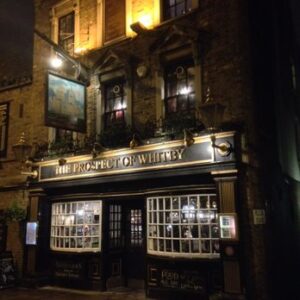
The Prospect of Whitby is one of London’s oldest pubs and it is believed to be the oldest riverside pub on the Thames. There has been a pub on this site since 1520 which means it existed during the reign of Henry VIII. In fact, the original flagstone floor is still visible in the pub today. Four hundred year old craftsmanship endures.

The four hundred year old flagstone floor and pewter bar make the Prospect of Whitby one of the most authentic historic pubs in London.

The first pub on the site was called the Pelican. Because of its proximity to the river it quickly became a den of cutthroats, pirates, thieves, highwaymen, and many other unsavory denizens of the area. Larger ships had to berth in the middle of the river and goods were ferried to shore in smaller boats by men called lightermen. This made it easy for criminals to steal from the ships, and The Pelican often served as a base for these felons to disperse their stolen goods. In spite of the name on the sign, because of the constant nefarious activity the tavern eventually became known as the Devil’s Tavern. Of course, with this sort of clientele the local prostitutes congregated here as well.

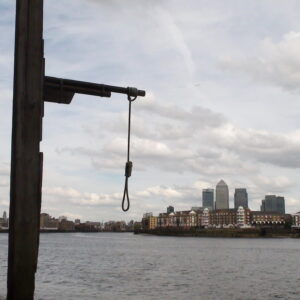
Naturally with the large criminal contingent in attendance, the tavern also claims its proximity to the execution dock used to hang those condemned to death by the Admiralty Courts. To this day there is a scaffold and hanging noose outside the tavern. Wapping Old Stairs next to the tavern was where some of those sentenced to death – usually pirates – were chained to posts to await the incoming tide and death by drowning.

Like the Town of Ramsgate pub, the Prospect of Whitby was a favorite of the Hanging Judge George Jeffries (1645-1689) (see the Town of Ramsgate post.   https://numberonelondon.net/2021/05/historic-pub-crawl-town-of-ramsgate/) Once he began to frequent the establishment, the criminal element moved their activity elsewhere, or at least conducted their activities out of his sight. He had a special window built in the tavern that overlooked the execution dock so he could watch those whom he had condemned die. To this day people have reported seeing a man’s face gazing out the window where Jeffries used to sit. In an interesting side note, Jeffries supposedly had the bodies of those hanged dumped into the Thames. The body snatchers hid out in boats along the river’s edge to fish out the bodies and sell them to local medical schools.

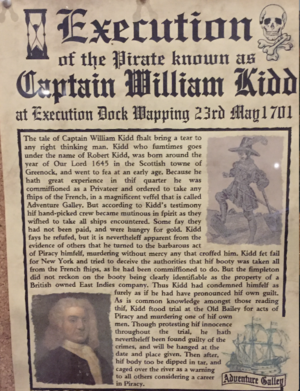
The most famous criminal hanged at the execution dock at the Prospect of Whitby was Captain William Kidd. Ironic, as the Scottish sea captain was originally appointed by the Crown to hunt down pirates. He discovered piracy was much more profitable than hunting down pirates. He did quite well for a while. Unfortunately, in 1698 he captured The Quedagh, which was sailing under a French pass. The captain, however, was an Englishman and the rich cargo Kidd took was property of the East India Company. Kidd was eventually captured and brought back to London where he was sentenced to death for piracy and for the murder of one of his own crewmen (in 1697) who had dared to cross him.
It took three tries to execute Captain Kidd. The first two ropes broke. The third one held and once he was dead his body was dipped in tar and hung by chains on the banks of the Thames as a warning to other pirates.

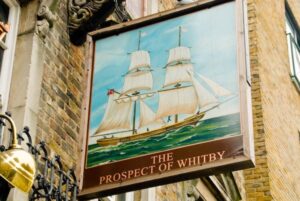
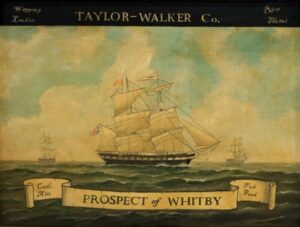
After a fire in the early nineteenth century the tavern was rebuilt and renamed. As the owners had tried everything to disassociate their tavern from its dangerous reputation, for a while they had removed all signage. Those who wished to direct someone to the tavern would say “You want the tavern across from the Prospect of Whitby. The Prospect of Whitby was a collier that berthed next to the tavern. The ship hauled coal from Newcastle on Tyne to London. Eventually the directions were shortened to the Prospect of Whitby and the owners of the newly rebuilt establishment decided to adopt the name permanently. Much more amiable a name than The Devil’s Tavern. Even with the new name a few of the tavern’s more lucrative activities continued. The cock fighting pit and the bare knuckle boxing arena were in use well into the nineteenth century.

Of course the pub claims its more upstanding celebrity visitors as well. The diarist Samuel Pepys (1633-1703) was said to have had supper at the tavern quite frequently. Charles Dickens (1812-1870) was known to visit as well. The artists J.M.W. Turner (1775-1851) and James Abbott MacNeill Whistler (1834-1903) both visited and made sketches of views from the pub.

Is the pub haunted, you ask?

According to customers from the eighteenth century forward, the Prospect of Whitby is the grand central station of riverside hauntings. To name just a few:

Supposedly one is often accosted walking to the pub at night by the waterlogged ghosts of the men hanged or drowned at the execution dock in search of their bodies taken by the body snatchers. Other similar ghosts are said to be in search of Judge George Jeffries to exact revenge.

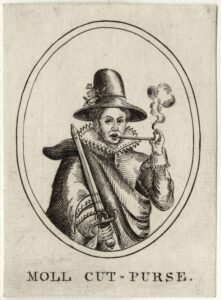
The ghost of a young woman dressed in a doublet, breeches, and smoking a pipe is often seen sitting in the dark corners of the pub watching guests drink. Supposedly, she was a moll cutpurse – a woman who would sidle up to unsuspecting (translation:drunk and in search of feminine company) men and cut their purses from their belts. She is believed to have been caught by one of her marks before she could get away and the gentleman beat her to death in the back of the tavern. One wonders if she is visiting the pub these days in search of her next mark.

Oh, and remember that fire in the early nineteenth century? The cobblestone streets around the tavern all but guarantee it is shrouded in fog at night. The cobblestones retain heat and the cold night air pulls that heat out as fog. The fog was even thicker in the nineteenth century when horse and foot traffic kept the roads heated at all times. As a result it was not unusual to see shapes, but nothing clearly, if one happened to stroll by the tavern after closing time. However, people began to say they saw lights in the Prospect of Whitby long after the owners had closed up and gone to bed. Not just lights, but lights enough to see clear through the pub to the river. And in those lights they saw a figure moving about the tavern. A figure very like that of Captain William Kidd. Eventually the owners decided they did not want people coming to the pub after closing in an attempt to see the mysterious figure. So one night they decided to leave the lights on in the tavern. Big mistake. That very night a fire broke out in the back of the tavern and burned nearly to the execution dock. If not for the newly inaugurated fire brigade the fire might have spread throughout the dockside buildings. Needless to say once the tavern was restored the lights were left out after closing. Just in case. A vengeful Captain Kidd is not to be trifled with.  


These days there is no need to imagine what the pub might have looked like when pirates, cutthroats, and thieves occupied the tables there. From the rickety stairs to the stone-flagged floors to the crooked doors and heavy rum flagons the Prospect of Whitby looks very much as it did then. For a trip back in time to the swashbuckling days of yore, this pub is definitely worth a visit. Just pay attention to sudden chills and the hairs on the back of your neck!


HISTORIC PUB CRAWL – The Grenadier – aka The Most Haunted Pub in London

THE GRENADIER

BELGRAVIA / KNIGHTSBRIDGE

18 Wilton Row, London

LOUISA CORNELL


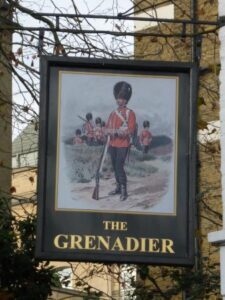
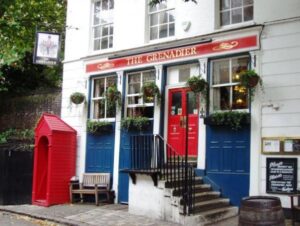
The building that houses The Grenadier was originally built in 1720. It served as the officers’ mess for the senior infantry regiment of his His Majesty’s Army, the 1st Regiment of Foot Guards. The building was, in fact, located in the courtyard of their barracks. This particular regiment played an important role in the defeat of Napoleon at Waterloo. And after they defeated the emperor’s French Imperial Guard they felt the need to adapt the Imperial Guard’s bearskins as their regimental trademark and they changed their name to the Grenadier Guards. Apparently when one whoops the derrieres of Napoleon’s elite one can do that.

It is understandable then that when the building was repurposed as a tavern called The Guardsman in 1818 that many of its customers were members of the regiment still housed in the nearby barracks. In honor of their success at Waterloo it wasn’t long before the tavern changed its name to The Grenadier. Because of its rather out of the way location, the Duke of Wellington and even King George IV are said to have stopped by for a pint or two.


The upper rooms of the tavern were used by the more urbane customers. The common soldiers used the cellar as their personal haven to drink and wile away the hours playing cards. It is said on a September evening in 1818 a young Grenadier guard named Cedric was caught cheating at cards. His fellow card players punished him with a beating so brutal he died, right there in the cellar of The Grenadier.

And apparently, Cedric never left. Whilst his presence is felt in various ways throughout the year, for some reason the month of September still gets Cedric stirred up. During September a solemn, silent spectre is said to be seen moving slowly across the low-ceilinged rooms. Objects have been known to disappear or to be moved during the night. Unseen hands rattle tables and chairs. Footsteps have been heard in empty rooms. Low moans can sometimes be heard from the cellar when there is no one down there. At times rooms in the pub become icy cold and can remain so for hours, days, or even an entire month at the time.

A Chief Superintendent from New Scotland Yard was having a drink at The Grenadier one evening when he noticed puffs of smoke swirling around him. He reached out to try and detect the source of the smoke and snatched his hand back in pain. He’d been burned by a cigarette. The thing was, there was no one there.

Another even more recent event involved a barman who went down into the cellar to fetch some cigars for the bar. Cigarette breaks were hard to come by, especially when The Grenadier was busy. He stopped for a moment to have a cigarette. The landlord’s cat appeared in the cellar, an unusual event in and of itself as the cat wasn’t ever allowed out of the owner’s flat over the pub. Suddenly the cellar turned icy cold. The barman’s crystal ashtray flew across the room into the wall. The cat bowed up and sank his teeth and claws into the barman’s ankle. Needless to say the barman shook off the cat and shot up the stairs out of the cellar and back into the pub.

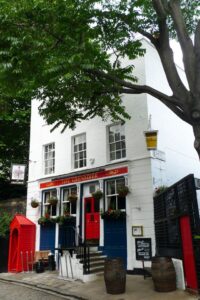
The Grenadier is still hard to find if you don’t know exactly where it is. The building is surrounded by lovely cottages and one must weave in and out of various cobblestone lanes and narrow private side streets to reach the beautiful Georgian building beneath the shade of a magnificent tree. The distinct red and blue accents against the whitewashed walls gives the pub a distinct pop.


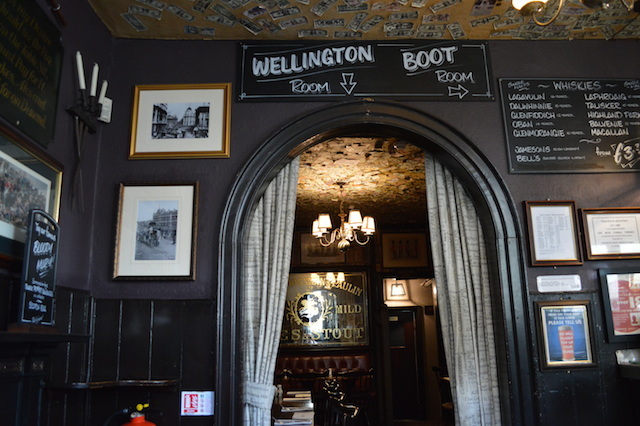
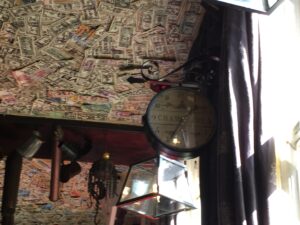
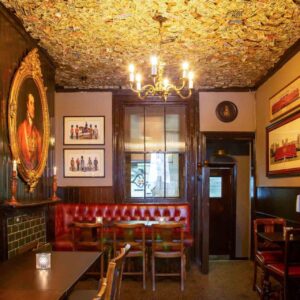
The Grenadier is the typical old pub with random objects on the walls and sturdy wooden furniture. The Boot Room is where the general public imbibes as it has more of the common touch. Which includes a ceiling papered with pound notes. Why? To pay Cedric’s gambling debts, of course. If one doesn’t want to incur his wrath or have him light up a cigarette next to one it is best to do one’s part.


The Wellington room is a bit more elegant with ornate mirrors and leather Chesterfield seating. Which creates an atmosphere that has been called spooky. Be forewarned.


For a more personal visit to the most haunted pub in London, check out this post by our very own Kristine Hughes-Patrone and her travel companions!

https://numberonelondon.net/2015/07/the-wellington-tour-dinner-at-the-grenadier/

GHOSTS OF WATERLOO

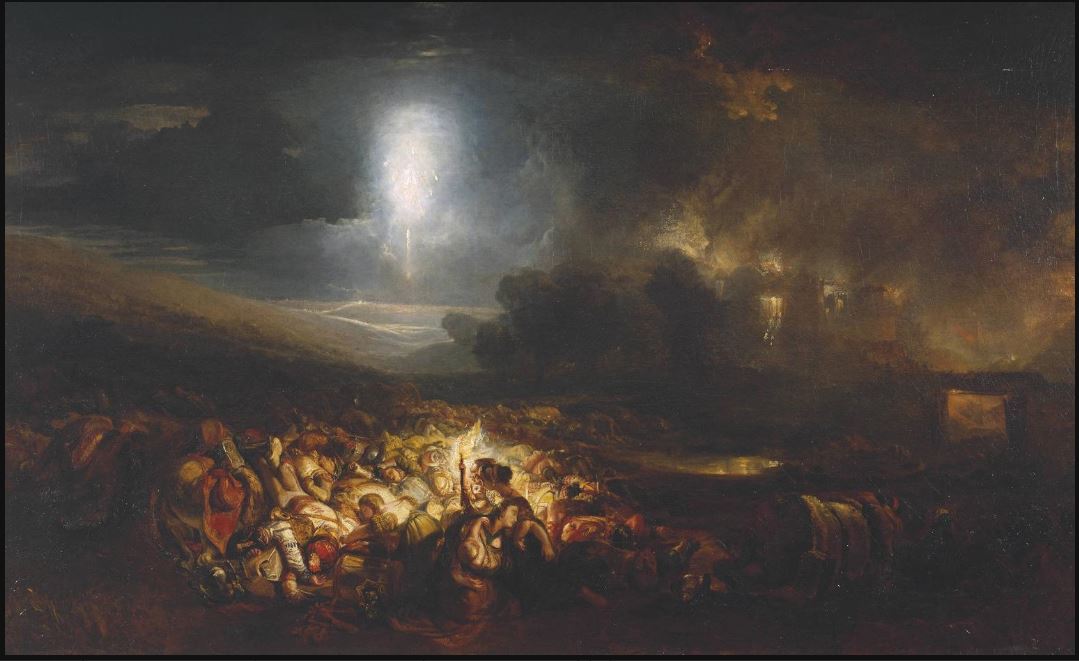
The Field of Waterloo J.M.W. Turner
1818

The Battle of Waterloo took place on June 18, 1815. The actual battle lasted about nine hours. There are varying estimates of the combined death toll of all of the soldiers lost that day, but the most often quoted number is 50,000 men.

With so violent a battle and so high a cost, it is little wonder there are stories of those whose spirits never left that blood-soaked field. Interestingly enough, those of Flemish descent whose ancestors fought in the battle or whose ancestors lived in the area during the battle, are said to have an innate and often undesired ability to see the specters who return to the battlefield to relive the fight or who come in search of someone or something they left behind in death.

Local guides who give tours of the battlefield during the day often refuse to step foot there after dark. Locals who live in the area of the Hougomont farm, the museum, and the battlefield usually give the area a wide berth at night.

Some of the more well-known legends and sightings include:

A French soldier seen wandering the battlefield in the moonlight searching for his fallen comrades. More than one visitor has reported seeing him, especially near the Hougoumont Farm.

Another famous ghost is The Lady in White, thought to be the spirit of a woman who tended the wounded and dying soldiers. She is often seen near the Mont-Saint-Jean Farm which was used as a hospital during and after the battle. She is sometimes seen on the battlefield still in search of wounded soldiers to tend.

Locals often claim to hear the sounds of drums, battle cries, horses and cannon fire at midnight as if the battle never ended.

For an interesting account of a skeptic perhaps converted by his own experience check out this intriguing blog post.

http://hauntedohiobooks.com/news/a-clairvoyant-vision-of-the-battle-of-waterloo/?fbclid=IwY2xjawFi6KBleHRuA2FlbQIxMQABHUnF3B__VLpBR55fVeJ4nDunczN8f6S2nxNu7jviMR-YTBjwE0DNodIjng_aem_q60beDjio8go_ga7nE2uPA

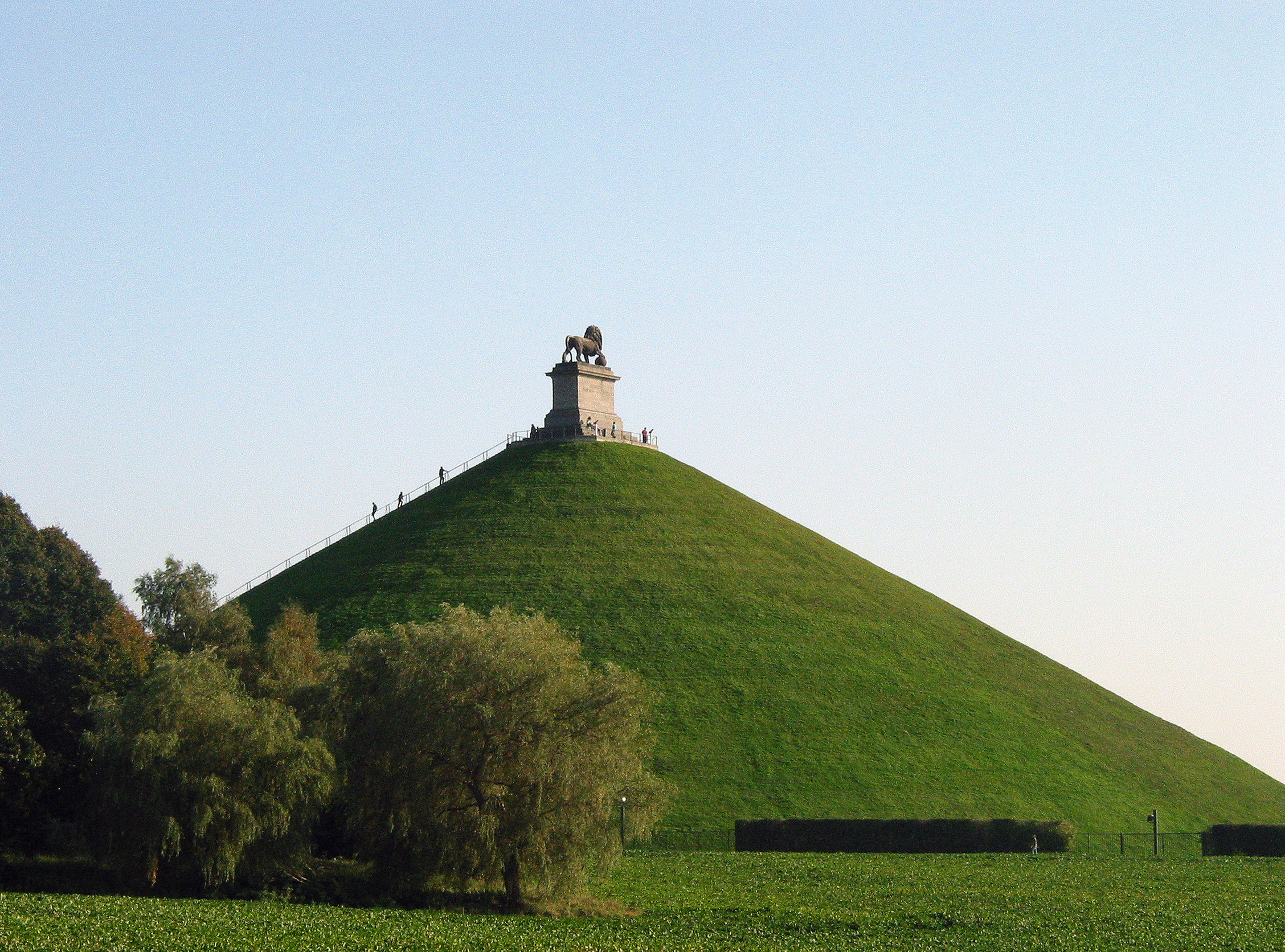
One of the items on my bucket list is to climb to the top of the Lion’s Mound at midnight and allow the profundity of that place to fill me.

By Jean-Pol GRANDMONT – Own work, CC BY 3.0, https://commons.wikimedia.org/w/index.php?curid=11569789

I for one do not find it hard to believe a place where so much sudden and violent death took place still retains the spiritual energy so much agony and sorrow produced. As the Duke of Wellington said:

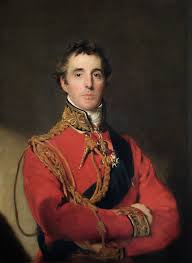
“Next to a battle lost, the greatest misery is a battle gained”


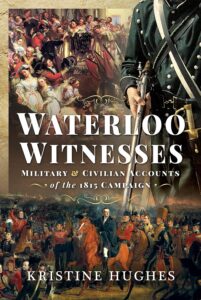
To immerse yourself in the non-military, military, and very human side of the Battle of Waterloo through first-hand accounts I humbly suggest our own Kristine Hughes’s book Waterloo Witnesses. The accounts she has collected, discusses, and weaves together to create a picture of the lives, loves, hopes, fears, triumphs, and tragedies of the people who actually lived this momentous point in history will allow you to see the hearts, minds, and souls that will remind us of the price of war and of the spirits of those to whom we owe so very much. Perhaps some of the very people whose personal accounts she has recorded still walk the battlefield in search of what they lost and what they gave to free the world of tyranny.

Perhaps, though, the very best words ever written about that momentous campaign are the first-person accounts recorded as events unfolded. It is these vivid accounts that Kristine Hughes has collected together in order to convey the hopes, fears and aspirations of their authors. They inject the story of the battle with a level of humanity that reclaims it from the realm of legend and restores it to the people who witnessed it.

https://www.amazon.com/Waterloo-Witnesses-Military-Civilian-Accounts/dp/1399003623


THEY DIDN’T BURN WITCHES, THEY BURNED WOMEN

BUT NOT IF THEY WERE WELSH!


Wellcome collection

Accusations of witchcraft across Europe for several centuries resulted in the persecutions, imprisonments, torture and executions of hundreds to thousands of people, most of them women. There were an estimated 1000 executions in England, and between 3,000 and 4,000 killings in Scotland.  However, oddly enough, only five people were hanged for witchcraft in Wales. Why?

After all, Welsh court records dating from the 16th century, held at the National Library of Wales, show that suspicions and verbal accusations of witchcraft like those seen across the rest of Britain and Europe were common in Wales. They also happened under similar circumstances where accusations often followed an argument, or a request for charity which was denied.

The records indicate bitter arguments between neighbors and family members often precipitated these accusations. Horses were killed, cattle were bewitched, pigs perished, men and women were injured, there were miscarriages and even murders in these accusations. Their accusers were neighbors, relatives, and in many cases, people with financial and personal reasons to make such accusations. However, if a case came to court, juries usually found the accused not guilty. Again, we ask Why?

Actually, there were a couple of very good reasons.

First of all, Wales was considered a land of magic, enchantment, superstition, and connection to the supernatural long after the rest of Britain had become enlightened. People from the rest of England, both the wealthy and aristocratic and the poor and uneducated, often went to Wales looking for consultations with enchanters and soothsayers and healers.

Wise women, cunning folk and soothsayers, were highly regarded in Wales, using magic to perform important services for the community. They were often the only physicians available in entire counties. Their knowledge of herbal medicine and folk remedies was unsurpassed in Britain. They served as midwives, arbitrated arguments, advised on animal husbandry and crop plantings, and performed myriad other services through the simple witchcraft of centuries of knowledge passed down from mother to daughter.

Women in Wales even looked like witches. They tended to dress in long, heavy woolen skirts, aprons, blouses and large woolen shawls. Most village women brewed mead and ale. They let their community know that there was ale for sale by placing some form of signage outside their cottages. The most popular and well-remembered of these signs was a broomstick.


There is speculation among some researchers that the traditional tall, black hat of the Welsh woman served as inspiration for the wide-brimmed hat of the fairy tale witch.

Another good reason was the adherence of the Welsh to unreformed religion long after the Church of England was established and made the faith of Britain. The Welsh preferred to worship within the household in ways that mimicked Catholic practices.  They believed in prayer rather than doctrine. There is evidence that many people continued to seek the aid of charmers instead of the church. Elizabethan and Stuart politicians frequently spoke about the religious ignorance in Wales.

Priests were asked to create curses in the form of prayers. People consulted wise women to offer prayers that melded the Catholic faith with old Celtic practices. Many in Britain considered Wales a country steeped in darkness due to their adherence to so many of the old ways.

A charm attributed to Gwen ferch Ellis, the first woman to be hanged for witchcraft in Wales, included the words “Enw’r Tad, y Mab, a’r Ysbryd Duw glân a’r tair Mair” (translated as “the Father, the Son and the Holy Spirit of God, and the three Marys”.) These charms were never really meant to cause harm, but only to ward off evil.

Charm written out by Gwen ferch Ellis
(Image: Michael Jones/National Library of Wales)

A third, and most fascinating reason was the power of language, the Welsh language, to be more specific. When witch hunts came to Wales in the form of witch hunters appointed by Parliament like Matthew Hopkins (c. 1620 – 12 August 1647)  they had a number of strikes against them. In addition to the attitudes of the people who were judges and made up juries when it came to witchcraft none of the witch hunters spoke or read Welsh.

Frontispiece from Matthew Hopkins’s The Discovery of Witches (1647), showing witches identifying their familiar spirits

Evidence in many of these cases consisted of people hearing supposed spells and being able to speak them back to the witch hunter to be written down. Any writings of the accused witch be they recipes or books of herbal medicine were seized, but they proved useless because none of the English or Scot witch hunters could read them. Needless to say any Welsh-speaking individuals asked to translate pleaded ignorance of what was written. No sense in taking chances when it came to crossing a Welsh woman, just in case!


IN MEMORY OF THE THOUSANDS OF PEOPLE, MOSTLY WOMEN, MURDERED FOR THE SUPPOSED CRIME OF WITCHCRAFT ALL OVER THE WORLD TO THIS DAY.

AND IN HONOR OF THESE FIVE MARTYRS TO WELSH TRADITION

BENDIGEDIG FYDDO

1594

Gwen ferch Ellis, of Bettws, Denbighshire

1622

Rhydderch ap Evan, a yeoman, Caernarvonshire,

Lowri ferch Evan, Caernarvonshire

Widow Agnes ferch Evan,  Caernarvonshire

1655

Margaret ferch Richard,  Anglesey