Visiting The Household Cavalry Museum

Opened in 2007 by Her Majesty, Queen Elizabeth II, the Household Cavalry Museum is located in Horse Guards, with an entrance off the Parade. Victoria here, looking forward to another look at the HCM when the Wellington Tour visits on Saturday, September 6, 2014.  Kristine and I hope you can join us…and refer you HERE for the complete details on the itinerary, costs and the fine print. 

 
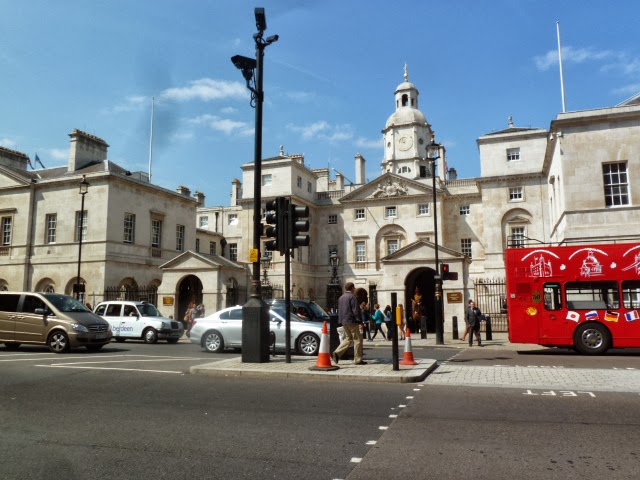
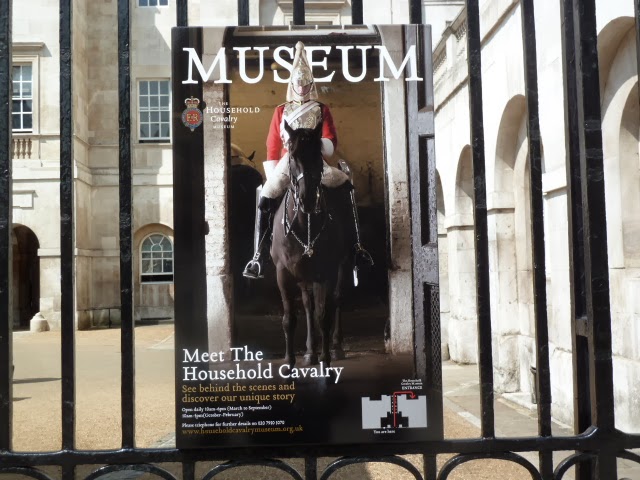
Horse Guards, Whitehall
 
 
The history of the Household Cavalry goes back at least 300 years.  Though we are most aware of these soldiers in their colorful traditional uniforms as mounted sentinels at Horse Guards, as they change the guard at Buckingham Palace, and as escorts of the Queen on grand official occasions, the members alternate between active service on armoured vehicles in the “regular army” and ceremonial duties.

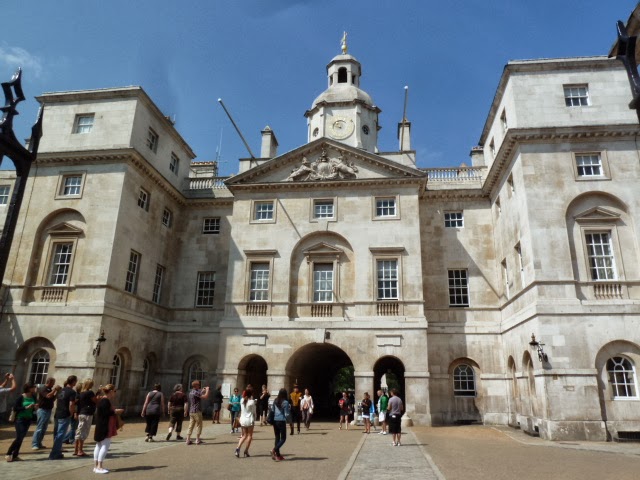
A closer view; the Parade is through the central arch
  
The Museum provides the history of the Horse Guards Building, designed by William Kent and completed by John Vardy in 1755, after Kent’s death.  The Duke of Wellington, as commander in chief of the British Army in the 19thCentury kept his office in Horse Guards until he retired shortly before his death in 1852.
 
 
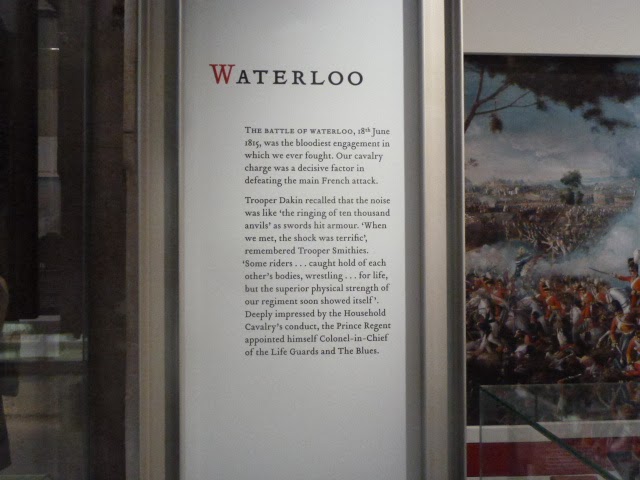
Currently, two regiments make up the Household Cavalry, the Life Guards and the Blues and Royals.  Originating after the 1660 Restoration of Charles II to the throne, they provided personal Security for the monarch. Throughout the 17th and 18thcenturies, the cavalry fought in many wars, in Holland, in Germany, in Portugal and Spain. At the Battle of Waterloo, the regiments served bravely, capturing a French Eagle, a prized standard with far-reaching symbolic importance. It was the bloodiest battle of their history.

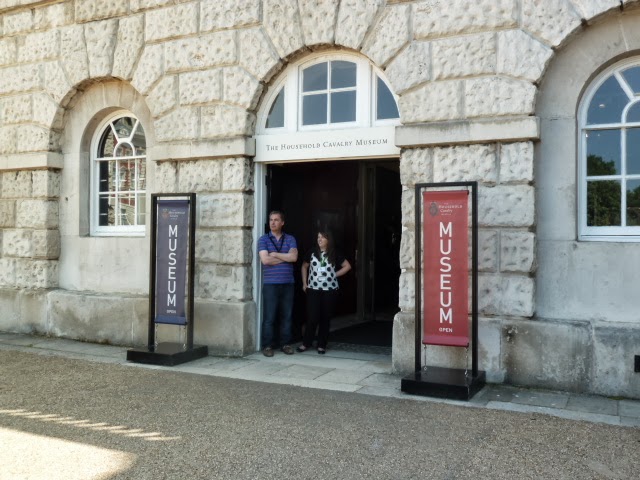
Museum Entrance, opening onto the Parade
 
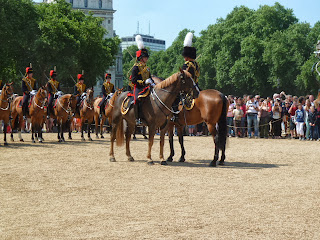
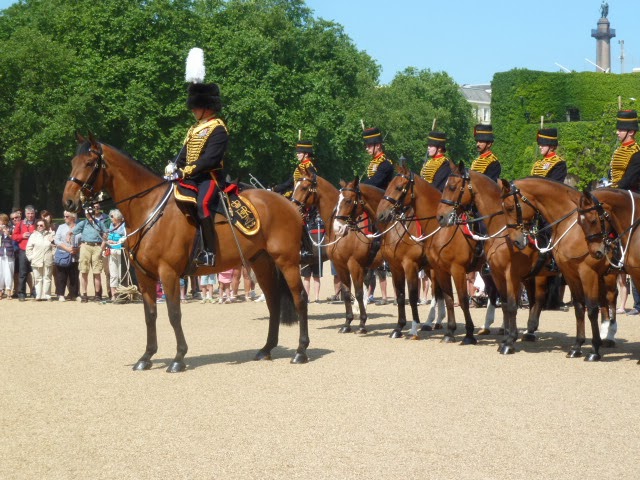
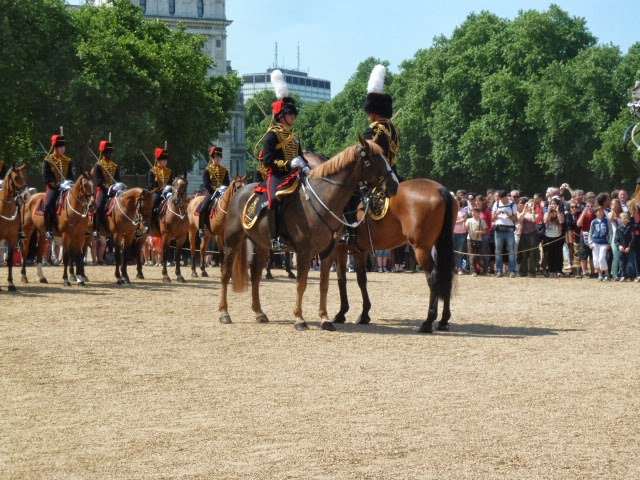
What everyone was looking at on July 11, 2013, on the Parade


The museum also chronicles the service of the Household Cavalry regiments in the Crimean and Boer Wars, among other engagements.  In WWI, WWII, and in numerous later conflicts, the regiments performed their duties in armoured cars, in tanks, and in helicopters.
 
 
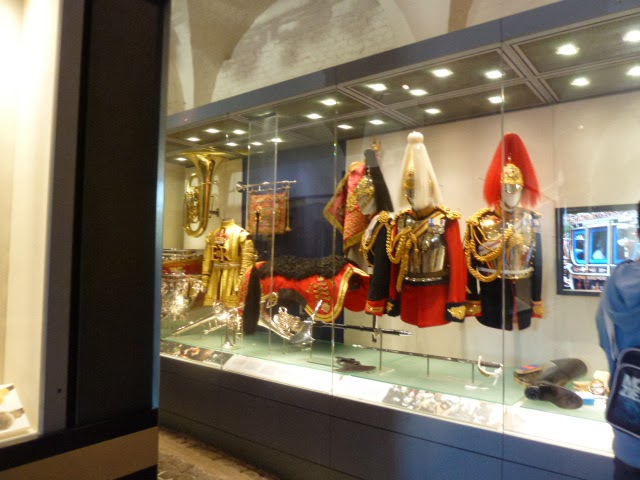
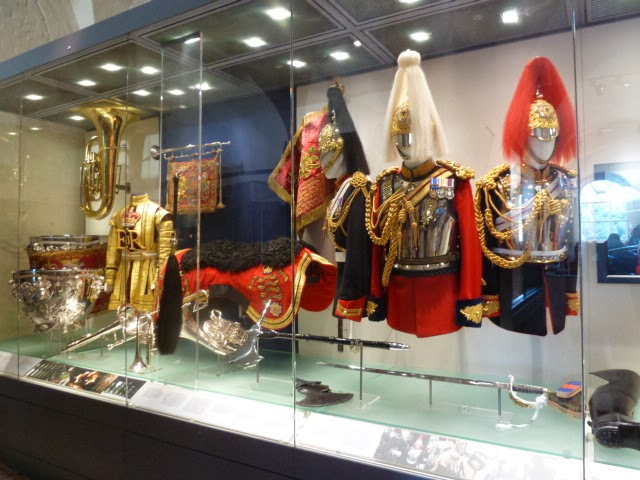
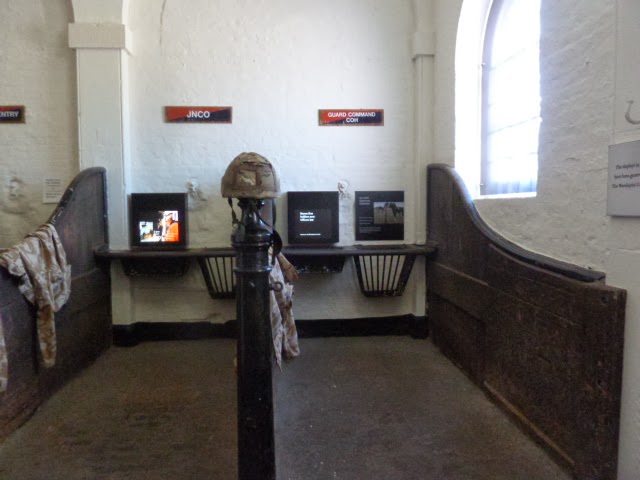
In the Museum
 
 
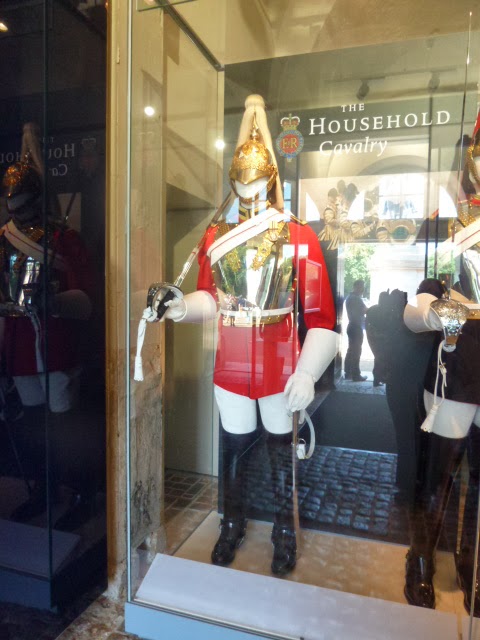
Ceremonial Uniforms

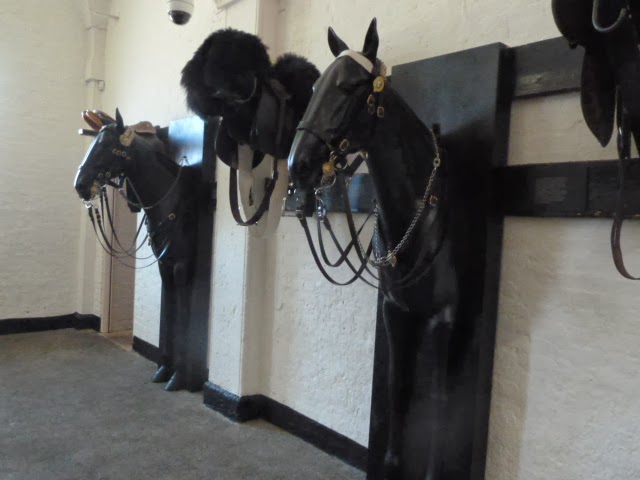
The horses get their due!!
 
The museum covers the choice and training of the horses, a matter of great interest
to many of us who love the sleek mounts, groomed to perfection and amazingly well behaved.  Each year, the horses are named with the same initial, thus preserving the year of their arrival in the Cavalry.  As an example, from the museum guidebook, “… Invader, Imogene and India arrived in 2008 and Jubilee Jenna and Jupiter in 2009.”  After an average of six months training, the four- or five-year old “recruits” serve for another 14 to 16 years, before withdrawal to a  private stable or a retirement home.
 
The Saga of Waterloo, June 18, 1815
 

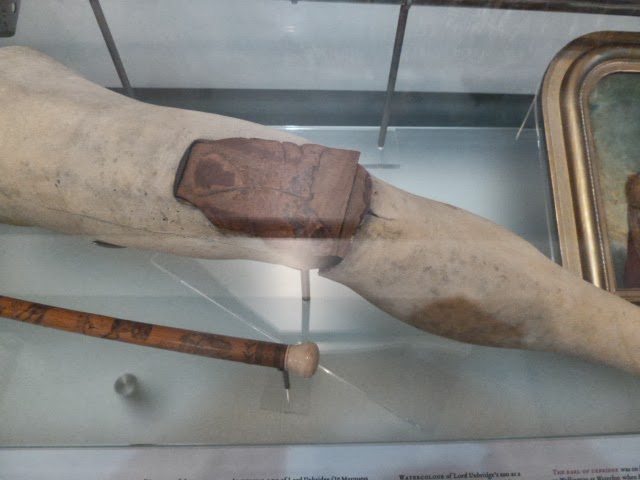
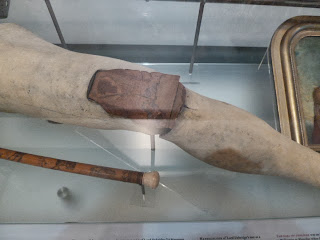
The cavalry commander at the Battle of Waterloo was Henry Paget, Earl of Uxbridge and later, 1st Marquess of Anglesey. As the battle wound down, Paget sat on his horse beside the Duke of Wellington when a cannon shot shattered his leg.  Supposedly he said, “By God, sir, I’ve lost my leg.”  Wellington reportedly replied coolly, “By God, sir, so you have.”  After the amputation, Paget urged many improvements in the making of prosthetics for walking and riding.  He served the government and the army for another 37 years before finally passing away in 1854.  One of Paget’s artificial limbs is on display in the Museum.
For a few weeks each summer, the Household Cavalry conducts a retreat for the members and the horses at the Norfolk seashore – which is the reason that in my photographs taken in July 2013, their substitutes, members of the King’s Troop Royal Horse Artillery take over, wearing their black ceremonial uniforms based on those of the Hussars at the Battle of Waterloo almost 200 years ago. 


The Duke of Wellington’s office as Commander-in-Chief of the British Army was above the center arch leading from Horse Guards’ Whitehall façade to the parade ground.  The display photographed above depicts the final departure of the Duke from his position shortly before he died in 1852.  He was 83 years of age and had served his nation for 65 years.


The website for the Household Cavalry Museum is here.
 
Join us on The Wellington Tour!


Victoria Station and the Grosvenor Hotel

Guoman Grosvenor Hotel

The Wellington Tour, 4-14 September, 2014, will begin at the Guoman Grosvenor Hotel, 101 Buckingham Palace Road. The hotel is connected to Victoria Station, home of several rail and tube lines, plus hundreds of busses, coaches, and taxis.  It is super-convenient and appears quite lovely in its newly restored state.

Victoria Station with Grosvenor Hotel at far right
 
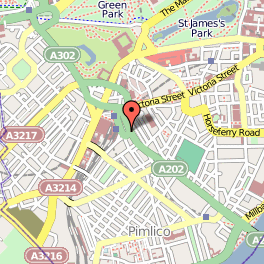
Map of Victoria Station neighborhood
Station and hotel at red marker
Square tan building just under words ‘Green Park’ is Buckingham Palace
Apsley house at the far left upper corner
 
  
The little map above shows the position of Victoria Station and the hotel, which you can see on any London map.  I can’t imagine any more efficient location for almost every London attraction.
 
 
Victoria Station interior
 
Victoria Station itself is the second busiest in London (after Waterloo Station), with many rail lines to destinations in south and southeast England, including the Gatwick Express.  The Circle and District tube lines and the Victoria line stop here, and the Victoria Coach Terminal is adjacent.  The station has many shops, bars, and food sources, right at hand.  An upgrade of the facility is planned for the next few years, to include more escalators and improved accessibility.
  

Guoman Grosvenor Hotel
 
The hotel has been newly refurbished and updated, at a cost of  £20 million. The Grosvenor (not to be confused with Grosvenor House, another London hotel on Park Lane) was opened in 1862, one of the earliest of London’s Victorian Railway Hotels built beside railroad stations.


Many of these old hotels had declined into disuse in the past decades, and the Guoman Grosvenor is not the only one to be newly redone.  I recently wrote about the St. Pancras Renaissance hotel, formerly the Midland Grand Hotel, and the Great Northern Hotel at King’s Cross, both on Euston Road, here
 
 
Réunion Bar
 
                
In addition to meeting rooms, the bar (above), a gym, a business center, and the Grand Imperial Cantonese Restaurant, the hotel promises all 21st century amenities.  Additionally, the adjacent Victoria Station complex houses many restaurants and a shopping arcade.
 
Guoman Grosvenor Hotel
 
 
The hotel website is here.  Hope to see you on this street in September, 2014.
 
For details on the Wellington Tour, click here.


Dining In Berkeley Square

London residents and visitors alike looking for a peaceful and engaging afternoon spent in good company might do much worse than a stroll around Berkeley Square followed by some fine dining at one of the nearby restaurants.

While it may not be a major London attraction, Berkeley Square certainly has its fair share of history – Maggs Brothers Books has been trading from Number 50 since 1853 and  Gunter’s Tea Shop once stood at Nos. 7 and 8. Berkeley Square is still a light and airy space with a number of interesting features; two statues over 150 years apart can be found within the square as well as the iconic pump house dating back to 1800 which sits at the centre of the four quadrants that makeup the space.

From Berkeley Square you can make it to Oxford Street and Regent Street in just a few minutes on foot, however the Square itself remains relatively quiet and laid-back despite its central location. It’s a great location to unwind after a busy day walking the streets for the latest in innovative Christmas gifts and at just 6 minutes’ walk from Green Park tube station you can access the rest of London in no time at all.

A walk in the square followed by dinner at one of the many surrounding restaurants can make the perfect end to a busy day. With that said let’s take a look at some of the top choice for dining near Berkeley Square.

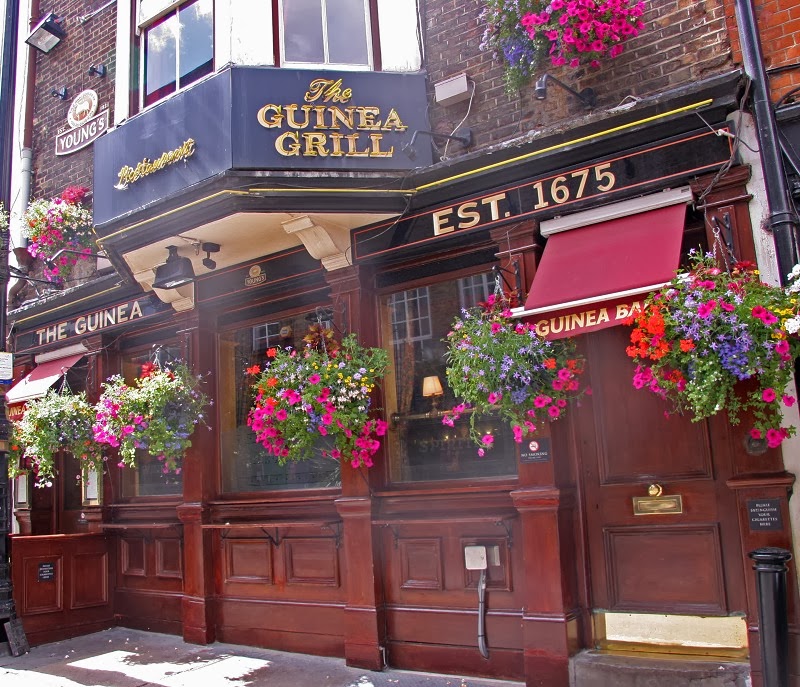
The Guinea Grill

30 Bruton Place, Mayfair, London, W1J 6NL (see map)


While prices may be just the wrong side of dear The Guinea Grill is the perfect destination for those on the lookout for truly traditional British food. An atmospheric, dimly lit location provides the perfect setting to warm up, with a selection of cooked-to-perfection steaks and a fine assortment of savoury pies, during those cold winter months. Seating is said to be a little on the cramped side however the staff are excellent and provide a warm and welcoming front to what it a very class and well established (since 1952) dining location near Berkeley Square. History: A tavern has existed on this spot since the 15th century. Bruton Place formerly housed the stables and coach houses of the residents of the Square. Look closely and you’ll find vestiges of this use in the existing architecture and hardware on the street. Mayfair servants, including coachmen and footmen, frequented the Guinea Tavern, as well as the nearby Coach and Horses and The Only Running Footman (below).

The Punch Bowl

41 Farm Street, Mayfair, London, W1J 5RP (see map)


A place brimming with history The Punch Bowl has been around since 1750 as a public house and is currently a grade two listed building. Until recently the pub was owned by Guy Ritchie and has had a stream of a-list celebrities for customers over the past years. On to the dining itself and you can expect the standard range of British fare and pub classics at The Punch Bowl with reasonable prices (for Mayfair) to boot. Maybe not the pick of the bunch when it comes to dining, The Punch Bowl as a location is hard to surpass and is almost always full with happy diners. History: Farm Street takes it’s name from Hay Hill Farm, as the area was known in the 1700’s. Building began on the stables and mews in the street in the 1740’s.

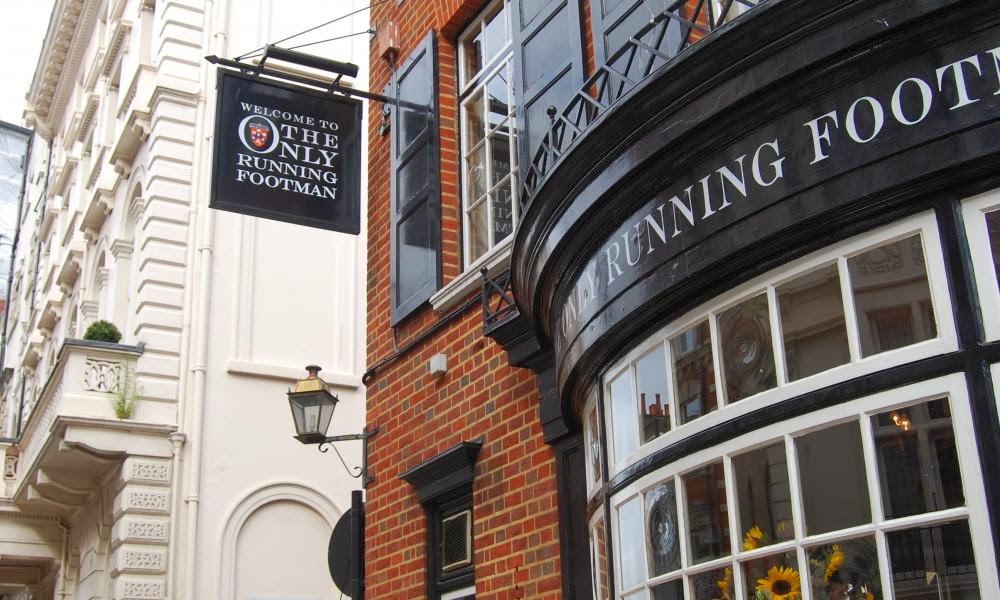
The Only Running Footman

5 Charles Street, Mayfair, London, W1J 5DF (see map)


Just a minutes’ walk from Berkeley Square The Only Running Footman is certainly accessible for that after stroll dinner. The pub come restaurant is set out over four floors with the upper three offering fine dining and the ground floor serving up a well-rounded selection of pub grub. Perhaps better known for its atmospheric and roaring downstairs pub than quiet and relaxed upstairs dining, The Only Running Footman provides a plentiful menu at reasonable prices; you can expect efficient and friendly service from the staff. History: Originally called The Running Horse, a pub has stood on this spot since 1749, at least.

Greig’s Grill

26 Bruton Place, Mayfair, London, W1J 6NG (see map)


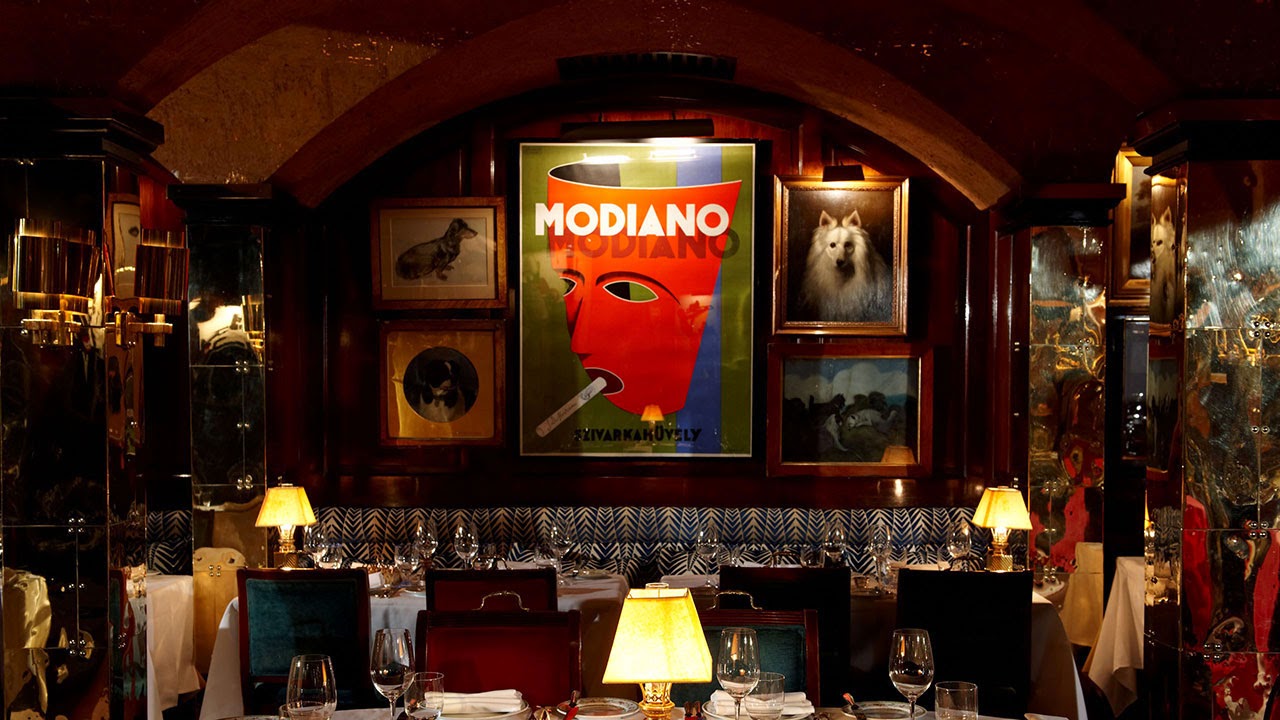
Another steakhouse, Greig’s Grill is all about the steaks which never fail to get rave reviews. Large, exquisitely cooked steaks are the bread and butter at Greig’s and you’d really be missing out if this was not your dish of choice; not least because of the mediocre reviews accompanying their other offerings. An old-fashioned traditional feel complete with wood panelling and luxurious chandeliers help to give the place an authentic feel. Prices for steak are reasonable although you may find you get a little less than you paid for with some of the other dishes. The staff are dependable and the wine equally easy on the pocket as the steaks.

Annabel’s

44 Berkeley Square, Mayfair, London, W1J 5QB (see map)


With one of the biggest reputations in London, some may argue the world, Annabel’s is best known as an elegant nightclub where old-time rockers, aspiring business women and of course the regulars converge at this members only location situated within Berkeley Square. You’ll hear little of the food, which is described as good and dependable, because it’s all about the experience of being at one of London’s top and most exclusive clubs. Expect an expensive night and bear in mind that the biggest barrier may well be getting invited; being a members only club you’ll either need to signup or be invited by an existing member. History: Opened in 1963 by Mark Birley, the Club’s earliest members included Frank Sinatra and Princess Margaret. Ownership changed hands in 2007, when Annabel’s was purchased by Richard Caring, who also owns The Ivy.

On The Shelf: Across The Pond

In Across The Pond: An Englishman’s View of America, author and literary critic Terry Eagleton skewers Americans relentlessly – but it’s okay, because Eagleton gets around to other nationalities, as well. Especially his own (British, as the title of the book implies).  Eagleton sets a wry tone in his introduction, where he writes, ” . . . the discerning reader will note that when I make large generalizations about the British, Irish and Americans in this book, my comments must occasionally be seen as involving a degree of poetic license and a pinch of salt.” From there we embark on a tour de force of political incorrectness that’s by turns either oddly refreshing or startlingly at odds with what one personally knows to be true.

Eagleton compares the Americans to the British early on while setting forth one cause for the divide in our national characters: “Henry James thought that America lacked mystery and secrecy, that its landscapes were all foreground, but found just such an air of enigma in Europe. This was not, he considered, by any means wholly to its credit. Civilisations which prize the mannered, devious, playful and oblique generally have aristocratic roots, since it is hard to be mannered, devious and playful while you are drilling a coal seam or dry-cleaning a jacket. And aristocratic social orders, as James was to discover, can be full of  suavely concealed brutality. A dash of American directness would do them no harm at all. A culture of irony requires a certain degree of leisure. You need to be privileged enough not to have any pressing need for the plain truth. Facts can be left to factory owners.” Of course, this example supposes that British aristocrats make up the whole of the English population. Or at least that part of it which is playful and/or enigmatic. And surely the UK has at least one or two plain talking dry cleaners available to them in a crisis?

In an attempt to rationalize American zeal, willingness and industry, the author writes, “It was a communal act of willing that brought America about in the first place. The nation itself is the work of the will. It is not just a country like any other but a project, a vocation, a mission, a destiny, a spiritual enterprise. Nobody thinks this about Belgium. It is not the case with Wales, Slovenia or the United Arab Emirates, which some Americans might suspect is a movie company. Britain is not the work of the will. The British never planned their empire, for example. It just fell into their laps in a fit of absent-mindedness. They awoke one morning to find that they were governing India, even though nothing had been further from their thoughts. They did not particularly savour the prospect, but it seemed churlish not to get on with it.” One can just about hear the Wellesley’s turning over in the respective graves now.

As Eagleton warned in his introduction, much salt was pinched in the writing of this book and oddly enough, the majority of it falls on the British Isles, rather than on America, as the title would suggest. “Like comedy, the British are traditionally suspicious of the success ethic. Unlike Americans, they are not an affirmative nation. Among their national icons are a ship that sank (the Titanic) and a calamitous military defeat (Dunkirk). Defeat is what the British are particularly good at. They are maestros of utter disaster. No doubt there are bunkers deep below Whitehall where intensive seminars in how to screw up are secretly conducted. Glorious defeats, like the Charge of the Light Brigade, are almost to be elevated over stupendous victories. The British are not particularly heroic, but brave out of necessity. Unlike Americans, the only kind of heroism for which they have a sneaking admiration is one forced on you when the odds are hopeless and your back is to the wall. After such sporadic bursts of self-sacrificial glory, they resume their normal, grumpy, unheroic existence until the next catastrophe happens along. They need the occasional hardship in order to show what stuff they are made of, and suspect that American civilization is too easy and flaccid in that respect. The States may be full of virile, chisel-jawed, bestubbled types, but all those stretch limos and Jacuzzis are fatally weakening. This is ironic, since quite a few Americans see the British themselves as effete. This is largely because their accents can sound vaguely gay, rather like their prose styles.”

Wellington continues to roll, Churchill’s moaning aloud and I’m left wondering exactly what England ever did to Eagleton to deserve such treatment. Perhaps Across the Pond would have been funnier if it had been based on truths. Even stereotypical truths. Like this one:

“An American friend of mine once confessed to me that he found a certain philosopher rather standoffish. I told him that he had the word almost correct: it wasn’t standoffish, it was Scottish. Scottish men tend to smile less than American men do, a fact that can easily be mistaken for churlishness. In fact, a male Scot will probably smile only faintly if he meets you after a twenty-year absence and you are his mother.”

Now, that’s funny.

Published by W.W. Norton and Company, Hardcover ISBN: 9780393088984

The Wellington Tour: Frogmore House…in Windsor Great Park

The Wellington Tour will visit Frogmore House on  September 13, 2014, a special treat,  for all of you can come with Kristine and me, Victoria, on our great adventure.  For all the details on the tour, click here.

Frogmore House, from the lake

For the Frogmore House website, click here.

Aerial View, House is center right

Frogmore House has served as a sort of refuge for various members of the royal family for several centuries.  The property became part of the royal holdings in the 16th century and was leased out to others. The land was acquired because it was adjacent to Windsor Great Park, though it was as marshy as its name indicates.  Several houses were built  by the Aldworth family, and the larger, known as Great Frogmore, was eventually leased to the Duke of Northumberland, (1665-1716), who was the natural son of Charles II and the Duchess of Cleveland. Eventually it was purchased for ‘
Queen Charlotte (1744-1818), wife of George III, in 1792.

Queen Charlotte, c. 1789-90, by Sir Thomas Lawrence
National Gallery, London
 
 
 Charlotte and her daughters often fled to Frogmore to escape from the confines of palaces and castles, to this comparatively modest house where they could enjoy a bit more relaxation.  Queen Charlotte was an avid gardener and brought a number of unusual plants to this estate. Several of the princesses painted or sketched works shown here.
 
For a brief segment of the conversation of HRH Charles, Prince of Wales with the Royal Librarian about Frogmore interiors, click here.
 

The Green Pavilion, 1817, from Pyne’s Royal Residences
 
 
The Green Pavilion has been restored to its look during Queen Charlotte’s lifetime.  Upon her death, Frogmore was left to her eldest unmarried daughter, Princess Augusta, though most of the furnishings were sold for the benefit of all the princesses.
 
 
The Mary Moser Room, photographer: Christopher Simon Sykes
The Royal Collection © 2009 Her Majesty Queen Elizabeth II
 
 
The flowered panels by artist Mary Moser (1744-1819) were commissioned by Queen Charlotte, who chose the artist’s name for the room.  The unusual four-tier revolving bookstand at the right dates from this same period of time.
 
After the death of Princess Augusta in 1840, the crown repurchased the estate and Queen Victoria gave it to her mother, Victoria, Duchess of Kent, as her home. Many alterations and modernizations were made once more and the Duchess presided over the redecoration of several principal rooms.
 
The Duchess of Kent’s Drawing Room, photographer: Derry Moore
The Royal Collection © 2009 Her Majesty Queen Elizabeth II
 
 In addition to artistic interests, reading and stitching, the ladies who enjoyed the informality of Frogmore sometimes organized theatrical programs and concerts by their friends as well as professional musicians. I suspect that after seeing the grandeur of nearby Windsor Castle, we will thoroughly understand why time at Frogmore was so precious.


The Colonnade
 
 All of the residents of Frogmore have enjoyed the garden, and like the rooms, re-imagination often reigned. After the Indian Mutiny, Lord Canning, Governor-General of India, presented an Indian Kiosk captured at Lucknow in 1858  to Queen Victoria who had it placed near the house.
 
 
Indian Kiosk
 
 
After the death of her mother and her husband, both in 1861, Queen Victoria often sought seclusion at Frogmore She loved the house and garden where  ‘all is peace and quiet and you only hear the hum of the bees, the singing of the birds’. She built a mausoleum for Prince Albert and herself on the grounds. It is rarely open to the public due to ongoing restoration projects. 
 
Though no royals have lived at Frogmore for some time, it is often used for meetings and other activities.  Below is the family portrait taken at the reception held at Frogmore after the wedding of the Queen’s eldest grandson to Autumn Kelly in 2008. 
 
 
This image released by the family shows the wedding group of Peter Phillips, top center left, and his bride Autumn Kelly, top center right, at Frogmore House, Windsor Castle, England and (seated left to right front row) Prince Philip, Queen Elizabeth II, Ivy Kelly, Edith McCarthy, (standing left to right) Mark Phillips, Princess Anne, Kity Kelly, Brian Kelly. (AP Photo/Sir Geoffrey Shakerley, HO)

This image released by the family shows the wedding group of Peter Phillips, top center left, and his bride Autumn Kelly, top center right, at Frogmore House, Windsor Castle, England and (seated left to right front row) Prince Philip, Queen Elizabeth II, Ivy Kelly, Edith McCarthy, (standing left to right) Mark Phillips, Princess Anne, Kitty Kelly, Brian Kelly. (AP Photo/Sir Geoffrey Shakerley, HO)


I am looking forward to seeing this lovely house which has been so dear to many generations of the royal family.  It is open only a few days each year, so The Wellington Tour is fortunate to be eligible.
 
Consider joining us for The Wellington Tour in September 2014.