The Wellington Tour is still nine months away and so I do not dwell on it. Much. It would be folly for me to think on the prospect of seeing England again this far ahead of our departure. So I’ve decided that the best thing to do is to put the Tour as far from my mind as possible. You would think it would be relatively easy to accomplish this state of enforced amnesia, but it is not. Reminders seem to be round every bend. Rory Muir’s new biography of the Duke of Wellington was just published in December and so I’ve been reading reviews of it whilst awaiting the arrival of my own copy (oh, Joy!). And then there are the gossip items one can’t help reading lately regarding the engagement of the present Duke of Wellington’s granddaughter, Sofia Wellesley, to ex-guardsman and current crooner James Blunt, pictured below. Lately, one can hardly turn around without encountering the Duke of Wellington. And there was the diorama of the Duke of Wellington’s funeral procession, with rolls of handcoloured pictures of all the dignitaries and their carriages, which I found recently on eBay. It looked something like a thicker Etch-A-Sketch, the pictures moved along rollers that were controlled by the two knobs beneath the glass window. Alas, I was forced to stop bidding when the price flew above four hundred dollars, more’s the pity. It would have been a grand addition to my future Wellington Museum.

And then there’s Masterpiece Theatre, which seems to be on a mission to remind me of the Wellington Tour on a regular basis. I watch a lot of PBS, and thus have been treated to the spate of commercials and programs running up to the premiere of the new season of Downtown Abbey. PBS has been running Season Three episodes of Downton Abbey almost non-stop. Hubby has even gotten into the spirit of things, though unwittingly.
“Hey, Hon!”
“Yeah?”
“You watching your PBS?” (Hubby watches his shows in the living room – I in the bedroom).
“No. Why?”
“That woman’s on again. You know, the one who’s in every British program ever made.”

I switched over to our PBS channel, where I saw the Dowager Countess of Grantham on the screen. “Maggie Smith,” I yelled.”It’s Downton Abbey. I’m going there.”
“Riiight.”
“Downton is really Highclere Castle and we’re going there on the Wellington Tour.”
“Better you than me. My good man,” answered Hubby.
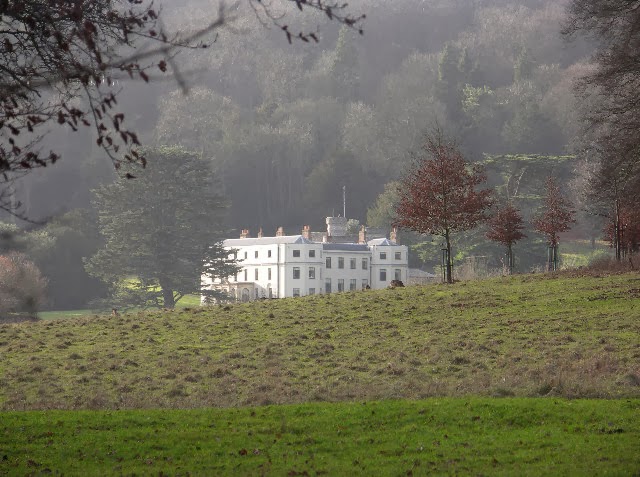
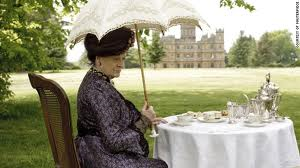
In fact, I’m watching The Secrets of Highclere Castle – again – as I write this. Once more I hear that Highclere Castle costs roughly a million pounds a year to maintain. And that within it’s walls is the priceless Van Dyck of Charles I, visible in the photo below.


I wonder if the family will be at breakfast when we arrive . . . . . . Once more, I’m told that in 1839 Highclere House was remodeled in the Gothic style. And that Capability Brown redesigned the landscape, which features a ruin-like folly and various temples, including the Temple of Diana, below.
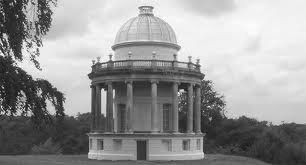
In fact, the more I think on it, the more I realize that what I want to see most at Highclere are the grounds.

In the photo above, we see one of the fifty-six Cedars of Lebanon planted by the first Earl. I’m glad that Victoria and I have blocked out an entire day for our visit to Highclere, so that we’ll all have the time to take it in at our leisure. You can click this think for a map of the grounds.
This will also leave us plenty of time to visit the Tea Rooms
|
Highclere Castle Afternoon Tea Menu Tea and Coffee
A glass of Sparkling Elderflower/Champagne
Selection of sandwiches that may include;
Roasted Chicken and Stuffing
Smoked Salmon and Horseradish
Honey Baked Ham
Egg and Cress
Freshly Baked Scones
Clotted Cream and Homemade Jam
A selection of cakes: Victoria Sponge, Carrot Cake or a Coffee and Cream Cake
  ; |
and, naturally, the Gift Shop. But returning to the house . . . .

I do want to see Lady Mary’s bedroom . . . . . . .
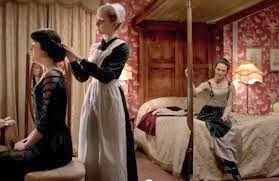
where Mr. Pamuk died.

It’s part of the tour, as is the gallery along which the ladies of the house carried the body.

I know, I know – with all that’s happened on Downton Abbey, why do I keep going back to that episode? Could it be because it was strangely comedic?

Of course, I’ll be tuning into Downton Abbey this Sunday since I can’t wait to find out what Thomas the Footman has up his sneaky sleeve this season. That should keep me from thinking about The Wellington Tour. Much.
Why not consider joining Victoria and me on our Tour? We’d love to have you with us as we experience all the fun of Highclere Castle, as well as the exciting feast of additional sites we have planned.




_1.jpg)