Fashions of 1814

Victoria here.  Time to take a brief look at some of the fashions worn by ladies 200 years ago. 

Here are a few examples from my collection of fashion prints from Regency-era magazines
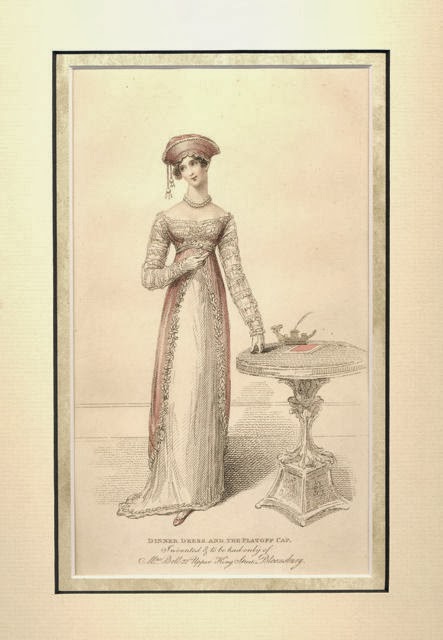
This is framed on my wall…and I love it. 
La Belle Assemblee
Dinner Dress and the Platoff Cap, April 1814,
“Invented and to be had only of Mrs. Bell 
22 Upper Brooke Street, Bloomsbury”
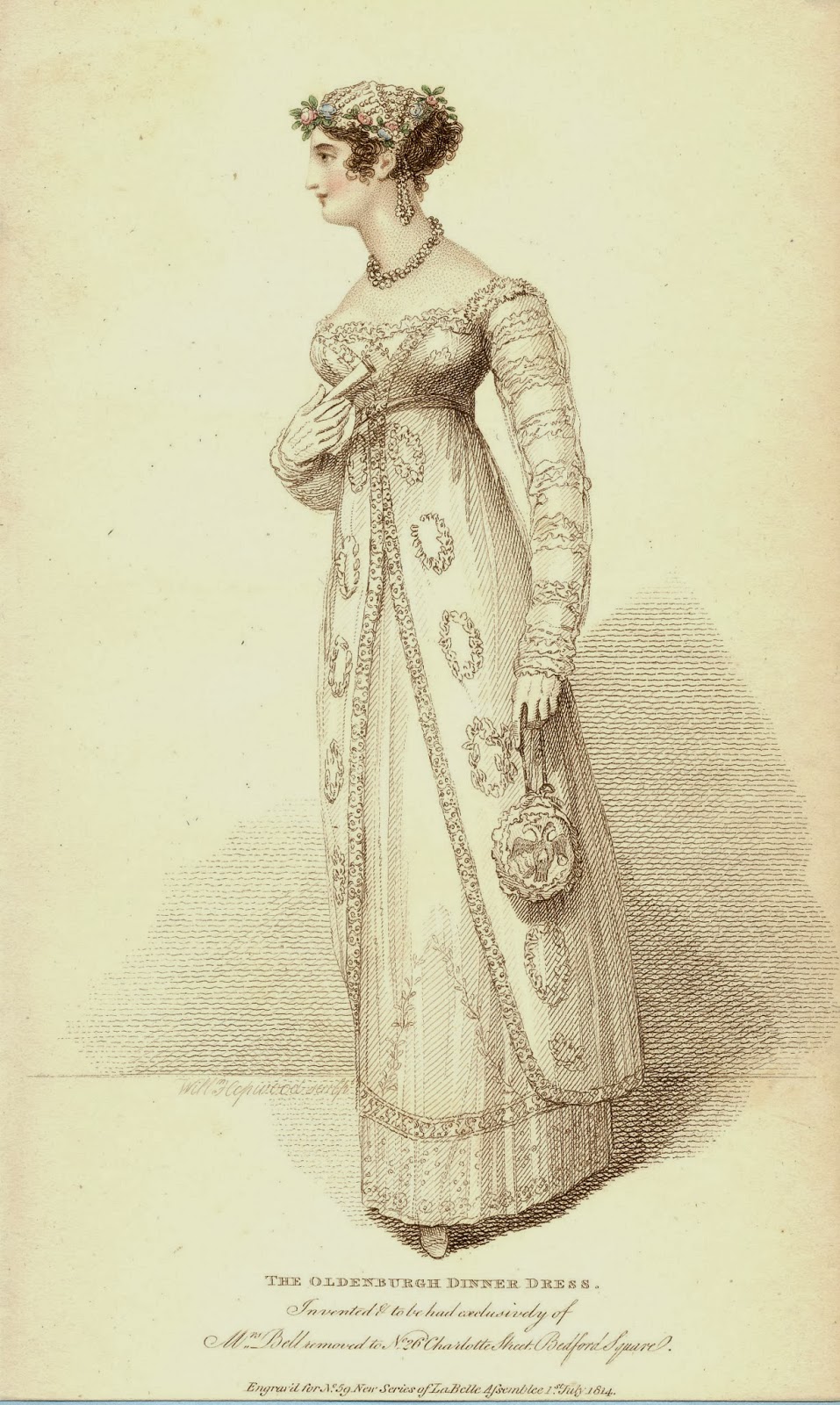
The Oldenburgh Dinner Dress July 1814

            French white satin slip, decorated round the bottom with a rich blond lace, and headed with a superb pearl trimming: a wreath of laurel leaves formed of pearls, in an angle in the front of the slip. The trimming is perfectly novel, and the effect of it is more elegant than can be conceived from the engraving which we have given. Over the slip is a short Russian robe of white crape, open front, edged round with a rich pearl trimming to correspond with the slip; the wreaths which ornament the robe is formed of pearls also, to correspond. The front of the dress is formed in a most novel and tasteful style, peculiar to the inventress, Mrs. Bell. The back continues full, and the waist very short. Crape long sleeve, trimmed with pearl bands at regular distances. Small lace cap, superbly decorated with pearls, and finished with tassels to correspond; a fancy flower is placed to the side. The form of this cap is extremely elegant, exquisitely tasteful, and becoming. A white satin Chapeau Bras, ornamented with a spread eagle on the crown, worked in chenille, is indispensable. The hair is worn up a-la-Grecque on the left side, where it is fastened in a full knot. Gloves and slippers of white kid. Plain ivory fan.

 
Ackermann’s September, 1814
 
Evening Half dress Published in Ackermann’s Repository of Arts, September 1814
A plain frock, with full-drawn back, composed of striped sarsnet Italian net of peach-blossom colour; full flounce of blond lace, headed with tufts of the same; a quilling of blond round the top of the dress; long full sleeve of white satin, inlet with lace. Hair in short full curls behind, and blended with flowers on the front of the head. Slippers of white kid. Limerick gloves.
 
  
Somehow the artists at Ackermann’s seemed to have fallen in love with rear views this year.  There were quite a few. 

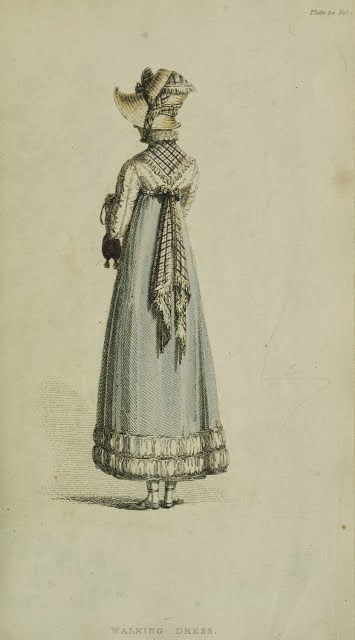
Walking Dress, October 1814, Ackermann’s
 
Walking dress Published in Ackermann’s Repository of Arts, October 1814
An evening primrose-coloured French sarsnet petticoat, trimmed round the bottom with a double border of clear muslin, drawn full with narrow ribband of corresponding colour to the petticoat; high body of jaconot muslin, with reversed drawstrings; long sleeve, drawn to correspond. A silk ruff. A silk net handkerchief-sash, tied in streamers and small bows behind. A Shipton straw bonnet, tied under the chin with a net handkerchief crossing the crown, and trimmed with a band of the same silk net. Sandals of evening primrose-coloured kid. Gloves to correspond.

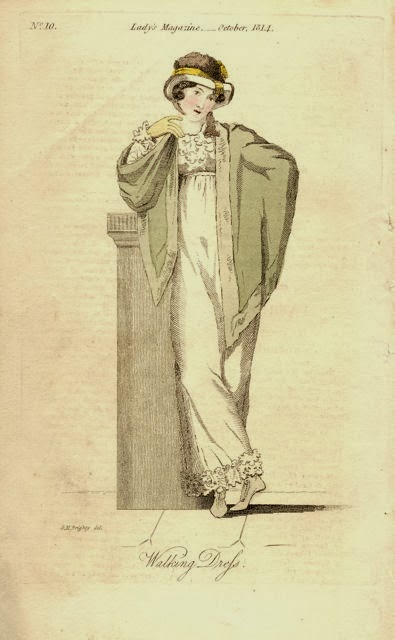
Walking Dress
Ladies Magazine, October, 1814
 
I have no description of this ensemble, but I love the hat — and the casual pose.  She looks quite modern.

I used some of these images on the e-book covers of my Regency Romances.  I love them.
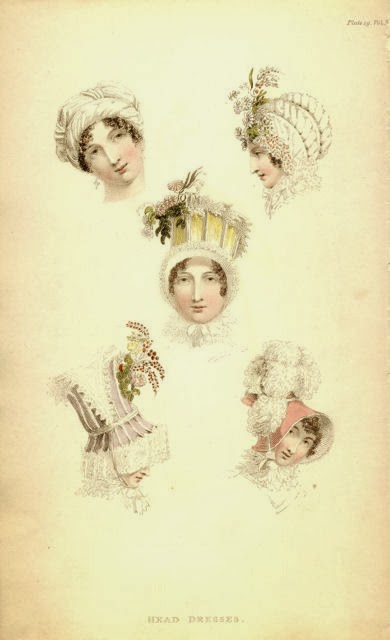
 
Ackermann’s, December 1814 Head Dresses
 
Head dresses  Published in Ackermann’s Repository of Arts, December 1814
No. 1. A full turban, made eithe
r in tiffany or silver net; the crown lashed with silk or silver cords.

No. 2. A melon cap, made of white satin quilted, with narrow bead trimming inlet, ornamented with a full cluster and wreath of flowers, blended with a quilted border of lace.

No. 3. A Persian calash, formed upon a wire fabric, and composed of satin-striped ribband, trimmed with a full border of blonde lace, appliqued with a heading of Vandyke: a net handkerchief crosses the crown en suite, with a large cluster of wild flowers in the centre.

No. 4. A cottage bonnet, made in salmon colour and white velvets, ornamented with a double plume of ostrich feathers.

No. 5. A Russian-à-la-mode, composed of orange and white velvets, trimmed round the edge with a quilling of Vandyke lace; the crown decorated with flowers and wreaths of Vandyke lace. 

It seems that 1814 was a banner year for portrait painters…and their lovely subjects’ raiment. Here is an example.
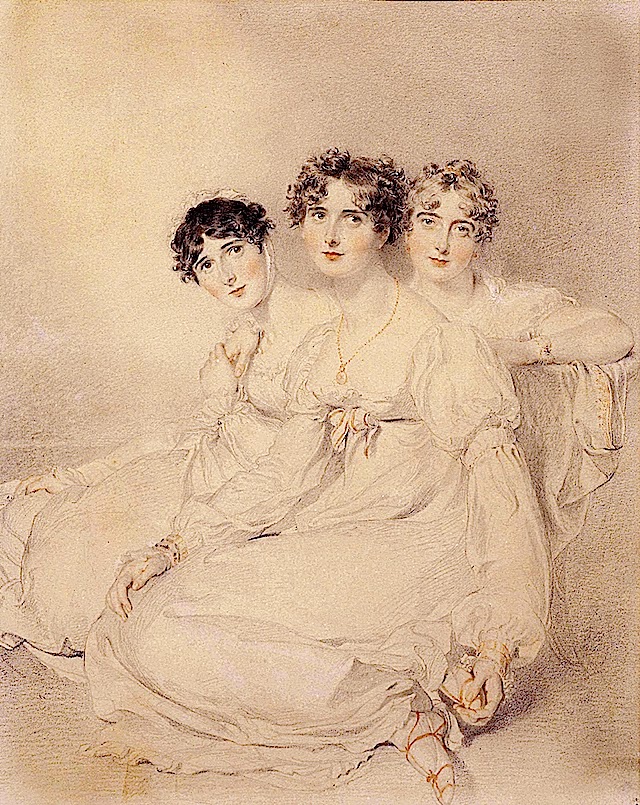
Sir Thomas Lawrence, 1814
 Lady Bagot, Lady Fitzroy Somerset (later Lady Raglan), and Lady Burghersh (later Countess of Westmorland), all three nee Wellesley-Pole. Three nieces of  the Duke of Wellington in fashionable gowns.

Visiting the Windsor Museum

The Wellington Tour will explore the Museum of Windsor on September 12, 2014 — we hope you’ll be with us.

The Museum is located on the ground floor of the Windsor Guildhall a building designed by Sir Christopher Wren and built in the 17th Century, though it was originally begun by another architect who died in 1689. Nevertheless, it bears the unmistakable stamp of Wren.
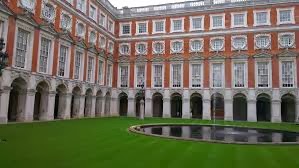
Wren’s addition to Hampton Court Palace
 
Prince George of Denmark, husband of Queen Anne
 

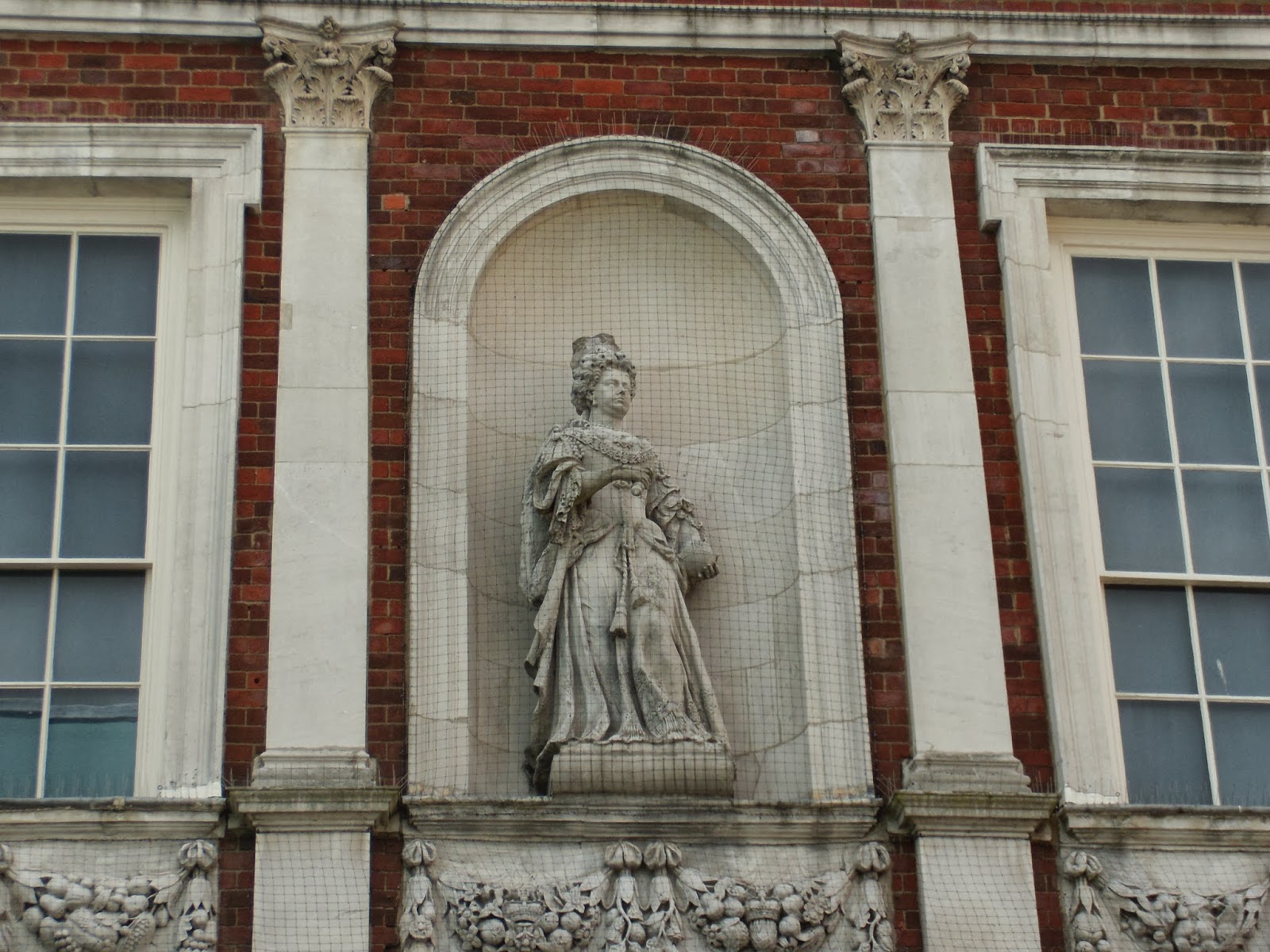
Om true Wren style: Queen Anne

For several hundred years, the Windsor Guildhall served as headquarters for the council and Lord Mayor of the town. 


This Council Chamber and the adjacent room are available now for meetings, weddings, and other events.

The Museum, on the ground floor, tells the story of the town from earliest evidence of human habitation to the present.  Among our favorite displays are the intricate dioramas of Windsor history.
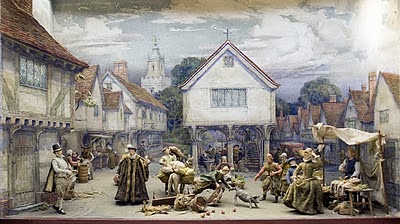
Windsor Market-place, 1607

The Museum (website here) was masterminded by our dear departed friend Hester Davenport and her associates.  So our visit with the Wellington Tour participants will be bittersweet for Kristine and Victoria who spent time with Hester here several times and knew of her long years of work toward its establishment.
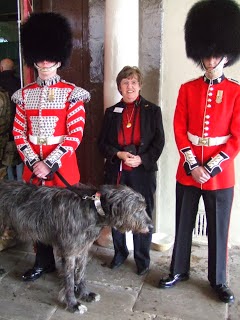
Hester and the Scots Guards

Here are three of our blog posts on the subject of Hester and the Museum.

Hester on the dioramas
http://onelondonone.blogspot.com/2011/03/windsor-dioramas-by-guest-blogger.html

Hester In Memoriam
http://onelondonone.blogspot.com/search?updated-max=2013-10-14T03:30:00-04:00&max-results=10&start=27&by-date=false

The Windsor Museum
http://onelondonone.blogspot.com/2011/08/travels-with-victoria-windsor-museum.html#more

The Museum is located on the High Street, almost in the shadow of Windsor Castle.  Among its famous neighbors is this Crooked House, photographed frequently!
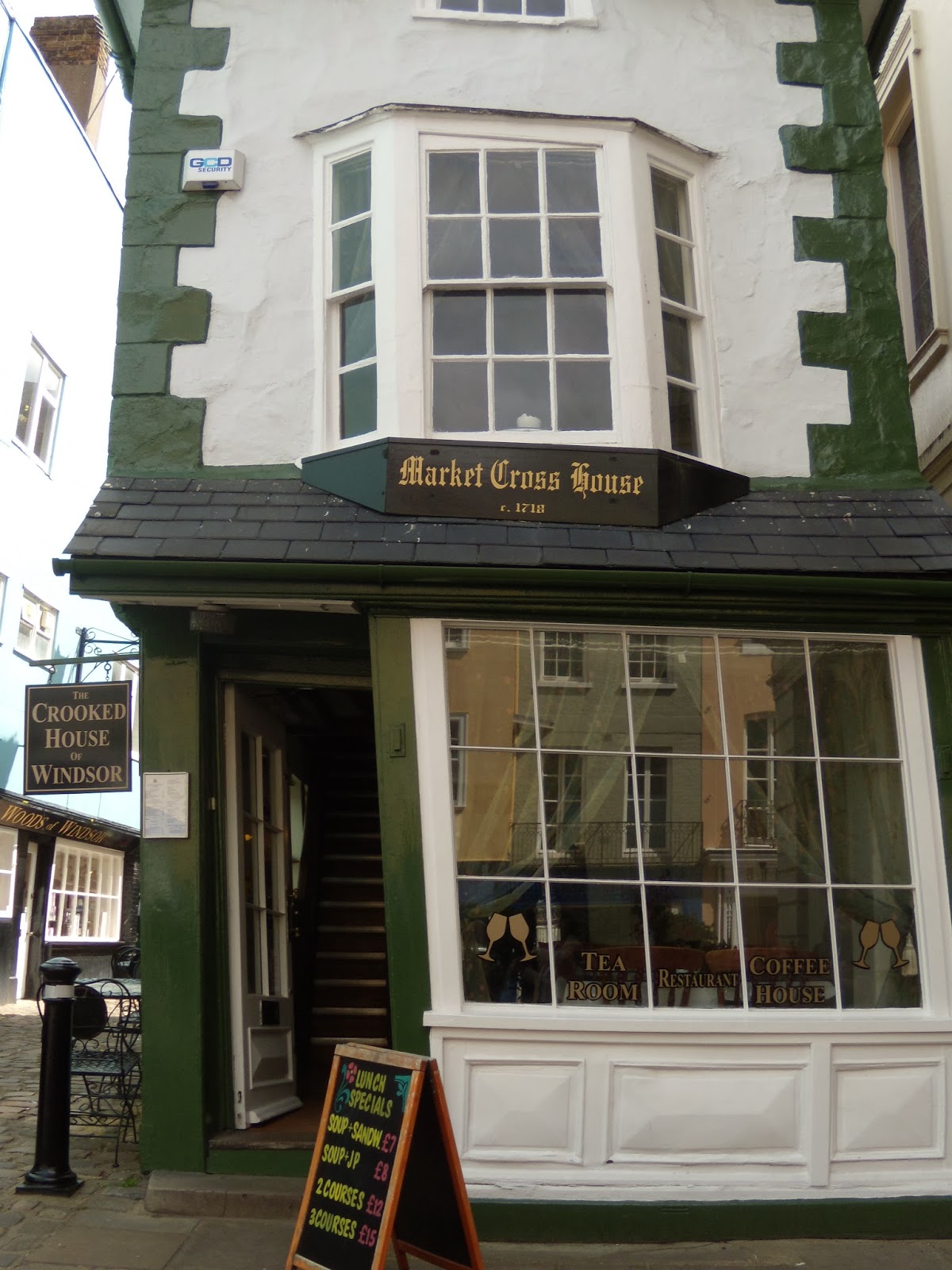
Market Cross House aka The Crooked House
 
 
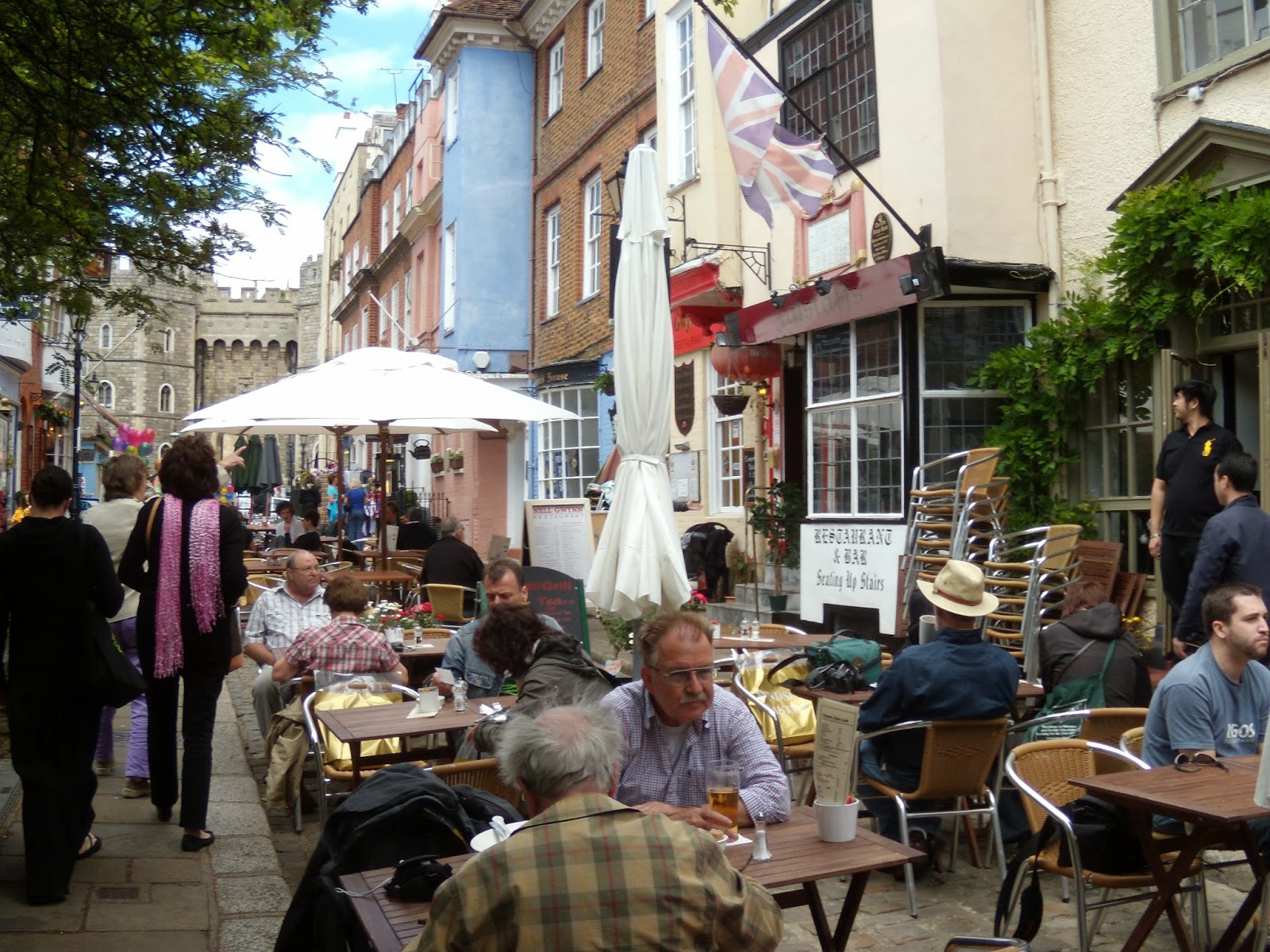
Many restaurants are in the adjacent streets
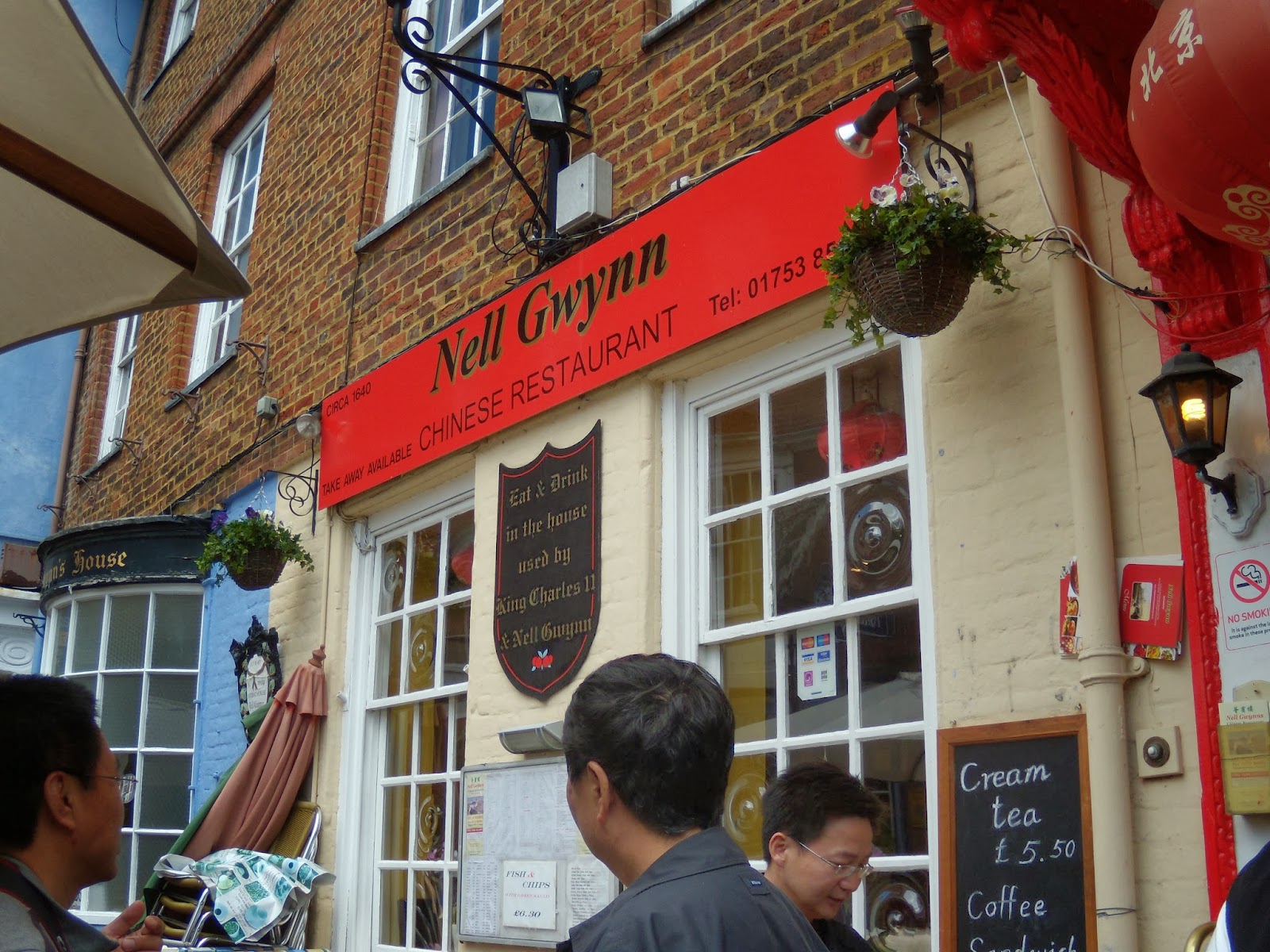
This amused us greatly: The Nell Gwynn Chinese Restaurant!!


The Changing of the Guard at Windsor Castle marches right up the High Street


on their way to the castle


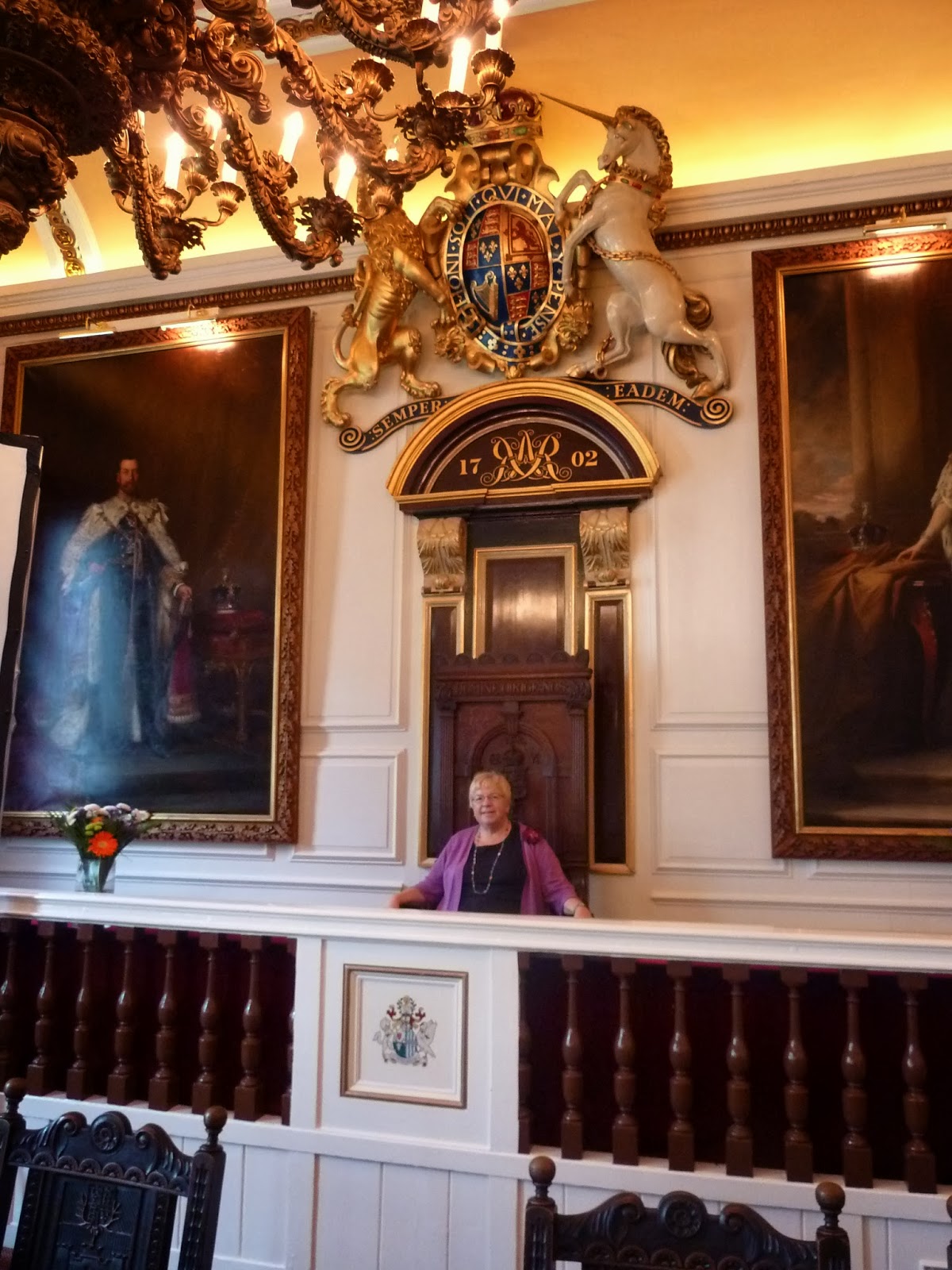
Victoria here, reminding you to make your reservation soon.  And that’s an order, from one who sat in the Lord Mayor’s Chair!
The Wellington Tour
September 4-14, 2014
 

A Pinterest Post – Basil Gill

I recently came across the arresting photo above while looking through the Pinterest boards. Hello, said I, this face begs further scrutiny. Clicking through, I discovered that this is the English actor Basil Gill (1877 – 1955) and s further search through Google Images led me to the discovery that I’d already pinned another photo of Mr. Gill to my board Absolutely Fabulous. In that photo (below) Mr. Gill resembles nothing so much as the quintessential English Dandy.

Searching the web for concrete facts about Basil Gill turned up not much more than bare bones credits for roles he’d played, until I found a site called a site called Shakespeare – The Players, which provided the following information.

“Basil Gill’s first stage appearance was in Wilson Barrett’s The Sign of the Cross. After touring in Australia and the United States, he had his chance to play Shakespeare when he joined Sir Herbert Beerbohm Tree’s company in 1903. He stayed with Tree until 1907, and during those years he played in Richard II, Fenton in The Merry Wives of Windsor, Ferdinand in The Tempest, Claudio in Much Ado About Nothing, Horatio in Hamlet, Richard II, Brutus in Julius Caesar, Orsino in Twelfth Night, Florizel in The Winter’s Tale, and Octavius Caesar in Antony and Cleopatra. This range of parts offered Gill do not occur often in an actor’s life.


“After he left Tree Gill still performed in many of Shakespeare’s plays; there were so many that it is simpler just to list them: 1908, Bassanio in The Merchant of Venice; 1910, Henry VIII, A Midsummer Night’s Dream, and Julius Caesar; 1911, Malcolm in Macbeth; 1912, he played in revivals of many of the parts he had played before; 1913, Bassanio in The Merchant of Venice with Johnston Forbes-Robertson; Twelfth Night, and Julius Caesar; 1914, Henry IV; 1915, Henry VIII; 1916, played in Julius Caesar for the Shakespeare Tercentenary at the Drury Lane Theatre; 1616, Romeo; 1920, Julius Caesar; 1926 and 1928, Macbeth; 1932, he twice played Brutus in Julius Caesar; 1933, As You Like It, A Midsummer Night’s Dream, and Twelfth Night; 1934, Henry VIII, Julius Caesar, and The Merchant of Venice; 1935, The Merchant of Venice and Macbeth; 1936, Richard II and the ghost in Hamlet.
“Gill was a handsome leading man, something of a matinee idol, so he played romantic parts in many modern and “popular” plays as well, but he was best known as one of the theatre’s leading performers of Shakespeare for almost four decades. He also played in thirty-five films during his career. His first part was in 1911 when he played Buckingham with Sir Henry Beerbohm Tree as Wolsey in Henry VIII; his last film was in 1939 and it was in the late 30’s he played in two popular movies, Journey’s End and The Citadel.”


Gill died at his home in Hove, Sussex. If you know anything else
regarding Basil Gill, pleasae let me know.


But Back to Masterpiece Theatre . . . . .

You’ll forgive me for returning to a topic on which I posted as recently as Friday, but Masterpiece Theatre is truly getting on my nerves. On Friday I touched on the fact that it seems just recently to want to remind me of the Wellington Tour at every turn. Today, I have a new gripe – the way Masterpiece Theatre treats it’s U.S. viewers like second class citizens.

I was doing a bit of gardening on Saturday. Now, before you get the wrong picture in your head, I live in Florida and so use the term “garden” loosely. Disabuse yourself of Capability Brown-like borders and vistas.

The reality, especially since I’ve been ignoring the garden of late, is more like this –

Except that it’s more overgrown. So, there I was hacking through the underbrush, being bitten rather painfully on my neck by something rather large, when it dawned on me that the fact that Masterpiece Theatre airs shows like Downton Abbey and Sherlock earlier in Britain than in the U.S. was exceedingly unfair. Why make us wait to see them when they didn’t have to? Surely our fan base is as large as theirs, or even larger. There are more of us then of them, after all.

And then I started thinking that it was additionally unfair that Britain kept all their good bits of history on their side of the pond, as well. I mean in that they are entitled. They own it all. They can do what they want with their heritage sites and stately homes and the like. But they’ve got so much of the stuff, large numbers of it going to rack and ruin at such an accelerated rate that English Heritage itself can’t keep up. Therefore, you’d think they’d pack a few of the crumblier ones up and ship them over here and therefore share the wealth, if you will. I mean, if they could FedEx the London Bridge over here, then surely a moderately sized stately pile wouldn’t be a problem? Once they arrived here, we could round up the HGTV hosts to reassemble them and then renovate and redecorate them according to historic designs. Instead of Property Brothers or Love It or List It or Income Property we could call the show The Castle Crew or even History Handyman or some such. Or we could get the neighbors in to redo the place for the new owners to the designs of Adams or Ackermann or Inigo Jones and then have a big reveal at the end of each episode. Think of the ratings.

And whilst we’re at it, why don’t they send a few Royals over here to head our government? Oh, I know the Royals no longer actually run the British government, but then there aren’t that many politicians over here actually running the government either. Instead of our having to deal with cracked out mayors and sniping senators, there would at least be entertainment value in seeing what hats the Royals wore while at the same time they might drum up some business for American fashion houses. And really, the more we have to deal with the healthcare fiasco in this country, the more National Health seems like a jolly good idea.

And so my mind went, until I became aware of the bite I’d received on my neck, which was beginning to itch. It was a large bite. The welt it left was about the size of a rather large grape. It was so large that it made me wonder just what the deuce had bitten me, since I hadn’t gotten a look at it. I doubt it was a brown recluse spider since I’m still alive and hope it wasn’t one of those devilish insects that lays eggs beneath the skin of their victims. I also hope I’m still alive by the time Season 3 of Sherlock finally airs here on January 19th.

The Wellington Tour: Masterpiece Theatre

The Wellington Tour is still nine months away and so I do not dwell on it. Much. It would be folly for me to think on the prospect of seeing England again this far ahead of our departure. So I’ve decided that the best thing to do is to put the Tour as far from my mind as possible. You would think it would be relatively easy to accomplish this state of enforced amnesia, but it is not. Reminders seem to be round every bend. Rory Muir’s new biography of the Duke of Wellington was just published in December and so I’ve been reading reviews of it whilst awaiting the arrival of my own copy (oh, Joy!). And then there are the gossip items one can’t help reading lately regarding the engagement of the present Duke of Wellington’s granddaughter, Sofia Wellesley, to ex-guardsman and current crooner James Blunt, pictured below. Lately, one can hardly turn around without encountering the Duke of Wellington. And there was the diorama of the Duke of Wellington’s funeral procession, with rolls of handcoloured pictures of all the dignitaries and their carriages, which I found recently on eBay. It looked something like a thicker Etch-A-Sketch, the pictures moved along rollers that were controlled by the two knobs beneath the glass window. Alas, I was forced to stop bidding when the price flew above four hundred dollars, more’s the pity. It would have been a grand addition to my future Wellington Museum.

And then there’s Masterpiece Theatre, which seems to be on a mission to remind me of the Wellington Tour on a regular basis. I watch a lot of PBS, and thus have been treated to the spate of commercials and programs running up to the premiere of the new season of Downtown Abbey. PBS has been running Season Three episodes of Downton Abbey almost non-stop. Hubby has even gotten into the spirit of things, though unwittingly.

“Hey, Hon!”
“Yeah?”
“You watching your PBS?” (Hubby watches his shows in the living room – I in the bedroom).
“No. Why?”
“That woman’s on again. You know, the one who’s in every British program ever made.”

I switched over to our PBS channel, where I saw the Dowager Countess of Grantham on the screen. “Maggie Smith,” I yelled.”It’s Downton Abbey. I’m going there.”
“Riiight.”
“Downton is really Highclere Castle and we’re going there on the Wellington Tour.”
“Better you than me. My good man,” answered Hubby.

In fact, I’m watching The Secrets of Highclere Castle – again – as I write this.  Once more I hear that Highclere Castle costs roughly a million pounds a year to maintain. And that within it’s walls is the priceless Van Dyck of Charles I, visible in the photo below.

I wonder if the family will be at breakfast when we arrive . . . . . . Once more, I’m told that in 1839 Highclere House was remodeled in the Gothic style. And that Capability Brown redesigned the landscape, which features a ruin-like folly and various temples, including the Temple of Diana, below.

In fact, the more I think on it, the more I realize that what I want to see most at Highclere are the grounds.

In the photo above, we see one of the fifty-six Cedars of Lebanon planted by the first Earl. I’m glad that Victoria and I have blocked out an entire day for our visit to Highclere, so that we’ll all have the time to take it in at our leisure. You can click this think for a map of the grounds.

This will also leave us plenty of time to visit the Tea Rooms


Highclere Castle Afternoon Tea Menu
Tea and Coffee
A glass of Sparkling Elderflower/Champagne
Selection of sandwiches that may include;
Roasted Chicken and Stuffing
Smoked Salmon and Horseradish
Honey Baked Ham
Egg and Cress
Freshly Baked Scones
Clotted Cream and Homemade Jam
A selection of cakes: Victoria Sponge, Carrot Cake or a Coffee and Cream Cake
&nbsp
;

and, naturally, the Gift Shop. But returning to the house . . . .

I do want to see Lady Mary’s bedroom . . . . . . .

where Mr. Pamuk died. 

It’s part of the tour, as is the gallery along which the ladies of the house carried the body.

I know, I know – with all that’s happened on Downton Abbey, why do I keep going back to that episode? Could it be because it was strangely comedic?

Of course, I’ll be tuning into Downton Abbey this Sunday since I can’t wait to find out what Thomas the Footman has up his sneaky sleeve this season. That should keep me from thinking about The Wellington Tour. Much.

Why not consider joining Victoria and me on our Tour?  We’d love to have you with us as we experience all the fun of Highclere Castle, as well as the exciting feast of additional sites we have planned.