Home Front Daily Life in the Civil War North

Victoria here…I have written earlier on this blog about programs at Chicago’s Newberry Library, and while I am far away at the moment, I want to tell you about an exhibition on display there until late March, if you have the chance to get to Chicago by then.

 
Views of the Newberry Library in the Autumn of 2013
 
 
“Home Front: Daily Life in the Civil War North” marks the 150th anniversary of the U.S. Civil War, 1981-1865.  The exhibition is interesting and well organized, and it may be of particular interest to readers of this blog because of the position of Great Britain.  Less than a century after separating from Britain, would the USA survive or break apart? 

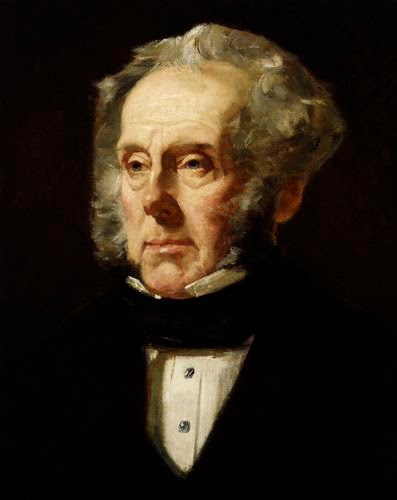
Henry John Temple, 3rd Viscount Palmerston, ca. 1855
Artist: Francis Cruikshank

British Prime Minister Lord Palmerston (1784-1865) was said to be more sympathetic to the cause of the secessionist states, probably for several reasons, especially including the importance of southern cotton to the textile mills of Britain.  Yet, the grains that traveled east across the Atlantic from Northern ports were of equal concern.  Most of the controversy was played out in diplomacy concerning the shipping, blockades, embargoes, neutral rights, etc. on the high seas.  President Lincoln needed to keep Britain on his side, or at the least prevent the British from directly supporting the Southern States

Samuel Colman Jr., Ships Unloading, New York, 1868
Terra Foundation for American Art, Chicago
 
 
From the Library’s Text Labels:  “Samuel Colman’s Ships Unloading depicts a busy New York port, where a ship known as the Glad Tidings is docked. The ship’s most important cargo was cotton, the mainstay of the South’s slave economy and New York City’s most important export. But since the early war years, the Glad Tidings had been instrumental in facilitating a free labor model of the cotton trade that aimed to replace slavery with wage work. The crops the Glad Tidings brought to New York had been grown and harvested in the South by wage-earning ex-slaves. Colman’s painting is therefore a reminder of epochal historical change. In the foreground, a black worker and two white counterparts tend to a cotton bale that has spilled open, while a single white worker wrestles with another bale. On the left edge of the painting a banner reads “London and New York,” reminding viewers that the South supplied the vast majority of raw cotton for the English textile industry through the port of New York. Visible only under considerable magnification are the words “New York Petroleum Co.” painted across the head of the barrel facing the viewer, foreshadowing the presence of the commodity that would fuel the engines of American commerce, and warfare, for generations to come.”


Albert Bobbett, Edward Hooper, and Louis H. Stephens, “Principle vs. Interest” from Vanity Fair
New York: Louis H. Stephens, April 13, 1861
Newberry folio A 5 .93 v. 3

Again from the Newberry’s texts: ‘In “Principle vs. Interest,” England’s John Bull casts a sidelong glance at the seated Confederate president, Jefferson Davis, who appears as a cotton broker. Bull turns his back on the black male figure, signaling that England’s abolitionist principles will not stop it from acting on its commercial interests. Characteristic of cartooning style at that time, the slave is literally encased and flailing helplessly in a cotton bale.’

Many other exhibits refer to activities in Chicago and elsewhere in the North during the Civil War. 

“Group of Chicago Zouave Cadets” from
Frank Leslie’s Illustrated Newspaper, NY, July 28, 1860
 

According to the exhibition, ‘More than 70 US Army volunteer regiments fashioned themselves “Zouaves,” borrowing the term and the uniform from French Army regiments serving in North Africa during the mid-nineteenth century. Instantly recognizable in their colorful garb, Zouave regiments sported tasseled fezzes, short, open jackets trimmed with braid and baggy pants, often in brilliant red. Sheet music, periodicals, and parades featuring precision drills contributed to the popularity of the Zouave regiments.

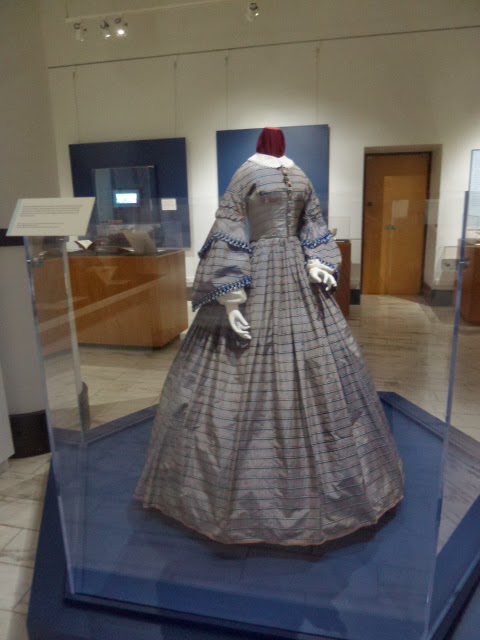
This Zouve-style silk dress worn by Sarah Cadwallader Logan Knowland, 1865-66, particularly interested me for the carefully stitched pleating and fine fabric.  I find it interesting that military styles often influence women’s fashions.

Dress, based on Zouave Style,
Chicago History Museum,


“Home Front” is open through March 24, 2014.  Among other exhibits are paintings by Winslow Homer and Frederic E. Church; first editions by Walt Whitman, Emily Dickinson, Harriet Beecher Stowe, and Louisa May Alcott; sheet music from Chicago-based music publishers; and  displays about changing roles of women and children. 

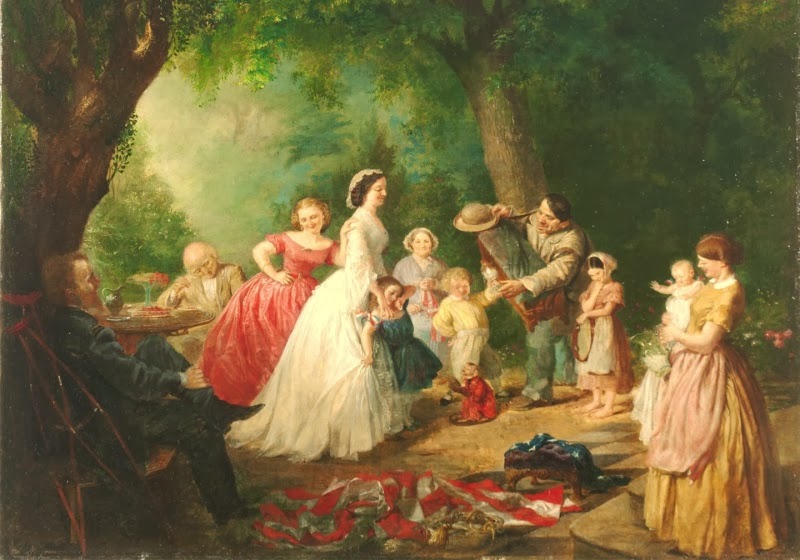
 Lilly Martin Spencer, The Home of the Red, White, and Blue ca. 1867-68
Terra Foundation for American Art, Chicago

Lilly Martin Spencer was born in Exeter, England, to French parents; the family emigrated to the U.S. when she was 8 years old in 1830.  Her husband, Benjamin Rush Spencer,  married in 1844 in Cincinnati, devoted his life to her artistic career.  Lily Spencer’s popular paintings focused on daily life, particularly of women.  After the Civil War,  she was well known for depicting the results of the war and the changes it brought in the American family.  In the scene above, the mother in white — said to be a self-portrait — and her daughters in red and blue assist the poor.  The man at the left seems to be a wounded war victim.  the painting is seen as m allegory of how women are repairing the war-torn nation.

Another aftermath of the war is simply and effectively shown below.


Fruit Piece: Apples on Tin Cups

    William Sidney Mount, Fruit Piece: Apples on Tin Cups, 1864
Terra Foundation for American Art, Chicago
According to the Library text, “William Sidney Mount’s Fruit Piece: Apples on Tin Cups depicts two weathered tin cups, known as “dippers,” each with an apple sitting atop. The tin cups were standard issue for Union soldiers, who often wore them dangling from their belts as they marched, or on their saddles as they rode into battle. These cups were objects of war, yet by placing them in this domestic setting, Mount’s painting suggests that the distance between battlefield and home front could easily collapse. The artist donated his painting to the 1864 Great Metropolitan Fair in Manhattan, where its sale helped the US Sanitary Commission raise money.”
“Home Front: Daily Life in the Civil War North” was organized by the Newberry and the Terra Foundation for American Art. the Library’s website is here. The Digital Exhibition is here.

William Kent: Designing Georgian Britain

William Kent


Whilst in Manhattan recently, I was fortunate enough to be able to take in the current Exhibition at the Bard Gallery – William Kent: Designing Georgian Britain, which will move to the Victoria and Albert Museum in London from March 22 to July 13, 2014.

The Exhibition contains nearly 200 examples of Kent’s elaborate drawings for architecture, gardens, and sculpture, along with furniture, silver, paintings, illustrated books and new documentary films. As most of his best-known surviving works are in Britain’s great country houses, the exhibition is rich in loans from private as well as public collections.

As the Exhibition website tells us: “Kent devised a style that catered to the Grand Tour alumni, recreating the splendors of Roman palazzi. A jovial house guest of his patrons, ‘Kentino’ (as he was affectionately known) and his creations reminded them of the best days of their lives, before they returned, inherited, and dutifully managed their old family estates.” Kent’s notebooks and drawings kept during his own time in Italy form a part of the current Exhibition and it was fascinating to see these items, written in his own centuries ago, up close.

You may recall a recent post on this blog on Devonshire House in London and, if so, you’ll know how delighted I was to find items from the House included in the Kent Exhibition.

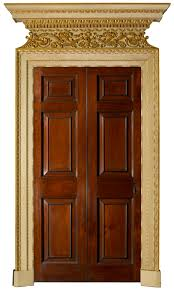
Door and surround from the East Drawing Room (later the dining room), Devonshire House

Lord Burlington is the best- known today of several patrons who embraced Kent’s design ideals and Kent lived in his London townhouse, Burlington House (today the home of the Royal Academy) for most of his life and was also, in effect, artist-in-residence at Burlington’s new Italianate villa at Chiswick.

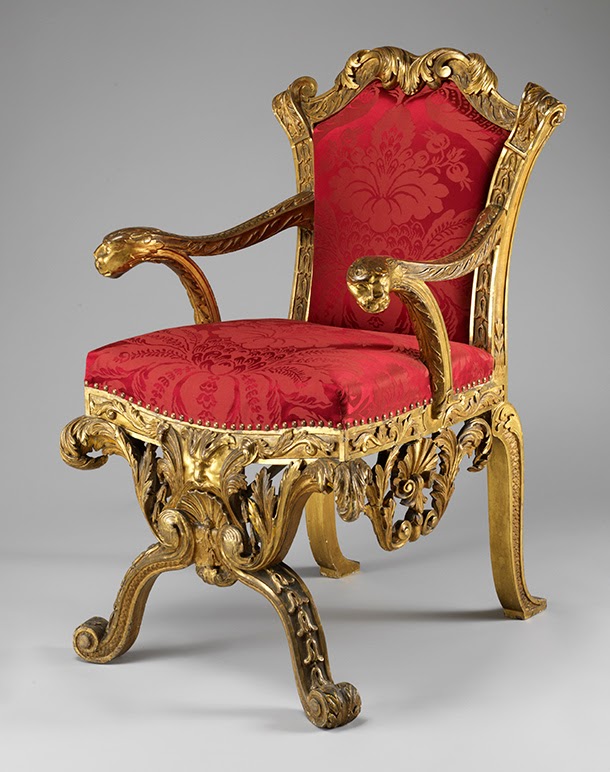
Armchair for Devonshire House William Kent. Armchair for Devonshire House William Kent 1733-40. Carved gilt wood, modern upholstery.


As Victoria reminded me, some of the Devonshire House items were sold as part of the Chatsworth Attic Sale held at Sotheby’s in 2010, which included some 20,000 items from the Duke of Devonshire’s home. You can read all about that sale here. And you will find prices realized here. The sale brought in over six million pounds in total.

Of Kent’s public works, the exhibition examines 10 Downing Street, the Houses of Parliament, the Horse Guards at Whitehall, and the Royal Mews. One section is devoted to Holkham Hall, designed with the assistance of Lord Burlington for Thomas Coke, 1st Earl of Leicester, who was among Kent’s most important patrons. You can read Victoria’s post on her visit to Holkham Hall here.


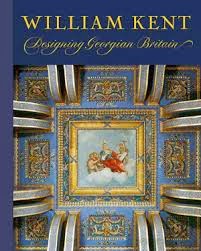
There is a book that’s been published to coincide with the Exhibition entitled William Kent: Designing Georgian Britain, edited by Susan Weber, and published with Yale University Press,
presents twenty-one essays by leading scholars of eighteenth-century British art and design, including Julius Bryant (co-curator), Geoffrey Beard, John Harris, John Dixon Hunt, Frank Salmon, and David Watkin. The book is richly illustrated with over 600 color images, including the pieces featured in the exhibition. A chronology of Kent’s projects, an exhibition checklist, and an extensive bibliography round out this scholary publication.

You can read more about the Exhibition on the Bard Graduate Center website here.

Love & Marriage at Reasonable Rates

                                By Guest Blogger Adrian Teal


In spite of the ease with which the randy young bucks who populate my Gin Lane Gazette could secure the services of a prostitute, there seems to have been a ubiquitous urge to find a girl to hurry up the aisle in the Georgian era. Until the middle of the 18th century, there was a thriving industry of clandestine, ‘quickie’ marriages, which Lord Hardwicke’s Marriage Act of 1754 was designed to ban. Under the existing system, a couple could be joined in matrimony by the simple expedient of exchanging vows before witnesses. Many an eligible heiress was cajoled to the altar by a false-hearted adventurer on the make, and many innocents who were too young to marry without parental consent later regretted having themselves shackled together in wedlock. Parish officers sought to make the bastard children of the poor the concern of other local administrations by arranging nuptials of the parents in next-door parishes, and countless drunken sailors and their sweethearts staggered up to a parson to plight their troths. 
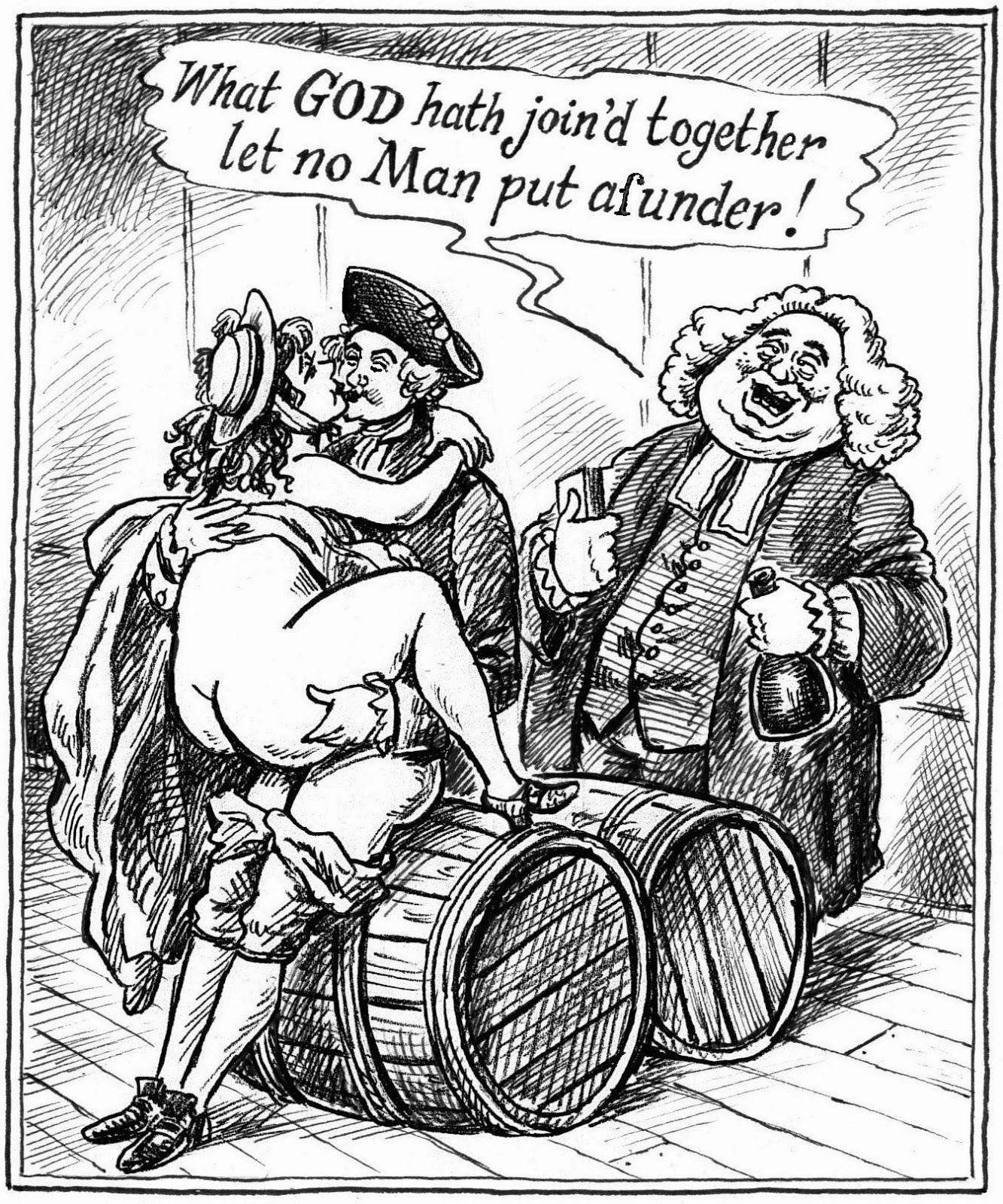


With Hardwicke’s legislation threatening to end this freedom, there was a stampede of London’s citizens in the direction of amenable and avaricious clergymen, who would happily conduct an express wedding ceremony for a quart of gin. The purlieus of the Fleet Prison were infamous as the base from which these parsons operated, and their shotgun couplings became known as ‘Fleet Weddings’. The day before the Act was enforced, 45 couples were joined in Fleet ceremonies by 11 o’clock in the morning, and nearly a hundred pairs were married before the day was over.

 A little later in the century, you could always do a moonlight flit to Gretna Green in the Scottish borders, if you were determined to marry your girl a safe distance from parental interference. Scottish law permitted ‘irregular marriages’, which meant that as long as they were conducted before two witnesses, practically anyone could perform marriage ceremonies. This included the local blacksmiths, who were nicknamed ‘anvil priests’. Richard Rennison was perhaps the most famous, and he presided over more than 5,000 ceremonies. Less well-known than Gretna Green’s smithy, however, was an English equivalent located in the Peak District.

 
In the churchyard of Peak Forest, near Chapel-en-le-Frith, stand the ruins of a chapel. Christian, the royalist Countess of Devonshire (who was born on Christmas Day, hence the name) ordered the chapel’s construction in the 17th century, and she eventually passed on its management to the local clergy. This put it beyond the jurisdiction of the Church, and the clergyman presiding was authorised to approve wills and issue marriage licenses off his own bat. He even had a seal of office to prove it. He made a tidy profit, as couples seeking a hurried wedding ceremony began to flock his way. He was often dragged out of bed in his nightshirt by furious parents in hot pursuit of amorous fugitives. By 1754 there were two ceremonies a week, netting him £100 per annum.


For those who had married in haste and were repenting at leisure, redress was very difficult to come by. The aristocracy could arrange a legal separation, but divorce was a protracted, expensive, and complicated business, and for the ‘lower orders’, it was nigh-on impossible. One solution was to hold a wife sale. This method of dissolving a marriage entailed the wife being led by a halter around her neck, and tethered to a post or fence in a public place. She was then auctioned to the highest bidder. Often, the purchaser was known to both parties, and before the sale there was probably a fair degree of collusion between the vendor, the wife, and the new ‘husband’ about the price and desired outcome.

 
Henry Brydges (1708-1771), Marquess of Carnarvon, and later the 2nd Duke of Chandos, contracted his second marriage by such means. He married a former chambermaid called Anne Wells, who came from Newbury in Berkshire. They had first met a few years before, when the Duke and a friend were dining at The Pelican, on the London road at Newbury. A commotion in the inn’s yard caught their attention, and they were told that a harsh husband was going to sell his long-suffering wife, who was being led by a halter in the traditional fashion. The Duke was captivated by her looks and her stoicism, whipped out his purse, and bought her. He married her at Keith’s Chapel, Mayfair, on Christmas Day, 1744.

 
This chapel was run by the notorious minister Alexander Keith, who conducted innumerable clandestine weddings. In one year, Keith married 723 couples for a one-guinea fee, and he was excommunicated on Episcopal orders. In retaliation, Keith ‘excommunicated’ the angry bishop. He was committed to the Fleet Prison, but continued plying his trade. He coerced four Fleet parsons into conducting weddings on his behalf, and put his name on the marriage certificates. He even advertised his services in the newspapers, and married about 6,000 couples.

 
The first person to place a lonely hearts advertisement in their local newspaper is thought to have been a lady called Helen Morrison. In 1727, she ran a notice requesting approaches from potential husbands in the Manchester Weekly Journal. This approach was to become common practise as the century progressed, and the advertisements of 18th-century singletons range in their tone from charming or importunate, via brusque, to downright cold and clinical. In Miss Morrison’s day, however, the world was unprepared for what it saw as her scandalous immorality and forwardness, and she was locked up in a lunatic asylum for four weeks.


Adrian Teal is an author and artist. Visit his site Teal Cartoons here and read Adrian’s Huffington Post columns here. To read about Adrian’s take on 18th century cartoons, click here.


Back on Track

Kristine and Victoria have completed our travels for the time being — and both are in Florida at the moment, avoiding the snowstorms of the East Coast and Midwest.

And while in Florida, we know what kind of pubs in which to hang out!

2014 is an exciting year — we are leading our first tour, The Wellington Tour, featuring haunts of you-know-who.  We hope you will consider joining us.  All the details are here.

Arthur Wellesley, 1st Duke of Wellington

The Wellington Tour will begin in London on September 4,  visiting the Duke of Wellington’s London residence Apsley House, his offices at Horse Guards in Whitehall, and other spots he was known to frequent.

We will travel by bus to Walmer Castle, where the Duke lived as Lord Warden of the Cinque Ports and where he died on September  l4, 1852. Onward to Brighton and the Royal Pavilion where the Duke conferred with George IV, William IV, and Queen Victoria.

Brighton Pavilion

We will also visit Stratfield Saye, the Duke’s country home and tour the nearby Highclere Castle, better known today as Downton Abbey.  The Castle is the home of the Earls Carnarvon, some of whom were both neighbors and colleagues of the Duke in the House of Lords.  We complete our tour in Windsor, also a royal residence where the Duke often attended  monarchs — and that is just a smattering of the many delights you will enjoy on our tour.

Highclere Castle, aka Downton Abbey

Please join us!!  www.wellingtontour.blogspot.com/

Frogmore House, Windsor

2014 is also the 200th anniversary of the publication of Jane Austen’s Mansfield Park, about you will hear much on this blog and elsewhere.  The Jane Austen Society of North America will hold its Annual General Meeting in Montreal This year, on the theme “Mansfield Park in Montreal: Contexts, Conventions, and Controversies.”


2014 is also the 200th anniversary of the first “end” of England’s war with Napoleonic France.  And it will mark significant anniversaries of events in the War of 1812, including the British burning Washington, D.C.  Perhaps we should mark these events this year as well as next since the 100th anniversaries were almost forgotten because of the Great War, which began in 1914.


So a belated welcome to 2014, and now we return you to your regularly scheduled program….