Born in 1784, at the age of 16 John Blanch was apprenticed to London gun maker, Jackson Mortimer. After a short-lived partnership with Mortimer, who at this point had become Blanch’s father-in-law, Blanch established his own business in 1809. He worked mainly for John Manton, but he soon became well established and respected as a gun maker in his own right. Blanch’s respected standing as a businessman and gun maker is evidenced by his rapid advancement through the ranks of the Farriers Company, culminating in 1834 with the prestigious appointment of ‘Master’.
He was an early advocate of the breech loading gun.
In 1826 the business was moved from the premises in Fish Street Hill to 29 Gracechurch Street where it would stay for the next 89 years.
Physical Description
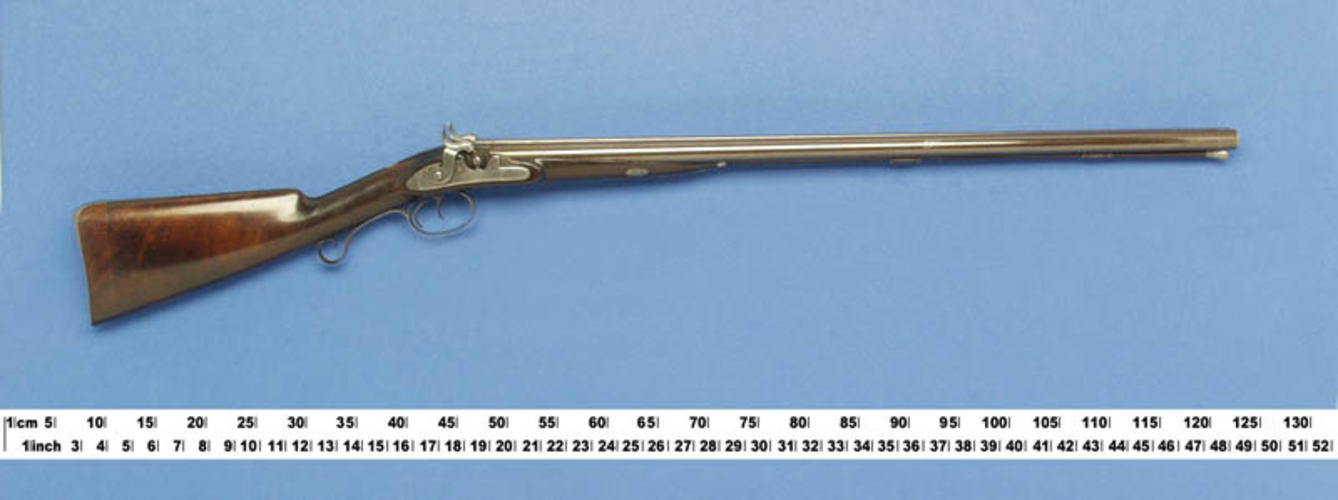
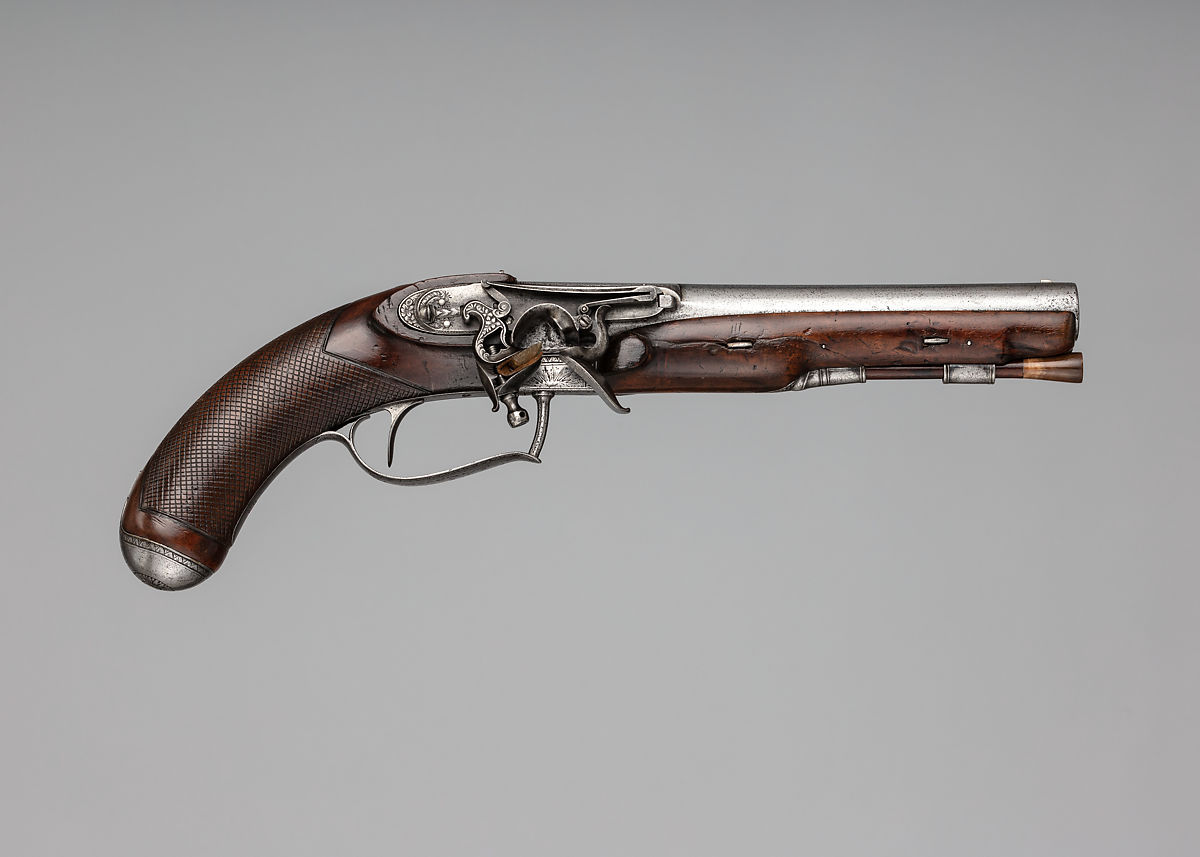
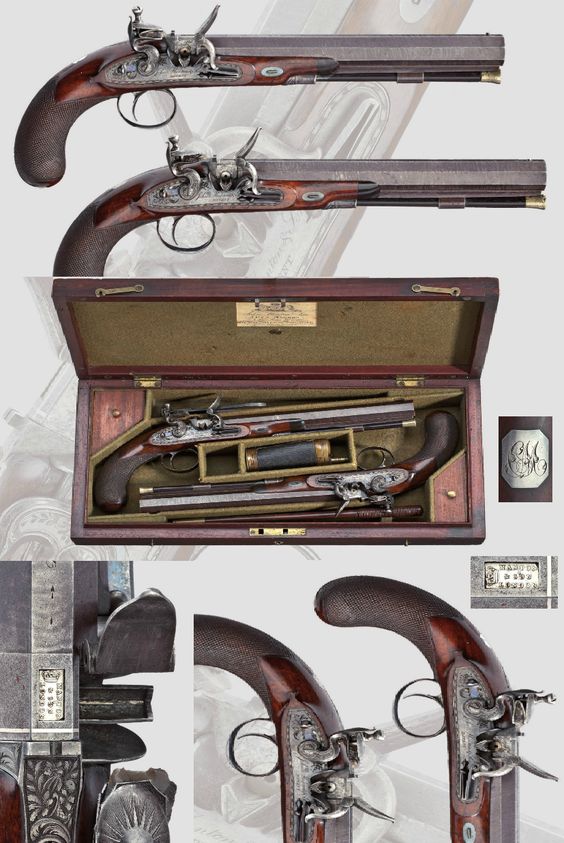
Small steel blade foresight let into 16-pointed star inlay of gold. Two gold breech bands with an engraving of game. Steel screw in vent under nipples, hand hold guard bow, wooden stock, chequered grip and cheek piece. Mounts finely engraved with game and leaf scrolls. Silver monogram plate.
Ezekiel Baker
24 White Chapel Road
Established 1775
Ezekiel Baker was apprenticed to gunsmith Henry Nock and opened his own shop in 1775. He wrote a book about his experiences making and using rifles—Twenty-three Years Practice and Observations with Rifle Guns which was published in 1804. His greatest accomplishment was the design for what became known as the Baker Rifle.
The British Army experimented with rifles after the American Revolutionary War, but found all available rifle designs either too fragile, cumbersome or slow firing to be able to use in a generalized war. On 4 February 1800, a number of leading gun makers were invited to Woolwich to trial their rifle designs by the Board of Ordinance, who were responsible for the procurement of weaponry for the army. Baker’s design was chosen, and he was given an initial order for 800 rifles. That same year the “Experimental Corps of Riflemen” was raised by Colonel Coote Mannington and Lieutenant-Colonel the Hon. William Stewart. The corps was manned by volunteer officers and soldiers from a variety of British regiments and militias. It was renamed and normalized into the army under the name the 95th Rifles Regiment of Foot.
By 1810, five British battalions, three of the 95th and two of the 60th Regiments, as well as several light companies of the King’s German Legion were equipped with the Baker rifle. The rifle was renowned for its accuracy and range. It was used throughout the Napoleonic Wars and continued in service until the 1830s.
A .65″ Baker type smooth bore flintlock cavalry carbine, combining elements from the 1803 pattern.
Shooting the War: Frontline Home Movies, is a documentary that uses home movies, both British and German, shot on the front lines to document WWII. Their films captured all aspects of the war, including life on the home front, camp life, battles and the D-Day Landings. Narration and interviews with ex-servicemen and experts put the films into context. Absolutely fascinating stuff. (1 hour)
Henry Nock learned his trade as a gunsmith in Birmingham in what was known as the Gun Quarter, an area of Birmingham known for years as the world’s center for gun making and munitions manufacturing. At the age of 27 he made his way to London and in 1768 opened up a gunsmith shop.
In addition to being a skilled craftsman Nock was a pioneer in the realm of firearms and has to his credit many innovations and inventions. One such patented invention would impact the gun trade and be adopted as a standard within the industry. It was a removable octagonal barrel that facilitated much improved maintenance. This development would come to be known as ‘Knoxform’ and is described in the patent application as a process to: “…take the Barrell from the lock, which renders the Barrell exceedingly easy to be cleaned, and there is no obstruction of the Breech Pin as in other Guns.”
The making of guns and gun locks were not Nock’s only business. He knew that diversification was paramount to a successful business. The first recording of this manufacture of edged weapons appears in the Board of Ordnance records for December 20th 1777 where it is recorded that he is advanced 200 pounds to provide bayonets, which suggests a rather large order.
Henry Nock was one of the finest and most influential arms makers of his time. His contribution cannot be understated, and he produced some of the very finest and most beautiful guns of that era.
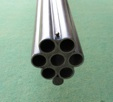
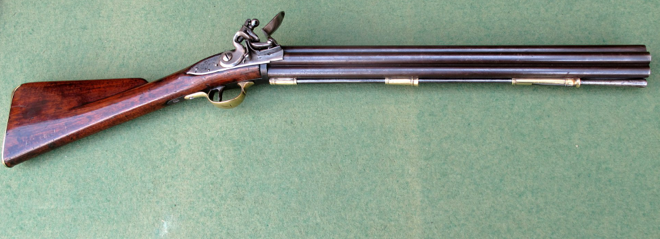
An exquisite example of Henry Nock’s work. This circa 1780 ‘seven’ barreled volley gun was part of an order of 500 such weapons made and supplied by Nock during the 1780’s to the British military at a cost of £13 each.
In 1784 Nock became a Freeman of the Gunmakers Company. In 1789 he was appointed gunmaker-in-ordinary to King George III , largely as a result of his patented breech for hunting guns and other inventions. In 1802 Nock became Master of the Gunmakers Company. He made weapons covering the whole field from pistols to muskets. The great variety is perhaps illustrated by his coach blunderbuss which, like naval pistols, had a more corrosion resistant brass barrel. Such weapons were intended to be used at short range and did not take a large enough charge to require iron barrels. Nock continued to innovate until his death – late in life he was making breech loading muskets
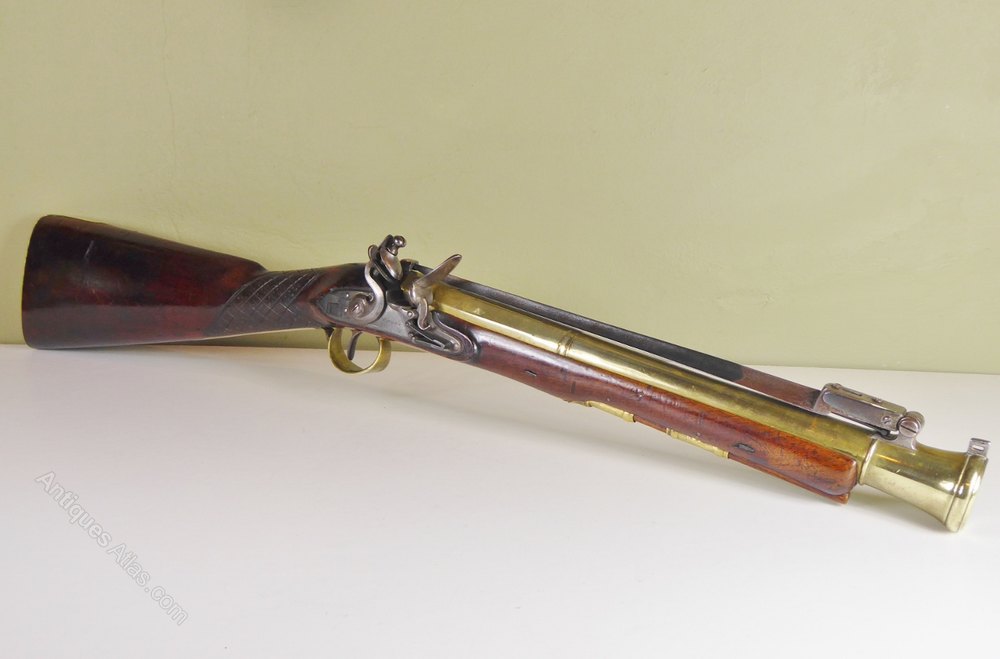
Coach Blunderbuss
The brass barrel with a flared and ringed muzzle, tapering inward and backward to a ring fronted octagonal staging. The barrel topped with a spring release triangular and concave sided bayonet. The steel flint lock mechanism engraved ‘H NOCK’ for Henry Nock, 1741 – 1804. The underside with a ramrod held within ringed brass pipes, the trigger guard with floral engraving, finished to the end with a flower head finial. The walnut stock with a hatched hand hold, and brass butt plate.
In 1770 Durs Egg appeared in London “with 3 shillings and 6 pence in his pocket” and found work with the then famous British gunsmith Henry Nock. By 1772 he had his own business with rented premises in the Haymarket, Panton Street. On 3 June 1776 he sold two “Ferguson Rifle Guns” to the British army for £31, the first of many regular orders for arms, and by 1778 he was ensconced at St James, Piccadilly, where he counted the Prince Regent among his customers.
Among the numerous Durs Egg weapons which are shown as masterpieces in the weapons collection in Windsor, is a pair of pistols on which the trademark “Gun Maker To His Royal Highness” appeared for the first time. The prince’s esteem for Durs Egg was revealed in a letter to his brother Prince Ferdinand of Hanover:
“… the rifle barrel gun was made by the best workman we have here; he is a Swiss German and his name is Egg. This gun is made after Ferguson rifle, it is almost the neatest piece of workmanship, ever was made.”
From 1799 Durs Egg was allowed to call himself “Gun Maker To His Majesty, the Prince of Wales and the Duke of York”.
During the war years against Napoleon Bonaparte, Durs Egg produced a large number of rifles and pistols for the army and he also supplied the French royalists, who had established themselves on the Channel Islands, with a large series of carbines. The historian John F. Hayward mentions in his work “The Art of the Old Gunsmiths” that Durs Egg was particularly famous for his double-barreled shotguns and dueling pistols, which he produced in large numbers.
Unfortunately for Durs Egg, the defeat of Napoleon and the ensuing peace meant that in 1815 his income fell from around £90,000 pa to about £2,300. He was also beginning to lose his sight at this time and became completely blind by 1822. He died in 1831.
Only one of his sons, John Egg (1795) followed in his footsteps. The financial situation, however, grew so dire that he had to close the doors of the business from 1831 until 1837 when he reopened at No. 4 Pall Mall in the Opera Colonnade, a few doors down from his father’s old shop. After this he was quite successful, although as a gunsmith he wasn’t in the same class as his father. John Egg was probably the supplier of arms for the last known pistol duel in England in 1843.
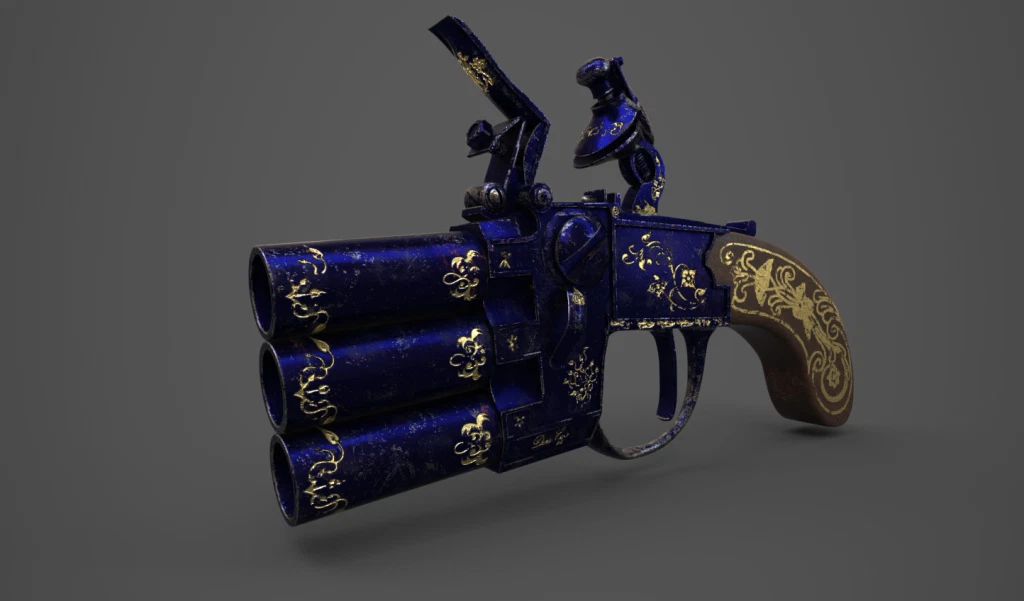
Triple barrel pistol created for the Prince Regent -still included in the Windsor Castle armaments collection.
Joseph Egg & Sons
No. 1 Piccadilly (1802) Final and most well-known address.
Established Walker & Egg “Gunsmiths and Patent Spring Truss Makers” in 1801 at 59 Frith Street.
Established Tatham & Egg in 1802 at 37 Charing Cross (Partnership dissolved in 1814)
Established Joseph Egg & Sons in 1835
Jean Joseph Egg (1775-1837) was the brother of Durs Egg and worked for Henry Tatham from 1801. The two men later co-founded the company Tatham & Egg. In 1814 Joseph opened his own shop at Piccadilly Circus.
In 1800 he took out a patent for a “method of bending steel without the assistance of heat, which may be applied to the manufacturing of surgical instruments.” In 1814 he advertised a self-adjusting truss, invented by him, protected by a German patent, used in many hospitals, and made at his shop at the corner of Piccadilly and the Haymarket. While these were both financially advantageous endeavors, his true fortune and claim to fame came from his guns.
Joseph was probably the most creative of the entire Egg gunsmith dynasty. His specialty at first was a new type of miniature pistols (pocket pistols) of the highest quality, whose precision is reminiscent of the work of watchmakers. They have one or two barrels and fittings made of engraved silver, in some cases even gold. This was followed by a whole series of inventions and patents. Joseph Egg’s weapons can be found in Windsor Castle, the Leningrad Hermitage and the Metropolitan Museum of Art, New York.
Joseph Egg also dedicated a large portion of his business to high-end pistols, carbines and coach guns for wealthy patrons, with most of them never seeing much use despite being based on very practical designs.
In 1813 he took out a patent for “applying and improving locks.” He also took out patents for a waterproof gun lock he devised, a self-primer, a percussion priming magazine, and he took out a French patent for a pellet lock.
This rare pistol is distinguished by its inverted flintlock. This repositioning of the ignition mechanism is emblematic of London gunmakers’ pursuit of inventive methods to improve upon traditional firearm design. Joseph Egg, one of the preeminent gunmakers active in London in the early nineteenth century, patented the configuration in 1813, likely drawing inspiration from a small group of German rifles made in the 1750s which also featured inverted flintlocks. Benefits of the inverted lock included a cleaner sightline down the barrel and a downward-directed flash that allowed for improved vision when firing. Ultimately, Egg’s design failed to gain popularity and few firearms of this type were made. Today, only three examples of inverted flintlocks by Egg and Henry Tatham, a gunmaker with whom Egg partnered from 1801–14, are known.
Joseph Manton was born in Grantham, Lincolnshire in 1766, and at the age of 14 was apprenticed to a local gunmaker. In 1781, he began working under his brother, John Manton, a gunmaker of 6 Dover Street, London.
In 1789, at the age of 23, Joseph started out on his own, working mostly on ways to improve rifling and wadding. His fantastic and modern ideas garnered interest from the British government and he was given patronage to explore many of his ideas further. Joseph Manton’s fame spread rapidly. He would go on to register twice as many patents as any other gunmaker.
In 1792 he opened his Mayfair gun shop which was soon patronized by prominent businessmen, leading politicians and nobility. He was awarded a Royal Warrant as well as lucrative contracts from the East India Company. Manton also opened his famous shooting gallery at No. 25 as the young bucks called it. A smart business move, as it allowed potential customers to fire Manton’s various guns before deciding to place an order for one themselves.
Captain Gronow wrote of visiting the shooting gallery:
When in London, Byron used to go to Manton’s shooting gallery in Davies Street, to try his hand, as he said, at a wafer. Wedderburn Webster was present when the poet, intensely delighted with his own skill, boasted to Joe Manton that he considered himself the best shot in London. “No, my lord,” replied Manton. “not the best, but your shooting today was respectable,” upon which Byron waxed wroth, and left the shop in a violent passion.
Lords Byron, Yarmouth, Pollington, Mountjoy, Walliscourt, Blandford, Captain Burges, Jack Bouveric, and myself were in 1814, and for several years afterwards, amongst the chief and most constant frequenters of this well-known shooting gallery, and frequently shot at the wafer for considerable sums of money. Manton was allowed to enter the betting last, and he generally backed me. On one occasion, I hit the wafer nineteen times out of twenty.
Manton is credited with the invention of the tubelock in 1814. This was really the precursor to the percussion cap, and was an important milestone on the path from flintlock to percussion cap guns. The principal was very simple – instead of using a bit of flint to generate a spark on steel to ignite powder, the hammer instead struck down on a pill of ‘fulminate of mercury’ wrapped in copper. When struck, the pill would explode, the flame igniting the main powder charge. Although this technology was superseded in 1822 by a cup filled with fulminate (the percussion cap), it was nevertheless an important step in firearms manufacture. Plenty of sportsmen adopted it as well as a variation that was adopted by the Austrian military.
Joseph Manton was firm friends with Colonel Peter Hawker, a great sportsman and pioneering wildfowler. They worked together to produce some of the fowling pieces of the muzzle-loading era, and really turned the ‘fowling piece’ into the ‘sporting shotgun’ that we recognize today. The idea of making a sporting shotgun a thing of beauty began with Manton. His skill as a silversmith was nearly as great as his skill as a gunmaker. Many of his guns were considered works of art. In fact, his guns were so beautifully made they are still highly sought today.
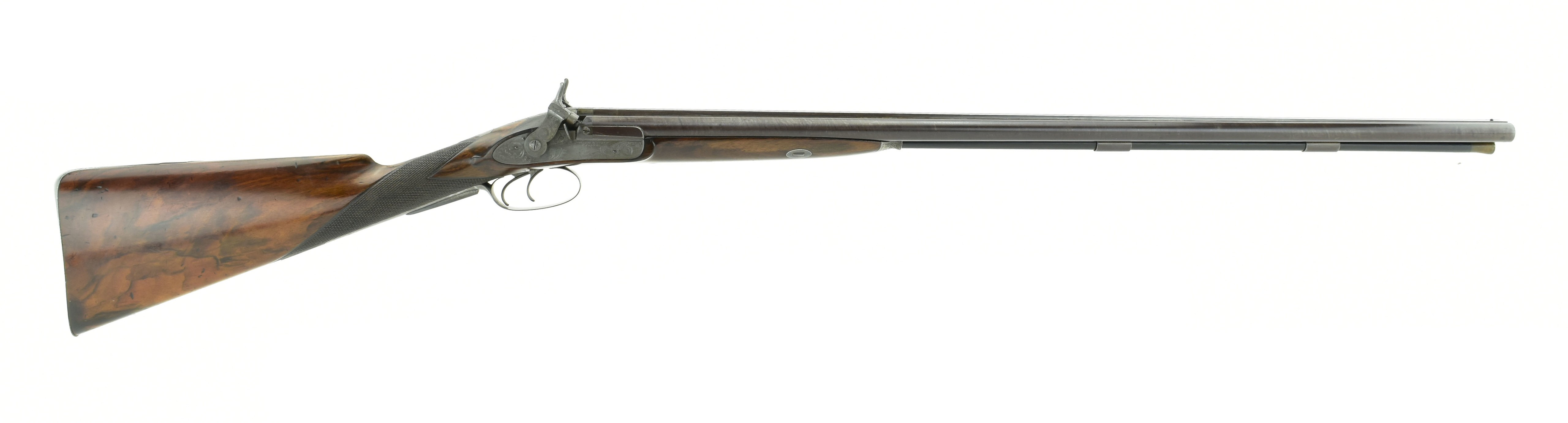
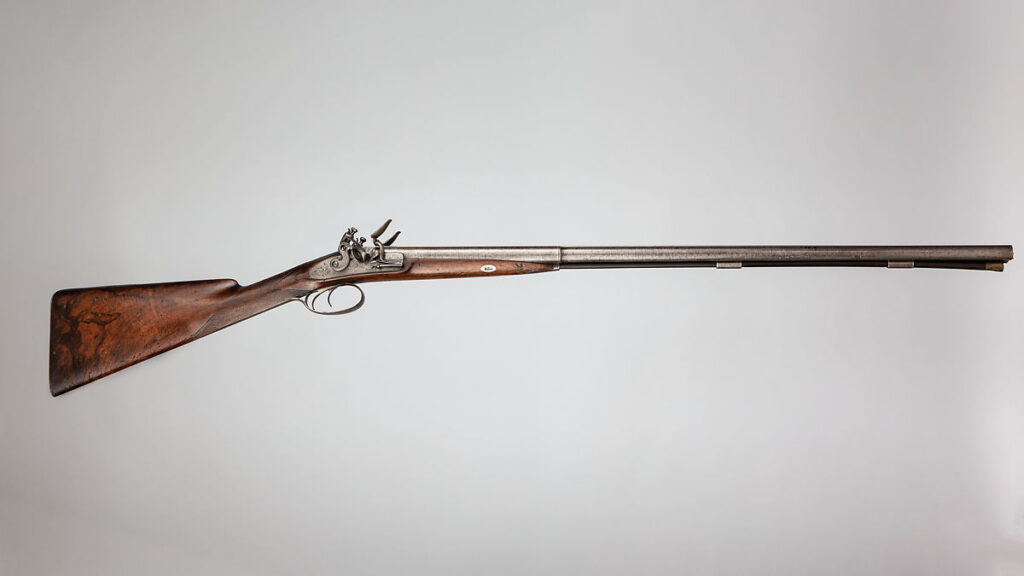
Double-Barreled Side-by-Side Flintlock Shotgun ca. 1837
Manton is also credited with paving the way to breech-loading guns. This started with the development of a disposable cannon cartridge. Instead of loading all pieces independently into the front of the gun, a wooden cup (cut to fit down the rifling on a rifled cannon barrel) was attached to a bag of powder, which in turn was attached to a cannon ball. This self-contained ammunition was also available for smaller guns, and was the start of what we know today as modern bullets.
All of these techniques came together in the development of Manton’s dueling pistols which had a reputation for a truer aim than any pistols in England. As many deaths in duels were a result of poorly aimed pistols and weapon malfunction, Manton’s pistols became the chosen weapon for all duels where the purpose was merely to satisfy one’s honor rather than to kill one’s opponent.
A case of flintlock pistols, John Manton & Sons, London, ca. 1814
Manton did all of this research and development in conjunction with the British army, with the army lending Manton a gun and ongoing investment. When Manton went to bill the army for his work, they fell out, as the army felt Manton wanted too much (£30,000 in 1820 works out as £3,500,000, give or take a few quid). Manton had patented the design already so the army had to pay him to use it – their offer was one farthing per shell (a farthing was ¼ of a penny or 1/960 of a pound – equivalent today to £0.13 per shell). Although the production rate of shells would have been great, this did not agree with Manton and he refused the offer. During the long dispute, the army was still allowed to make shells, but had to buy the wooden cups from Manton.
In the end, the army won out, Manton lost the legal battle and his fortune along with it. In 1826, the great man was declared bankrupt, the bank seizing his workshop on Oxford Street as well as his large stock of guns. Although the company tried to restart, increasing debts forced its closure once again, leaving Joseph Manton in debtors’ prison between 1828 and 1829.
Manton’s gun shop produced a generation of gunmakers that made London gunmaking what it is today. James Purdey, Thomas Boss, William Moore and Charles Lancaster all worked for him and these four men alone went on to found some of the best gunmaking businesses of all time.
Joseph Manton died on 29 June 1835 at the age of 59. Colonel Hawker wrote in his epitaph that while his tomb may hold his mortal remains, ‘an everlasting monument to his unrivalled genius is already established in every quarter of the globe by his celebrity as the greatest artist in firearms ever the world produced, as the founder and the father of the modern gun trade, and as a most scientific inventor in other departments, not only for the benefit of his friends and the sporting world, but for the good of his king and country’.
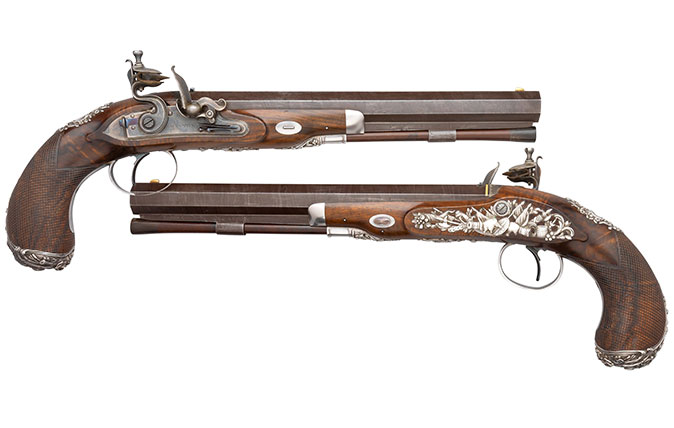
30 Bore Dueling Pistols made in 1790 for the 2nd Marquess of Hertford