HISTORIC PUB CRAWL – Town of Ramsgate

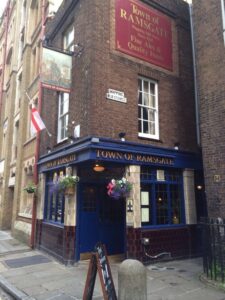
TOWN OF RAMSGATE

WAPPING

62 Wapping High Street, London

LOUISA CORNELL


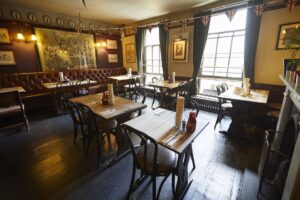
The first pub on this site was established during the War of the Roses (1460’s.) It was called The Hostel. The street numbers changed over the years, but the site was always home to a pub under various monikers. In 1533 it became known as The Red Cow, supposedly in honor of a barmaid with flaming red hair who worked in the establishment. At some point it was the Prince of Denmark, no idea why. In 1766 it was renamed the Ramsgate Old Town and eventually in 1811 it acquired its present name – the Town of Ramsgate.

Why the Town of Ramsgate, you ask? Good question, and I have a slightly nefarious answer. Sailors from Ramsgate in Kent landed their catches at the Wapping Old Stairs, next to the pub, in order to avoid the river taxes charged further up the river at the Billingsgate Fish Market. It is debated whether the pub was named to attract the fishermen or if the fishermen named the pub after their own safe harbor. Either way the harbor at Ramsgate as seen in 1850 graces the pub sign now and is etched into the mirror at the entrance to the pub today.

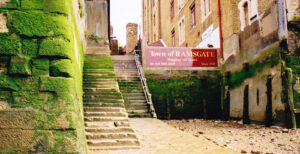
Now about those stairs.

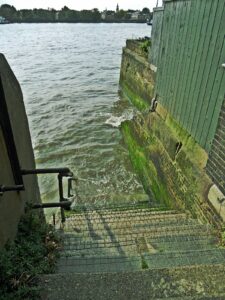
Wapping Old Stair

Those stairs led up to the execution docks where prisoners of the Admiralty Courts were hanged on short ropes for their crimes. Why short ropes? Because short ropes took longer to finish the deed and patrons of the Town of Ramsgate often stood outside the pub to watch and cheer. Most of these prisoners were convicted of smuggling, mutiny or piracy. Not all pirates were hanged. If one looks today one can see the chains where pirates were locked on the stairs waiting for the rising tide to come in and drown them.

Old Wapping Stairs as the tide comes in

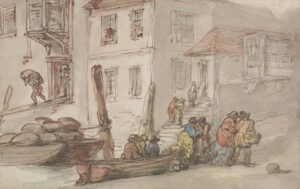
The stairs were depicted to great fame in the works of Rawlinson (cartoons) and Dibden (poems.)

Wapping Old Stairs – Thomas Rawlinson

Many returning sailors arranged to meet their sweethearts at the Wapping Old Stairs when they returned from the sea. This aspect of the history of the pub and the stairs is commemorated by the verse on the wall of the pub.

“Your Polly has never been faithless she swears, since last year we parted on Old Wapping Stairs”

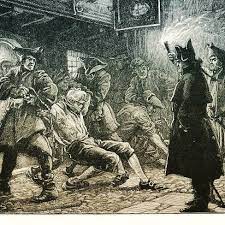
The Town of Ramsgate shares a great deal of its history with the lives of England’s sailors. Many a drunk would wander from the safety of the pub to be pressed into service in the King’s Navy.

A press gang at work.


The pub’s cellars served as jail cells for convicts who were set to be deported to Australia.

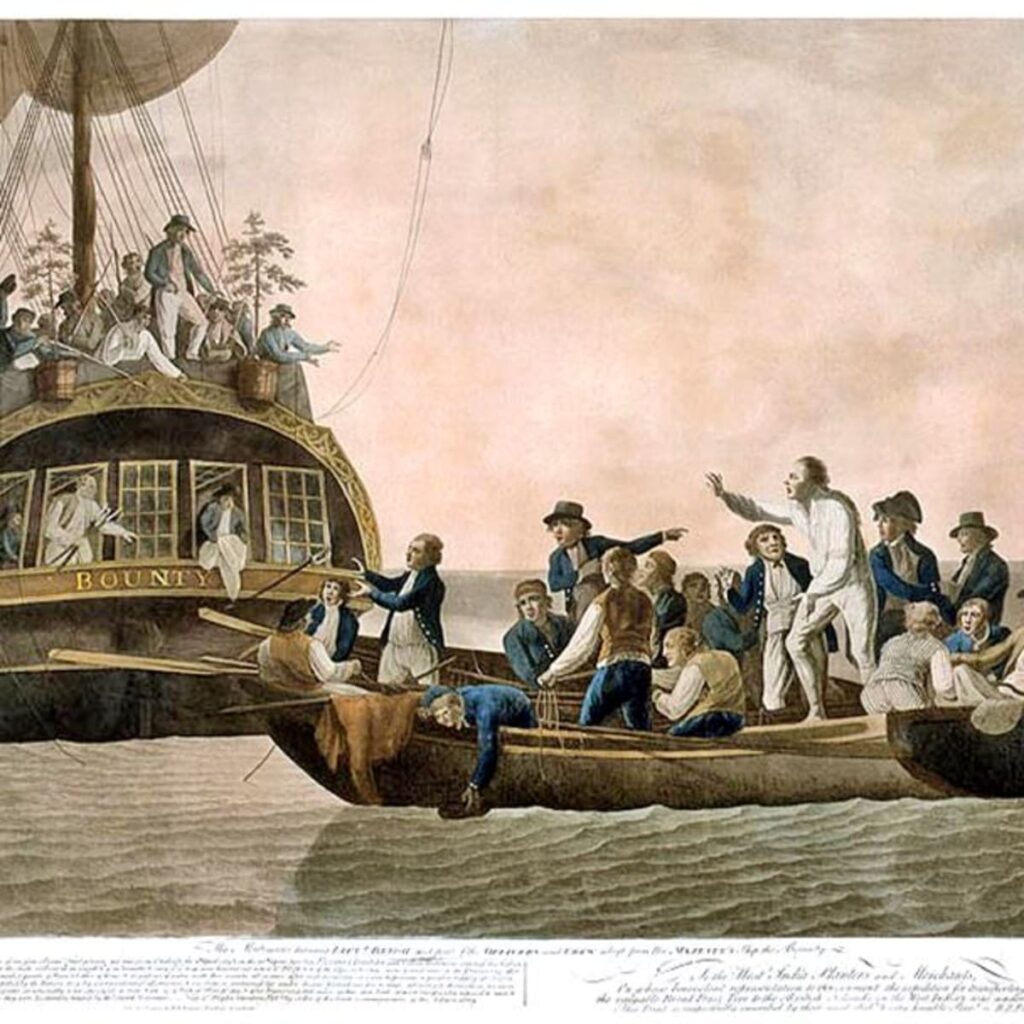
Legend has it Captain Bligh and Fletcher Christian had their last drinks before setting sail on their ill-fated trip to Tahiti at the Town of Ramsgate in 1789. Likely true, as it is documented this is where Bligh and his voyage sponsor Sir Joseph Banks met at the pub to inspect the Bounty before purchasing it for the voyage.

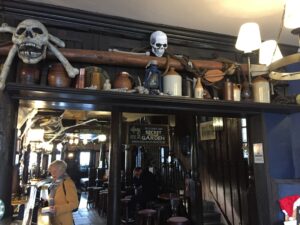
These days the pub is only known for lively arguments on quiz night.   


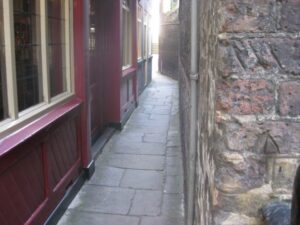
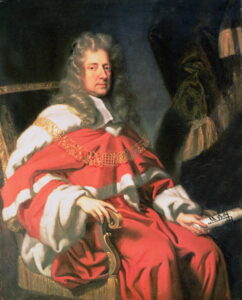
Should you decide to explore the alleyway to the side of the pub that leads to the Wapping Old Stairs you might encounter the local ghost, a ghost the Thames Police have reported seeing to this day. Judge George Jeffreys, 1st Baron Jeffreys, (15 May 1645 – 18 April 1689) rose to prominence during the reign of James II. He became Lord Chief Justice and eventually Lord Chancellor. His loyalty to the king was without question. However, after Monmouth’s Rebellion in 1685 he was sent to the West Country to conduct the trials of those rebels who participated in the rebellion. He gained a reputation for his abuse of the attorneys of the accused, his sometimes biased application of the law and his tendency to hand out death sentences like drinks at a political rally. He became the most feared and hated judge in England.

After James II fled England and William and Mary ascended the throne, Jeffreys waited to long to follow his king to the Continent. In 1688 he disguised himself as a sailor, shaved his distinctive bushy brows, and waited at the Town of Ramsgate to catch a ship. Unfortunately, a victim of his cruelty – either an accused rebel or an attorney for same recognized the judge. He was captured by a mob at the Town of Ramsgate and narrowly missed being hanged at the top of the Wapping Stairs. He was taken to the Tower of London and died there of kidney failure in 1689.

It is said his ghost can be seen leaving the pub and trying to take the stairs down to the docks to meet the ship he missed, ever looking over his shoulder in search of the angry mob that captured him so long ago.


HISTORIC PUB CRAWL – The Coal Hole

THE COAL HOLE

THE STRAND

15 and 16 Fountain Court – London

Louisa Cornell


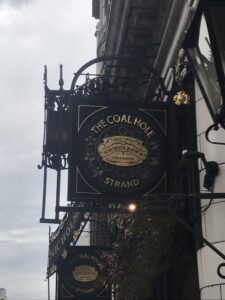
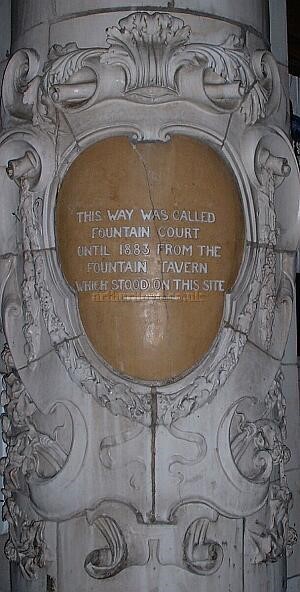
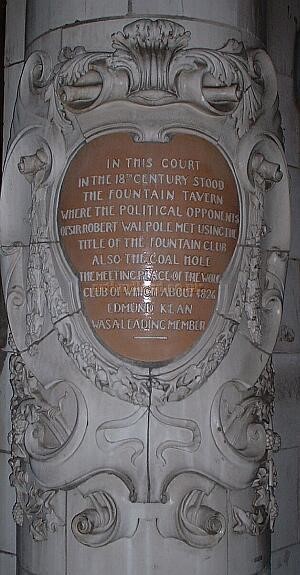
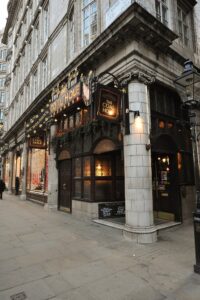
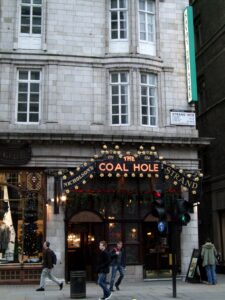
Originally established in 1815, The Coal Hole was a tavern that had formerly been known as The Unicorn. It was located in a corner of an alley called Fountain Court, just off The Strand. Fountain Court received its name from Fountain Tavern, an eighteenth-century establishment where the opponents of Sir Robert Walpole met.

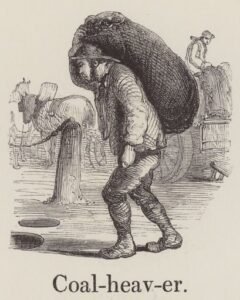
In its early days, The Coal Hole, appropriately enough, was the haunt of London’s coal heavers.  These burly men with strong backs and stronger work ethics saw to the unloading of coal from ships and barges and also delivered coal to the homes of London’s citizens. Which made for a rough and rowdy establishment when the work was done, and the coal heavers did their bit to unwind after a hard day’s labor.

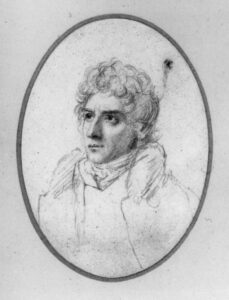
Eventually the famous actor, Edmund Kean (1787-1833) established the Wolf Club at The Coal Hole. The purpose of the club? Drunken orgies and general high jinks. Kean was the chairman of the club and usually called the group to his idea of order around eleven in the evening. Though it had no real platform it was very well attended by celebrities of the day. Songs, soliloquy, limerick composition, and various drinking games were on the program so far as most records show.

Edmund Kean

After the death of Kean, John Rhodes directed the tavern’s entertainment in the form of a forerunner of the nightclub. He had a passion for silver plate and furnished the establishment with silver tankards, goblets, loving cups, and flagons enough to put many of London’s finest hotels to shame. He is said to have had a fine baritone voice and was one of the most popular singers to take a turn at entertaining The Coal Hole’s patrons. But he went to great lengths to provide every sort of entertainment available.

‘John Rhodes begs to inform his friends and the public they will find every variety of Vocal Entertainment at the above old established house, commencing every evening at Eight o’Clock precisely. Glees, Duets, Solos, Catches, Comic Singing &c., executed by the most numerous and talented company of vocalists in the metropolis, under the direction of the celebrated Mr. Baldwin, for sixteen years Vocal Director at Mr. Rouse’s Grecian Saloon.’

‘The celebrated writer of comic songs, Mr. John Labern, is engaged exclusively for this establishment, where only can his original and humorous productions be heard and obtained.’

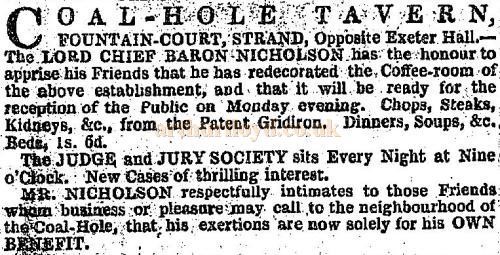
The above advertisement appeared in the newspapers to advertise the various amenities available at The Coal Hole. The Judge and Jury Society were performances led by Renton Nicholson (1809 – 1861) an impresario, actor and writer. These acts mocked and satirized members of London society and the preoccupations of the popular press. Though his acts were derided by some for their crudeness, they were attended by many aristocrats, politicians, and other prominent citizens.

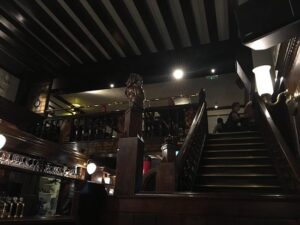
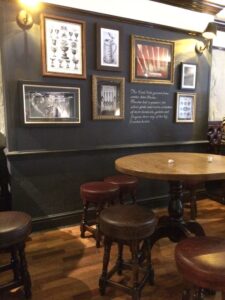
Whilst the supper club aspect is gone, The Coal Hole remains one of the few pubs in London to retain its original decor and ambiance. Its proximity to the city’s theatres promises an influx of the after performance crowd and one never knows who might stop in for a pint after the curtain falls.


HISTORIC PUB CRAWL – The Bunch of Grapes

THE BUNCH OF GRAPES

LIMEHOUSE REACH

76, Narrow Street – London

Louisa Cornell

This post is the first in what I intend to be a series of posts on some of the historic pubs in London and throughout the UK. I realize that the phrase “Historic Pub Crawl” could actually have two meanings. I intend it to mean visits to historic pubs. However, it could mean a series of visits to pubs one after another that ends up being a historical event. If you know the motley crew associated with Number One London, you know any trip we take can and usually does end up being a historic event. But I digress.

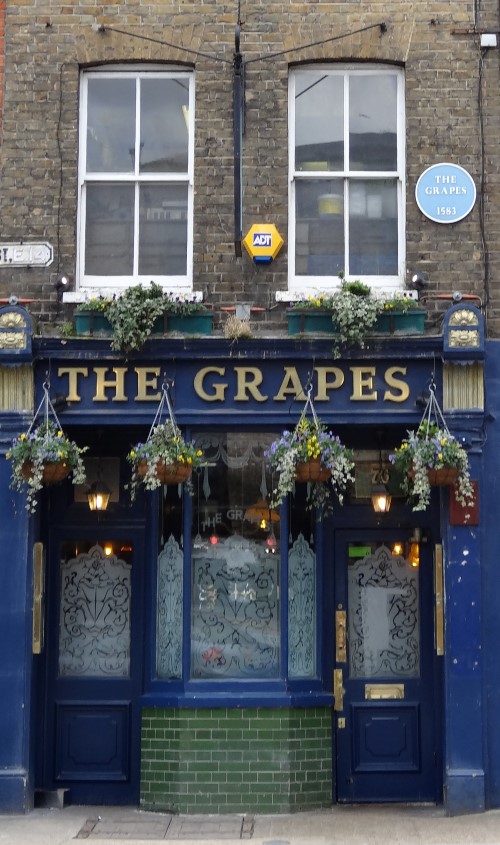
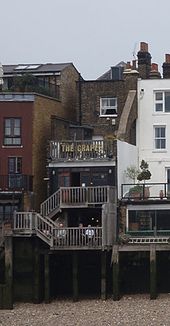
Although the current name of the pub is simply The Grapes, a tavern of some sort or another has stood on the present site for almost 500 years. And for most of those years it was known as The Bunch of Grapes. The first tavern was built on this spot in 1583, but the current building dates from 1720. Imagine the history it has seen, surviving the Blitz during World War II, and still operating as a pub to this day.

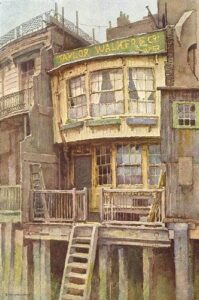
Painting of The Bunch of Grapes in the 19th century.


I will confess I first discovered this fascinating pub whilst I did research for my novel, A Study in Passion. My heroine had to visit a Chinese apothecary in search of aid for her pet pangolin. In the eighteenth and nineteenth centuries, the Limehouse area of London was home to England’s largest Chinese community. Not surprising when one realizes much of the Chinese community in London was made up of sailors and tradesmen from the many ships bringing in goods from the Far East and their families. They left the East India Company ships coming into the Limehouse Dockyards and established every sort of business from apothecaries to trading and import companies to boarding houses, to yes – opium dens.

Before the pub was built the location was in proximity to lime kilns, customs houses, docks and shipyards. By the Elizabethan Era Limehouse was established as the doorway to world trade in London as most of the ships embarking on trade trips across the British Empire left from these docks. Supposedly, Sir Walter Raleigh set sail on his third voyage to the New World from a spot just below the Bunch of Grapes.

The pub’s greatest claim to fame may well be its thinly veiled description used in the first chapter of the novel Our Mutual Friend by Charles Dickens. Again, not a surprise as Dickens was said to be a frequent visitor to the pub in the 1820’s when he visited his godfather who lived in Limehouse.

“A tavern of dropsical appearance… long settled down into a state of hale infirmity. It had outlasted many a sprucer public house, indeed the whole house impended over the water but seemed to have got into the condition of a faint-hearted diver, who has paused so long on the brink that he will never go in at all.”

A rather more sinister aspect of the history of The Bunch of Grapes associates it with the watermen who operated ferry services on the Thames for both passengers and freight. Because of the stringent rules against dissection and obtaining corpses for same, a great deal of supplemental income might be made by providing London’s medical schools, anatomists, and physicians with fresh corpses. Apparently these watermen would lurk about the back stairs of The Bunch of Grapes and drag inebriated customers down said stairs to drown them in the Thames before taking them by boat to their waiting customers.

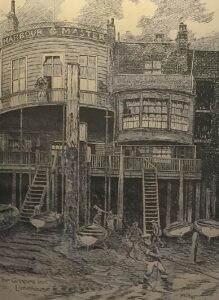
Back stairs at The Grapes – Current view. Imagine the steps 200 years ago!


Note to the characters in my Regency romances: Do not leave The Bunch of Grapes by the back stairs if you have indulged in too much drink.


Note to those who wish to visit The Grapes today: If at all possible visit on a Monday as the current owner of the pub, Sir Ian McKellen, has been known to run the pub quiz on Mondays from time to time.

Sir Ian McKellen


THE VERY PINEAPPLE OF POLITENESS

Pineapple by Theodorus Netscher, 1720, Fitzwilliam Museum

This is an oil painting of a pineapple grown in Sir Matthew Decker’s garden in Richmond, Surrey. The painting by Theodorus Netscher, made in 1720, is a celebration of the successful cultivation in England of a pineapple plant that actually produced fruit.

During the 18th century, a pineapple cost the equivalent of £5,000 today. They became such a symbol of wealth that the pineapple motif was used to decorate buildings – John Murray, the 4th Earl of Dunmore, built a 75ft-high stone pineapple atop a pavilion in his estate in 1761 (below).

Though native to South America, pineapples (scientific name: Ananas comosus) made their way to the Caribbean island of Guadeloupe, and it was here that Christopher Columbus first spotted their spiky crowns in 1493. Despite dogged efforts by European gardeners, it would be nearly two centuries before they perfected a hothouse method for growing a pineapple plant.

Thus, into the 1600s, the pineapple remained so uncommon and coveted a commodity that King Charles II of England posed for an official portrait (above) in an act then symbolic of royal privilege — receiving a pineapple as a gift. But was it a gift? Or had the pineapple been grown in his own hothouse? According to post entitled, “A pineapple? . . . Gosh, thank you Mr. Rose” on the Parks & Gardens UK blog, that question remains to be answered.

What is for certain is that on 9th August 1661 John Evelyn noted in his diary that he “first saw the Queene-Pine bought from Barbados presented to his Majestie…the first that were ever seen in England were those sent to Cromwell foure years since.”

Certainly plants must have survived the journey more than once, because King Charles used pineapples again on 14th August 1668, to impress the French ambassador, by serving them  at a banquet held in his honour.  Evelyn was there too and tasted “that rare fruite called the King-Pine” because ”his Majestie having cut it up, was pleased to give me a piece off his owne plate to taste of.” Sadly, Evelyn was mildly disappointed by the taste because  “in my opinion it falls short of those ravishing varieties of deliciousnesse described in cap. liggons history & others but possibly it might be, and certainly was, much impaired in coming so farr. It has yet a graceful acidity, but tastes more of the Quince and Melon, than of any other fruite he mentions.”

Of course, all this assumes that it is John Rose in the picture.  This attribution comes from Horace Walpole who had the original painting hanging in the Breakfast Room at Strawberry Hill.  It  features in his description of the house as  ” a most curious picture of Rose, the royal gardiner, presenting the first pine-apple raised in England to Charles 2d, who is standing in a garden. The whole piece is well painted , probably by Dankers. It was a present to Mr W from the Rev.Mr Pennicott of Ditton, to whom it was bequestheed by Mr London, grandson of him who was partner with Wise”. [A description of the villa of Horace Walpole,1774].

Author Lucy Ingless tells us more about 18th century pineapple cultivation in an article on The Foodie Bugle:

“In 1735, twenty-one year old American Robert Hunter Morris accompanied his diplomat father on a trip to London and on the 30th of June visited a friend’s garden of ‘luctutious plants’ (does this mean succulents?), which included ‘the pineapple, of which he had a great many and they seemed to flourish very well. They grew in pots of earth which were set in a bed of tanners bark’. Incidentally, Robert was an interesting young character, who was very conscious of his father’s welfare and notes many tiny details about London life that would otherwise be missed. His London diaries are short and worth a read if you come across them.

“An article on education in the London World during 1755 makes casual reference to the pineapple thus:

“Through the use of hothouses…every gardiner that used to pride himself in an early cucumber, can now raise a pineapple.”

“By 1772, pineapples were no longer the preserve of those with hothouses of their own. They were available to purchase at the markets, and also as plants to take home and grow for yourself, or with which to stock a nursery. I love the sound of Andrew Moffett’s ‘Pinery’ on Grange Road in Southwark, where ‘Fruiting and Succession Plants’ were to be purchased of the largest and sweetest sort, guaranteed ‘free of insects’.

“As the 18th century went on, the pineapple became a common theme on dishes, plates, teapots, tea caddies and even in architecture. Many believe it symbolises hospitality.

“By February 1798, any problems with planting environment had clearly been overcome, as Mr William North, at his Nursery near the Asylum in Lambeth, Surrey, was advertising new forms of dwarf broccoli above his pineapple plants. The advertisement from the Morning Chronicle gives an insight into 18th century horticulture, and also gives rise to the excellent title of this post: “To the curious in vegetables”. It is interesting to see that by this stage, the pineapple was worthy only of a nota bene but also interesting to note that a London tradesman was content to advertise not only the largest selection in England, but also in Europe: The largest collection of Pine-Apple Plants and Grape Vines in Pots for the Hot-house, &c., in Europe, with every other article of the first quality in Horticulture.”

The pineapple entered the broader Georgian culture in a number of ways. The phrase ‘a pineapple of the finest flavour’ was a metaphor for the most splendid of things. In Sheridan’s popular play The Rivals, Mrs Malaprop exclaims: ‘He is the very pineapple of politeness.’

Even after growing pineapples on English soil became a possibility, getting hold of one was still so costly that many nobles didn’t eat them, opting instead to simply display them around their homes as one would a precious ornament or carry them around at parties. Those who weren’t quite as affluent could rent a pineapple for a few hours at a time. This pineapple would be passed around from renter to renter for their respective parties over the course of several days until finally being sold to the individual who could afford to actually taste it.

Pineapples held pride of place on dinner tables and on Negri’s tradecard below, the premises soon to be known by the name of “Gunter’s.”

There were also pineapple-shaped cakes, pineapple-shaped gelatine molds, candies pressed out like small pineapples, pineapples molded of gum and sugar, pineapples made of creamed ice, cookies cut like pineapples and pineapple shapes created by arrangements of other fruits. There were also ceramic bowls formed like pineapples, fruit and sweet trays incorporating pineapple designs, and pineapple pitchers, cups and even candelabras.

An original eighteenth-century pineapple pit was discovered at the Lost Gardens of Heligan in Cornwall. In 1997, after much historical research and horticultural effort, the pinery saw its first twentieth century fruit – grown just as it would have been done in the past. In a nod to Charles II, the second pineapple produced there (the first was sampled by the staff …) was delivered to Queen Elizabeth on her 50th wedding anniversary. For an in-depth and technical look at the structure of early English hothouses and the construction of a “pinery,” see this post on the Building Conservation website.

Click here to read more on age old growing techniques and the world’s most expensive pineapple.