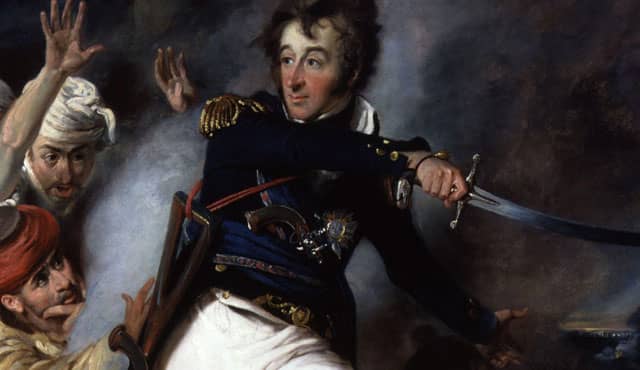
Chances are you’ve never heard of Sidney Smith, but his name should be right up there with those of Nelson, Wellington and Napoleon.
British Admiral Sir William Sidney Smith (1764-1840) served during the American and French Revolutions, he was the only person known to have been at both the Battles of Trafalgar and Waterloo and he was the man about whom Napoleon said, “That man made me miss my destiny.”
Intrigued? You can read more about the life and exploits of Sidney Smith on Wikipedia and watch the video below. Many thanks to author Gaelen Foley for directing me to this YouTube channel.
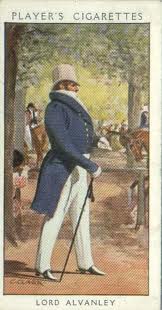
We first introduced you to Lord Alvanley in a previous post on this blog, but as his Lordship has recently been mentioned in Waterloo posts about Countess Brownlow and Katherine Arden, his sister, we thought it was time that we encountered him once again.
William Arden, 2nd Baron Alvanley (8 January 1789 – 16 November 1849) was the son of Richard Arden, 1st Baron Alvanley. He was an officer in the Coldstream Guards, attaining the rank of Captain in the service of the 50th Regiment of Foot. In 1835, Alvanley fought a duel with Morgan O’Connell. According to a near contemporary report “[Alvanley] went through the business with the most perfect sang froid, but on his way to the field he whimsically intimated a singular alarm. Having descended a hollow, ‘My Lord’, said he to his second, ‘you get me down well enough, but’, alluding to his full size, ‘should I fall, I do not know how the devil you will ever get me up again.'”
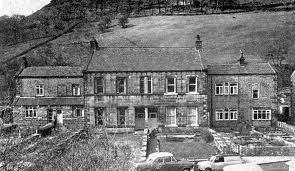
Underbank Hall
It was to Alvanley that Brummell turned whilst in exile in France for help and for many years Alvanley regularly sent the Beau financial support. However, because of his spending habits, his family estates had to be sold to pay debts. Underbank Hall in Stockport was sold by auction in 1823, most of the Bredbury estate was sold in lots in 1825, the Arden Hall mansion in 1833. He was forced to dispose of his half-pay on 10 June 1826. He later served in the Forest Troop, King’s Regiment of Cheshire Yeomanry Cavalry, as a cornet, but resigned on 17 January 1840. He did not marry and had no children. On his death, the title went to his only brother, the Hon. Colonel Richard Arden.
From The Letter-bag of Lady Elizabeth Spencer-Stanhope
“But a yet more celebrated leader of fashion mentioned by Mrs Stanhope as being present at the ball given by the Duchess of Bolton was Lord Alvanley. One of the accepted dandies in the same category as Lord Petersham, the Duke of Argyle, Lords Foley and Worcester, Beau Brummell and his great friend, Henry Pierrepont. Lord Alvanley had served with distinction in the army, and further enjoyed the reputation of being one of the wittiest men in Europe. Short and somewhat stout, with a small nose and florid cheeks usually adorned with a lavish sprinkling of snuff, like his rival Lord Petersham, he cultivated a lisp which accentuated the humour of his utterances. He also adopted much the same method of enhancing his value by indulging in certain peculiarities which, however inconvenient to his fellows, appear to have been accepted by them with surprising amiability. For instance, being fond of reading in bed, when he at length felt sleep overpowering him, he would extinguish his candle by the novel method of popping it alight under his bolster, or flinging it into the middle of the room and taking a shot at it with his pillow—but if the shot was unsuccessful, with a heavy sigh he left it to take its chance. So well known, indeed, was this little habit of Lord Alvanley, that hostesses who were anxious not to have their houses set on fire at midnight would depute a servant to watch in a neighbouring apartment till his lordship composed himself to sleep, a precaution which was invariably adopted by Mrs Stanhope when he paid his annual visit to Cannon Hall.
Cannon Hall
“However, despite such minor failings, Lord Alvanley enjoyed a popularity seldom surpassed. To his other recommendations was added that of being a celebrated gourmet, and the excellence was proverbial of the little dinners which he gave in his house in Park Street, St James’s, to which never more than eight friends were bidden, and at which there was an apricot tart on the sideboard all the year round. Moreover, although like Brummell and Sheridan, many a bon mot was fathered upon him to which he had never given utterance, yet his reputation as a wit was well deserved, and at a date when both the dandies and the fine ladies prided themselves upon their undisguised insolence, Lord Alvanley remained a shining example of good-nature, so that, save, perhaps, in one instance recorded in this book, his wit never offended.”
Born in Birmingham, needlewoman Mary Linwood moved to Leicester with her family when she was nine, where her mother opened a private boarding school for young ladies in Belgrave Gate, and where Mary herself became a schoolmistress and later headmistress. Mary worked her first needlework picture at the age of 13 and went on to produce a collection of 64 pictures, specialising in full size copies of old master paintings that were worked worked using a combination of irregular and sloping stitches to more closely resemble paint.
By the age of 31, Mary had attracted the notice of many, including the royal family and in particular that of especially Queen Charlotte, who had been such a champion of Mrs. Delany’s needlework. Mary moved to London and opened an exhibition of her work at The Panthenon, Oxford Street and in 1776 and 1778 her pictures were displayed at the exhibition of the Society of Artists. In 1785 she was summoned to court at Windsor by George III to show her work and according to the Morning Post there were ‘several pieces of needlework wrought in a style superior to anything of the kind yet attempted’ for which she received the Queen’s ‘highest encomiums.’ In the following year Mary sent examples of her work to the Society for the Encouragement of Arts and was awarded a medal. Word of her work spread and in 1783 the Empress Catherine of Russia accepted an example of her work, whilst the King of Poland was also numbered amongst her supporters.
An Exhibition of Mary Linwood’s needlework at Savile House, Leicester Square, London
Mary’s 1798 “needle painting” Partridges, after the painting by Moses Haughton, Exhibited at the Hanover Square Rooms
In 1798 Mary began a series of exhibitions in n the Hanover Square Concert Rooms where she showed thirty nine copies of her work. In 1809, the collection moved into a permanent gallery at Savile House, Leicester Square, the former studio of Sir Joshua Reynolds, the property of the Earl of Aylesbury, where she held an exhibition of fifty-five ‘needle paintings.’ The exhibition remained opened until her death in 1845. She was a regular tourist attraction, mentioned in Curiosities of London and Mogg’s New Picture of London and Visitors’ Guide to its Sights in which the writer observed: “This beautiful style of needlework is the invention of a Leicestershire lady, and consists of fifty nine of the finest pictures in the English and foreign schools of art, possessing all the correct drawing, just colouring and light and shade of the original pictures from which they are taken; in a word, Miss Linwood’s exhibition is one of the most beautiful the metropolis can boast and should unquestionably be witnessed, as it deserves to be, by every admirer of art.”
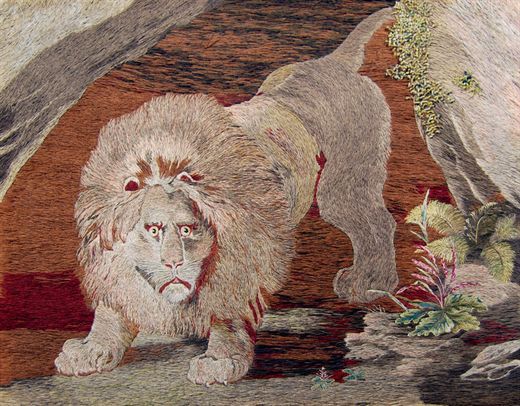
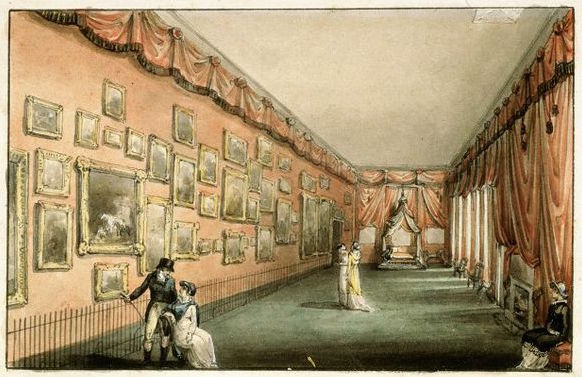
Mary’s exhibitions were the first to be lit by gas lighting to enable viewing late into the afternoon and she displayed each picture in a specially designed scene, her work being popular for nearly 50 years. Other exhibitions were held in Liverpool, Edinburgh, Glasgow, Belfast and Dublin. The pictures appear to have been cleverly set for picturesque effect. The principal room, a fine gallery, was hung with scarlet cloth, trimmed with gold; and at the end was a throne and canopy of satin and silver. A long dark passage led to a prison cell, in which was Northcote’s Lady Jane Grey Visited by the Abbot and Keeper of the Towerat Night; the scenic illusion being complete. Next was a cottage, with casement and hatch-door, and within it Gainsborough’s Cottage Children, standing by the fire, with chimney-piece and furniture complete. Near to this was a den, with lionesses; and further on, through a cavern aperture was a brilliant sea-view and picturesque shore. The large picture by Carlo Dolci had appropriated to it an entire room. The large saloons of Savile House were well adapted for these exhibition purposes, by insuring distance and effect.
View of Mary Linwood’s Gallery, watercolour c. 1810. V&A
A mention in Chambers’ Book of Days tells us that: The pictures were executed with fine crewels, dyed under Miss Linwood’s own superintendence, and worked on a thick tammy woven expressly for her use: they were entirely drawn and embroidered by herself, no background or other important parts being put in by a less skilful hand—the only assistance she received, if such it may be called, was in the threading of her needles.
And from Mogg’s New Picture of London and Visitor’s Guide to it Sights for 1844: Miss Linwood’s Exhibition of needlework is one of those which has not ceased to create an interest after its novelty had in a measure subsided, and is deserving, did the pages of this work permit, of a minute description. This beautiful style of picturesque needlework is the invention of a Leicestershire lady, and consists, at present of 59 copies of the finest pictures of the English and foreign schools of art, possessing all the correct drawing, just colouring, and light and shade, of the original pcitures from which they were taken; in a word, Miss Linwood’s exhibition is one of the most beautiful the metropolis can boast, and should unquestionably by witnessed, as it deserves to be, by every admirer of art.
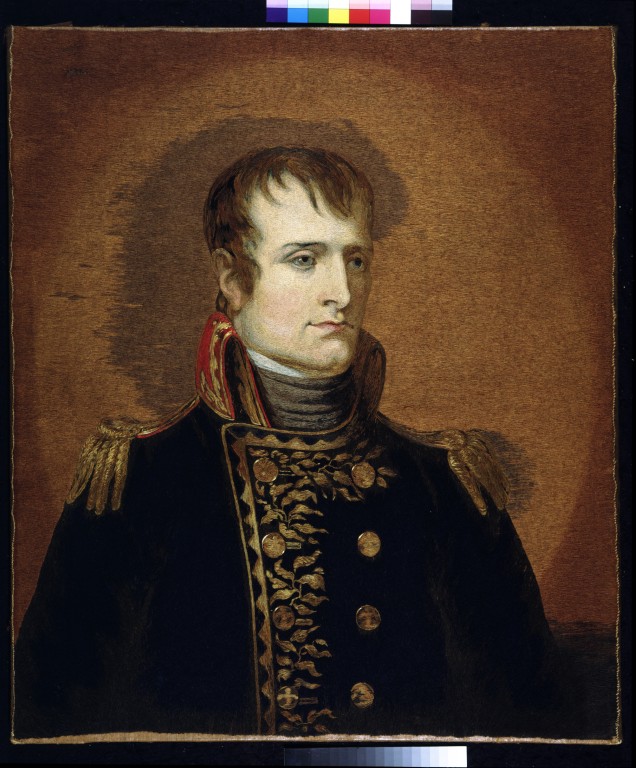
Napoleon, embroidered in wool by Mary Linwood in 1825, from the collection at the Victoria and Albert Museum.
The technique of this portrait is known as needlepainting, a type of embroidery, in which oils or other paintings were faithfully copied, with the brush strokes rendered by stitches worked in crewel wool. In 1808 Talleyrand introduced Mary to Napoleon, whose portrait she embroidered twice. He wanted her to take her exhibition to Paris, but was prevented by the outbreak of war between the two countries. Mary received the Freedom of Paris from him in 1825 for the portrait above.
In Music and Friends: or, Pleasant Recollections of a Dilettante, author William Gardiner writes:
“I have understood that Miss Linwood’s mode is analogous to that of a painter; she first sketches the outline, then the parts in detail, and brings out the whole of the design by degrees. I once saw her at work, accoutred as she was with pincushions all round her, stuck with needles, threaded with worsted of every colour, and after having touched the picture with a needle, instead of a brush, she would recede five or six paces back to view the effect. Leicester was a convenient place for dyeing her worsteds; still there were many colours she could not obtain: but being a woman of great genius, she set to work and dyed them herself. Miss Linwood’s skill was well known before she opened her exhibition in London, and it was a common practice for amateurs, in passing through Leicester, to stop and solicit a sight of her extraordinary performances.”
In 1844, during her annual visit to her Exhibition in London, Mary was taken ill and conveyed in an invalid carriage to Leicester, where her health rallied for a time, but a severe attack of influenza terminated her life in her ninetieth year. Mary had continued to exhibit her work until her death. Her last work, completed when she was 75 years of age, was The Judgement of Cain, which had taken her a decade to complete.
Upon her death, Mary’s collection of 100 pictures was offered to the British Museum who could not accommodate it. The work was auctioned at Mr. Christie’s auction rooms at Saville House on 23 April 1846 with the exception of a few. In her will she left her embroidered picture after Salvator Mundi by the seventeenth century Carlo Dolci to Queen Victoria. Mary had previously been offered three thousand guineas for this piece by the Marquis of Exeter of Burleigh House which she had refused. The whole collection fetched a disappointing £300. Her work is now in the collections of the Victoria and Albert Museum, Leicester Museum and Kew Palace. Mary Linwood was buried in St Margaret’s Church, Leicester.
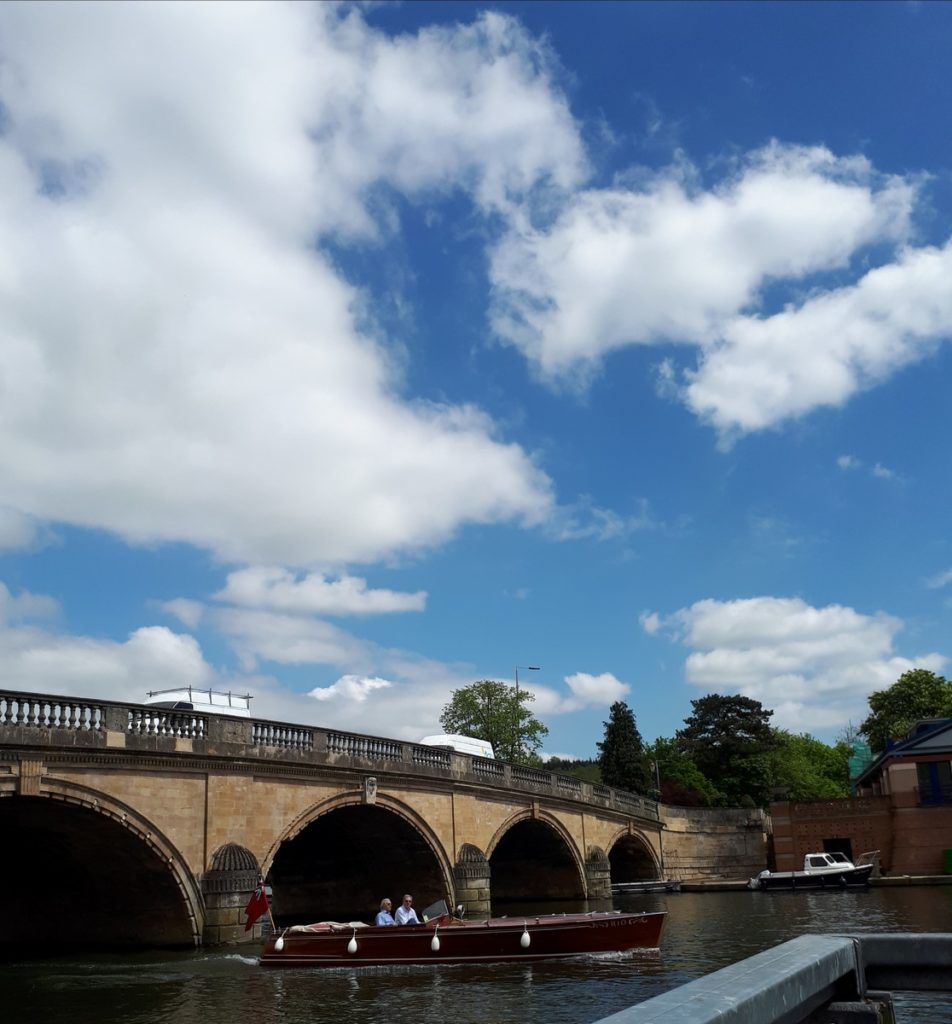
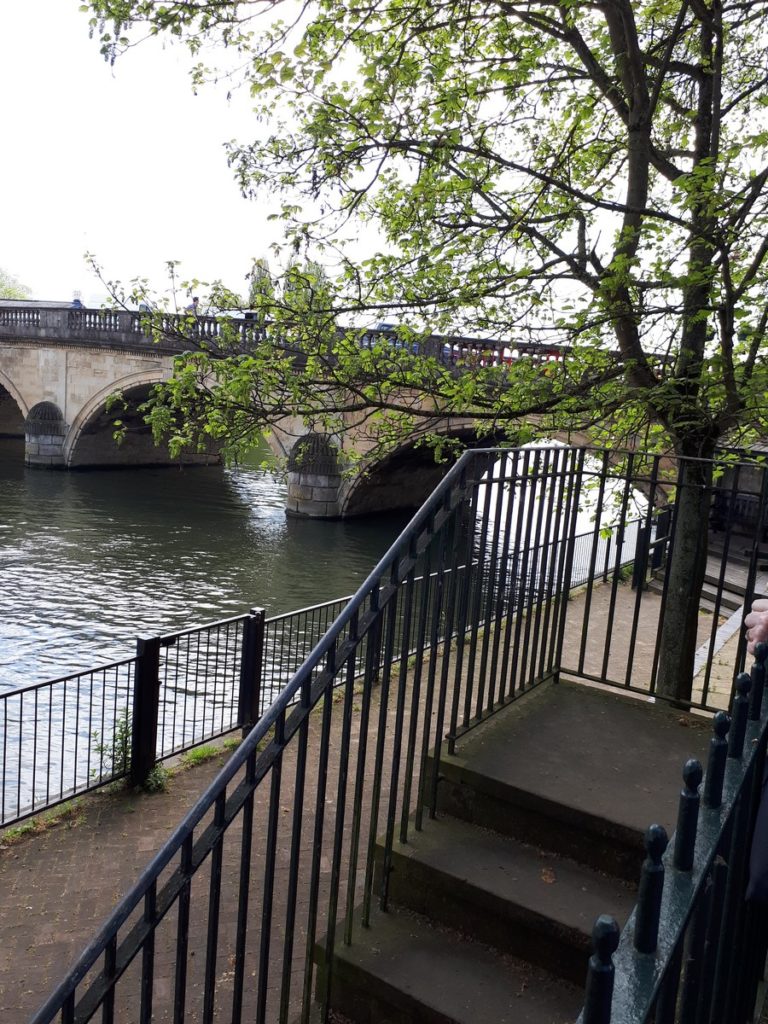
Since the Wellington archives are closed at the weekends, Vicky and I had another welcome opportunity to spend some time with our friend, author Beth Elliot. This day, Beth took us to beautiful Henley-on-Thames, set on the River Thames in Oxfordshire. Dating back to 1179, Henley has been home to the famous annual Regatta, which began in 1839 and which has been considered “Royal” since Prince Albert became a patron of the race in 1851. The Grade I listed Henley Bridge, above, is a five arched bridge across the river built in 1786.
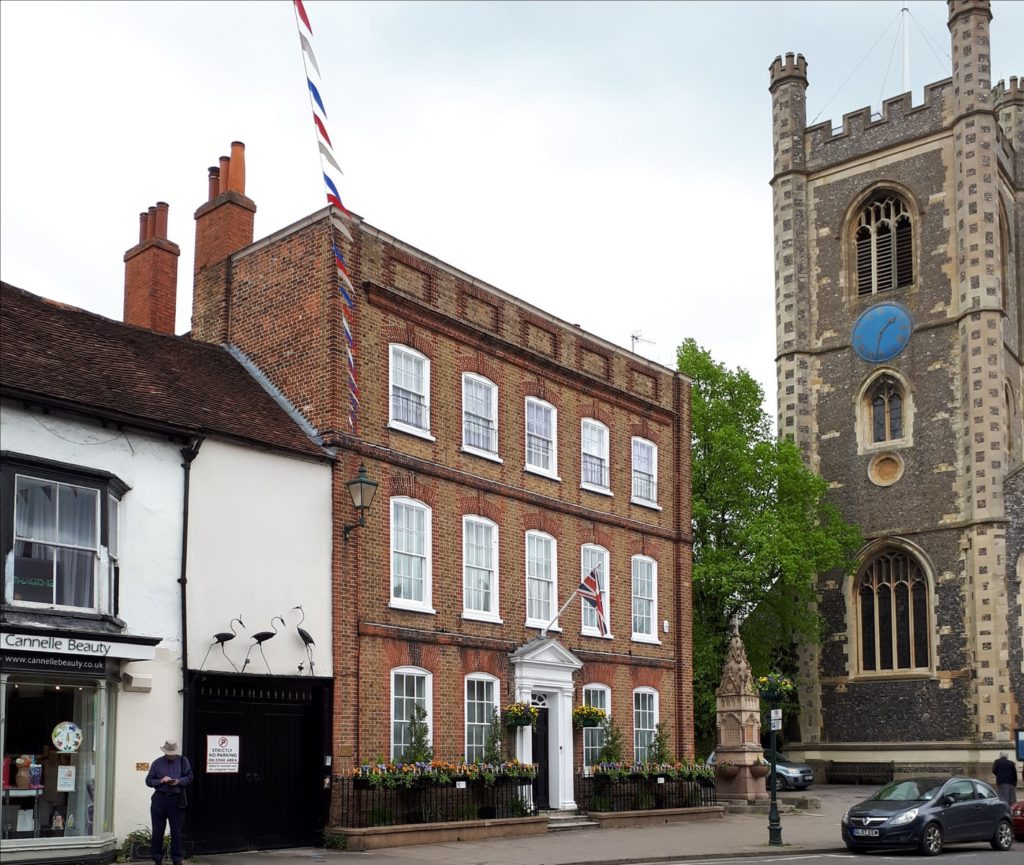
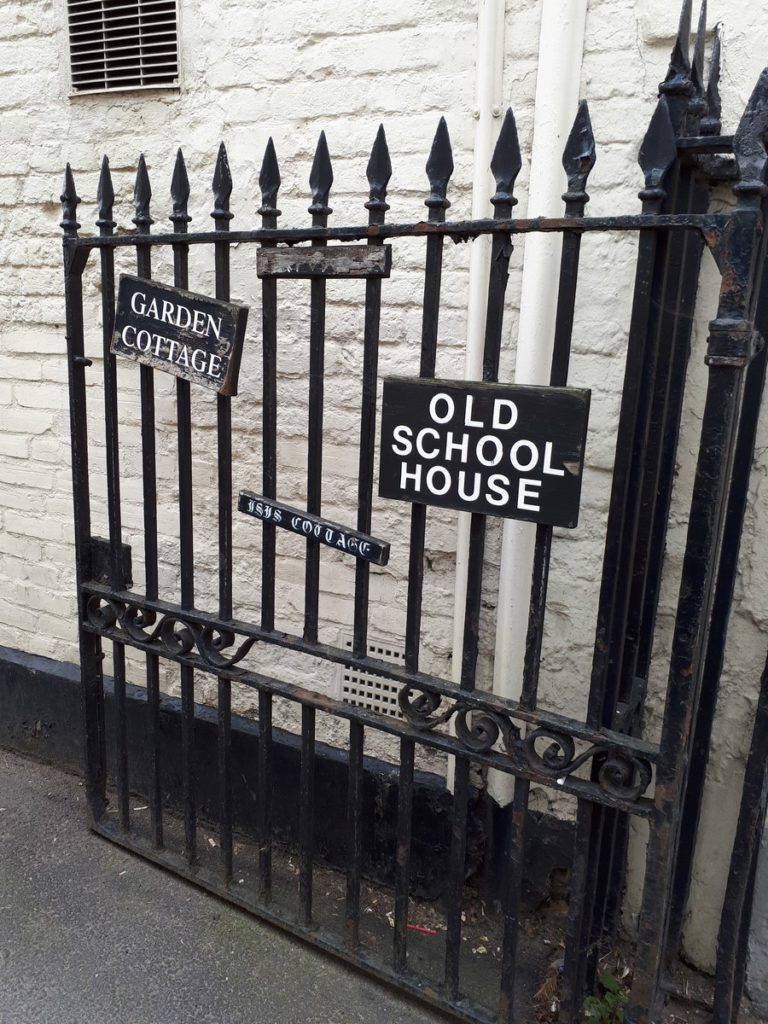
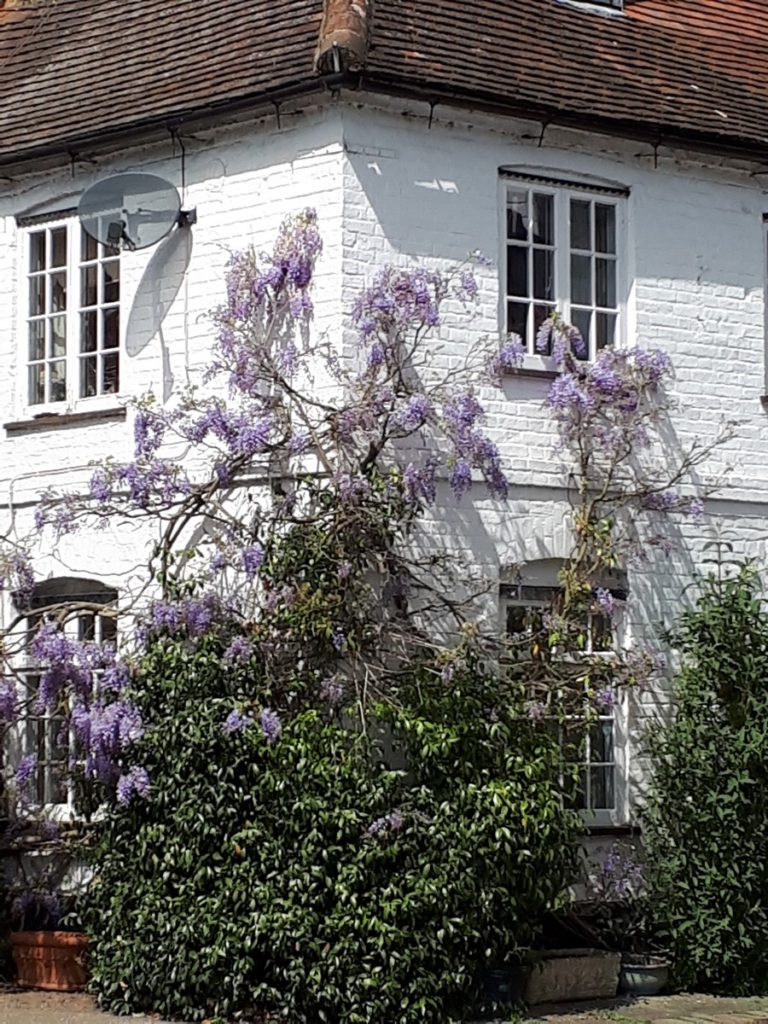
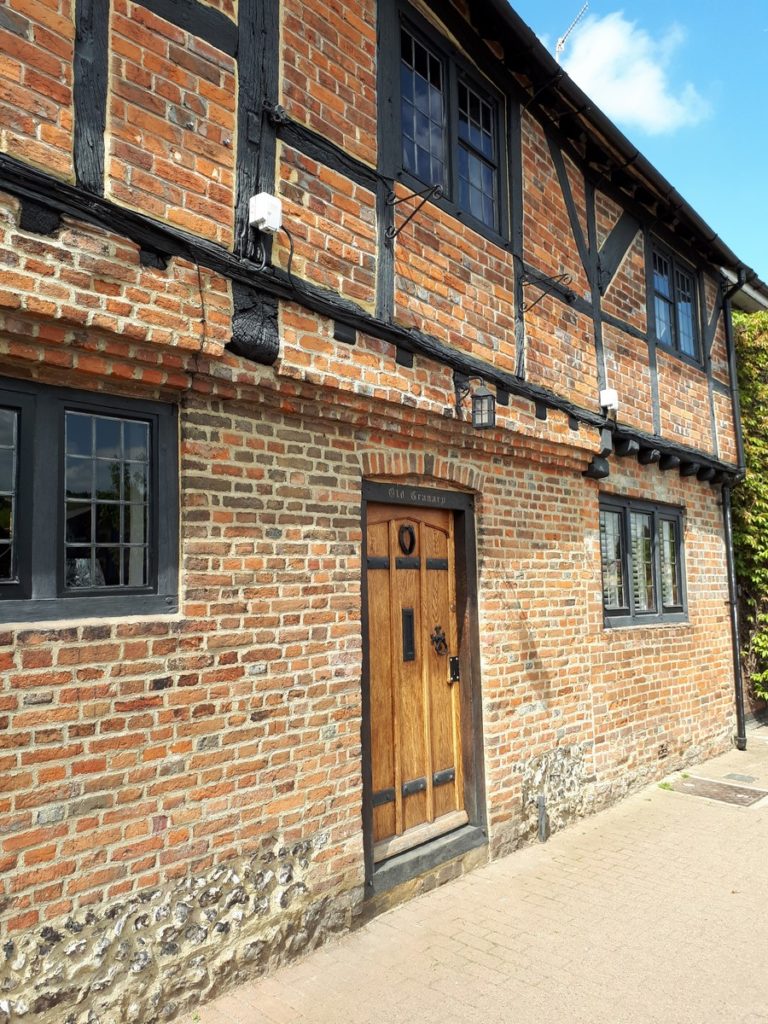
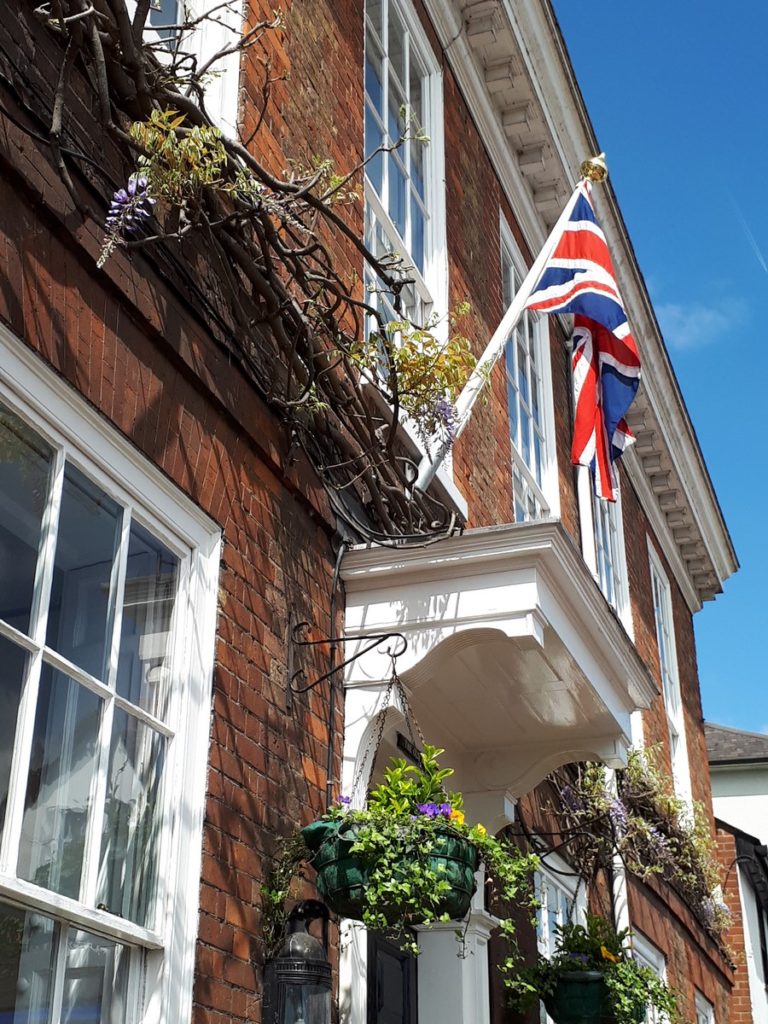
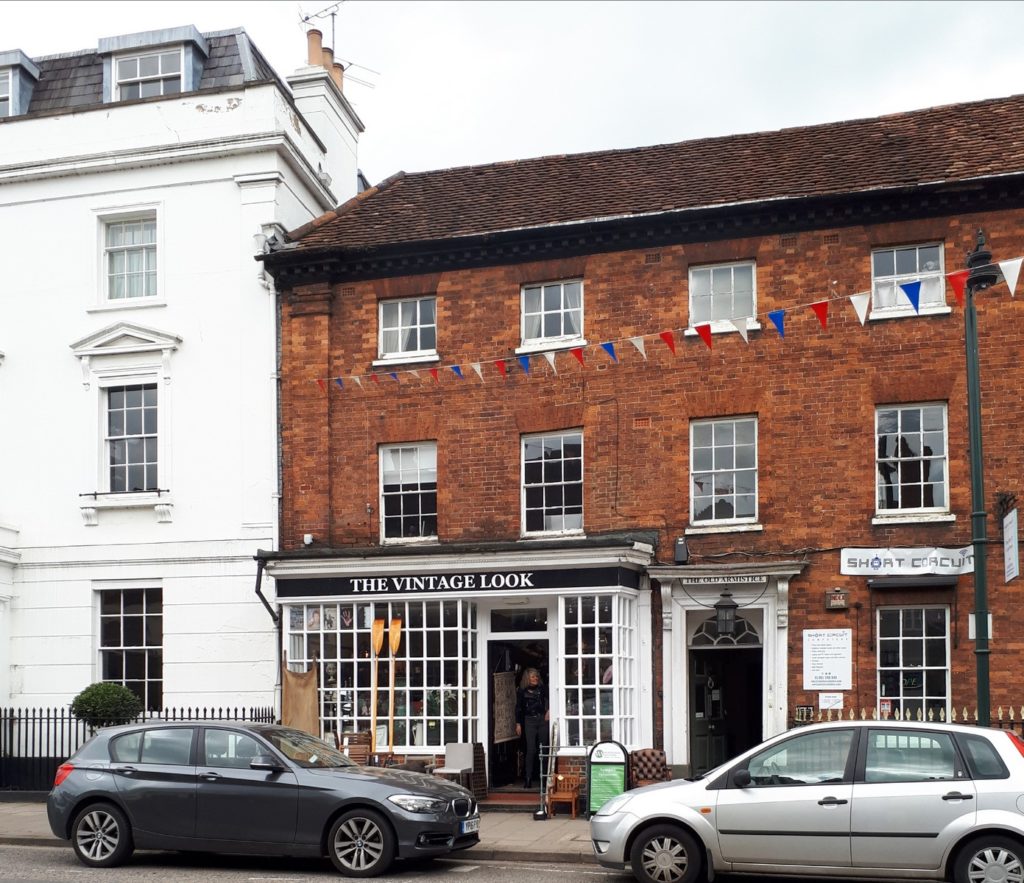
In fact, historic Henley-on-Thames boasts 369 listed buildings, of which these are but a few –
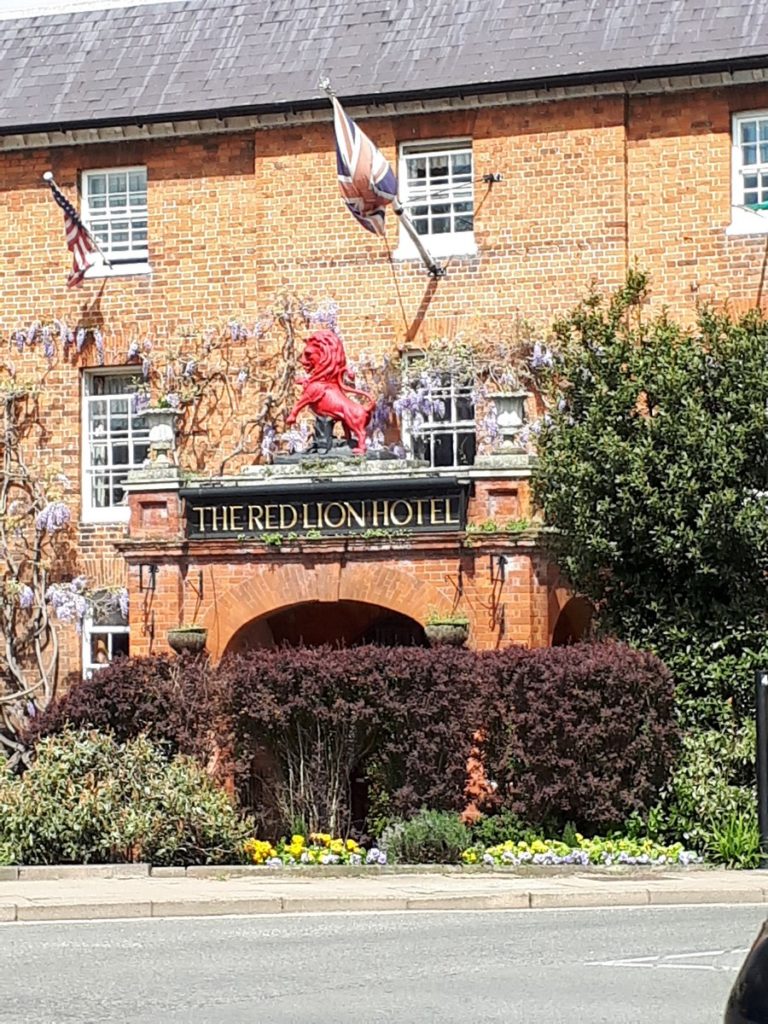
The Red Lion Hotel, above, began life centuries ago as a coaching inn on the London to Oxford Road. From their website:
“The earliest guest of note whose visit was recorded, was Charles I who stayed in the hotel in 1632 on his way from London to Oxford. The original Coat of Arms, painted above the fireplace in one of the rooms, has been preserved and glassed over following its discovery during alterations in 1889. These alterations included the addition of the porch upon which the effigy of the Red Lion was placed and the building of the central hall where previously an archway had led to the courtyard.
“The Red Lion was, in the old days of slow travelling, the resting place of the Duke of Marlborough on his way from Blenheim to London. He furnished one room which was kept for his command on his stately journey through Henley. His furniture remained in the hotel until 1849 (over a century).”
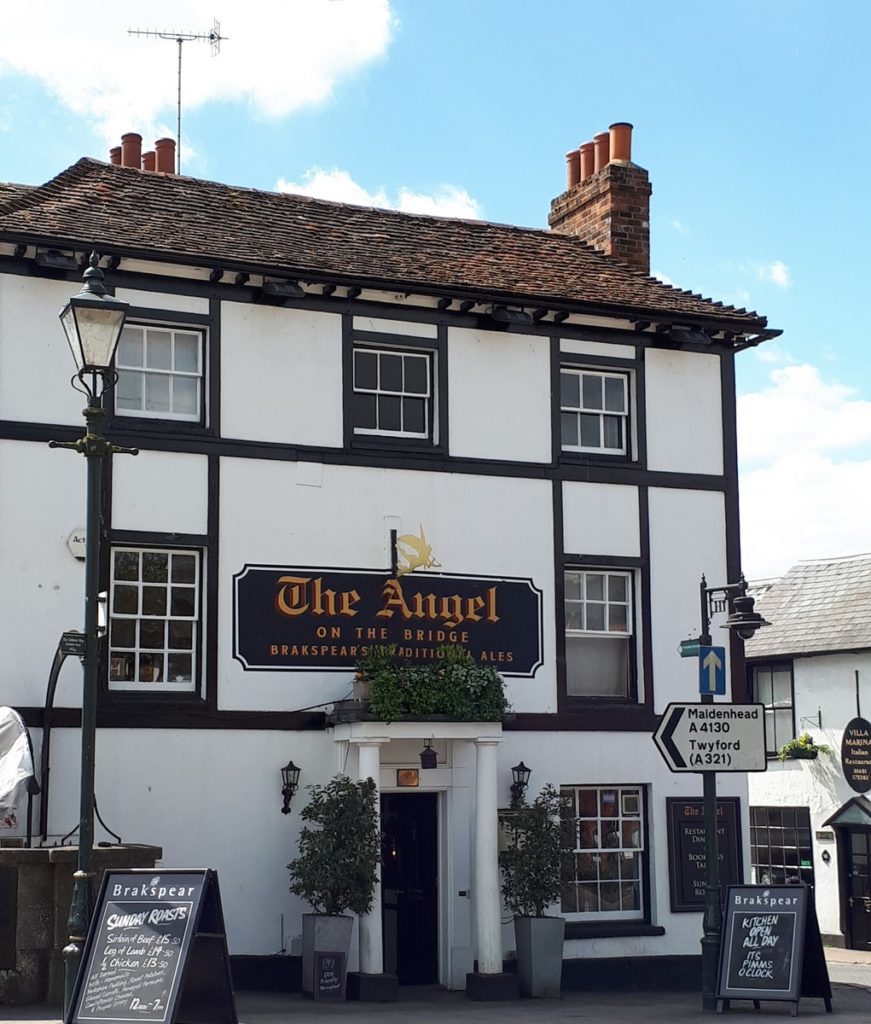
When it came time for a meal, Vicky, Beth and I chose the Angel at the Bridge, a slightly newer pub, having been built as recently as 1728. The deciding factor was it’s location, directly on the riverside, and the sign below –
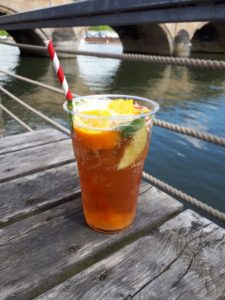
Again, the weather was glorious and we relaxed by the water as we ate our lunch, followed by a shared cheese plate and several glasses of Pimms. At last, we roused ourselves and set off for a bit of shopping, author/researcher style.
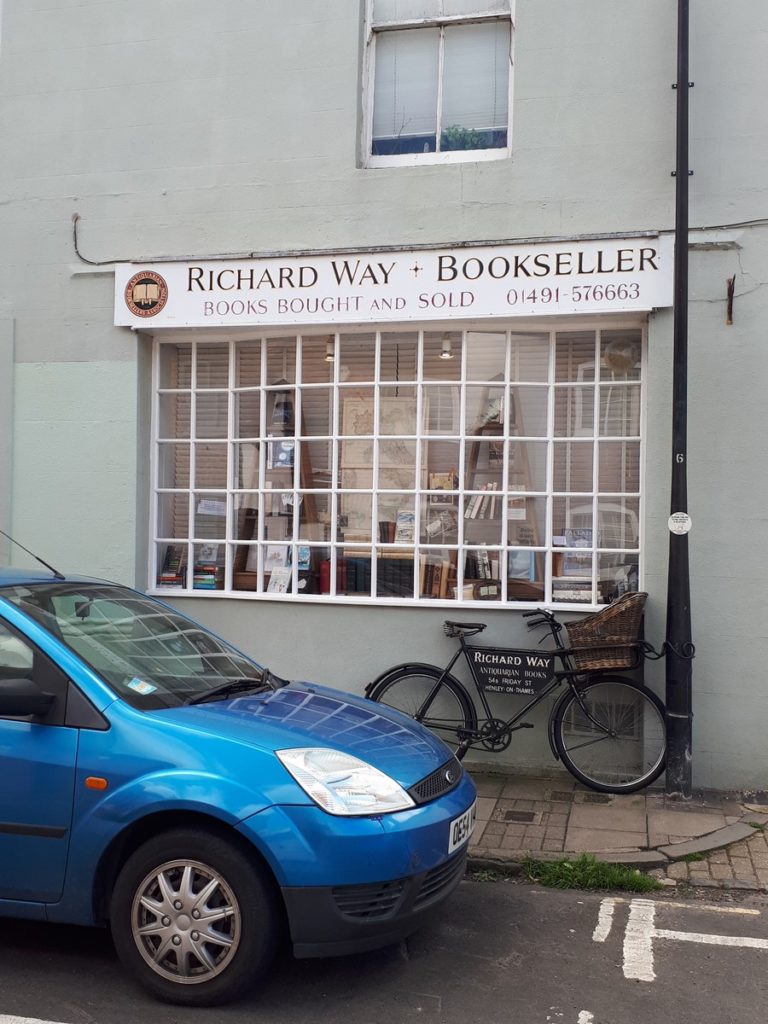
In the bookshop above, I found a period print of Rotten Row and snapped it up while Beth and Vicky chatted about Venice and French authors with the lady who ran the shop. If you’re ever in Henley, I do recommend your dropping in – it’s just higgedly piggedly enough to make browsing an adventure.
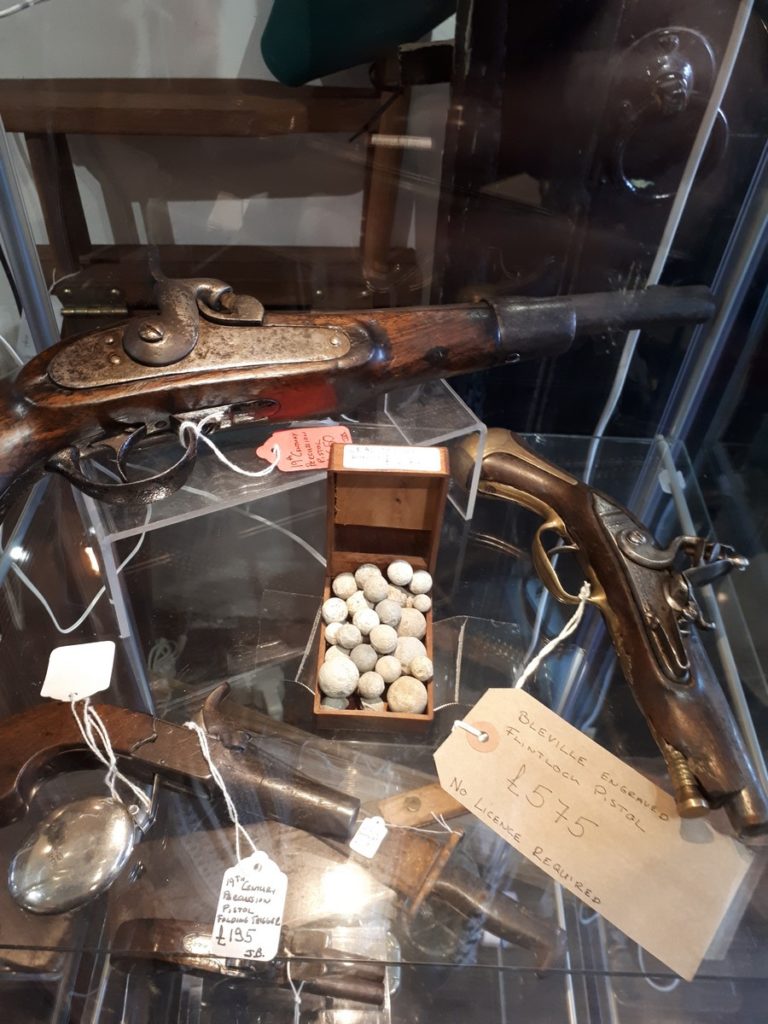
Of course, we also stopped in at several antique shops. In one, I found the display below. If only I knew a highwayman, I could have gotten his Christmas present sorted on the spot.
There are many more adventures with Beth to come, so stay tuned!
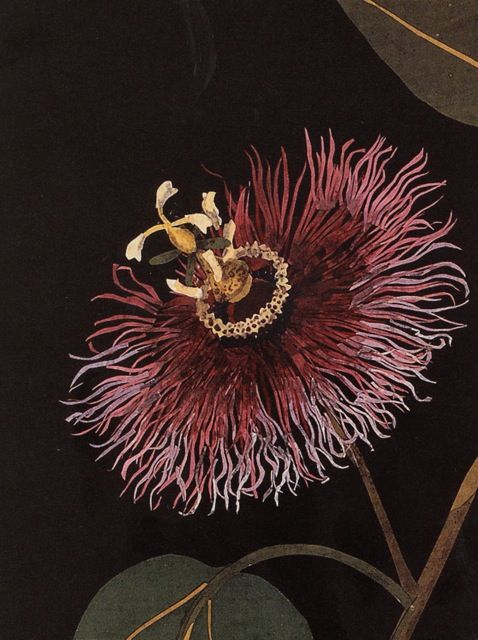
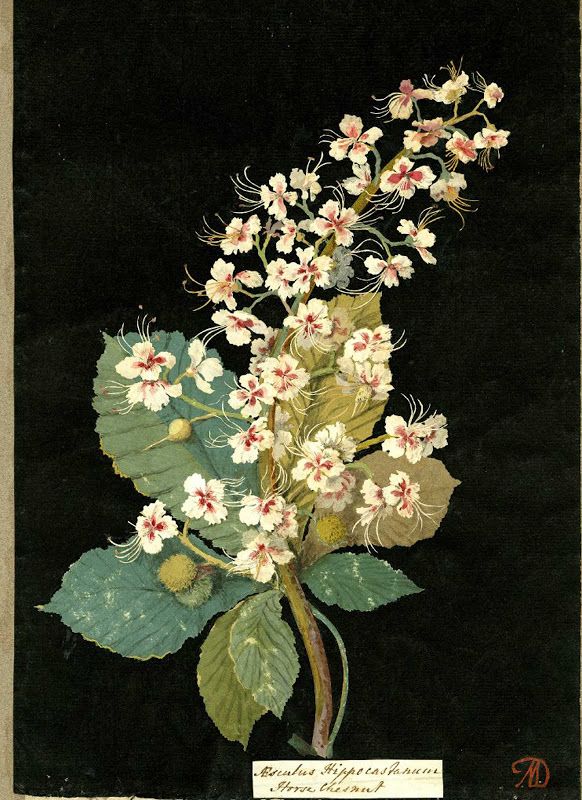
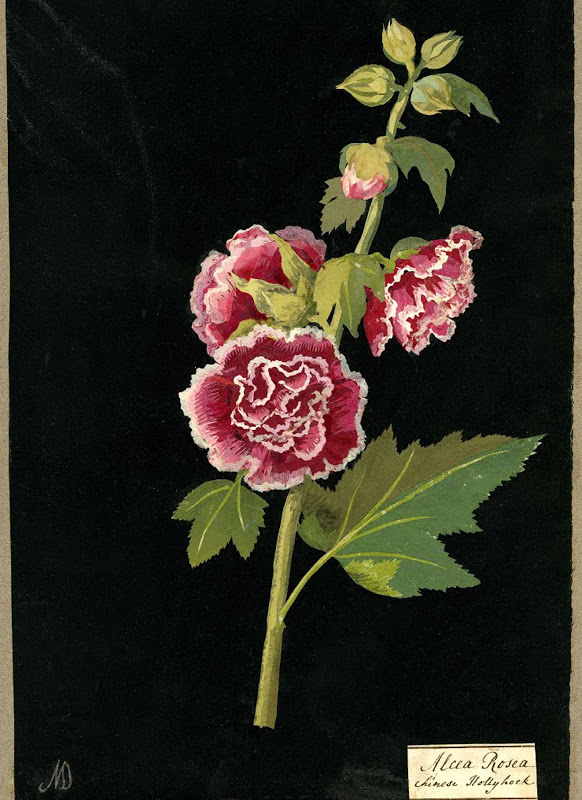
A few years ago I had the opportunity to visit an exhibition called “Mrs. Delany and Her Circle,” at the Yale Center for British Art. The show, organized by the Center for British Art and Sir John Soane’s Museum in London, included work in every conceivable medium.
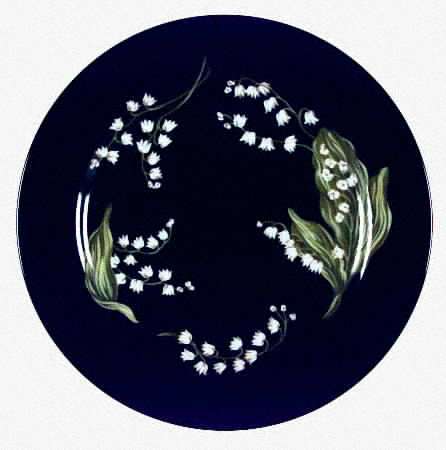
Tiffany and Company were inspired to create a china pattern called “Mrs. Delany’s Flowers.”
One of the items included in the exhibition was the needlework Mrs. Delany executed on a black ground for the court dress mentioned in a previous post and shown here.
The piece of fabric was placed between two panes of glass, allowing visitors to examine it closely. I have been doing crewel, embroidery and needlepoint for decades and must say that I’ve never seen anything so astonishing. Mrs. Delany’s stitches were neat and well placed, but that was only the beginning. The reverse of the fabric had been as neatly wrought as the front, with nary a knot in sight. The threads were as vibrantly coloured today as they must have been two hundred years ago, showing the detail of the design and the subtlety of color variations throughout the work. It is astonishing to realize that the designs for Mrs. Delany’s work originated in her own mind. Perhaps she worked her pieces directly from that picture in her mind’s eye. However, she was also able to translate those designs onto other pieces of fabrics and to write instructions and colour directions down, thus making needlework “kits” for her friends and family to execute.
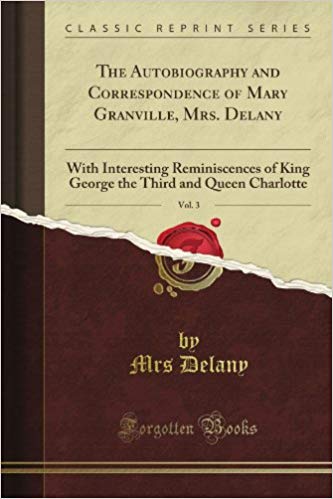
In 1861, Augusta Hall (Baroness Llanover) edited a volume called The Autobiography and Correspondence of Mary Granville, Mrs. Delany. In the appendix, the editor wrote:
“Were it possible to give a list of the work designed and executed by Mrs. Delany with the needle, independent of the quantity of various works in various ways designed by her for her friends to execute, it would be a much more extraordinary exemplification of what may be achieved by human industry and ingenuity, aided by natural talent, than the catalogue of her paintings. The Editor is not able to give an account of more than the specimens of Mrs. Delany’s needlework which are in her own possession, and that of her sister, and a few other relations. Of these are a number of chairs, the backs and seats of which are embroidered in a manner entirely different to anything that has ever (in the knowledge of the Editor) been done for a similar purpose. They consist of magnificent groups of flowers from nature, some on light and some on dark grounds, all different from each other, and all executed in worsted chenille, (made upon linen thread;) possessing the finest semi-tones of colour, which produce a variety of tint and harmony, as well as depth of colour, which never appear in the modern dyes of wool of any description. Some of these chairs are worked in embroidery stitch upon canvas, by which means the utmost freedom of outline was possible, and the most exact imitation of nature. In other sets of chairs cloth was used as the ground upon which the outline of the flowers must have been sketched, and the shades and colours filled in by sewing down the worsted chenilles by the eye, and cutting them off where required. These specimens prove Mrs. Delany’s marvellous talent for design, as well as ability in execution, and are suitable for furniture which though ornamental was yet useful; but there also exist bed hangings, and chair and sofa covers, which combine in as remarkable a manner striking effect with every day utility. Some of these were the covers of her drawing-room chairs in London, where the ground was brilliant dark blue linen, bordered with leaves cut out by herself in white linen, and edged and veined with white knotting of different sorts and thickness, sewed down along the edge. A bed completed by herself, and her sister Ann Granville, was of nankeen, with designs executed in white linen, for the headboard and hangings, all different, but well adapted to the various parts, and of a washing material, the durability of which as well as the excellence of the work is best proved by its endurance for near a hundred years in continual use! Mrs. Delany did not employ silk for her furniture, but woollen or linen materials; and the worsted chenilles, made on linen thread, never were attacked by the moths: there is now a box of them in the Editor’s possession left from Mrs. Delany’s work, which are still fit for use; it ought also to be mentioned that all these chenilles were wound on two cards folded together by herself in a peculiar manner, which prevented the chenilles being cut by the edges of the cards.”
Mrs. Delany died April 10th, 1788, and was interred in a vault belonging to St. James’ church, where a monument has been erected to her memory.
For further reading on Mrs. Delany read Mrs. Delany: Her Life and Her Flowers by Ruth Hayden (ISBN: 071418022X / 0-7141-8022-X ); Mrs. Delany (Mary Granville): A Memoir, 1700-1788 by George Paston (ISBN: 1150362642 ) and The Autobiography and Correspondence of Mary Granville, Mrs. Delany by Augusta Hall (Baroness Llanover).