Travels With Victoria: Holland Park

On all my trips to London, I have meant to visit Holland Park, and I finally made it.  Today Holland Park is in the center of town. When it was in its heyday as the gathering place  for the grand Whigs in the late 18th and early 19th centuries it was a country house, beyond the boundaries of London and Westminster.
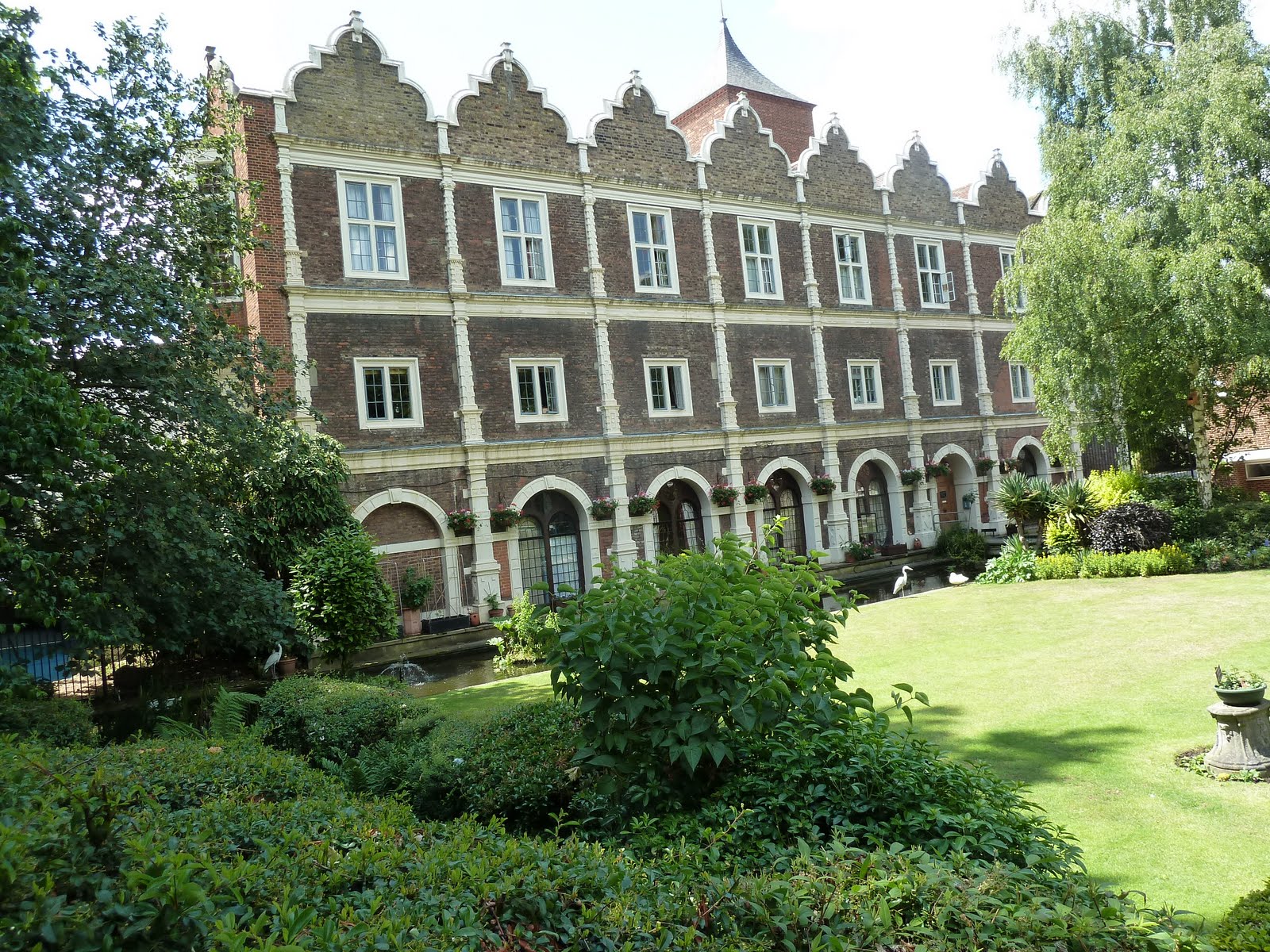
Holland House, today
Very little of the original house remains after most of it was destroyed in 1940 by German bombs. The remainder, above, was turned into a youth hostel. Elsewhere in the park the Opera Holland Park performances are held outside.
As part of the Open Squares Weekend, June 11-12, 2011, I wanted to visit the garden, a very attractive design for its placement in the midst of a shady park.

Above is the Jacobean House as it appeared in a drawing of 1812 when it was already 200 years old. First built in 1605 for Sir Walter Cope, it was known as Cope Castle, and occupied 600 acres of land in Kensington about two miles west of London. The house was inherited by Cope’s son-in-law, Henry Rich, first Earl Holland, who lost his head to the forces of Parliament in the Civil War. His family regained the estate, now known as Holland House, at the Restoration.

 Several generations later, it became the property of Henry Fox, 1st Baron Holland (1705-1774), who lived there with his wife Caroline Lennox (1723-1774), daughter of the 2nd Duke of Richmond.  They had eloped due to the political emnity of the father and prospective son-in-law, as well as considerations of difference the in ages of the couple. Nevertheless, it was a happy marriage, though marred by the tendency of their sons toward dissolute lives.

Caroline Lennox Fox, Lady Holland

Their story is told in the book The Aristocrats by Stella Tillyard, an account of the lives of the Lennox sisters, later produced for television.  Among Caroline’s children was the renowned late 18th century politician and stateman Charles James Fox, whose life is full of fascinating contradictions. He was the arch rival of Prime Minister William Pitt the Younger.

Whig politican Charles James Fox (1749 -1806)

Henry Vassall Fox, 3rd Baron Holland (1773-1840), was traveling in Naples, Italy, when he met Elizabeth Vassall, Lady Webster, wife of Sir Godfrey Webster, 4th Baronet.  Baron Holland and Lady Webster fell in love, though she already had borne five children to Webster (3 of whom survived infancy).  Webster sought and obtained a divorce on the grounds of adultery, a shocking and rare situation in those days. His estranged wife already had a child with Holland, a son, Charles Richard Fox, who later became a general in the British Army. A few days after the divorce, Baron Holland married Elizabeth;  They had 3 more children who lived to adulthood. 

Statue of 3rd Baron Holland in the park.

Lord and Lady Holland lived at Holland House, and for forty-plus years, they presided over a brilliant social and political salon, despite the fact she had been divorced and was not received at court. All the influential Whigs, including the Prince of Wales, and leading government ministers came to Holland House.
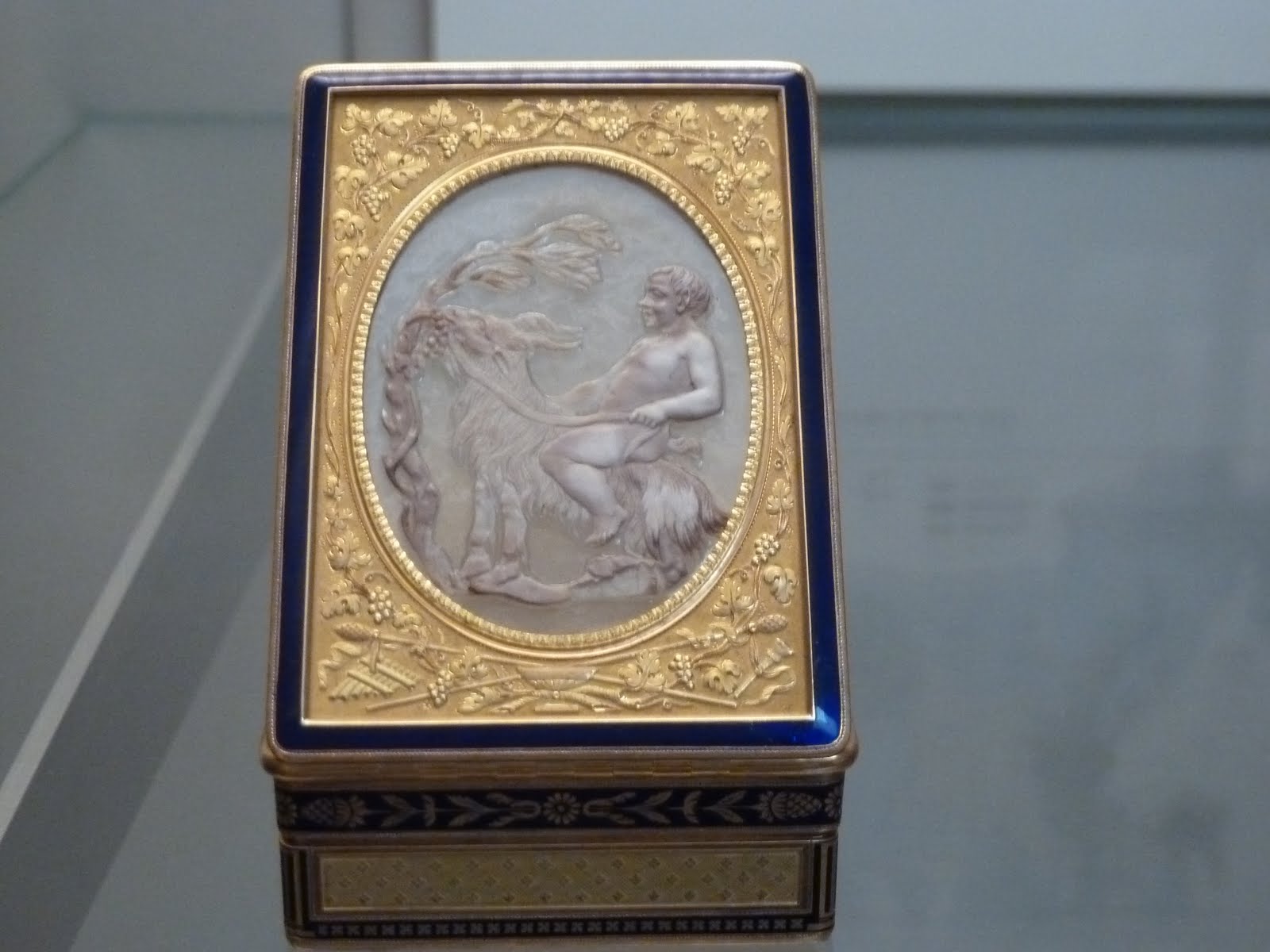
The Gold Cameo Box, shown here at the British Museum, was bequeathed to Lady Holland by Napoleon in 1821, having been a gift from the Pope to Napoleon in 1797.  Lord and Lady Holland were supporters  and admirers of Napoleon, as were many prominent Whigs.

Henry Edward Fox, 4th Baron Holland, and his wife had no male offspring and thus the Holland title became extinct.  The house passed to the Fox-Strangways family, Earls of Ilchester, who also entertained political and social leaders there into the 20th century. King George VI and Queen Elizabeth attended a ball at Holland House just a few days before it was destroyed.

Searching the library in the bombed out Holland House

Though there is not much of the house remaining, the park is lovely, home to roaming peacocks among other wildlife. There are also fields for team sports and gently winding walks, often crowded with joggers and strollers.

Exiting the park to the north, the residential area is lovely, with large mansions in white stucco dominating the streets.

I couldn’t decide which side of the street I wanted to choose, so I have delayed the decision!  I think either one would do!!

Next post: Recollections of Lord and Lady Holland by Charles Greville
Next on Travels with Victoria:  The Gardens of Westminster Abbey

The Charlotte Gunning Portrait at Chawton House by Guest Blogger Hester Davenport

The Portrait of Charlotte Gunning (1759-94)
copyright Chawton House Library

On 15 May 1784 it was the turn of Charlotte Margaret Gunning, Maid of Honour to Queen Charlotte, to have use of the Royal Coach. Her friend Mary Hamilton called at St James’s Palace, and went with Charlotte to ‘Romney’s, the Painter’s’ where Miss Gunning was ‘to sit for her picture’. That half-length portrait now hangs in Chawton House Great Hall.
Mary Hamilton had also been employed in the royal household, to help with the education of the young princesses; she found her duties arduous, thankfully withdrawing from court after five years. Perhaps the two young women talked over the difficulties of royal service, which included their reputations as ‘learned ladies’. Both had had ‘masculine’ educations in the classical languages: according to Fanny Burney Miss Gunning was derogatively nicknamed ‘Lady Charlotte Hebrew’ for her learning.
Charlotte was the daughter of Sir Robert Gunning (1731-1816), a diplomat who was so successful in conducting the King’s business with the Empress of Russia that in 1773 he was made  Knight of the Bath. His daughter’s appointment as Maid of Honour to Queen Charlotte in 1779 was no doubt a further sign of royal favour. He had two other children, his son George who would inherit the baronetcy, and another daughter Barbara. His wife had died when Charlotte was eleven-years-old, but in the 1780s he ordered portraits of himself and his three children from the society portraitist, George Romney (1734-1802).
The painting of the 25-year-old Charlotte is interesting in its apparent contradictions. The colours are muted, with the head veiled in white and the black dress severely plain, yet it is very low-cut, and the sitter looks out self-assured and even challenging. A warm glow in the sky behind suggests there is feeling and passion beneath that cool exterior. Charlotte’s hair is dressed high on her head and fashionably powdered. A hat might have been expected, but scarves, called ‘fascinators’, sometimes replaced large hats, especially for evening wear.
There were six Maids of Honour, paid £300 a year, with duties that must have been stultifyingly dull, standing in attendance at the Queen’s ‘Drawing rooms’ and other court functions (though periods of duty were rotated). Charlotte kept her position for nearly twelve years before managing to escape. It was not easy to withdraw from royal service, as both Mary Hamilton and Fanny Burney discovered, and reaching her thirtieth birthday in 1789 Charlotte must have feared a dreary life of spinsterhood. But on 6 January 1790 she achieved an honourable discharge when she married a widower, Colonel the Honourable Stephen Digby, the Queen’s Vice Chamberlain. Another of Charlotte’s friends, Mary Noel, wrote in a letter of her surprise that Sir Robert gave his consent ‘as it must be a very bad match for her if he has four children’, though she also recorded Charlotte saying that she ‘can’t live without his friendship and could not keep that without marrying him’.
For Fanny Burney the news of the forthcoming wedding was a shock: she believed that Digby had been paying her marked attention for two years and that she should have received the proposal. Her sense of betrayal was huge and she gave vent to her feelings in page after page of her journal. She never blamed Charlotte but no doubt got sly pleasure from noting the King shaking his head over ‘Poor Digby’ (because his bride was a learned lady) or recording the strange details of the wedding: that it was performed by Dr Fisher, Bishop of Salisbury, in the Drawing-room of Sir Robert’s house in Northampton, with the guests sitting round on sofas and ladies’ workboxes not cleared away. The new Mrs Digby paid a visit to Miss Burney, ‘quite brilliant in smiles and spirits’ and Fanny did her the justice of saying that she believed that Miss Gunning had ‘long cherished a passionate regard’ for Colonel Digby.
Two children, Henry Robert and Isabella Margaret, were born in quick succession, but the marriage was not to be long-lasting. In June 1794 Charlotte Digby died (possibly in childbirth – the brief obituary notice in the Genteman’s Magazine gives no cause of death). She was buried in the vault of Thames Ditton church where Digby’s first wife lay: he would join his two ‘dear wives’ there in 1800.
Charlotte Gunning wrote no books, has found no place in history. But there could surely be no more suitable place for her portrait than Chawton Women’s Library, in the society of so many other ‘learned ladies’.
Permission to reprint this article, which first ran in The Female Spectator, was kindly granted by that publication and Chawton House Library.   

Earthquake! (Again)

From the Letters of Frances, Lady Shelley

August 12. (Devon 1852) — “We felt a tremendous earthquake shock at Beer Ferrers at 7:30 this morning. It was not felt at Plymouth, but, so far as we can ascertain, it was first felt at Beer Town, where all the crockery ware on the shelves rattled for some seconds. We heard a great noise, like the blowing up of a powder magazine, which we thought must have occurred at Plymouth. The house rocked to its foundations. I happened to be writing at the time, and the pen was dashed out of my hand. At Beer Alston, due north from here, the shock was greater. Tiles were thrown from the roof, people rushed into the street, and in the new mine close to the Tamar, those who were working in the upper gallery rushed below, believing that the earth had fallen in upon the men working there. At Tavistock a chemist told me that all his bottles rattled and shook so much that he expected them to fall to the floor. On the Moor many of the great stones were detached from the Tor, and at Two Bridges the landlord told us that while he was in his stable the noise and shaking was so great that he ran out thinking that the building would fall about his ears. On the first floor of his house the children screamed, and his wife expected the floor to give way. A wall had been thrown down at Widdicombe, on the Exeter road. We have traced the shock in a direction from east to west, increasing in intensity as it proceeded.

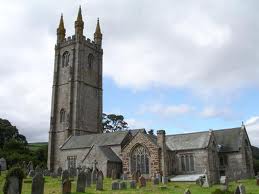
St. Pancras Church, Widecombe
“The last recorded convulsion of this kind was in October 1752, just a hundred years ago. During the evening service in Widdicombe church, a ball of fire burst through one of the windows, and passed down the nave. Large stones, which were detached from the tower of the church, broke through the roof. The clergyman, the Rev. Mr. Lynn, and his clerk remained in their places, and a huge beam from the roof actually fell between them. The clergyman continued to pray aloud, in the presence only of the dead and the wounded. Four persons were killed, and sixty-two persons seriously injured. The most harrowing tales respecting this shock are still told by the peasantry of Dartmoor. A hundred years ago the shock was heralded by a violent storm of thunder and lightning. On the present occasion there was no storm. The sky was overcast, the air was heavily charged, and had been so for some days.”

Travels With Victoria: Marlborough House

Saturday, June 11, 2011, was not only the Trooping of the Colour (see my post of 7/30/11).  It was the first day of the Open Squares weekend.  Being an unabashed Nosey Parker, I love this time when many of the private squares and parks in London are opened to the public.

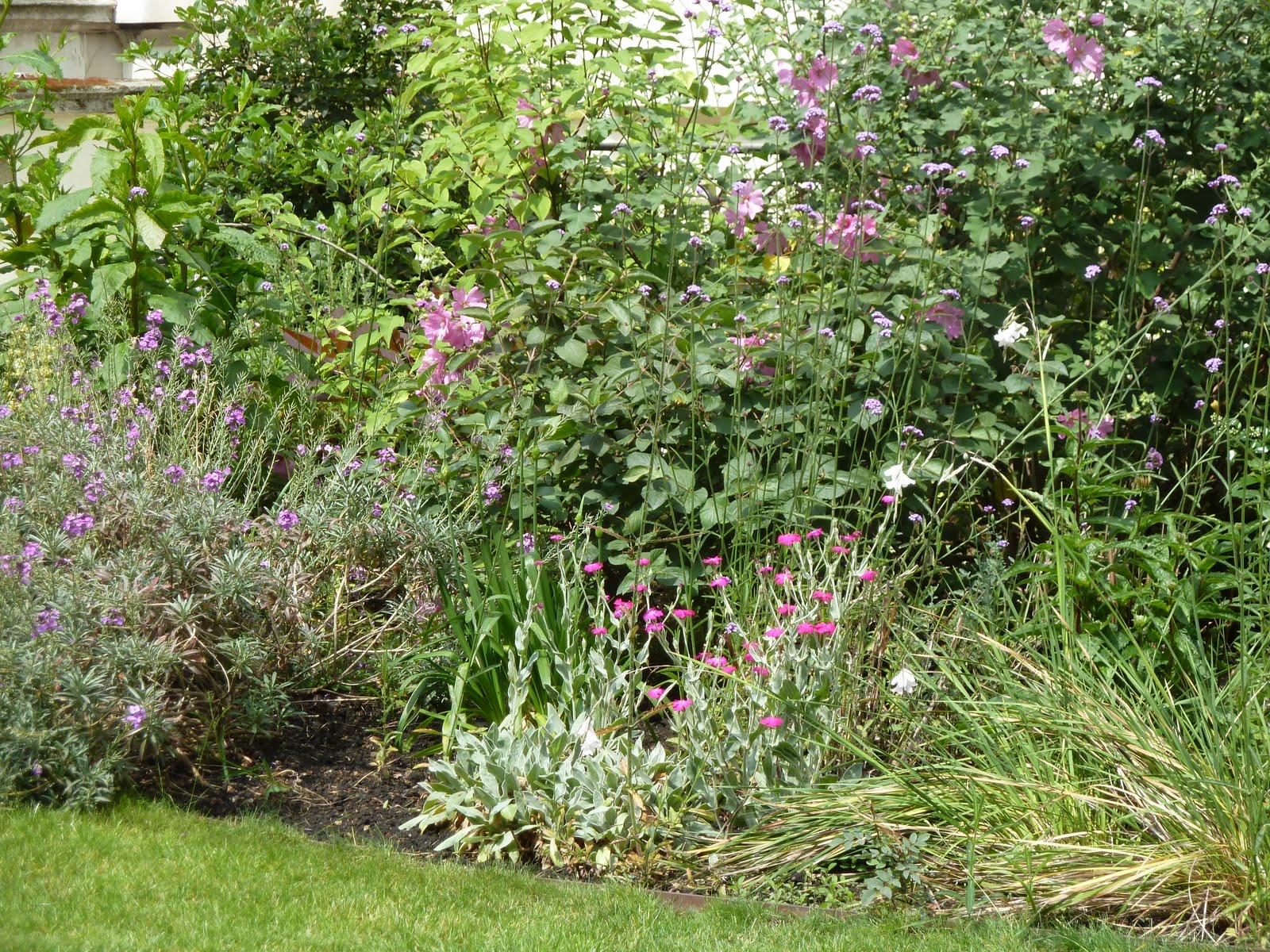
Garden at Carlton House Terrace

While the Queen was reviewing her troops on the parade ground at Horse Guards, I wandered to a few of the gardens in the vicinity of St. James.

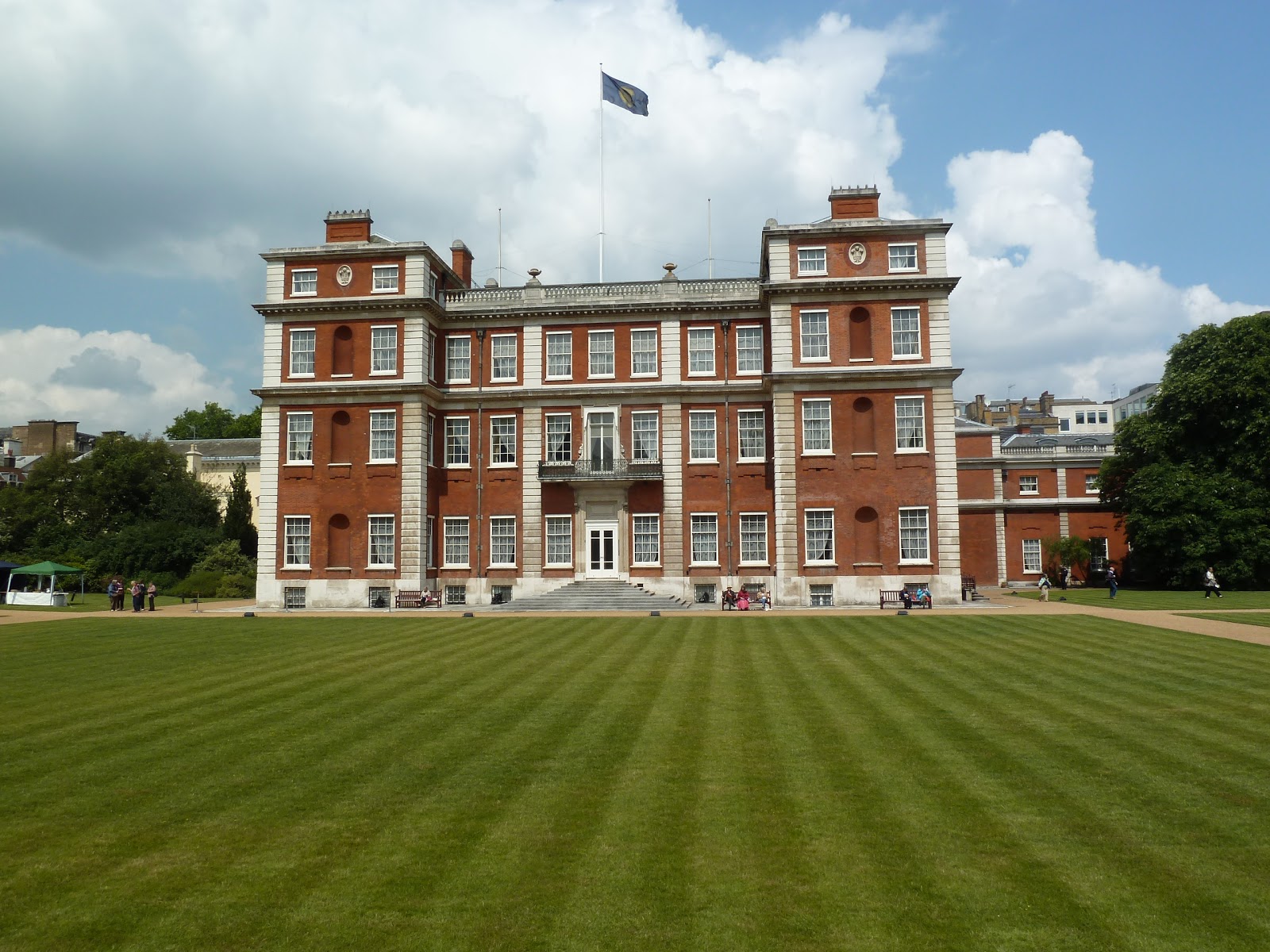
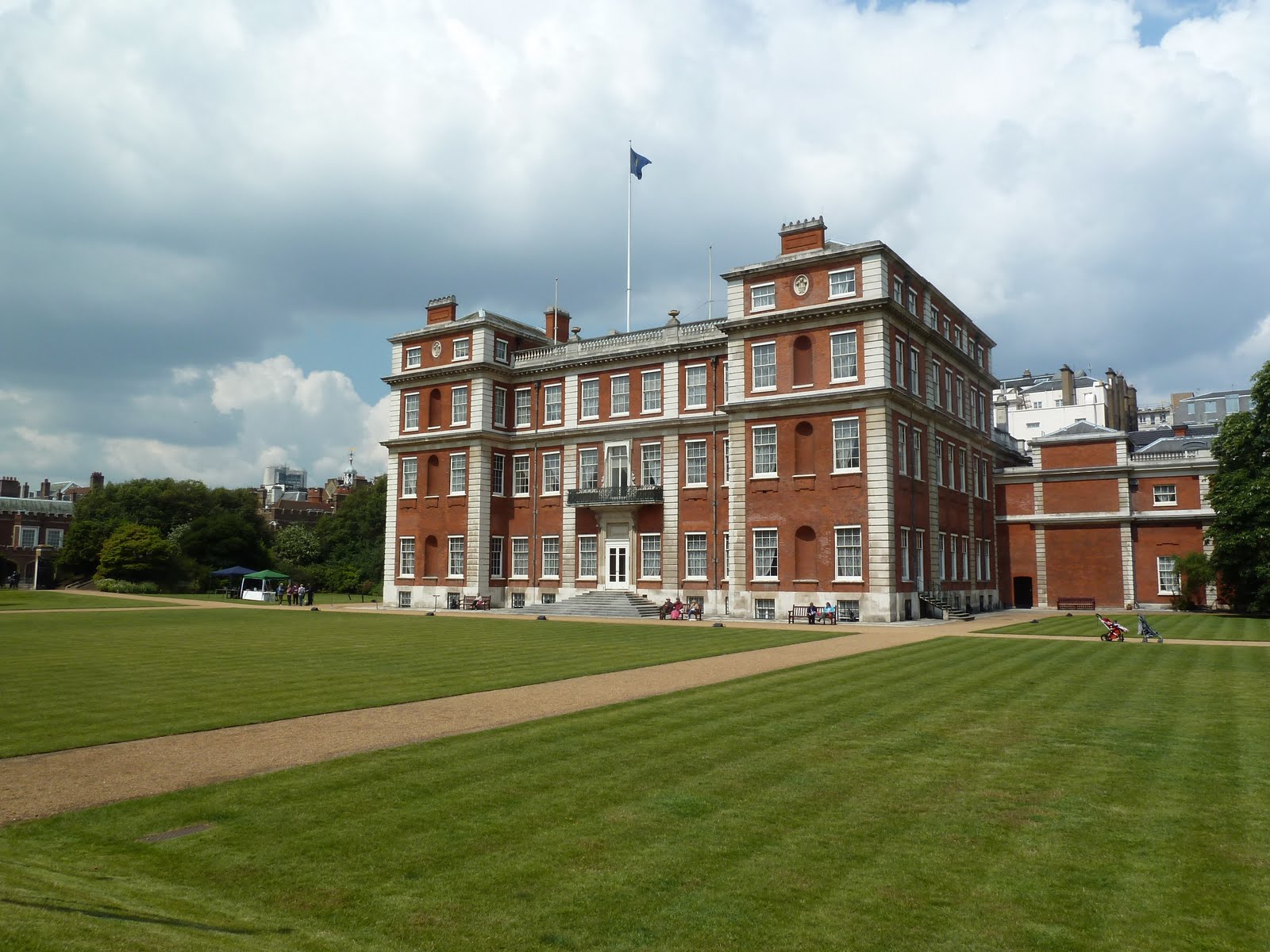
Marlborough House, St. James


You can take an excellent virtual tour of the interior and exterior of the house here. Marlborough House is now the home of the Commonwealth Secretariat and the Commonwealth  Foundation.

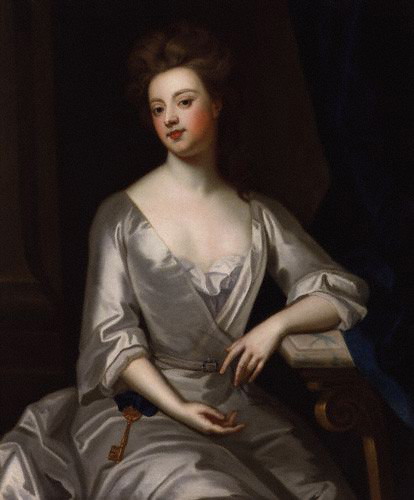
In learning more about Marlborough House, I found it was associated with a large number of remarkable people, particularly women. The house was built on land leased from the crown adjoining St. James Palace for Sarah Churchill, 1st Duchess of Marlborough, who was a close friend of and adviser to Queen Anne.

Sarah, Duchess of Marlborough (1660-1744)  National Portrait Gallery

Sarah chose as architect Sir Christopher Wren. She disliked Sir John Vanbrugh who was building Blenheim, the magnificent baroque country house in Oxfordshire which was to be a gift of a grateful nation to the 1st Duke of Marlborough for his victory in the Battle of Blenheim in 1704.

The Original Marlborough House

 Sarah wanted a plain and convenient house, without florid embellishments; in her own words, “…unlike anything at Blenheim.” She laid the foundation cornerstone in 1709, but she quarreled with and later dismissed Wren. The feisty duchess took over the supervision of Marlborough House’s completion.  Like her disputes with the Blenheim builders, the economical and thrifty Sarah refused to give in to excessive costs and overcharging.

Sir Christopher Wren (1632-1723)

Wren’s original design was dramatically altered in 1770 when a third floor and additional wings were added.

 The Marlborough family occupied the house until 1817 when the property reverted to the Crown. Marlborough House was being prepared to be the London home of Princess Charlotte and her husband Prince Leopold with their expected child when the Princess died in childbirth in November, 1817, putting the entire country into mourning.

Charlotte and Leopold, c. 1816

Leopold did occupy Marlborough House and lived there until he became King of Belgium in 1831. He was not only the widower of Princess Charlotte; he was the brother of the Duchess of Kent and uncle to Princess Victoria.  Marlborough House was next presented to Queen Adelaide, consort of William IV, for her use.

Adelaide of Saxe-Meiningen, Queen of England (1792-1849)

Adelaide, the first dowager queen for almost 150 years,  did not spend a great deal of time at Marlborough House. She was viewed with suspicion by the Duchess of Kent and other advisors to the young Queen Victoria, and thus spent more time in the country wandering from one rented house to another.

Years later, a collection of artifacts from the Great Exposition of 1851 was displayed to the public in Marlborough House, making it a museum of arts and science. It’s success led to Queen Victoria and Prince Albert deciding to build permanent displays on a grand scale, which became the Science Museum, the Natural History Museum, and the Victoria and Albert Museum in Kensington.

After a period of time when it was used as a national art school, the building was remodeled as a home for the Prince of Wales, later Edward VII (1841-1910), and his wife Alexandra of Denmark. Further additions were made before the couple moved in.  Their active social life led to the fame of the Marlborough House Set, a circle of fashionable aristocrats as well as a few who were not very aristocratic at all.  But no doubt amusing!

Anita Leslie’s 1973 book about this Eawardian group makes fascinating reading. George V was born here in 1903.  After Queen Victoria died, Bertie (having lived for decades as Prince of Wales)  reigned only only nine years as Edward VII.  Another dowager queen, Alexandra moved back to Marlborough House, where she lived until her death in 1925.

Queen Alexandra

To return to my visit to the Marlborough House Garden, I enjoyed a cup of tea and sat on a damp bench — the weather was cool and occasionally it tried to rain, but I believe that is not allowed on the day of Trooping the Colour, so it always blew away in a short time.

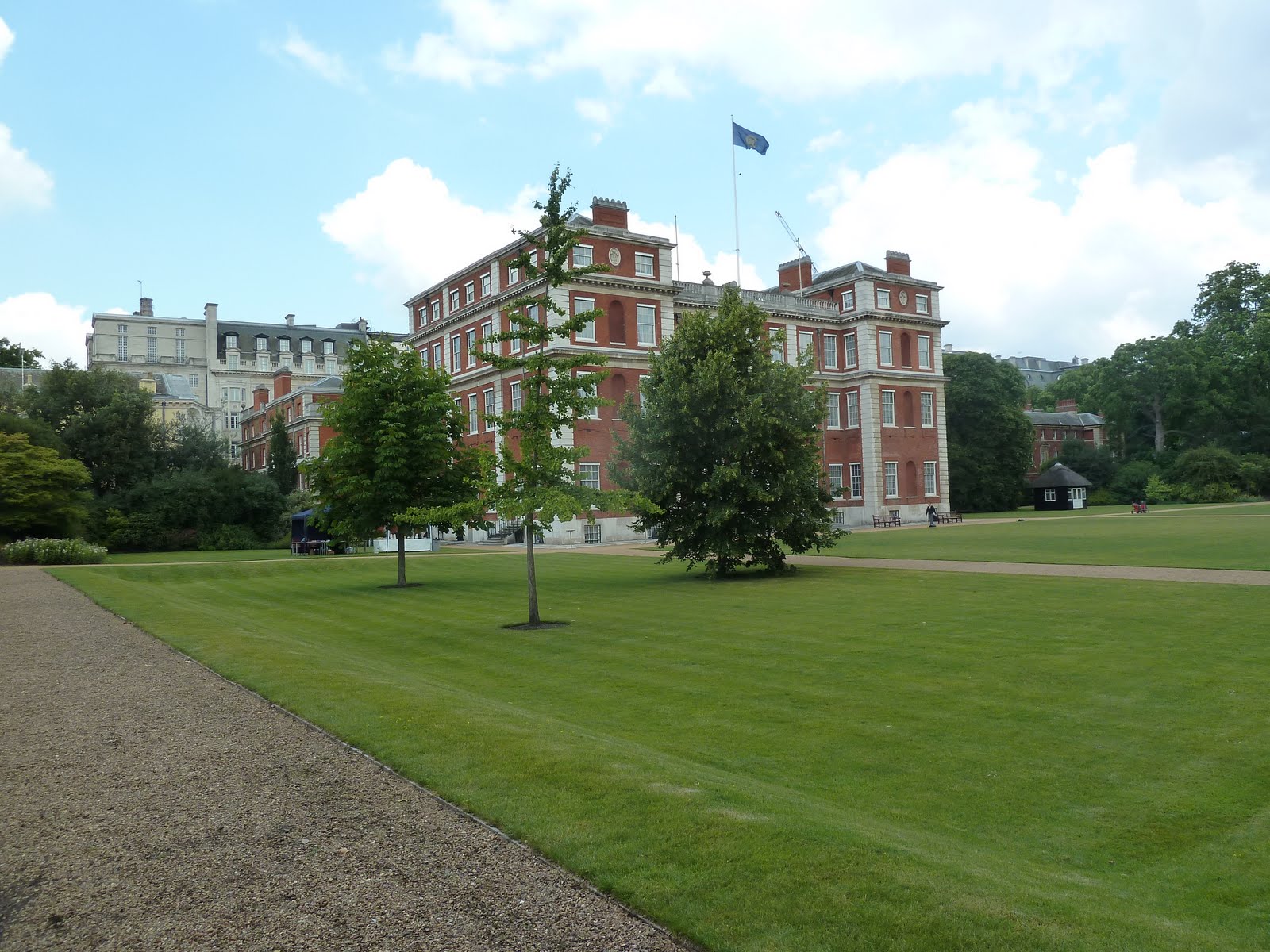
The Garden brochure says, “The garden has been largely maintained in its original formal 18th-century layout, with a number of large, plain expanses of lawn, intersected by gravel pathways.” Flowers and hedges were restricted to the boundaries, but at the eastern end, there is a shrubbery with a woodland path where I found the pet cemetery.

A row of little headstones marks the final resting point for some of Alexandra’s most beloved pets.

On several of the stones there were pictures of the little dogs, which looked like King Charles spaniels, with their mistress.

As I walked around the garden, I realized that the bands I heard were right outside the wall as the troops returned to Buckingham Palace from Trooping the Colour.  A little cluster of us peered over the wall and watched the parade.

The Queen and Prince Philip on their way back to the Palace for the flyover by the Royal Air Force.

A final view of Marlborough House.

Memorial to Queen Alexandra just outside Marlborough House where she lived much of her life. It was designed by Sir Alfred Gilbert and dedicated in 1932 by George V, Queen Alexandra’s son.

Travels with Victoria has only a few more stops to make; watch for them after a short break.

Snorkeling the Atlantis Ruins

During our recent trip to the Atlantis Resort in Nassau, Brooke and I spent some time snorkeling the underwater ruins.

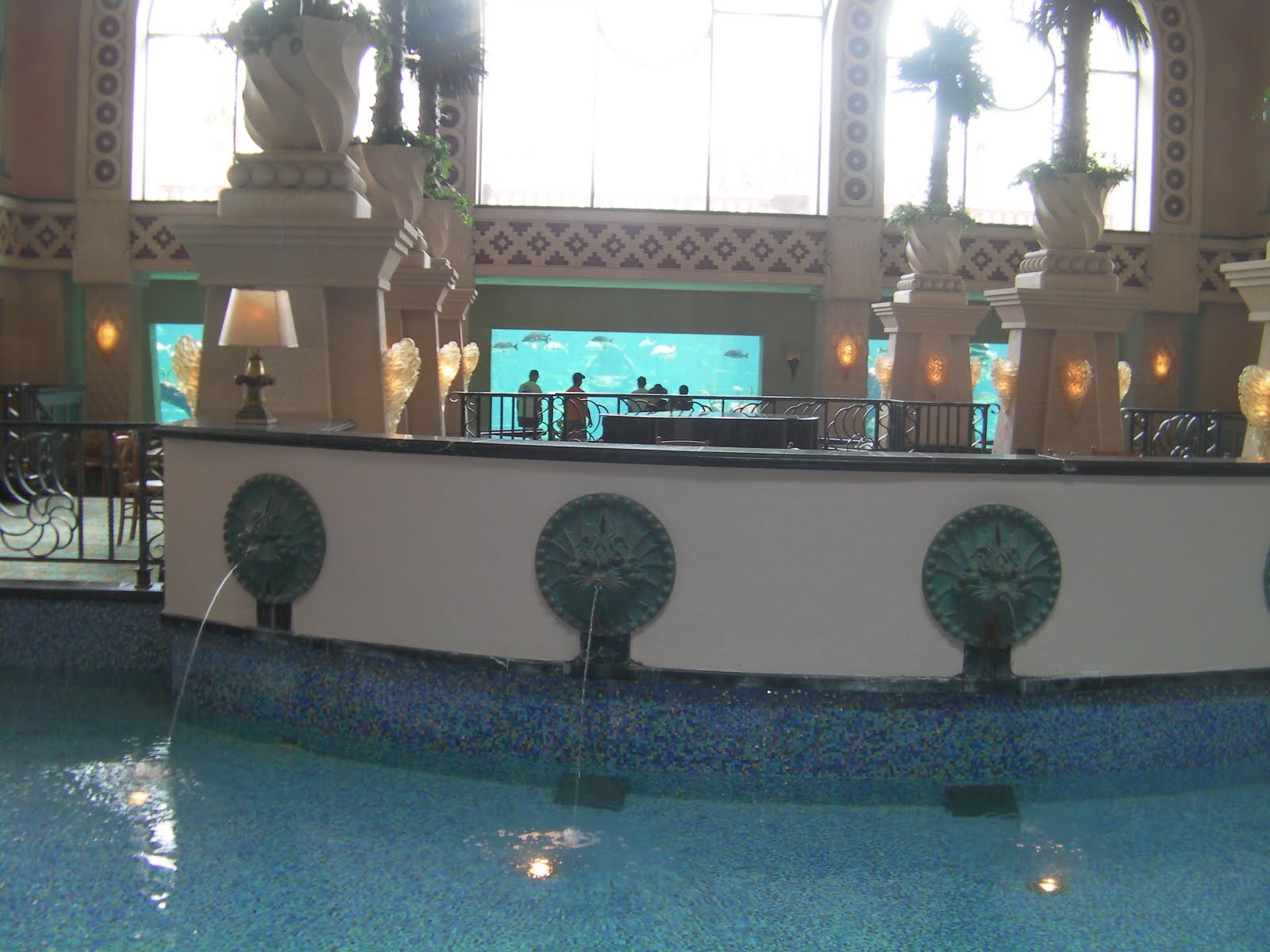
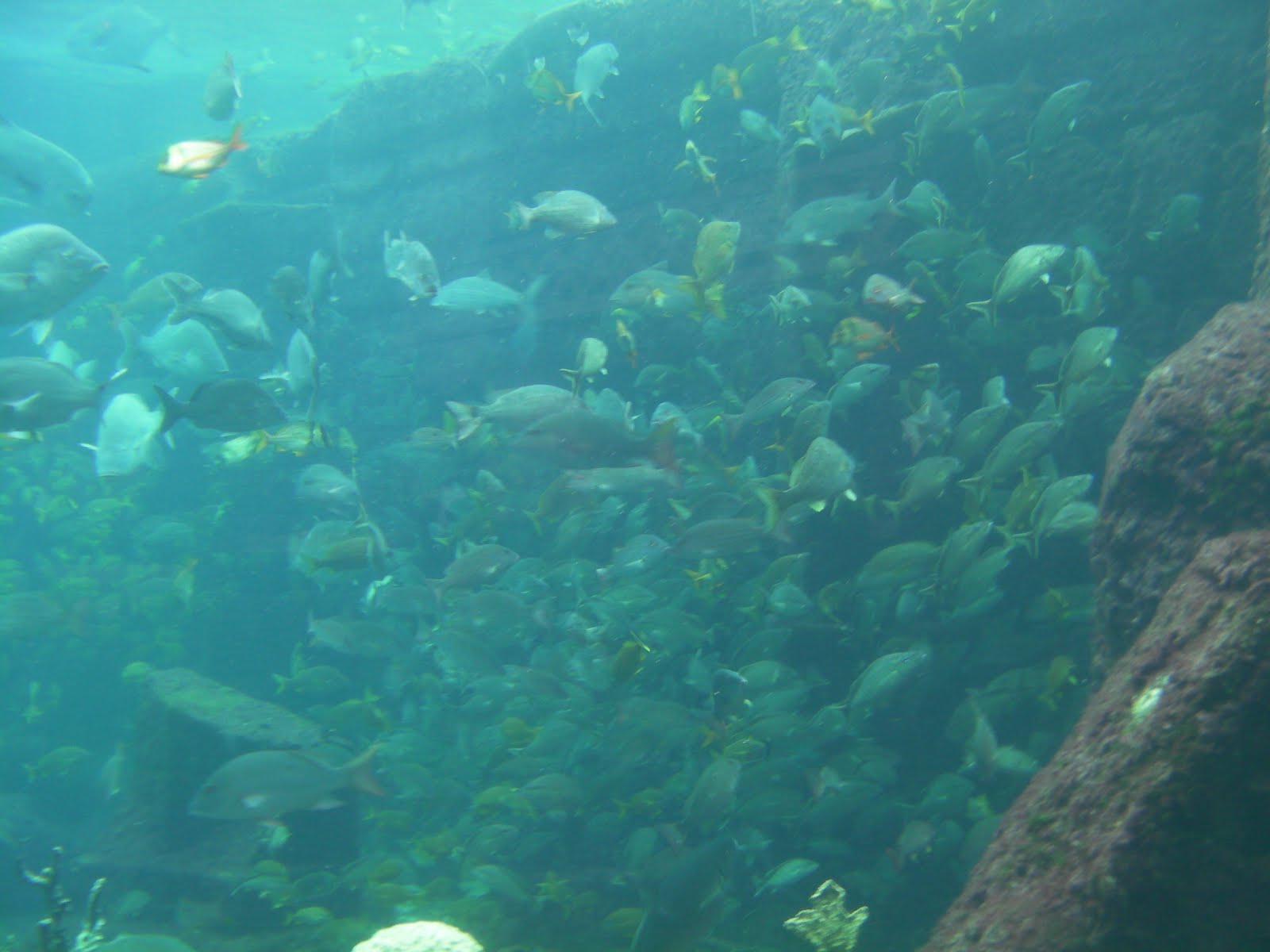
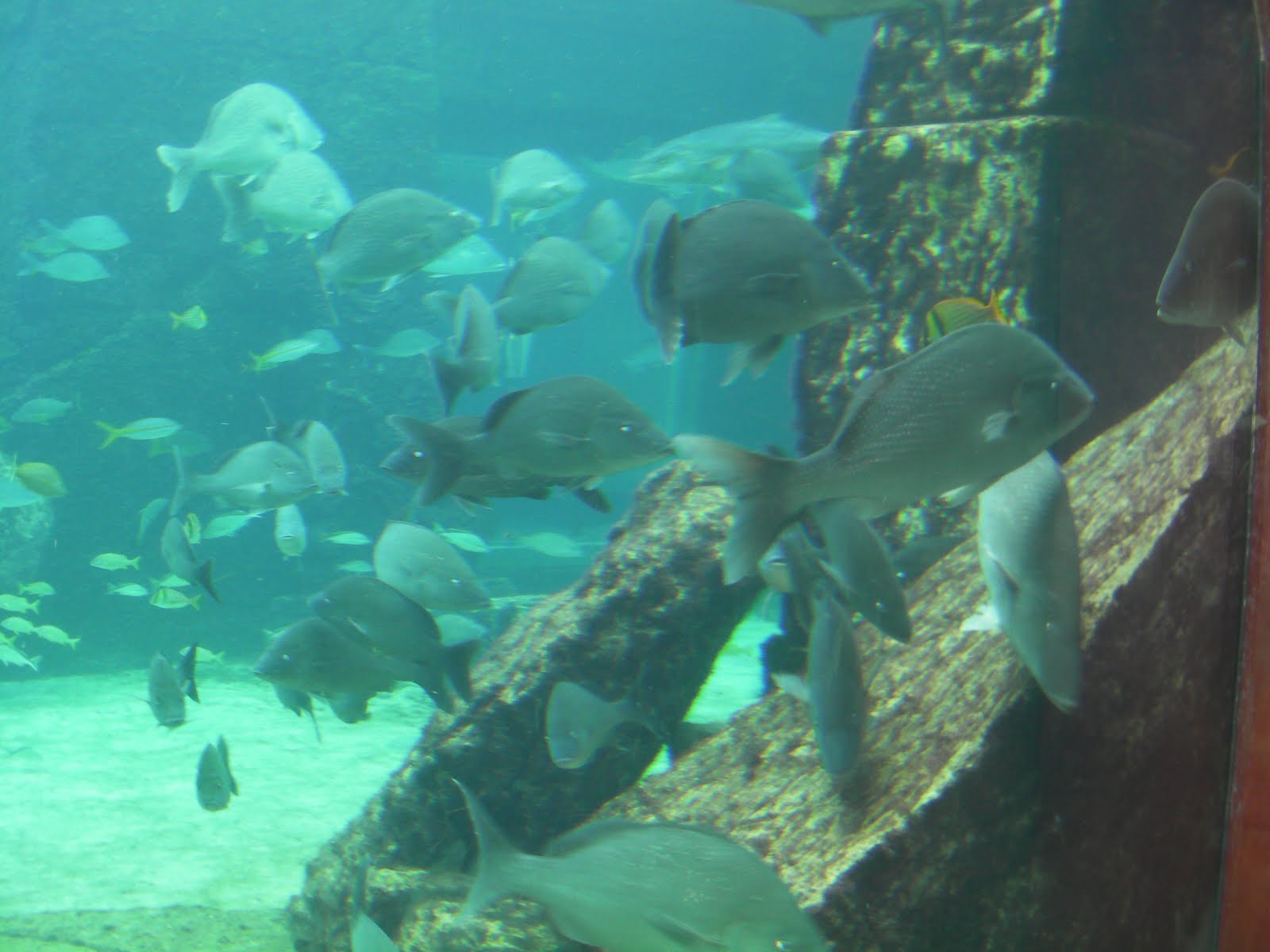
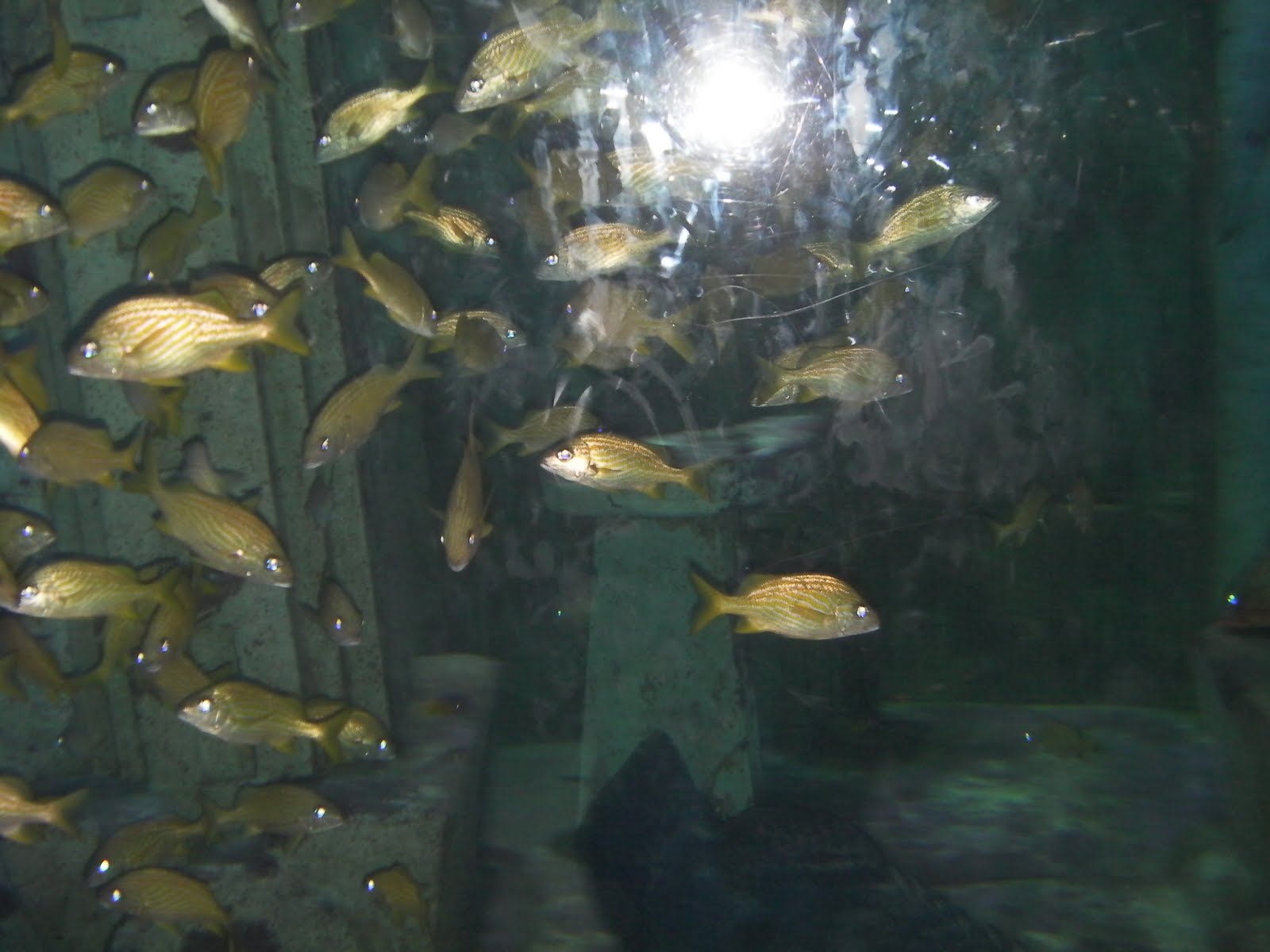
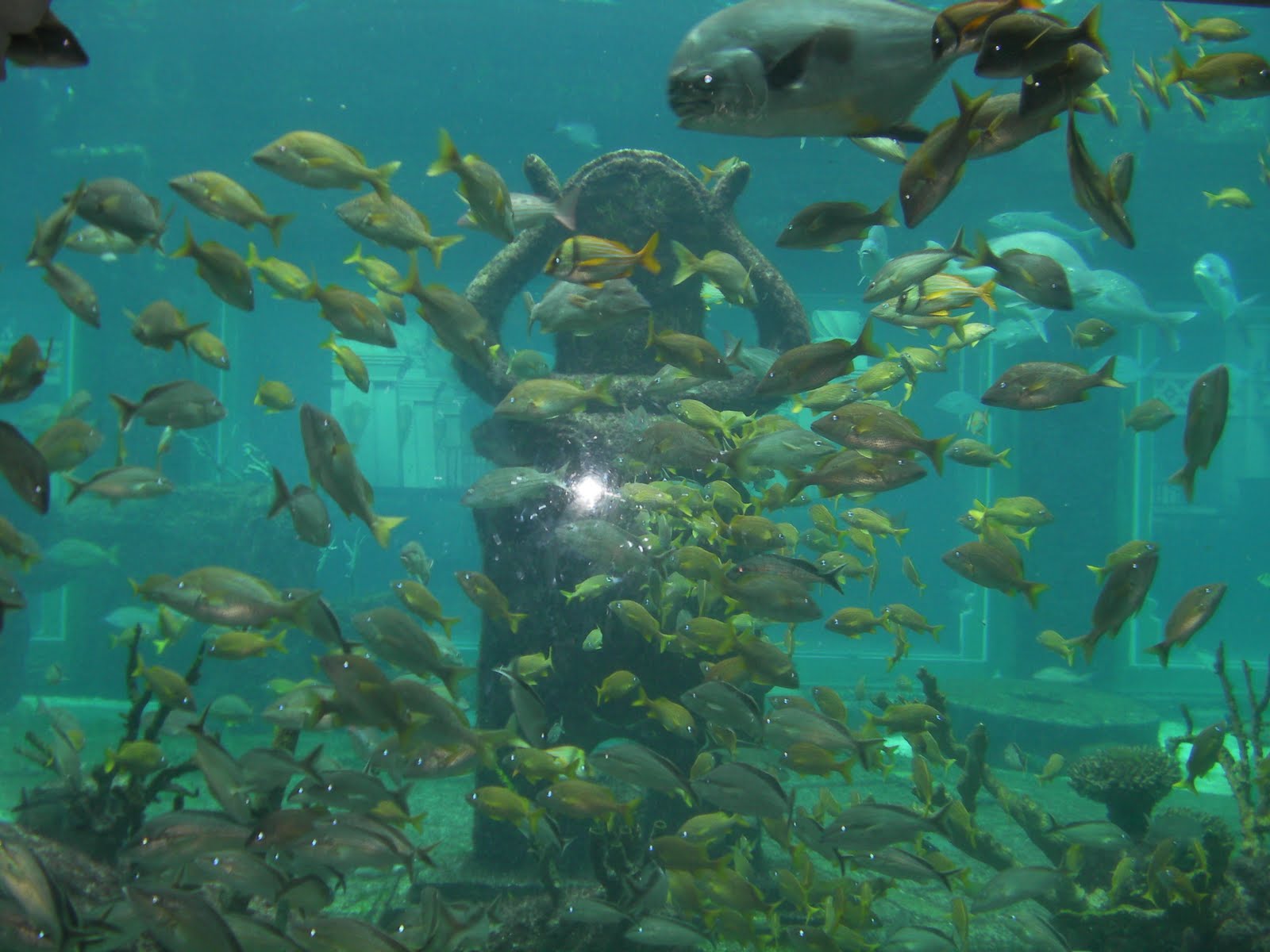
The two million gallon tank holds sharks, manta rays, eels, grouper and a variety of other sea life and can be seen through windows in the underwater walkway that meanders through the resort.

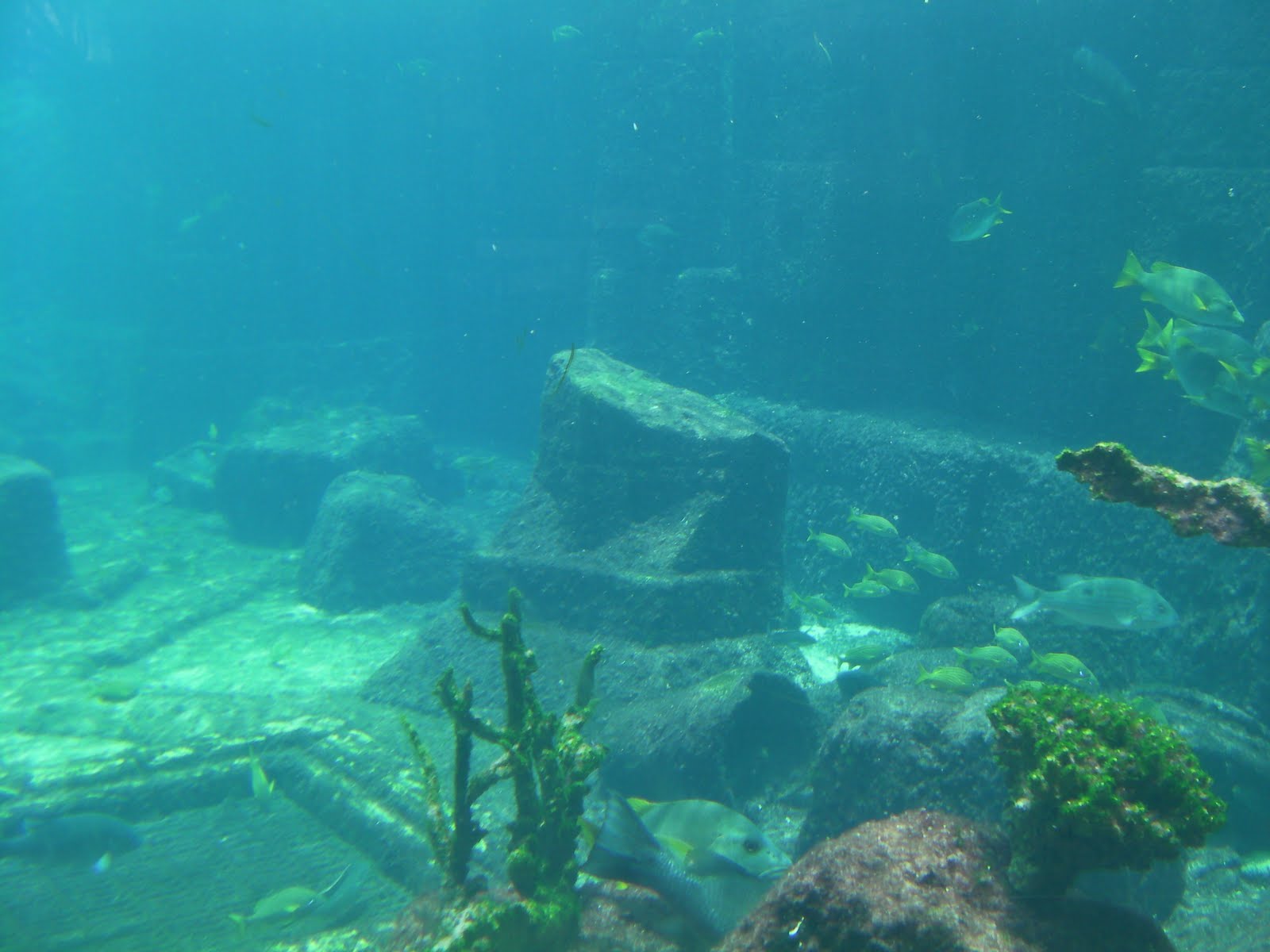
Man-made ruins recreate the Lost City of Atlantis.

We donned our snorkel kit and dove in – along with several others in our group, including a teenaged girl who screamed out loud whenever she saw anything that moved. Believe me, there was alot of moving sea life. Thus, a lot of screaming. Where were the sharks when we needed them?

It was pretty incredible to be swimming whilst surrounded by an array of sea life.

All was going along swimmingly (har, har) until I turned around and came face to face with a Manta ray that was literally about ten feet away. What to do? Do I swim up – or down? Who has the right of way? What is the proper underwater etiquette for situations like this?
Thankfully, the Ray solved the problem by diving  beneath me and swimming away. He could have at least introduced himself . . . .

The rest of the dive was beautiful, if uneventful.

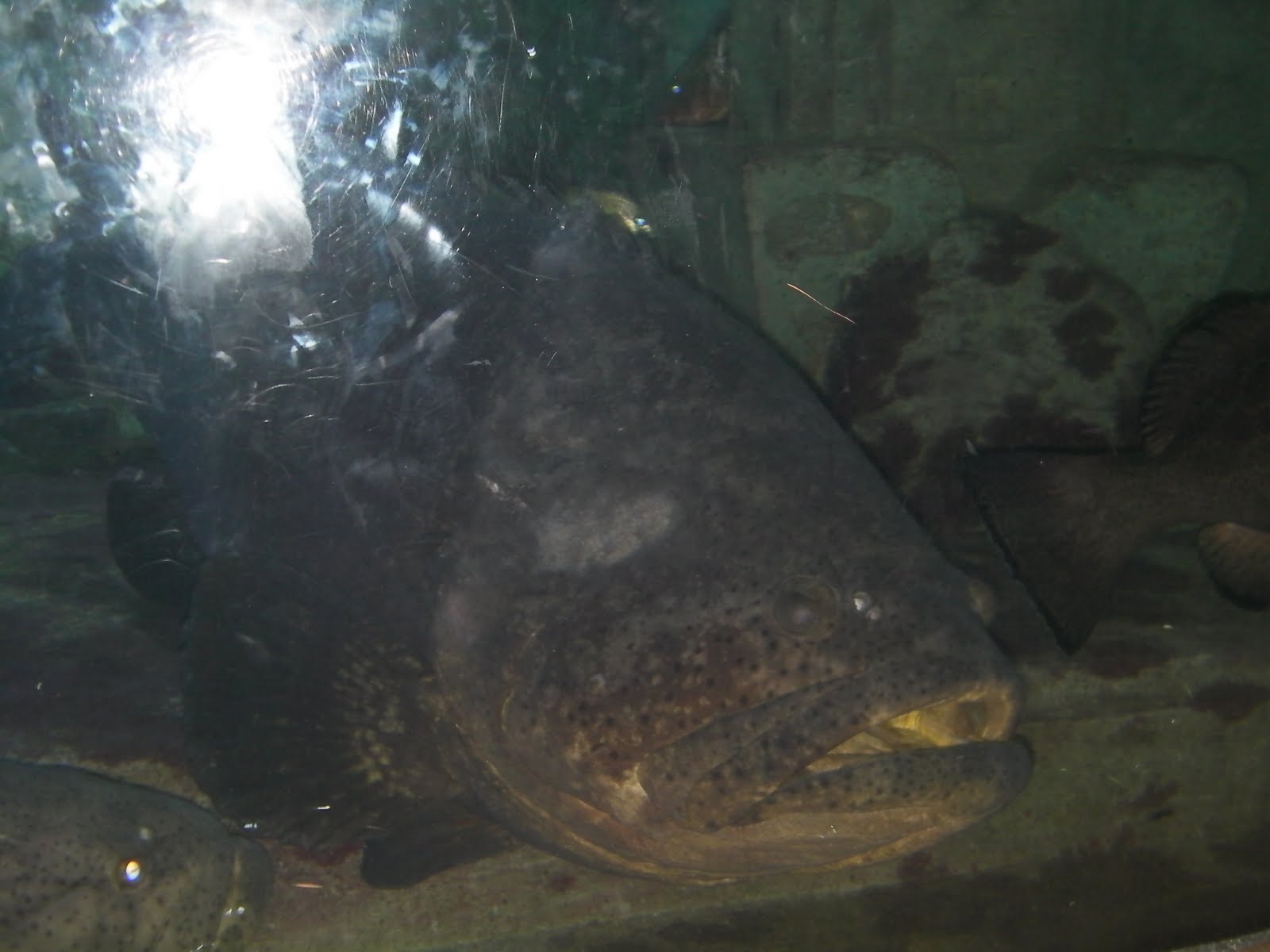
I swam by a resting Giant Grouper . . .

And took time out to wave to those looking into the tank through the windows.

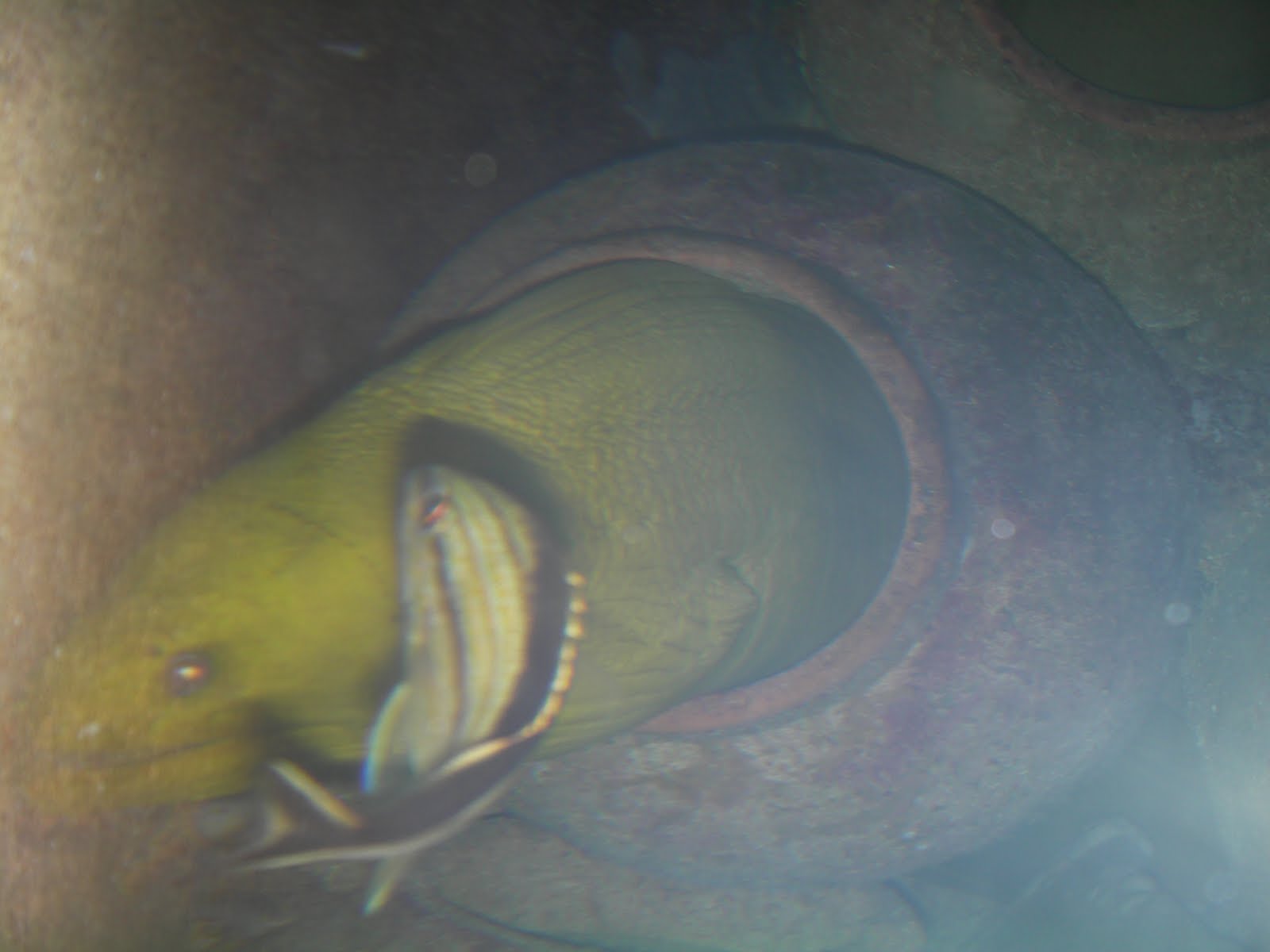
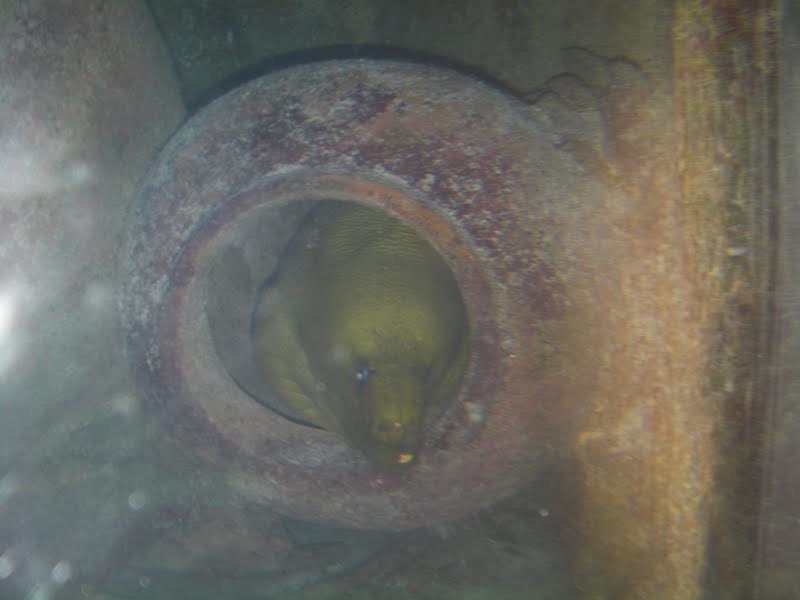
This eel had the good grace to stay in his hidey-hole and not scare the life out of me.

So ended our snorkeling adventure. One of the women in our group approached me as I dried off  and said, “Oh. My. God. I couldn’t believe how close that Ray got to you!” I didn’t think anyone else had noticed my close call, but apparently they had. Actually, the encounter with the Ray was nothing as compared to having to listen to that girl scream at the top of her lungs for an hour. My ears are still ringing. All of this begs the question, “If you’re that scared of fish, why go snorkeling?”