The History of Greys Court by Jo Manning – Part Two

The early 18th century wing of the house has splendid, detailed plasterwork dated from 1760; the kitchen, modernized to the mid-20th century, is spacious and cheerful. One can imagine the last owner, Lady Brunner, whipping up trifle and Yorkshire puds. There is nothing at all pretentious about it.

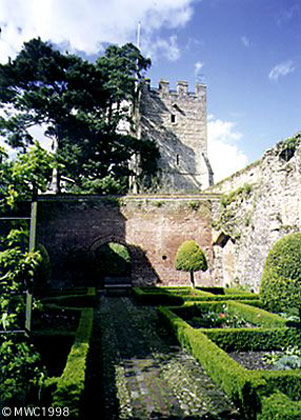
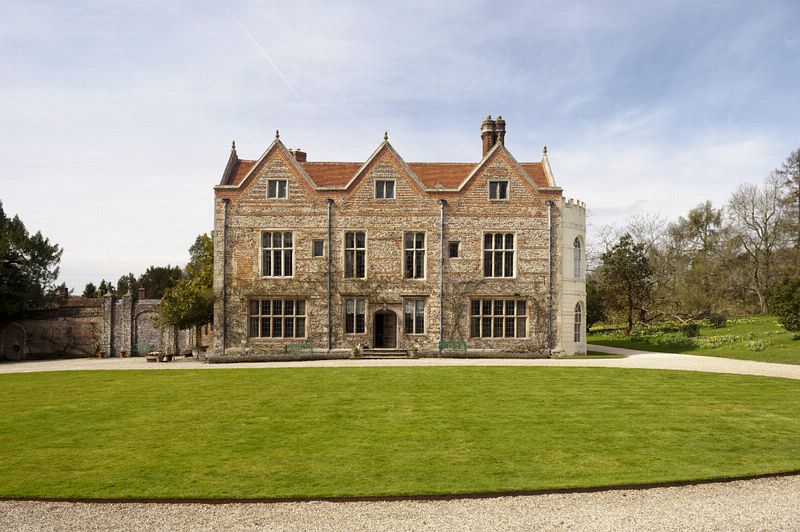
The house is situated in the western part of the de Greys’ medieval courtyard, facing the Great Tower — built and crenellated so long ago by John de Grey upon his return from war in France.  The 12th-century, the 14th, Tudor, Elizabethan, and Jacobean times, sit side by side, an abundant and unique richness for the eye.
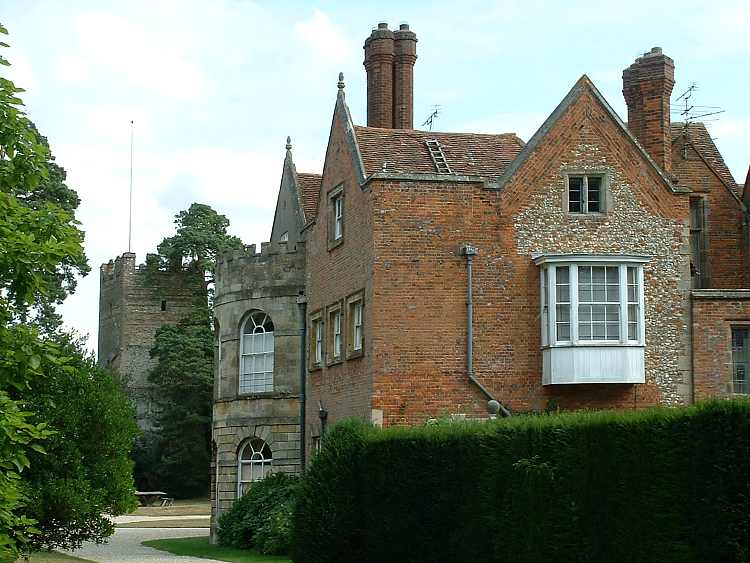
copyright Peter Goodearl

I like this photo because it shows the 14th century Great Tower, the 16th century (Jacobean) house, and the bits of old stone (the lighter colored ones) from the medieval walls used in the construction of the newer house

In 1937, Sir Felix and the afore-mentioned Lady Brunner brought Greys Court, creating the many contemporary fine gardens and walks and bringing a very different kind of lifestyle to the Medieval/Jacobean history of Greys Court and its environs.  For a very brief period, the property had been held by Lady Evelyn Fleming, mother of the travel writer Peter Fleming and his perhaps more famous brother Ian, author of the James Bond spy novels. Lady Fleming’s tenure was marked by “improvements” to the property that were quickly reversed by the new owners, the Brunners, whose taste – thank goodness! — was quite different.  The family that was to make Greys Court its home for over 65 years was not from an ancient and titled background, but rather a newer Victorian-created title…and the theatrical world. Thus began a whole new chapter in the fabulous history of Greys Court.

Elizabeth, Lady Brunner (see her obituary, January 28th, 2003, in The Telegraph  was born Dorothea Elizabeth Irving, the daughter of H.B. Irving and Dorothea Baird, both of whom were actors.  (Her mother created the parts of Trilby in George du Maurier’s play of that name, and Mrs. Darling in Peter Pan.) Her grandfather was the famous actor-manager Sir Henry Irving, whose original family name was Brodribb. It was no surprise when she, too, trod the boards, making her stage debut at the age of 12.  Her credits as an adult were to include Titania in A Midsummer Night’s Dream, in Trilby, like her mother, and a role in a silent film version of Charlotte Bronte’s novel, Shirley.

She married Sir Felix Brunner, a baronet, in 1926 and gave up her acting career.  Her husband’s family was of Swiss descent; his great-great grandfather, a Protestant minister, had emigrated to Liverpool in 1832.  Sir Felix and Lady Brunner had five sons, who grew up at Greys Court.  The family donated the property to the National Trust in 1969 and the elder Brunners lived there for the rest of their lives.  As I said above, it is homey, not luxurious, and although filled with wonderful theatrical memorabilia (including a cast of Sir Henry Irving’s hands) and an extensive library of novels and plays amongst other volumes, one can imagine a young and growing family living there. The bedrooms and bathrooms are rather modest.
A fey touch is a wooden statue in honor of the Brunners’ head gardener that is quite amazing to venture upon!  There is nothing the least bit stuffy about Greys Court, which is probably why, on the day we went, there were so many young families milling about.  And, yes, the Tea Room is lovely, and the giftshop is full of plants, seeds, garden implements and other items for the garden, as befits the nature of Greys Court.

A brief postscript to our visit….

We stopped at Henley-upon-Thames before continuing to Greys Court, where we bought a stuffed toy at Asquith’s at 2-4 New Street for my youngest grandchild, 5-year-old Lily.  Click here to see this charming shop for yourselves.  She chose – amongst hundreds of teddy bears! – a sweet and rather realistic looking hare. Now, note the sign below about Red Kites:
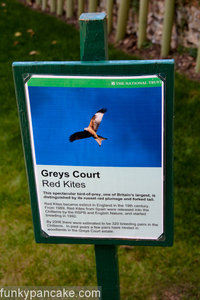
They are very much in evidence at Greys Court, these handsome once-extinct-in-England birds of prey, circling, in particular, the area above the car park where visitors go to have their picnics.  We suddenly noticed that one bird seemed to be swooping lower and lower, its beady eyes on the little hare from Asquith’s!  Hurriedly, not wanting the hare to become kite food, we stuffed it into the picnic hamper, and not a minute too soon J It would have been rather a sight, and not at all a happy one, for Lily to see her hare picked up for lunch! (It was quite a realistic-looking little hare!)
For opening times at Greys Court, et cetera, click here.

The History of Greys Court by Jo Manning

GREYS COURT, AN UNUSUALLY BEAUTIFUL NATIONAL TRUST SITE NEAR HENLEY-UPON-THAMES
On my latest visit to London this past spring, my daughter suggested that we go to Greys Court, a National Trust house she’d been curious about but had never visited.  The original buildings on the site dated from before the 12th-century and there was a famous garden; it was in the foothills of the Chilterns, outside of Henley-on-Thames (where I’d never been) and we could explore that town as well.  We’d picnic on the extensive grassy grounds overlooking the house and have tea later in the Tea Room located in the Cromwellian Stables.
(Yes, I know, looking at the photo above – that is certainly not a medieval building! – but the rest of the surrounding buildings – erected over at least 600 years — are decidedly from the early medieval period and these very well evoke for the visitor those days of yore.)
This site is mentioned in the 11th century Domesday Book as Redrefield (Rotherfield). The owners were the de Grey family, barons who fought with their kings at Crecy, Bosworth, in the Scottish wars, and in the Hundred Years War with France.  The most famous of the de Greys was John de Grey, a professional soldier who became one of the original Knights of the Garter. After the Battle of Crecy 1346 he was given a license to crenellate Rotherfield, i.e., fortifying it by providing the walls with battlements.
Upon the death of his grand-daughter, Alice, in 1455, the lands passed to the crown. Henry VII awarded it first to his uncle, Jasper Tudor, then, in 1514, Robert Knollys received the property “for the annual rent of a Red Rose at Midsummer”.  Robert Knollys’ son, Francis Knollys, a good friend of King Henry VIII, became the next owner of these lands. (His wife was first cousin to Queen Elizabeth I through her mother’s family, the Boleyns.)
A view from the Knot Garden up to the Great Tower
Francis Knollys was a firm and committed Protestant and a lifelong confidante to his queen. He was treasurer of the royal household for almost 25 years and also oversaw Mary, Queen of Scots, in her captivity.  He died in 1596.The tombs of the Knollys family are alongside those of the de Greys in Rotherfield Greys Church.
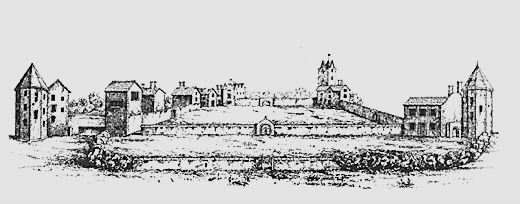
Greys Court c1600 copyright National Trust

Francis Knollys was responsible for the original structure that is the present house, which is basically a handsome Jacobean structure; some additions to the house were carried on by his son, William, who became Earl of Banbury in 1626.  (One of the delightful Tudor additions is a donkey wheelhouse with a 200 foot well! Odds are that this is something few visitors – and I include myself – have never seen the likes of before J It’s amazing.)
After being passed on to several other members of the Knollys family, it was sold to William Paul, whose daughter married the Baronet William Stapleton in 1724.  Greys Court remained in the Stapleton family for over 200 years before being sold in 1935.
Under the ownership of the Stapletons, the property was made up of some 8,000 acres of woodland, parkland, and farmland.  They incorporated stone from the several medieval buildings on site to further enlarge the house, but today the entire estate comprises only 300 acres, a far cry from the original expansive holdings.

Those marvelous wisteria trellises, with bluebells beneath

What sets Greys Court apart from other stately homes is that it is not a very large house.  It strikes one as a house in which one could live an almost-normal family life.  It is homey, and the gardens add much to its charm, set as they are amongst medieval ruins such as the Great Tower and the picturesque crumbling walls.

The gardens are rife with rambling, oh-so-fragrant old-fashioned roses and those old walls are draped with wisteria. (The wisteria is also trained over a stunning number of trellises, making quite a beautiful sight.) There’s a clean, clear pond nestled near the Great Tower in which all sorts of tiny swimming wildlife like newts and tadpoles can be seen and enjoyed. Children particularly enjoy the tower and the pond and threading their way through a modern garden maze (commissioned in 1981 in honor of Archbishop Runcie), and under the wisteria trellises. There’s a 19th century icehouse and the faint foundations of medieval gatehouses and other long-gone walls can be seen traced on the earth.

Part Two tomorrow!

Travels with Victoria: Trooping the Colour 2011

Trooping the Colour is held each June in celebration of the Queen’s birthday (her actual birthday is April 21) and is a well-loved pageant.  On Saturday, June 11, 2011, I could not resist going to the Mall to watch the procession of troops, bands, cavalry and royal carriages from Buckingham Palace to Horse Guards and back.

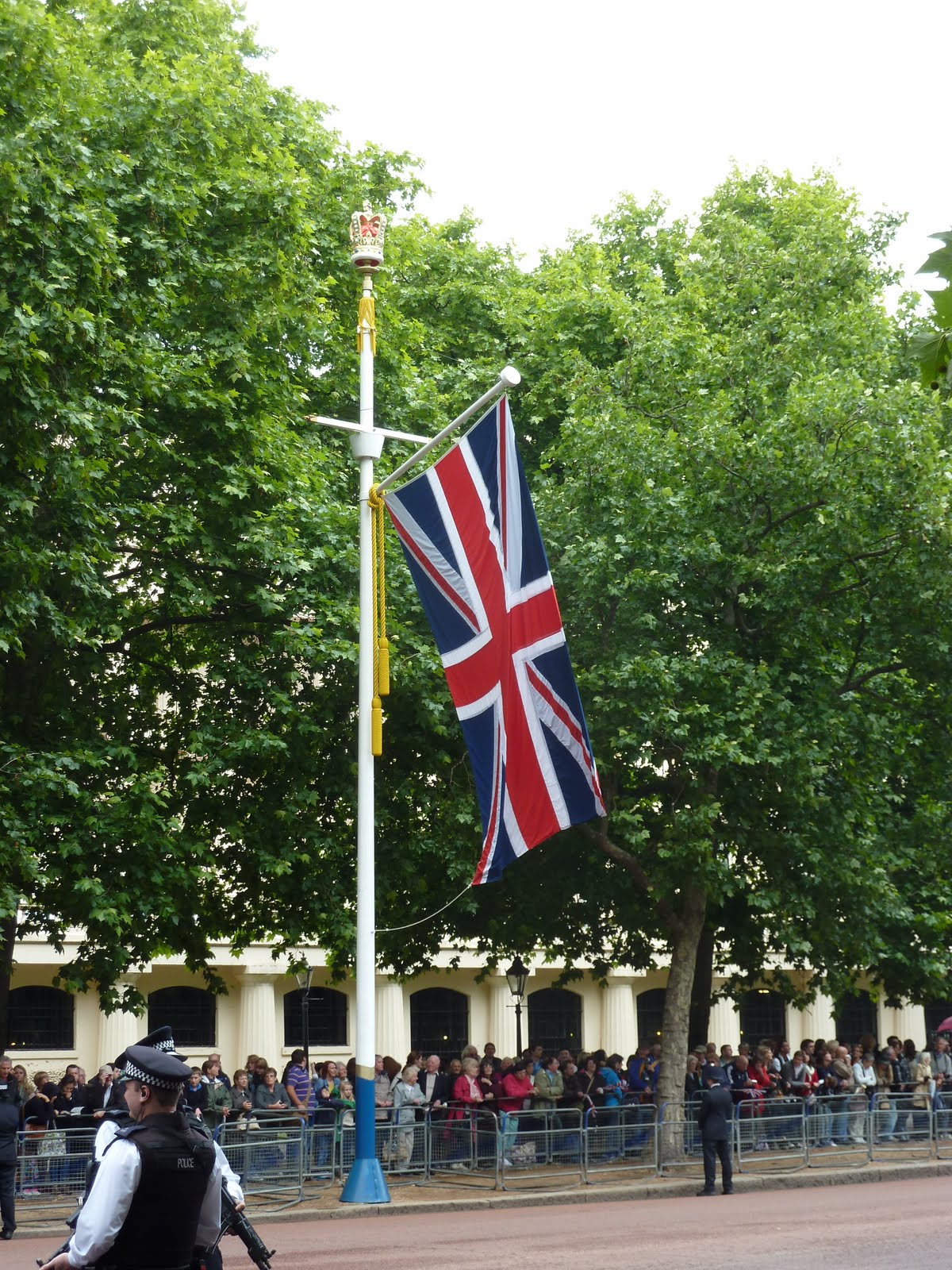
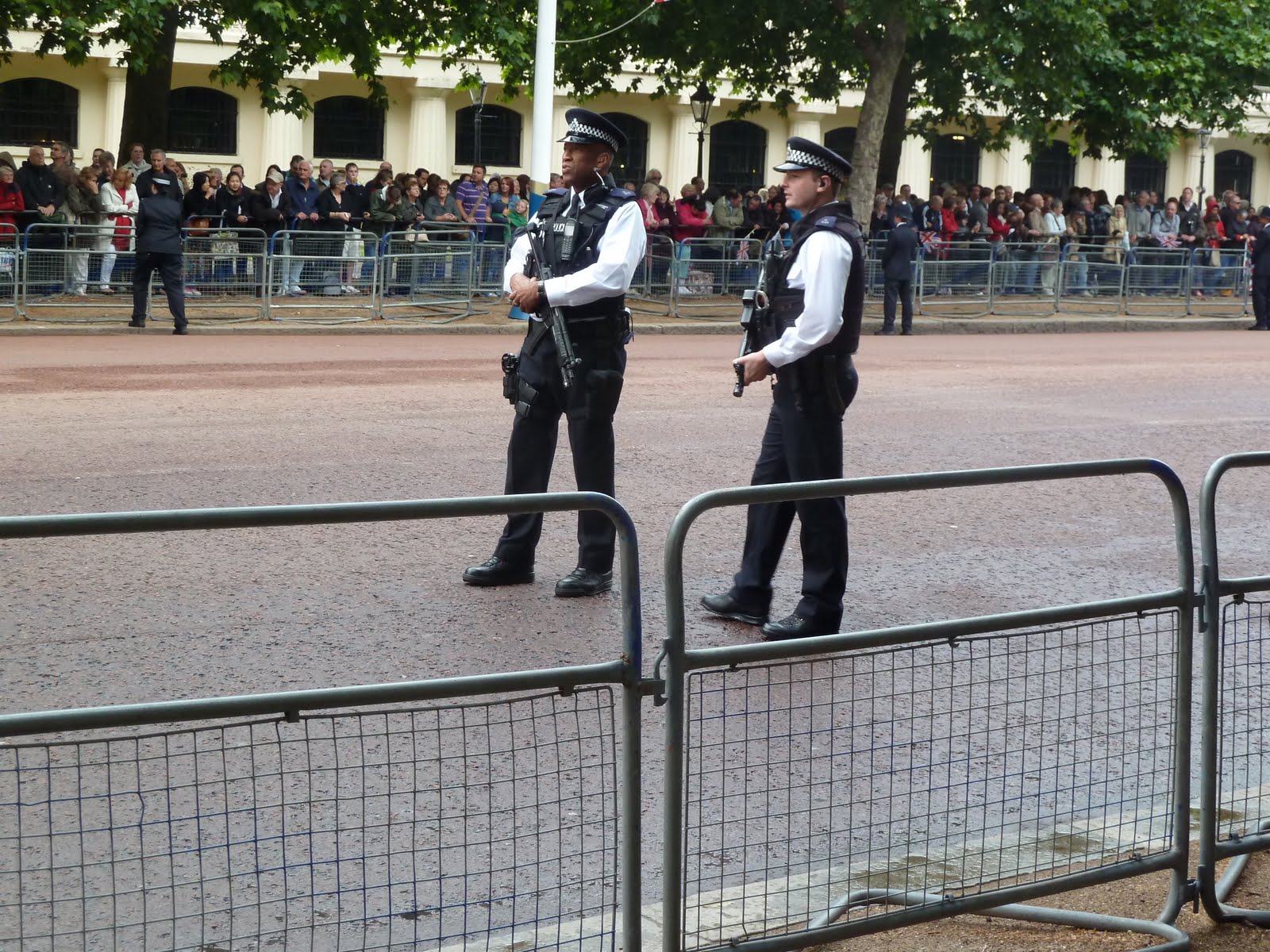
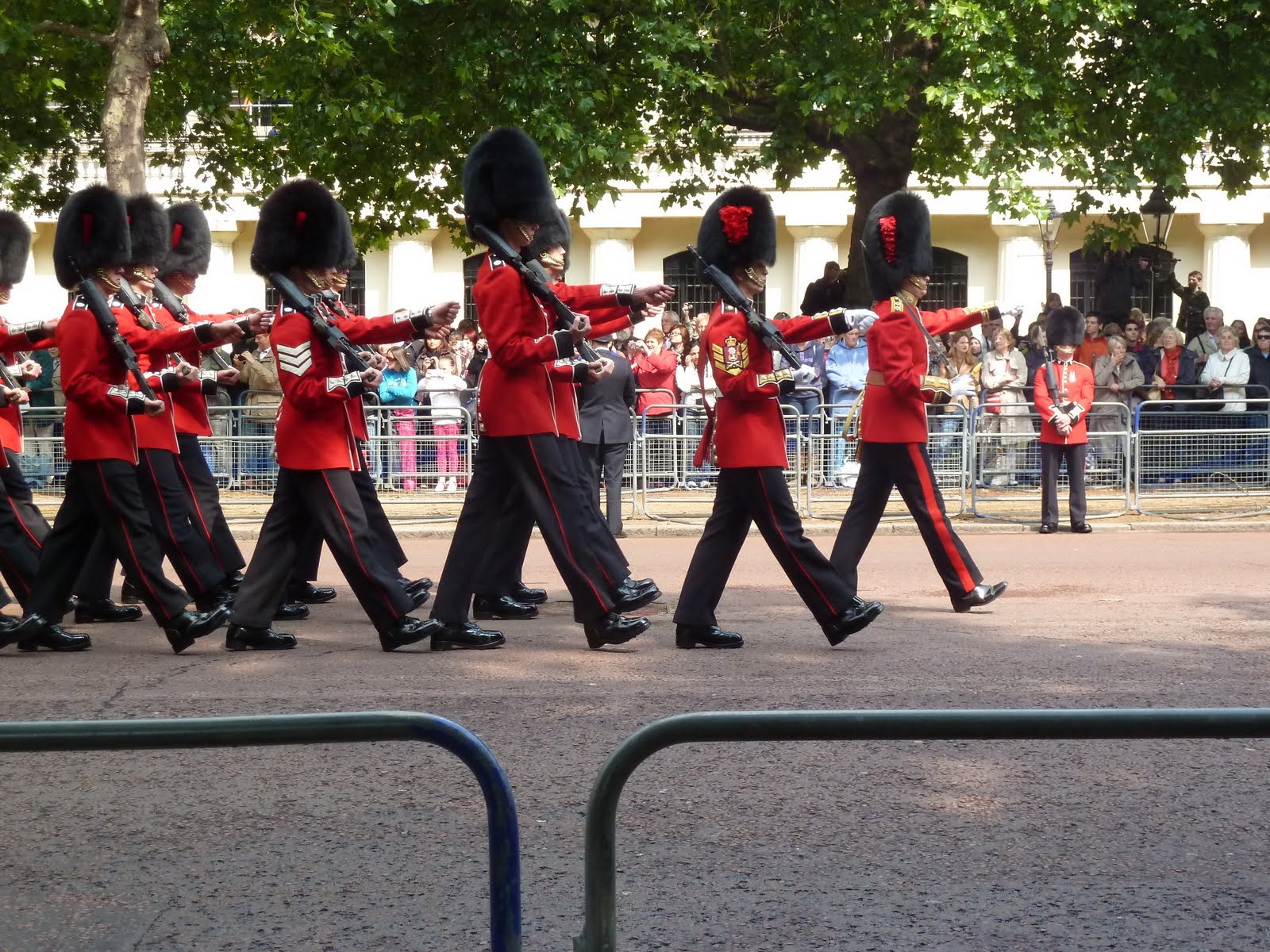
First to patrol the processional route were the police who stood every few yards with their automatic machine guns near the red-coated guards.  The difference is that the soldiers, in their bearskin hats, had to remain at attention, or parade rest, while the police were far more casual.

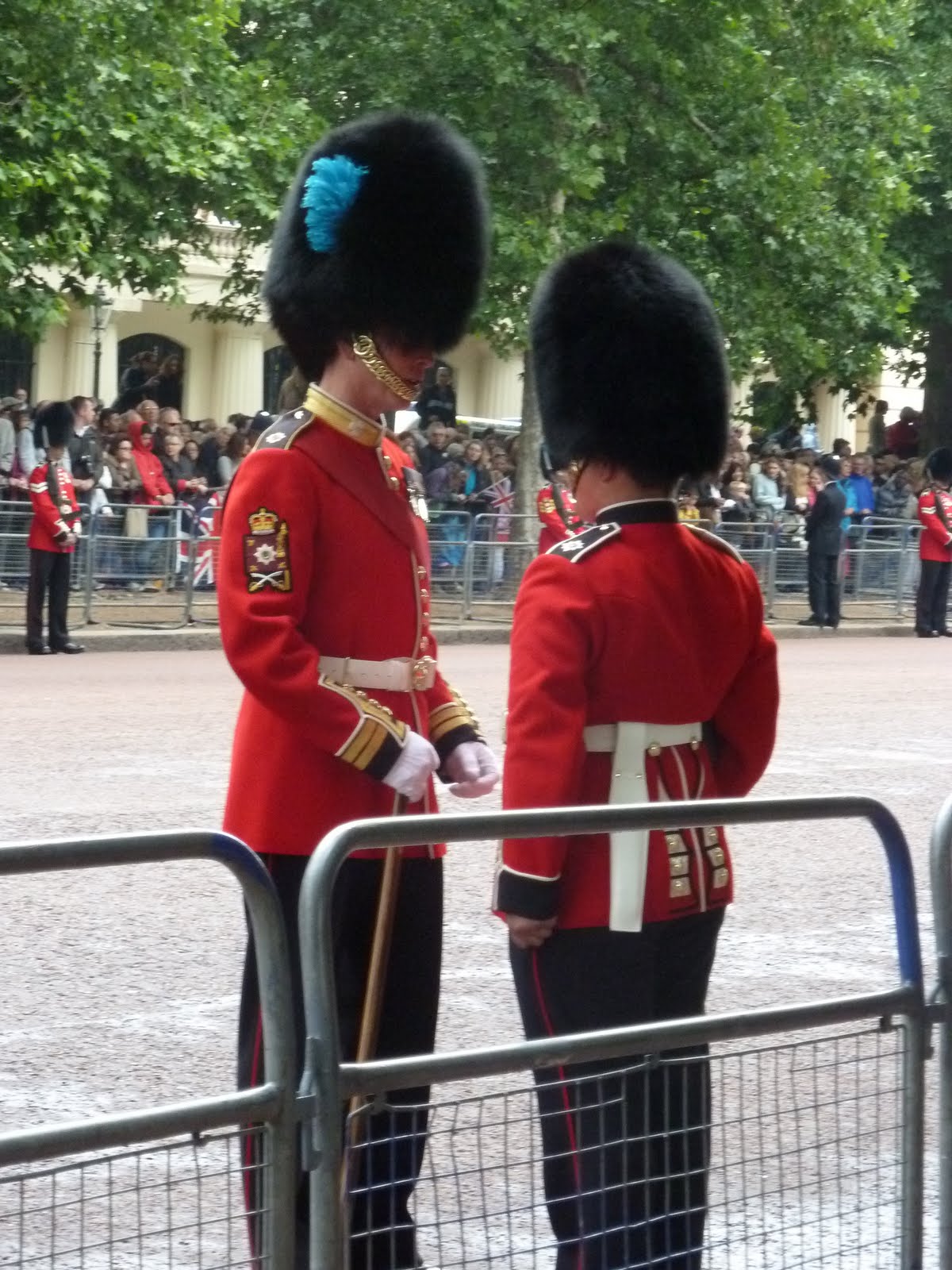
Inspection
Keeping an eye out for trouble
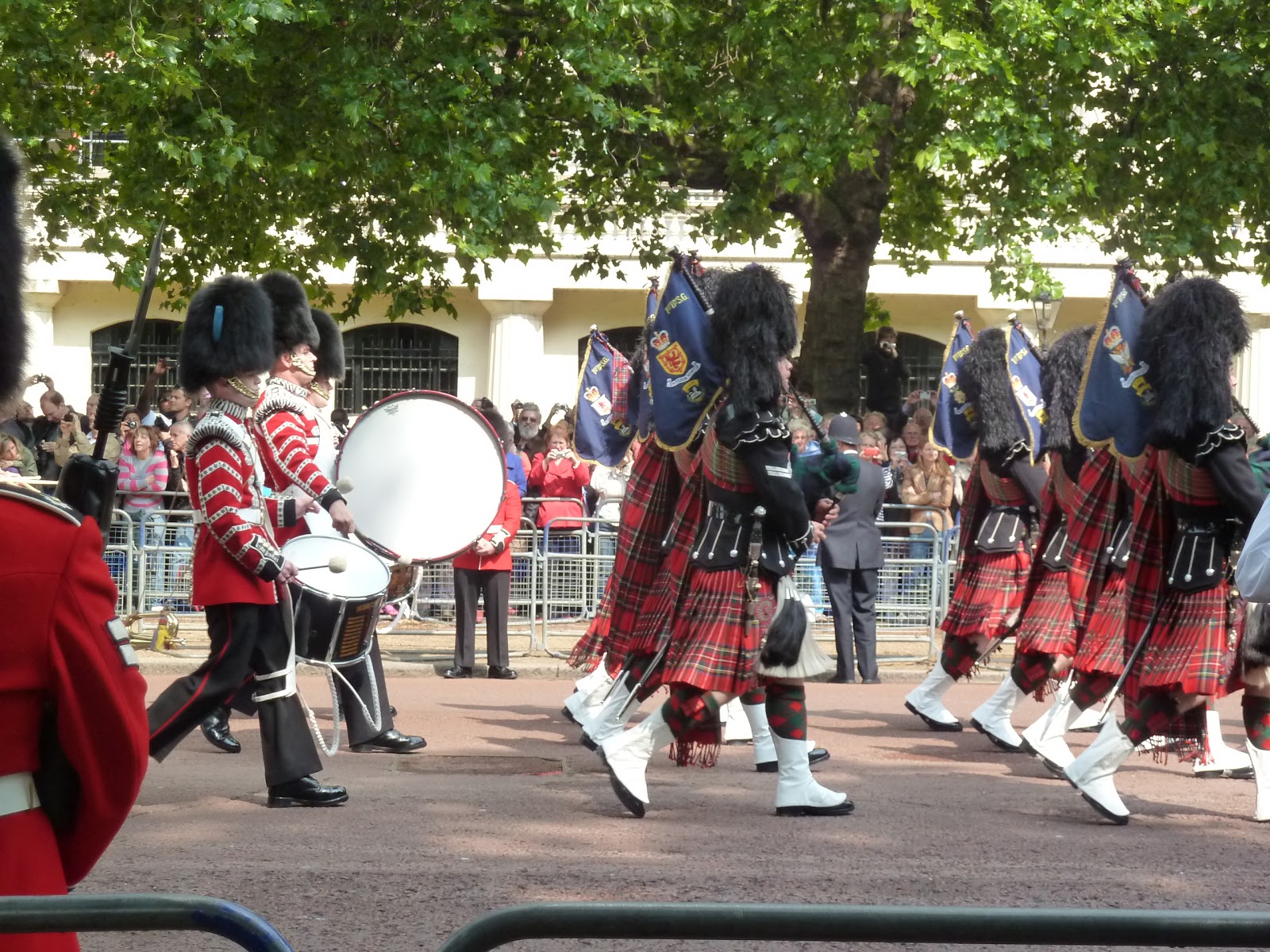
Today’s ceremony Trooping the Colour has evolved from the ancient practice of assembling the soldiers before the battle and displaying the flag around which they are to rally in the midst of noise, confusion, smoke, flying shot and cannonballs in the battlefield. Each Trooping of the Colour displays for the Queen and assembled guests, as well as the massed military, a particular flag. On June 11, 2011, the colour trooped was the battle flag of the 1st Battalion Scots Guards.

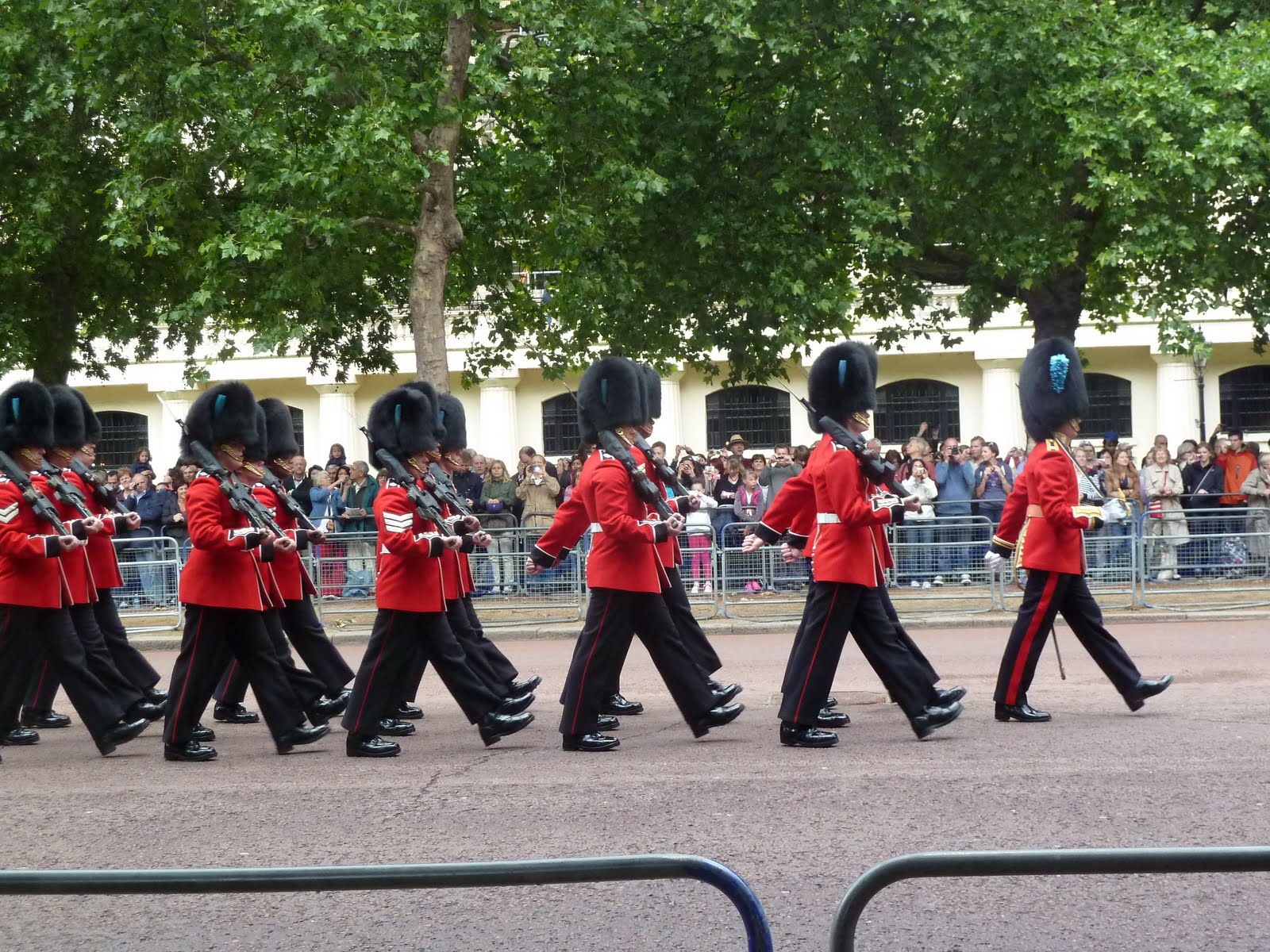
Leading the march down the Mall were the Irish Guards, here with their Irish Wolfhound mascot ahead of the troops.
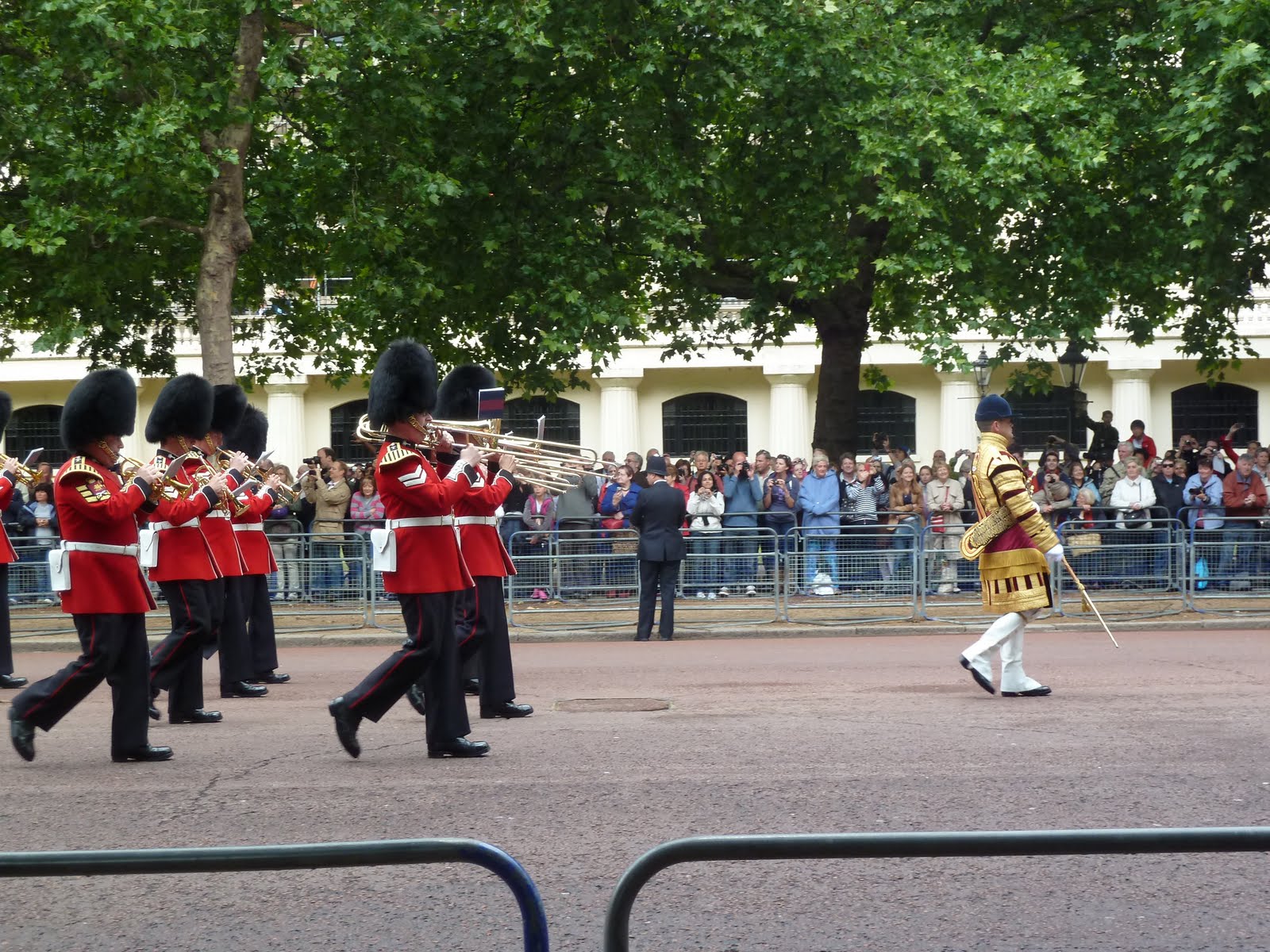
First of many bands.

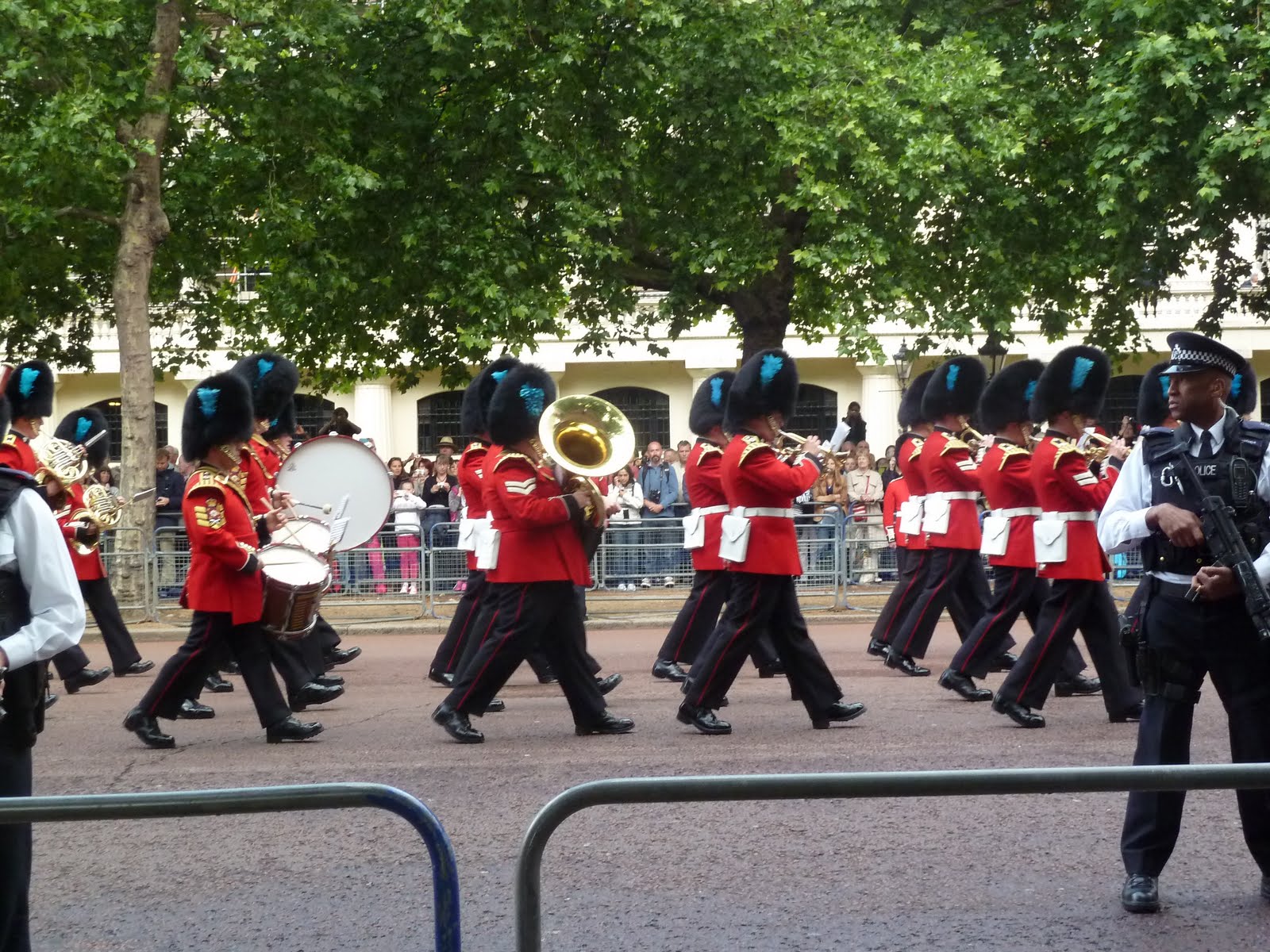
The Irish Guards can be identified by the blue plumes on their hats and by the arrangement of buttons on their tunics.

Band of the Irish Guards


The Coldstream Guards

Band of the Scots Guards
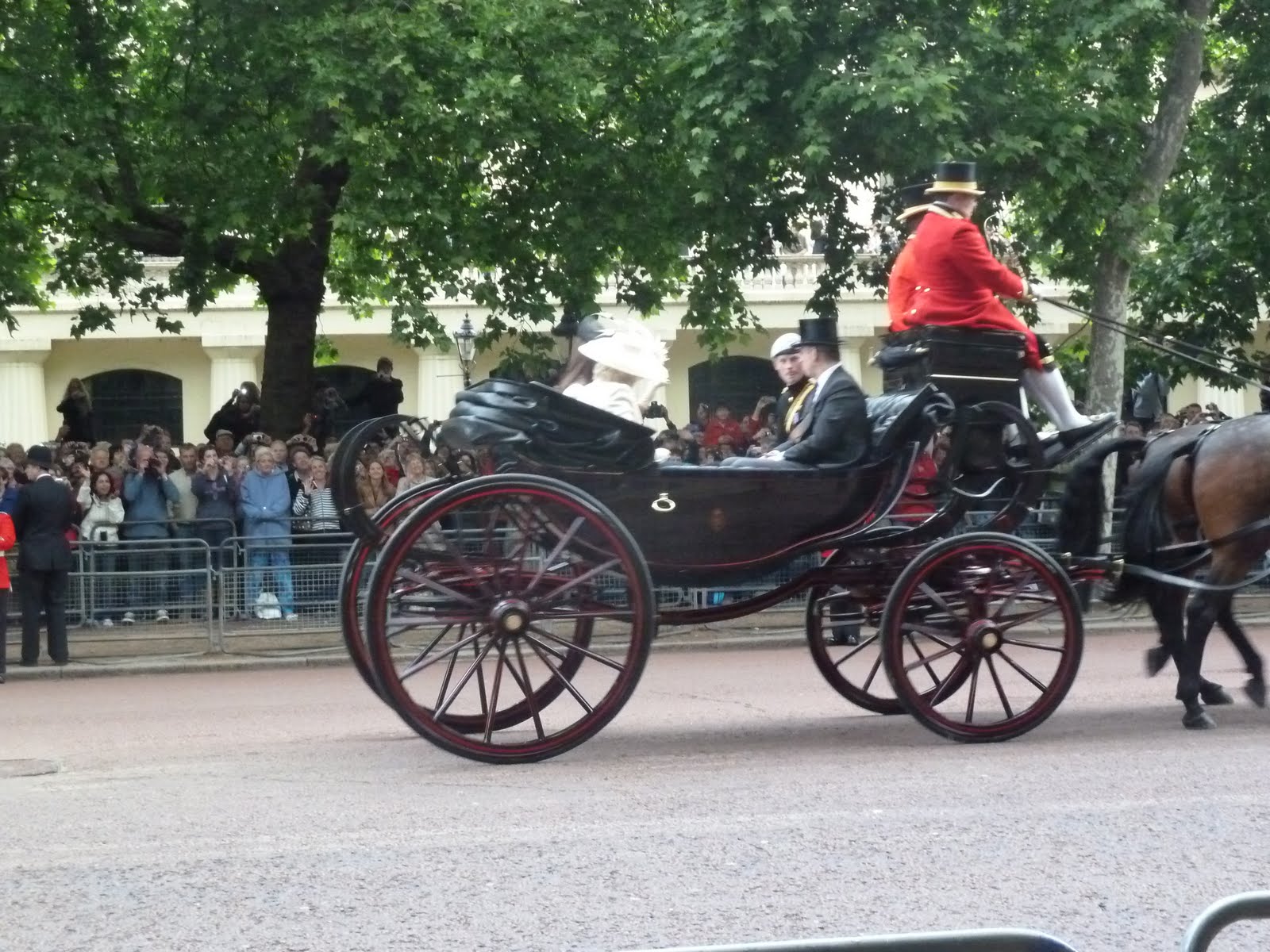
In this carriage: the Duchess of Cornwall in the big white hat, almost blocking the view of the
Duchess of Cambridge; across from them are Prince Harry, on the left and the Duke of York.
Above, a photo of the Duchess of Cambridge from the British Royals website.
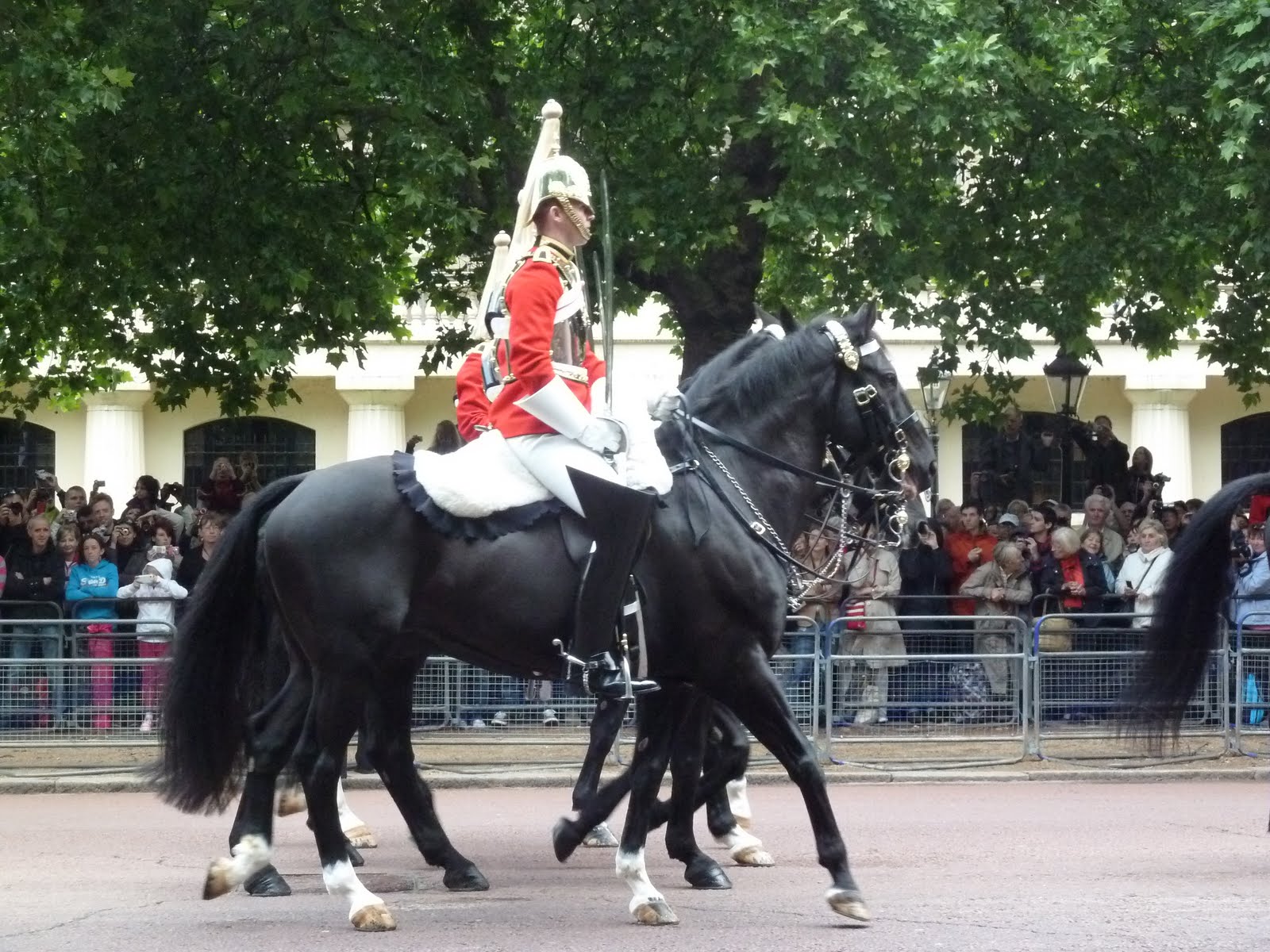
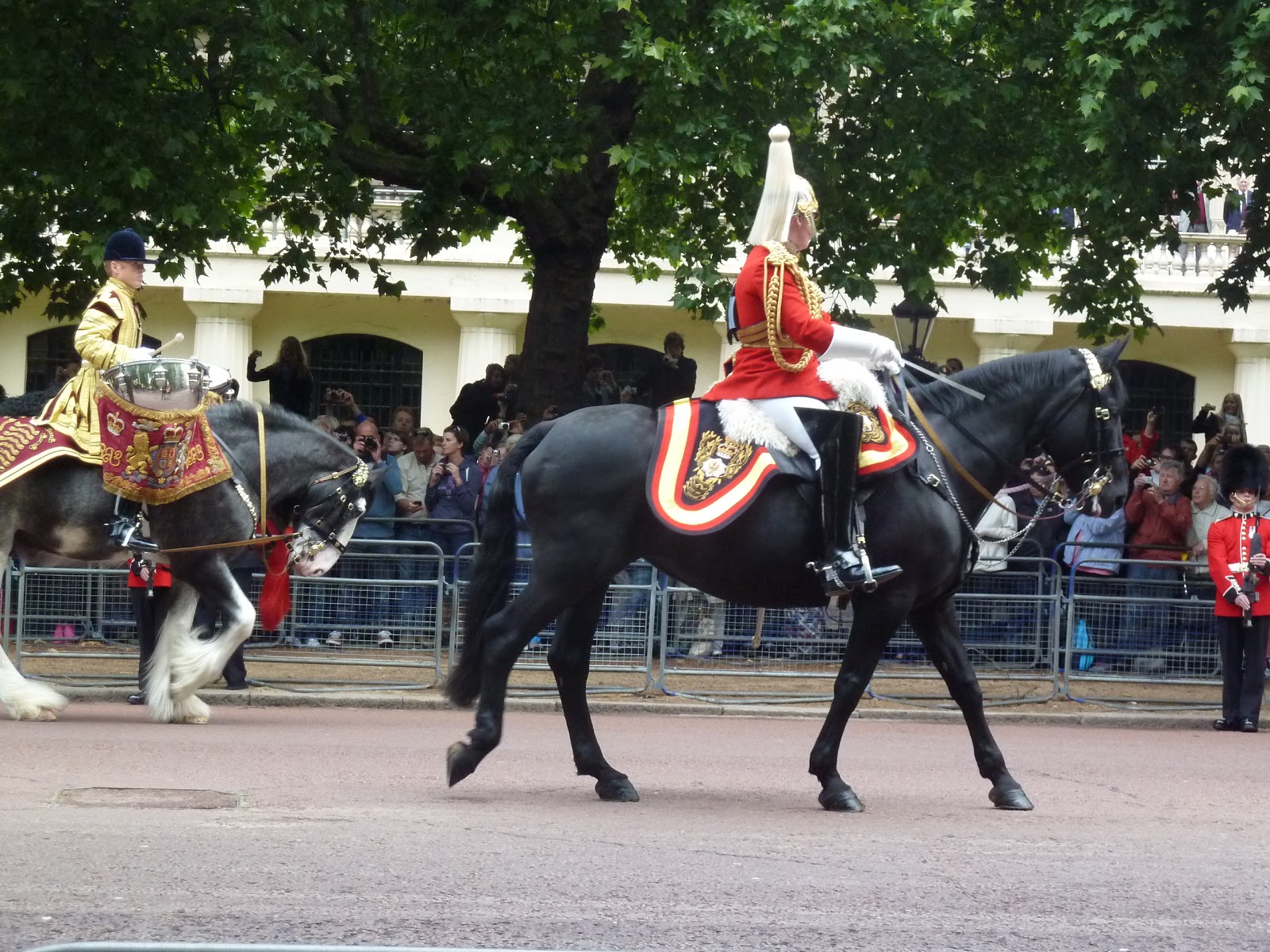
In addition to Foot Guards, the Household Cavalry was well represented; Above, members of the Life Guards.

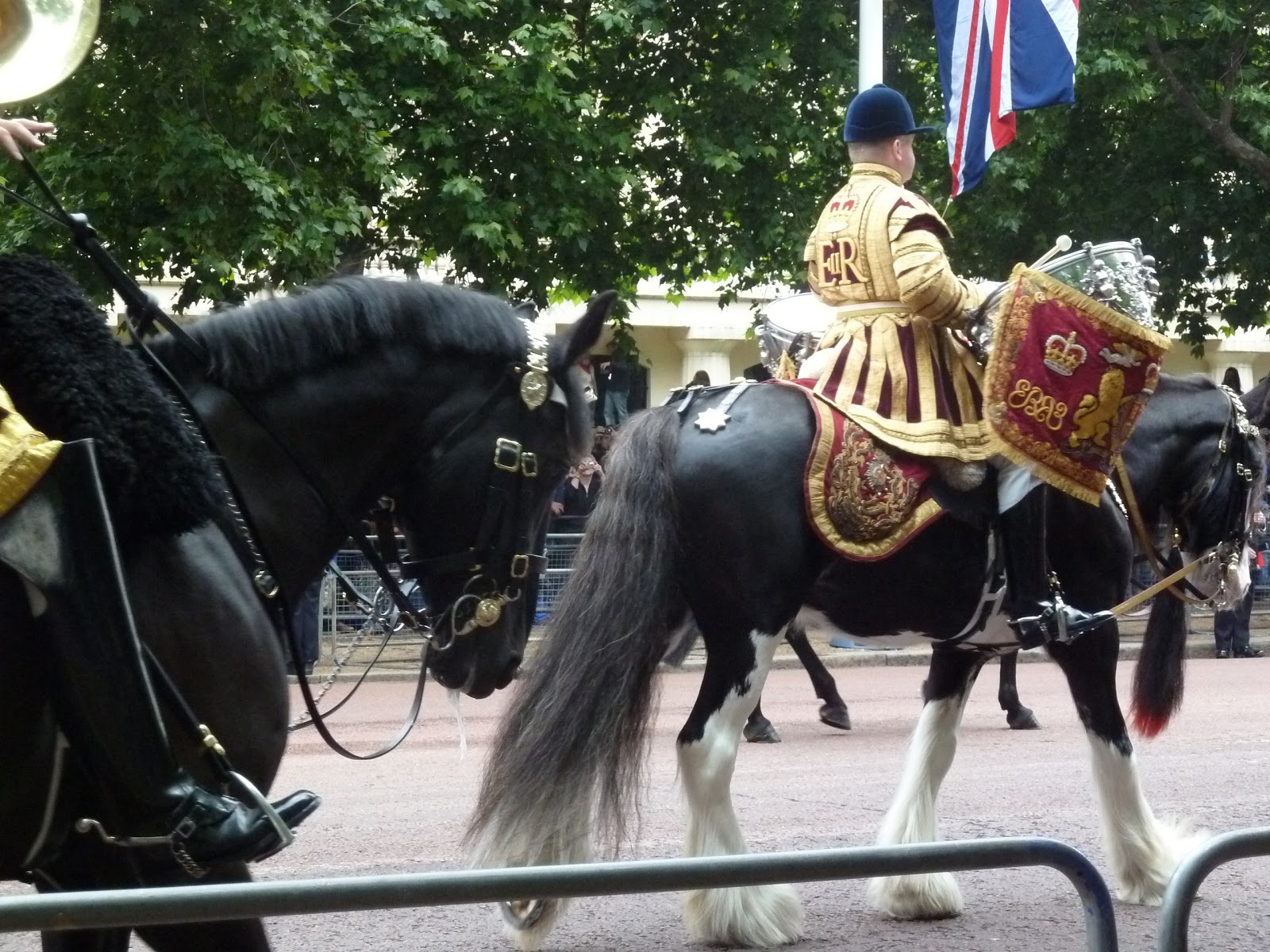
I love the drummers in the mounted bands; the horse’s reins are attached to the stirrups so the rider can beat the time. See also the photo below.

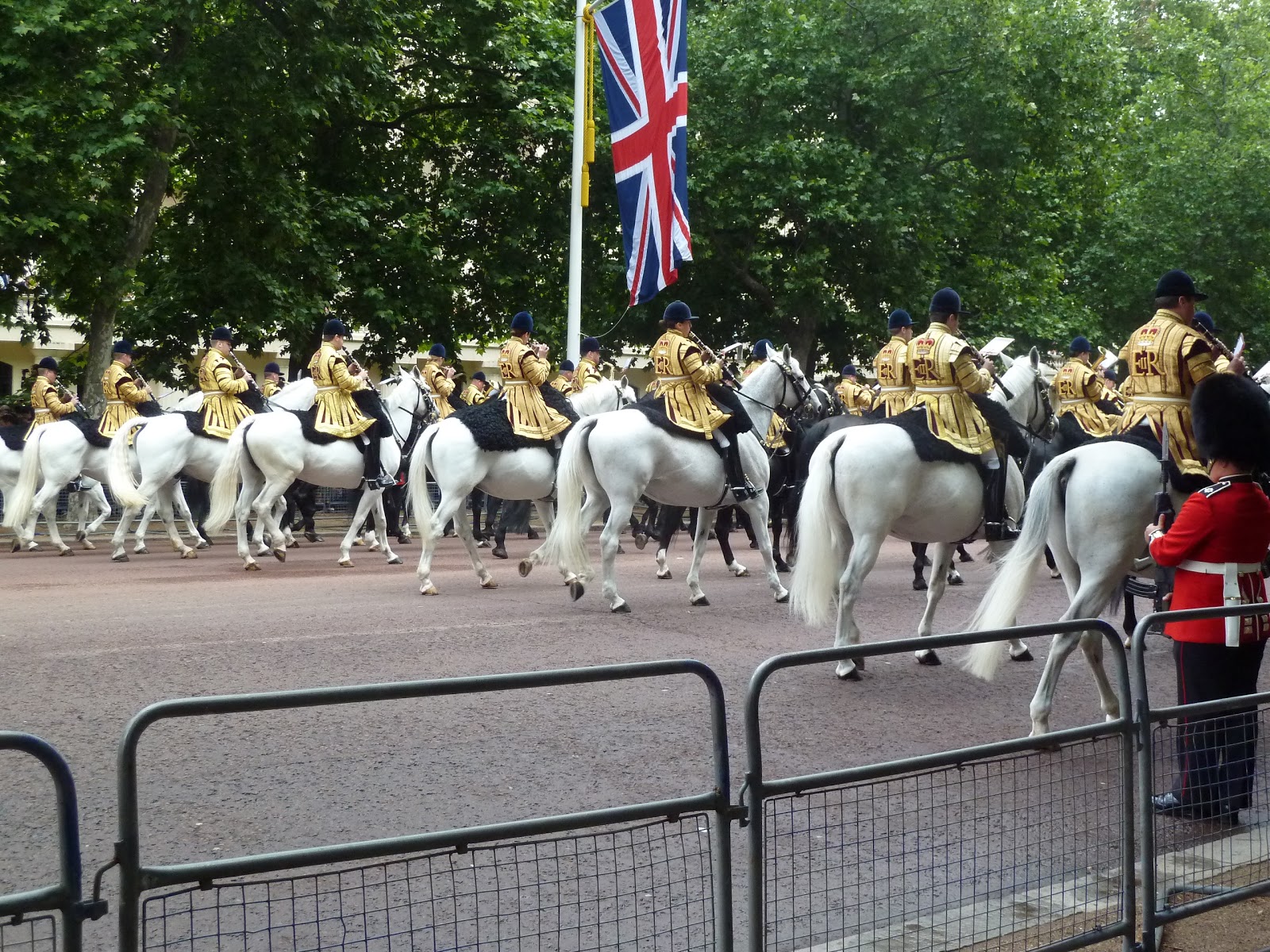
The mounted band of the Household Cavalry.

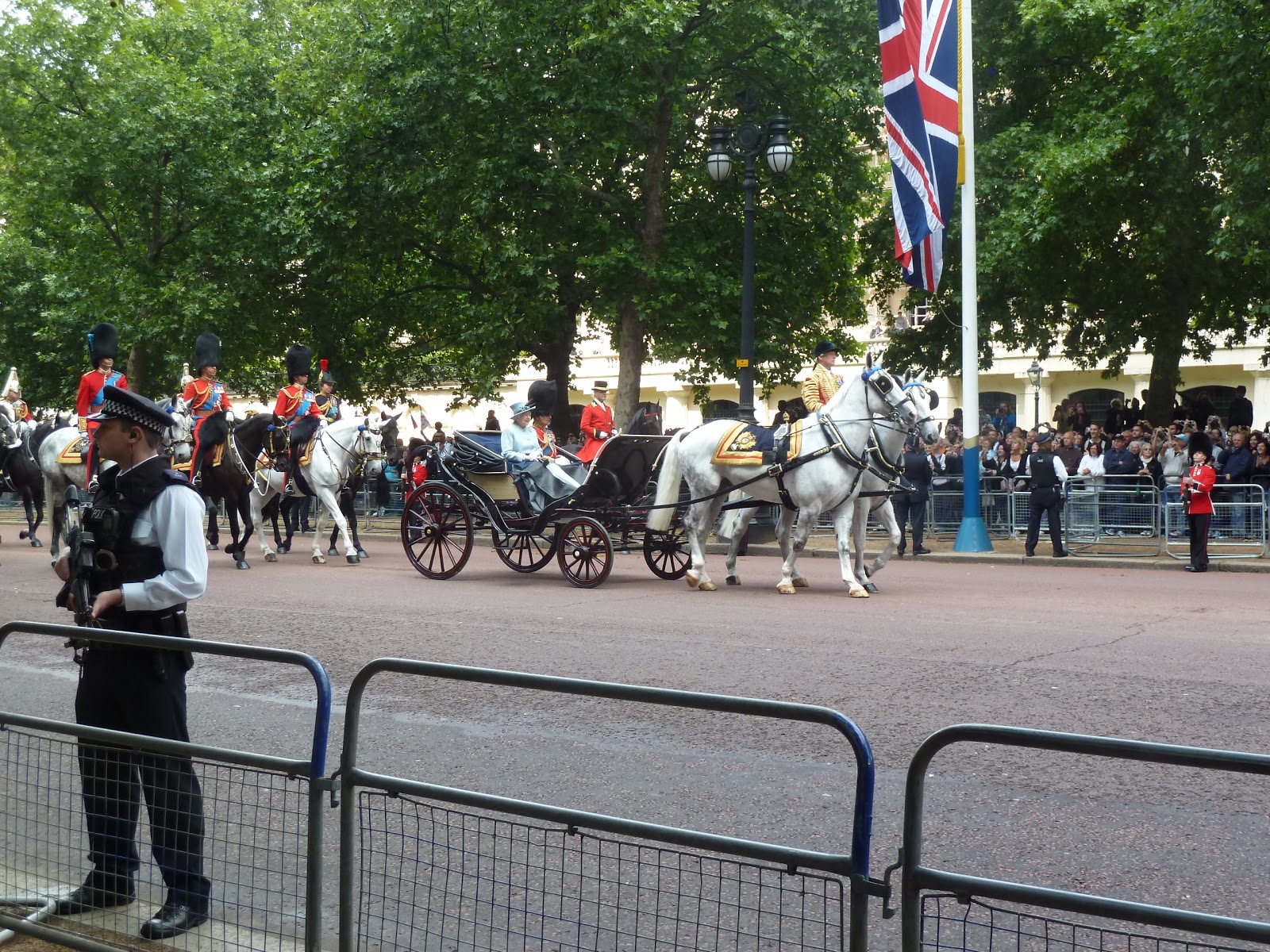
The Queen and Prince Philip, in his uniform as Colonel of the Grenadier Guards, ride in the carriage.

Behind the Queen’s Carriage are, l-r, Prince William, Duke of Cambridge, in the uniform of Colonel of the Irish Guards; Prince Charles, Colonel of  the Welsh guards; the Duke of Kent, Colonel of the Scots Guards; and Anne, Princess Royal, Colonel of the Household Cavalry’s Blues and Royals.

Here’s a closer shot of the Queen’s escort  from the Daily Mail.

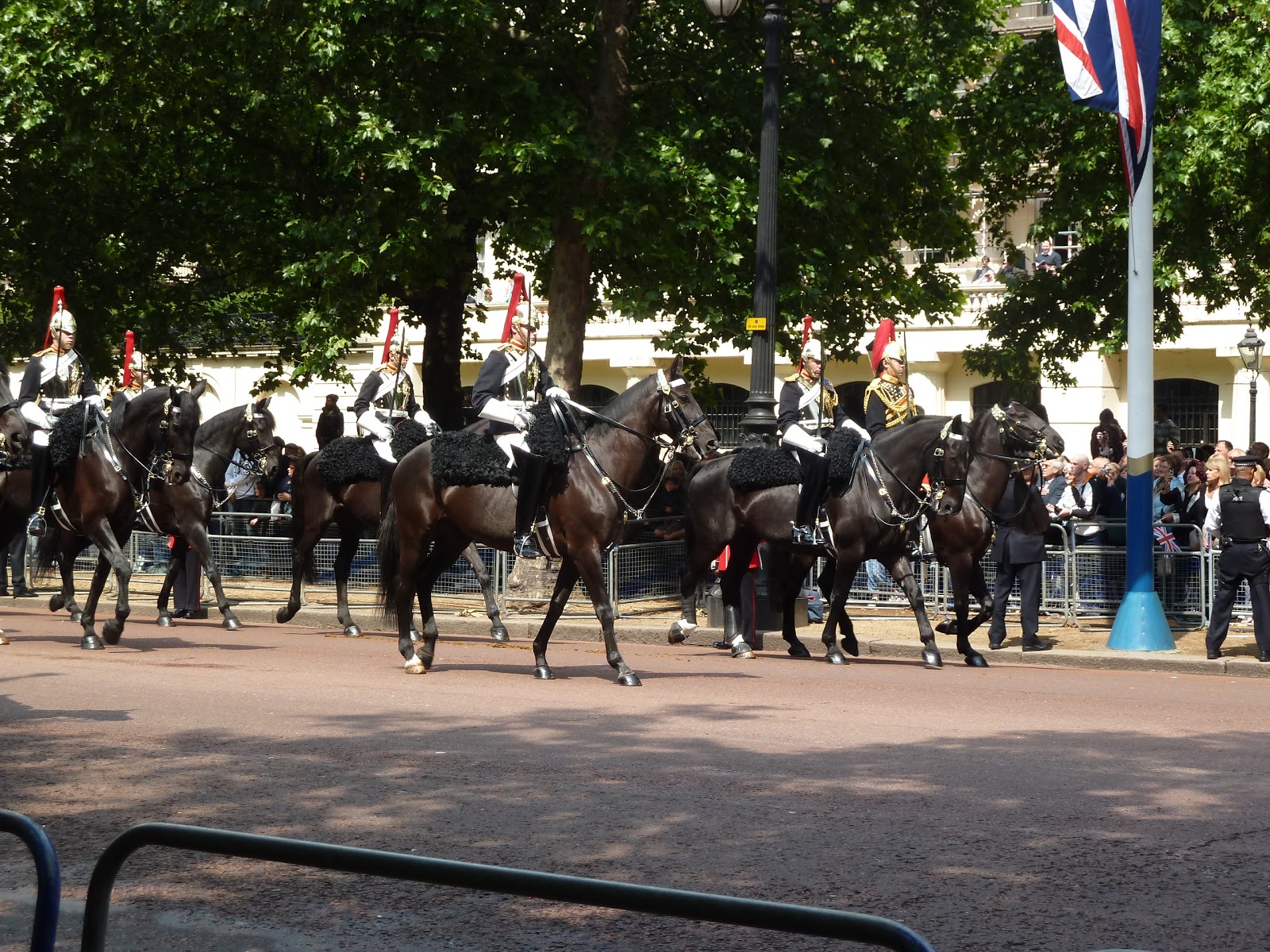
Finally, the Blues and Royals, in their blue tunics with red plumes, part of the Household Cavalry.

It was a magnificent parade; All the military and the Royals, along with hundreds of invited guests, were  massed at Horse Guards Parade where the ceremony went on for just over an hour.  While they were going through their paces, I left the crowd lining the Mall, most of whom were waiting for the return parade back to Buckingham Palace.  But —  not having a lot of Saturdays to spend in London — I decided not to wait but to explore further.  Next, Marlborough House.

Trembleuse Cups and Saucers

Copyright Worthopedia

Recently, I was watching the British version of Antiques Roadshow and saw an example of a Trembleuse cup and saucer being appraised. I had never heard of these items and it fascinated me. Which prompted me to think that they would, perhaps, fascinate you, too, so I decided to share a few of these gorgeous pieces.
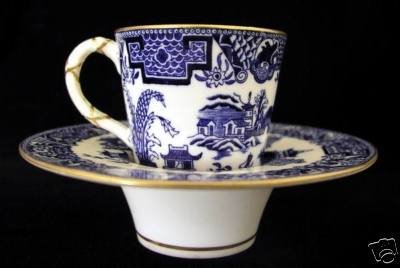
Trembleuse cups and saucers were specifically designed for a person who suffered from the trembles and were virtually “spillproof.” The example above was made by Royal Worcester and is marked with a date symbol for the year 1882. It is printed under the glaze in a beautiful rich blue and decorated with gold trim. The cup has a molded handle. Note both the deep inset of the saucer in which the cup firmly rests and the saucer’s very wide border, all of which was designed to avoid spilling of the hot liquid by a trembling hand.


Copyright J. Paul Getty Museum

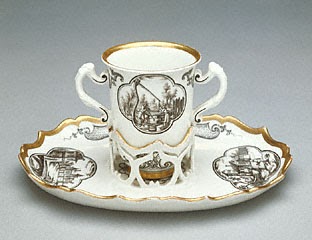
In the 1700s, this double-handled cup pictured above would probably have been used to serve coffee or hot chocolate. Following the Chinese and Japanese custom, Europeans in the 1700s usually drank tea from small handless bowls.

Cups made at the Du Paquier porcelain manufactory were tall, higher than they were wide, and could be unstable. For this reason, the factory developed a trembleuse (literally “trembling”) form, in which a raised ring or basket on the saucer held the cup in place and prevented spillage caused by a shaky hand.

Porcelain painters often imitated engravings with black enamel decoration known as schwarzlot; this decoration was typical of the Du Paquier factory.

Copyright the Victoria and Albert Collection


Circa 1775 Copyright The Lessing Photo Archive


Royal Worcester 1878 – Copyright Trocadero.com


19th century cranberry glass copyright Miller’s Antiques

It seems to me that a Trembleuse is exactly what poor Liz needed whenever she went for coffee at her neighbor, Hyacinth Bucket’s house! (That’s Bouquet) By the bye, the pair of cups and saucers on Antiques Roadshow were valued at five thousand pounds.