God Save the Queen(s)

In this Diamond Jubilee year, it’s perhaps fitting to reflect upon the reigns of both Queen Elizabeth II and Queen Victoria, England’s two longest reigning monarchs. To date, Queen Elizabeth has been on the throne for 60 years and still has a few years to go before breaking the regal record held by Queen Victoria for a reign of 63 years and 7 months (and 2 days).

Naturally, all monarchs begin their reigns upon the death of their predecessor.  
Queen Elizabeth, her grandmother, Queen Mary and her mother, Queen Elizabeth,  the Queen Mother at the funeral of Queen Elizabeth’s father, King George VI in February, 1952.
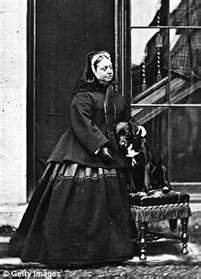
However, as is well known, Queen Victoria took her mourning upon the early death of her husband, Prince Albert, to a whole new level.
 The widowed Queen Victoria

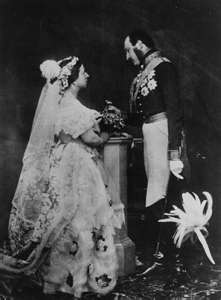
To back up a bit, Victoria and her cousin Albert were married on February 10th, 1840, at the royal chapel of St. James, in London.

 Queen Elizabeth and her cousin, Prince Philip, were married on November 20, 1947 in Westminster Abbey, London.

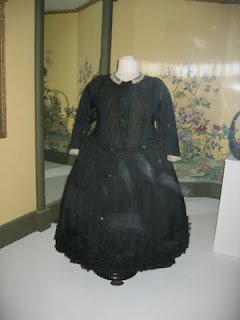
Queen Victoria’s uninterrupted mourning affected all aspects of her life, not the least of which was her fashion sense, as can be seen by the dress above, on display at the Costume Museum in Bath. Queen Victoria stood a mere five feet tall and, as the above dress will attest, seemingly enjoyed her food.

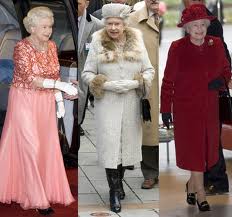
 In contrast, Queen Elizabeth stands at a comparatively statuesque 5′ 4″, eats a bit less and is known for wearing an often bright and always colourful wardrobe.

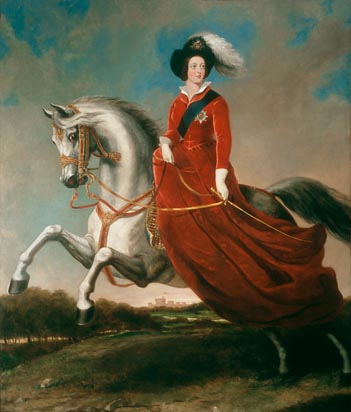
One thing that Queen Victoria and Queen Elizabeth have in common is their love for horses and horseback riding. Each began riding early in their lives and continued to ride as long as they were able. Queen Elizabeth is still in the saddle . . . . . 

Queen Victoria’s Diamond Jubilee was marked by many celebrations, including, on 22 June 1897, a progress to St Paul’s Cathedral, where a short service of thanksgiving was held outside the building, as the Queen was too lame to manage the steps. Thankfully, Queen Elizabeth is in fine health and a host of Jubilee celebrations will be held throughout the land over the coming months.

The Queen’s 80th birthday portrait, taken in February 2006

Queen Victoria’s Diamond Jubilee Photo

Queen Elizabeth II’s Official Diamond Jubilee Portrait

Dark Shadows

Anyone of a certain age will recall coming home after school in time to watch Dark Shadows on the telly, which spoke to our generation in a way our mother’s soap operas could not. Many of us were Barnabas Collins fans, including Johnny Depp, who fought for years to bring the story to the big screen. “I do remember, very vividly, practically sprinting home from school in the afternoon to see Jonathan Frid play Barnabas Collins,” the actor says. “Even then, at that age, I knew — this has got to be weird.”

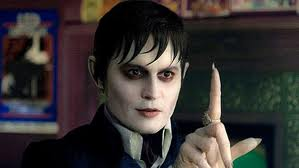
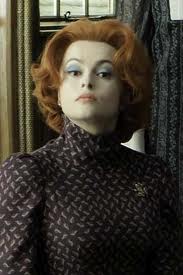
How appropo, as these days anything starring Johnny Depp has typically got to be a tad weird. And directed by Tim Burton, as this film is. And to co-star Helena Bonham Carter, which this film does. She plays Dr. Julia Hoffman. See below. And to feature Depp in wacky make up. Done. See above. And below, in the first photo of Depp as Tonto in the new Lone Ranger movie.

But I digress . . . . . the new Dark Shadows storyline begins in the 18th century, when Barnabas is turned into a vampire by the brokenhearted witch Angelique (Eva Green) and buried alive. The film then flashes forward two centuries, as Barnabas is freed from his tomb and returns to his home and the dysfunctional relatives who now reside there.

Principals involved in the film have given us a less clear vision of what to expect from the film:

“We’re changing it a little bit,” Burton said last fall. “I wouldn’t do it if it felt like it was just doing the same thing. For me, it’s about trying to go back to the original drawings and kind of capture that spirit a little bit more of what the drawings are. It feels different even though it’s a similar story, but we’re kind of expanding it a bit.

Bonham Carter muddled the water even further via the following comment, “It’s very original, and it’s kind of uncategorizable,” she said. “It’s going to be impossible to sell, frankly, because it’s a soap opera, but it’s very, very subtle, I don’t know. We’ll see. It’s a ghost story, but then it’s an unhappy vampire story.”

The film opens in theaters on May 11th, and no doubt the characters will garner themselves a whole new set of fans. If, that is, anyone comes away with a clear understanding of what the film was actually about.

So what’s next for Depp, who has never been one to rest long upon his laurels? The big screen version of The Night Stalker, with Depp playing Kolchak, the reporter in the seersucker suit who keeps running into monsters on his beat, originally played by Darren McGavin. No doubt there’ll be a part for Helena in this one, as well.

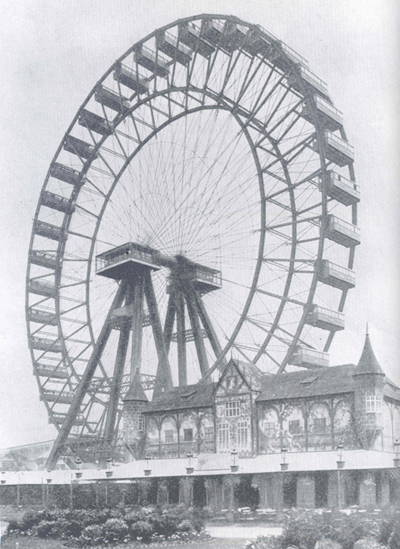
The Earl's Court Wheel

From Discoveries and Inventions of the 19th Century (1898) by Robert Routledge

” . . . . . . amid the attractions of an International Exhibition, it was not lost upon the enterprising people of the States when the ” World’s Fair” at Chicago was in preparation in 1893. It was then that Mr. G. W. G. Ferris, the head of a firm of bridge constructors at Pittsburg, conceived the idea of applying his engineering skill to the erection of a huge wheel, revolving in a vertical plane, with cars for persons to sit in, constituting, in fact, an enormous “merry-go-round,” as the machine once so common at country fairs was called. The novelty of the Chicago erection was, therefore, not the general idea, but the magnitude of the scale, which, for that reason, involved the application of the highest engineering skill, and the solution of hitherto unattempted practical problems. Several thousand pounds were, in fact, expended on merely preliminary plans and designs. The great wheel at Chicago was 350 feet in diameter, and to its periphery were hung thirty-six carriages, each seating forty persons. At each revolution, therefore, 1,440 people would be raised in the air to the height of 250 feet, and from that elevation afforded a splendid prospect, besides an experience of the peculiar sensation like that of being in a balloon, when the spectator has no perception of his own motion, but the objects beneath appear to have the contrary movement, that is to say, they seem to be sinking when he is rising, and viceversd.

“This curious structure was not begun until March, 1893, yet it was set in motion three months afterwards, having cost about £62,500. The Company had to hand over to the Exhibition one half of the receipts after the big wheel had paid for its construction, but even then they realised a handsome profit, and at the close of the World’s Fair, they sold the machine for four-thirds of its cost, in order that it might be re-erected at Coney Island.

“No sooner had the great Ferris wheel at Chicago proved a financial success than an American gentleman, Lieutenant Graydon, secured a patent for a like machine in the Un1ted Kingdom; and as it has now become almost a matter of course that some iron or steel structure, surpassing everything before attempted, should form a part of each great exhibition, a Company was at once formed in London, under the title of “The Gigantic Wheel and Recreation Towers Co., Limited,” to construct and work at the Earl’s Court Oriental Exhibition of 1895, a great wheel, similar in general form to that of Chicago. But the design of the London wheel had some new features . . . and, moreover, having been planned of larger dimensions than its American prototype, presented additional engineering problems of no small complexity. After due deliberation the scheme of the work was entrusted to Mr. Walter B. Bassett, a talented young engineer, connected with the firm of Messrs. Maudslay, Sons, & Field, and already experienced in designing iron structures. Under this gentleman, with the assistance of Mr. J. J. Webster in carrying out some of the details, the work has been so successfully accomplished that the ” Great Wheel”- of 1895 may be cited as one of the crowning mechanical triumphs of the nineteenth century. . . .
“The wheel at Earl’s Court exceeds the Ferris wheel in diameter by 50 feet, being 300 feet across. It is supported on two towers, 175 feet high, each formed by four columns 4 feet square, built of steel plates with internal diaphragms, and surmounted by balconies that may be ascended in elevators raised by a weight of water, which, after having been discharged into a reservoir under the ground level, is again pumped up to the top of the towers. Between the balconies on each tower there is also a communication through the axle of the wheel, which, instead of being solid as at Chicago, is a tube of 7 feet diameter, and 35 feet long, made in sections, riveted together, of steel 1 inch thick, and weighing no less than 58 tons.”
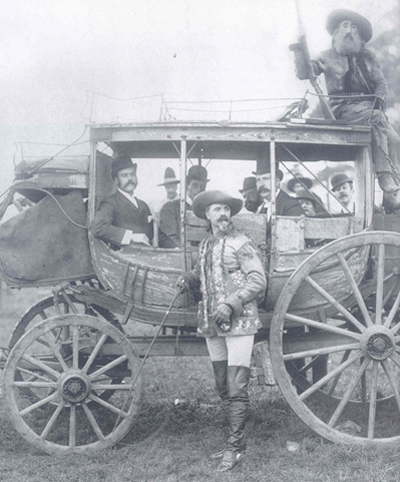
You can read much more about the history of Earl’s Court as an entertainment venue here. Other rides included a Water Chute and showman who appeared at the grounds included none other than Buffalo Bill, show below at Earl’s Court.

Sedan Chairs

Sedan chairs, also called litters, are enclosed seats carried on poles that have been used for centuries, or at least as early as the Eyptian Empire. Sedan chairs were introduced to Britain from Spain – before leaving Madrid in 1623 to return to England, the Prince of Wales, later Charles I, was given a gift by the Prime Minister that included “three sedan chairs of curious workmanship.” He later gave two of these chairs to the Duke of Buckingham, who used them in the streets of London and prompted outrage for “reducing free born Englishmen to the condition of beasts of burden.”

Benjamin Franklin in his sedan chair
Sedan chair made for Queen Maria Luisa of Parma circa 1795

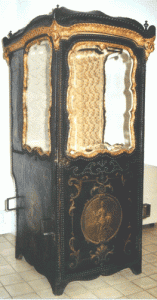
A late 18th century French sedan chair – click here to see the inside

By 1726 there were 400 sedan chairs registered in London. They were used in Edinburgh until the 1860’s.

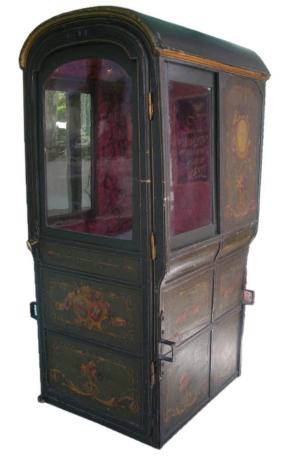
Above is a modern day Chinese sedan chair, traditionally used to carry a bride to her wedding. There is also a foundation in Hong Kong that raises money through their Sedan Chair Charities Fund and annual sedan chair races. Come to that, there are even sedan chair races still going on in England.

You can see examples of sedan chairs in museums throughout Great Britain:


From the Ulster Folk and Transport Museum

From the Museum of Leathercraft

From the Victoria and Albert Museum

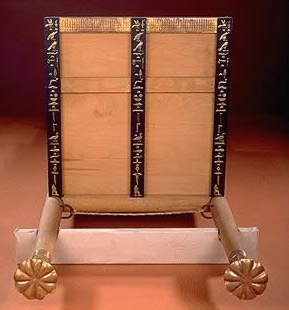
And coming full circle, the sedan chair of Queen Hetepheres from the Egyptian Museum, Cairo 

Captain Gronow on His School Friend Shelley

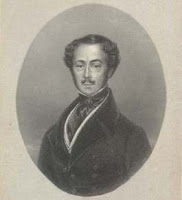
Rees Howell Gronow (1794-1865) wrote his Reminiscences late in his life.  He knew many leading figures of his era.  Below are his comments on Percy Bysshe Shelley (1792-1822), one of the most famous of the Romantic Era English Poets. 

Rees Gronow
SHELLEY

Shelley, the poet, cut off at so early an age; just when his great poetical talents had been matured by study and reflection, and when he probably would have produced some great work, was my friend and associate at Eton. He was a boy of studious and meditative habits, averse to all games and sports, and a great reader of novels and romances.  He was a thin, slight lad, with remarkably lustrous eyes, fine hair, and a very peculiar shrill voice and laugh. His most intimate friend at Eton was a boy named Price, who was considered one of the best classical scholars amongst us.  At his tutor, Bethell’s, where he lodged, he attempted many mechanical and scientific experiments.  By the aid of a common tinker, he contrived to make something like a steam-engine, which, unfortunately, one day suddenly exploded; to the great consternation of the neighbourhood and to the imminent danger of a severe flogging from Dr. Reate.

Percy Byssche Shelley
Soon after leaving school, and about the year 1810, he came, in a state of great distress and difficulty, to Swansea, when we had an opportunity of rendering him a service; but we never could ascertain what had brought him to Wales, though we had reason to suppose it was some mysterious affaire du coeur.

 The last time I saw Shelley was at Genoa, in 1822, sitting on the sea-shore, and, when I came upon him, making a true poet’s meal of bread and fruit; He at once recognized me, jumped up, and appearing greatly delighted, exclaimed, “Here you see me at my old Eton habits; but instead of the green fields for a couch, I have here the shores of the Mediterranean. It is very grand, and very romantic.  I only wish I had some of the excellent brown bread and butter we used to get at Spiers’s: but I was never very fastidious in my diet.”  Then he continued, in a wild and eccentric manner: “Gronow, do you remember the beautiful Martha, the Hebe of Spiers’s?  She was the loveliest girl I

ever saw, and I loved her to distraction.”

 Shelley was looking careworn and ill; and, as usual, was very carelessly dressed.  He had on a large and wide straw hat, his long brown hair, already streaked with grey, flowing in large masses from under it, and presented a wild and strange appearance.

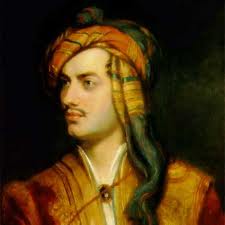
Lord Byron
During the time I sat by his side he asked many questions about myself and many of our schoolfellows; but on my questioning him in turn about himself, his way of life, and his future plans, he avoided entering into any explanation: indeed, he gave such short and evasive answers, that, thinking my inquisitiveness displeased him, I rose to take my leave.  I observed that I had not been lucky enough to see Lord Byron in any of my rambles, to which he replied, “Byron is living at his villa, surrounded by his court of sycophants; but I shall shortly see him at Leghorn.” We then shook hands.  I never saw him again; for he was drowned shortly afterwards, with his friend, Captain Williams, and his body was washed ashore near Via Reggio.  Every one is familiar with the romantic scene which took place on the sea-shore when the remains of my poor friend and Captain Williams were burnt, in the presence of Byron and Trelawney, in the Roman fashion. His ashes were gathered into an urn, and buried in the Protestant cemetery at Rome.  He was but twenty-nine years of age at his death.
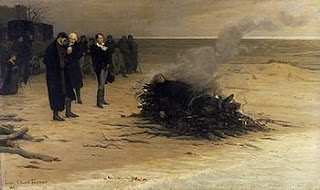
The Funeral of Shelley

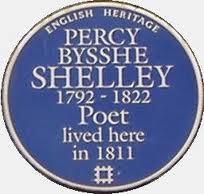
Notes from Victoria: This painting by Louis Edouard Fournier, completed in 1889 obviously long after the event, shows Edward Trelawney and Byron at the cremation of Shelley’s remains on the shore.  Also pictured are Mary Shelley, second wife of Percy, kneeling at the far left, and Leigh Hunt, though neither of them actually attended. One of several blue plaques honoring Shelley, the version below can be found at 15, Poland Street, WI, London, between Oxford Circus and Soho Square; Shelley resided here after he left Oxford.