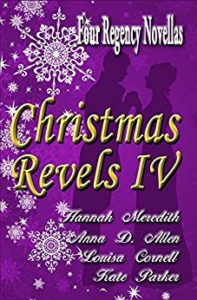
CHRISTMAS REVELS IV – A REGENCY CHRISTMAS ANTHOLOGY

From  A Perfectly Unforgettable Christmas

“Miss Howard has the right of it. I haven’t any brothers or sisters to insult anymore. I have to make do with Redford,” Lucien said with a half-smile in the butler’s direction.

“I don’t have any either. Brothers or sisters, I mean. And my Papa is dead so I won’t ever have any.”

“My condolences.” Lucien bit into the biscuit. For some reason his belly had no difficulty with the gingery concoction. Perhaps Bonaparte was onto something.

“I think I should like to be your doxie,” the angelic little girl declared.

Lucien choked down an entire biscuit and reached for his tea.

“Oh, dear,” Redford muttered.

Oh dear?

His butler nodded repeatedly in the direction of the French windows, rather like a seizing chicken. The mysteriously opened French windows. The windows in which a horrified Lady McAlasdair now stood giving Lucien a glare of reproach so powerful as to turn him to a pillar of salt should he remain under it for long. Lucien lurched to his feet. A lightning bolt of pain shot up his leg. He grasped the mantel to keep his feet.

“Lady McAlasdair.” He executed a shallow bow. “Would you care for some tea?”

“I should like to know, Lord Debenwood, precisely what you have been telling my daughter.” Never had he seen a lady lovelier. Or more deadly.

“I asked Lord Debenwood what a doxie is and he told me, Mama.” Miss Lily dragged her cloak-clad mother to the footstool and indicated she should sit. To his astonishment, she did. Then again, the child had managed to persuade him to take tea with her, a doll, and a dog.

“And what made you ask his lordship such a question?” She stroked her daughter’s hair and all the while accused Lucien with her eyes.

“You and Miss Howard wouldn’t tell me. I came over here to thank Lord Debenwood for my gift and to bring him some of Mrs. McGillicutty’s biscuits. He said I could ask him anything.” She sent Lucien a dazzling smile. He hated to think of the men of London once she reached her mother’s age. They didn’t stand a chance.

“Oh, he did, did he?”

For a man who had given up on feeling anything years ago, Lucien found himself aroused and indignant at the same time. She raised an eyebrow. A dare if ever he saw one.

“I made the offer after she plied me with biscuits and had already asked me every question imaginable. I didn’t see the harm in one more.” He offered a Gaelic shrug, only because he suspected it might annoy her. It did.

“One more? Biscuit or question?” She spied the child’s coat and hat on the blanket chest at the foot of the bed and fairly shot up from the footstool to fetch them.

“Both.”

“Why on earth would you answer such a question?” She wrestled her daughter into the coat and settled the wool hat on her head.

His leg tortured him mercilessly. Only yesterday he’d have sat down throughout her visit and damned all gentleman’s manners and intruding neighbors to perdition. He wasn’t exactly certain what made him remain standing now. “I was endeavoring to be honest and truthful with the child.” He grinned in spite of the scolding scowl on Redford’s face.

She stopped fastening her daughter’s coat and slowly crossed the room to stand close enough to shake the snow off her cloak onto his bare feet. “You are endeavoring to be a horse’s arse. And succeeding. Admirably,” she muttered huskily between clenched teeth.

The rough timbre of her voice scraped across his skin with a pleasurable sort of pain. The pain brought about when coming from someplace very cold into someplace warmer than he’d ever imagined.

“Quite,” Redford affirmed quietly.

“Stow ‘em, Redford.”

“Yes, my lord.”

“I don’t understand, Mama. Don’t you want me to be a doxie?” Seated on the blanket chest, Miss Lily stroked Bonaparte’s head. “I think it would be very nice.”

Redford began to clear the tea table. Lucien couldn’t be certain, but he thought he heard the man mumble, “Stop talking.” Good advice. Too bad he’d never been very adept at taking the advice of others.

“What exactly did you tell my daughter?” Lady McAlasdair demanded.

“He said doxies are women who are paid to be nice to men who are lonely,” Lily offered before he could answer. “Some men aren’t good at making friends so they have to pay them. I think Lord Debenwood is lonely. That’s why he is so angry all the time. I should like to be his doxie, but he wouldn’t have to pay me. He’s already given me Miss Debenwood, and he lets me have Bonaparte during the day. I could be his doxie as a trade.”

Every time the child said doxie, Lady McAlasdair’s color deepened from pink, to pinker, to pinker still. Lucien wondered if the color was the same all over her body. He raised an eyebrow exactly as she had done. He’d put on a pair of buckskins under his dressing gown for the sake of his little female visitor. Lucien crossed his arms over his chest to draw the mother’s gaze to the vee of naked flesh where the garment gapped open.

“I am going to kill you later,” she promised.

“I look forward to it.”


The Sergeant’s Christmas Bride – Sergeant Jacob Burrows just wants a place to bed down for the night. He never expects to be confronted by a lady with a gun. Elizabeth FitzWalter intends to drive the stranger off her land, until she realizes he meets her most pressing need.

Home for Christmas – When Charity Fletcher receives a mysterious bequest—a house by the sea—she hopes to rebuild her life. Lord Gilbert Narron leases a seaside house to hide from his memories of war. Charity’s refuge is Gil’s bolt-hole… but what both are seeking is a home for their hearts.

A Memorable Christmas Season –The last thing Lady Roekirk expects at her Christmas party is a dead traitor in her parlor… or the Crown’s Spymaster helping her hide the body. Thirty years earlier, she’d been forced to wed another and Lord Keyminster became a spy. After this long, does their love stand a chance?

A Perfectly Unforgettable Christmas – Every day, Lucien Rollinsby endures a memory of Christmas Eve. Not even his lovely new neighbor can make him forget that horrible night five years ago. Caroline McAlasdair remembers that Christmas Eve, too. But if Lucien recalls her presence there, it will destroy their only chance at happiness forever.

Buy Links:   Amazon – http://a.co/4ogrKbC

Apple iBooks – https://itunes.apple.com/us/book/christmas-revels-ii-four-regency/id1047951334?mt=11

Barns and Nobles – https://www.barnesandnoble.com/w/christmas-revels-ii-hannah-meredith/1122771468?ean=9781942470007

Kobo – https://store.kobobooks.com/en-us/ebook/christmas-revels-ii-four-regency-novellas

Print – https://www.createspace.com/5739761


Authors’ Biographies:

Hannah Meredith is, above all, a storyteller. She’s long been fascinated by the dreams that haunt the human heart and has an abiding interest in English history. This combination led her to write historical romance. Hannah is a member of RWA, the Heart of Carolina Romance Writers, and SFWA.


Anna D. Allen lives deep in the woods with too many books and not enough dogs. She holds a Bachelor of Science and a Master of Arts in Language and Literature. Her future plans include growing tomatoes and cleaning out the freezer. When not writing or reading, she can be found in the kitchen.


Kate Parker grew up reading her mother’s collection of mystery books by Christie, Sayers, and others. Now she can’t write a story without someone being murdered, and everyday items are studied for their lethal potential. It’s taken her years to convince her husband that she hasn’t poisoned dinner; that funny taste is because she just can’t cook.


Louisa Cornell is a retired opera singer living in LA (Lower Alabama) who cannot remember a time she wasn’t writing or telling stories. Anglophile, student of Regency England, historical romance writer— she escaped Walmart to write historical romance and hasn’t looked back. She is a member of RWA, Southern Magic RWA, and the Beau Monde Chapter of RWA.


Social Media Links:

Hannah – http://www.hannahmeredith.com

https://www.facebook.com/HannahMeredithAuthor


Anna – http://beket1.wix.com/annadallen

https://www.facebook.com/pages/Anna-D-Allen/366546213501993


Kate – http://www.KateParkerbooks.com

https://www.facebook.com/Author.Kate.Parker/


Louisa – http://onelondonone.blogspot.com/

http://www.louisacornell.com/

https://twitter.com/LouisaCornell

https://www.facebook.com/RegencyWriterLouisaCornell

https://www.facebook.com/louisa.cornell

https://www.pinterest.com/louisacornell/


OPERATION PIED PIPER – Guest Post by Alix Rickloff

OPERATION PIED PIPER                

WWII was declared on September 1st 1939, and by the end of that month over 800,000 London school children had been evacuated to the countryside ahead of the expected German bombardment.

Planning for Operation Pied Piper, as it was known, began years earlier. The bombing casualties sustained during WWI had frightened the British government badly. Taking into account advances in technology, they were certain that should war break out with a remilitarized Germany, any bombing campaign would result in catastrophic loss of civilian life.

As war grew closer, the government divided the country into zones of “evacuation” “neutral” or “reception”, compiled lists of available housing, and began an all-out crusade to convince the public of the necessity of evacuation. Posters and pamphlets were used successfully to persuade parents that their children would be safest far from the inner cities, especially London. Teachers, local authorities, railway staff, and over 17,000 WVS (Womens’ Volunteer Service) volunteers were brought on board to assist with the planning and implementation.


To prepare for evacuation, parents were given a list of items each child needed to take with them which included a gas mask, sandwiches for the journey, and a small bag containing such essentials as a change of underclothes, pajamas, slippers, toothbrush, comb, washcloth, and a warm coat. Yardly Jones recalls preparing before his evacuation:

“We went down Wavertree Road and bought an enamel cup, a knife, fork, and spoon from a list we had. I guess we bought clothing as well, I don’t remember, but I do know I was a little upset since I knew we weren’t that well off and I knew my mother couldn’t afford to go out and buy these things.”
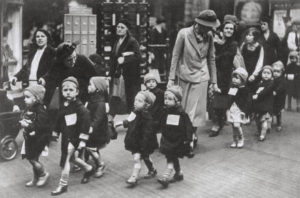
The day of departure, children assembled at their local school where labels were attached to their collars with name, home address, school, and destination. After tearful farewells, teachers and volunteers marched the children to the station where trains waited to take them to such far-flung destinations as Devon, Cornwall, and Wales. Teacher L.A.M. Brech recalls:

“All you could hear was the feet of the children and a kind of murmur because the children were too afraid to talk. Mothers weren’t allowed with us but they came along behind. When we got to the station we knew which platform to go to, the train was ready, we hadn’t the slightest idea where we were going and we put the children on the train and the gates closed behind us. The mothers pressed against the iron gates calling, ‘Goodbye darling.’ I never see those gates at Waterloo that I don’t get a lump in my throat.”
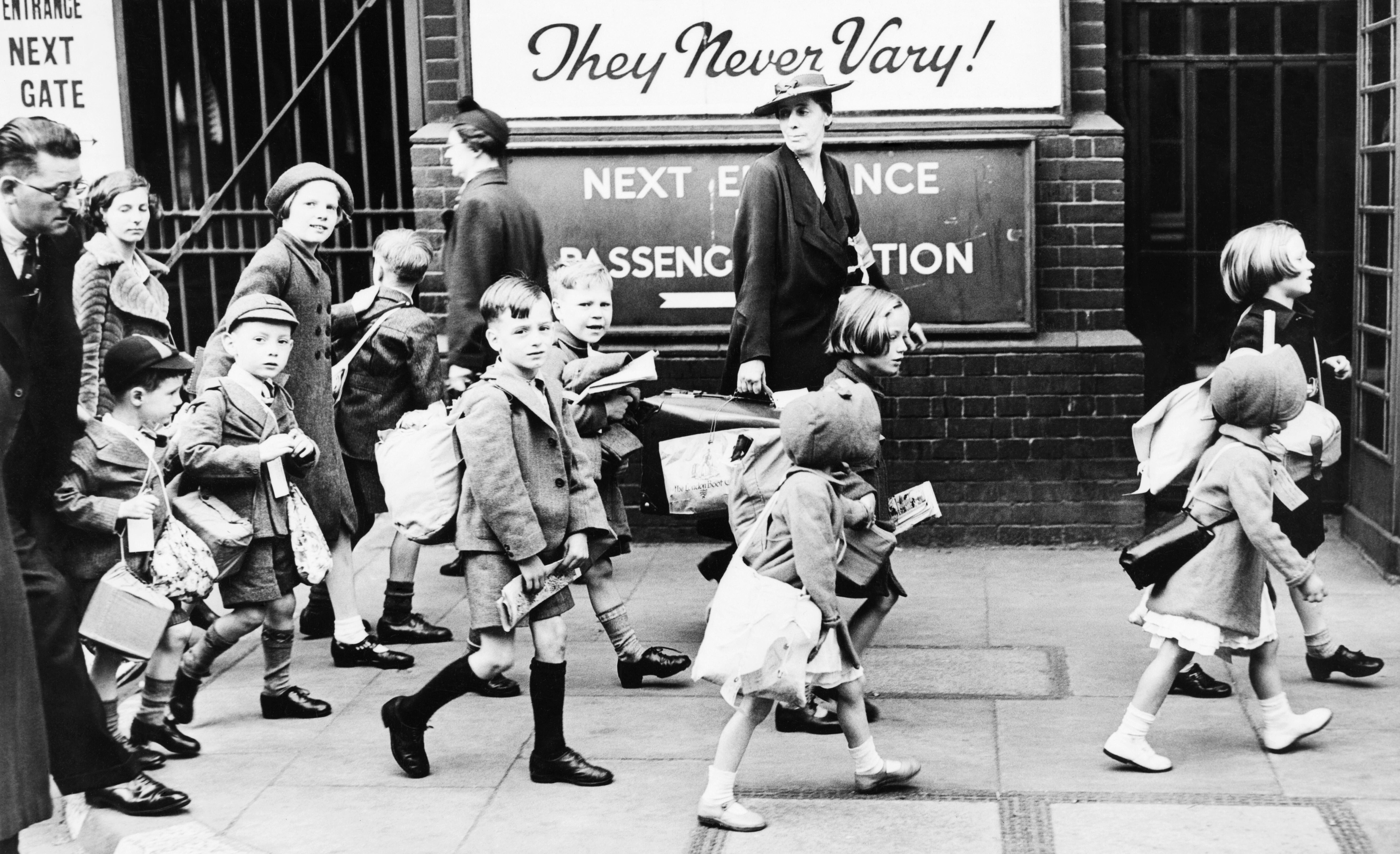

 

Upon arrival, billeting officers arranged for housing. In many instances, this meant nothing more than lining the children up against a wall and allowing families to choose as Beryl Hewitson recounts:

“I noticed boys of about 12 went very quickly—perhaps to help on the farm? Eventually only my friend Nancy and myself were left—two plain, straight-haired little girls wearing glasses, now rather tearful.”

And Irene Brownhill remembers her own arrival in the country:

“…next to us a little thin girl sobbing and very upset and wanting her mother. I put her in the middle of my sister and me and she stopped crying. The people coming around to choose kept saying they would take my sister and me but they did not want three girls only two…”

It was common for the young evacuees to have trouble adjusting to country life. Some had never seen a farm animal before or eaten a fresh vegetable. Others were bored by the lack of entertainments outside of the city. Jean Chartrand remembers two boys billeted with her relatives:

“…one boy had put the pail under the cow’s udders and was holding it there whilst the other boy was using the cow’s tail like a pump handle…”

Evacuee John Wills said his biggest shock was the fresh air: “Nearly knocked us off our feet.” Later he and a friend decided to return to London. “We walked home on the thumb with the odd lift. I much preferred to take my chances in the air raids.”

Host families could be equally surprised by the children they were housing. Because the majority of children came from the poorer sections of cities, there was an idea that they would be undisciplined and dirty. And while this was sometimes the case, more often than not their fears were founded on bias and preconceived notions.

“How I wish the prevalent view of evacuees could be changed. We were not all raised on a diet of fish and chips eaten from newspaper and many of us are quite familiar with the origins of milk. It was just as traumatic for a clean and fairly well educated child to find itself in a grubby semi-slum as vice versa,” Jean McCulloch explained.

By the end of 1939 when the expected bombing didn’t materialize, parents were quick to bring their children back home. And by January of 1940, nearly half of those children sent away in the first weeks had returned to their families. But these were to be short-term homecomings. When France fell in June 1940 and again in the fall of 1940 at the start of the London Blitz, additional evacuations were set in motion. And this time, children would not see their families again until the end of the war almost five years later.

The lasting effects of the evacuation ran the gamut. Some had idyllic experiences with caring families who maintained close ties long after the war ended like Michael Clark:

“We could not understand these strange people who for some reason we were sent to live with, but as the years have gone by I realize just what diamonds they were”

Others, like Gloria McNeill, homesick and unhappy, recall the forced separation and sometimes squalid and violent conditions these children found themselves in.

“Every time I hear Vera Lynn sing “Goodnight children everywhere’ I see a forlorn 11-year old curled up in a corner of a strange bedroom, hiding tears behind the pages of The Blue Fairy Book.”

Operation Pied Piper officially ended in 1946 bringing to a close one of the largest organized movements of civilian population during wartime and one of the most heartbreaking and inspiring chapters of British history.

Sources:

Dwight Jon Zimmerman. “Operation Pied Piper: The Evacuation of English Children During World War II.” www.DefenseMediaNetwork.com

Laura Clouting. “The Evacuated Children of the Second World War.” www.iwm.org.uk

“Primary History World War 2: Evacuation” www.bbc.uk

Ben Wicks. No Time to Wave Goodbye (Stoddart Publishing, 1988)

 

From the author of Secrets of Nanreath Hall comes this gripping, beautifully written historical fiction novel set during World War II—the unforgettable story of a young woman who must leave Singapore and forge a new life in England.

On the eve of Pearl Harbor, impetuous and overindulged, Lucy Stanhope, the granddaughter of an earl, is living a life of pampered luxury in Singapore until one reckless act will change her life forever. 

Exiled to England to stay with an aunt she barely remembers, Lucy never dreamed that she would be one of the last people to escape Singapore before war engulfs the entire island, and that her parents would disappear in the devastating aftermath. Now grief stricken and all alone, she must cope with the realities of a grim, battle-weary England.

Then she meets Bill, a young evacuee sent to the country to escape the Blitz, and in a moment of weakness, Lucy agrees to help him find his mother in London. The unlikely runaways take off on a seemingly simple journey across the country, but her world becomes even more complicated when she is reunited with an invalided soldier she knew in Singapore.

Now Lucy will be forced to finally confront the choices she has made if she ever hopes to have the future she yearns for.

 

Author Bio:

Critically acclaimed author of historical and paranormal romance, Alix Rickloff’s family tree includes a knight who fought during the Wars of the Roses (his brass rubbing hangs in her dining room) and a soldier who sided with Charles I during the English Civil War (hence the family’s hasty emigration to America). With inspiration like that, what else could she do but start writing her own stories? She lives in Maryland in a house that’s seen its own share of history so when she’s not writing, she can usually be found trying to keep it from falling down.


Websitewww.AlixRickloff.com

Facebook: www.facebook.com/AlixRickloffAuthor

Twitter: www.Twitter.com/AlixRickloff

Pinterest: www.Pinterest.com/AlixRickloff

Intstagram: https://www.instagram.com/alix_rickloff

Buy This Book: http://bit.ly/2oM4Gy4



A NUMBER ONE LONDON GIVEAWAY!

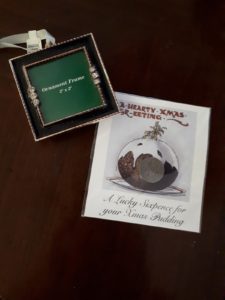
Have you already subscribed to our newsletter? If not, this is your lucky day. Simply sign up using the link in the right sidebar and you may be the lucky winner of a picture frame tree ornament and a lucky sixpence for your Xmas Pudding.


Good Luck – The winner will be announced next week!

Sorry, due to mailing restrictions, winner must be resident of the US.

BRUSHING UP ON BOSWELL

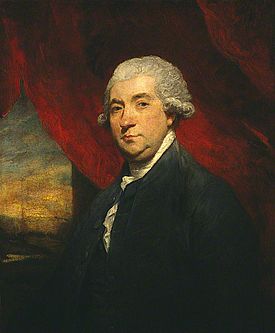
James Boswell by Sir Joshua Reynolds, 1785


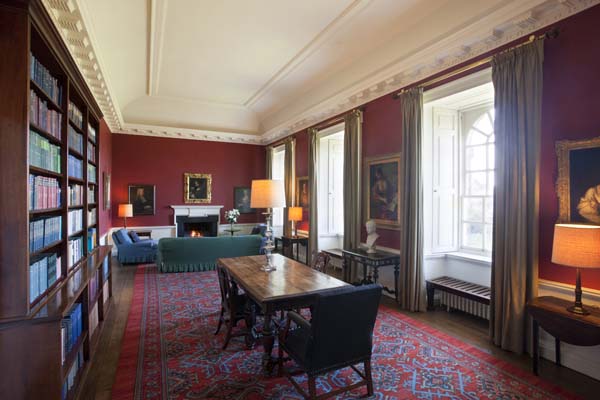
James Boswell is best known as the biographer of Dr. Samuel Johnson, but he was also 9th Laird of Auchinleck, in Scotland, with the family seat being Auchinleck House, in Ayershire, below, since it was built circa 1760. Boswell visited often and he and Dr. Johnson stayed here together in 1773 during their return from the Hebrides. As it turns out, a small group of lucky travelers will be staying here and we’ll have the entire estate to ourselves during Number One London’s 2018 Scottish Writer’s Retreat in September. Can there be a more perfect location for a writer’s retreat than the home of the author commonly said to have written the greatest biography in the English language – or the man who spent nine years working on The Dictionary of the English Language?

In light of my upcoming stay, I thought it would only be fitting for me to brush up on my Boswell/Johnson knowledge by re-reading Boswell’s Journals and Christopher Hibbert’s excellent biography, The Personal History of Samuel Johnson.

Samuel Johnson by Sir Joshua Reynolds, circa 1772

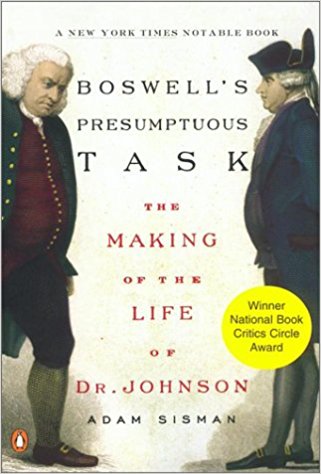
Also on my reading list is Adam Sisman’s book, Bowell’s Presumptuous Task, which garnered this review by Bibliomane01 on Amazon:

“In this magnificent work Mr Sisman describes the making of that greatest of all biographies, Boswell’s Life of Dr Johnson. To his contemporaries the task that Boswell had taken on was presumptuous indeed – to record the life of the greatest literary man of his age, while being dismissed himself as a frivolous and reprobate dilettante incapable of any serious activity. Well, the world knows that Bozzy succeeded in confounding his critics, but the tragic irony of his predicament was that he succeeded too well. While hailing the book as a masterpiece, the current and future literary establishment dismissed Boswell’s own role as little more than that of a stenographer. Macaulay’s damning essay on Boswell formed the opinion held by too many people for far too long. The true story of Boswell’s genius became well known to scholars in the 20th century; with this book, Mr. Sisman brings the story to a wider audience. It is a remarkable portrait of Boswell’s love for Johnson and the great struggles he endured to bring his hero to life in the pages of his biography. Battling drink, debauchery, depression and his own self-destructive nature, Boswell managed to pull off the one great sustained piece of effort of his life. In his book Johnson was brought to life once again, an image so convincing that it took over 150 years for people to discern the art behind the apparent ingenuousness of Boswell’s technique. Sisman does a good job of showing how the Johnson of the Life was as much a product of Boswell’s gift as the historical record (although I think readers would have benefited from a few examples of textual analysis to illustrate this). His final chapter on the gradual unearthing of the Boswell papers provides an exciting ending and his writing is clear and compelling. “Boswell’s Presumptuous Task” is nothing short of a triumph.”

The “gradual unearthing of the Boswell papers” mentioned above refers to a cache of Boswell’s private papers and journals found at Malahide Castle just outside of Dublin in the 1920’s. Boswell’s great-great-grandson, Lord Talbot de Malahide sold the papers to American collector Ralph Isham and they now form part of the collection at Yale University. Having only just visited Malahide Castle in September, I’m looking forward to reading Sisman’s book soon.

If you’d like to join us on The Scottish Writer’s Retreat, you will find complete details herethere are only two places remaining!

BRITBOX TV – IS IT WORTH IT?

by Kristine Hughes Patrone

If you’re at all like me, you probably prefer watching British television to American television. Not so long ago, this was almost impossible to do in the USA. The only options available were Masterpiece Theatre or buying mini-series and movies on video tape or CD. Then came Acorn TV, which was much better than what we had, offering more content and many British shows otherwise unavailable to us. Acorn TV answered a need and served a purpose. Yes, we had to pay for the service, but if you were a dedicated Brit telly fan, the monthly fee of $4.99 was worth it.

Enter Britbox, a joint service by the BBC, ITV and Amazon video, allowing those of us in America to stream UK telly. When it first launched I yawned. In fact, I’d been yawning for quite a while as my Acorn TV subscription had become a tad stale. Who needs Britbox, thought I, it will most likely be nothing more than another version of Acorn TV, where the same old programs were rerun again and again. And again. After several years of subscribing to Acorn TV, I’d grown tired of the slow turnover of “new” shows and I’d been seriously considering dropping my subscription. Admittedly, old standards such as Blacks Books, Cradle to Grave and Grandma’s House  were interspersed with more contemporary, and desirable, shows such as Vera, Doc Martin, A Place to Call Home, and Happy Valley, but new episodes were slow in coming. And besides, I wanted access to more than just dated, and well watched, series TV. I wanted prime time British telly.

I’m a huge fan of Coronation Street, the UK soap opera that’s been on the air since 1960. I’ve seen every episode aired since 1970, discovering the program on YouTube and watching it for months until I’d caught up with the current episodes. I also used to be able to watch new episodes on YouTube, where a handful of lovely people would upload them soon after they aired in the UK. Recently, Coronation Street’s parent company, ITV, began policing YouTube and reporting “pirated” content, which was quickly taken down. It’s almost impossible to find a recent episode on the platform any more. When I learned that Hulu was streaming new episodes of Coronation Street, of course I headed their way. $5.99 per month, so worth it to see Corrie. I signed up for their free trial and waited for new episodes of Coronation Street. And waited. And waited.  As of last night, as I write this on November 9, the latest episode available on Hulu was October 23rd. And that’s been the latest episode for almost two weeks now. Not. Funny. Not. Happy.

And so I found myself on the Britbox website. Since Britbox is affiliated with ITV, the producers of Coronation Street, chances were better that new Corrie episodes would drop in a more timely fashion. Taking a lesson from my Hulu experience, I checked the Corrie line up before getting too excited and, lo and behold, they had Corrie episodes right up until yesterday’s date. Joy! I cancelled my trial period at Hulu and signed up with Britbox and then browsed their line up of other shows.


And they had plenty that was current. Don’t get me wrong, there were still a good amount of old saws like Poirot, Dalziel and Pascoe, Rosemary and Thyme, Sharpe with Sean Bean (Sean Bean !!), Fawlty Towers, Upstairs, Downstairs and Cranford, but there were also many more current shows, such as Broken with Sean Bean (Sean Bean !!), Cold Feet 2017, Strictly Come Dancing, Kat and Alfie, The Great Chelsea Garden Challenge, Flog It!, In The Dark, Ordinary Lives, The Moorside, plus documentaries, Royal specials and, in addition to Coronation Street, new episodes of favourite soaps Emmerdale, Holby City and East Enders.


Acorn TV does seem to be stepping up it’s game with the arrival of Britbox on the scene, adding new shows like Loch Ness and The Good Karma Hospital, but they’re going to have to step up their line up of current shows in order to keep pace with the new kid on the block. For now I’ll keep both subscriptions for a total of $11 per month, but it would be lovely if the UK telly powers that be would just let us subscribe to their t.v. tax and allow us to watch real time telly. Until then, I’m happy to have new episodes of Coronation Street and I’m also enjoying Broken –  it’s gritty, gripping and heartbreaking. In short, entirely binge worthy. As is Ordinary Lies. And Scott & Bailey. And Britbox will also be airing the Queen’s Christmas speech on the day.

If you’ve subscribed to any of these streaming services, or are considering signing on for any of them, I’d love to hear your thoughts.