BLOOMING AT HADDON HALL BY VICKY HINSHAW

Originally published in 2010, we’re re-running this post now because we think you may like to look at Haddon Hall’s glorious gardens on this cold December day. Victoria and Kristine revisited Haddon Hall this past September on Number One London’s Country House Tour and the gardens were stunning. Do check our new line-up of tours at Number One London for details on the 2018 Country House Tour!


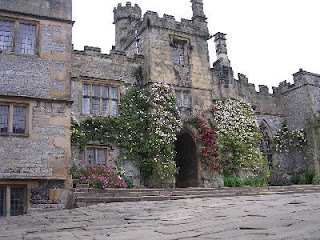
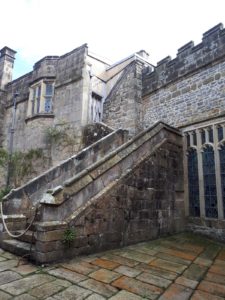
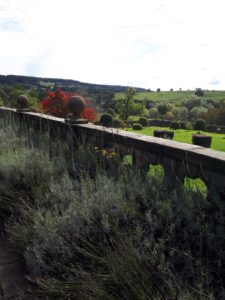
I visited Haddon Hall on a cool early summer day and found roses climbing all over the ancient grey walls, their colorful profusion a perfect complement to the lichen-covered stone.

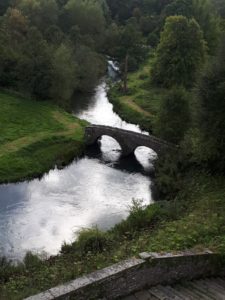
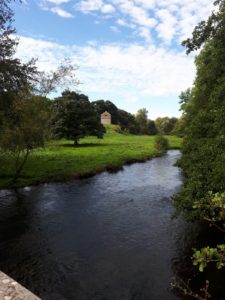
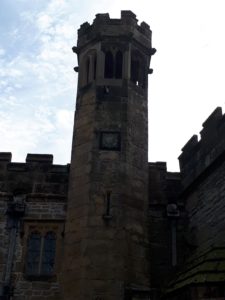
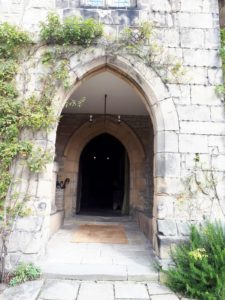
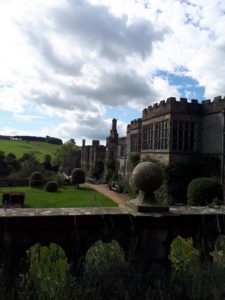
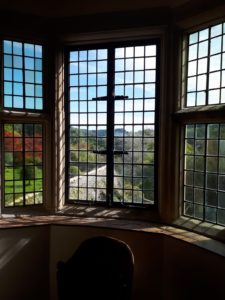
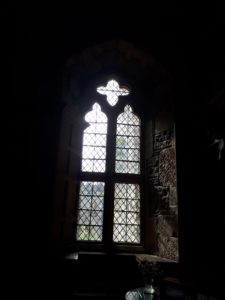
Haddon Hall, high above the Wye River near Matlock in Derbyshire, is typical of medieval manor houses: built of local rock with thick walls and small windows.


The property is listed in the Domesday Survey conducted shortly after William the Conqueror took over England. The Domesday Book was a great survey completed in 1086, a sort of census. William wanted to know who the landholders were and what taxes he could collect from them, so his clerks looked for property holders from the time of Edward the Confessor. The judgment of the assessors was final and there was no appeal. The name Domesday comes from the Old English word dom (same root as doom in modern English) meaning accounting or reckoning. The book of this census is known by the English as ‘Domesday’, that is the Day of Judgment.


Many of the finest English Country Houses evolved from ancient foundation structures of which few traces remain. Rebuilding, remodeling, and redecorating have been beloved preoccupations for centuries. Houses were altered by almost every generation to incorporate the latest technological improvements or to enhance the size, style and beauty of their surroundings. The richer the family members, the more they rebuilt over and over again.


The Haddon estate came into the Vernon family through the marriage of its heiress in 1170 to Richard Vernon.

The oldest and best-preserved old houses usually are passed down in a family through the female side. History repeated itself when in the mid-1550’s, Dorothy Vernon eloped with Sir John Manners, a son of the Duke of Rutland, against the wishes of her father. But despite his opposition to the match, Haddon Hall soon became the property of the Manners family, which has owned it ever since. It was, however, a secondary residence to the Rutland’s primary estate, Belvoir (pronounced Beever) Castle.

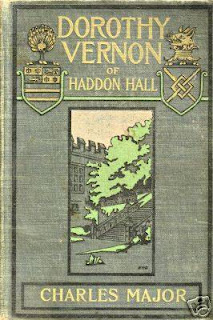
Since secondary residences were visited rarely, there was little urge to remodel to wife’s property.  This pattern is repeated many times throughout the history of various stately homes. Cotehele in Cornwall and Chiswick near London are two more excellent examples. The romance of Dorothy Vernon and Sir John Manners was the basis for the 1902 novel Dorothy Vernon of Haddon Hall by Charles Major, popular author of historical romances including When Knighthood was in Flower (1898). Major altered parts of the story and his novel was further enhanced when it was made into a movie starring Mary Pickford in 1924. The story has also inspired a play and an opera.


Haddon’s exterior is typically medieval, severe and somber, yet softened by lovely gardens.


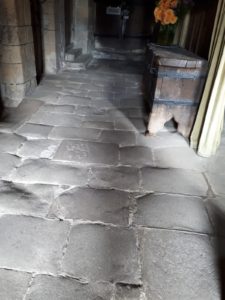
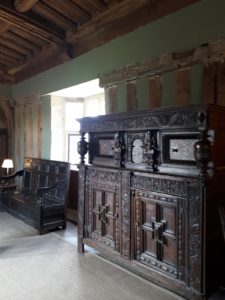
Inside, many rooms are open to visitors.  In 1370, Richard de Vernon built the banqueting hall to house forty to fifty people. The house and continued to grow in subsequent centuries, both in number of inhabitants and in number of rooms and outbuildings.


The long gallery was added later and is typical of those found in Tudor and Elizabethan era houses, designed to replace cloister-style open air walkways. One strolled back and forth in the long gallery to take daily exercise where it was somewhat more protected.

Throughout the 18th and 19th centuries, Haddon Hall was ignored and fell into disrepair. Not until the 1920’s was major restoration begun. It continues today under the direction of Lord and Lady Edward Manners. Haddon Hall is often used in films and stood in as Prince Humperdink’s castle in The Princess Bride.

Whether it was the elopement story or the abundant roses, I found Haddon Hall very romantic and great inspiration for the imagination.

Previously published in 2010.

THE WELLINGTON CONNECTION – TOURISTS

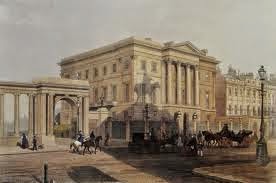
As many of you know, I always make time to visit Apsley House when I’m in London, either dropping in on my own or scheduling the visit as a stop on one of my tours. In April 2018, we’ll be visiting Apsley House as part of the 1815 Waterloo Tour, but our group will be far from the first tourists to pay a call in order to admire the stunning interiors and artwork. In fact, tourists have been trying to gain entry into Apsley House since the time when the first Duke still lived there. Oddly enough, it seems that people were commonly writing to the owners of various houses in the hopes of being allowed inside and of being given a tour of the premises. Horace Walpole was plagued by applications for admission to his Strawberry Hill and owners of other unique properties were also applied to for the same purpose.
In 1850, the Duke of Wellington replied to a letter written to him by Lady Salisbury inquiring as to how best she and Lord Salisbury should deal with those who applied to them with requests to see their home, Hatfield House. In other words, how best to deal with 19th century tourists. The Duke answered her thusly:
London, July 27, 1850
  ” . . . . . I permit my servants to show the House and Place to whom they please and as they please. But I avoid to give an order that anything should be shown to anybody. I enclose the Lithograph answer sent to every application. You will find some regulation of the same description very convenient to yourself and Lord Salisbury. . . . . . “
Copy of Lithograph
 
   Field Marshal The Duke of Wellington presents his 
compliments. He is not in the habit of giving orders 
to his Servants to show his House or its contents to 
Gentlemen with whom he is not acquainted. They 
are responsible for the good, cleanly and safe 
keeping thereof, and they must form their own 
judgment as to whom they will admit to see it, taking 
care always that those whom they may admit do 
not interfere with the convenient occupation of their 
apartments by his son, his daughter-in-law and himself. 
 
Unfortunately, the Duke was also plagued with requests from tourists at Walmer Castle, as the following letter to Lady Salisbury the following September illustrates –
Walmer, September 19, 1850
     “. . . . . You are amused by the applications made to me. I have had a most curious one from one of the young ladies who were in the habit, as children, of coming to my Garden Gate in Hyde Park. This young lady is now with some friends a Broadstairs! and she insists upon my sending her an order that the interior of Walmer Castle should be shewn to her and her friends during the time that I am residing there; at which time, she has heard that the interior of the Castle is not usually shewn.
I have told her that my Predecessor in the office of Lord Warden had fitted up part of this Castle as a residence for the Lard Wardens, which I now occupy! that I have one room in this Residence, in which I sleep, dress and write all day! that the remainder of the House is occupied by my daughters-in-law and their Children or by other visitors, male or female! That I permitted the Servants to shew to whom they pleased, excepting when inhabited. But at such periods only when not inconvenient to the inhabitants. I added that I believed that I was the only individual in England who would be required by anybody to make a shew of his Bed Room and Dressing Room; and that I doubted much whether my daughters-in-law, or their Children, or any Ladies or Gentlemen, inhabitants of Rooms in this Residence, would much like the proposition that their Rooms should be made a shew of while they should inhabit them. I have received no answer.”
Alas, visitors are no longer allowed into the private apartments at Apsley House, though Wellington’s room at Walmer Castle has been preserved as it was at the time of his death and is still on view. As our visit will be confined to viewing the public rooms only at Apsley House during the 1815 Waterloo Tour, I like to think that the Duke won’t mind our presence too much. Complete details regarding the upcoming Tour can be found here.


HAPPY BIRTHDAY JANE AUSTEN!

Jane Austen December 16, 1775 – June 18, 1817

By Victoria Hinshaw

My dearest Jane,

Here I am in the snowy midwest of the United States (that country born just after you), 242 years after your birth, expressing my thanks to you for all your talents and achievements.  I can only hope that somehow you are aware of the esteem in which you are held by millions of people.  Are you surprised that your novels are still adored 200 years after their publication? And that you are celebrated as one of English Literature’s most famous authors?

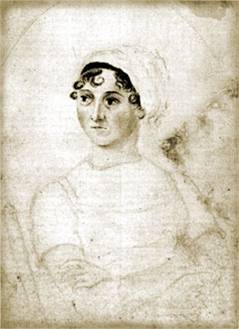
Jane Austen, sketch by sister Cassandra

How do you account for the fact that many of us call ourselves Janeites? That we gather yearly in several countries to discuss your work, from the earliest of juvenilia to the final letters, prayers and poems you wrote just before your demise? That we scour your words, the accounts of relatives and friends, the objects you touched, your travels, your acquaintances, and every scrap we can uncover that might relate to your life? That universities devote entire courses of you? And that your work has provided the backbone for a whole industry of films, television series, sequels, continuations, contemporary interpretations, and scholarly treatises?

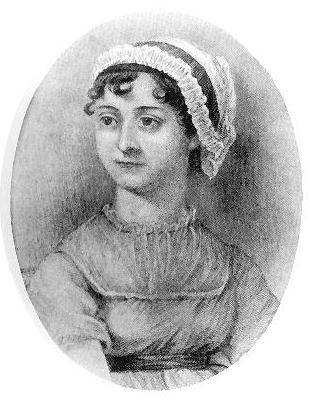
Jane Austen, as revised 1871

I wonder how you would like to visit Chawton Cottage and see how it has become a shrine to you and your books?  Or Chawton House, where the mansion has been restored to its late 18th century appearance and is now a library of women’s writings before 1900? I would not recommend that you travel the streets of London to see the blue plaques on the buildings where you stayed with Henry — it’s far too dangerous unless you have a blue badge guide and skillful driver.  Of a car, not a chaise.

Would you believe that among the most popular reasons that people visit Stoneleigh Abbey, Netley Abbey, The Vyne or the Wheatsheaf Inn is that you were there?  Or that one of the highlights of my life was to eat an apple in the garden of Chawton House when the gardener told me it was from a tree which you probably knew and from which you sampled the fruit.  I wasn’t alone either.

And were you lingering high in the lofts of Winchester Cathedral when JASNA held a service dedicated to your memory, and that was only one of many so held in that great place? I hope you died in the knowledge that your family loved you and that someday you would be commemorated worldwide.

Perhaps some of us have overdone things a bit and owe you an apology. Zombies, vampires, sea monsters, as well as highly fantasized so-called bio-pics have played fast and loose with the facts of your stories and your life. But through it all, we know, if we love Jane Austen (and we do!), all we have to do is pick up a copy of one of your books and immerse ourselves once more.

Most of all, I want to express my gratitude for the brilliant way you have enriched my life and that of many of my friends.  You are one of a kind, Jane Austen, and we are so lucky to have “known” you.  Thank you, Jane.

Yrs very affecly,
V. Hinshaw

THE DEATH OF PRINCE ALBERT

by Victoria Hinshaw

On the night of 14 December, 1861, Queen Victoria lost her beloved husband Prince Albert. In the custom of the time, most of her subjects learned of his death through the tolling of church bells, traditional alert to crisis.

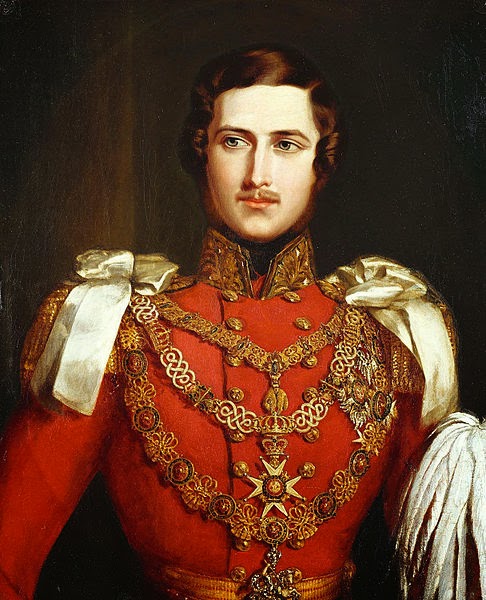
Prince Albert of Saxe-Coburg-Gotha, 1840

In 2011, 150 years after the event, the BBC History Magazine carried an article about how the death of Prince Albert threatened the continuing existence of the monarchy.  Here is a topic with everything: love, dynasty, death and mourning, royalty, and Future Considerations, the capital letters well-deserved.  Most of the information in this post comes from the magazine article  by Helen Rappaport, author of Magnificent Obsession: Victoria, Albert and the Death that Changed the Monarchy, published by Hutchinson, 2011.

Victoria was already Queen when she and Albert of Saxe-Coburg-Gotha were married on February 10, 1840.  There is no doubt that she adored him — handsome, clever, and virile, Prince Albert had long been intended to be  her spouse by their mutual uncle, Leopold, King of the Belgians, since 1831 and the widower of the late Princess Charlotte of Wales, who died in 1817.

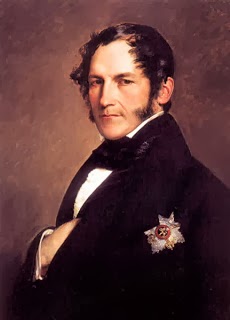
Leopold I, King of the Belgians; portrait by Winterhalter

King Leopold was the brother of both Victoria’s mother, the Duchess of Kent, and Albert’s father, Ernst I, Duke of Saxe-Coburg and Gotha.

Queen Victoria  and Prince Albert with their children in 1846; Painted by Franz Xavier Winterhalter
Queen Victoria and Prince Albert were parents of four sons and five daughters and eventually 42 grandchildren, most of whom married into European royalty and aristocratic families.
There is little doubt from her writing that her marriage to Albert was a love match for Victoria.  If those early years were difficult for Prince Albert, he was confident of her adoration, and he worked hard to win the confidence of her advisers, government officials, and the public.
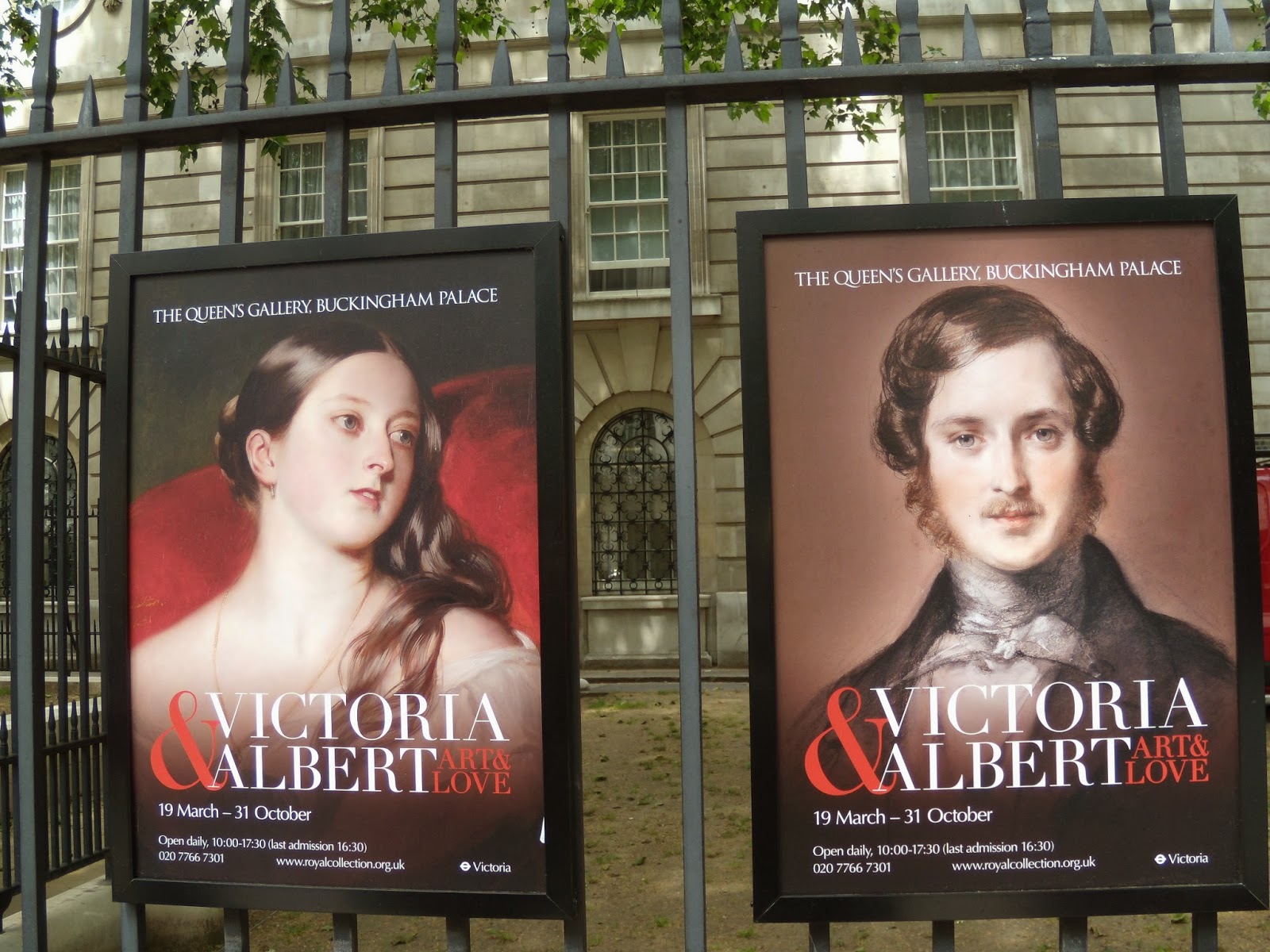
2010 Exhibition at The Queen’s Gallery, Buckingham Palace, London
Several years ago, Kristine and I attended the exhibition “Victoria and Albert: Art and Love” and feasted our eyes on the lovely portraits and objects they gave each other. According to the catalogue, “This exhibition is the first ever to focus on Queen Victoria and Prince Albert’s shared enthusiasm for art. Bringing together more than 400 items from the Royal Collection, it celebrates the royal couple’s mutual delight in collecting and displaying…”  We examined each item, until we could hardly stand on our tired feet.  Seeing their love so obviously expressed gave us a new appreciation of their mutual trust and dependence upon one another
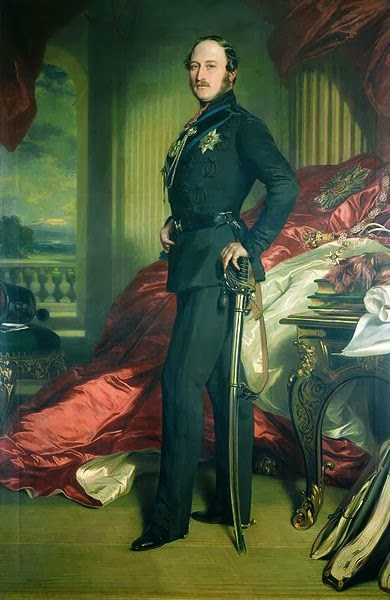
Prince Albert, 1859, by Winterhalter
 By the time he died, most people (according to Rappaport) considered Albert to be King in all but name. Regarding the press accounts of his death, Rappaport writes, “Many of them were tinged with a profound sense of guilt that Albert had never been sufficiently valued during his life time for his many and notable contributions to British culture as an outstanding patron of the arts, education, science and business.” The Queen was plunged into a profound depression which lasted for many years.
The Death of Prince Albert
 As seemed to be common in the British Royal Family, first sons and their ruling fathers often did not see eye to eye.  Prince Albert was disappointed in his eldest son, known as Bertie, who succeeded his mother as monarch King Edward VII in 1901. Albert had kept Bertie to a strict regimen of preparation for his eventual role as King, but Bertie, being young and mischievous, managed to involved himself in troublesome activities.  The Queen, in part, blamed her son for her husband’s illness and death.
The fear grew in Britain that the Queen would never recover from her grief, and her exaggerated mourning would endanger the continuation of the monarchy.  Victoria and Albert had, during their 20-year reign, re-established the dignity of the royal family, so greatly reduced during the period of the Hanovers, the first four Georges and William IV.
Prince and Princess of Wales, wedding in 1863
Rappaport writes, Victoria “became increasingly intractable in response to every attempt to coax her out of her self-imposed purdah…the only thing that interested Victoria now was her single-handed mission to memorialize her husband in perpetuity.”
The Albert Memorial, Kensington Gardens, London, one of many memorials to the Prince Consort
 Not until 1871 did Queen Victoria begin to appear in public again. Rappaport writes, “…discontent escalated into outright republican challenges and calls for Victoria’s abdication…when Queen Victoria attended a thanksgiving service at St. Paul’s Cathedral” to celebrate the recovery of the Prince of Wales from an attack of typhoid fever, the disease which may have killed his father ten years earlier.  From then on, public sympathy was recovered for the Queen and her son.
Queen Victoria, 1899, NPG
With the help of her favorite PM, Disraeli, and her beloved Scottish servant, John Brown, the Queen became “…a respected figure of enduring dignity and fortitude, ageing into her familiar image…only now that people started calling themselves ‘Victorian’s’…”
Albert and Victoria resting side by side in the Royal Mausoleum at Frogmore

HOW TO SCORE THE MARKLE SPARKLE

Meghan Markle made her first official appearance along with fiance Prince Harry in Nottingham on 1 December and her coat (Mackage ‘Elodie’ Navy Wool Coat US$790) and boots (KG by Kurt Geiger Violet Black Suede Over the Knee Boots £229) sold out on the same day. How did everyone find out what pieces she was wearing, so fast? Kensington Palace’s newest fashion icon has us mere mortals wanting to shop pieces, but how do we get the 411 about what they are and where to buy them? I mean before they sell out?

Well, it seems that Meghan has been a trendsetter since at least November 2016, when the website Meghan’s Fashion debuted. Loaded with photos of Meghan’s outfits and the required links to shopping those looks, this site should be bookmarked by all Royal watching fashionistas. Can’t decide between Meghan’s outfit or Katherine’s? No problem, there’s a Kate’s Closet site, as well.


And another similar site Princess Charlotte Style for all your tiny princess buying needs.

Then there’s Meghan’s Mirror, a site similar to those above, but which also features Meghan’s best looks, her favourites, her fashion rules and even what’s on her reading list.

Want to see Meghan’s airport look? No problem!


And here’s Meghan’s yoga style


Even more exciting, Meghan has designed her very own dress line, The Meghan Markle Collection, available online at Canadian retailer Reitman on 27 April, in store 28 April. There’s no way to guess whether Ms. Markle will be able to continue selling her line beyond this season and after marrying into the Royal family, so this may be our only chance to get one of the gorgeous dresses below – all selling for under $100. Mark your calendars!

The Terrace $90


The Sunset $95


The Soirée $85

You can find photos of the full line here.

Of course, the one MM fashion item we’re all eagerly awaiting is her wedding dress. Trust Number One London to bring you all the speculation, guesses and possible winners as soon as we can.