THE DEATH AND BURIAL OF QUEEN CAROLINE – Part II

Continuing the Accounts of the Death and Burial of Queen Caroline, August 1821

Queen Caroline had long been a popular figure with the masses. During her funeral procession, riots broke out in the London streets. The following account was published in the Manchester Guardian on 18 August 1821:

“Before six o’clock a crowd assembled at Hyde Park Corner. The anxiety of the people as to the course the funeral procession [for Caroline of Brunswick] would take was here most strikingly displayed. The crowd were unwilling to depart from a place where there was a favourable chance of joining or viewing the procession; but there was the greatest agitation and alarm lest it should pass another way.

“The procession reached Kensington at half past nine. It was after eleven that it moved on into Hyde Park, and an attempt was made to pass, but this failed, for the people, apprehensive that the hearse would not pass through the City, shut the gates.

“About twelve o’clock the procession entered the Park, and during its passage through it a scene of confusion and outrage ensued of which the annals of this or any other Christian country can present few parallels. Vast numbers of persons on foot and on horseback passed with great speed along Park Lane. Their object was suspected by the Guards to be to reach that gate before them, with the view of meeting the procession, and forcing it to turn back. To prevent this, the Guards galloped through the Park to gain Cumberland Gate before them. The procession moved at a very quick pace through the Park. Suddenly, it halted, and it was understood that the people had closed the gates. It became necessary to force a way for the procession through whatever impediments might present themselves. The people were equally bent on turning the procession, and forcing it into the route of the city. Here a contest arose, and here, we deeply regret to say, blood was shed!

“Some stones and mud were thrown at the military, and a magistrate being present, the soldiers were sanctioned in firing their pistols and carbines at the unarmed crowd. Screams of terror were heard in every direction. The number of shots fired was not less than forty or fifty. So completely did the soldiery appear at this period to have lost the good temper and forbearance they previously evinced, that they fired shots in the direction in which the procession was moving. Immediately upon the cessation of the firing, the latter part of the procession joined the rest of the funeral train. The rain, which had lately abated, again poured in torrents, as the procession advanced.”

Harriet Arbuthnot, by John Hoppner

Harriet Arbuthnot, diarist and close friend of the Duke of Wellington wrote in her Journal:

“August 1821: 15th Most disgraceful riots have taken place in London at the Queen’s funeral. The people were dissatisfied at the procession being settled not to go thro’ the City and actually, by force and violence, by breaking up the roads and blocking them with carts and carriages, forced it into the City. One man was killed and many wounded, and nothing prevented a dreadful slaughter but the exemplary patience and forbearance of the military…”

A few days later, she wrote: ” 21st – Mr. Arbuthnot writes me word from London that he thinks all the mischiefs at the Queen’s funeral were caused by Sir Robert Baker’s folly and cowardice, that the Riot Act was not read and the soldiers fired without orders; but, after all, men with arms in their hands cannot be expected to stand and be pelted to death without retaliating. Inquests are sitting upon the two men who were killed, and nothing ever was so absurd as the proceedings. Sheriff Waithman acts as Counsel for the dead men and treats the Coroner and everybody with the utmost impertinence; the Life Guards were paraded today that the witnesses might try and identify the man who fired, but all picked out different people and most of them men who were not on duty, so that it is quite a farce…”

On the 30th of August, Mrs. Arbuthnot wrote: “…There was a great riot at the Knightsbridge barracks at the funeral of the two men who were killed on the day of the Queen’s funeral.  The people hissed and hooted the soldiers and at last attacked one who was amongst them unarmed. His comrades defended him and a general battle ensured. Nobody was much hurt.”

Queen Caroline memorial plate.

Mrs. Arbuthnot added a month later:

“Sept. 14 1821:  The Duke of Wellington dined with us and told me that he was quite sure Sir Robert Wilson was at the bottom of whole riot at the Queen’s funeral. The Ministers have evidence that he offered five shillings to the first man who wd break up the roads, and gave beer to the mob to excite them; he also abused one of the soldiers and d—-d him, on which the soldier loaded his pistol and cocked it, which preparation rather alarmed Sir Robert, and he made off. he is to be dismissed the Service as soon as the King returns, and he is expected today. I asked the Duke why he was not tried for treason for obstructing the King’s Highway, but he said people were afraid of appearing as witnesses from the violence of the mob.”
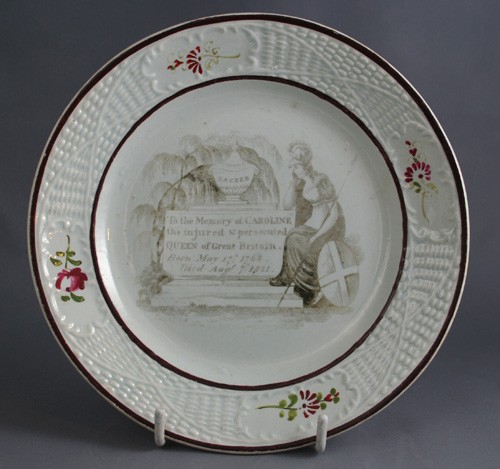
Another memorial to Queen Caroline

From the Hamburg papers, published September 5, 1821, in The Times:

“Brunswick, August 25:  Yesterday was performed here the funeral ceremony of the entrance and depositing of the body of the late Queen of England, with all the solemnity and attachment to the House of their Princes which characterises the brave Brunswickers….The citizens of Brunswick…drew the car to the church themselves….Immediately behind it followed several hundred merchants and citizens with tapers. Behind the train of the citizens followed the carriages of the English, Alderman Wood, Lord Hood, Lady Hamilton, Austin, etc. and several carriages belonging to persons of this city attached to the House of Brunswick…There were 20,000 persons who followed the royal corpse, and the greatest tranquillity and order prevailed during the whole of the funeral solemnity.  The church was hung with black, and 60 young ladies, all dressed in white with black sashes, received the corpse, and accompanied it, with wax tapers, to the vault. ”

Burial place of Caroline of Brunswick

Caroline is buried in the Brunswick royal tomb in the cathedral in Brunswick (in German, Dom St. Blasii et Johannis), a large Lutheran church in the city now known as Braunschweig.

Cathedral of St. Blaise and St. John, Braunschweig, Germany

Numerous volumes have been published about the life of Caroline of Brunswick, her trials and tribulations. Below, the 1996 biography by Flora Fraser, published by Knopf.


Ms. Fraser’s conclusion (p.466): “[Caroline’s] high-spirited, even reckless, response to her predicament brought her unprecedented liberty, as she confounded the machinations of her husband and of the governments in England and on the Continent to bring her to book. But in the end Caroline’s breathtaking audacity had fatal consequences, contributing to the loss of her daughter, her crown and her life.”

THE DEATH AND BURIAL OF QUEEN CAROLINE

Princess Caroline of Brunswick, Princess of Wales,  by Sir Thomas Lawrence, 1798 – Victoria and Albert Museum, London

The married life and death of Queen Caroline (1768-1821 were equally frenzied. Though she was never officially crowned, Caroline of Brunswick-Wolfbuttel was the wife of King George IV and thus, Princess of Wales and after the 1820 death of George III, the Queen of England.  She died on August 7, 1821,  just a month after her husband’s lavish coronation ceremony which she was physically restrained from attending.

Queen Caroline, ca. 1821, by James Lonsdale – National Portrait Gallery, London

For an account of her death, we turn to excerpts from a letter from Viscount Hood to Henry Brougham, M.P., who had represented the Queen at her recent trial and had gone to York to attend Assizes.

Brandenburgh House, 8th Aug., 1821.
“. . . The melancholy event took place at 25 minutes past 10 o’clock last night, when our dear Queen breathed her last. Her Majesty has quitted a scene of uninterrupted persecution, and for herself I think her death is not to be regretted. . . . She died in peace with all her enemies. Je ne mourrai sans douleur, mais je mourrai sans regret (I shall not die without pain, but I die without regret)  was frequently expressed by her Majesty. I never beheld a firmer mind, or any one with less feelings at the thought of dying, which she spoke of without the least agitation, and at different periods of her illness, even to very few hours of her dissolution, arranged her worldly concerns. . .”

George IV in Coronation Robes, by Sir Thomas Lawrence, 1821

King George IV learned the news of the death of his estranged — and  much despised — wife while on board a ship bound for his visit to Ireland.  Apparently illness had accomplished what he had tried to do so often in life — rid himself of Caroline.  Though there were rumors of poison and other nefarious plots, her death was officially ruled to be from natural causes.  George IV greatly resented the popular acclaim that Caroline enjoyed; she was a favorite of the people; they probably loved her mainly because they detested the Prince Regent/King and his profligate ways.

Even in death, Caroline left controversy in her wake, as expressed by our old friend, the Diarist Thomas Creevey:

Mr. Creevey to Miss Ord.

“Cantley, Aug. 11.
. . . The death of this poor woman under all its circumstances is a most striking event and gave me an infernal lump in my throat most part of Thursday. . . .  (There) is one subject which gives me some uneasiness in the making of her will, the Queen wished to leave some diamonds to Victorine, the child of Pergami, of whom she was so fond. This was not liked by Brougham and her other lawyers, so the bequest does not appear in the will ; but the jewels are nevertheless to be conveyed to Victorine. This, you know, is most delicate matter to be employed on her deathbed in sending her jewels from Lady Anne Hamilton and Lady Hood to Pergami’s child appears to me truly alarming. I mean, should it be known, and one is sure it will be so, for Taylor had a letter from Denison last night mentioning such a report, and being quite horrified at it. On the other hand, when I expressed the same sentiment to Brougham, he thought nothing of it. His creed is that she was a child-fancier: that Pergami’s elevation was all owing to her attachment to Victorine, and he says his conviction is strengthened every day of her entire innnocence as to Bergami. This, from Brougham, is a great deal, because I think it is not going too far to say that he absolutely hated her; nor do I think her love for her Attorney General (Brougham) was very great.”

Henry Brougham ( 1778-1868) advisor and attorney to Caroline, later Lord Chancellor of GB by Sir Thomas Lawrence, 1825

Creevey is referring to Victorine, the daughter of Caroline’s companion and perhaps lover, Pergami. She was one of several children Caroline doted upon during her lifetime, Whether any of them were her illegitimate offspring was widely discussed but never proved. Several were left legacies in her will.

Caroline, Princess of Wales, by Sir Thomas Lawrence, 1804, NPG

George IV was desperate to rid himself of his wife.  They had been estranged since shortly after their arranged marriage in 1795, even before the birth of their only child, Princess Charlotte of Wales (1796-1817).  Even after Charlotte’s lamented death in childbirth, Caroline had remained abroad, living in Italy until her husband became king. But when she returned to England, she faced an unpleasant situation.

Trial of Queen Caroline by Sir George Hayter, NPG

When  King George tried to divorce his wife in a trial before the House of Lords in 1820, Henry Peter Brougham (1778–1868), later 1st Baron Brougham and Vaux, defended her.  The fact that the case was later dropped gave him great prestige.  He became Lord Chancellor of Great Britain under King William IV.

Letter from Henry Brougham, M.P., to Mr. Creevey.

“Aug. 14, 1821.

DEAR C,
I have seen Lushington and Wilde repeatedly. They are at this moment in negociation with the Govt. ; or rather throwing up all concern with the funeral on account of this indecent hurry. Their ground is a clear one : they won’t take charge of it from Stade the port in Hanover to Brunswick without knowing that arrangements are ready to receive them. . . . The Govt., only wishing the speedy embarkation, as they avow, for the sake of not delaying the dinner at Dublin, insist on getting it on board as quick as possible, and don’t mind what happens afterwards. … I shall, I think, be satisfied with going to Harwich with it, and not go, as I had intended, to Brunswick.”

Poor Caroline. Though the people mourned her, only those required to accompany her body apparently wanted to do so.  She had requested burial in her native Brunswick.

Mr. Creevey to Miss Ord.

” Cantley, Aug. 18th.

“. . . Here is Brougham again. He has been at Harwich, where he saw the body of the Queen embarked about 3 o’clock on Thursday; and then immediately came across the country, and, after travelling all night, got here to dinner yesterday, and proceeds to Durham to-night to join the circuit there. I wish very much I had been at Harwich : according to Brougham’s account it must have been the most touching spectacle that can be imagined the day magnificently beautiful the sea as smooth as glass
our officers by land and sea all full dressed soldiers and sailors all behaving themselves with the most touching solemnity the yards of the four ships of war all manned the Royal Standard drooping over the coffin and the Queen’s attendants in the centre boat every officer with his hat off the whole time minute guns firing from the ships and shore, and thousands of people on the beach sobbing put aloud. … It was as it should be and the only thing that was so during the six and twenty years’ connection of this unhappy woman with this country. . . And now what do you think Brougham said to me not an hour ago? that if he had gone with the Queen’s body to Brunswick, it would have been going too far it would have been over-acting his part ; ‘ it being very well known that through the whole of this business he had never been very much for the Queen ! ‘ Now upon my soul, this is quite true, and, being so, did you ever know anything at all to equal it ?”

Apparently Mr. Creevey did not approve of Mr. Brougham’s dismissal of any affection for the lady he had served as adviser since 1812.

Engraving of funeral procession of Caroline, August 14, 1821, British Museum
Caroline had long been a popular figure with the masses.   During her funeral procession, riots broke out in the London streets.  We will continue reporting on Queen Caroline’s death and burial soon.

THE BREWER’S HORSE

From The Horse-World of London by William John Gordon (1893)

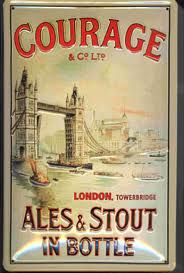
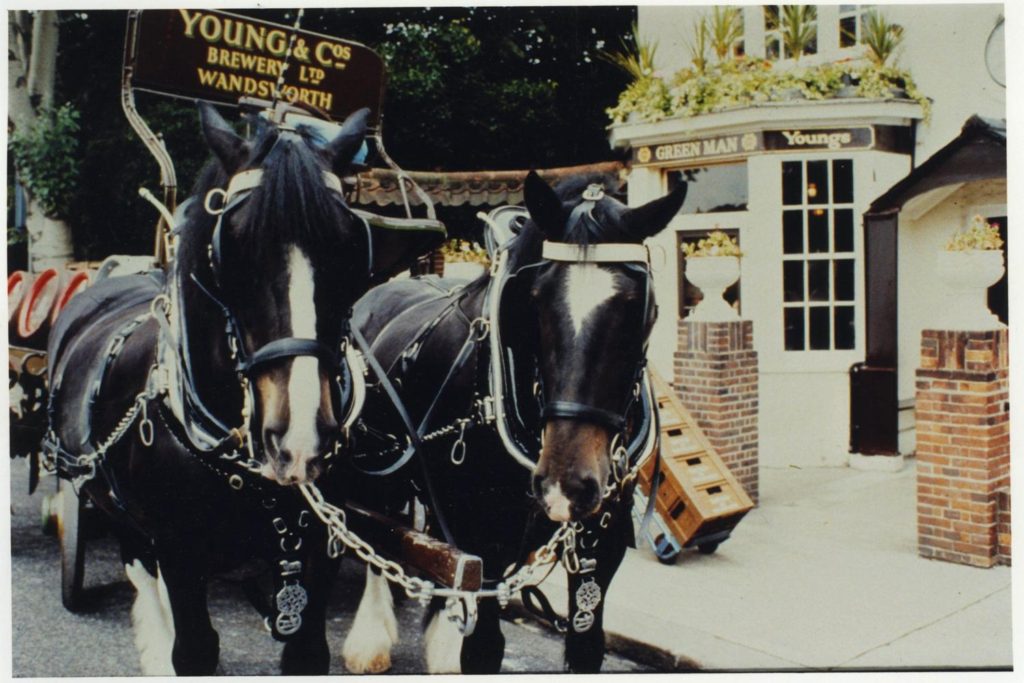
The brewer’s horse is a splendid animal, the most powerful as a rule of London’s heavy brigade. At the Cart-horse Parade, in which teams of all classes compete, the first, second, and third prizes were taken for the only two years in which they entered by Messrs. Courage, whose cast horses are generally sold for an average of 321. each, one of them having fetched fifty-one guineas, the highest price ever obtained for a horse cleared out of a stud as being past the work of the trade in which he made his first appearance in town. In fact, there is no stud in the kingdom of higher level excellence than that under Mr. Laird’s care at Horselydown, which is saying much, considering that the 3,000 horses owned by the larger London brewers are worth at the very lowest estimate 90L apiece.

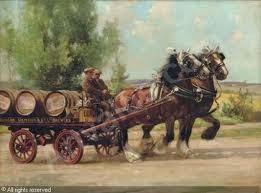
A barrel of beer weighs 4 cwt.; a brewer’s van carries 25 barrels, which means 5 tons; the van itself weighs not less than 35 cwt., some of them weigh over 2 tons; the harness weighs three quarters of a hundredweight; the men weigh—what? It is a delicate question. To answer it Mr. Laird weighed a drayman for us, a fine young man in his twenty-ninth year, he weighed 20 st. 10 lbs.! And the horse he drove, a five-year-old gelding standing 17*2 and still growing, was then put on the scale, and dipped the beam at just over the ton.

But this is hardly a fair average. Let us throw the men in with the sundries, and say these tremendous horses have to draw 8 tons; and this is for three horses worked unicorn fashion, two at the pole and one as leader. According to one horse-keeper, who had been twenty-seven years in his position, it now takes three horses to do the work that four did twenty years ago. ‘The vans have improved, the roads have improved, and the horses have improved, especially the horses’; but this is not the usual opinion, for even with the brewer’s horse the laudation of the past is the consolation of the many.

On most of these horses there is not a pound of superfluous flesh. They are working regularly every week-day, doing often their fourteen hours a day, sometimes doing sixteen hours, resting on Sundays, and having a light load on Monday, which is the brewer’s dull day; out at five o’clock in the morning, back into stable at seven at night; averaging six years of work; and then, in many cases, realising over 201. under the hammer when cleared out to make way for the newcomers.

Most of those under notice to quit look little the worse for wear, although perhaps their legs may have come over a little with the draught, which in the suburbs is severe, the load being no light one to drag over a hilly track at the brewer’s walking rate of five miles an hour easy. But it does not do for a team to have a weak horse, unless, maybe, the leader, who can shirk now and then if he chooses, for the rate of the slowest is ever the rate of progress; hence horses are worked together only so long as they work equally, and the weak one is rejected immediately he is found out, lest he should demoralise his companions.


There is a prevalent notion that hairy-legged horses stand heavy work better than others, but the value is not in the hair, but in the stout bone it should cover. One of Courage’s best horses is a Clydesdale, with his fore legs so fine, because fleshless and so thinly-haired, that the question has been asked if it was intended ‘to go racing with that animal’; but Clydesdales, though now improving every year, do not run quite heavy enough for brewers’ work, and nearly all the horses are shires. Some brewers—Barclay & Perkins, for instance —have nothing but shires in their stables; and this particular stud, a singularly fine one, averages seven and a half years of brewery life.

Of course all the brewers do not work their horses on the same system. Hoare’s, by way of example, work their 160 horses only five days a week, and no horse is allowed to be out more than ten hours without being examined by the horse-keeper. Their horses are bought at six years old and cleared out on the average at twelve, which is as soon as they show the least sign of decay; and there is not a horse in their stud weighing under 16 cwt. or standing under 17 hands, which compares rather awkwardly for the antiquarians with the 14 ‘handfuls’ which Henry VIII. fixed as the minimum of stallions in 1535. A range of twelve inches, unless the horses were of very different classes, seems too wide to be true. The thoroughbred racehorse increases a hand in height every century; in 1700 ho stood 13-2, he now stands 15-2; and it certainly looks as though the heavy horse had also grown a little.

It is noteworthy that these big horses should so very seldom have bad tempers; they are almost as intelligent as dogs, and quite as amiable. They are in rude health, it is true, and that may account for their being comfortable and pleased with themselves, more especially as they are kept hard at regular work, but it is scarcely enough to answer for their peculiar placidity under all circumstances.

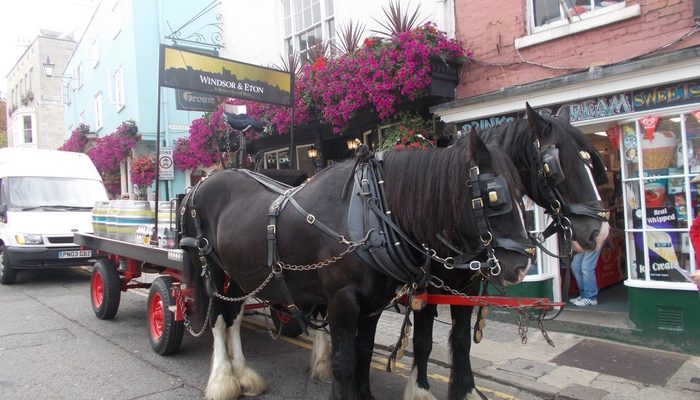
Kristine and Victoria can personally attest to the fact that beer is still being delivered by horses in Windsor – as seen outside the Horse and Groom, opposite St. George’s Chapel.

The one great secret of keeping them in condition is attention to their feet. There is no animal more carefully shod than a brewer’s horse. Many of them have a different make and shape of shoe on each hoof. At Courage’s, for instance, no such things as standard sizes are known; the shoe is always made specially to fit the foot, and the shoes are never thrown away, but are mended—soled and heeled, in fact—by having pieces of iron welded into them again and again as they are worn. Some of the shoes are steel-faced; some are barred, the shoe going all round the foot; some have heels, some have toes; some have one clip, some have two; in fact, there are almost as many makes of shoe as there are in a Northampton factory.

SCOTLAND – BEYOND THE RETREAT

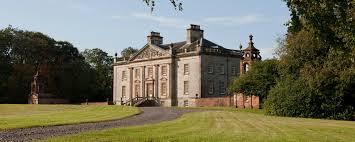
Auchinleck House

It won’t be long now before the start of Number One London’s Scottish Writer’s Retreat. Our group will be staying at Auchinleck House, family seat of James Boswell’s family, above. A fitting setting, really, as he and Dr. Johnson were known to have stayed in the house together several times.

But “retreat” may be a bit of a misnomer, as our group will be doing much more than staying in to write; we’ll be touring the surrounding area, visiting nearby estates, museums and places of historic interest. Perhaps we should rename it “The Tour to Inspire Writers?” One of the most inspiring items on the Retreat itinerary will be our visit across the water to the wildly romantic Isle of Arran, as seen in the video below.

While our September Retreat has been sold out for quite some time, we’ve added another for 2019 – details can be found here.