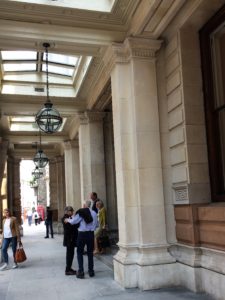
I recently visited the new addition to the Royal Academy in London and concentrated on the addition of the building at 6 Burlington Gardens to the campus, in a very sympathetic renovation.
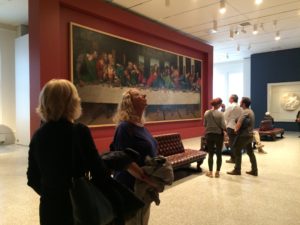
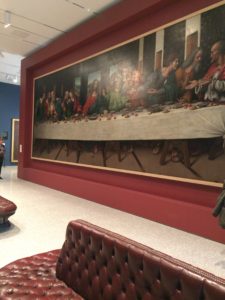
An exhibition showing early works, founding members, and methods of teaching emphasized learning to paint and sculpt by copying great works of art, as seen in the first part of this post. Another great work of art used for copying purposes was Leonardo de Vinci’s Last Supper in a copy made in the 16th century by the master’s students. It was purchased and hung in the RA in 1817 as an inspiration for the students and fellows.
Copy of The Last Supper
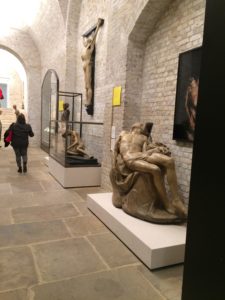
Several copies of works by Michelangelo were included in a section of the exhibition called “Michelangelo as Muse.”
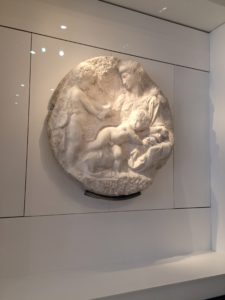
The Taddei Tondo, a.k.a. The Virgin and Child with the infant St. John
In the words of current RA President Christopher Le Brun, “The Taddei Tondo has become one of the great icons of the Royal Academy. Many people consider it to be one of the greatest works of sculpture in the UK.”
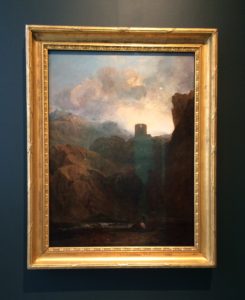
J.M.W. Turner, Dolbadern Castle, North Wales, 1800
Turner’s Diploma work, given permanently to the RA as all academicians must do when elected, depicts a remote Welsh castle; He accompanied it with a poem:
How awful is the silence of the waste,
Where Nature lifts her mountains to the sky,
Majestic solitude, behold the tower
Where hopeless Own, long imprison’d, pined.
And wrung his hands for liberty in Vain.
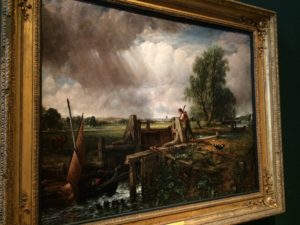
John Constable, The Lock, 1834
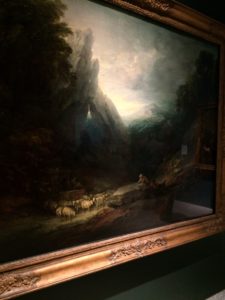
Like Turner, Constable was more inspired by nature and landscape than by studying great works of art. Although Gainsborough was better known for his portraits than his landscapes, he too preferred to work from nature.
Thomas Gainsborough, Romantic Landscape 1783
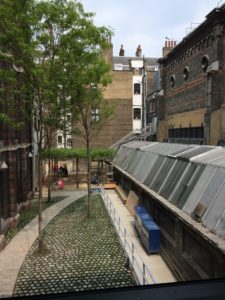
The new part of the RA is connected to the old part by walkways and bridges, allowing outdoor spaces for the students as well.
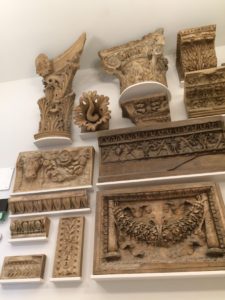
Architectural fragments from the vaults are found in hallways, for the use of architectural students, as are casts of famous statues as examples for sketching.
Venus de MiloFarnese Hercules
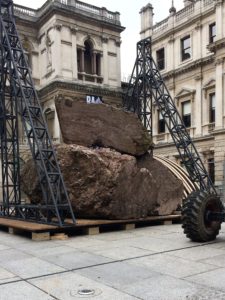
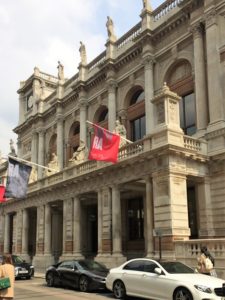
“Old” fans of the Royal Academy will be pleased to know that the Burlington House section remain much as before with exhibition galleries, the Fine Rooms, and other features still in evidence, as well as provocative new offerings from the latest artists.
The familiar facade of Burlington House in PiccadillyPreparing for the Annual Summer Exhibition
I look forward to visiting in July to see the entire display: 250 years of the Summer Exhibition. Good show, RA!
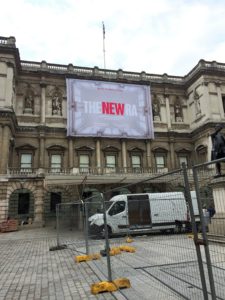
After two hundred fifty years, the Royal Academy of Arts (RA) is celebrating its anniversary by adding an adjacent building to increase its exhibition space. The new look, not quite completed, opened May 19, 2018. I visited on May 24 and was delighted with newly added facilities. The annual Summer Exhibition will open June 12, 2018.
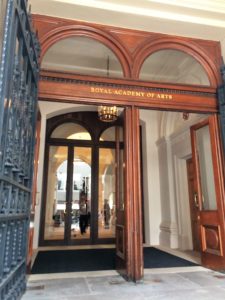
Burlington Gardens Entrance
The newly added building once held the Museum of Mankind, located “behind” the Piccadilly site of Burlington House, home of the RA since 1868. The Museum of Mankind, an adjunct of the British Museum, moved out of the building in 2004. The RA subsequently bought it and held a competition for a design to merge the two structures. After a complicated series of setbacks, the eventual winner, architect David Chipperfield succeeded admirably. More building pictures are below, after the story of one of the opening exhibitions I enjoyed so much.
The exhibition The Making of an Artist: The Great Tradition intrigued me. As a researcher into the art and architecture of the Georgian, Regency, and Victorian periods, I was familiar with many of the early RA fellows, but had never seen the works shown, drawn from the vaults of the RA.
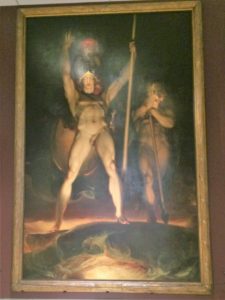
Satan summoning his Legions 1796-97 by Sir Thomas Lawrence, RA
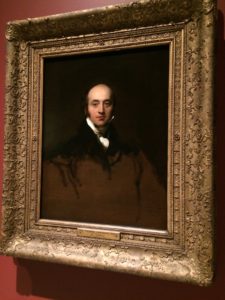
The huge, almost monumental painting leads the visitor into a selection of works by some of the earliest members. Lawrence, largely self-taught, studied briefly at the RA before earning fame as a portraitist and becoming a full member. He was the fourth president of the RA.
Thomas Lawrence, RA, self-portrait, c.1820
At the beginning of the exhibition, a text panel explains The Royal Academy Foundations: In 1768 a group of painters, sculptors and architects convinced King George III to support the creation of the Royal Academy of Arts. Their aim was to improve the quality of art in Britain and to raise the status of British artists and architects. The new Academy had three key functions that continue today:
Run an art school, training the next generation of artists
Hold an exhibition, selling contemporary art annually, now the Summer Exhibition
Elect as Royal Academicians a small number of leading painters, sculptors and architects (and eventually printmakers)
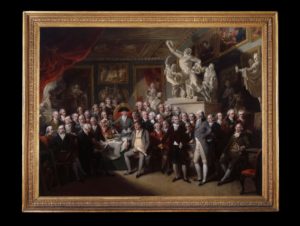
Royal Academicians by Henry Singleton, 1795, picture from the RA
The full title is The Royal Academicians Assembled in their Council Chamber to Adjudge the Medals to the Successful Students in Painting, Sculpture, Architecture and Drawing. In the back row are the two female founding members, Angelika Kauffmann and Mary Moser. They were not allowed to participate in the life drawing classes.
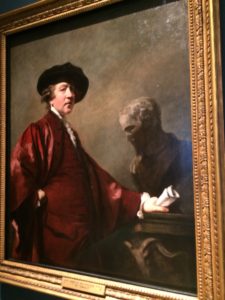
First RA President, Joshua Reynolds, Self Portrait, c. 1780
The esteemed portraitist Joshua Reynolds was elected the first RA President.
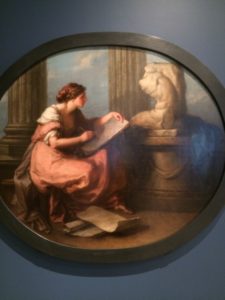
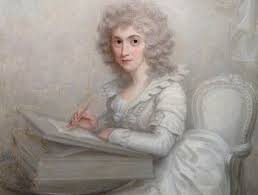
Angelika Kauffmann, among the founding members of the Royal Academy
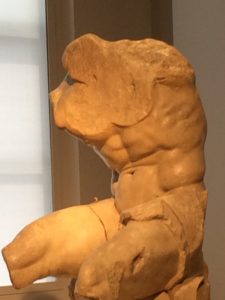
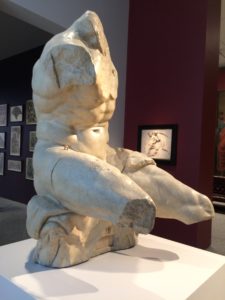
Kauffmann is shown sketching the torso, one if many sculptures or copies used as models by RA members and students to hone their drawing skills. The torso, like others of its ilk, has been in the possession of the RA for 250 years. It stands nearby, seen below in two views.
Note how the light changes the hue of the photograph, according to the angle.
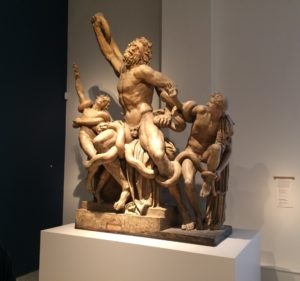
In the painting of the RA members above, you will see a model of the Laocoon, an ancient Greek statue used for the same purpose as the torso. The exhibition asks the question: “Does great art begin with studying nature, or studying great art of the past?” One must decide for oneself! But Reynolds considered the study of great art essential for artists.
Cast of Laocoon and his Sons, from a Roman version of a Greek original, c. 10-20 AD
Part Two, further adventures at the RA, coming soon.
It is my pleasure to introduce you to Mrs. Simpson, cook at the Regency Town House in Hove, who has kindly consented to write us a letter regarding herself and her seaside slice of England.
Dear Mesdames. January 16 1830.
Having but lately come to the art of reading and writing, I have not had cause as yet to write a letter. Even if I had though, ‘twould not have been a letter to a group of Ladies, I’m sure! I feel that honoured to be asked to write this, though I know not what a Cook in Sussex might say to interest Ladies from the New World. By rights, methinks, ’tis you honoured Ladies who should be writing to me, to instruct me in how life is lived in the Colonies.
Later: I have just been speaking with Mary-Ann. She be Ladies Maid to our Mistress and so, – especially in The Season – meets lots of maids from other countries. She has just informed me that people Over There cannot abide to be referred to as from “The Colonies”. So please excuse any other mistakes I may make: ’tis from pure ignorance and not malice, I do assure you.
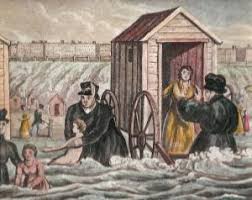
Well then: – the town I live in be called Brighton and be in the County of Sussex. ‘Twas an old fishing village until the time of my Great-Grandam.
But then came here an Indian gentleman. Mary-Ann says there be Indian people Over There too, but they be not of the same make as this Gentleman who came from the large country which gave us cotton. But there! Now she says too there is cotton grown where you live as well, so I know not how this difference between our Indian Gentleman and your Indian people comes about. No doubt ’tis some distinction from the world of Men which doth not interest me much: – the world of Women be far less complicated, it seems to me.
Howsomever, what does this Indian Gentleman do when he arrives in our ancient village (for that ’twas all it was before-times) but to tell the Gentry that there be properties in the water and the air here which do bring about good health and that only he knows the way of it, which is through natural spring waters and sea-bathing!
Now this be not a tarry-diddle I am certain-sure; for all who live in coastal towns and hamlets do indeed fare well and so any Woman with The Knowledge can say. (In case not many of our sort hath ventured to your shores, I should explain that The Knowledge is that which is passed down from certain women to woman through the ages as to healing, and easing pain, and all Women’s Matters – of which these God-rotted Barber-Surgeons and Men-midwives are surpassingly ignorant!)
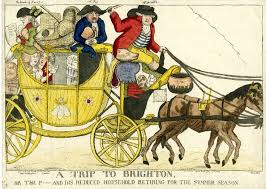
Well, once he hath hung his shingle and claimed to have the Healers knowledge did a very stampede of the sickly gentry whip up their horses and have themselves carried to Brighton. Ho! The old folk say there was a veritable procession of gouty Land-Owners, and syphillictic Young Bloods, and addle-pated Old Ladies,all of whom needed victualling,some and accommodation and a BathHouse, and the fortunes of the ordinary folk began to prosper.
But what changed the fortunes of all was when our putridly plump Princeling and his accompanying Mistresses and cronies and Macaroni Boys did come to visit. Which they did because Gorgeous George – as folk did name him locally – was a veritable treasure trove of ailments such as gout and pox and liver complaints; and the flux and the sweats and lethargy.
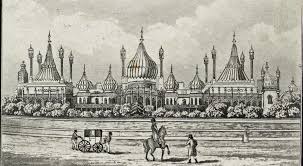
Now, this pallid Prince hath many a castle and home to his name, but nothing would do for it than that he build the most whimsical, fairy-like palace in all Christiandom, methinks, right in the middle of our town!
And from then on there were no way of keeping out all the gentry, and their attendants, and their friends, and the Soldiers, and the hangers on, and the miliners and mantua makers, and cobblers and hosiers (and Uncle Tom Cobly and all, I shouldn’t wonder) and Brighton be now a real city!
In fact it be whispered abroad that this new-made invention of the Steam Train will be put on a service from London to Brighton – so people could take that long, rumbly journey here and back again in ONE day!! I scarse believe it, myself.
Mary-Ann hath also told us that in the Col…excuse me…”Over There” you have no Royalty or Gentry at all, but that a families station in life depends singly on the money they have? Oh how we did laugh, the two of us!! For ours do depend on Breeding: for all the world as though they was prime bloodstock horses or hounds! And as for money? Half the Gentry in England sit in their crumbling manors, eating of bread and cheese and trying to marry off their chinless progeny to the highest bidder simply in order to make the roof sound again!
But there! I know not what more to say and have taken up much of your time, I’m sure, that you could be putting to better cause. Howsomever, do any of you gentle women have a query or a quiz for me to address, I should consider it a right honour to respond as best I can.
With humble felicitations,
Yours faithfully,
Mrs. Simpson, Humble Cook of Brighton, England.
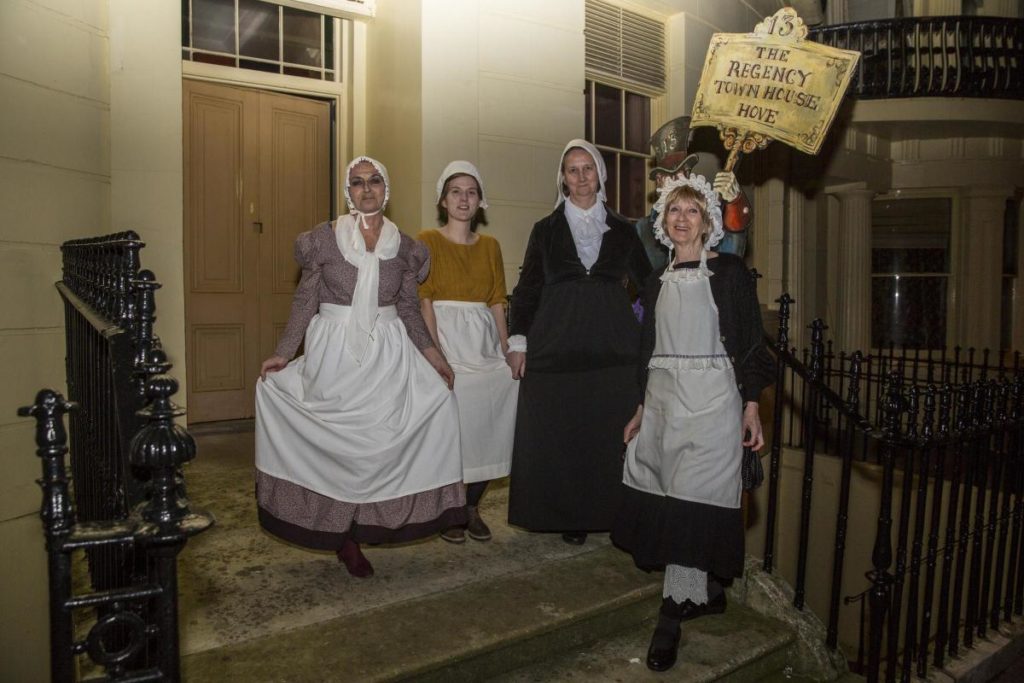
Here I be, a-making of my curtsy, with our two scullions and our Housekeeper, Mrs. Ainslie.
We’ll be meeting Mrs. Simpson in person on Number One London’s 2020 Regency Tour, when we visit the Regency Town House in Hove – complete itinerary here.
A Coloured Canvas, Lives, loves and losses in the artistic heart of Regency England
This is a novel about Sir Thomas Lawrence but, as the sub-title suggests, it is much more than a biography of the 18th/ 19th century portrait painter who was only six when he started impressing patrons at his father’s Black Bear Inn by sketching their pictures. The story is full of engaging characters and is told with humour and insight into the world of Regency Bath and London in the years from the American and French Revolutions, through the Napoleonic Wars and the accession of George IV to the coming of the railway, but it touches also on some of the political events and personalities of the era.
All sorts of people stopped at the Black Bear on their way from London to Bath, among them actors including David Garrick and, perhaps, the young Sarah Siddons, as yet unknown but on her way to becoming the leading tragedienne of the period. Did he draw her likeness then? Did she recognise in the boy and herself potentials for greatness? Was that the beginning of the long and tempestuous relationship between the renowned artist and the Siddons family?
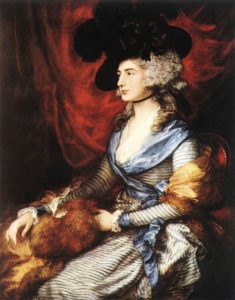
Sarah Siddons
Using extensive research into letters, newspapers and comment of the time, I explored the influence his father and many close friends exerted on Lawrence’s career as it developed from West country sketcher to portraitist of Kings and Queens, Popes and Emperors, Prime Ministers, distinguished ladies, diplomats and sportsmen. I singled out some of his subjects for their particularly intriguing stories. Among those are the beautiful but confused Mr Bell, the unprepossessing but clever Irish politician, Mr Curran, the irascible artist, Henry Fuseli, neither rival nor admirer. Children and their pets were particular favourites as of course were members of the Siddons/ Kemble family.
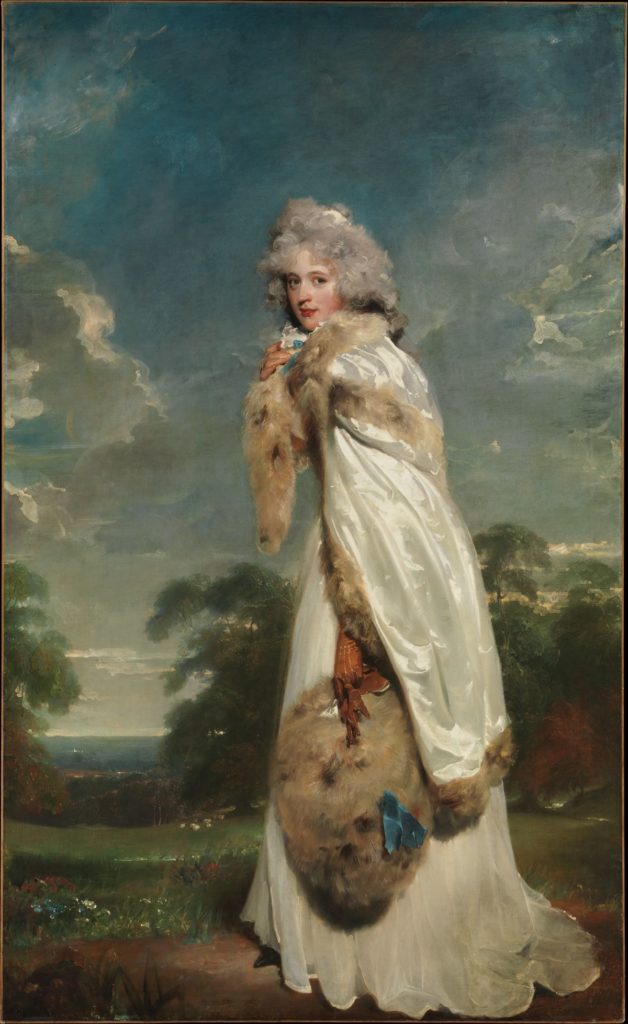
Elizabeth Farren, later Countess of Derby, by Sir Thomas Lawrence, 1790
Every year from 1789 when he was twenty, his work was to be seen at the Royal Academy Exhibition. His best known studies though not always his best liked were ‘Pinky’, a wintry portrait of Miss Elizabeth Farren and the gigantic ‘Satan’ in which he blended the most imposing features of two friends: the handsome head of actor John Philip Kemble and the powerful body of champion boxer ‘Gentleman’ John Jackson.
The distinguished career was not without its problems. Despite his huge output and ever-increasing income, he was never out of debt and yet he was known to be far from profligate in his personal life. His family, which he supported, not unwillingly, for most of his life, was a financial burden; he spent, often unwisely, on works of art and the latest domestic innovations like a plumbed (but cold water) bath. His friends and advisers, Joseph Farington and John Julius Angerstein helped him organize his budget and kept him out of the bankruptcy court.
And throughout his life at all its stages, Sarah Siddons, her actor brothers Kemble, her husband-manager William who disliked and disapproved of Thomas, and above all her two daughters, sweet Sally and selfish Maria, contenders for his love in their different ways. An intense, difficult triangle that drove him to the brink of madness—or was it a quadrangle? Lawrence was to live out his life as a bachelor, his name, probably but not certainly, platonically linked with several women. His friendship with Sarah Siddons diminished but endured till his death at the age of 60 in 1830.
Note: A Coloured Canvas is available on both Google Books and Amazon. Corille was born in Scotland, lives in Australia and has a background in theatre and radio. You can visit her website here.
The following correspondence is from The Despatches, Correspondence, and Memoranda of Field Marshal Arthur, Duke of Wellington
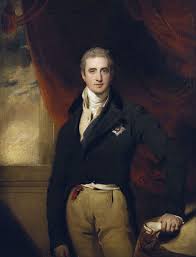
Robert Stewart, Viscount Castlereagh, Lord Londonderry
Wellington’s letter to Mr. Bankhead
London, 9th Aug.. 1822
Dear Sir: I called upon you with the intention of talking to you about Lord Londonderry, and of requesting you would call upon him. He promised me that he would send for you, but, lest he should not, I entreat you to find some pretence for going down to him. I entertain no doubt that he is very unwell. It appears that he has been overworked during the session, and that his mind is overpowered for the moment and labours under a delusion. I state the impression made upon me in the interview I have just had with him. I told him that this was my impression, and I think it is his own, and he will probably communicate it to you; but, lest he should not, I tell you what I think, begging you never to mention to anybody what I have told you. I am setting out this moment for the Netherlands; I would have stayed with Lord Londonderry, but he would not allow me. I shall be very much obliged to you if you will write me a line and have it left at my house to let me know how you find him, and particularly if you think I am mistaken.
Ever, dear Sir, yours most faithfully,
Wellington
Mr. Bankhead to Field Marshall the Duke of Wellington
Lower Brook Street, 9th Aug., 1822
My Lord,
I am this moment (8 o’clock) returned to my own house from Lord Londonderry’s, where I have been for two hours; and I lose not a moment in answering the letter which your Grace has condescended to write to me. Thirty years intimacy with Lord Londonderry makes me know his peculiarities intimately. His nerves are never unstrung unless when he has some bodily indisposition. I conceive that at this moment he has a preternatural fullness of the vessels of the head, and that this (rather than the wear and tear of work) makes him nervous. I have had him cupped, and he experiences the greatest possible relief in the feelings of his head and of his mental competency.
He is gone down to Cray with Lady Castlereagh, and I purpose to see him there to-morrow. Perhaps a feverish affection of a few days may follow this casual derangement of the system, but knowing the natural soundness of Lord Londonderry’s constitution, I have no doubt but that by quietness and ordinary care of a few days he is likely soon again to be reinstated in his general health.
I know that Lady Londonderry has written a few lines to your Grace before she left St. James’s Square.
I have the honour to be,
your Grace’s most obedient humble servant,
Charles Bankhead
To the Duke of Wellington from the Marchioness of Londonderry
Lady Amelia Anne Hobart, Marchioness of Londonderry
London, 9th Aug., 1822.
My Lord: From your kind feeling with respect to Lord Londonderry I am sure you will be glad to hear that he saw Bankhead, who ordered him to be cupped. The blood resembled jelly, and he was instantly relieved, and I have hopes that he will be well in a few days; but I really think he was upon the verge of a brain fever.
Yours most sincerely,
A.Londonderry
Lord Fitzroy Somerset, afterwards 1st Baron Raglan
Lord Fitzroy Somerset to Field Marshal the Duke of Wellington.
London, 12th August, 1822.
My Dear Lord
It is with great concern that I have to announce to you the melancholy intelligence of the death of Lord Londonderry, which took place, by his own hands, this morning between seven and eight o’clock.
I enclose a copy of Bankhead’s statement, which will show you what occurred from the time you first sent him to attend Lord Londonderry, and will prove to you that you were right in the apprehensions you expressed to Bankhcad that his mind was not what it ought to be.
Lord Liverpool, whom I saw as soon as he arrived from Combe Wood, desired me to communicate this lamentable event to you, and to express to you his wish that you should return to England immediately. He is in the greatest distress. His first idea was to set off for Scotland immediately, and break the intelligence to his Majesty himself; but upon reflection he has thought it best not to leave London, but to depute Mr. Peel to do that office for him. He laments your absence amazingly, and would have requested you to go to the King if you had been in the way. As it is, however, his Majesty is better prepared for the shock than anybody else, for he mentioned to Lord Liverpool on Saturday, that he had seen Lord Londonderry the day before, and was quite convinced that he was not right in his mind, and that he felt great alarm for the consequences of the break up of such a mind as Lord Londonderry’s.
Lord Liverpool has written to the King, and entreated his Majesty not to make any arrangement for filling Lord Londonderry’s office till his return from Scotland, assuring him that
he will keep the machine going till that time in the best way he can.
I understand from Bankhead that Lady Londonderry apprehended the possibility of Lord Londonderry’s making away with himself, and placed everything out of his reach that she thought him likely to make use of; but unfortunately he had in one of his despatch-boxes the knife with which eventually he put an end to his life. He had got up in the night and gone into the dressing-room to wash his face, and then returned quietly to his bed.
I presume you will be able to arrive here between Thursday and Friday. Lord Liverpool looks forward to your return with great anxiety. Lord Westmorland and Lord Maryborough are the only ministers in town. The latter would have written to you, but Lord Liverpool has employed him to write to Lord Harrowby and Lord Wellesley; and as I am writing, he thinks it unnecessary to do so.
Your most faithful and affectionate,
Fitzroy Somerset
Enclosure-
Fife House, 12th Aug., 1822.
From the time Dr. Bankhead first saw Lord Londonderry on Friday evening last he was satisfied that his head was seriously affected, and that he laboured under very general mental delusion. He had been cupped in his house in St. James’s Square on that evening, from which he seemed much relieved; and in the quiet of the evening Lord and Lady Londonderry went down to Cray, Dr. Bankhead promising to follow them the next day, and to stay at Cray all Sunday. On Friday night Lord Londonderry was restless, and asking many questions during the night, which manifested incoherence and delirium. On Saturday morning he took some opening medicine which Dr. Bankhead had sent him, remained in his bed all the day, and was kept particularly quiet, using slops only as nourishment, and barley-water as drink.
When Dr. Bankhead arrived at Cray in the afternoon of Saturday he found Lord Londonderry rather better from the favourable operation of the cooling medicine, but still there was heat and fever, great thirst, and an unusual watchfulness and suspicion of manner, and a constant anxiety lest he should not be well enough to go abroad in the appointed time. He asked several questions very irrelevant and quite at variance with his usual calm manner. In the night of Saturday he had some refreshing sleep, but on the whole of Sunday his fever still continued, as well as the delirium and unhappiness of mind and manner. Dr. Bankhead quitted his room about midnight, leaving his Lordship tolerably comfortable, and Lady Londonderry in the room with him, both retiring to rest. Dr. Bankhead slept in a room close to his Lordship, and on the morning of this day, about 7 o’clock, Lady Londonderry’s maid called him, saying that Lord Londonderry wished to see him. Dr. Bankhead instantly repaired to the bedroom, but found that his Lordship had that moment gone into the dressing-room adjoining to the bedroom. On entering this instantly, the Doctor saw Lord Londonderry standing opposite to the window with his face to the ceiling, having on his dressing-gown. The Doctor immediately ran towards him, saying, “My dear Lord, why do you stand so?” upon which, without turning, he answered, “Bankhead, let me fall upon your arm; it is all over.” In the agony of the moment, Dr. Bankhead caught him on his arm, and, dreadful to relate, saw a short-bladed knife in his right hand fiercely clenched, with which he had deeply divided the carotid artery; and from the sudden effusion of blood he fell instantly from Dr. Bankhead’s arms on his face upon the floor, and was instantly dead without a struggle.
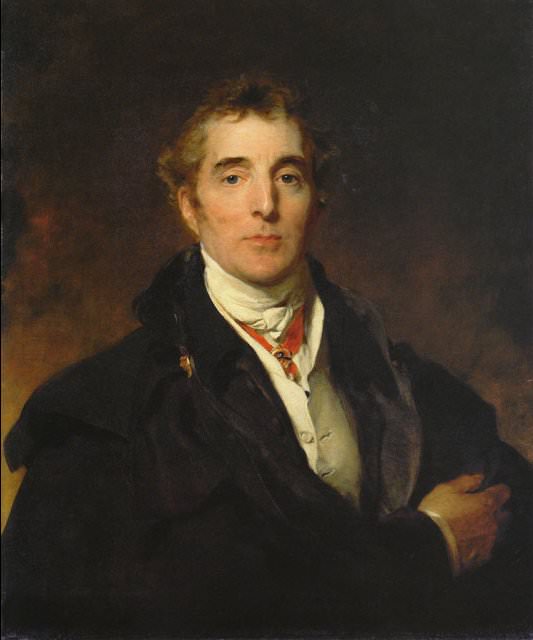
The Duke of Wellington
The Duke then wrote:
13th Aug., 1822.
I saw Lord Londonderry frequently during the last days of his life.
I dined with him on Saturday, the 3rd of August, at Cray, and sat next to him at dinner. There was a very large party, and I thought Lord Londonderry was in particularly good spirits at dinner.
I had occasion, both before and after dinner, to talk to him on subjects on which the delusions of his mind would have appeared, if he had at that time laboured under any. They related to certain anonymous letters received by Mr. Arbuthnot and others of the Treasury, which were known to come from a person by the name of Jennings, who had been under examination before a committee of the House of Commons; and although I thought Lord Londonderry was cold in his manner on the subject of some of these letters, which was not unusual with him, I never saw him more decided or more clear in his opinion. I saw a letter from him to Mr. Arbuthnot on the same subject the next day, Sunday, the 4th of August, in which he expressed himself with more than usual clearness and decision.
I did not see Lord Londonderry on Monday the 5th, but on Tuesday the 6th he came to the Ordnance office early, to a meeting of certain persons to consider of the means of reforming the commissariat in Canada. Upon this occasion I thought him very low. He took no part in the discussion, and manifested no interest in it. After the meeting had broken up he waited to talk to Mr. Arbuthnot and me about Jennings’s letters, about which he showed that he felt more than I thought he had on the preceding Saturday, but there was no appearance of agitation respecting them.
I met Lord Londonderry at the Cabinet on Wednesday the 7th of August. The subject of discussion was the instructions for himself on his mission to Vienna. Lord Liverpool read them to the Cabinet, and there was some discussion upon them; but Lord Londonderry took no part in the discussion, and he appeared very low, out of spirits, and unwell. There was, however, no appearance of agitation. After the Cabinet was over I went into Mr. Beckett’s, and after leaving him I met Lord Londonderry as he was coming out by the back door of his office. We walked together through the Park and the Ordnance office to his own house. Lord Londonderry was remarkably low and silent. He held me by the arm, but scarcely said a word; but there was no symptom of agitation.
After leaving him at his door I returned to my office, and in about half an hour went to Carlton House to take leave of the King previous to my departure for the Netherlands. I found Lord Londonderry at Carlton House. The King was gone out, and I walked with Lord Londonderry back to his own house, where I left him. He was equally low as before.
I had occasion, in about an hour afterwards, to go to my own house, and as I was returning down the Park I stopped to speak to his Royal Highness the Duke of York, who was in his buggy. Lord Londonderry came up the Park on horseback, and joined us, and in a few seconds I left him and the Duke of York together; he then appeared very low and out of spirits.
I did not see him on Thursday the 8th of August.
On Friday the 9th I was proceeding on horseback through St James’s Square from the Ordnance office to my own house, to set out for the Continent at about four o’clock in the afternoon. Lady Londonderry called to me, and was talking to me from her window, when Lord Londonderry passed me in rather a quick and hurried pace, and told me he wanted to speak to me. I followed him into his house and his room.
I cannot give a better account of what passed in this interview than by copying a letter which I wrote to Mr. Arbuthnot (who had left London that evening) immediately after it was concluded, before I set out for Dover:—
Charles Arbuthot
London, 9th August, 1822.
My Dear Arbuthnot
“I am just setting off, but I cannot go without making you acquainted with the impression made upon my mind by an interview I have just had with Lord Londonderry.
“It appears to me that his mind and body have been overpowered by the work of the session, and that he is at this moment in a state of mental delusion. He took me into his house to talk to me about the same story that he told to you and to Lord Liverpool; and, strange to say, he imagined from my manner at the last Cabinet and afterwards walking home with him that I had heard of something against him and believed it. He thought the same of the Duke of York; and he told me some strange story of a man telling him this day that his horses were waiting for him when he was coming out of Carlton House, of his not having ordered his horses to town, and of the arrival of the horses, and of his being informed of their arrival, as proofs that the person who had ordered up his horses, and that the person who informed him they were waiting, thought there was so much against him that he ought to fly the country. This impression was so strong upon his mind that he rung the bell to desire that inquiry might be made as to who had ordered up his horses, and the delusion was not removed till he was informed that the horses were not in town.
“He is certainly very unwell, and I did not conceal from him my opinion that he was so, and that his mind was not in its usual and proper state. I offered to stay with him, but he would not allow me, as he said it would make people believe that there was some reason for it. I begged him to send for Dr. Bankhead, and, between ourselves, I have informed Dr. Bankhead that it is my opinion that he is labouring under a temporary delusion. He cried excessively while talking to me, and appeared relieved by it and by his conversation with me, and he promised me to see Bankhead.
“I am afraid that he has mentioned the story above referred to, to more persons than Lord Liverpool, you, and me. I have entreated him to say no more about it to anybody, but I fear he will.
“I write you all this in order to urge you to see him as soon as you can after you will return to London and observe him well, and see if his mind is quite right. If it is not, and he should go abroad, I think you ought to make him take Bankhead with him; and, if that is not accomplished, I think you ought to mention the matter to Planta. Otherwise, it is my opinion that this impression of mine should never go beyond ourselves.
“He is quite clear and right about public matters, but agreed with me that his mind had been overpowered by the work of the session, and that he was labouring under a delusion.
“Destroy this letter, and believe me, etc. Wellington.”
The remains of the noble Marquess, after lying in state for several days, were removed from his house in St. James’s Square, followed by the Ministers of State, principal Nobility, and private friends of his Lordship, in carriages, and interred, with funeral pomp, in Westminster Abbey, on Thursday, the 22d of August, 1822.