Part Three of our series focuses on Comic Reads and, really, one can’t help but opening with P.G. Wodehouse . . . . can one?

P.(Pelham) G.(Grenville) Wodehouse is best known (and loved) for his comic novels, which include the Jeeves and Wooster series and the Blandings Castle series. If you think of Stephen Fry and Hugh Laurie when you hear “Jeeves & Wooster,” I’m here to tell you that the unlikely pair began life as characters in Wodehouse’s books, including What Ho, Jeeves, Carry On, Jeeves and Jeeves and the Feudal Spirit, to name but a scant few. Wodehouse’s books, characters and plots are just plain silly and, boy, do we love them. Prepare to stretch the limits of belief, to suspend reality and to chuckle aloud. Bertie Wooster invariably gets himself into a bind (money, girls, relatives, etc.) and Jeeves gets him out – whether Bertie ever learns about Jeeves’s involvement or not. One thing Bertie is not clueless about is his dependence upon Jeeves, which this passage from Jeeves and the Hard Boiled Egg clearly illustrates:
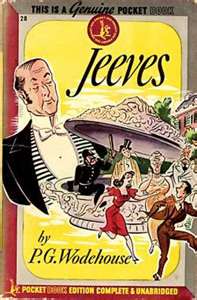
Sometimes of a morning, as I’ve sat in bed sucking down the early cup of tea and watched my man Jeeves flitting about the room and putting out the raiment for the day, I’ve wondered what the deuce I should do if the fellow ever took it into his head to leave me. It’s not so bad now I’m in New York, but in London the anxiety was frightful. There used to be all sorts of attempts on the part of low blighters to sneak him away from me. Young Reggie Foljambe to my certain knowledge offered him double what I was giving him, and Alistair Bingham-Reeves, who’s got a valet who had been known to press his trousers sideways, used to look at him, when he came to see me, with a kind of glittering hungry eye which disturbed me deucedly. Bally pirates!
The thing, you see, is that Jeeves is so dashed competent. You can spot it even in the way he shoves studs into a shirt.
I rely on him absolutely in every crisis, and he never lets me down. And, what’s more, he can always be counted on to extend himself on behalf of any pal of mine who happens to be to all appearances knee-deep in the bouillon. Take the rather rummy case, for instance, of dear old Bicky and his uncle, the hard-boiled egg.
Read more here and once you’ve finished, you can visit The World of P.G. Wodehouse here and the P.G. Wodehouse Society here. And what a backlist! For Sebastian Faulks’ take on Jeeves’s place in popular fiction, click here.
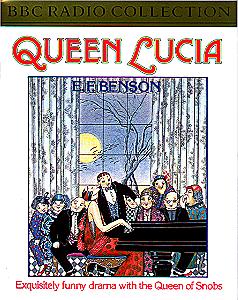
If Wodehouse is literary slapstick, E.F. Benson’s humour is subtle – his characters don’t realize that they’ve received a proverbial pie in the face until several pages on. Social one-upsmanship is rampant, and Mrs. Emmeline Lucas, known to her friends as Lucia, has artistic pretensions and exchanges Italian phrases with her consort, the perennial bachelor Georgey Pilson, alongside whom she can often be found practising the piano. Lucia’s adversary is Miss Elizabeth Mapp, who once ruled as the town of Tilling’s social queen until Lucia moved in and displaced her. Let the games begin. For a taste of just how far Lucia will go where pretension is concerned, here’s a passage from Queen Lucia, in which Lucia returns to her new home in Tilling: “Something of the consciousness of her sovereignty was in her mind, as she turned the last hot corner of the road and came in sight of the village street that constituted her kingdom. Indeed it belonged to her, as treasure trove belongs to the Crown, for it was she who had been the first to begin the transformation of this remote Elizabethan village into the palace of culture that was now reared on the spot where ten years ago an agricultural population had led bovine and unilluminated lives in their cottages of grey stone or brick and timber. Before that, while her husband was amassing a fortune, comfortable in amount and respectable in origin, at the Bar, she had merely held up a small dim lamp of culture in Onslow Gardens. But both her ambition and his had been to bask and be busy in artistic realms of their own when the materialistic needs were provided for by sound investments, and so when there were the requisite thousands of pounds in secure securities she had easily persuaded him to buy three of these cottages that stood together in a low two-storied block. Then, by judicious removal of partition-walls, she had, with the aid of a sympathetic architect, transmuted them into a most comfortable dwelling, subsequently building on to them a new wing, that ran at right angles at the back, which was, if anything, a shade more inexorably Elizabethan than the stem onto which it was grafted, for here was situated the famous smoking-parlour, with rushes on the floor, and a dresser ranged with pewter tankards, and leaded lattice-windows of glass so antique that it was practically impossible to see out of them. It had a huge open fireplace framed in oak-beams with a seat on each side of the iron-backed hearth within the chimney, and a genuine spit hung over the middle of the fire. Here, though in the rest of the house she had for the sake of convenience allowed the installation of electric light, there was no such concession made, and sconces on the walls held dim iron lamps, so that only those of the most acute vision were able to read. Even then reading was difficult, for the book-stand on the table contained nothing but a few crabbed black-letter volumes dating from not later than the early seventeenth century, and you had to be in a frantically Elizabethan frame of mind to be at ease there. But Mrs Lucas often spent some of her rare leisure moments in the smoking-parlour, playing on the virginal that stood in the window, or kippering herself in the fumes of the wood-fire as with streaming eyes she deciphered an Elzevir Horace rather late for inclusion under the rule, but an undoubted bargain.”
For an in-depth article on these characters and the series, read the Philip Hensher article here. You’ll find the E.F. Benson Society’s website here.

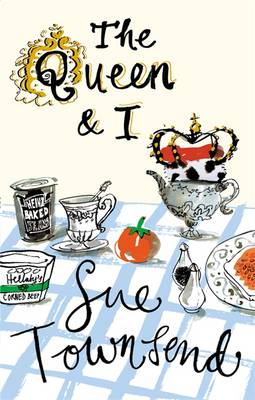 Sue Townsend set Victoria’s sense of humor zinging with her hilarious book The Queen and I. Somehow, the characters of Queen Elizabeth, the Duke of Edinburgh, and the Queen Mother rang completely true when I first read it back in 1992. After they became non-royal in the fictional republic, they seemed quite natural. I completely bought the idea that Liz would turn into an excellent cook with the cheapest cuts of meat and that the Duke of E. would be very upset that Liz wanted to be known as Mrs. Windsor rather than Mrs. Mountbatten from now on.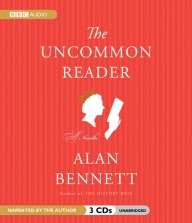
Another book featuring royalty is Alan Bennett’s The Uncommon Reader, a novella by the writer of the Tony-winning play The History Boys and The Madness of King George, this story has the Queen discovering the joys of reading through a palace kitchen worker named Norman. Soon, Her Majesty’s preoccupation with literature leads to fears of senility amongst royal insiders. If they thought the Queen’s reading a book was bad, just wait till they learn she means to write one . . . . .
Part Four Coming Soon!