Anecdotes of Sheridan from the Pen of Thomas Creevey


Richard Brinsley Sheridan

“. . . Sheridan entered into whatever fun was going on at the Pavilion as if he had been a boy, tho’ he was then 55 years of age. Upon one occasion he came into the drawing-room disguised as a police officer to take up the Dowager Lady Sefton for playing at some unlawful game; and at another time, when we had a phantasmagoria at the Pavilion, and were all shut up in perfect darkness, he continued to seat himself upon the lap of Madame Gerobtzoff [?], a haughty Russian dame, who made row enough for the whole town to hear her.
“The Prince, of course, was delighted with all this; but at last Sheridan made himself so ill with drinking, that he came to us soon after breakfast one day, saying he was in a perfect fever, desiring he might have some table beer, and declaring that he would spend that day with us, and send his excuses by Bloomfield for not dining at the Pavilion. I felt his pulse, and found it going tremendously, but instead of beer, we gave him some hot white wine, of which he drank a bottle, I remember, and his pulse subsided almost instantly. . . . After dinner that day he must have drunk at least a bottle and a half of wine. In the evening we were all going to the Pavilion, where there was to be a ball, and Sheridan said he would go home, i.e., to the Pavilion (where he slept) and would go quietly to bed. He desired me to tell the Prince, if he asked me after him, that he was far from well, and was gone to bed.
So when supper was served at the Pavilion about 12 o’clock, the Prince came up to me and said: “‘ What the devil have you done with Sheridan to-day, Creevey? I know he has been dining with you, and I have not seen him the whole day.’
“I said he was by no means well and had gone to bed; upon which the Prince laughed heartily, as if he thought it all fudge, and then, taking a bottle of claret and a glass, he put them both in my hands and said:
“‘ Now Creevey, go to his bedside and tell him I’ll drink a glass of wine with him, and if he refuses, I admit he must be damned bad indeed.’
“I would willingly have excused myself on the score of his being really ill, but the Prince would not believe a word of it, so go I must. When I entered Sheridan’s bedroom, he was in bed, and, his great fine eyes being instantly fixed upon me, he said :— “‘ Come, I see this is some joke of the Prince, and I am not in a state for it.’
“I excused myself as well as I could, and as he would not touch the wine, I returned without pressing it, and the Prince seemed satisfied he must be ill.
“About two o’clock, however, the supper having been long over, and everybody engaged in dancing, who should I see standing at the door but Sheridan, powdered as white as snow, as smartly dressed as ever he could be from top to toe. . . . I joined him and expressed my infinite surprise at this freak of his. He said:
“Will you go with me, my dear fellow, into the kitchen, and let me see if I can find a bit of supper.’


Kitchens at the Royal Pavilion, Brighton
“Having arrived there, he began to play off his cajolery upon the servants, saying if he was the Prince they should have much better accommodation, etc, etc, so that he was surrounded by supper of all kinds, every one waiting upon him. He ate away and drank a bottle of claret in a minute, returned to the ballroom, and when I left it between three and four he was dancing.
In the year 1810, Mrs. Creevey, her daughters and myself were spending our summer at Richmond. Sheridan and his wife (who was a relation and particular friend of Mrs. Creevey’s) came down to dine and stay all night with us. There being no other person present after dinner, when the ladies had left the room, Sheridan said : “‘A damned odd thing happened to me this morning, and Hester [Mrs. Sheridan] and I have agreed in coming down here to-day that no human being shall ever know of it as long as we live; so that nothing but my firm conviction that Hester is at this moment telling it to Mrs. Creevey could induce me to tell it to you.’
“Then he said that the money belonging to this office of his in the Duchy being always paid into Biddulph’s or Cox’s bank (I think it was) at Charing Cross, it was his habit to look in there. There was one particular clerk who seemed always so fond of him, and so proud of his acquaintance, that he every now and then cajoled him into advancing him £10 or £20 more than his account entitled him to. . . . That morning he thought his friend looked particularly smiling upon him, so he said:—
‘”I looked in to see if you could let me have ten pounds.’
“‘Ten pounds!’ replied the clerk; ‘to be ‘sure I can, Mr. Sheridan. You’ve got my letter, sir, have you not?’
“‘ No,’ said Sheridan, ‘what letter?’
“It is literally true that at this time and for many, many years Sheridan never got twopenny-post letters,* because there was no money to pay for them, and the postman would not leave them without payment.
“‘Why, don’t you know what has happened, sir?’ asked the clerk. ‘There is £1200 paid into your account. There has been a very great fine paid for one of the Duchy estates, and this £1200 is your percentage as auditor.’
“Sheridan was, of course, very much set up with this £1200, and, on the very next day upon leaving us, he took a house at Barnes Terrace, where he spent all his £1200. At the end of two or three months at most, the tradespeople would no longer supply hi
m without being paid, so he was obliged to remove. What made this folly the more striking was that Sheridan had occupied five or six different houses in this neighbourhood at different periods of his life, and on each occasion had been driven away literally by non-payment of his bills and consequent want of food for the house. Yet he was as full of his fun during these two months as ever he could be—gave dinners perpetually and was always on the road between lames and London, or Barnes and Oatlands (the Duke of York’s), in a large job coach upon which he would have his family arms painted.”
* The charge at this time for letters sent and delivered within the metropolitan district was only 2d., payable by the recipient; but country letters were charged from l0d. to 1s. 6d. and more, according to distance.

The Windsor Dioramas by Guest Blogger Hester Davenport

A few years ago in Sebastopol in the Crimea I walked around a compelling recreation of a moment in the siege of the city during the Crimean war where the closest figures are almost life-size. This kind of model is called a diorama. In Windsor Museum we have our own diorama of a siege but ours in on a small scale, as are the others which pinpoint moments in the town’s history. They’re like miniature theatres, in glass-fronted cases and lit from above, all of them lively and dramatic, where you almost expects the tiny figures to continue the actions they’ve just begun.


Part of a diorama showing the barons attacking Windsor Castle in 1216
© Windsor Museum

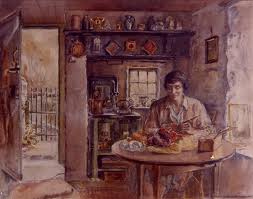
The Windsor dioramas were commissioned in the 1950s from two friends, Judith Ackland and Mary Stella Edwards. They had met when at Regent Street Polytechnic in 1919, where they studied art, and afterwards they set up a home and studio together in a cottage called The Cabin, on the beautiful North Devon coast.


The Cabin at Bucks Mills
appledorearts.org

For many years they spent the summers travelling, painting landscapes and selling their art, but after the Second World War, perhaps feeling they were too old for gipsy living, they started a new career making dioramas. After meticulous research into their subjects Mary painted the backgrounds, while Judith made the figures. She developed her own way of modelling figures which she called ‘Jackanda,’ using wire and compressed cotton-wool. Remarkably she could not only position her figures in a life-like way, but even on a miniature scale – each figure measures around 10 cms – she could create expression and in the case of historical characters recognisable portraits.


Judith Ackland at work by Mary Stella Edwards
Bucksmillscabin.blogspot.com


The Windsor commissions came about after one of their dioramas was shown in the Guildhall as part of a Florence Nightingale centenary exhibition. The enlightened local council then asked the women to create a diorama for 1957, which would mark 350 years since John Norden’s map of Windsor in 1607.

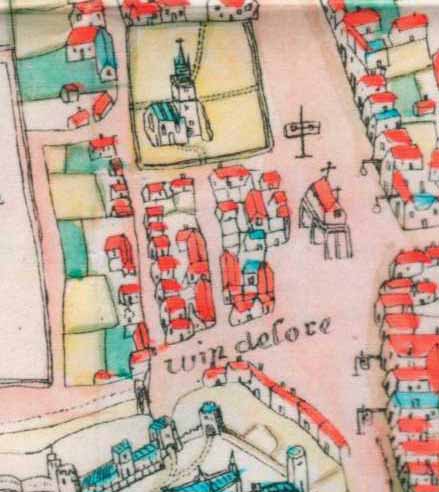
Detail of John Norden’s 1607 map of Windsor
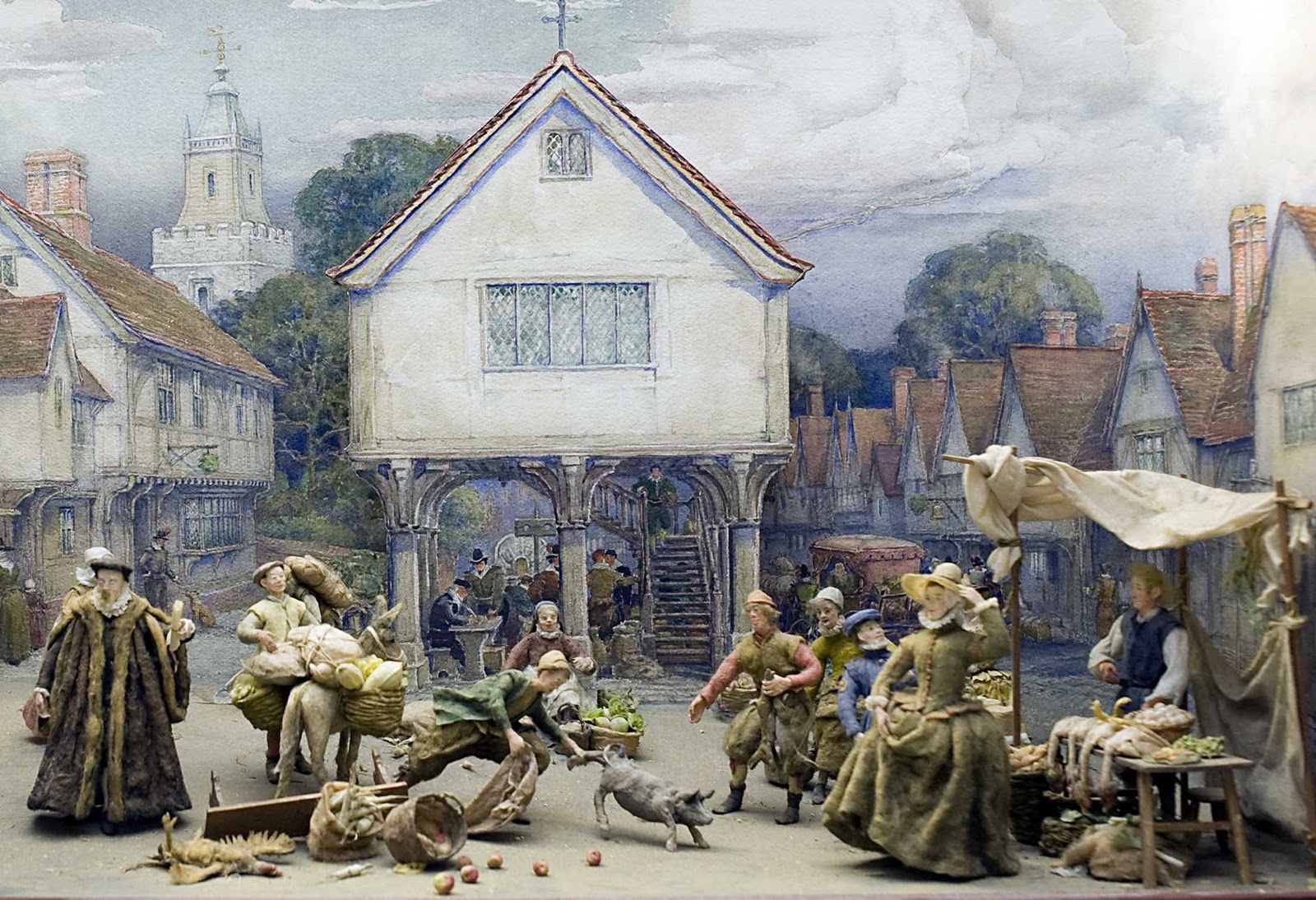
It was the first map of the town and shows the recently-built Market Hall (1596), with the old parish church behind. You can also see the pillory where wrong-doers were punished by being forced to stand pinioned by their neck and wrists, enduring cat-calls and, if unlucky, well-aimed fruit and vegetables (our Museum has a model pillory for visitors to stick their heads in, and a basket of fruit and veg., luckily fluffy, for friends and relations to throw).

Windsor Market-place in 1607 © Windsor Museum

The women peopled their market scene with imagination: a pig has made a bid for freedom, overturning a stall. Vegetables cascade across the ground and a plucked chicken lies with its feet in the air. There are other stalls, a group of women churning butter and behind them a butcher’s shop. An elderly man in a fur-edged robe, oblivious to the mayhem, must be someone important, perhaps the Mayor. A well-dressed woman with her page pulls her skirts out of the way.

Every detail has been researched, even to the type of coach seen in the background. One of the clever aspects of these dioramas is the way three-dimensional modelling merges with two-dimensional figures and landscape without any sharp division.
So successful was this scene that the women were asked to make another, and the following year they produced Windsor Bridge in the year 1770, again carefully researched.

Windsor Bridge in 1770

It’s a windy day, washing is blowing on a line and the women crossing the bridge have to hang on to their hats. An artist sitting at the corner
sketching is recognisably Paul Sandby, who painted many Windsor scenes including the bridge.

Paul Sandby sketching by Watkins William Winn
museumwales.ac.uk

The river is imagined running across the front of the diorama, and a boy is fishing in it. Masts of the barges which carried goods up and down the river can be seen, and bargees with their horses which hauled the boats along. Above looms the Castle, as it was in 1770, when the Round Tower was short and squat.

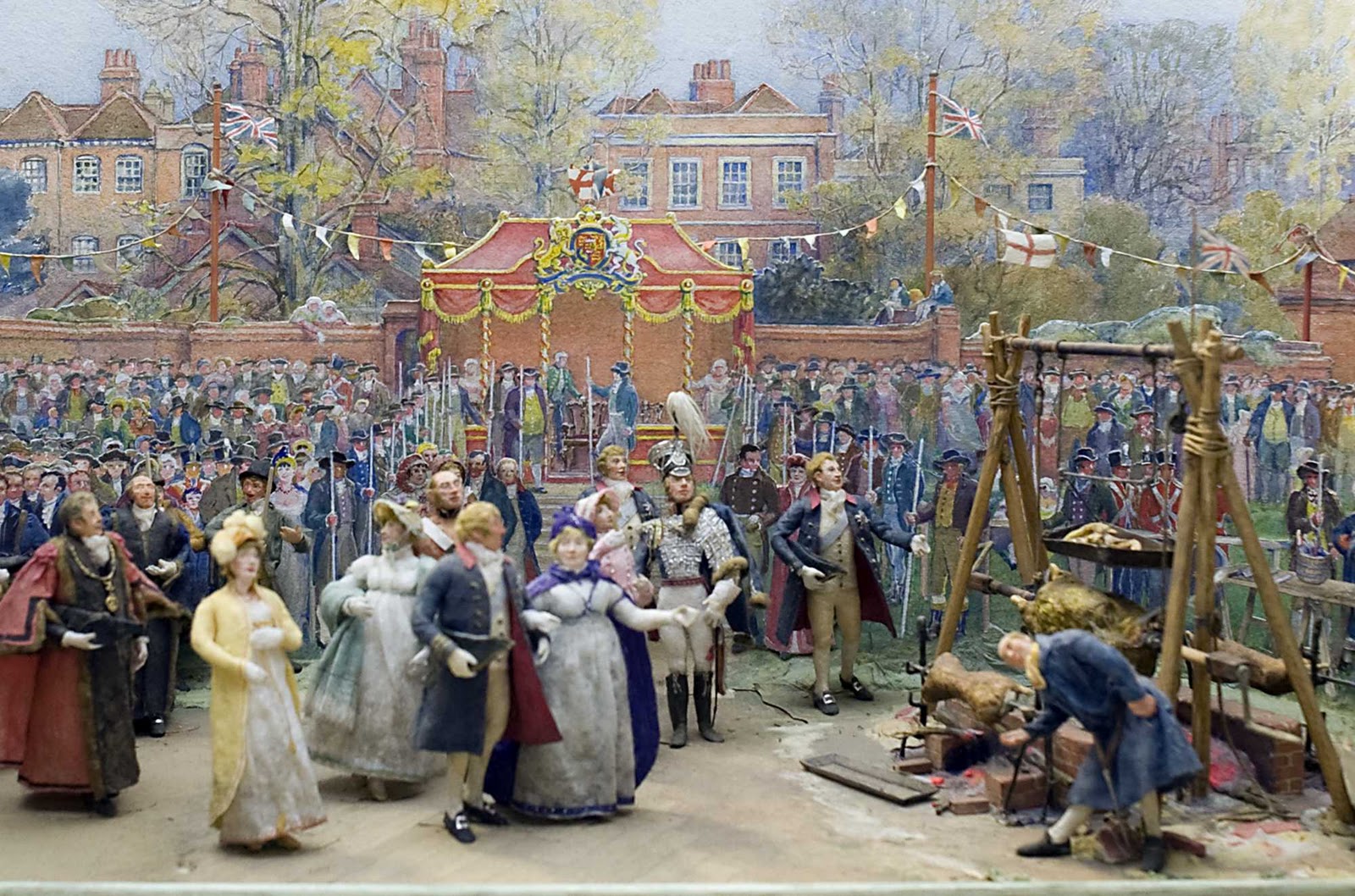
A year on and the women produced their most ambitious work: the Golden Jubilee celebrations of George III in Bachelors’ Acre in 1809, 150 years after the event.
On 25 October, when George III entered the 50th year of his reign, rejoicing was nationwide. In Windsor the so-called Bachelors of Windsor organised an ox-roast on the Acre – the name of this piece of open ground is thought to come from a time when butts were set up there for young men to practice their archery. Unfortunately the King, in his 71st year, lame, deaf and of poor sight, was too infirm to attend, but at one o’clock Queen Charlotte arrived on the arm of her second son, Frederick Duke of York, with most of her other children in tow (the Prince of Wales was also absent as he shunned public appearances because of his unpopularity over his treatment of his wife Caroline of Brunswick). The Mayor is in his robes, with the Corporation all dressed in blue with white wands of office. Even the cook had been given a blue smock and white silk stockings.
All the figures were researched from portraits in the Royal Collection. Princess Augusta is on the left in yellow, plump Princess Elizabeth is in blue, with the Duke of Kent, Queen Victoria’s father behind her, Princess Sophia is in pink with the really bad sheep of the family, the swaggering Ernest Duke of Cumberland at her side in uniform (he was believed to harbour incestuous thoughts about his sister Sophia and less than a year later suspected of killing his valet.) The Duke of Sussex is behind him. The royal party graciously partook of slices of the meat served on silver dishes, before retiring to the garden at the back for a ‘cold collation.’
Unfortunately because of its complexity and the illness of one of the women, the Jubilee diorama was late in delivery and over-budget. So for the next one, the Council laid down strict rules, and consequently it is the least detailed.

It shows the siege of Windsor Castle in 1216. After King John had failed to keep to the terms of Magna Carta (1215), the furious barons invited Prince Louis of France to take the English throne. Much of southern England fell into their hands, but Windsor Castle held out and after three months the attackers withdrew (they should have waited as King John died not long afterwards).

Once more, the Castle, the armour and weapons of war were meticulously researched. (It’s a pity you can’t see the horses behind the tents in the photo.) This is the diorama on show at the new Museum at the moment and the other three will take their turns. There are dressing-up clothes of the period for children, and one little boy was proud to have spotted the man who is collapsing with an arrow fired from the Castle walls in his neck.

Note the men lighting a bonfire against the Castle walls to weaken them.
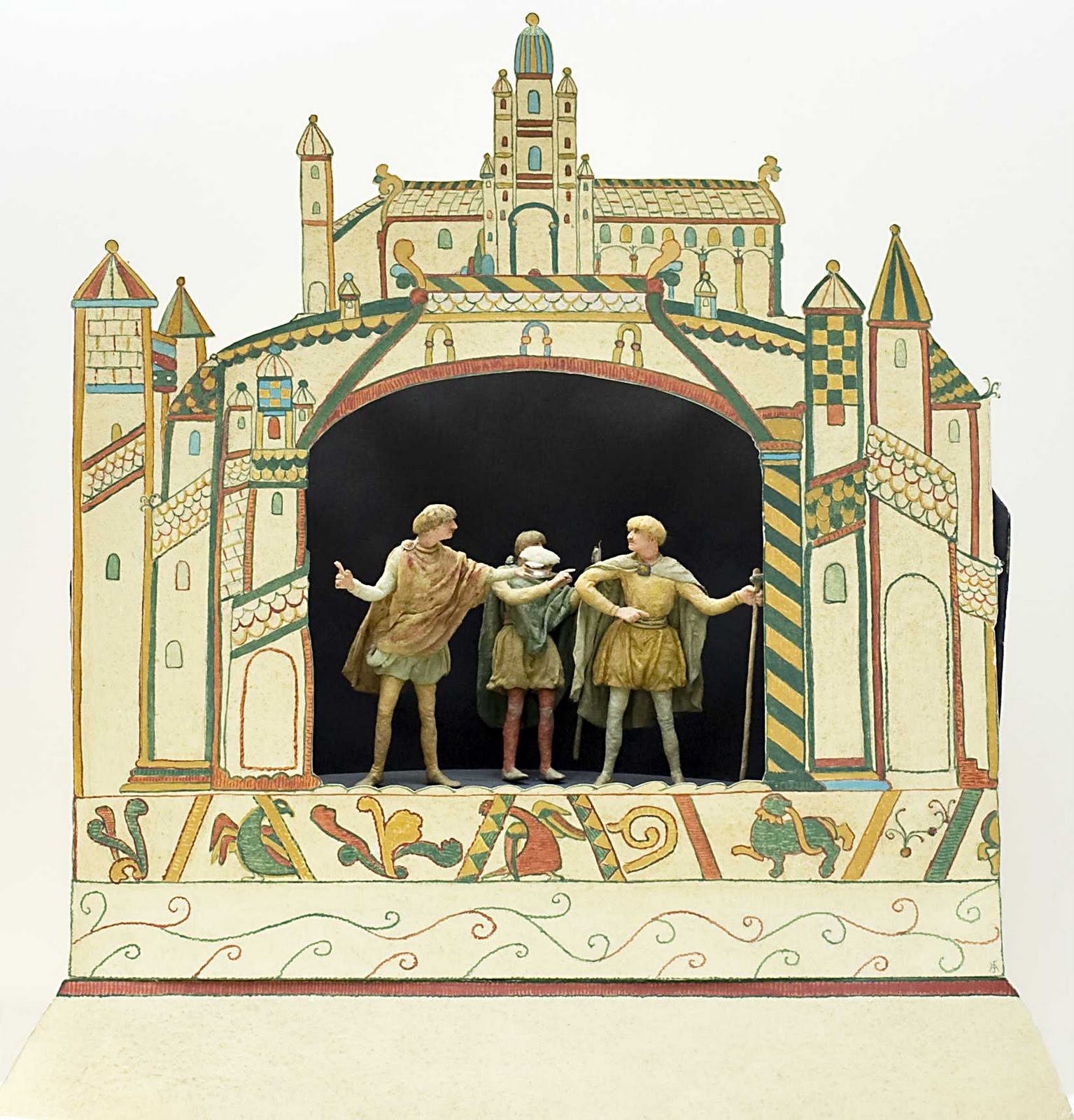
Judith and Mary made other dioramas for Windsor, though they are simpler in scope, including one not in a case and with only three figures, which celebrates the Bayeux Tapestry.

Judith Ackland died in Devon in 1971. Thereafter Mary Stella Edwards organised exhibitions of her friend’s work and moved to what had been her family home in Staines, not far from Windsor, where she died in 1989. (The Cabin was kept as it was, and is now part-owned by the National Trust.) It had been a remarkable partnership and one we are proud to display in our Museum.

Mary Stella Edwards by Judith Ackland

Mary Stella Edwards and Judith Ackland

Yale's Beinecke Rare Book Library

On March 4, 2011, I visited the Beinecke Rare Book and Manuscript Library on the Yale University campus with Diane Gaston and her kind DH who drove us up from Washington, D. C. I have written several times in the last month about our visit to the exhibition Thomas Lawrence: Regency Power and Brilliance at the Yale Center for British Art. We didn’t have time for a lot more on our visit to New Haven, CT, but we did take a turn around the very fascinating Beinecke Rare Book Library, just a few blocks from the YCBA. Jim Perkins snapped this of the two intrepid researchers on our way across campus.

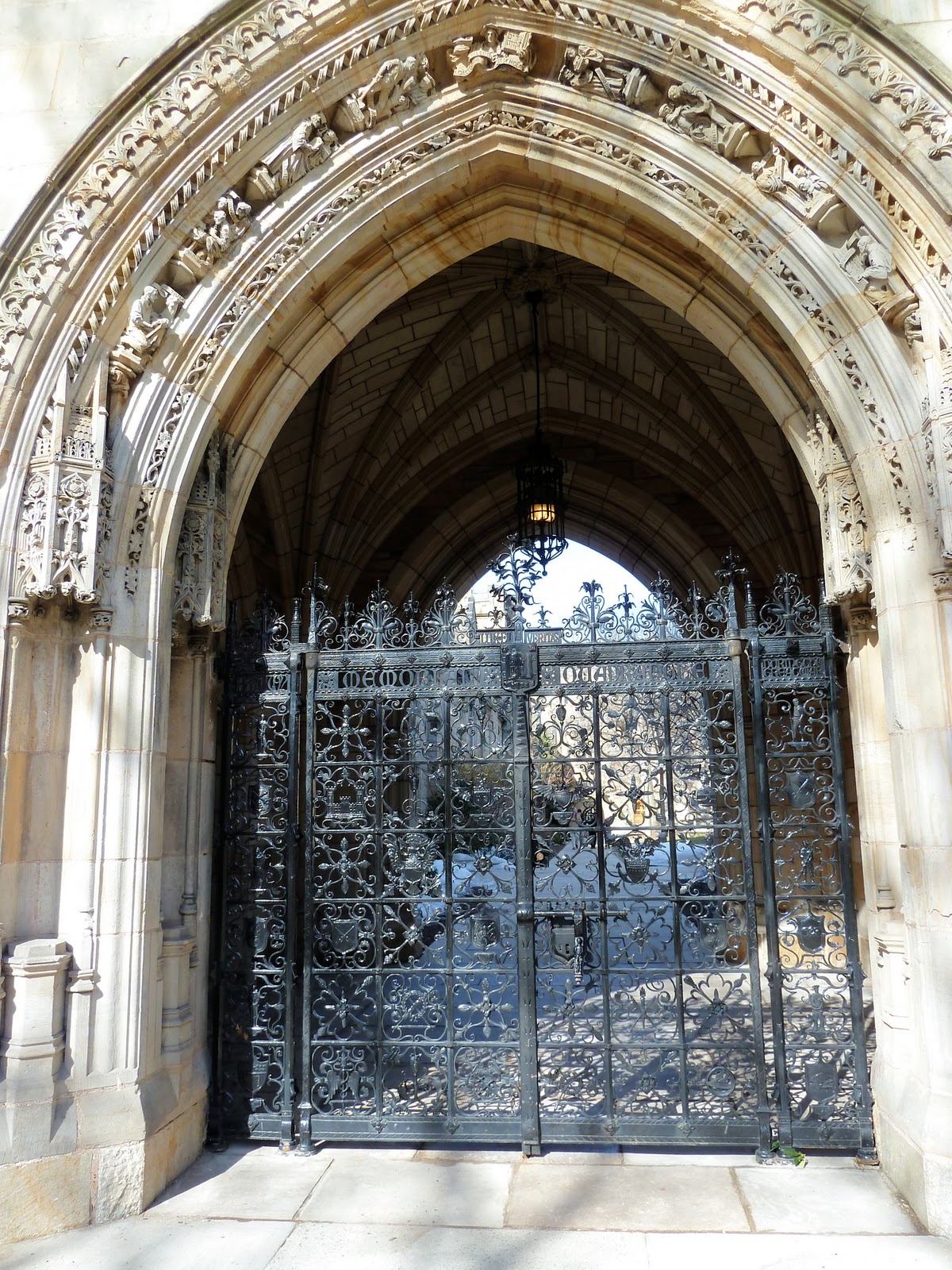
The Yale campus is renowned for its Gothic architecture, such as this tower, but it also has many modern buildings, some of which are truly masterpieces of contemporary architecture by some of the world’s leading practitioners. The neo-Gothic buildings are quite beautiful if hardly practical in today’s technological age. 

Peeking through this elaborate gate, one could expect to see dedicated students and brilliant professors in the same rarefied atmosphere of the greatest universities — it almost could be Cambridge or Oxford’s dreaming spires.  Alas, we did not have time to investigate  and any students we  saw were either hurrying along with their phones to their ears — or practicing jumps on their skateboards. 

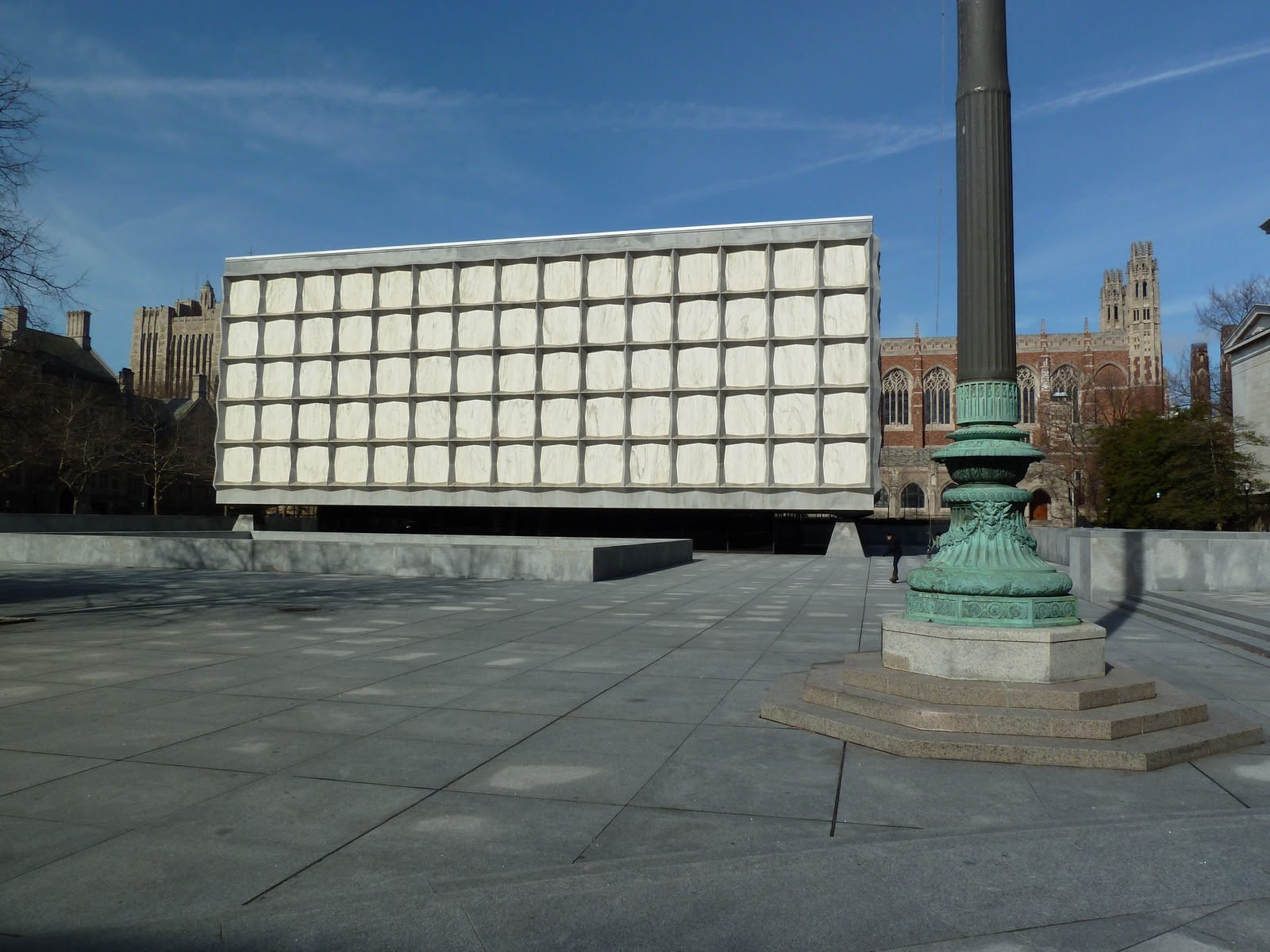
Nevertheless, we were a bit disappointed when we came upon the Beinecke’s building. While the proportions were good, it looked rather bland, a grid upon a white surface without embellishment.  It was designed by Gordon Bunshaft (1909-1990), of Skidmore Owings and Merrill, a student of the 20th century’s greatest architects such as Mies van der Rohe.  Bunshaft also designed Lever House, on NYC’s Park Avenue, the Hirshhorn Museum of the Smithsonian Institution in Washington, D. C.,  and other iconic buildings. But we quickly changed our opinions when we entered this magnificent structure.

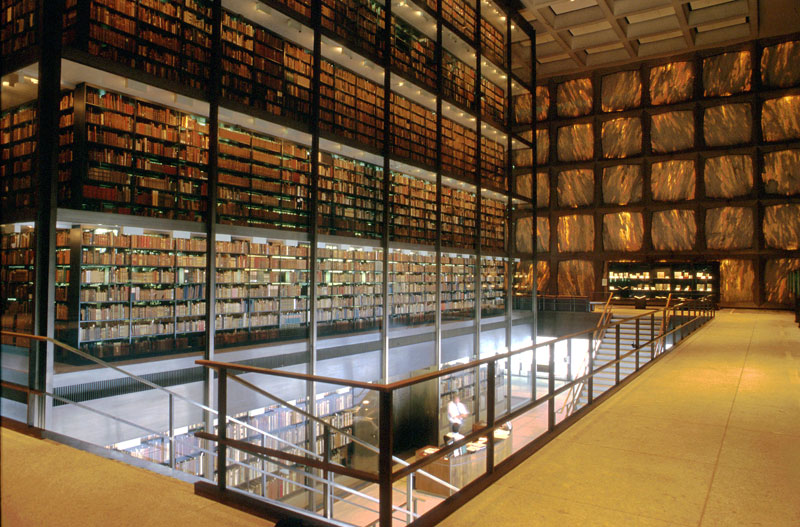
In my photograph, you can see the glass-enclosed collection displayed in all its glory. On the right, you see some of the sections of translucent marble that bring the filtered sunlight inside. The effect is breathtaking. I will include a better photo from their website (link below).  Around the outside of the glass-wrapped stacks is exhibition space, occupied by several treasures — a copy of Audubon’s Birds of America — and a Gutenberg Bible. Other than the first picture below, the photos are mine.  I love a museum that allows photos — why not, I always wonder when there are restrictions on cameras without flashes.


Yale University’s Beinecke Rare Book and Manuscript Library, completed 1963
It is said that this treatment of glass enclosed books was the inspiration for the British Library’s glass tower of George III’s collection in their new building of 1997.

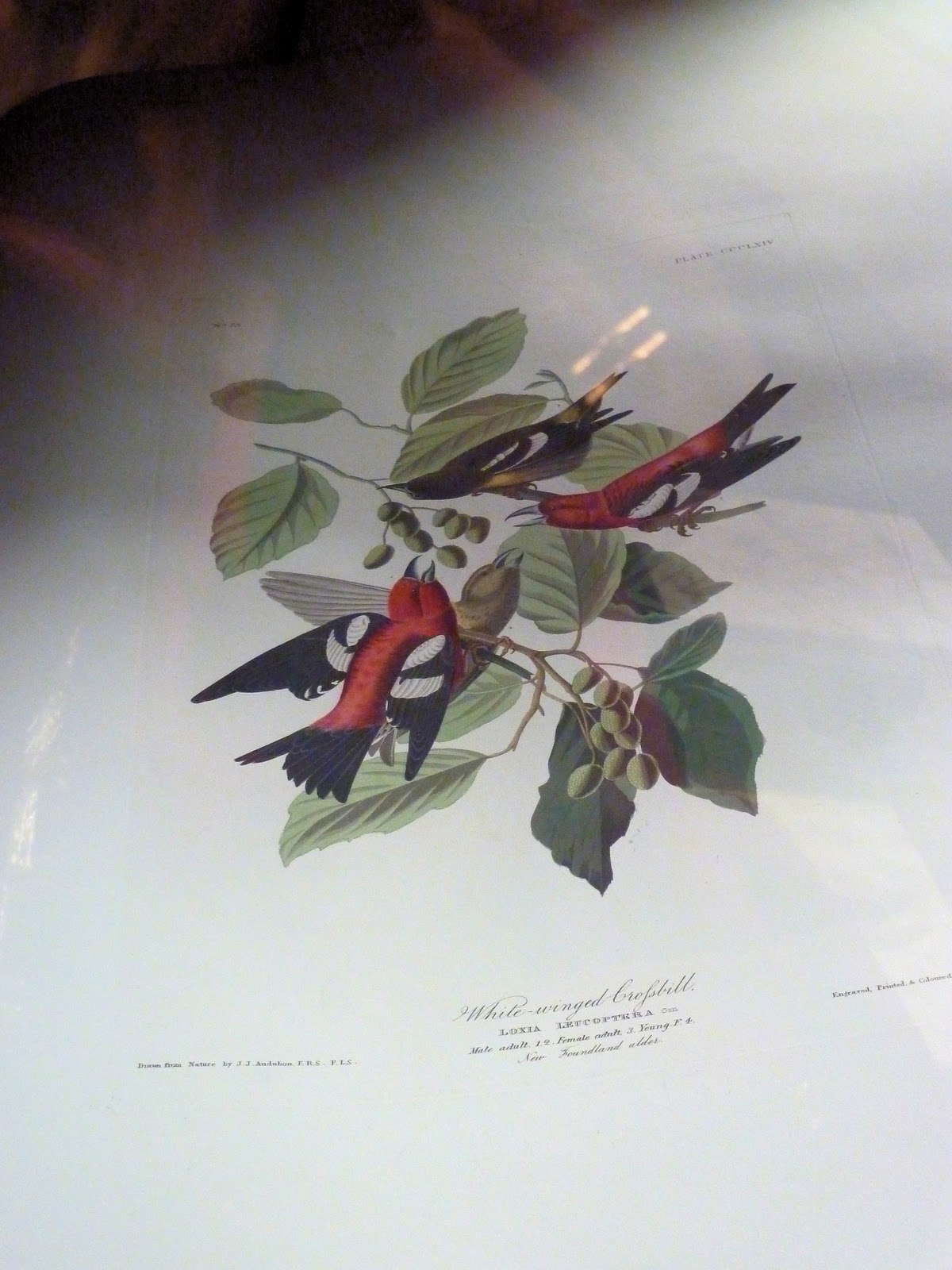
Among of the Beinecke’ treasures are two sets of The Birds of America, the works of John James Audubon (1785-1851).  Audubon was born in Haiti and came to the US in 1803. For more than ten years he drew and painted American birds.  According to the text panel, each book contained 425 plates showing 1055 birds, mostly drawn from life.  To the left is the page showing the white-winged Crossbill.  The plates were engraved and hand colored ion Edinburgh and London; the books were sold by subscription.

To the right is Audubon’s Orchard Oriole in one of the two volumes of The Birds of America in Yale’s Beinecke Rare Book and Manuscript Library.  The building was a gift of the Beinecke family in 1963; it is one of the world’s largest  buildings devoted  to the preservation of rare books and manuscripts.  In addition to the visible stacks, there are several floors underground for archived of precious books and papers.

Collections range from medieval
and renaissance manuscripts to papers relating to the life, family and careers of a wide range of persons, from Boswell to “Walt Whitman to Langston Hughes.  I am looking forward to attending the next meeting of the Angela Thirkell Society, which will be held at the Beinecke.  How Ms. Thirkell’s papers ended up at Yale will be an interesting topic!

Every day a page is turned in the Beinecke’s Gutenberg Bible, one of five complete Gutenbergs in the U.S.  To the left is the page we saw, not too elaborate, but certainly an interesting design.  Johann Gutenberg of Mainz, Germany, printed these Bibles about 1455, the world’s first books printed with moveable type.  There are 21 complete Gutenberg Bibles in the world and another 20+ incomplete versions.  This copy, once in the Benedictine Abbey in Melk, Austria, was purchased by Mrs. Edward S. Harkness for presentation to Yale as a memorial for Mrs. Stephen V. Harkness.

At right is one of the many displays around the Beinecke Library as part of an exhibition called Psyche and Muse, shown until June 13, 2011.  According to the brochure, it “explores cultural, clinical and scientific discourse on human psychology and its influend on twentieth-century writers, artists, and thinkers.”  I am sure that F. Scott Fitzgerald and his wife Zelda and their friends provided rich source material for the exhibition’s essays. Diane and I could have spent hours investigating each display and panel. However, another visit to Thomas Lawrence beckoned and we had to pass up a close examination.
Here is  link to the Beinecke’s website.
For more information about Psyche and Muse, start here.


Blair Castle to be Sold by Savills


Copyright Francis Frith

 Blair Castle, one of Scotland’s oldest continuously occupied estates, is for sale through Savills. Set in 1,500 acres near Dalry, Ayrshire, it has been the home of the Blair family since 1105. The current owner, Luke Borwick, a descendant of the founding family, endeavored – a la Monarch of the Glen – to maintain the estate with golfing weekends, weddings, advertising shoots and other commercial activities. During its long history, Mary Queen of Scots, William Wallace and Robert the Bruce have enjoyed hospitality at the castle, which is now to be sold along with its contents.

In addition to the 16 bedroom house, the 670 acre grounds include 12 cottages, salmon fishing and woodlands. From the Savills listing description: “Blairquhan Castle lies at the heart of the estate, overlooking the Water of Girvan which flows for over 3½ miles along the northern boundary of the estate. It is rare to find an estate which affords such privacy. About 670 acres in all, the estate also has 12 further estate properties, a walled garden with glasshouse, ice house, outstanding woodlands, farmland, a Purdey Award winning low ground shoot, roe stalking, trout fishing, and salmon and sea trout fishing. Lord Cockburn, writing as he worked his way around the South Circuit of the Scottish Bench in September 1844, wrote about his stay at Blairquhan: `I rose early…and surveyed the beauties of Blairquhan. It deserves its usual praises. A most gentleman-like place rich in all sorts of attractions – of wood, lawn, river, gardens, hill, agriculture and pasture.'”

Also from the Savills site: “Approached by way of three drives, the principal route to the Castle, the three mile Long Approach, starts at the Ayr Lodge and runs alongside the Water of Girvan. The castle is first glimpsed through the trees on the approach. A key characteristic of the castle is the extent to which it has
been preserved as William Burn and Sir David Hunter Blair completed it in 1824. Certain improvements were warranted, since the castle had only one bathroom on the principal floor when it was originally built, with accommodation for 18 resident indoor servants. An ambitious refurbishment in 1970 won the Saltire Award and was followed by an ingenious conversion by the architect Michael Laird, which made use of the former servants’ rooms to provide a modern Estate Office.

“There are now 16 bedrooms and 12 bathrooms and a driver’s overnight room. The castle has been extremely well maintained, with work including significant roof repairs, re-leading the main tower, and installation of new central heating boilers. Laid out over three floors, the accommodation is as shown in the accompanying photographs and on the layout plans. In all, there are over 70 rooms. Reception rooms include a saloon, two drawing rooms, a library and a dining room. In addition there are three kitchens, a library, a billiard room, picture galleries, a table tennis room, museums, stores and wine cellars.”

Whilst bits of British history hit the selling block daily, some as large or larger than Blair Castle, it’s always heart rending to read of these individual properties, their owners and their history. One can only hope that whomever purchases the Estate will preserve it to the same standards the family strove to achieve.
You will find more pictures and info about the Estate, it’s lodgings, gardens and history here. And all the sale details from property agent Savills website here. To read more about recently saved Scottish castles, click here.