It’s Ba-a-a-aa-aack!
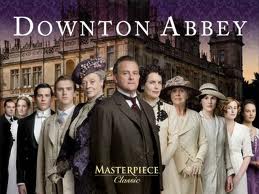
PBS is re-running the first episodes of Downton Abbey in
December 2011, as a prelude to showing the latest season, seen in the UK last fall. I expect a big fuss on many loops and blogs as again we re-hash our opinions — both positive and negative — on the show.
Our frequent guest blogger, Jo Manning, was in England to see season two — and here is her view of the new episodes.
Downton Abbey… Upstairs, Downstairs and/or Brideshead Revisited Redux? A Personal Opinion
by Jo Manning
As I put fingers to computer keyboard, I am reminded of that line in the vice-presidential debate in 1988 between Texas Senator Lloyd Bentsen and Indiana Senator Dan Quayle, where Quayle kept making references to himself as a new Jack Kennedy. Bentsen delivered the scathing putdown:
“Senator, I served with Jack Kennedy, I knew Jack Kennedy, Jack Kennedy was a friend of mine. Senator, you’re no Jack Kennedy.”
In relation to this 2011 ITV mini-series, Downton Abbey, I am moved to paraphrase that excoriating putdown:
“ITV, writer Julian Fellowes, the cast of Downton Abbey, I watched Upstairs, Downstairs and Brideshead Revisited devotedly, and many, many times. Gentlemen, ladies, you are neither of those truly wonderful productions, not by a very long shot.” I would add, “You are absurd and unrealistic, for starters!”
I saw the second episode of this series – which had begun with the repercussions of the sinking of the Titanic upon the fortunes of a wealthy earl – the Earl of Grantham — and his family – an American-born heiress wife and three daughters – with my daughter in West London. She’d warned me, “You have to see this to believe it.” She was correct. We could not stop laughing at the terribly clichéd plot, the wooden acting, the stereotyped characters, and the overall, well, yes, the overall silliness of this production. And I’m not talking de gustibus…here; this is more than a mere matter of taste.
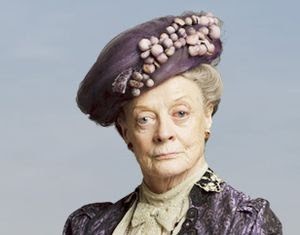
But the amazing – and, truly, unbelievable aspect – of this venture is that most people – especially those Anglophiles in the United States – ADORE IT! It has received awards, including prestigious US Emmys for outstanding t.v. mini-series/movie, for writing, for directing, and for the incomparable Maggie Smith in the supporting actress category. Smith is the only palpable reason for watching this awful production; her chewing up and spitting out the scenery is a highly seasoned tour de force, simply delicious. (The mini-series also won for cinematography and costumes at the Creative Arts Emmys.)
How did it happen that it beat out Pillars Of The Earth, for heaven’s sake, a magnificently produced mini-series with outstanding acting that was based on Ken Follett’s popular novel? It has to be Anglophilia, simply that.
And the awards did not stop there. Downton Abbey entered the Guinness Book of World Record as “the most critically acclaimed television show” of the year. (Brideshead Revisited garnered this honor in 1981 for the original t.v. series.) Well, no one was polling a certain family in West London, for sure!
To compound this unbelievable love-fest, ITV confirmed in November that a third series has been commissioned and will air beginning in September 2012. Truly, I am gobsmacked L
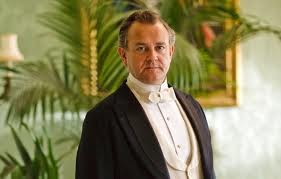
Where do I start, not wanting to give away what happens in the second series… Well, there’s Hugh Bonneville – never the most accomplished of actors — as the Earl of Grantham, who acts as if he has an iron rod up his bum and whose monologues to the servants and others are stunningly stupid; Lady Mary, his eldest daughter, played by Michelle Dockery – whose acting gamut runs from A to D, arrogance to disdain — gives us no reason whatsoever to sympathize with her plight as the eldest-daughter-who-has-to-marry-well. She has obviously matriculated from the same acting school as Mr Bonneville. Chemistry between Lady Mary and anyone simply does not exist. She is a cold fish, with nothing lovable about her; the idea that she would fall into bed with a young handsome Turk she has only just met is totally off the wall. And, too, chemistry is also sadly lacking between the youngest (and wannabe social activist daughter) and the Irish chauffeur. Their “attraction” is excruciating, painful, non-existent.
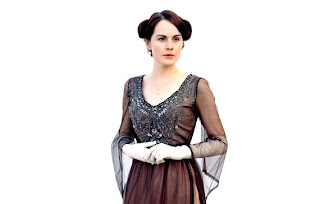
Poor, still beautiful Elizabeth McGovern is the Earl’s rich American wife… She used to be a pretty good actress – remember how exquisite she was when only a teenager, in Ordinary People? — but the dialogue coming out of her mouth lays her low. How does she not choke on it?
The servants also have their share of pretty awful characters. The butler, played by veteran character actor Jim Carter, has the same rod up his bum that the Earl of Grantham and Lady Mary strut around with, and don’t get me started on the whiny, sycophantic valet! His performance…oh, gag me with a spoon!
A major element of the first series was the problem with Lady Mary unable to inherit the earldom, since she is a woman, and male primogeniture prevails in England. (Recent events with the children of Prince William and Kate Middleton notwithstanding, as Downton Abbey is set in the first decades of the 20th century and the Earl and Countess of Grantham are not royals.) Fellowes has the aristos try to get this changed. Well – and Fellowes should be well aware of this, coming from the class he does – you cannot do this, the conditions of inherited titles being what they are. Everyone, then, would know it!
The piece is scorching. As well it should be. Do note this comment of A.N. Wilson, too, which echoes exactly what I have been saying:
“Fellowes is an absurd, rather than malign, figure in our public life, so one would not wish to respond t
o this latest bid for publicity with too much of a po-face. I acknowledge I’m in a minority when it comes to Downton Abbey, and that most of the nation will be gripped by the new series of this unrealistic depiction of upper-class life in the old days.”
For those who’ve not come across this expression, po-faced translates as humorless or disapproving. A.N. Wilson is an outspoken journalist and commentator and a prolific writer of fictional and biographical works. Look him up in WorldCat: http://worldcat.org/identities/lccn-n77-3675.
Will not go into the editing problems, the telephone poles in the village, etc. That is sloppy film editing, nothing to do with the problems with Fellowes’ writing and the lousy acting that prevails. (Still cannot believe he got an Oscar for Gosford Park, an entertaining film with several great moments… It could be his one shining moment, though; so much else that he has done is so bad.)
When Anglophiles who love good English drama of the sort carried by PBS’s Masterpiece Theatre can anticipate with so very little difficulty the next line coming out of a character’s mouth, that’s…not good. As a comedy, Downton Abbey succeeds beautifully; as a drama, it is embarrassing. Drama should surprise us, enlighten us, and make us ponder possibilities, not bore us to death, in my opinion.
Really, need anyone say more?
Well, yes. From a Daily Mail article – and, spoiler alert! – don’t click on this link unless you desperately do want to know – despite my caveats — what happens in Series Two:
“ ‘I know it’s a cliché,’ he cried at one point, shouting to be hear over the thundering ‘background’ music and Lady Mary doing her special blinking vole look.
“Cliché? That hasn’t stopped Fellowes before, we bellowed back.
“Oh dear. It’s terrible. It’s wonderful. It’s a disaster. It’s terrific. And without our Downton fix, what are we going to do to amuse ourselves on Sunday nights now?”
[Oh, be still my heart… “Lady Mary doing her special blinking vole look.” Perfect, just perfect! Could not have put it more perfectly myself J]
Well, here’s a thought… Go out and rent the wonderful film of the Isabel Colegate book, The Shooting Party. The book was published in 1980; the film was released in 1985. It is the real thing…English aristocrats seeing the ebbing of the world they knew, on the eve of the First World War, and they are both works of art, the book and the movie. Yes, really, they are genuinely works of art, not trumped up absurdities.
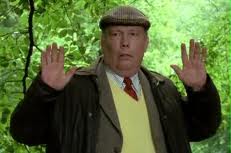
But did you know he was an actor before turning to writing? Not a terribly successful actor. Probably his most memorable role was as the overweight, annoying neighbor who tries to win the widowed Susan Hamps
hire’s heart in the television sitcom Monarch Of The Glen. Yes, that was Fellowes: Kilwillie!
From the IMDB website, http://www.imdb.com/title/tt0088111/ :
“Autumn, 1913: on the eve of the Great War, a small party of lords and ladies gather at the Hertfordshire estate of Sir Randolph Nettleby. A code of propriety governs all: dress, breakfast, relations with the estate’s peasants, courtship, shooting, adultery. Lionel Stephens, who is courting Sir Randolph’s daughter, gets into a shooting competition with Lord Gilbert Hartlip; Lord Gilbert’s wife carries on discreet affairs; a pamphleteer circles the estate calling for no more killing, and Sir Robert’s grandson hopes to protect a wild duck he’s befriended. A way of life is ending: Lord Gilbert’s violation of the gentlemen’s code suggests internal rot as the real world presses in.”
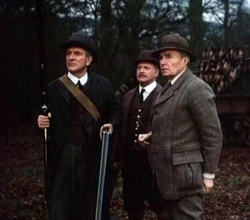
James Mason gives the performance of his acting career as Sir Randolph Nettleby, who hosts what will probably be the last gathering of his aristocratic family and friends as the world prepares to blow asunder. The cast of The Shooting Party is superb, absolutely first-rate – John Gielgud, James Fox, Robert Hardy, Cheryl Crawford, Gordon Jackson, Dorothy Tutin, to name only a few — and the story bittersweet and memorable. No posturing, no bombast, no nonsensical plotting, and, best of all, that Julian Fellowes fellow had nothing whatsoever to do with it.
Thanks, Jo, for your uninhibited opinions and your suggestion of The Shooting Party. We invite our readers’ opinons too — please comment on your views of Downtown Abbey. Do you love it — or were you disappointed? Come one, come all! We want to hear from you.