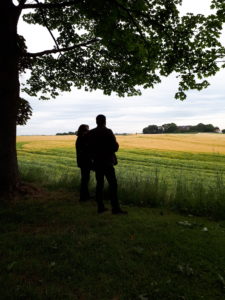
Originally published in 2010, we’re re-running this post now because we think you may like to look at Haddon Hall’s glorious gardens on this cold December day. Victoria and Kristine revisited Haddon Hall this past September on Number One London’s Country House Tour and the gardens were stunning. Do check our new line-up of tours at Number One London for details on the 2018 Country House Tour!
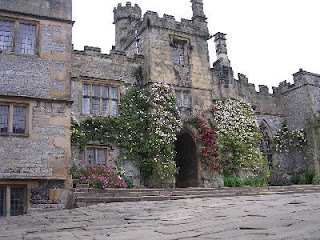
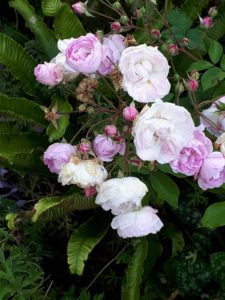
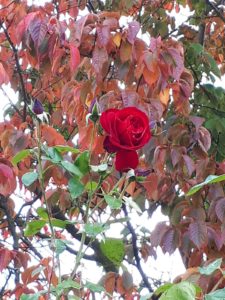
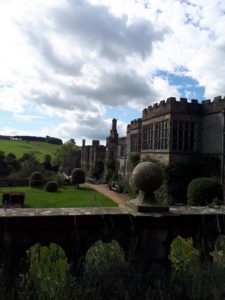
I visited Haddon Hall on a cool early summer day and found roses climbing all over the ancient grey walls, their colorful profusion a perfect complement to the lichen-covered stone.
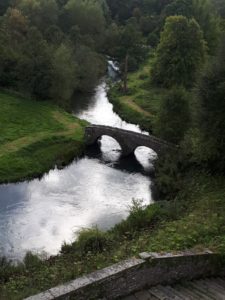
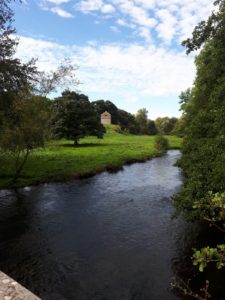
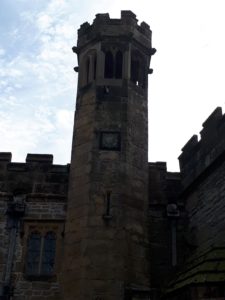
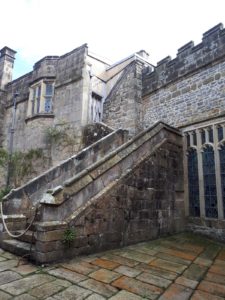
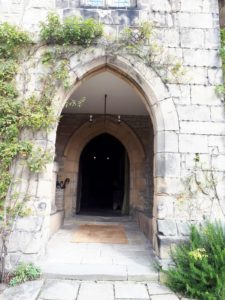
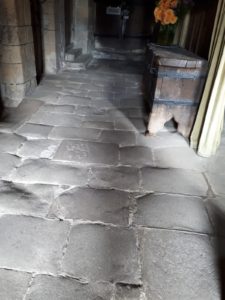
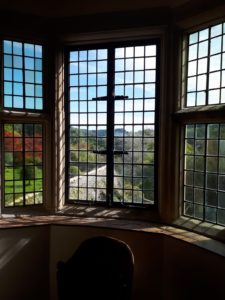
Haddon Hall, high above the Wye River near Matlock in Derbyshire, is typical of medieval manor houses: built of local rock with thick walls and small windows.
The property is listed in the Domesday Survey conducted shortly after William the Conqueror took over England. The Domesday Book was a great survey completed in 1086, a sort of census. William wanted to know who the landholders were and what taxes he could collect from them, so his clerks looked for property holders from the time of Edward the Confessor. The judgment of the assessors was final and there was no appeal. The name Domesday comes from the Old English word dom (same root as doom in modern English) meaning accounting or reckoning. The book of this census is known by the English as ‘Domesday’, that is the Day of Judgment.
Many of the finest English Country Houses evolved from ancient foundation structures of which few traces remain. Rebuilding, remodeling, and redecorating have been beloved preoccupations for centuries. Houses were altered by almost every generation to incorporate the latest technological improvements or to enhance the size, style and beauty of their surroundings. The richer the family members, the more they rebuilt over and over again.
The Haddon estate came into the Vernon family through the marriage of its heiress in 1170 to Richard Vernon.
The oldest and best-preserved old houses usually are passed down in a family through the female side. History repeated itself when in the mid-1550’s, Dorothy Vernon eloped with Sir John Manners, a son of the Duke of Rutland, against the wishes of her father. But despite his opposition to the match, Haddon Hall soon became the property of the Manners family, which has owned it ever since. It was, however, a secondary residence to the Rutland’s primary estate, Belvoir (pronounced Beever) Castle.
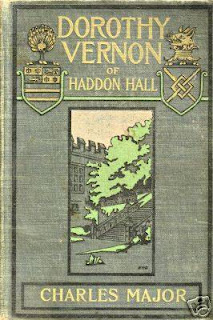
Since secondary residences were visited rarely, there was little urge to remodel to wife’s property. This pattern is repeated many times throughout the history of various stately homes. Cotehele in Cornwall and Chiswick near London are two more excellent examples. The romance of Dorothy Vernon and Sir John Manners was the basis for the 1902 novel Dorothy Vernon of Haddon Hall by Charles Major, popular author of historical romances including When Knighthood was in Flower (1898). Major altered parts of the story and his novel was further enhanced when it was made into a movie starring Mary Pickford in 1924. The story has also inspired a play and an opera.
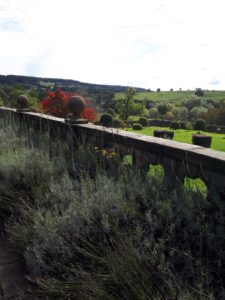
Haddon’s exterior is typically medieval, severe and somber, yet softened by lovely gardens.
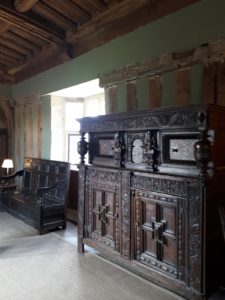
Inside, many rooms are open to visitors. In 1370, Richard de Vernon built the banqueting hall to house forty to fifty people. The house and continued to grow in subsequent centuries, both in number of inhabitants and in number of rooms and outbuildings.
The long gallery was added later and is typical of those found in Tudor and Elizabethan era houses, designed to replace cloister-style open air walkways. One strolled back and forth in the long gallery to take daily exercise where it was somewhat more protected.
Throughout the 18th and 19th centuries, Haddon Hall was ignored and fell into disrepair. Not until the 1920’s was major restoration begun. It continues today under the direction of Lord and Lady Edward Manners. Haddon Hall is often used in films and stood in as Prince Humperdink’s castle in The Princess Bride.
Whether it was the elopement story or the abundant roses, I found Haddon Hall very romantic and great inspiration for the imagination.
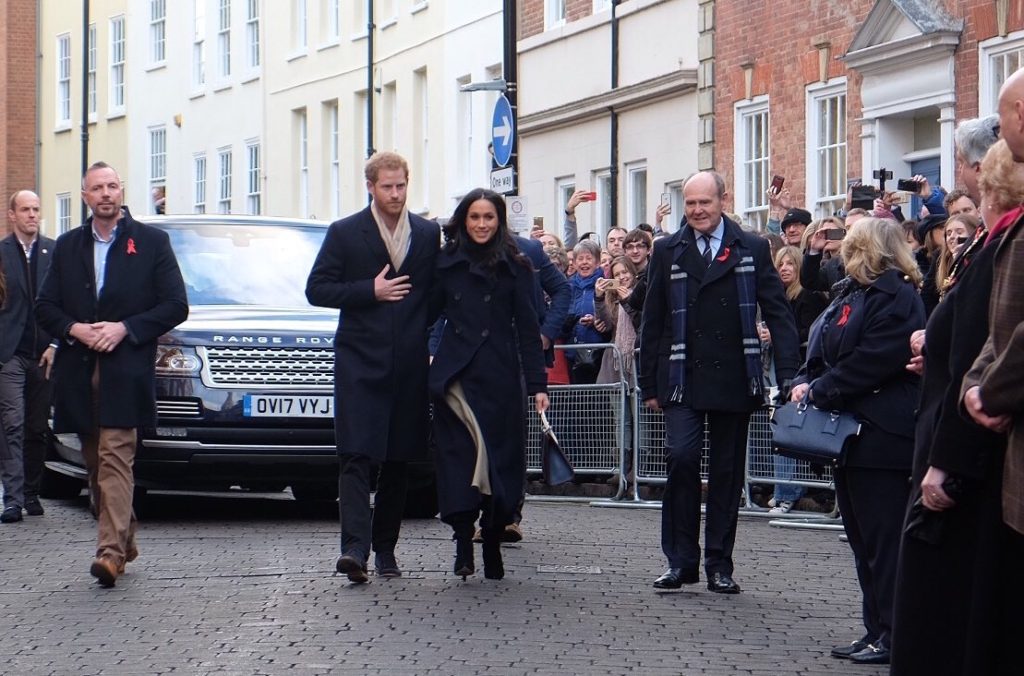
Meghan Markle made her first official appearance along with fiance Prince Harry in Nottingham on 1 December and her coat (Mackage ‘Elodie’ Navy Wool Coat US$790) and boots (KG by Kurt Geiger Violet Black Suede Over the Knee Boots £229) sold out on the same day. How did everyone find out what pieces she was wearing, so fast? Kensington Palace’s newest fashion icon has us mere mortals wanting to shop pieces, but how do we get the 411 about what they are and where to buy them? I mean before they sell out?
Well, it seems that Meghan has been a trendsetter since at least November 2016, when the website Meghan’s Fashion debuted. Loaded with photos of Meghan’s outfits and the required links to shopping those looks, this site should be bookmarked by all Royal watching fashionistas. Can’t decide between Meghan’s outfit or Katherine’s? No problem, there’s a Kate’s Closet site, as well.
Then there’s Meghan’s Mirror, a site similar to those above, but which also features Meghan’s best looks, her favourites, her fashion rules and even what’s on her reading list.
Want to see Meghan’s airport look? No problem!
And here’s Meghan’s yoga style
Even more exciting, Meghan has designed her very own dress line, The Meghan Markle Collection, available online at Canadian retailer Reitman on 27 April, in store 28 April. There’s no way to guess whether Ms. Markle will be able to continue selling her line beyond this season and after marrying into the Royal family, so this may be our only chance to get one of the gorgeous dresses below – all selling for under $100. Mark your calendars!
Of course, the one MM fashion item we’re all eagerly awaiting is her wedding dress. Trust Number One London to bring you all the speculation, guesses and possible winners as soon as we can.
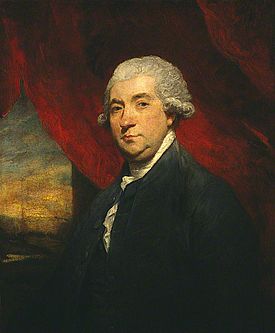
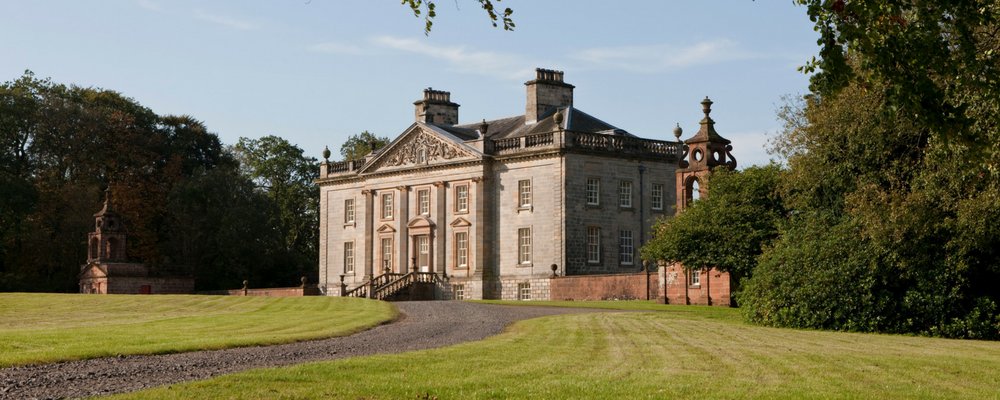
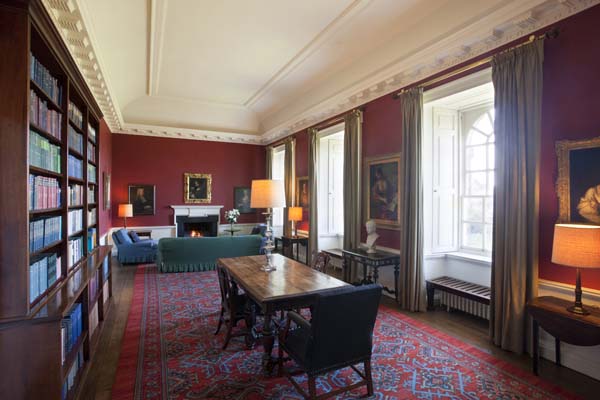
James Boswell is best known as the biographer of Dr. Samuel Johnson, but he was also 9th Laird of Auchinleck, in Scotland, with the family seat being Auchinleck House, in Ayershire, below, since it was built circa 1760. Boswell visited often and he and Dr. Johnson stayed here together in 1773 during their return from the Hebrides. As it turns out, a small group of lucky travelers will be staying here and we’ll have the entire estate to ourselves during Number One London’s 2018 Scottish Writer’s Retreat in September. Can there be a more perfect location for a writer’s retreat than the home of the author commonly said to have written the greatest biography in the English language – or the man who spent nine years working on The Dictionary of the English Language?
In light of my upcoming stay, I thought it would only be fitting for me to brush up on my Boswell/Johnson knowledge by re-reading Boswell’s Journals and Christopher Hibbert’s excellent biography, The Personal History of Samuel Johnson.
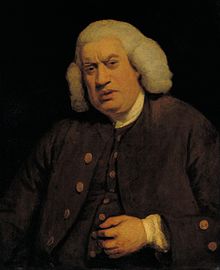
Samuel Johnson by Sir Joshua Reynolds, circa 1772
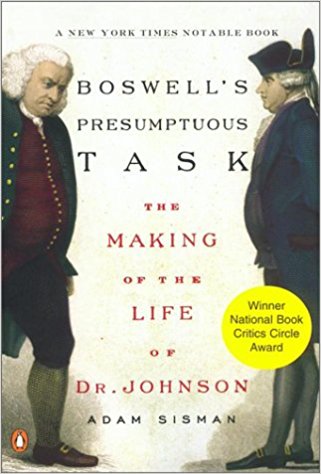
Also on my reading list is Adam Sisman’s book, Bowell’s Presumptuous Task, which garnered this review by Bibliomane01 on Amazon:
“In this magnificent work Mr Sisman describes the making of that greatest of all biographies, Boswell’s Life of Dr Johnson. To his contemporaries the task that Boswell had taken on was presumptuous indeed – to record the life of the greatest literary man of his age, while being dismissed himself as a frivolous and reprobate dilettante incapable of any serious activity. Well, the world knows that Bozzy succeeded in confounding his critics, but the tragic irony of his predicament was that he succeeded too well. While hailing the book as a masterpiece, the current and future literary establishment dismissed Boswell’s own role as little more than that of a stenographer. Macaulay’s damning essay on Boswell formed the opinion held by too many people for far too long. The true story of Boswell’s genius became well known to scholars in the 20th century; with this book, Mr. Sisman brings the story to a wider audience. It is a remarkable portrait of Boswell’s love for Johnson and the great struggles he endured to bring his hero to life in the pages of his biography. Battling drink, debauchery, depression and his own self-destructive nature, Boswell managed to pull off the one great sustained piece of effort of his life. In his book Johnson was brought to life once again, an image so convincing that it took over 150 years for people to discern the art behind the apparent ingenuousness of Boswell’s technique. Sisman does a good job of showing how the Johnson of the Life was as much a product of Boswell’s gift as the historical record (although I think readers would have benefited from a few examples of textual analysis to illustrate this). His final chapter on the gradual unearthing of the Boswell papers provides an exciting ending and his writing is clear and compelling. “Boswell’s Presumptuous Task” is nothing short of a triumph.”
The “gradual unearthing of the Boswell papers” mentioned above refers to a cache of Boswell’s private papers and journals found at Malahide Castle just outside of Dublin in the 1920’s. Boswell’s great-great-grandson, Lord Talbot de Malahide sold the papers to American collector Ralph Isham and they now form part of the collection at Yale University. Having only just visited Malahide Castle in September, I’m looking forward to reading Sisman’s book soon.
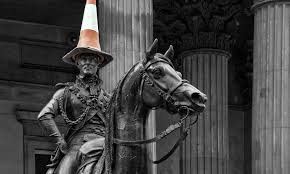
Being at a remove of two hundred years from the victory at the Battle of Waterloo, it’s difficult for us to appreciate the Duke of Wellington’s resultant contemporary popularity. To put it in perspective, Wellington could be said, without exaggeration, to have been the world’s first rock star, a media phenomenon whose level of popularity reached fever pitch. Combine the present day public interest in Princess Diana with that of Michael Jackson and you’ll get a fair idea of Wellington’s celebrity status post-Waterloo and his ability to single-handedly drive the 19th century media engine. Printsellers, the contemporary equivalent to our modern day paparazzi, worked at fever pitch to regularly issue new Wellington engravings, with which the populace decorated their walls. The public clamored for news of Wellington’s doings, with no detail of his life being too inconsequential to report. The media responded by giving the public what they wanted – not a single day passed in which Wellington’s name was not mentioned in print.
Enter English journalist Albany Fonblanque who, from 1820 to 1830, was successively employed on the staff of The Times and the Morning Chronicle, whilst he contributed to the Examiner, to the London Magazine and to the Westminster Review. While writing for London newspapers, Fonblanque also sought to reform his profession, often turning to satire in order to point out the flaws in current journalistic styles. So, when the Duke rose to political power in 1828, and with the public still rabid for daily details of Wellington’s life, Fonblanque used satire in order to point out the absurdities in some of the pieces being printed and the level to which the press had sunk in order to provide the public with the content they desired. Fonblanque wrote a piece entitled, The Duke of Wellington at Home –
“THE Duke of Wellington generally rises at about eight. Before he gets out of bed he commonly pulls off his nightcap, and while he is dressing he sometimes whistles a tune, and occasionally damns his valet. The Duke of Wellington uses warm water in shaving, and lays on a greater quantity of lather than ordinary men. While shaving he chiefly breathes through his nose, with a view, as is conceived, of keeping the suds out of his mouth; and sometimes he blows out one cheek, sometimes the other, to present a better surface to the razor.
“When he is dressed he goes down to breakfast, and while descending the stairs he commonly takes occasion to blow his nose, which he does rather rapidly, following it up with three hasty wipes of his handkerchief, which he instantly afterwards deposits in his right-hand coat pocket. The Duke of Wellington’s pockets are in the skirts of his coat, and the holes perpendicular. He wears false horizontal flaps, which have given the world an erroneous opinion of their position. The Duke of Wellington drinks tea for breakfast, which he sweetens with white sugar and corrects with cream. He commonly stirs the fluid two or three times with a spoon before he raises it to his lips. The Duke of Wellington eats toast and butter, cold ham, tongue, fowls, beef, or eggs, and sometimes both meat and eggs; the eggs are generally those of the common domestic fowl. During breakfast the Duke of Wellington has a newspaper either in his hand, or else on the table, or in his lap. The Duke of Wellington’s favourite paper is the “Examiner.” After breakfast the Duke of Wellington stretches himself out and yawns. He then pokes the fire and whistles. If there is no fire he goes to the window and looks out. At about ten o’clock the General Post letters arrive. The Duke of Wellington seldom or never inspects the superscription, but at once breaks the seal and applies himself to the contents. The Duke of Wellington appears sometimes displeased with his correspondents, and says pshaw, in a clear, loud voice. About this time the Duke of Wellington retires for a few minutes, during which it is impossible to account for his motions with the desirable precision.
“At eleven o’clock, if the weather is fine, the Duke’s horse is brought to the door. The Duke’s horse on these occasions is always saddled and bridled. The Duke’s horse is ordinarily the same white horse he rode at Waterloo, and which was eaten by the hounds at Strathfieldsaye. His hair is of a chestnut colour. Before the Duke goes out, he has his hat and gloves brought him by a servant. The Duke of Wellington always puts his hat on his head and the gloves on his hands. The Duke’s daily manner of mounting his horse is the same that it was on the morning of the glorious battle of Waterloo. His Grace first takes the rein in his left hand which he lays on the horse’s mane; he then puts his left foot in the stirrup, and with a spring brings his body up, and his right leg over the body of the animal by the way of the tail, and thus places himself in the saddle; he then drops his right foot into the stirrup, puts his horse to a walk, and seldom falls off, being an admirable equestrian. When acquaintances and friends salute the Duke in the streets, such is his affability that he either bows, touches his hat, or recognises their civility in some way or other. The Duke of Wellington very commonly says, “How are you?’—‘It’s a fine day’—‘How d’ye do?’—and makes frequent and various remarks on the weather, and the dust or the mud, as it may be. At twelve o’clock on Mondays, Wednesdays, and Fridays, the Duke’s master comes to teach him his political economy. The Duke makes wonderful progress in his studies, and his instructor is used pleasantly to observe that ‘the Duke gets on like a house on fire.’
“At the Treasury the Duke of Wellington does nothing but think. He sits on a leathern library chair, with his heels and a good part of his legs on the table. When thus in profound thought, he very frequently closes his eyes for hours together, and makes an extraordinary and rather appalling noise through his nose. Such is the Duke of Wellington’s devotion to business that he eats no luncheon. In the House of Lords the Duke’s manner of proceeding is this: he walks up to the fire-place, turns his back to it, separates the skirts of his coat, tossing them over the dexter and sinister arms, thrusts his hands in his breeches’ pockets, and so stands at ease. The characteristic of the Duke’s oratory is a brevity the next thing to silence. As brevity is the soul of wit, it may confidently be affirmed that in this quality Lord North and Sheridan were fools compared with him.”
Back in May, I revisited the Battlefield at Waterloo with author and battlefield guide Ian Fletcher, accompanied by one of my favourite travel mates, Denise Costello. Ian and I were on a mission to put together a different kind of Waterloo Tour. He is experienced in battlefield tours and can bring every moment of the Battle to life in a way that is both engaging, educational and exacting – which regiments were where, who was leading the charge, why were certain geographic points chosen by the French and Allied armies, what went wrong . . . . and what went right?
Denise Costello and Ian Fletcher overlooking the Battlefield at Waterloo.
On the other hand, my tours are focused more upon social history – which English families were living at Brussels during the Battle, who attended the Duchess of Richmond’s Ball, how did the civilians fare before, during and after the Battle and what wide ranging impact did the Battle, and the victory, have upon life in London and England at large?
In an effort to blend these two views of Waterloo, Ian and I hit upon the idea of doing a tour that focuses on the year 1815 as a whole, instead of focusing on the Battle alone. And so the 1815 London to Waterloo Tour was born. Before the Tour heads for Belgium, our group will explore the London of 1815, including Apsley House and the many clubs, houses, streets and sites that have a connection with the campaign, including the house in St. James’s Square where Henry Percy delivered the captured French Eagles to George IV after the Allied victory. Author Louise Allen will speak to our group on the subject of her book, To The Field of Waterloo: The First Battlefield Tourists 1815 – 1816. Once in Waterloo, we will walk the key sites on the Battlefield and also visit a host of museums and related sites including the superb new Waterloo Memorial with its high-tech exhibits and 3D cinema, the famous Lion Mound and panorama, the wonderful presentation at refurbished Hougoumont and the headquarters of both Wellington and Napoleon.
Speaking of Waterloo tourists, below is an account of Dr. Samuel Butler’s visit to the Battlefield a year after the Allied victory. His vivid impressions take in all of the sites we’ll be seeing on the Tour, complete details of which can be found here.
The Forest of Soignes
From: The Life and Letters of Dr. Samuel Butler: Headmaster of Shrewsbury School
July 9th. 1816 —From Brussels through Waterloo to the field of battle, about fourteen miles, through the Forest of Soignies, almost all the way a most detestable pavi full of holes. Waterloo is a miserable village of about twenty houses; its small red brick church, designed in segments of ellipses, is about twenty-five or possibly thirty feet in diameter. Here are monumental inscriptions to the memory of many of our brave country men. In about half a mile from Waterloo we quit the Forest of Soignes, and the ground becomes an elevated plain with some moderate undulations. In about two miles more we come to a place where a bye-road crosses the principal road. Here is an elm of moderate size on the right-hand side of the road, some of whose branches have been torn off by cannon balls; this is the famous Wellington tree, where the Duke was posted during the greater part of the battle, and is somewhat nearer the left wing than the centre of the battle. Close to the cross-road opposite this runs La Haye Sainte, a broken stumpy hedge. Directly opposite this tree, on the road-side, lay the skeleton of an unburied horse, and near the tree itself I picked up a human rib. The whole field of battle is now covered with crops of wheat and rye, which grow with a rank and peculiar green over the graves of the slain and mark them readily. About one hundred and fifty yards below the Wellington tree, which itself stands on the top of Mount St. Jean, in the hollow, is the little farm of La Haye Sainte, where the dreadful slaughter of the German Legion took place; they defended the place till they had spent all their ammunition, and were then massacred to a man, but not till they had taken a bloody revenge. The house and walls, the barn doors and gates, are full of marks from cannon and musket balls. In the barn are innumerable shot holes, and the plaster is still covered with blood, and the holes which the bayonets made through their bodies into it are still to be seen.
La Haye Sainte
“In a hollow near this scene of carnage lie the bodies of two thousand French Cuirassiers in one grave, and about twenty yards farther is the spot to which Bonaparte advanced to cheer the Imperial Guard for their last charge; it is scarcely possible but that he must have exposed himself greatly in so doing. The little valley between the undulation of Mount St. Jean, where the British were posted, and that of La Belle Alliance, which was occupied by the French, is not more than about a quarter of a mile across; the Duke of Wellington and Bonaparte, whose general station was on this hill, cannot have been more than that distance, or a very little more, from each other. On going to the station of Bonaparte we had a fine view of the whole field, and, though quite ignorant of military affairs, could not but see the superiority of the British position. The undulation on their side being a little more abrupt than that of the French, they were themselves protected in some measure, and their force considerably concealed, while that of the French was perfectly distinguishable. The right wing of the British was at Hougoumont [rather Goumont], a chateau of great importance and of very considerable strength. Their left wing was at the end of La Haye, about a short half-mile or less from the farm of St. Jean, which was almost of the same importance for its protection as Hougoumont for that of the right. The whole line could not extend more than a mile and a quarter. The French were posted on the opposite eminence, and here in this small space three hundred cannon, independent of all other weapons, were doing the work of death all day. Our guide, a very intelligent peasant, told us that the whole ground was literally covered with carcasses, and that about five days after the stench began to be so horrid that it was hardly possible to bury them on the left of the British, and of course on the right of the French position. At less than a mile and a half is the wood from which the Prussians made their appearance. La Belle Alliance is about half a mile or a little less from Mount St. Jean; here we turned off to see the chateau of Hougoumont, which was most important to secure the British right and French left wing, and was therefore eagerly contested; four thousand British were posted here, and withstood with only the bayonet and musketry all the attacks of an immense body of French with cannon. The French were posted in a wood, now a good deal cut down, close to the wall of the garden at Hougoumont. The British had made holes in the wall to fire through, and the French aimed at these holes. The whole wall is so battered by bullets that it looks as if thousands of pickaxes had been employed to pick the bricks. The trees are torn by cannon balls, and some not above eight inches in diameter, being half shot away on one side, still flourish.
Hougoumont
“Passing round the garden wall to the gates, the scene of devastation is yet more striking. The front gates communicate with the chateau, a plain gentleman’s house, the back ones (which are directly opposite) with the farmer’s residence. This was occupied three times by the French, who were thrice repulsed; but the English were never driven from the chateau. The tower, or rather dovecote, of the chateau was burnt down, but a chapel near it, about twenty feet long, was preserved in the midst of the fire; the flames had caught the crucifix and had burnt one foot of the image, and then went out. This was of course considered a great miracle. From the chapel we went into the garden. Its repose and gaiety of flowers, together with the neatness of its cultivation, formed a striking contrast with the ruined mansion, the blackened, torn, and in some parts blood-stained walls, and the charred timbers about it. In a corner of this garden is the spot where Captain Crawford and eight men were killed by one cannon ball, which entered opposite them by a hole still there and went through the house and lodged in another wall; I have seen the ball in the Waterloo Museum.
The Waterloo Musuem, Wellington’s former headquarters
Going along the green alleys of the garden, quite overarched with hornbeam, we see the different holes broken by the English to fire on their enemies, and a gap on the northeast angle of the garden is the gap made by the French, who attempted to enter there, but were repulsed. Had they gained entrance the slaughter would have been dreadful, as we had four thousand men in the garden, which from its thick hedges has many strongholds, and they were greatly more numerous. The English also lined a strong hedge opposite the wood in which the French were, which they could not force, but the trees are terribly torn by cannon. The loss of Hougoumont would probably have been fatal to us. From the gap above mentioned, looking up to the line of the British on Mount St. Jean, is one small bush; here Major Howard was killed.
La Belle Alliance
“Leaving Hougoumont, we returned to La Belle Alliance, where we once more reviewed the field of battle, and found some bullets and fragments of accoutrements among the ploughed soil. The crop is not so thriving on the French side, but it was still more richly watered with blood; in fact the soil, which on the British position is rather a light sand, is here a stiffish clay. From La Belle Alliance we proceeded to Genappe, another post, passing by a burnt house called la maison du roi; here Napoleon slept on the eventful eve of the battle. Following the course of the French in their retreat, we proceeded to another post, to Quatre Bras. Here was the famous [stand ?] made by the Highlanders against the whole French Army on the 16th. It is a field a little to the left at the turning to Namur. Hence we proceeded, having Fleurus on our right, to Sombreffe, where was the severe battle of the Prussians on the 16th, and thence to Namur, where the French continued their retreat.
The tourqoise circle upper right marks Genappe
“At Genappe, which is a straggling village, with narrow streets, dreadful slaughter was made by the Prussians on the night of the 16th; here Bonaparte’s carriage was taken, and he narrowly escaped himself. From hence to Namur the road was strewed with dead, the Prussians having killed, it is thought, not less than twenty thousand in the pursuit. Nothing can be more detestable than the paved roads, more miserable than the villages, or more uninteresting in the natural appearance of the country than the whole course from Brussels to Namur, about forty-seven miles, the scene of all these great historical events in the present and past ages.”


 Meghan Markle made her first official appearance along with fiance Prince Harry in Nottingham on 1 December and her coat (