Apsley House and it's Environs

From Walks in London by Augustus Hare (1894)

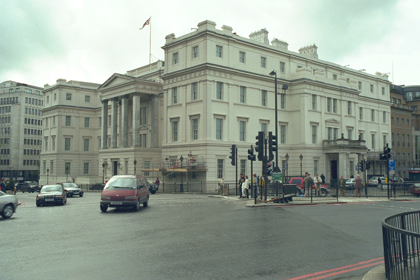
At the entrance of Belgravia, opposite Hyde Park Corner, is St. George’s Hospital (above, now the Lanesborough Hotel), occupying the site of Lord Lanesborough’s house, which bore the couplet—
It is my delight to be
Both in town and country.’
John Hunter died in the board-room of the Hospital, Oct. 16, 1793. Close by was the original site of ‘Tattersall’s,’ now built over, formerly well known as ‘The Corner,’ and much frequented on Sunday afternoons, when horses and dogs were exhibited on ‘The Green.’ It was here that Lord Hatherton’s hounds, sent up for sale, took advantage of the wicket being left open one Sunday, disappeared, and were all found safe back at Teddesley in Staffordshire next day.

Hyde Park Gate with Apsley House to the right

Close to Hyde Park Corner rises the pillared front of Apsley House (Duke of Wellington), over which, on fine afternoons, the sun long threw a spirit-like shadow from the statue of the great Duke upon the opposite gateway. The house was built in 1784 for Henry Bathurst, Lord Apsley, from designs by the brothers Adam: it was originally red brick; the stone front and portico were added in 1828. It will always excite interest from its associations as the residence of Arthur Wellesley, first Duke of Wellington, who died Sept. 14, 1852. At its gates, for many years, people used to watch for the appearance of the silver-haired veteran in his well-known blue coat and white waistcoat and trousers.

‘The peculiar characteristic of this great man, and which, though far less dazzling than his exalted genius and his marvellous fortune, is incomparably more useful for the contemplation of the statesman, as well as the moralist, is that constant abnegation of all selfish feelings, that habitual sacrifice of every personal, every party consideration, to the single object of strict duty—duty rigorously performed in what station soever he might be called on to act.’—Lord Brougham, Statesmen of George III.’

On the right of the Entrance Hall in Apsley House is a room appropriated as a kind of Museum of Relics of the Great Duke. It is surrounded by glass cases containing an enormous plateau, candelabra, etc., given by the Spanish and Portuguese Courts after the Peninsular War; a magnificent shield with reliefs symbolising the victories of the Duke, presented, with candelabra, by the Merchants and Bankers of London in 1822; and services of china given by the Russian, Prussian, and French Courts. In a number of table-cases are preserved the swords, batons, and orders (including the extinct order of the Saint Esprit) which belonged to the Duke; his two fieldglasses; the cloak which he wore at Waterloo; the sword of Napoleon I.; the dress worn by Tippoo Saib at his capture; and the magnificent George set with emeralds, originally given by Queen Anne to the Duke of Marlborough, and presented by George IV.

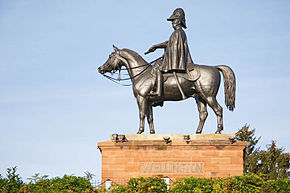
The Corinthian Arch, which forms the entrance of the Green Park, removed in 1883 from a position immediately opposite Apsley House, was erected from designs by Decimus Burton in 1828. In its former position it supported the equestrian statue of the Duke of Wellington by  Wyatt (1846)—the ‘hideous equestrian monster’ of Thackeray. This statue, commemorating the great military achievements of the Duke, and intrusted to the keeping of the nation in 1846, was only preserved from destruction in 1883 by the spirited protest of Colonel Charles Lindsay I It was removed amid a storm of ridicule, the cocked hat being described as ‘too big for the Duke, and the Duke too big for the horse, and the horse too big for everything.’ It is now at Aldershot. In its place a smaller equestrian statue by Boehm has been erected. The horse is admirable in intelligent alertness, the Duke gravely observant, and the four figures at the angles of the pedestal, representing a Grenadier, Highlander, Welsh Fusilier, and Inniskillen Dragoon, are full of originality, though their taste may be questioned.

The road which passes beneath the arch leads into the Green Park (of fifty-six acres), called on some old maps Stonebridge Close, on others Upper St. James’s Park. It skirts the gardens of Buckingham Palace by Constitution Hill, where no less than three attempts have been made upon the life of Queen Victoria: the first by a lunatic named Oxford, June 10, 1840; the second by Francis, another lunatic, May 30,1842; and thethird by an idiot named Hamilton, May 19, 1849. It was at the top of the hill that Sir Robert Peel was thrown from his horse, June 29, 1850, and received the injuries from which he died on the 2nd of July. The principal houses on the opposite side of the Park are Stafford House, Bridgewater House, and Spencer House. Till 1825 ‘the Ranger’s Lodge’ stood in the Park near Piccadilly: the stags which ornamented its gateway are now at Albert Gate.

The Longest Reigning Monarchs

In this year celebrating the Diamond Jubilee of Queen Elizabeth II’s reign, we can look back on those majestic beings who top the longevity lists for English monarchs.

Still number one is Her Imperial Majesty Victoria Regina (1819-1901) with sixty-three years, 216 days  on the throne, from 1837 to 1901.
Victoria’s Coronation portrait by artist George Hayter, 1837
Perfectly indicative of the incredible changes in the world during her long reign is the fact that she was portrayed at the beginning by an artist in oils and near the end by a photographer.
Queen Victoria’s Diamond Jubilee Portrait, 1897
She celebrated the only Royal Diamond Jubilee until this year.  Below is one of the many souvenirs created for the event.  Festivities took place all over the empire, as they will throughout the Commonwealth for Elizabeth II’s Diamond Jubilee this year.
Elizabeth II was born in 1926 to the second son of King George V, the future King George VI (1895-1952) and his wife, Elizabeth Bowes-Lyon, later best known as the Queen Mother (1900-2002). The present Queen succeeded her father upon his death in 1952 and was formally crowned in 1953.  Now in second place for longevity of reign, Elizabeth  II might  surpass Victoria’s record in another four year or so.


Elizabeth II in 1953
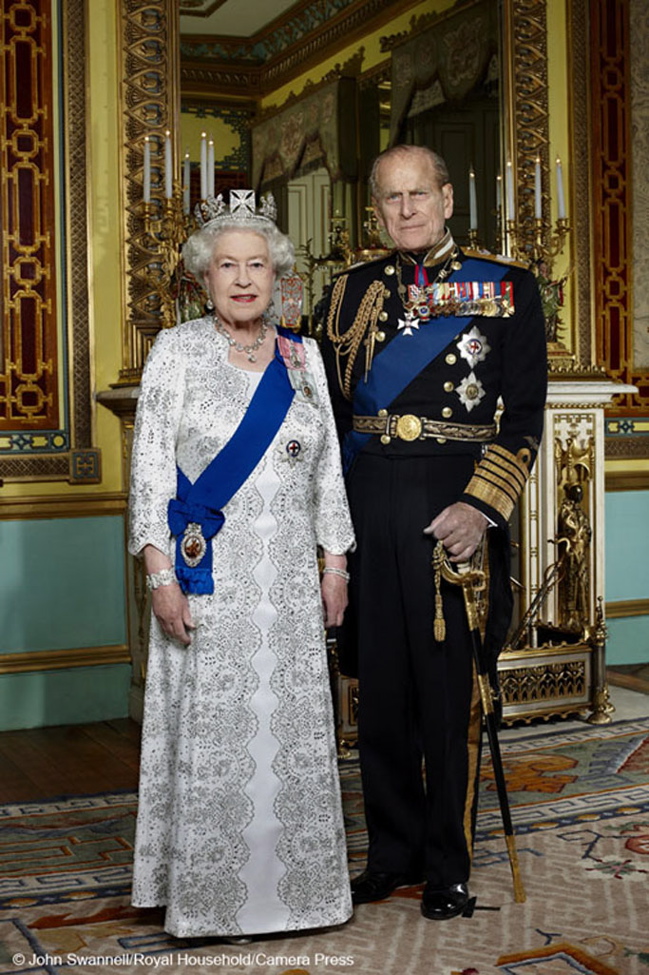
The official Diamond Jubilee Portrait by John Swannell
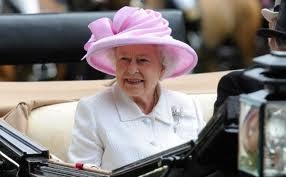
I rather prefer her in the pink hat worn at Ascot in 2011!
Number three in longevity is George III who reigned from October 25,1760, when he was merely 22 and succeeded his grandfather George II, to January 29, 1820, though his duties had been taken over in 1811 by his son, George, Prince of Wales, as Regent.
George III, by Allan Ramsay, 1762

George III is perhaps most renowned in the U.S. as the King who “lost the colonies” for his country.  It is said that this fact plagued him for many years. But his eventual mental breakdowns were more likely to have been caused by inherited disease, usually attributed to porphyria, from which other members of the Hanoverian family may have suffered.

In fourth place is James I (1566-1625), because his time as James VI of Scotland is included.  James I was the son of Mary, Queen of Scots (1542-1587), and was crowned King of Scotland at age 13 months in 1567.   Mary was a cousin of Elizabeth I, but the two women were never to overcome the rivalries of their circles and develop a cooperative relationship.  Elizabeth I (1533-1603) eventually had Mary put to death. 
Mary, Queen of Scots, by Nicholas Hilliard, c. 1578

Ironically, it was Mary’s son James, the Scottish King, who untied Britain and Scotland and became Elizabeth I’s successor, King James I.
James I
Britain under James I continued its Renaissance flowering of literature (Shakespeare, Donne) and the arts in what became known as the Jacobean Age.  The bible — King James Version — was translated into English; we celebrated 400 years of this great work in 2011. 
The next two monarchs in longevity are Henry III (reigned 1226-1272) and Edward III (reigned 1327-1377), 56 and 50 years respectively.  Next is William I of Scotland (1165-1214), followed by Llywelyn of Gwynedd (1195-c.1240).

Taking 9th place in longevity is Elizabeth I (1533-1603), who followed her sister Mary Tudor and brother Edward VI as a successor to Henry VIII.  Elizabeth was age 25 when she was crowned and reigned for more than 44 years.

detail of Elizabethan procession, c. 1575
Our own Elizabethan Age began in 1952. Above is the Queen with her consort, Prince Philip, Duke of Edinburgh.  The royal couple has celebrated their  64th  wedding anniversary.


Elizabeth has been on the throne throughout the terms of office of eleven U. S. presidents, from President Eisenhower to President Obama.  Congratulations and best wishes to Elizabeth II and Philip — and all their children, grandchildren, and great grandchildren too.

Elizabeth II and some of her subjects


A Stroll Down Piccadilly

From Walks in London by Augustus Hare (1894)

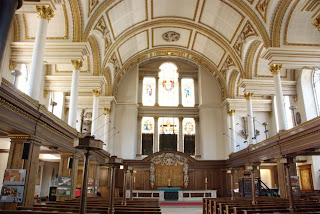
Turning eastwards (out of St. James’s Street and onto Piccadilly), we find, on the right, St. James’s Church, built by Wren, 1684. Hideous to ordinary eyes, this church is still admirable in the construction of its roof, which causes the interior to be considered as one of the architect’s greatest successes—probably his best interior, except St. Stephen’s, Walbrook.

The marble font is an admirable work of Gibbons: the stem represents the Tree of Knowledge, round which the Serpent twines, offering the apple to Eve, who stands with Adam beneath. The organ was ordered by James II. for his Catholic chapel at Whitehall, and was given to this church by his daughter Marj’. The carving here was greatly admired by Evelyn.

‘Dec. 10, 1684.—I went to see the new church at St. James’s, elegantly built . The altar was especially adorned, the white marble inclosure curiously and richly carved, the flowers and garlands about the walls by Mr. Gibbons, in wood: a pelican, with ber young at her breast, just over the altar in the carv’d compartment and border invironing the purple velvet fringed with richly embroidered, and most noble plate, were given by Sir R. Geare, to the value (as is said) of £200. There was no altar anywhere in England, nor has there been any abroad, more richly adorned.’—Diary.

The Princess Anne of Denmark was in the habit of attending service in this (then newly built) church, and it was one of the petty insults which William and Mary offered to the Princess (after her refusal to give up Lady Marlborough) to forbid Dr. Birch, the rector, to place the text upon the cushion in her pew, an order with which the rector, an especial partisan of the Princess, refused to comply.
Among the illustrious persons who have been buried here are Charles Cotton, the friend of Izaak Walton, 1687; the two painters Vandevelde, 1693 and 1707 ; Dr. Arbuthnot, the friend of Pope and Gay, the slouching satirist, of whom Swift said that he could ‘do everything but walk,’ 1735; Mark Akenside, the harsh doctor who wrote the ‘Pleasures of Imagination,’ 1770; Michael Dahl, the portrait-painter, 1743; Robert Dodsley, footman, poet, and bookseller, 1 764; the beautiful and brilliant Mary Granville, Mrs. Delany, the beloved and honoured friend of George III. and Queen Charlotte, 1788; William, the eccentric Duke of Queensberry, known as’ Old Q.,’ 1810; James Gillray, the caricaturist, 1815; and Sir John Malcolm, Governor of Bombay, 1833.i In the vestry are portraits of most of the rectors of St. James’s, including Tenison, Wake, and Seeker, who were afterwards Archbishops of Canterbury.

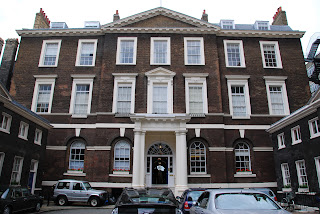
On the other side of Piccadilly, nearly opposite the church, are the Albany Chambers (above), which take their name from the second title of Frederick, Duke of York, second son of George II., to whom the principal house (first known as Melborne, then as York House) once belonged. ‘The Bachelor of the Albany’ was a character well known at the beginning of the present century.
‘In the quiet avenue of the Albany (Albany court Yard), memories of the illustrious dead crowd upon you. Lord Byron wrote his “Lara” here, in Lord Althorpe’s chambers, afterwards (1837) occupied by Lord Lytton; George Canning lived at A. 5, and Lord Macaulay in E. 1; Tom Duncombe in F. 3; Lord Valentia, the traveller, in H. 5, and Monk Lewis in K. 1.’—Blanchard Jerrold.

Sackville Street, which opens on the north, has the distinction of no standard lamps, retaining the first form of gas-lamp, projecting from the walls of the houses.

On the right, in returning, is Burlington House (now the Royal Acadamy of Arts, above), built from designs of Banks and Barry, 1868-74. The inner part, towards the courtyard, is handsome; that towards the street, and the sides of the building, are spoilt by the heavy meaningless vases by which they are overladen. In the construction of this commonplace edifice one of the noblest pieces of architecture in London was wantonly destroyed—the piazza, of which Sir William Chambers wrote as ‘one of the finest pieces of architecture in Europe,’ and which Horace Walpole said ‘seemed one of those edifices in fairy-tales that are raised by genii in a night-time.’ Its stones were removed to Battersea Park, but London, which has spent £10,696 on the Temple Bar Memorial, has never been able to afford the sum necessary for their reconstruction!
The old house (the second on the site) was built from the designs of Richard Boyle, third Earl of Burlington, but the portico has been attributed to Colin Campbell. Burlington House was bought by the nation in 1854. The central portion of the modern buildings is devoted to the Royal Academy, which was founded in 1768, with Reynolds as President. It consists of forty Academicians and thirty-one Associates. Their first exhibitions took place in Somerset House, but, from 1838 to 1854, they were held in the eastern wing of the National Gallery. How great was their early mediocrity may be seen from the cuttings in vellum and paper, landscapes in human hair, and devices in shell-work described in Exhibition catalogues of the last century, though these were interspersed with great works by Reynolds and Flaxman.
In Cork Street, facing the back of Burlington House, General Wade’s house was built by Richard Boyle, Earl of Burlington, a house which was so uncomfortable as to make Lord Chesterfield say that the owner could not be at his ease in it, and so intended to take the house over against it and loot at it. The famous tavern of the ‘Blue Posts’ in this street has been recently rebuilt.

From the end of Savile Row, an archway and passage lead into Conduit Street, through what was once the two-winged garden
pavilion of Burlington House, the countrified position of which in the seventeenth century was chosen by its founder ‘because he was determined that no one should build beyond him.’ All the streets in this neighbourhood—Cork Street, Old and New Burlington Street, and Boyle Street—record the names and titles of the Boyle family. In Boyle Street still stands the school founded by Lady Burlington, on the edge of her gardens, for the maintenance and education of eighty poor girls.

Hard by, in Savile Row (named from Dorothy Savile, wife of the architect Earl of Burlington), at No. 12, George Grote, the historian of Greece, died, June 19, 1871; at No. 17 Richard Brinsley Sheridan (above) died, July 7, 1816. His so-called friends suffered him to be arrested by a sheriff’s officer upon his death-bed, and he would have been carried off, in his blankets, to a spunging-house, if his physician had not threatened the officer with the responsibility of his dying on the way; yet seldom has there been such an array of rank as when he was borne hence to his grave in Westminster Abbey!

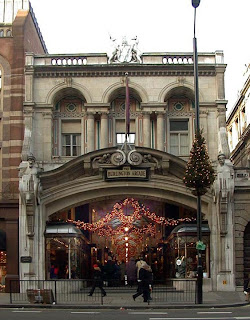
The Burlington Arcade (above) was built from designs by Ware for Lord George Cavendish in 1815, and is ‘famous,’ as Leigh Hunt says, ‘for small shops and tall beadles.’ Just beyond, in Piccadilly, was the little underground newsvendor’s, whither Louis Napoleon Bonaparte ‘would stroll quietly from his house in King Street, St. James’s, in the evening, with his faithful dog Ham for his companion, to read the latest news in the latest editions of the papers.’

In old times this was the celebrated ‘White Horse Cellar,’ where might be seen what Hazlitt calls ‘the finest sight in the metropolis,’ the starting of the coaches in Piccadilly. Latterly there has been a revival of the love of the road, and a number of coaches (frequently with amateur drivers) in Northumberland Avenue attract the enthusiasm of a little crowd on their morning departures and their evening arrivals. Bond Street, Albemarle Street, Dover Street, and Grafton Street occupy the site of Clarendon House and its gardens, built by the Lord Chancellor Earl of Clarendon, who laid out the gardens at a cost of £50,000.

In The English Garden

Gardeners the world over seek to re-create their own patch of Englishness by way of a garden. No matter where in the world one lives, it is possible to obtain such quintessentially English plants as lavender, hollyhocks and roses. One can even go so far as to install hedgerows, herbaceous borders and a ha-ha in the garden. But it occurred to me that what really sets an English garden apart are the things one finds in the garden, decoration-wise. A few urns or a lichen covered bit of crumbling statuary are both fine and dandy, but nothing says “English garden” quite like a dovecote or, say, a hen house. In fact, you could do worse than to take a page from the Duchess of Devonshire’s book and get yourself an entire flock of fowl.  To that end, we’ve taken a stroll around the internet and rounded up a host of unique – and beautiful –  garden decorations on offer for feathered friends.

The Dorset based company Flytes of Fancy offer Gypsy hen houses in such themes as the Willow, below

The Gypsy Daydream, above, is offered at £3900.00, depending on any additional bespoke requirements and your delivery preferences. Each henhouse is hand-painted by the resident artist and can be further customized to your specifications.

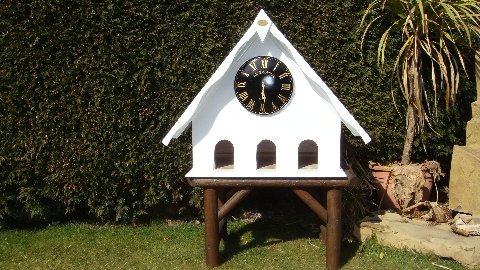
The Branscombe model dovecote, above, available from http://www.dovecotes.co.uk/, offers four storeys of living space for 20 to 24 pair of doves. No doves? No problem . . . . whilst called “dovecotes” these houses have always been used to more commonly house pigeons.


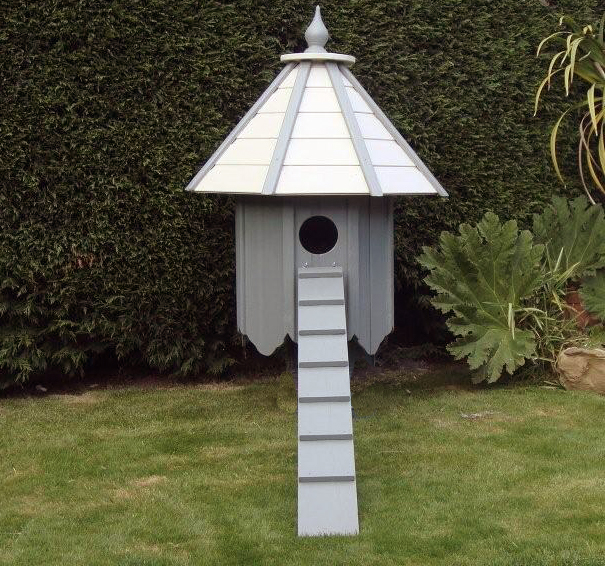
Marks Dovecotes offer even more variety in dovecote construction, including the Westminster Slate model shown here

Should you not be a fan of either hens or doves, have no fear – Marks Dovecotes also offer a duck house

Should you wish to house smaller feathered friends, this birdhouse from the Highgrove Shop is just the ticket

Looking to attract a particular species of bird? The Patch birdiebox below, from Garden Loverz, features a lever on the front gives you control over the type of birds you would like to nest in your garden.

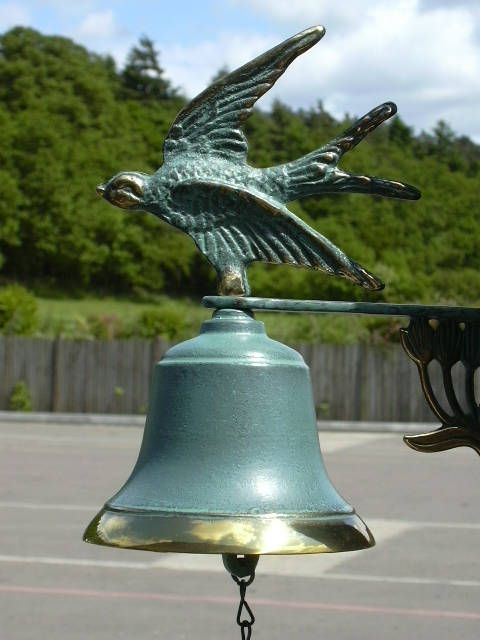
Finally, we just couldn’t resist showing you this Flying Bird porch bell in a verdigris finish available from Gifts and Gardens.

A Day with JASNA-GCR

On May 5, in the Crystal Ballroom of Chicago’s Millennium Knickerbocker Hotel, JASNA-GCR (Jane Austen Society of North America, Greater Chicago Chapter) held its Spring Gala, Chawton Comes to Chicago, a day of excellent presentations, good food, shopping, meeting and greeting old friends and new.

Jeff Nigro, JASNA-GCR’s regional coordinator, welcomed everyone and enumerated the events of the day.

Elizabeth Garvie, long a favorite of Janeites as the “real” Elizabeth Bennett for her role in the 1980 BBC version of Pride and Prejudice, gave a charming performance of selections from Jane Austen’s life and works, “Jane Austen Delights.”

I particularly enjoyed her reading from Lesley Castle (from the Juvenilia), in which the writer of a letter pleads with her correspondent for pity over her disappointment at having prepared a wedding feast which could not now be eaten as intended because the groom had been stuck down, completely ignoring the real tragedy. She thinks only of her own wasted expense and effort — and how they will ever consume the victuals she has prepared.  The ironic humor of the passage has never before struck me with such vivid force.
Elizabeth Garvie and David Rintoul as Lizzy and Darcy
Clearly the audience’s favorite part of the performance was Ms. Garvie’s portrayal of Emma‘s Miss Bates. Every nuance of the lady’s overwrought arrival at the ball (Ch. 38) was perfectly articulated and left us all laughing and applauding.  We could have listened all day!  Despite the fact that Ms. Garvie has played innumerable characters by a wide variety of authors since her turn as Lizzy Bennet, we were all convinced of her special affinity for the works of Jane Austen.
Elizabeth Garvie
Author Lindsay Ashford told the story of how she moved to Chawton and became immersed in the life and times of Jane Austen.  As she learned more and more about the writer, reading in the very rooms in which Jane herself might have read, eating where she would have frequently dined, Ashford was more and more obsessed with Austen and her early death at a mere age 41.
Victoria Hinshaw and Lindsay Ashford
When she learned arsenic had been detected in an analysis of a lock of Jane’s golden hair, her imagination took flight.  Could the author — – also beloved daughter, sister and aunt — have been murdered with arsenic?  And by whom?  Now Ashford has published The Mysterious Death of Miss Austen, a novel in which this is exactly what happens.  Written from the point of view of Jane’s dear friend Miss Anne Sharp, once the governess to Edward Austen’s children, the novel has enjoyed considerable attention around the world.
Ashford is the partner of Steve Lawrence, CEO of the Chawton House Library.  Below they are pictured in the costume promenade at last October’s Fort Worth, TX, JASNA AGM.
Following Ashford’s talk, Steve Lawrence brought us up to date on activities at Chawton House Library, showing pictures of the latest projects, such as the “new” 18th C. barn discovered nearby and rebuilt on the edge of the property. 

It seems impossible that
the library is already about to celebrate it’s tenth anniversary.  Where have all these years gone?  On the other hand, it his hard to imagine the world in the village of Chawton, of Austen studies, or of on-line availability of many heretofore impossible-to-find novels without the library and its holdings.  For more information, here is the website.

JASNA-GCR Program Chair Elisabeth Lenckos and Steve Lawrence
The luncheon was enjoyed by all, and featured short readings from works by four members of the organization —  whose writings are “inspired” by Jane Austen.

JASNA-GCR Readers
Victoria Hinshaw read from her novel The Fontainebleau Fan; Holly Bern read from her story “People of the Book” in Wooing Mr. Wickham,” a collection of prize-winning stories chosen in a Chawton House Libary contest and edited by Lindsay Ashford; Elisabeth Lenckos read from her story, “Jane Austen 1945,” also a winner in the Wooing Mr. Wickham collection; and Karen Doornebos read a selection from her novel Definitely Not Mr. Darcy.  Karen’s website is here.

Karen and Victoria with a Chawton House Library poster
Sandy Lerner, seated, and Diane Capitani, JASNA-GCR education outreach coordinator
Dr. Sandy Lerner, aka Ava Farmer, author of Second Impressions, related her experience fulfilling her long-held ambition of writing a sequel to her favorite novel, Pride and Prejudice.  One of her motivations for assembling the collection of books which form the nucleus of the Chawton collection today was to immerse herself in the world and sensibilities of Jane Austen’s times, aimed at finishing that novel.  It was published recently, and is available everywhere.
Dr. Lerner is the founder and benefactor of the Chawton House Library; all proceeds from the sale of Second Impressions are donated to the library.  She told us of her many acquisitions of novels by early women writers whose work, while popular at the time, was never catalogued in libraries or preserved in any organized fashion.  She particularly was interested in works such as letters and diaries which might never have been published but had been saved among family papers.  Of particular note, she said, were accounts of travels in the 18th and early 19th centuries, often recorded for the enjoyment of family members.
Sandy Lerner; Marsha Huff, past president of JASNA; Elizabeth Garvie
Gail Murphy, Laura Whitlock, Debra Miller and William Phillips enjoy the program.

Tempting our pocketbooks were lovely items from Vintage Pine (http://www.vintagepine.com/), Figaro Interiors, and Jane Austen Books (http://www.janeaustenbooks.net/).

The lively and active JASNA-GCR group has recently updated its website, here.  Please visit soon.