The War of 1812 Begins: The U.S. Declares War on Great Britain

On June 18, 1812, President James Madison signed an Act of Congress declaring war on the United Kingdom of Great Britain and Ireland. The next day he issued a proclamation of war, here.

James Madison, 4th President of the United States of America

The War of 1812 is almost forgotten in both the U.S. and U.K., but to many Canadians, it is an important aspect of their history, ending for the most part, U.S. attempts to control and annex parts of Canada.

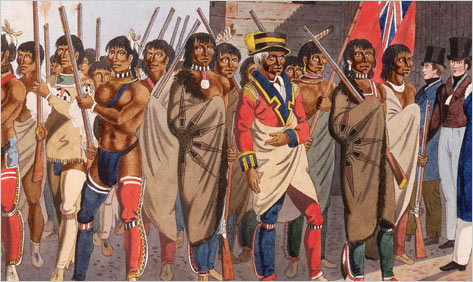
Historian Alan Taylor of the University of California-Davis has written a book advancing the theory that the war was “in effect a civil war between related members of a founding nation.” In The Civil War of 1812: American Citizens, British Subjects, Irish Rebels, and Indian Allies, Taylor looks at the conflict from multiple points of view.

U.S. Historian Alan Taylor in Toronto

An interesting article from the Canadian Broadcasting Company on Alan Taylor’s book is here.  This site will also connect you to various Canadian commemorations of the War of 1812.

As I remember from my high school American History course, the impressment of American seamen by British ships on the high seas was a basic cause of U.S. complaints. The British, embroiled in the Napoleonic Wars on the Peninsula and the Continent, claimed the right to stop and board ships to find deserters; sometimes they were also said to have taken naturalized or other Americans to force them to serve the British Navy. A further aggravation to the growing American merchant fleet were the Orders in Council,  His Majesty’s naval blockade of  continental ports, as part of the war with France.

USS Constitution, in action 1812, painted by
Anton Otto Fischer, U.S. Naval Historical Center 

Historians have added additional motivations for declaring war. The U.S. definitely wanted to control more of Canada. Growing controversy among the War Hawks and the fledgling political parties put President Madison in a bind. The war debate in Congress was heated and extremely partisan, only barely passed by Madison’s political allies.  Further, U.S. expansion caused continual controversy with Native Americans, who often turned to the British Army for assistance.  We all know the sad story of the fate of the Native Americans, moved farther and farther west away from their ancestral homes.

One wonders why the young, weak, and struggling United States of America would attempt to defeat the strongest maritime nation in the world. The U.S. Constitution had been in effect for less than a quarter of a century; there was no professional army; instead the government had to  rely on little-trained state militias.  One can hardly avoid the suspicion many leaders in the U.S. relied upon the British being quite thoroughly preoccupied with war against Napoleon.

Another factor was the very slow process of communication in those days.  Upon the declaration of war, the U.S. had not heard that British Prime Minister Perceval had been assassinated on May 11, 1812, and replaced by a government headed by Lord Liverpool (1770-1828, Prime Minister 1812-1827).  He had already rescinded the Orders in Council before the formal declaration, but who knew in Washington?

Robert Jenkinson, 2rd Earl of Liverpool
by Sir Thomas Lawrence

We don’t have to provide a spoiler alert to reveal that the war led to nothing, for all practical purposes, on the part of the U.S. and U.K.  In Canada, it was seen as confirming their unique relationship with both their neighbor to the south and the British.  The Treaty of Ghent confirmed the status quo ante bellum, that is, a return to the situation before the war was declared. The hostilities had been in vain.

Among the commemorations in the U.S., the estate of James Madison (1751-1836), near Jefferson’s Monticello, will host a number of events.  Their website is here.

Montpelier, near Charlottesville, Virginia

The U.S. did have a few contributions to its popular history from the War of 1812, such as the composition of the Star Spangled Banner in 1814 by Francis Scott Key as he watched the bombardment of Fort McHenry in Baltimore Harbor. For more on the flag at the Smithsonian, click here.

During naval battles on Lake Erie, one of the more memorable of American legends took place when Oliver Hazard Perry (1785-1819), commanding the U.S. ships, won and reported to General William Henry Harrison, “We have met the enemy and they are ours: two ships, two brigs, one schooner and one sloop.”

Captain Oliver H. Perry
U.S. Naval Academy Museum Collection

Andrew Jackson (1767-1845) came into national prominence after his victory in the Battle of New Orleans, a totally unnecessary event that took place after the peace treaty had been signed ending the war.  That battle cost the life of General Edward Pakenham, brother-in-law of the first Duke of Wellington and the deaths of hundreds of British and less than a dozen American soldiers. Jackson later became the 7th president of the U.S, serving from 1829-1837.

Battle of New Orleans, as painted by Edward Percy Moran in 1910
Library of Congress

From time to time, we hope to return to the battles, mishaps, and personalities of the War of 1812 .  Stay tuned.

Waterloo Skeleton Found

As the 200th Anniversary of the Battle of Waterloo approaches, a stunning discovery was made near the site of the Lion’s Mound – the intact skeleton of a British soldier. Crews were working on constructing a parking lot when a piece of equipment uncovered the remains, unfortunately destroying the skull in the process. However, other artifacts were uncovered along with the bones: a spoon, coins and the musket ball believed to have caused his death still between his ribs. Historians believe he is from one of the Duke of Wellington’s British regiments, and described the discovery of the skeleton as one of the best ever war finds.

Yves Van Der Cruysen, director of the Battle of Waterloo Association, said: ‘This is a major discovery. “It is the first time for over a hundred years that a complete corpse of a combatant from the time has been discovered in such a good state.”

“He could have been buried by a comrade or simply missed when the bodies were gathered up after the battle for burial. We hope to find evidence of his regiment from the spoon and the leather epaulets that were found with the corpse. And we know the names of the combatants thanks to military records of the time. When the soldier’s regiment can be determined we should be able to find his identity.”

Thanks to our loyal reader June Sproat for the heads up on this story!

What's a Manège?

If you know this blog, then you know that I spend an inordinate amount of time looking at UK property listings. From Grade I Listed historic estates to the smallest timbered cottage, I’ve taken virtual tours of just about every type house that can be found in Britain. Often, the property listings include a list of outbuildings and other features – paddocks, stabling, ornamental lakes, coach houses, conservatories, etc., etc., etc. Occasionally, I’ll find mention of something called a “Manège.” Time and again, I’ve asked myself, “Exactly what in the heck is a manège?” A manger? A manger in the French manner? Something one manages? A management office? A farm office?   Hhhhmmmm  . . . . .
 According to Merriam-Webster.com, a manège is:

1: a school for teaching horsemanship and for training horses
2: the art of horsemanship or of training horses
3: the movements or paces of a trained horse
 
 
Other than this, the availability of internet information concerning the manege is slim to none. Go on, Google the word, I’ll wait . . . . . see?
 
 
I did find a website called Equine World UK, where I found the following useful information:
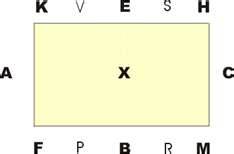
A horse riding manege or dressage arena is usually marked around the edge with letters. In the riding lesson or during a dressage test this enables instructions to be given as to when to perform a particular action. Arena sizes may vary but most riding schools have an arena that is 20 metres by 40 metres, whilst others may have an arena that is 20 metres by 60 metres.
The images below shows the location of the letters that denote a particular point in the arena. Although there may be physical markers around the edge of the arena, there are no markers to identify the positions of the internal letters and so these must be memorised.
So, a manège is an indoor riding ring or school. And should never be confused with a ménage, which is the French word for “household,” or with the French term “ménage à trois,” which may be the topic of a future post, perhaps featuring the Hamiltons or the Duke of Devonshire. 
Perhaps the most famous indoor riding school is the Spanish Riding School in Vienna, where the famous Lipizzaner stallions are trained and housed.
For more on the Stallions and their training, click here.

SAVE Britain's Heritage

An organization called SAVE Britain’s Heritage has been campaigning for historic buildings since its formation in 1975 by a group of architects, journalists and planners. Its Dare to Care: Buildings at Risk 2012-13 report, published June 1, contains almost one hundred homes in need of restoration, from castles to cottages.

Buildings featured in the 2012 report, Dare to Care, range from enchanting cottages, such as Shellards Cottage above, farmhouses and town houses to forlorn country piles, deserted chapels and crumbling mills – all crying out for restoration. These neglected treasures, ripe for sensitive repair, often lie in idyllic locations, surrounded by fields or in country villages or beside rivers and canals.

SAVE’s latest report contains almost 100 new cases, resulting from a major consultation with local authorities in England. It also features up-to-date case histories of buildings rescued since appearing in earlier SAVE reports. Finally, the report highlights the scandalous waste of several historic buildings over the past twelve months. These include the demolition of a 19th-century brewer’s villa in Hungerford, Berkshire, and the imminent destruction of Charles Barry’s elegant Royal Sussex County Hospital in Brighton.

A must read for anyone interested in Britain’s heritage and an essential tool for prospective restorers, SAVE’s reports play a critical role in the conservation of Britain’s historic buildings. Some two-thirds of the country houses included in SAVE’s first report, published in 1977, had found new owners or uses within three or four years and good news has continued ever since. Marcus Binney, SAVE’s President says, ‘This is the 23rd of SAVE’s annual reports on buildings at risk, each one illustrating a remarkable selection of endangered properties in varying states of repair, but all candidates for immediate action.’


Here are some highlights from the 2012 report:

Milton Damerell House, Devon: this treasure trove of architectural detail and history is currently on the market for £495,000. Dating back to 1500, this handsome Grade II listed house is an amalgamation of four centuries of architecture. Thought to have been a vicarage at one time, and located within beautiful countryside, this building boasts extraordinary surviving features and the promise of a mysterious hidden tunnel.

Shellards Cottage, (above) Essex: This historical gem, a charming thatched cottage built around 1500, is situated at the end of a country lane and would make a delightful home or rural bolt hole.

Ivy Cottage in County Durham: When this idyllic house – which dates back to the 17th century – was listed in 1987 the Inspector recorded that it was already empty and derelict. Two decades later, this picturesque sandstone building, in a small rural village, continues to cry out for a new owner and a new life.

The Georgian Toll Cottage at Marple, near Stockport: stands in a picturesque position next to a hump bridge at the junction of the Peak Forest and Macclesfield Canals. Pathetically boarded up, it cries out for some TLC.

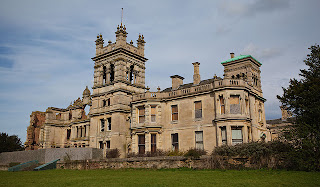
Overstone Hall, (above) on the outskirts of Northampton: is a majestic Italianate mansion in a 40 acre walled park but poses a considerable challenge. It was built in 1866 to the designs of W M Teulon, younger brother of the great Victorian ‘rogue’ architect S S Teulon. After suffering a fire it was put up for sale two years ago. It would make for a magnificent hotel, offices, or could be adapted sensitively for multiple residential use.

For further information, visit the Save Britain’s Heritage website.

Windsor Greys Jubilee Statue Appeal

Private individuals in Windsor and Berkshire are seeking to raise funds for the Windsor Greys Jubilee project to raise a statue to a pair of Windsor Greys,  the breed of horse that always draw the Queen’s carriage, as well as all the Royal carriages – see photo below of the Greys pulling William and Kate’s Wedding Carriage. Windsor Greys are not a specific breed of horse but are rather a name applied to a group of horses that are specially bred and selected according to appearance and temperament for the ceremonial duties of the British Monarchy. At present, about thirty Greys are in Royal service and are housed at the Royal Mews.

The statue project suffered a setback when the chosen artist, sculptor Althea Wynne, was killed in a car crash. Robert Rattray, a sculptor specializing in wildlife, will now carry the project forward. It is hoped that the bronze statue will be placed on the A308/A322 roundabout adjoining the Long Walk in Windsor and will commemorate Queen Elizabeth’s Diamond Jubilee in the town of Windsor, as Queen Victoria’s Diamond Jubilee is commemorated there by the statue of that monarch at the entrance of Windsor Castle.

Rosemary Ussher, one of the driving forces behind the campaign, told The Observer, “It is very important we recognise The Queen’s contribution to our society, but the horses will now also be in memory of Althea.”

You can donate by sending a donation to Windsor Greys Jubilee Appeal, 35 Queen’s Road, Windsor, Berkshire SL4 3BQ or by clicking here.