All The Queen's Hats

In the past  months, we have been watching Queen Elizabeth II at many events — the wedding of her grandson, the Diamond Jubilee, and many annual ceremonial events.  We are constantly fascinated by her lovely hats. 

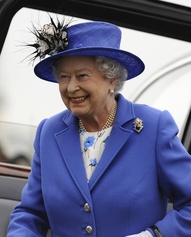
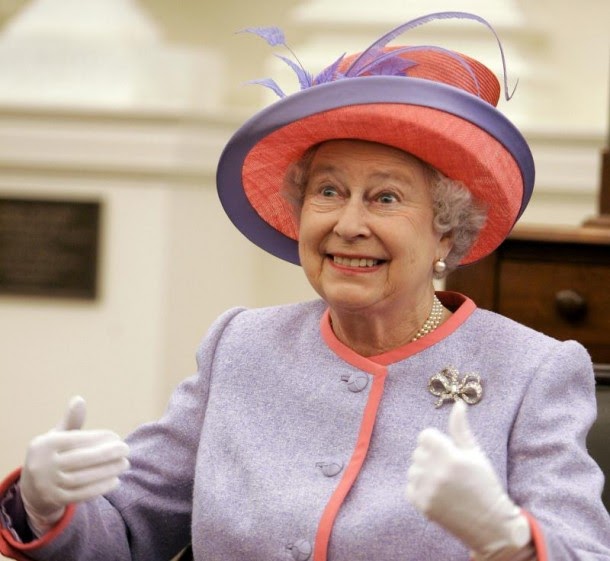
Her hats cannot cover up her face, since that is why people come out — to see her!  So that means none of the big brims or fluttery veils that can be so flattering. And since she so often is climbing in and out of limos, they can’t be too big.  Or in danger of blowing off. However, her milliners certainly manage to come up with a wonderful and colorful selection of styles — here are a selection of our favorites.

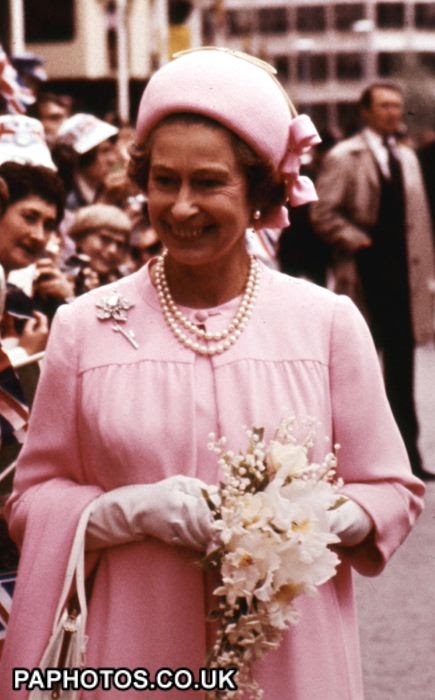
For the Silver Jubilee in 1977, The Queen’s pink chapeau, decorated with 25 bells for the years in her reign, was designed by milliner Frederick Fox, who made more than 350 hats for Her Majesty.

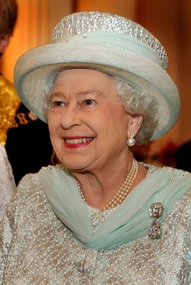
At the Wedding of Prince William and Catherine Middleton, 2011

The Queen with the Duchess of Cambridge in Leicester

Boarding the Spirit of Chartwell for the Thames Procession
Both of the Queen’s ensembles were created by her chief dresser-designer, Angela Kelly, who also made the creamy lemon outfit Her Majesty wore to the Royal Wedding.
At the Silver Jubilee Service of Thanksgiving at St. Paul’s Cathedral, 5 June, 2012

Queen Elizabeth II in Northern Ireland, June 26, 2012, in Wedgwood Blue

Below, the pink number that is Victoria’s all-time favorite, worn at Ascot, 2011.

Another view below:

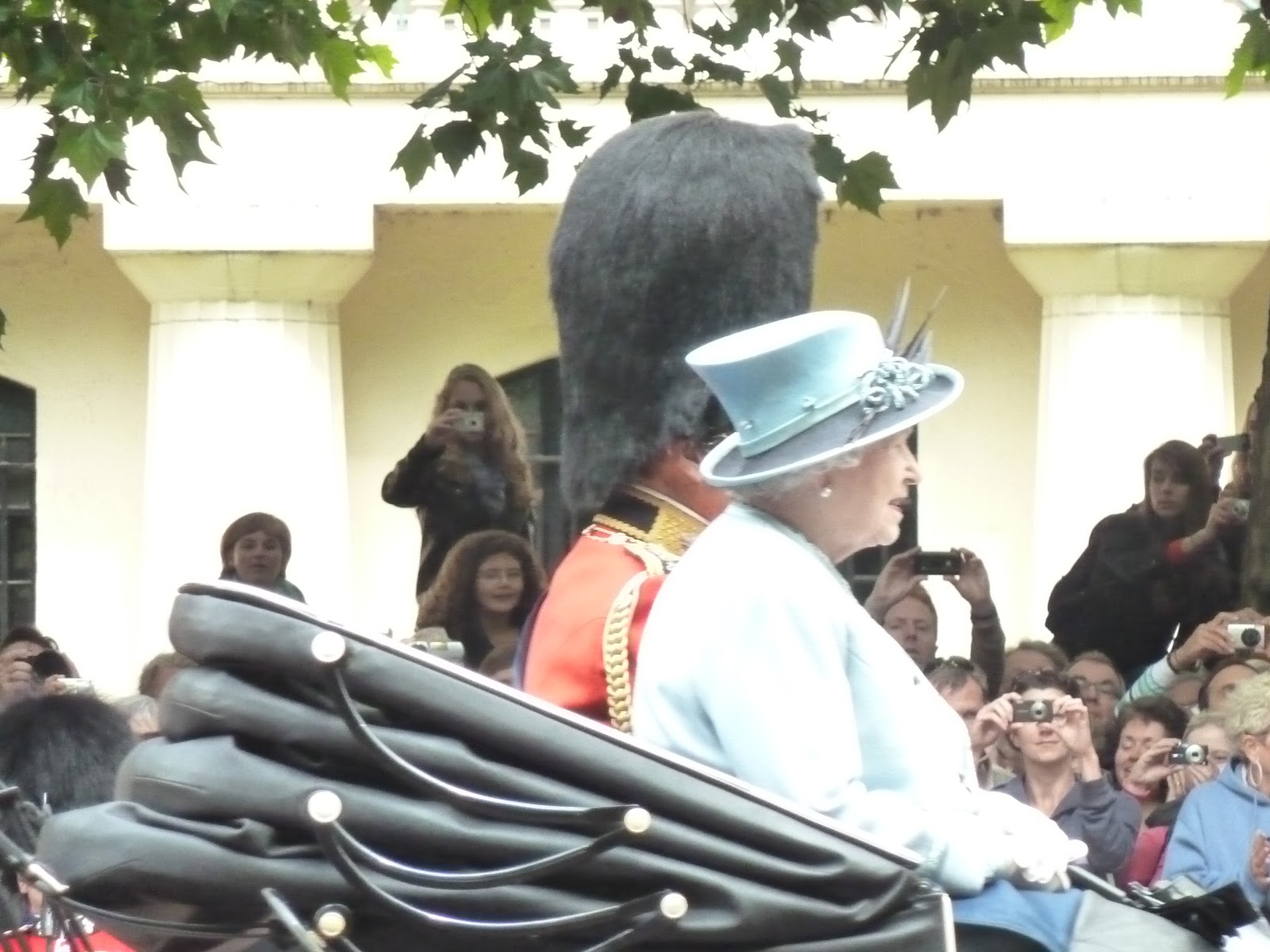
Trooping the Colour, 2011.

A rainbow of colo(u)r:

The Queen at Epsom Derby, this hat by Rachel Trevor Morgan
A paler blue hat by Philip Somerville, also a long-time milliner to Her Majesty

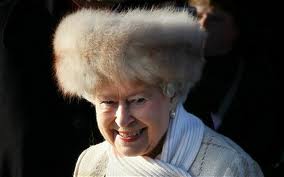
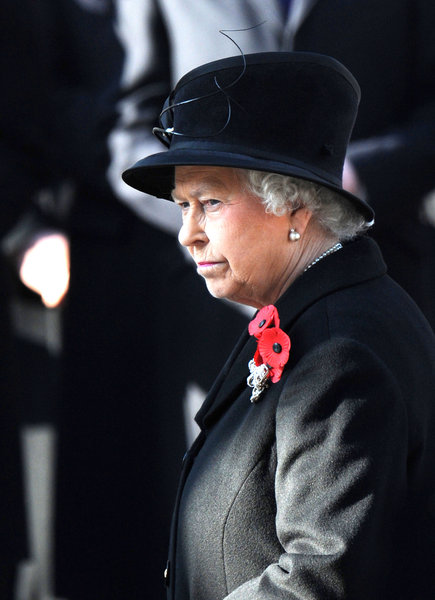
The Queen rarely wears beige, brown or black, being more visible in her favorite colorful couture, but there are exceptions!

At Remembrance Day, November 13, 2011

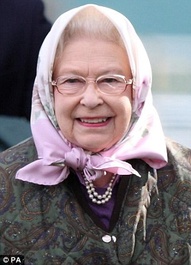
Sometimes, while not on official duties, the Queen enjoys a headscarf!
Regalia of the Order of the Garter

The Real Thing in Headware
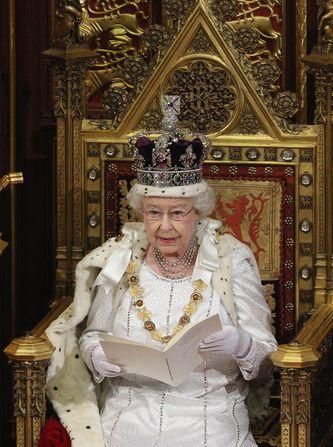
9 May, 2012 opening Parliament

London 2012: Olympic Equestrians

Victoria here, writing about two of my favorite subjects: London (or, rather, make that Greenwich) and horses.

I’m hoping that, like 2008, I will be able to watch some of the Olympic Equestrian events between July 27 and August 12.  Six sets of medals will be awarded, for individual and team accomplishments in three categories: Eventing, Dressage, and Show Jumping.  All three call for the very highest talents, training, and cooperation among horses and riders, and with the Pentathlon, they are the only Olympic sports that involves human-animal collaboration.

The venue for the Equestrian events is Greenwich Park
 on the grounds between the Queen’s House and the Greenwich Observatory, a spectacular setting just downriver from London.  This newly laid out — and temporary — facility was home to an Olympic Test Event last summer. 
2011

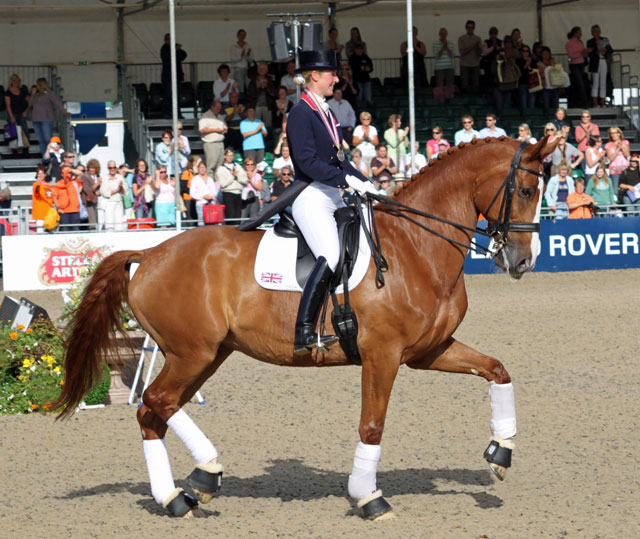
An even better view (below) shows rider Karin Donckers of Belgium in the dressage competition in 2011. Does it get any more spectacular than this, London lovers?  There were some protesters, but the powers-that-be promise to return the site to its usual lawn and tree-studded parkland.

In 2008, the Olympic Equestrian  events were held far from Beijing in Hong Kong, so the competitors are pleased to be more centrally located this year.  In 2012, as in 2008, medals will be awarded in six categories, as below, listing the winners in 2008:

In Eventing, Germany won gold, Australia won silver and Great Britain bronze. For the individual medals in Eventing, riders from Germany, the USA, and Great Britain won the gold, silver and bronze medals respectively.

Zara Phillips, 2012 Team GB in Eventing
In Dressage, the team winners were Germany, the Netherlands and Denmark, while the winning individual riders were from the Netherlands, Germany for both silver and bronze.
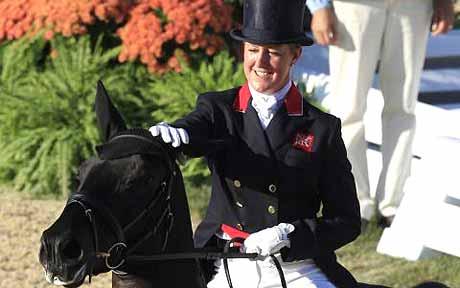
Nicola Wilson, 2012 Team GB in Dressage
The 2008 winners in Show (or Stadium) Jumping were USA, Canada, and Norway; in the individual events, winning riders were from Canada, Sweden, and the USA. Below, Team USA with their 2008 gold medals. 
2008 Beijing (Hong Kong venue) Olympics

The Equestrian events are clustered as follows:

Eventing: Saturday 28 – Tuesday 31 July
Dressage: Thursday 2 – Thursday 9 August
Jumping: Saturday 4 – Wednesday 8 August

Eventing competitions — often called Horse Trials —  are three-day series of activities which include dressage, stadium jumping and a 5.7 kilometre cross-country course.  All three phases with the same horse and rider require a very high level of training and partnership.  2012 Team  GB members in Eventing are: William Fox-Pitt, Nicola Wilson, Mary King, Zara Phillips, and Kristina Cook. Cook won the 2008 individual bronze medal in Eventing.

Tina Cook 2012 Team GB in Eventing
William Fox-Pitt, 2012 Team GB in Eventing
Dressage movements are based on refined versions of abilities needed by war horses in combat situations.  Like the preliminary rounds of figure ska
ting or gymnastic competitions, a series of prescribed movements are performed and scored, followed by a free-style, though formal, sequence choreographed carefully and set to music. Such refined natural movements as the piaffe, passage and pirouette must be executed.  Both horse and rider need intense concentration, intimate control, and perfect harmony.
Carl Hester, 2012 Team GB in Dressage
Laura Bechtolsheimer, 2012 Team GB in Dressage
Charlotte Dujardin, 2012 Team GB in Dressage

Olympic Factoid:  At the 2012 Olympics, watch for the dressage appearance of Japan’s team member Hiroshi Hoketsu who is competing at age 71, oldest  team member in the London games.  This is, however, not the all-time oldest of Olympic competitors. Several competitors in the past in shooting competitions have been older. 
Hiroshi Hoketsu, 2012 Team Japan in Dressage

Olympic Factoid:  In the long-term medal race in Equestrian events, Germany leads with 28 gold medals, Sweden has 17 golds, France 12, USA 11, and Great Britain 6.
Olympic Factoid:  Ian Millar of Team Canada is expected to compete in a record 10th Olympics in Show Jumping.  In 2008, when he won the silver medal in Show Jumping, at 61, he was the oldest medal winner of the Beijing Olympics.

Alan Millar, 2012 Team Canada in Show Jumping

Olympic Factoid: Elizabeth “Beezie” Madden of Team USA was born in Milwaukee, WI, where I live.  You needed to know that, right???  Beezie won a bronze medal in individual Show Jumping in 2008 and was a member of both gold-medal Teams USA in 2004 and 2008.

The main website for the 2012 Olympics in London is:
For more information on the Equestrian Team GB:
NBC claims that all 32 sports, all 302 events will be shown on line and most on television, via NBC and its associated networks: MSNBC, CNBC and more.
Full details at:

http://www.nbcolympics.com/index.html

Specific Equestrian coverage at:

England in Song

A few weeks ago, on May 30, 2012, we posted a story The Milwaukee Symphony Goes British in a concert Victoria attended.  Here’s another musical blog (though without a note) about British song.

“There’ll Always Be an England” is the title of an article in Opera News magazine, a publication of the Metropolitan Opera Guild.  Hilary Finch, Music Critic of The Times of London writes about the enduring delights of British song. The article is here.

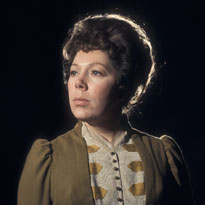
Janet Baker, acclaimed British mezzo
Ms. Finch asks, “So what is it about the English soul, as expressed in English song, that has such a powerful pull worldwide, and generation after generation?”  For her answers, I direct you to the article, which I guarantee you will enjoy.
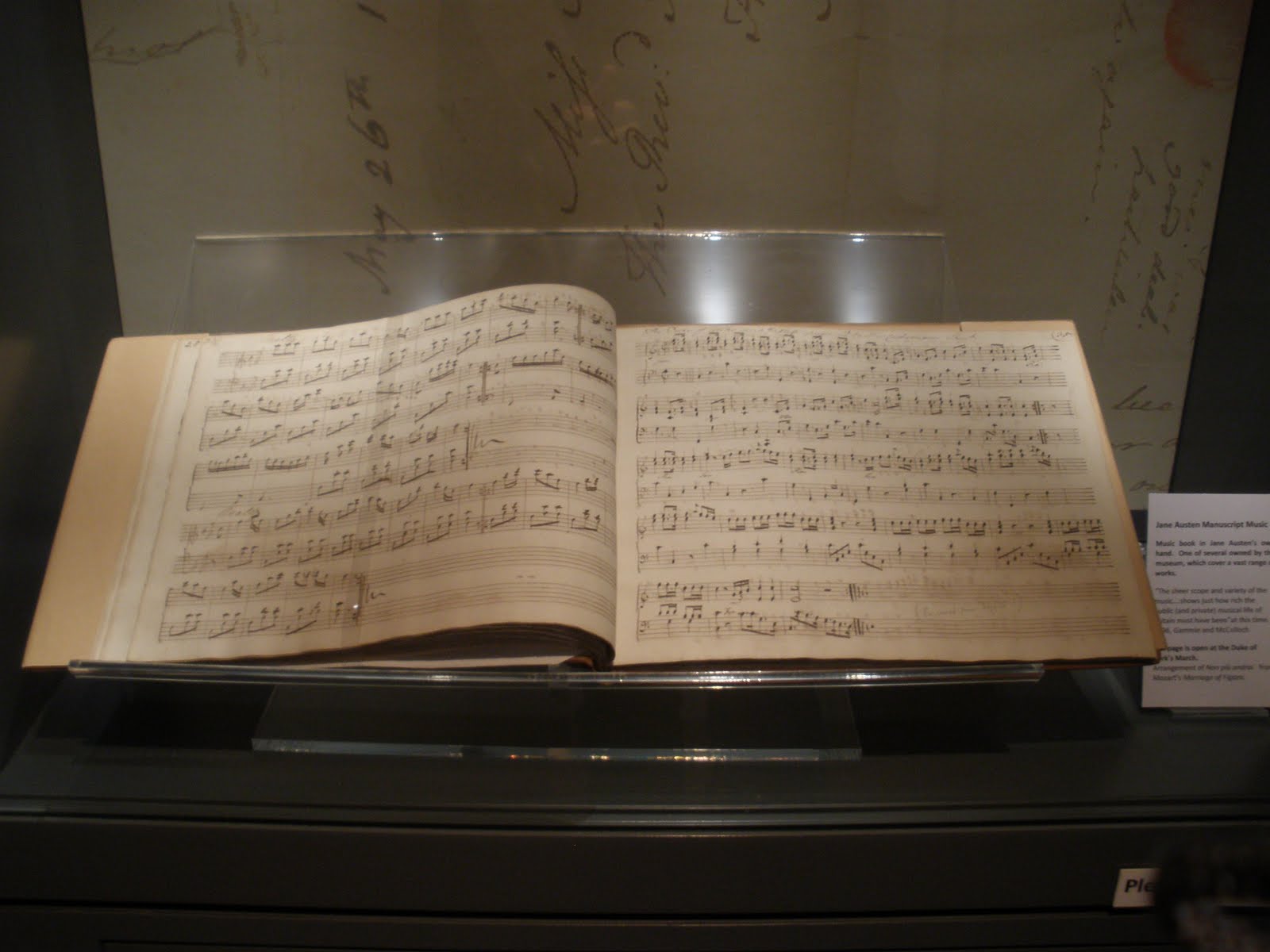
Music is always synonymous with Britain to me, whether it be the folk songs or the country dances we learned in school, many of which were transferred across the Atlantic almost unchanged, or the modern classics of Benjamin Britten or Ralph Vaughan Williams.  Jane Austen lovers know the music well, from the copies of songs Jane herself wrote out, now to be seen at the Jane Austen Museum at Chawton Cottage…

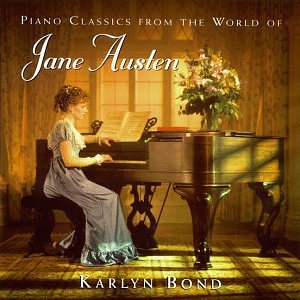
…to the lively soundtracks of the many versions of her stories.  There are also many CDs of music from her time for the fortepiano and other instruments.

For a selection of Austen-related books on and CDs of  her music, try the JaneAusten Books website, here.

The Sunday New York Times Arts Section on July 8, 2012, carried an article (here) about the centennial of the birth of Kathleen Ferrier, an acclaimed contralto from Lancashire, who died in 1953 at the early age of 41, but left an enduring legacy in her recordings. There are several YouTube versions of Ferrier singing. She often sang English folk music as well as Bach, Handel, and Mahler.

Kathleen Ferrier  (1912-1953)

One amusing tidbit from the Hilary Finch article is her nod to the British penchant for nonsense verse.  I could not agree more.  The lines of Edward Lear (The Owl and the Pussycat) and Lewis Carroll (Alice’s Adventures) are every bit as deserving of a tune as the dialect-laden lines of Robert Burns or the elegant works of Shakespeare or Byron.

Piano on Display at Jane Austen House Museum
 (not hers, but very similar)
And dare I write of English music without mentioning everyone’s favorites, the Boys from Liverpool?  British pop music is famous worldwide.
And starting this month in London, another season of The Proms; their website is here.
So, sing out, everyone!

There's An App For That

On this momentous day in the history of the United States and Great Britain, we thought we’d take a look not back, but forwards. It was only a matter of time before London tourists were empowered by technology. There are now a host of apps to make your next trip to the Old Smoke that much easier/more enjoyable. We’ve rounded up some of the smartest, most useful apps available today, any one of which would have made Prince Puckler-Muskau swoon with delight.

The London Tube App by Presslite (above) and the London Underground Free (below) both offer route maps, real time status updates, line delays, GPS locting and station exit locations.

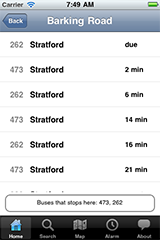
London Bus Stop Live (screenshot above) providing live departure information for every bus stop in London – real time bus departure times as predicted by the onboard GPS system in each bus. There’s no more getting wet waiting for buses, no more missing the last bus home and no more wondering if there’s time to nip into the shop or not. In fact there’s no more waiting for a bus ever again. Welcome to 21st century London.

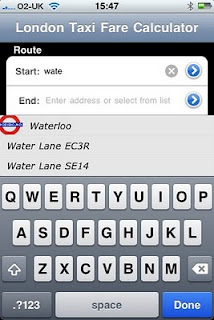
The London Taxi Fare Calculator allows you to check the fare for a taxi between two points anywhere in London, uses the iPhone’s GPS and iPhone maps to make the calculations and predict the best route, and has preset points of interest such as tourist attractions, landmarks, train stations, tube stations and airports.

London Mini A-Z – This map is a digital rendition of the famous “London A-Z Mini Atlas” and covers an area from West Hendon in the North West to Grove Park in the South East. Add this application to your iPhone or iPod Touch and you will have instant access to all 352 pages of the London Mini A-Z printed map.

The Time Out London app puts everything that’s great about the capital in one place, with information on gigs, events, bars, restaurants, club nights and film releases. Whether you’re out and about or planning from home, it’s simple to organise your days and nights out in London and invite your friends.

National Gallery – Take a virtual tour of the National Gallery’s collection, search by artist or time period and save screenshots of artwork on your phone or upload to Facebook. You can also listen to the stories behind the masterpieces in insightful interviews with artists, writers and experts.

Quirky London – If you want to find out where in-the-know Londoners go for a mid-week meet-up, a lively Saturday night out or an off-the-beaten-track Sunday stroll then this is the app for you. Packed with the museums, art galleries, restaurants, pubs, clubs and venues that make London truly great, Quirky London uncovers the city’s secrets and presents them to you in one easy-to-follow guide complete with maps, images and the nitty gritty info you need for your visit.

The Hidden London app will help you discover nearly 50 unusual, amazing, intriguing and surprising places to visit.

+ Discover a “Roman” bath right in the centre of London.
+ Hang out with Dennis the Menace and friends in London’s only cartoon museum.
+ Explore a mysterious crypt hidden in the depths of Fleet Street.
+ Browse through the first English dictionary in the 18th century house where it was written.
+ Investigate Sherlock Holmes’ most famous cases and consult with Dr Watson.
+ Visit Pango the pig, DJ the horse and even a few friendly dinosaurs.

The Green and Rural London app describes and maps London’s finest parks, gardens, squares, secret green boltholes, cemeteries, commons, and urban farms. Whenever you feel in need of a breath of fresh air, a moment’s repose, a wander around lawns and flowers, a playground, or a place to eat your lunch al fresco, turn to this app.

Urban Spoon – Search for local restaurants by neighborhood, cuisine or price. Find reviews from local newspapers, food blogs and fellow diners.

London On A Plate – this note-book guide contains personal reviews on some of London’s most valued food shops and restaurants, shopping pages, guiding you on must-haves to wear to dinner or ideas to dress your own dining table, from some of the capital’s most respected design talent. Markets to see and time to be inspired distilled into one pocket bible. One of the key purposes of this guide is to provide the home cook with recipes from some of London’s finest chefs, including John Torode, Fergus Henderson, Anna Hansen, Mark Hix, Peter Gordon and Sam and Sam Clark.

London City Slicker – London City Slicker brings the colour and history of London to life on your iPhone. Hours of superbly produced Video and Audio help you delve into the secrets and stories relating to London’s fabulous heritage and the people who lived there. Superbly crafted walking-tours have been created for anyone interesting in exploring or finding out more about London, without the cost of a Tour-Guide. Famous historian Adam Heart Davis takes you through important London sites on themed walks of about 2 miles in length or a few hours in duration. With integrated Google Maps, getting around the walking-tours could not be easier.

And we’ve saved the best London app for last – this one deserves its own drum roll –

The Time Travel Explorer app lets you explore historic London as it was in the past – Georgian, Regency and Victorian eras included. This version contains the mapping engine, the central area of London from Stamford’s 1862 map and a modern map of the same area. It also contains over 750 points of interest, 150 audio guides and over 1500 old and new pictures. The remainder of the 1862 map and additional historic maps from 1830 (Greenwood), 1799 (Horwood) and 1746 (Rocque) are available as separate purchases.

Time Travel Explorer – London Pro provides a bundle of all four maps at a discounted price. With TTX you can:
– follow your route on antique maps that show you the streets and buildings from centuries ago
– use GPS to show you what lies beneath the modern city and what has survived to the present day
– click on points of interest to get detailed information about your location
– get the highlights of London’s history right where you need them.

Features
– high-quality digitised images of important historical maps*
– 750 points of interest with full descriptions
– 1500 photos including life in London over 100 years ago**
– 150 audio guides**
– expert tour information from a qualified Blue Badge guide
– seamless transfer from one era to another – travel through time

Welcome to the 21st Century!

Christie's – The Exceptional Sale

“Brand Cabinet,” ca 1743. Est: £800,000-1,200,000. Photo: Christie’s Images.

The Exceptional Sale, taking place on 5 July in King Street, London, is Christie’s premier auction for the decorative arts. This exclusive annual sale includes the finest works of art in a variety of categories, from furniture and sculpture, to porcelain, silver and clocks. It is carefully curated to include only the very best examples.

From the Christie’s Press Release:

In 2008 Christie’s launched a unique sale platform for the very best decorative arts; The Exceptional Furniture Sale saw 10 masterpiece works realise a total of £10.3 million. Building on the success of this sale and The Exceptional Sale held in 2011, Christie’s is pleased to announce details of The Exceptional Sale 2012 which will take place on the evening of 5 July. Comprising 48 lots, the sale presents three centuries of decorative arts, from the first quarter of the 16th century to the first quarter of the 19th century. Featuring the finest examples of furniture, silver, sculpture, clocks and porcelain – including recent discoveries and previously unknown examples – the sale exemplifies the very best of European decorative arts. It is expected to realise a total in excess of £13 million. Robert Copley, Deputy Chairman Christie’s UK, International Head of Furniture and Decorative Arts states: ‘With The Exceptional Sale Christie’s celebrates excellence in furniture and the decorative arts. The attributes of this carefully curated auction are provenance, rarity, design, and craftsmanship. From exquisite furniture by André-Charles Boulle and Thomas Chippendale to the magnificent Leinster silver dinner-service; from a rare maiolica plate by Nicola da Urbino to a newly discovered marble group by Jan van Delen; from glittering Chinese clocks and ormolu-mounted porcelain to the finest examples of Italian pietre dure, The Exceptional Sale offers collectors an opportunity to acquire the very best.’


The exceptional Brand Cabinet (above), a George II ivory-mounted padouk medal-cabinet, circa 1743 (estimate: £800,000-1,200,000), was made for the wealthy young Dilettante Thomas Brand, who like many English milordi went on The Grand Tour, arriving in Rome in 1738. It is here that he probably purchased the ivory plaques that depict figures from Classical mythology such as Leda and the Swan. A couple of years later, Brand’s contemporary and ‘intimate friend’ Horace Walpole also made the Tour. On his return he designed a cabinet to house his precious ‘enamels and miniatures’. No doubt inspired by William Kent, his cabinet and Brand’s are both made of padouk and are attributed to William Hallett of Great Newport Street, in Covent Garden. Walpole’s cabinet subsequently hung in the Tribune at Strawberry Hill and is now in the Victoria and Albert Museum, while Brand’s cabinet remained at the family house, The Hoo, in Hertfordshire until it was first sold at Christie’s in 1938.

The Ogden Mills ‘Armoires à Six Medailles’ (above) are lavishly decorated with spectacular gilt-bronze mounts that fuse seamlessly with the scrolling foliate pattern of the sumptuous ground of brass and tortoiseshell première and contre-partie marquetry (estimate: £1,000,000–1,500,000). The Louis XIV armoire in contre partie is attributed to André-Charles Boulle, while the late Louis XVI in première partie is by Delorme. They are decorated to the doors with trails of medals celebrating the Life of Louis XIV as well as the figures of Aspasia and Socrates. Conceived initially with shelves to house collections of precious medals this series of armoires proved so successful it remained in production in Boulle’s workshop throughout the first half of the 18th century and was subsequently continued by Boulle’s followers.

To view the sale catalogue online, visit the Christie’s link here.