A Couple In England

Recently, I was reading Jerome K. Jerome’s Three Men In A Boat when I came upon the following passage:
“What we want is rest,” said Harris. “Rest and a complete change,” said George. “The overstrain upon our brains has produced a general depression throughout the system. Change of scene, and absence of the necessity for thought, will restore the mental equilibrium.” George has a cousin, who is usually described in the charge-sheet as a medical student, so that he naturally has a somewhat family-physicianary way of putting things.
I agreed with George, and suggested that we should seek out some retired and old-world spot, far from the madding crowd, and dream away a sunny week among its drowsy lanes—some half-forgotten nook, hidden away by the fairies, out of reach of the noisy world—some quaint-perched eyrie on the cliffs of Time, from whence the surging waves of the nineteenth century would sound far-off and faint.”
As I’ve recently been feeling the strain of a maternal broken hip, and as the exact meaning of the phrase “beck and call” has been made crystal clear to me in recent weeks, you can imagine the effect the above passage had upon my fatigued psyche. I agreed with every word I’d read, save for the bit about putting the nineteenth century far off.
Needing to get away, the three men in question eventually hit upon a fortnight’s boat trip as the answer to their problems. Unfortunately, rowing myself and my husband up and down the Thames held no appeal for me, so it became necessary for me to come up with an alternate itinerary. Naturally, the words “some retired and old-world spot” put me in mind of London. While the City might not, nowadays, be universally described as “far from the madding crowd,” I felt sure that my little bit of Mayfair and St. James’s would prove as soothing as ever. And nothing manages to calm my nerves more than a visit to Apsley House.
“Drowsy lanes – some half-forgotten nook . . . ” You may be sure that I gave this turn of phrase some thought. If I were a pipe smoking sort of lady, I’d have fired up a bowlful whilst ruminating on the myriad English places that fit this description. Where existed drowsy lanes?  I must admit, I got caught up on this one for a time, since there are endless possibilities. However, I then re-read the passage and saw again the “half-forgotten nook.” By Jove, we’d go to Bath! Half forgotten, indeed, as so much of the City remains as it was in a long forgotten time, said time being the Georgian period. Yes, Bath would do nicely, I thought.
Finally, I considered “some quaint-perched eyrie on the cliffs of Time,” which proved easily deciphered, as Windsor Castle, whilst not precisely on a cliff, is as quaint an eyrie as anyone might want. And practically speaking, if we circled back round for a stay in Windsor as the last leg of our visit, we should be ideally placed for the flight home.
Having determined our itinerary, I then informed my husband that we are going to London, Bath and Windsor at Christmas time. My husband is a study in understatment – so dignified, so reserved. And what a sense of humour! Where you or I would, upon hearing this marvelous news, have gushed and, at the very least, jumped for joy, my husband managed, no doubt by Herculean effort, to contain his excitement and offered me instead an admirably conservative, “Oh, eh?” 
I could tell that the husband was giving the proposed itinerary a goodly amount of thought. He tried to play it cool by keeping his eyes glued upon the t.v. and Pardon The Interruption, but after a time he turned towards me and asked what Bath was, what was there and why, exactly, we were going there. What a card!
I did get a rise out of him after I’d explained that we’d be doing a full Wellington day whilst in London – Apsley House, the Wellington Arch, Horse Guards and the daily 3 p.m. parade inspection, a stop by the Wellington Barracks and the Guards Museum, tea at the Langham, dinner at the Duke of Wellington pub and a night cap at the Grendadier. After hearing absolutely every last detail of my plans for a day simply steeped in Wellingtonia, my husband was so overcome with anticipation that the only words he could muster were “Oh. Joy.”
   I can only imagine what his response would have been to my proposing that he paddle us up and down the Thames for two weeks.

Royal Albert Hall, Since 1871

Royal Albert Hall,

On my very first trip to London — so long ago I dare not reveal the year — I attended a concert at this venerable institution.  Being a student and nearly penniless as were my companions, we sat way up at the top in the cheapest seats. Sad to say I don’t remember anything about the music we heard, but I will never forget the view of the vast auditorium packed with cheering fans. For what, I couldn’t say, though I assume it was one of the Proms.

Prince Albert, by F. X. Winterhalter

Prince Albert (of Saxe-Coburg and Gotha, 1819-1861) carved out a place in British history both as the Prince Consort who assisted his wife Queen Victoria in many ways, and as a promoter of science and technology developments.  He was the mover and shaker behind the Great Exhibition of 1851 and the development of South Kensington, which came to be known as Albertopolis, into a center of education, scientific and cultural development.

map showing the institutions of South Kensington/Albertopolis
For a fuller exploration of the architecture of the area, consult the Royal Institute of British Architects here.

Many now-great institutions grew here on the site of an agricultural oasis up to the mid-19th century:  the Natural History Museum…

Natural History Museum, Cromwell Road
… the Science Museum,
Science Museum, Exhibition Road 
  
… the Imperial College London, the Royal Geographical Society, the Royal College of Art, and the Royal College of Music. The Victoria and Albert Museum, sprawling repository of great works of the decorative arts is the eastern most part of the neighborhood.
Victoria and Albert Museum, Cromwell Road
Victoria and Albert Museum Entry

Northern most of the complex is the Albert Memorial, recently renovated, in Kensington Gardens opposite Royal Albert Hall. Sir George Gilbert Scott designed the Gothic structure, dedicated by Queen Victoria in 1872.

Albert Memorial
Prince Albert
Getting back to Royal Albert Hall, it was begun in 1867 and dedicated by Queen Victoria in 1871.  The design was conceived by Henry Cole, who was inspired by ancient Roman amphitheatres; the details were worked out by two Royal Engineers, Captain Francis Fowle and General Henry D. Scott.  The vast central auditorium is elliptical in shape, about 185 feet wide and 219 feet long; it can be rec
onfigured for many types of events both with traditional staging and in the round. 
Take a Virtual Tour of Royal Albert Hall here.
Funds for building the Hall came partially from profits of the 1851 Great Exhibition in Hyde Park. Prince Albert suggested that the area of South Kensington be filled with institutions to promote education and progress, but he died before the scheme was completed.

For a full timeline of the construction of the Hall and many of the events held there, click here.

Among the many stray facts about the Hall is the number of red bricks used: 6,000,000.  Originally it was lit by gas, which was replaced by full electric lighting in 1888.  Only minor damage to Royal Albert Hall occurred in Word War II; it was said that the German pilots, as they did for St. Paul’s Cathedral, left it alone because its distinctive appearance served as a landmark for their bombing runs. Refurbishment took place in 1996-2004, with the addition of many modern conveniences, upgrading the restaurant facilities and other amenities.

massed choirs in the RAH
Royal Albert Hall was purposely designed to adapt to all sorts of events, concerts, conferences, speeches, meetings, ceremonies, exhibitions, sporting events (tennis, wrestling, boxing) and even the circus.  Classical, opera, jazz, folk, rock and pop concerts have included the most famous performers in the world. Verdi, Wagner and Elgar all conducted their works at the RAH.  The list of stars who have play the Hall would illuminate not only the vast dome but the entire sky above.
Phantom of the Opera 25th Anniversary, 2011
Royal Albert Hall is held in trust for the nation of Great Britain but it operates entirely on its own earned funding.  Many educational programs are operated in collaboration with schools and other institutions.  Even if the hall is “dark” when you visit, you can book a tour.
The annual 8-week program of BBC Proms will run through Saturday, September 8, 2012.  For more info in the Proms, click here.
Rock on, RAH!

From the August 1801 Annual Register

Like many writers who dote on the late Georgian period, I have a selection of publications called Annual Registers, which are something like almanacks.  They contain a wide variety of articles, from serious accounts of international diplomacy to gossip and on-dits about unusual incidents.  Here are three items from The Annual Register, or A View of the History, Politics, and Literature for the Year 1801, from the Chronicle for  August p.47-48:

“1st  As the Marquis of Abercorn was driving the Marchioness and Lady Catharine Hamilton in a curricle, near Stanmore, the horses took fright, and set off at full speed;

Curricle

… in the attempt to pull them up, the reins snapped. The Marquis, embarrassed by the shrieks of the ladies, and unsteady in his seat, jumped into the road and broke his right thigh and left leg.

John James Hamilton, 1st Marquis of Abercorn (1756-1818)

The ladies kept their seats until the coachman, who was outrider, saw a convenient place, when, by forcing the horses towards the ditch, he contrived to have them thrown out upon the bank without injury. The horses again set off.

Lady Anne Jane Gore, Marchioness of Abercorn, 3rd wife of the 1st Marquis (d. 1827)
ca. 1800, New Orleans Museum of Art

The curate of Edgware coming along the road, made an attempt to stop them, but unfortunately lost the cap of his knee by a blow of the pole. A surgeon set the Marquis’s limb upon the spot.”

Royal Mail Coach, 1800

“At the Maidstone Assizes, on Thursday last, James and John Austin, brothers, were put to the bar on a charge of robbing the mail…from both of which they obtained a large booty, notes to a great amount having been paid previous to the discovery of those by whom the robbery had been perpetrated….It was proved that this bundle of notes consisted of the paper of different country banks, which had been stolen from the mails, and thus there was no doubt of the connection of this prisoner with the robbery….After all the various proofs of these facts had been minutely gone through, the jury brought in a verdict, acquitting the prisoner John, but finding James guilty. 


A Highwayman Re-enactor, near Belvoir Castle


The judge immediately pronounced sentence of death on the prisoner, adjudging him to be hanged in chains near the place where the robbery was committed….he confessed he was concerned in the robbery…at the same time confessed having stolen many letters and parcels while he was post-boy at Lamberhurst in Kent….”


Thames Wherry


“August 5th  As a party of ladies and gentlemen were amusing themselves in a wherry on the Thames near Shepperton, a salmon leaped from the river and fell into the boat.  In the struggle to seize the fish, the wherry was precipitated down the stream, and was at length overturned; but, the place was fortunately so shallow, that none of the parties were drowned, though they were immersed head over ears in the water.  Mr. Smith, who saw the accident, induced the party to accompany him to his hospitable mansion where a change of clothes was procured for the unfortunate party,  but the lady of Mr. Maintone, who was far advance in pregnancy, was seized with violent convulsions, in consequence of the fright, and expired before morning.”
 

Mourning Symbols

Fashion Museums in Britain

Red Silk Robe a l’Anglaise, Victoria and Albert Museum, 1760’s

Victoria here, taking some time off of Pinterest for a change…and ruminating on the wonderful fashion museums which have so carefully preserved the clothing and accessories of bygone eras.  The U.K. is replete with wonderful museums, almost all of which have some fashions, in even the smallest of local collections. The grandaddy of them all is, of course, The Victoria and Albert Museum in London, which modestly calls itself, The world’s greatest museum of art and design.” The website is here.

I suppose no one who has visited the sprawling site on Cromwell Road would quarrel with the designation, for it is truly superhuman to cover its many displays even in multiple visits.I can hardly drag myself out of the fantastic gift shop when I get there!

Would you be disappointed if I did not include a link to that wonderful shop?  Be forewarned — they are excellent at shipping.  Click here — if you dare.

The Costume Collection has been recently redone and has re-opened with an exhibition of ball gowns from the 1950s to the present. It will be on display through January 2013, along with selections from the permanent collection of historic fashions.

I love the Georgian, Regency and Victorian gowns usually on view.  Due to their fragility, the items are frequently rotated from storage to display and back.

V and A: White Dress with scalloped hem, ca. 1830
British, cotton muslin with wool embroidery, silk, satin and wadded rouleaux

V and A: Evening Dress, 1807-11  British,
machine made silk net, embroidered with chenille thread, with silk ribbon, hand sewn; over red petticoat

Among the V and A’s fashion exhibits

Also in London, Kensington Palace stores, conserves and exhibits Historic Royal Fashions.  Recently, the collection of Royal Wedding Gowns was restored. Beginning this fall, some of the storage areas, formerly Princess Margaret’s Apartment 1A, will be renovated for Prince William, Duke of Cambridge, and his Duchess, the former Catherine Middleton.

Parts of Kensington Palace formerly housed Diana, Princess of Wales, and is the home in which Prince William grew up.  Other members of the extended royal family also have quarters there.

Here is an article that tells more about the Palace, the renovations and the Royals.  For more details, click here.

Parts of Kensington Palace include the State Rooms of William and Mary, the childhood rooms of Queen Victoria, and the Royal Fashions.   I have not seen an announcement of the final plans for the fashions, but one assumes that  Historic Royal Palaces, which administers Kensington Palace a well as other former Royal residences in the London area (e.g. Tower of London, Hampton Court Palace) will take advantage of sharing the complex with the popular young Royals to attract visitors to their displays.

Queen Victoria’s Wedding Gown, Kensington Palace
The Assembly Rooms, Ba
th

In Bath, The Fashion Museum is located in the Assembly Rooms, which are administered by the National Trust.  The Fashion Museum has more than 30,000 items from1600 to the present. The website is here.

a view of storage at the Fashion Museum
display at the Fashion Museum
Gown of plain-weave white cotton, ca. 1813, with striped wool shawl
 Bath Fashion Museum
Lilac cotton sateen corset lined with cream cotton
1880-85, Bath Fashion Museum
Shoes of many eras carefully preserved, Bath Fashion Museum
Another excellent Fashion Museum shows many items owned and preserved the the National Trust at Killerton House, a Regency-era country villa in Devon. The website is here.
Killerton, NT
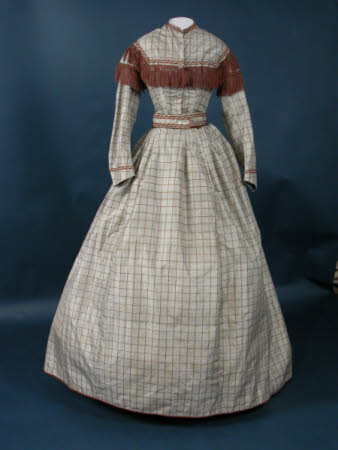
Croquet Dress, 1863-65, silk taffeta with glass buttons
Killerton House Fashion Collection
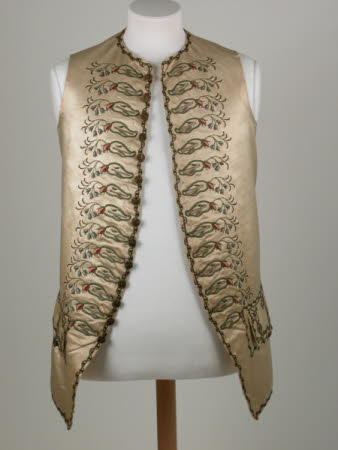
Man’s Waistcoat, 1750, silk, satin, metal
Killerton House Fashion Collection

Also at Killerton are many attractive rooms and an extensive garden to explore.  As always, NT has a selection of tasty delights at the tea-room not to mention the temptations of the NT gift shop.

Manchester City Galleries

I have never visited Manchester (something I need to remedy), but the Manchester City Galleries website (here) has an extensive on-line fashion collection.  Here are a couple of examples of their holdings.

Man’s Court Suit, 1775-85
Tennis Dress, 1880’s

Bodice, 1650-1660, Dorset, UK

For a list of museums with fashion and costume collections, click here.  And if you are a resident of the US, there are many outstanding fashion collections here too.  Do you have any recommendations for good fashion collections on either side of the pond?

The Kyoto Fashion Institute seems to be an amazing place, or at least its website and publications are excellent.  They organize many exhibitions, some of which are shown in venues outside Japan.    Click here.

The Court Journal for July 1835

From

 Gazette of the Fashionable World
July 1835
COURT AND FASHIONABLE LIFE.
— Their Majesties will come to town on Tuesday, and remain till Saturday, during which time two grand dinners will be given at the Palace. The King will hold an investiture of the Most Illustrious Order of St Patrick on Tuesday, at which the Earl of Howth will be appointed a Knight Commander of the Order. On Thursday his Majesty will inspect the Artillery at Woolwich.
The King and Queen will give a grand entertainment at St James’s Palace on Saturday next, in honour of the birth-day of the amiable Duchess of Cambridge. All the Royal Family, the foreign Ambassadors and their Ladies, his Majesty’s Ministers, the usual Court Circle, and a select number of the Nobility, are invited to the banquet.
The Duke of Cumberland honoured Viscount Canterbury with his company at dinner on Thursday evening. The Marquess Camden, Marquess of Hertford, Lords Lyndhurst, Hill, Fitzgerald, and Lieven, and a select party, were present to meet his Royal Highness.
The Duke of Cumberland will shortly take his departure for the continent, to represent his Majesty at the coronation of the Emperor of Austria at Prague. The Royal Duke, after the coronation, will remain on the continent with the Duchess and Prince George until next year.
— Sir Charles and Lady Ogle are preparing to take their departure for the Continent, where they will remain till the commencement of the next season.
— Lord Elphinstone, one of his Majesty’s Lords in Waiting, has been despatched to the Hague for the purpose of inviting his Majesty, the King of Wirtemburg, who, with his daughters, the Princesses Mary and Sophia, are at present staying on a visit to the King and Queen of Holland. His Majesty was last on a visit to the Royal Family here in 1830.
The Marquess of Hertford (above) will give another splendid entertainment on Saturday next, at his beautiful villa, in the Regent’s Park, to which more than five hundred distinguished persons are invited. It is said the noble marquess and his extensive suite will leave this country for Italy, soon after the prorogation of Parliament.
 — The King of Prussia has had medals struck in gold in honour of the late Emperor of Austria, which are intended for presents to diplomatists known to be favourable to the policy of the deceased Monarch. Copies in bronze are likewise to be taken, which are to be distributed among the soldiery.
The Earl of Mulgrave is about to proceed on a tour through Ireland. The Countess, during his Lordship’s absence, will pay a visit to Lord and Lady Ravensworth, in London.
The Duke of Somerset and the Lady St Maur gave a dejeuner on Monday, at Wimbledon Park, which was graced by nearly all the persons of high rank and fashion now in the metropolis. It was a brilliant day, and a late hour in the evening before the company departed.
The Marquess and Marchioness of Salisbury will give a grand entertainment at Hatfield House, next Saturday, to which the Duke of Wellington (above) and a large portion of the fashionable world are invited. The splendid palace, which has for some time been under a state of repair, is now finished. The interior has been newly decorated, and furnished in a style of magnificence peculiar to the refined taste of the noble owner.
  —The Duchess of St Albans lost a valuable ruby set with diamonds, at the Colosseum fete on Thursday week. It was picked up by a gentleman, and returned to her Grace a day or two afterwards.
— We understand that the inhabitants of Hammersmith have had a public meeting, at which they determined to testify their loyalty by erecting a triumphal arch across the road on Thursday next, when their Majesties visit the Earl and Countess of Mansfield, at Caen Wood. The arch is to be sixty feet high by forty feet in width; and the various lodges and societies of the neighbourhood are to be drawn up on either side of the road with their bands of music.
The marriage of Prince Leopold of Naples with Princess Maria of Orleans is now finally decided upon. The President and Grand Referendary of the Chamber of Peers are drawing up the articles, and the nuptials, which the King and Queen of the Belgians are to attend, are to take place at the Chateau d’Eu, in Normandy.
The Opening Banquet at Goldsmith’s Hall.—In order to do honour to the new Hall, a select party was invited to the opening dinner, which took place on Wednesday evening under very distinguished auspices. The Duke of Wellington, Sir Robert Peel, the Marquess Camden, Earl of Darlington, Lord Maryborough, Lord Abinger, the Vice-Chancellor, Lord Bexley, Sir Henry Hardinge, Sir Edward Cust, and many other persons of rank were present. The Duke of Wellington went in his state carriage, and was greeted with the hearty cheers of the crowd assembled to witness the company alight. Sir Robert Peel was received with a similar demonstration of popularity. The best arrangements were made for the reception of the guests, who amounted to about 250. The dinner took place in the Livery Hall, about seven o’clock, when the company sat down to a sumptuous repast, con sisting of all the luxuries and delicacies of the season. The band of the Coldstream Guards was stationed in the Marble Gallery. The chandeliers in the Livery Hall, especially the great one in the centre for seventy-two wax-lights, are perhaps as fine specimens of that manufacture as can be seen in or out of England. The branching arms, large and variegated centre shafts, exhibit nothing but glass, cither richly cut, or in masses of brilliant drops, long prisms, the whole when lighted producing a most dazzling effect. These, with the lustres in the Court rooms, as well as the great metal lamp chandelier, suspended from the dome over the grand staircase, were, we understand, supplied by Perry and Co., of Bond street.
The Duchess of St. Albans (above) gave another Dejeuner Fete, at Holly Lodge, on Saturday last. The house and grounds were decorated with choice flowering plants, the balconies filled with pink hydrangeas and white lilies, the long walk and the lawn before the house had orange trees full of fruit, and round the door and the music tent were stands of splendid flowers. Three large temporary rooms were erected, hung with pink and white, the draperies wreathed with roses, and at the end large looking-glasses were placed, which increased the appearance of the gay scene. The entertainments commenced with a concert, conducted by Sir G. Smart and Signor Gahussi, in which Grisi, Malihran, Stockhausen, Lablache, Tans burini, Rubini, Mr and Mrs Bishop, Mr and Mrs Knyvett Philips performed. During the intervals between the singing, the Coldstream band played in the grounds. About six o’clock the guests sat down to the banquet, after which they went to the hill, where the Grand Falconer exhibited a flight of hawks. Dancing then commenced in the tent and ball-room, continuing until near midnight, except during the interval occupied by the fireworks, which were exceedingly splendid.
— Lady Willoughby D’Eresby gave a grand ball last evening at her mansion in Piccadilly, which was so numerously attended, that for some time the street was rendered nearly impassable, although the ingress and egress were admirably regulated by the police.
The third grand ball given on Thursday by the Officers at Woolwich, was attended by all the beauty and fashion in that neighbourhood, and a number of lovely women and distinguished persons from the metropolis.
— Burleigh House, near Stamford, the magnificent seat of the Marquess of Exeter, on Tuesday last presented one continued scene of gaiety and old English hospitality, worthy the descendant of the great Lord Burleigh. All the Nobility and Gentry in that richly populated neighbourhood were invited, and many distinguished guests from London joined the enchanting scene of festivity and splendour.
— Lord Stanley is at Knowsley Hall, in Lancashire, the seat of his father, the Earl of Derby. His Lordship will return to his duties in Parliament immediately after Liverpool races, where several horses from the stud of Lord Derby are engaged to run.
The Duchess of Saxe-Weimar and family arrived at Deptford on Sunday from Rotterdam. Her Serene Highness was received by the Earl of Denbigh and Mr Hudson, and immediately entered one of the Royal carriages, followed by her suite in a second carriage and four. Near New Cross the Duchess was met by the Queen, and accompanied her Majesty to St James’s.
— On the evening of Tuesday week, while the Duchess of Cambridge was quitting the French Theatre, Sir James Reynett (above), who was handing her Royal Highness to her carriage, was robbed of a valuable gold snuff-box.
The accomplished Duchess of Sutherland gave a grand assembly on Wednesday, at Sutherland House, in the Green Park. The mansion presented, in the interior, one continued blaze of light, which reflected splendor on the magnificent collection of pictures displayed in the rooms of that noble building.