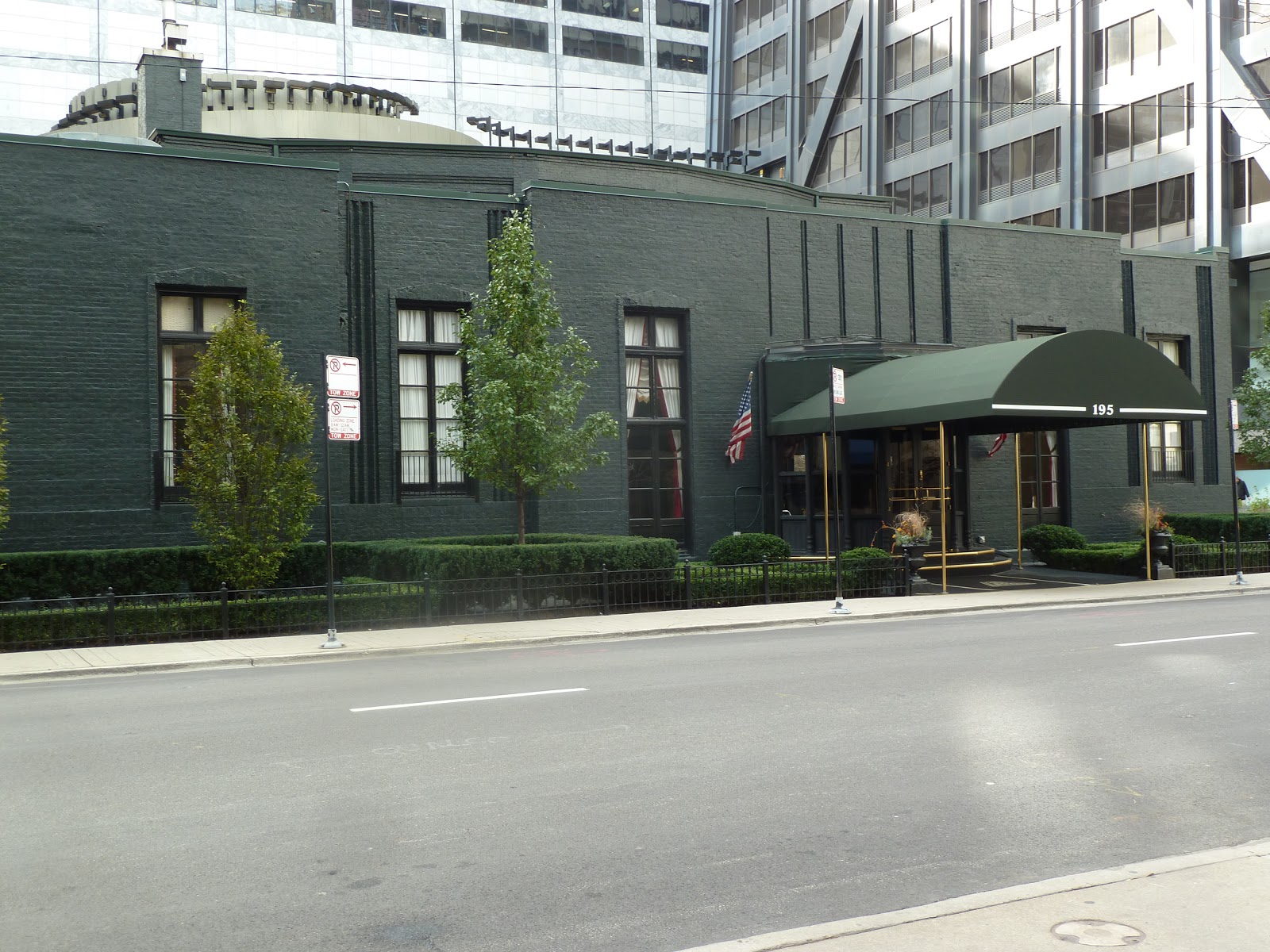
I try to stay in a different part of London each time I visit. So far, I’ve stayed in various hotels in Victoria, Bayswater and Kensington. This time over, I’ve opted to stay in Mayfair, more precisely in Half Moon Street, located between Piccadilly and Curzon Street. According to Christopher Hibbert’s London Encyclopedia, Half Moon Street took its name from a public house which stood on the corner of Piccadilly. The street backs onto Shepherd’s Market and is literally around the corner from the In and Out Club on Piccadilly, shown below.
In The Handbook of London: Past and Present, Volume 1 by Peter Cunningham, we find the following mentions of HALF MOON STREET, Piccadilly –
“Last Friday evening died Mrs. Winter, who many years kept the Half-Moon Ale-house, in Piccadilly, in which it is Said she acquired near 8000L., which she has left to her poorest relations.”— Gazeteer, Sept. 6th, 1758.
” Yesterday, James Boswell, Esq., arrived from Scotland at his lodgings, in Half Moon Street, Piccadilly.”— Public Advertiser, March 11th, 1768.
While lodging in Half Moon Street in 1768, Boswell entertained Dr. Johnson, Dr. Robertson, Baretti, and other literati. In fact, Half Moon Street lays claim to many literary residents. Pope, the actor, lived at No. 5, and his first wife, the celebrated actress (formerly Miss Young), died at the house on the 18th of June, 1803, aged 26. The celebrated physician, Dr. Samuel Merriman, occupied No. 26 from 1813 to 1825; and John Galt, the novelist, was at No. 29 in 1830. William Hazlitt, the essayist, lodged at No. 40 for a short time. He came from Down Street in 1827, and went to Bouverie Street, Fleet Street, in 1829.
In A Wanderer in London, author Edward Verrall Lucas, tells us –
“In Half Moon Street, named, like many other London streets and omnibus destinations, after a public house, lived for a while such very different contemporaries as Hazlitt, Shelley and Madame d’Arblay. I like the picture of Shelley there a hundred years ago: “There was,” says Hogg in his life of his friend, “a little projecting window in Half Moon Street in which Shelley might be seen from the street all day long, book in hand, with lively gestures and bright eyes; so that Mrs. N. said he wanted only a pan of clear water and a fresh turf to look like some young lady’s lark hanging outside for air and song.”
In addition to Shelley, Fanny Burney, Madame D’Arblay, lived for a time in Half Moon Street. In Literary Landmarks of London, Laurence Hutton writes –
“Madame D’Arblay (moved) to the corner of Piccadilly and Half Moon Street, on the east side of the latter thoroughfare; but the house no longer remains. She died in Lower Grosvenor Street, New Bond Street, in 1840. I remember Madame D’Arblay (Fanny Burney) living on the east side of the street, in the last house overlooking Piccadilly. Her sitting-room was the front room over the shop, then a linendraper’s, now a turner’s, shop.”
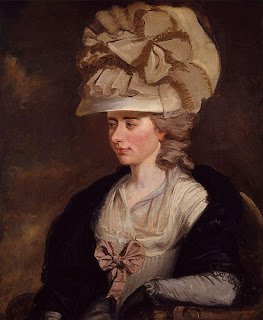
In Joyce Hemlow’s biography of Fanny Burney (Oxford 1958) we are told that, “In 1828 Alex, dissatisfied with his accommodation in 11 Bolton Street, persuaded his mother to move to 1 Half Moon Street, where he could have a large and well-lighted study. This dwelling was opposite Green Park and still near the squares that Fanny liked for their walks and fresh air. She was still within half an hour’s summons of the `gracious and beloved Princesses’ and easily accessible to members of the family who happened to come on brief visits to London . . . . . . Marianne Francis used to tell of typical evenings in Half Moon Street with Madame d’Arbvlay talking `in her animated, hand clasping, energetic French way, telling her long curious stories till she was quite hoarse, and dr Mama fast asleep but jumping up every now and then in her sweet way, to fall in with the current of the remarks, answering in her sleep.”
Moving forward in time, we come to a whole host of fictional literary characters who have called the Street home – Algernon Moncrieff’s Half Moon Street flat featured in the first act of Oscar Wilde’s The Importance Of Being Earnest, and Sapper’s Bulldog Drummond resided at 60A Half Moon Street. Personally, the most interesting fictional characters who live in the street are Bertie Wooster and his man, Jeeves. For live there still they must. Perhaps, if I’m vigilant whilst in residence there, I will catch a glimpse of Jeeves on his way back home from a shopping expedition at Berry Brothers. At the very least I may spot Gussie Fink-Nottle or Aunt Agatha. With luck, I’ll be invited round for a martini . . . . . . . .
And finally, since most things on Number One London tend to come back around to the Duke of Wellington, I’ll mention that Flemings Hotel in Half Moon Street was founded by Robert Fleming in 1851, a date commemorated by the hotel’s stained glass window depicting the Great Exhibition at Crystal Palace. Before founding the hotel, Fleming was a valet to the 1st Marquis & Marchioness of Angelsey at 1 Old Burlington Street in London. And that finishes up this post pretty neatly, what ho?