Narrative of the Sufferings of Elizabeth Woodcock
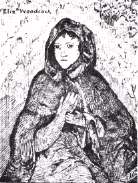
From A Selection of Curious Articles from the Gentleman’s Magazine, edited by John Walker (1819)
ELIZABETH WOODCOCK, aged forty-two years, went on horseback from Impington to Cambridge, on Saturday, being market day, the 2d of February, 1799. On her return home in the evening, between six and seven o’clock, being about half a mile from her own bouse, her horse started at a sudden light, which proceeded, most probably, from a meteor, a phenomenon which, at this season of the year, not unfrequently happens. She was herself struck with the light, and exclaimed “Good God! what can this be!” It was a very inclement stormy night, a bleak wind blew boisterously from the N.E. The ground was covered by the great quantities of snow that had fallen during the day, yet it was not spread uniformly over the surface. The deepest ditches were many of them completely filled up, whilst in the open fields there was but a thin covering; but in the roads and lanes, and many narrow and inclosed parts, it had accumulated to a considerable depth, no where yet so as to render the way impassable, but still enough to retard and impede the traveller. The horse, upon his starting, ran backward, and approached to the brink of a ditch, which the poor woman recollected, and, fearing lest the animal in his fright should plunge into it, very prudently dismounted with all expedition. Her intention was to walk, and lead the horse home; but he started again, and broke from her. She repeated her attempt to take hold of the bridle; but the horse, still under the impression of fear, turned suddenly out of the road, and directed his steps to the right over the common field. She followed him, in hopes of quickly overtaking him, but, unfortunately, she lost one of her shoes in the snow. She was already wearied with the exertion she had made, and besides, had a heavy basket on her arm, containing several articles of domestic consumption, which she had brought from market.
By these means her pursuit of the horse was greatly impeded; she however persisted, and followed him through an opening in a hedge, a little beyond which she overtook him (about a quarter of a mile from the place where she alighted,) and, taking hold of the bridle, made another attempt to lead him home. But she had not re-traced her steps farther than a thicket, which lies contiguous to the said hedge, when she found herself so much fatigued and exhausted, her hands and feet, particularly her left foot, which was without a shoe, so very much benumbed, that she was unable to proceed farther. Sitting down then upon the ground in this state, and letting go the bridle, “Tinker,” she said, calling the horse by his name, “I am too much tired to go any farther, you must go home without me;” and exclaimed, “Lord have mercy upon me! what will become of me!” The ground on which she sat was upon a level with the common field, close under the thicket on the South West. She well knew the situation of it, and what was its distance from and bearing with respect to her own house. There was then but a small quantity of snow drifted near her; but it was beginning to accumulate, and did actually accumulate so rapidly, that, when Chesterton bell rang at eight o’clock, she was completely inclosed and hemmed in by it. The depth of the snow in which she was enveloped was about six feet in a perpendicular direction; over her head between two and three. Her imprisonment was now complete, for she was incapable of making any effectual attempt to extricate herself, and, in addition to her fatigue and cold, her clothes were stiffened by the frost. Resigning herself, therefore, calmly to the necessity of her bad situation, she sat awaiting the dawn of the following day. To the best of her recollection, she slept very little during the first night, or, indeed, any of the succeeding nights or days, except on Friday the 8th. Early the next morning she distinctly heard the ringing of a bell at one of the villages at a small distance. Her mind was now turned (as it was most natural) to the thoughts of her preservation, and busied itself in concerting expedients, oy means of which any one who chanced to come near the place might discover her.
On the morning of the third, the first after her imprisonment, observing before her a circular holet in the snow, about two feet in length and half a foot in diameter, running obliquely upwards through the mass, she broke off a branch of the bush, which was close to her, and with it thrust her handkerchief through the hole, and hung it, as a signal of distress, upon one of the uppermost twigs that remained uncovered; an expedient which will be seen, in the sequel, to have occasioned her discovery. She bethought herself, at the same time, that the change of the moon was near; and having an almanack in her pocket, she took it out, though with great difficulty, and consulting it, found that there would be a new moon the next day, February 4th. The difficulty which she found in getting the almanack out of her pocket arose, in a great measure, from the stiffness of her frozen clothes, before-mentioned. The trouble, however, was compensated by the consolation which the prospect of so near a change in her favour afforded. She makes no scruple to say, that she perfectly distinguished the alterations of day and night; heard the bells of her own and some of the neighbouring villages, several different times, particularly that of Chesterton; was sensible of the living scene around her, frequently noticing the sound of carriages upon the road, the natural cries of animals, such as the bleating of sheep and lambs, and the barking of dogs.
One day she overheard a conversation carried on by two gypsies, relative to an ass which they had lost. She afterwards specified, it was not their asses, in general terms, that they were talking about, but some particular one; and her precision in this respect has been confirmed by the acknowledgement of the gypsies themselves. She recollects having pulled out her snuff-box and taken two pinches of snuff; but, what is very strange, she felt so little gratification from it, that she never repeated it. A common observer would have imagined the irritation arising from the snuff would have been peculiarly grateful to her, and that, being deprived of all other comforts, she would have solaced herself with those which the box afforded, till the contents of it were exhausted. Possibly, however, the cold she endured might have so far blunted her powers of sensation that the snuff no longer retained its stimulus. At another time, finding her left hand beginning to swell, in consequence of her reclining, for a considerable time, on that arm, she took two rings, the tokens of her nuptial vows twice pledged, from her finger, and put them, together with a little money which she had in her pocket, into a small box, sensibly judging that, should she not be found alive, the rings and money, being thus deposited, were less likely to be overlooked by
the discoverers of her breathless corpse.
the discoverers of her breathless corpse.
She frequently shouted out, in hopes that her vociferations reaching the ears of any that chanced to pass that way, they might be drawn to the spot where she was. But the snow so far prevented the transmission of her voice, that no one heard her. The gypsies, who passed nearer to her than any other persons, were not sensible of any sound proceeding from her snow-formed cavern, though she particularly endeavoured to attract their attention. When the period of her seclusion approached to a termination, and a thaw took place on the Friday after the commencement of her misfortunes, she felt uncommonly faint and languid; her clothes were wet quite through by the melted snow; the aperture before-mentioned became considerably enlarged, and tempted her to make an effort to release herself; but, alas! it was a vain attempt; her strength was too much impaired; her feet and legs were no longer obedient to her will, and her clothes were become very much heavier by the water which they had imbibed. And now, for the first time, she began to despair of ever being discovered or taken out alive; and declares that, all things considered, she could not have survived a continuation of her sufferings for the space of twenty-four hours longer. It was now that the morning of her emancipation was arrived, her sufferings increased; she sat with one of her hands spread over her face, and fetched the deepest sighs; her breath was short and difficult, and symptoms of approaching dissolution became every hour more alarming.
On Sunday, the 10th of February, a young farmer, whose name is Joseph Muncey, in his way home from Cambridge, about half past twelve o’clock, crossed over the open field, and passed very near the spot where the woman was. A coloured handkerchief, hanging upon the tops of the twigs, where it was before said she had suspended it, caught his eye; he walked up to the place, and espied an opening in the snow. He looked in, and saw a female figure, whom he recognized at once to be the identical woman who had been so long missing. He did not speak to her, but seeing another young farmer and the shepherd at a little distance, he communicated to them the discovery he had made. Upon which, though they scarcely gave any credit to his report, they went with him to the spot. The shepherd called out “Are you there, Elizabeth Woodcock?” She replied, in a faint and feeble accent, “Dear John Stittle, I know your voice; for God’s sake help me out of this place!” Every effort was immediately made to comply with her request. Stittle made his way through the snow till he was able to reach her; she eagerly grasped his hand, and implored him not to leave her. “I have been here a long time,” she observed. “Yes,” answered the man, “ever since Saturday.” “Aye, Saturday week,” she replied; “I have heard the bells go two Sundays for church.” An observation which demonstrably proves how well apprized she was of the duration of her confinement.
Mr. Muncey and Mr. Merrington, junior, during this conversation, were gone to the village to inform the husband, and to procure proper means for conveying her home. They quickly returned, in company with her husband, some of the neighbours, and the elder Mr. Merrington, who brought with him his horse and chaise-cart, blankets to wrap her in, and some refreshment, which he took it for granted she would stand in peculiar need of. The snow being a little more cleared away, Mr. M. went up to her, and, upon her entreaty, gave her a piece of biscuit and a small quantity of brandy, from both of which she found herself greatly recruited. As he took her up to put her into the chaise, the stocking of her left leg, adhering to the ground, came off. She fainted in his arms, notwithstanding he moved her with all the caution in his power. But nature was very much exhausted; and the motion, added to the impression which the sight of her husband and neighbours made upon her, was too much for her strength and spirits. The fit, however, was but of short continuance; and when she recovered, he laid her gently in the carriage, covered her well over with the blankets, and conveyed her, without delay or interruption, to.her own house.
Mr. Okes, a surgeon, first saw her in the cart, as she was removing home. She spoke to him with a voice tolerably strong, but rather hoarse: her hands and arms were sodden, but not very cold, though her legs and feet were, and the latter, in a great measure, mortified. She was immediately put to bed, and weak broth given her occasionally. From the time of her being lost she had eaten only snow, and believed she had not slept till Friday the 8th; her only evacuation was a little water. The hurry of spirits, occasioned by too many visitors, rendered her feverish; and her feet were found to be completely mortified, from being frost-bitten before she was covered with snow. She was so disturbed with company that Mr. O. had little hopes of her recovery. He ordered a clyster of mutton broth, which greatly relieved’ her, some saline mixture, with antimonial wine, and strong decoction of bark, and three grains of opium in the course of a day. He opened the vesications on her feet, and continued the use of brandy as at first; clysters, opium, and bark, being continued, with Port wine. The cold had extended its violent effects from the end of the toes to the middle of the instep, including more than an inch above the heels, and all the bottom of the feet, which were mortified, and were poulticed with stale beer and oatmeal boiled together. Inward cold, as she called it, affected her, and she desired the cataplasms might be renewed as often as possible, and very warm. The 19th and 20th she was seized with violent diarrhoea, which occasioned great weakness; and, two days after, several toes were so loose as to be removed by the scissars. The 23d she was taken up without fainting. All the toes were removed, and the integuments from the bottom of one foot, except a piece at the heel, which was so long ere it loosened itself that the os calcis and tendo Achillis had suffered. The sloughs on the other foot were thrown off more slowly, and two of the toes removed. All but one great toe was removed by the seventeenth; and, on removmg the sloughs from the heels, the bone was bare in many places: and, wherever the mortification had taken place, was one large sore, very tender.
The sores were much diminished, and the great toe taken off, by the end of March, and an unusual sleepiness came on. By April 17th, the sores were free from slough, and daily lessened; her appetite tolerably good, and her general health began to amend; but with all these circumstances in her favour, she felt herself to be very uncomfortable; and, in fact, her prospect was most miserable; for, though her life was saved, the mutilated state in which she was left, without even a chance of being ever able to attend to the duties of her family, was almost worse than death itself; for, from the exposure of the os calcis, in ail probability it would have required some months before the bottoms of her feet could be covered with new skin; and, after all, they would have been so tender as not to bear any pressure; the loss, too, of all her toes must have made it impossible for her to move herself but with the assistance of crutches. Mr. Okes ascribes the preservation of her life to her not having slept or had any evacuations under the snow, and to her resignation and the calm state of her mind.
After her rescue, tragi
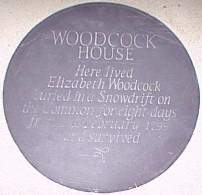
cally she did not survive long. She was taken ill and died on 24th July at the age of 43. At the end of her burial notice appears the following note: “She was in a state of intoxication when she was lost. Her death was accelerated (to say the least) by spirituous liquors afterwards taken, procured by the donations of various visitors.” News of her adventure spread around the country, and numerous engravings of her were published at the time. Elizabeth Woodcock’s cottage survives at Impington in Station Road, near to the war memorial, and now carries a commemorative plaque.