The Tour of Dr. Syntax, Part 8


The Tour of Dr. Syntax in Search of the Picturesque, Part 8

A Few Notes about Poetry…

At the time of the publication of Dr. Syntax by William Combe, the form of iambic tetrameter was very popular. 

Think of Byron’s She Walks in Beauty (1814):

“She walks in beauty, like the night
Of cloudless climes and starry skies;
And all that’s best of dark and bright
Meet in her aspect and her eyes:
Thus mellow’d to that tender light
Which heaven to gaudy day denies.”

People were quite accustomed to reading verse with four beats to a line, though I seem to recall that iambic pentameter (five beats per line) was taught more in my lit classes…

Combe in Dr Syntax uses the AABB of rhyming couplets; Byron, above, used ABAB. Both are equally familiar.

I admit that when I read the lines of Dr. Syntax aloud, I unconsciously use a sing-song expression that make is sound a little childish — sort of like nursery rhymes , or “Roses are Red, Violets are Blue, Sugar is Sweet, and so are you.”

In any case, The Adventures of  Dr. Syntax in Search of the Picturesque is poetry of a type that seems to lead to comic effects, just what the writer and publisher had in mind. Just as an example, here are the openings six lines from Canto 12.  Can you read them aloud without sounding sing-song?

 Excerpts from Canto XII

LIFE is a journey, — on we go,

Through many a scene of joy and woe:

Time flits along, and will not stay,
Nor let us linger on the way:
Like as a stream, whose varying course
Now rushes with impetuous force.

To pick up the story, we left Dr. Syntax with the Squire and his wife…singing songs.  Eventually they retire and the next morning, Dr. S. explains his quest for scenes of the picturesque.

“‘No,’ he (Dr. S.) exclaim’d, ‘I must away: —
I have a splendid book to make.
To form a Tour — to paint a Lake;
And, by that well projected Tome,
To carry fame and money home…'”
The Squire insists on giving Dr. S. a letter of introduction to a noble friend, and Syntax, after three kisses from the Squire’s wife, resumes his journey, finally assured of his own  fortune at last. When he arrives at the handsome home of Sir John, Syntax has more interest in his dinner than the Lord’s artworks.
Doctor Syntax with
My Lord — by Rowlandson
My Lord.
‘What think you, Doctor, of the show
Of pictures that around you glow?'”
Syntax.
‘I’ll by-and-by enjoy the treat;
But now, my Lord, I’d rather eat.'”
 Despite the Doctor’s rudeness, the butler  eventually conducts him to the cellar where he is invited to partake of the Lord’s beer.
At length the potent liquor flows,
Which makes poor man forget his woes.
Syntax exclaim’d, ” Here’s Honour’s boast;-
The health of our most noble Host —
And let fair Devon crown the toast.”
The cups were cheer’d with loyal song;
But cups like these ne’er lasted long.
And Syntax stammer’d, “Do you see ?
Now I’m of this fam’d cellar free,
I wish I might be quickly led
T’ enjoy my freedom in a bed.”
He wish’d but once, and was obey’d,
And soon within a bed was laid,
Where, all the day’s strange business o’er,
He now was left to sleep and snore.”
  
Doctor Syntax Made Free of the Cellar — by Rowlandson

Excerpts from Canto XIII 

Dr. Syntax has a night of dreaming he has been named a bishop…but is roused in the morning to breakfast with Sir John …but declines the invitation to hunt.
“Your sport, my Lord, I cannot take,
For I must go and hunt a lake;
And while you chase the flying deer,
I must fly off to Windermere,
Instead of hallooing to a fox,
I must catch echoes from the rocks;
With curious eye and active scent,
I on the Picturesque am
bent…”
Dr. Syntax travels four days until he reaches Keswick
“Soon as the morn began to break.
Old Grizzle bore him to the Lake;
Along the banks he gravely pac’d.
And all its various beauties trac’d;
When, lo, a threat’ning storm appear d!
Phoebus the scene no. longer cheer’d;
The dark clouds sank on ev’ry hill;
The floating mists the valleys fill:
Nature, transform’d, began to low’r.
And threaten’d a tremendous show’r.”
Doctor Syntax Sketching the Lake — by Rowlandson
‘I love,’ he cried, ‘to hear the rattle,
When elements contend in battle;
For I insist, though some may flout it,
Who write about it, and about it.
That we the Picturesque may find
In thunder loud, or whistling wind:
And often, as I fully ween.
It may be heard as well as seen;
For, though a pencil cannot trace
A sound as it can paint a place,
The pen, in its poetic rage.
Can make it figure on the page.'”
Later, when Dr. Syntax and his horse Grizzle are thoroughly wet… 
To that warm inn they quickly hied.
Where Syntax, by the fire-side,
Sat in the landlord’s garments clad,
But neither sorrowful nor sad:
Nor did he waste his hours away,
But gave his pencil all its play,
And trac’d the landscapes of the day.

Excerpts from Canto XIV


The next morning, Dr. Syntax meets up with a party of tourists with whom he discusses the nature of the picturesque and how the concept differs from the idea of the beauty of simple nature.
“‘The first, the middle, and the last.
In Picturesque, is bold contrast;
And painting has no nobler use
Than this grand object to produce.
Such is my thought, and I’ll pursue it ;
There’s an example — you shall view it.
Look at that tree; then take a glance
At its fine, bold protuberance ;
Behold those branches — how their shade
Is by the mass of light display’d :
Look at that light, and see how fine
The backward shadows make it shine :
The sombre clouds that spot the sky.
Make the blue vaulting twice as high;
And where the sun-beams warmly glow.
They make the hollow twice as low.
The Flemish painters all surpass
In making pictures smooth as glass :
In Cuyp’s best works there’s pretty painti
ng,
But the bold picturesque is wanting.'”
This satirical view of how nature is picturesque only in its exaggerated form is the message that William Combe, writer of Dr Syntax, was imparting — to make fun of those who extolled only the virtue of the twisted and grotesque. 
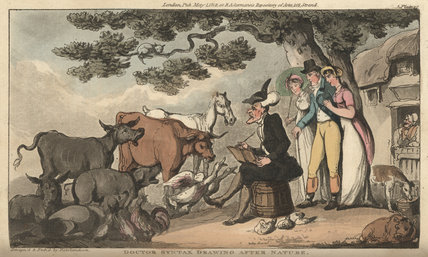
Dr. Syntax Drawing After Nature — by Rowlandson
A Squire of the party of travelers invites Dr. Syntax to his home where he is ca;led upon to sketch his host’s fine cattle. 
The Doctor now, with genius big,
First drew a cow, and next a pig:
A sheep now on the paper passes.
And then he sketched a group of asses :
Nor did he fail to do his duty
In giving Grizzle all her beauty. …”
As is so frequent, Dr. Syntax ends his day with a fine meal:
At length they to the house retreated.
And round the supper soon were seated ;
When the time quickly passed away.
And gay good-humour clos’d the day.”

End of Canto XIV 

 More Adventures of Dr. Syntax in Search of the Picturesque….coming soon.

A Couple In England – Day Two – Part Four

I returned to the hotel at about four o’clock, laden down with packages and panting for a drink. Opening the door to our room, I found Hubby sitting on the end of the bed, watching a competitive darts match on the telly.
“Hey, Hon,” said he in greeting, “You ever watch this?”
“Darts?”
“Yeah, I’ve been watching it for hours. These guys are great. Did you have fun?”
“I did,” I said, pulling off my boots, “And now I’m going to have rum.”
“Rum? Really? Where?”
“Right here,” I told him, taking the bottle and the six pack of Coke out of the carrier bag.
That earned me a smile from the Hubby. “My girl! I love you. Did you get ice?”
Ice? Really? “We’re in England. Learn to drink it with no ice.”
“I need ice.”
“I hear tell they have some downstairs at the bar. They probably have an ice bucket they can lend you, as well, if you ask nicely.”
“And I’ll get us some real glasses, too. We don’t want to drink out of the bathroom glasses.” Don’t we?
Hubby was gone and back in a flash and I made us two stiff drinks. I watched him watching darts as I sipped the glorious juice of the Gods. Egad, but that drink hit the spot.
“Why are you back so early?” Hubby eventually asked.
“I thought I’d come back here and get you and we could walk down to Apsley House together.” Hubby turned away from the telly long enough to give me the fish eye.
“The only way I’d walk to Apsley House today is if you told me it was seventy-four degrees over there. It’s freezing outside.”
“It is seventy-four degrees at Apsley House. And the sun is perennially shining. And they have a pool out back. With pool boys and cabanas.”
“Riiiiight.”
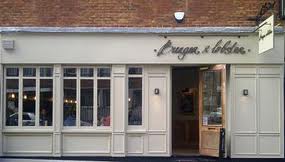
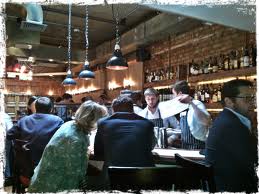
“Oh, listen . . . . . I stumbled on the most fantastic restaurant in the next street. It’s called Burger and Lobster.” I proceeded to regale the Hubby with all that I’d seen at the restaurant. “We’ll go and look at it when we go to dinner.”
 
“Where are we going for dinner? Not lobster?”
 
“Ye Olde Cheshire Cheese.”
 
“Oh, not that again!” said Hubby. I couldn’t blame him. On our last trip to London we’d tried twice to eat at the Cheshire Cheese, finding it closed both times. Once after we’d called to make sure they’d be open and, more dreadfully, another time when we’d let the cab go and found ourselves on the deserted streets of the City after business hours with no other cabs in sight. Hubby was not best pleased.
 
So we eventually toddled our way to the lobster joint, where we pressed our foreheads to the big plate window and watched as the people inside dug into their meals. The joint was packed.
 
“Boy, they look good,” sighed Hubby. “What do they have at the Cheesey joint?”
 
“English food. Roast beef, bangers and mash, like that.” Even as I said the words, I knew they couldn’t compete with the scene before our eyes – a restaurant filled with happy, bib wearing people cracking shells and slurping melted butter to their hearts content.
 
“I guess we should get a cab,” Hubby gamely offered.
 
“In a bit. There’s something I want you to see first.”
 
Hubby turned away from the window and sighed. “What is it? Something to do with the Duke? It had better be quick, because it’s freezing.”
 
“It’s just down the street. You’re going to like this.”
 
“Riiiiight.”
 
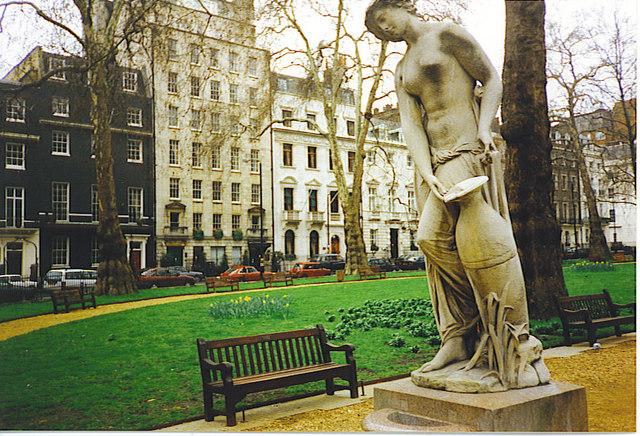
So off we went to Berkeley Square, which really is just down the street. I intended to show the Hubby something that I knew would be just up his alley and then jump in a cab down to Fleet Street. But you know what they say about good intentions . . . . we’d just entered the Square from Curzon Street when I was overcome with the need to begin pointing out sights of historical significance to the Husband.

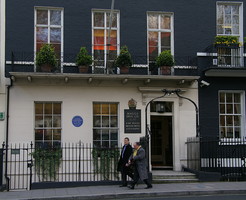
“That’s Maggs Brothers over there,” I said, pointing.
“It’s a bookshop. And the building is supposedly the most haunted in London.”
“Uh huh.”
 
“They sell rare and antiquarian books. They sold a copy of the Gutenberg Bible,” I told him, but received no response. I knew that I should just shut up, but again, I was compelled to go on. “And they sold Napoleon’s penis.”
 
“Riiiiight.”
 
“It was said to be Napoleon’s penis, but that was according to his doctor and his valet and you can’t trust anything the valet said. Look
at what he did with the death mask.”
 
“Death mask?”
 
“Yeah. You’ll see it at Apsley House. They said it was Napoleon, but now there’s speculation that the mask was taken from the living valet’s face, not the dead Napoleon’s face.”
 
“My good man.”
 
“Quite. And over there, where those buildings are, is where Gunter’s stood.”
 
 
“I just know you’re going to tell me what Gunter’s is.”
 
“Was. It’s not there any longer and more’s the pity. They were confectioners, most known for their ices. The ton would pull up in their carriages and the staff would bring out trays of ices so that they could eat them without climbing down. Of course, you could go in and eat, too.” Shut up, I advised myself. Save your breath. He has no idea what the ton was and no idea of the cultural significance of Gunter’s. Or Almack’s. Or Vauxhall Gardens, for that matter.
 
“We’re almost there,” I said. “The place I wanted to show you is right up the street.”
 
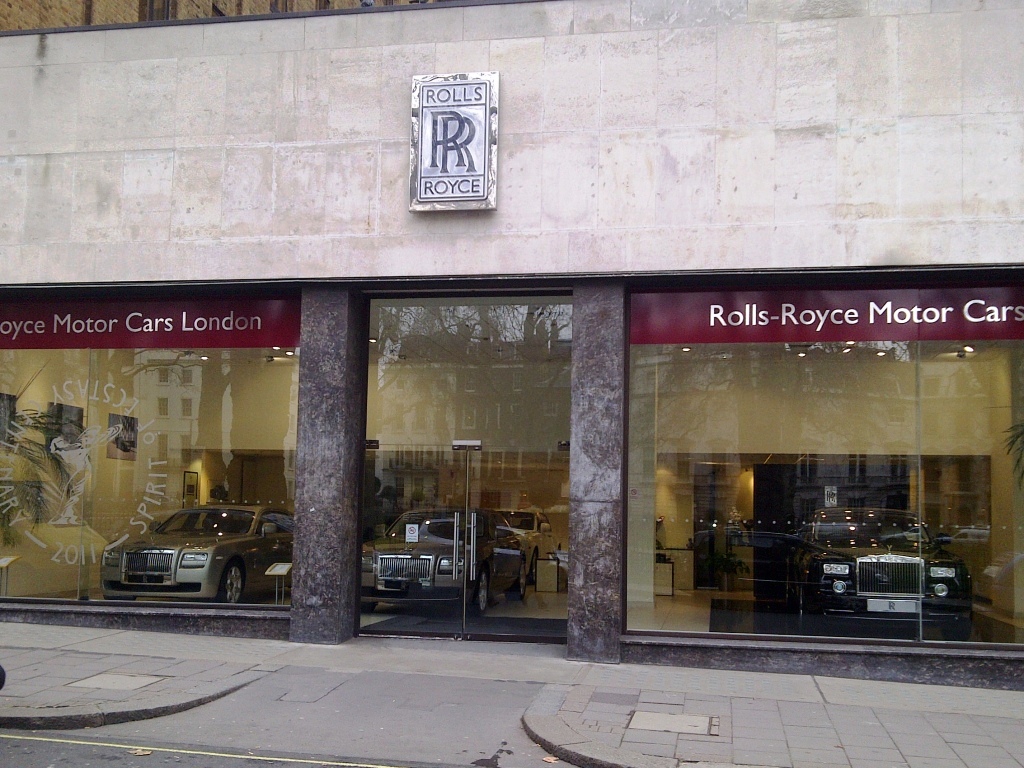
“A Rolls Royce showroom?” Hubby asked as we approached.

“And Bentley’s. I thought you’d like it.”

 
“I gotta be honest, Hon. This is even better than Napoleon’s penis.”
 
My good man.


Part Five Coming Soon . . . . . . . .

 

Pride & Prejudice Anniversary Merchandise

Commemorative stamps issued by the Royal Mail will be available starting February 21st.

Pride and Prejudice anniversary Journal and Mug from BBC America.

Pride and Prejudice T-shirt, BBC America

T-shirt – I’m not single, I’m just waiting for Mr. Darcy

Pemberley Christmas ornament

iPhone 5 case

iPhone 4 case

Tall, Dark and Darcy tote

Darcy quote vinyl wall decal

Elizabeth and Darcy bookends/shelf pillows

Set of 3 Pride and Prejudice votive candles

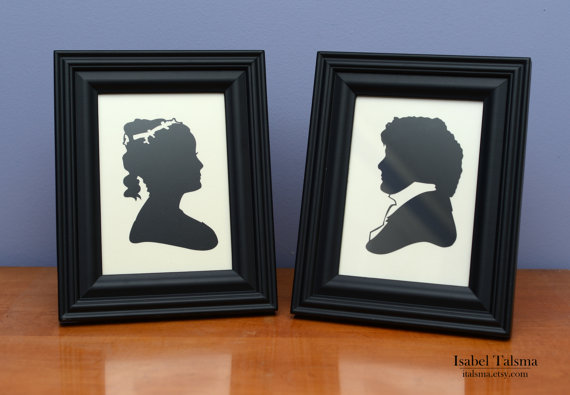
Handcut paper silhouettes

Jane Austen Silhouette

Book purse

Valentine Cards

Jane Austen reproduction ring

Jane Austen gypsum plaster bust

A Couple In England – Day Two – Part Three

After my Mayfair Stroll, I returned to the hotel in order to get properly dressed. The Hubby, but this time, was awake, but still in bed.
“You look comfy.”
“I am comfy,” he agreed, using the remote control in order flip through the UK television channels.
“Do you want to do something? Go out for a bit? I want to do a few things on Piccadilly.”
“Hon,” he began, looking at me properly, “Go and do whatever it is your heart desires. Really. I’ll be just fine here.”
“You’re going to stay in the room? In London?”
“I’m perfectly happy here. I’m not at work, so this is a vacation for me. Look, your idea of a vacation is different than mine. We both enjoy laying on the beach. We both enjoy a cruise. We don’t both enjoy walking around London from morning till night. Go. I’ll be just fine.”
“You won’t mind if I don’t come back for a few hours?”
“Just be back in time for dinner.”
By this time, I’d not only gotten properly dressed (an actual outfit in which all pieces were meant to be worn together, at the same time) and put my make up on. Finished, I put my coat on and I grabbed my purse.
Walking to the door, I hesitated. “Caffe Nero is just at the corner, as you know, and two doors down from that is Tesco Express. Oh, and there’s a Marks and Spencer Just Food a block down on Piccadilly. And Shepard’s Market behind us, where they have pubs and restaurants.”
“Go. Have fun. I promise not to have starved by the time you get back.”

Needing no further prompting, I scurried out the door and was soon at the corner of Half Moon Street and Piccadilly, where Fanny Burney/Madame D’Arblay lived.

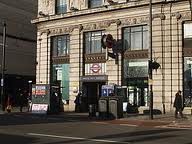
I headed down (up?) Piccadilly towards the Green Park tube station . . . .

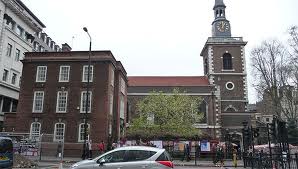
. . . . . . and headed for St. James’s Church as I wanted to take some time to contemplate Mrs. Delaney’s grave, located inside. Unfortunately, the church was locked up tight.

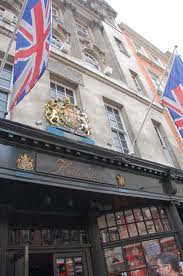
So, I walked back the way I had come until I reached Hatchard’s bookshop.
Since I had no timepiece on me, I didn’t check what time I entered the shop and so I can’t tell you with any accuracy how much time I spent inside, but I can safely say that it was two hours, at the very least. My favorite bookstores, hands down, are the antiquarian variety. Oh, to be able to browse the stacks and the piles of dusty tomes, arranged higgedly piggedly, never knowing what treasures are awaiting discovery. I have brought home suitcases full of used and antiquarian books after every one of my visits to England but, alas, it’s now becoming more difficult for me to find titles I don’t already own. Of course, there are thousands of titles I don’t yet own . . . . . but for the sake of sanity and space I’ve imposed restrictions on additions to my research library – the Duke of Wellington, Queen Victoria, George IV, Georgian, Regency and Victorian diaries and letters and a few more obscure areas of London interest.
 

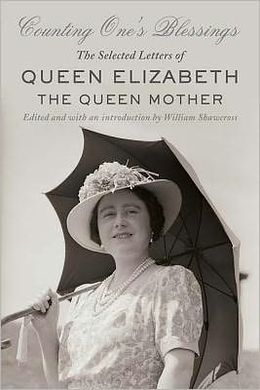
Next to an antiquarian bookstore, give me Hatchard’s – three floors of bibliophilic bliss conveniently located on Piccadilly, where it has stood since 1797. The contents of the shop, however, are decidedly 21st century. Here are just a few of the books I bought:

Being now both older and wiser, I had the clerk ship the books to my home, instead of having Hubby lug them around England over the next few day. Besides, this way he’d have no idea that I’d just spent several hundred pounds on reading material.

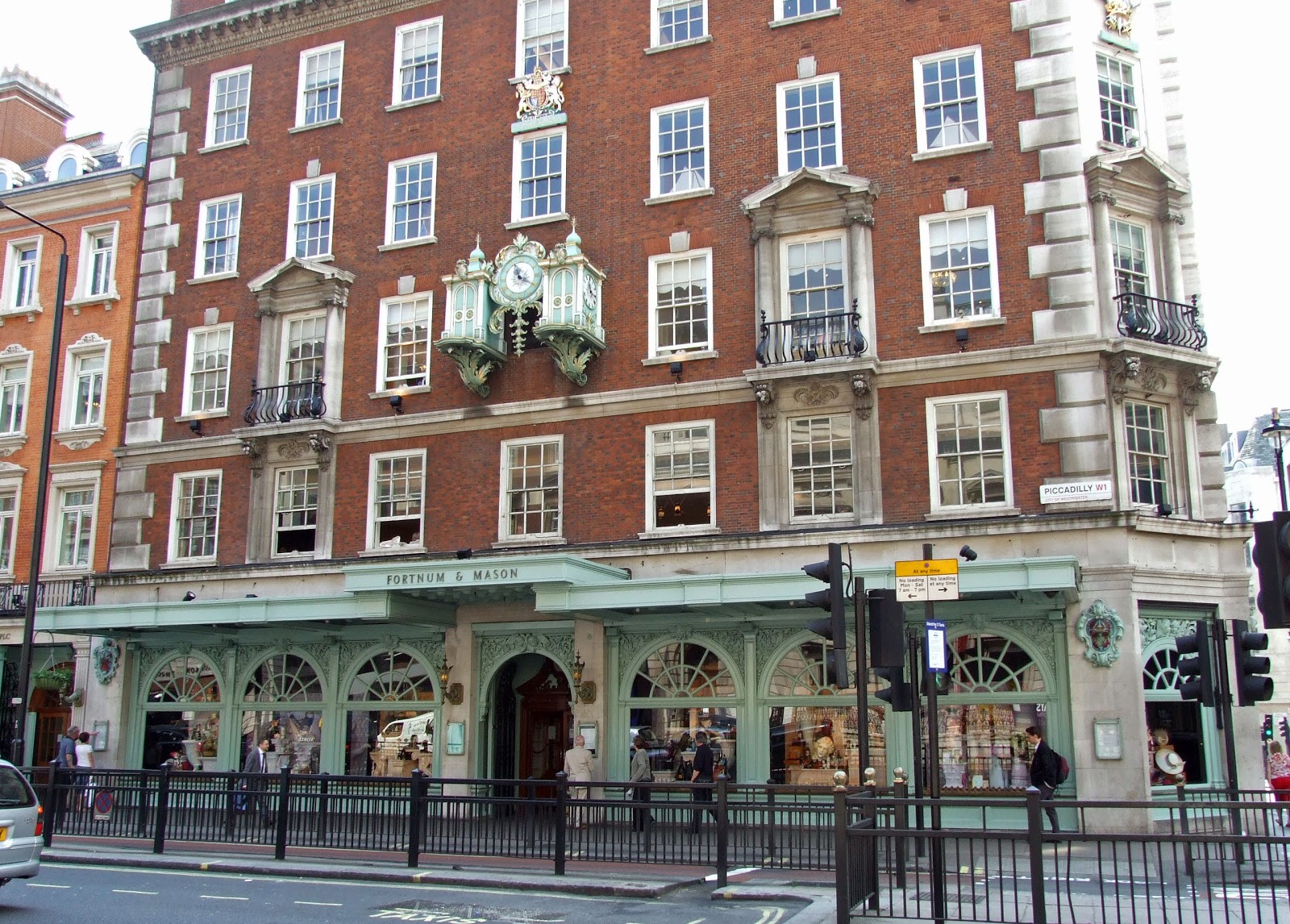
My very next stop was Fortnum and Mason, only a few doors down the street from Hatchard’s. Whenever I’m in London around Christmas, I like to stop in and buy my Christmas cards for the following year. Upstairs I went, only to find the entire holiday section already decimated! There was not a single box of cards remaining – and this was just the day after Boxing Day. Crushed, I headed over to browse the hats and purses, before making my way back downstairs to the food court, where I poked about for a bit before realizing that I was, in fact, famished.


Fortnum’s has at least three restaurants in which one may eat anything from an omlette to foie gras, including the Diamond Jubilee Tea Salon, but being a creature of habit when in London, I headed outside and a few doors down the street to Richoux Tea Rooms.
 
Typically, Richoux is an island of calm where one can order a civilized dish of tea and rest up between stops at the varied emporiums of Mayfair.
 

Alas, this was not to be . . . . after ordering my cream tea and pulling out a book to read, I could not help but overhear the conversation of the two gentlemen sitting next to me. A pair of Cockneys who were, obviously, brothers, it seems they chose Richoux in which to meet in order to catch up and regale one another with their opinions on various subjects, including inflation – “Old dad’s overcoat would cost you six thousand pounds to have made up today.” One of these men took himself to be a world traveler, who unfortunately made easy with his opinions on various places and people – “Switzerland’s not bad, especially Zurich, but the Jews are such dodgy geezers.” Now, I typically don’t go in for butting into other people’s conversations, and I refrained this time, but I did treat the pair to a raised eyebrow. Not that it mattered a wit to either of them, for the same brother went on, “Of course the Germans aren’t like us, but they’re awright.” I asked for the check and left before he could continue on to the Japanese, the Belgians, the French or the Armenians. Gas bag . . . . . .
 
I decided to head back to the hotel, making a pit stop in the Burlington Arcade in order window shop and appreciate the architecture.
 
My next stop was Boots Pharmacy, where I stocked up on all the essentials one can’t handily get in the States – their No. 7 skincare line and industrial strength hairspray, amongst other trifles. Then I headed up Clarges Street towards the Tesco Express, but I was brought up short when I passed a place called Burger and Lobster. Looking in the window, I saw tables filled with people chowing down on platters of lobster. Delicious looking lobster. There was a bit of a line at the door, but I finally got inside and asked the gentleman at the podium if I might see a menu. What ho! This was just the sort of place the Hubby would appreciate. I was told that there was no menu – they only served three things, to wit burgers, lobsters and lobster rolls. Genius! When I asked if I could make a reservation, I learned that not only are they a restaurant with no menues, they’re also a restaurant that doesn’t take reservations. First come, first served, I was told. I began to wonder whether or not they had waiters or if one had to bring their own apron and tray . . . . . . On I trudged to Tesco Express, where I purchased essentials for the hotel room in the form of a good sized bottle of rum and a six pack of Coke.
 
I’ll leave you here and will pick up Part Four soon. I must say, I can’t believe that I managed to cram enough into a single day in London to warrant four parts to this post, but looking back on the itineraries that Victoria and I typically set for ourselves, this agenda was a cake walk. And time does fly when one is having fun . . . . . . . .
 

The Strange Story of Elizabeth Woodcock

Narrative of the Sufferings of Elizabeth Woodcock

From A Selection of Curious Articles from the Gentleman’s Magazine, edited by John Walker (1819)
 
            
ELIZABETH WOODCOCK, aged forty-two years, went on horseback from Impington to Cambridge, on Saturday, being market day, the 2d of February, 1799. On her return home in the evening, between six and seven o’clock, being about half a mile from her own bouse, her horse started at a sudden light, which proceeded, most probably, from a meteor, a phenomenon which, at this season of the year, not unfrequently happens. She was herself struck with the light, and exclaimed “Good God! what can this be!” It was a very inclement stormy night, a bleak wind blew boisterously from the N.E. The ground was covered by the great quantities of snow that had fallen during the day, yet it was not spread uniformly over the surface. The deepest ditches were many of them completely filled up, whilst in the open fields there was but a thin covering; but in the roads and lanes, and many narrow and inclosed parts, it had accumulated to a considerable depth, no where yet so as to render the way impassable, but still enough to retard and impede the traveller. The horse, upon his starting, ran backward, and approached to the brink of a ditch, which the poor woman recollected, and, fearing lest the animal in his fright should plunge into it, very prudently dismounted with all expedition. Her intention was to walk, and lead the horse home; but he started again, and broke from her. She repeated her attempt to take hold of the bridle; but the horse, still under the impression of fear, turned suddenly out of the road, and directed his steps to the right over the common field. She followed him, in hopes of quickly overtaking him, but, unfortunately, she lost one of her shoes in the snow. She was already wearied with the exertion she had made, and besides, had a heavy basket on her arm, containing several articles of domestic consumption, which she had brought from market.
 
By these means her pursuit of the horse was greatly impeded; she however persisted, and followed him through an opening in a hedge, a little beyond which she overtook him (about a quarter of a mile from the place where she alighted,) and, taking hold of the bridle, made another attempt to lead him home. But she had not re-traced her steps farther than a thicket, which lies contiguous to the said hedge, when she found herself so much fatigued and exhausted, her hands and feet, particularly her left foot, which was without a shoe, so very much benumbed, that she was unable to proceed farther. Sitting down then upon the ground in this state, and letting go the bridle, “Tinker,” she said, calling the horse by his name, “I am too much tired to go any farther, you must go home without me;” and exclaimed, “Lord have mercy upon me! what will become of me!” The ground on which she sat was upon a level with the common field, close under the thicket on the South West. She well knew the situation of it, and what was its distance from and bearing with respect to her own house. There was then but a small quantity of snow drifted near her; but it was beginning to accumulate, and did actually accumulate so rapidly, that, when Chesterton bell rang at eight o’clock, she was completely inclosed and hemmed in by it. The depth of the snow in which she was enveloped was about six feet in a perpendicular direction; over her head between two and three. Her imprisonment was now complete, for she was incapable of making any effectual attempt to extricate herself, and, in addition to her fatigue and cold, her clothes were stiffened by the frost. Resigning herself, therefore, calmly to the necessity of her bad situation, she sat awaiting the dawn of the following day. To the best of her recollection, she slept very little during the first night, or, indeed, any of the succeeding nights or days, except on Friday the 8th. Early the next morning she distinctly heard the ringing of a bell at one of the villages at a small distance. Her mind was now turned (as it was most natural) to the thoughts of her preservation, and busied itself in concerting expedients, oy means of which any one who chanced to come near the place might discover her.
 
On the morning of the third, the first after her imprisonment, observing before her a circular holet in the snow, about two feet in length and half a foot in diameter, running obliquely upwards through the mass, she broke off a branch of the bush, which was close to her, and with it thrust her handkerchief through the hole, and hung it, as a signal of distress, upon one of the uppermost twigs that remained uncovered; an expedient which will be seen, in the sequel, to have occasioned her discovery. She bethought herself, at the same time, that the change of the moon was near; and having an almanack in her pocket, she took it out, though with great difficulty, and consulting it, found that there would be a new moon the next day, February 4th. The difficulty which she found in getting the almanack out of her pocket arose, in a great measure, from the stiffness of her frozen clothes, before-mentioned. The trouble, however, was compensated by the consolation which the prospect of so near a change in her favour afforded. She makes no scruple to say, that she perfectly distinguished the alterations of day and night; heard the bells of her own and some of the neighbouring villages, several different times, particularly that of Chesterton; was sensible of the living scene around her, frequently noticing the sound of carriages upon the road, the natural cries of animals, such as the bleating of sheep and lambs, and the barking of dogs.
 
One day she overheard a conversation carried on by two gypsies, relative to an ass which they had lost. She afterwards specified, it was not their asses, in general terms, that they were talking about, but some particular one; and her precision in this respect has been confirmed by the acknowledgement of the gypsies themselves. She recollects having pulled out her snuff-box and taken two pinches of snuff; but, what is very strange, she felt so little gratification from it, that she never repeated it. A common observer would have imagined the irritation arising from the snuff would have been peculiarly grateful to her, and that, being deprived of all other comforts, she would have solaced herself with those which the box afforded, till the contents of it were exhausted. Possibly, however, the cold she endured might have so far blunted her powers of sensation that the snuff no longer retained its stimulus. At another time, finding her left hand beginning to swell, in consequence of her reclining, for a considerable time, on that arm, she took two rings, the tokens of her nuptial vows twice pledged, from her finger, and put them, together with a little money which she had in her pocket, into a small box, sensibly judging that, should she not be found alive, the rings and money, being thus deposited, were less likely to be overlooked by
the discoverers of her breathless corpse.
 
She frequently shouted out, in hopes that her vociferations reaching the ears of any that chanced to pass that way, they might be drawn to the spot where she was. But the snow so far prevented the transmission of her voice, that no one heard her. The gypsies, who passed nearer to her than any other persons, were not sensible of any sound proceeding from her snow-formed cavern, though she particularly endeavoured to attract their attention. When the period of her seclusion approached to a termination, and a thaw took place on the Friday after the commencement of her misfortunes, she felt uncommonly faint and languid; her clothes were wet quite through by the melted snow; the aperture before-mentioned became considerably enlarged, and tempted her to make an effort to release herself; but, alas! it was a vain attempt; her strength was too much impaired; her feet and legs were no longer obedient to her will, and her clothes were become very much heavier by the water which they had imbibed. And now, for the first time, she began to despair of ever being discovered or taken out alive; and declares that, all things considered, she could not have survived a continuation of her sufferings for the space of twenty-four hours longer. It was now that the morning of her emancipation was arrived, her sufferings increased; she sat with one of her hands spread over her face, and fetched the deepest sighs; her breath was short and difficult, and symptoms of approaching dissolution became every hour more alarming.
 
On Sunday, the 10th of February, a young farmer, whose name is Joseph Muncey, in his way home from Cambridge, about half past twelve o’clock, crossed over the open field, and passed very near the spot where the woman was. A coloured handkerchief, hanging upon the tops of the twigs, where it was before said she had suspended it, caught his eye; he walked up to the place, and espied an opening in the snow. He looked in, and saw a female figure, whom he recognized at once to be the identical woman who had been so long missing. He did not speak to her, but seeing another young farmer and the shepherd at a little distance, he communicated to them the discovery he had made. Upon which, though they scarcely gave any credit to his report, they went with him to the spot. The shepherd called out “Are you there, Elizabeth Woodcock?She replied, in a faint and feeble accent, “Dear John Stittle, I know your voice; for God’s sake help me out of this place!” Every effort was immediately made to comply with her request. Stittle made his way through the snow till he was able to reach her; she eagerly grasped his hand, and implored him not to leave her. “I have been here a long time,” she observed. “Yes,” answered the man, “ever since Saturday.” Aye, Saturday week,” she replied; “I have heard the bells go two Sundays for church.” An observation which demonstrably proves how well apprized she was of the duration of her confinement.
 
Mr. Muncey and Mr. Merrington, junior, during this conversation, were gone to the village to inform the husband, and to procure proper means for conveying her home. They quickly returned, in company with her husband, some of the neighbours, and the elder Mr. Merrington, who brought with him his horse and chaise-cart, blankets to wrap her in, and some refreshment, which he took it for granted she would stand in peculiar need of. The snow being a little more cleared away, Mr. M. went up to her, and, upon her entreaty, gave her a piece of biscuit and a small quantity of brandy, from both of which she found herself greatly recruited. As he took her up to put her into the chaise, the stocking of her left leg, adhering to the ground, came off. She fainted in his arms, notwithstanding he moved her with all the caution in his power. But nature was very much exhausted; and the motion, added to the impression which the sight of her husband and neighbours made upon her, was too much for her strength and spirits. The fit, however, was but of short continuance; and when she recovered, he laid her gently in the carriage, covered her well over with the blankets, and conveyed her, without delay or interruption, to.her own house.
 
Mr. Okes, a surgeon, first saw her in the cart, as she was removing home. She spoke to him with a voice tolerably strong, but rather hoarse: her hands and arms were sodden, but not very cold, though her legs and feet were, and the latter, in a great measure, mortified. She was immediately put to bed, and weak broth given her occasionally. From the time of her being lost she had eaten only snow, and believed she had not slept till Friday the 8th; her only evacuation was a little water. The hurry of spirits, occasioned by too many visitors, rendered her feverish; and her feet were found to be completely mortified, from being frost-bitten before she was covered with snow. She was so disturbed with company that Mr. O. had little hopes of her recovery. He ordered a clyster of mutton broth, which greatly relieved’ her, some saline mixture, with antimonial wine, and strong decoction of bark, and three grains of opium in the course of a day. He opened the vesications on her feet, and continued the use of brandy as at first; clysters, opium, and bark, being continued, with Port wine. The cold had extended its violent effects from the end of the toes to the middle of the instep, including more than an inch above the heels, and all the bottom of the feet, which were mortified, and were poulticed with stale beer and oatmeal boiled together. Inward cold, as she called it, affected her, and she desired the cataplasms might be renewed as often as possible, and very warm. The 19th and 20th she was seized with violent diarrhoea, which occasioned great weakness; and, two days after, several toes were so loose as to be removed by the scissars. The 23d she was taken up without fainting. All the toes were removed, and the integuments from the bottom of one foot, except a piece at the heel, which was so long ere it loosened itself that the os calcis and tendo Achillis had suffered. The sloughs on the other foot were thrown off more slowly, and two of the toes removed. All but one great toe was removed by the seventeenth; and, on removmg the sloughs from the heels, the bone was bare in many places: and, wherever the mortification had taken place, was one large sore, very tender.
 
The sores were much diminished, and the great toe taken off, by the end of March, and an unusual sleepiness came on. By April 17th, the sores were free from slough, and daily lessened; her appetite tolerably good, and her general health began to amend; but with all these circumstances in her favour, she felt herself to be very uncomfortable; and, in fact, her prospect was most miserable; for, though her life was saved, the mutilated state in which she was left, without even a chance of being ever able to attend to the duties of her family, was almost worse than death itself; for, from the exposure of the os calcis, in ail probability it would have required some months before the bottoms of her feet could be covered with new skin; and, after all, they would have been so tender as not to bear any pressure; the loss, too, of all her toes must have made it impossible for her to move herself but with the assistance of crutches. Mr. Okes ascribes the preservation of her life to her not having slept or had any evacuations under the snow, and to her resignation and the calm state of her mind.
 

After her rescue, tragi
cally she did not survive long. She was taken ill and died on 24th July at the age of 43. At the end of her burial notice appears the following note: “She was in a state of intoxication when she was lost. Her death was accelerated (to say the least) by spirituous liquors afterwards taken, procured by the donations of various visitors.” News of her adventure spread around the country, and numerous engravings of her were published at the time. Elizabeth Woodcock’s cottage survives at Impington in Station Road, near to the war memorial, and now carries a commemorative plaque.