The Secrets of Bloxley Bottom, Episode 2: The Duke Approaches


The Duke of Wellington, riding upright upon his horse, felt himself relax as he approached Bloxley Bottom. He came here often and, when he did, he was able for a time to put officialdom behind himself, as the villagers, whilst well aware of who he was and what his achievements were, tended to treat him rather more like a man than like a figurehead. Here in Bloxley, the Duke was able to interact with people on a more personal level, perhaps because he was such a familiar figure to them. Or perhaps because the people of Bloxley were less given to humbug than those who lived elsewhere.

Turning into the high street, the Duke looked forward to the routine that would momentarily begin at his approach, for he was a man who championed routine; a man who felt that routine gave structure to life, whether that life be spent in the military, the government, or in Bloxley Bottom.
“Good day to you, yer Grace!” Walter Turner came out of his bakehouse, dusting his hands off upon his massive white apron.
The Duke of Wellington gave Walter his usual greeting – a two fingered salute to the brim of his hat. “Walter, how is the family?”

Walter smiled up at the Duke, exposing wide, yellowed teeth that reminded the Duke of an ivory set of dominoes his ADC’s had played upon at Talavera.
“Oh, you know how they go, Duke,” chuckled Walter, “hard to live with, but impossible to live without. Can’t complain. Hey, I’ve got some loaves just come out the oven. I’ll put three by for you to take back to the Castle on your way home. And Mrs. Preston wanted you to know that she’s got ducks what are ready. If you are.”
Loaves, live stock and more were always offered up for the Duke. They were part and parcel of the routine.
“Duke! Dooooook!” Old Rodney Casper had weaved his way up the street towards the Duke and Walter. His first question would be yet another part of the routine.
“Parley vooo?” Whenever Rodney was in his cups, which was more often than not, he insisted upon speaking French to the Duke. The problem was, Rodney did not know how to speak the language. Why he supposed that the Duke regularly conversed in French remained a mystery to all.
“I’m right as rain, Rodney. And you?”
“Come and see and come and say.” Rodney, in his musty, fusty mismatched suit of clothes and battered cloth cap, craned his neck, squinted his eyes and peered up at the Duke of Wellington for few moments before turning his attention towards Walter and giving his face the same intense scrutiny. Then, like some great bird, Rodney pulled his head back in and announced  “Gotta be off.” With that, he tottered in place for a few moments, seemed to pick up some steam and then began the long stagger home.

The Duke of Wellington sighed and gathered his reins. “Please tell Mrs. Preston that I shall have a talk with Mrs. Allen regarding the ducks,” he told Walter. “We shall no doubt find use for them. We’re to have a full complement of guests beginning on Thursday.”

The Duke rode on until he reached the bend in the road which would ultimately bring him to the dower house, home of Louisa, Dowager Baroness Boxley. He prepared himself for his next routine encounter, this with a resident a bit more recently come to the village.

 
“Wait for it . . . . wait for it . . . .” the Duke muttered to himself as, beneath him, his mount, called Bedford after the county it had been born in, prepared himself, as well. The horse’s nostrils flared and its eyes, the whites wide, fastened upon to the thicket at the side of the road as a dog came bounding out of it towards the pair.

And what a dog it was. The deuced strangest looking dog that ever was, thought the Duke as he tightened up on the reins in an effort to calm the horse. The animal, which had appeared in Bloxley Bottom seemingly out of the clear blue sky about a year ago and taken up residence in the thicket, was unlike any other dog the Duke had ever laid eyes upon. Or rather he was too much like too many canines the Duke had seen. As the Duke had been
known to say, this dog looked for all the world as though God, in a humorous frame of mind, had one day looked about his workshop, found spare parts left over from previous dogs he’d devised, cobbled the lot together and set it down in Bloxley to see what the villagers would make of it. In fact, one of the more witty townsfolk had named the dog Spot and Spot he’d remained, even though his coat was a uniform, unbroken shade of white.
The rear of the dog was narrow, like that of a terrier. Its mid-section gradually widened until it reached a great ruff of hair resembling the mane of a lion, which framed a massive head reminiscent of a bull dog, complete with a menacing under bite. Odder still, none of its various parts resembled any dog that had ever been known to inhabit the village.
As ever, the dog reached a seemingly self-imposed boundary, sat down upon its haunches, lowered its massive head and commenced a great growling that began in the region of its tail. Up through its body the growl traveled, past its shoulders and into the sinewy neck, through its throat and out its fearsome mouth.
“Arp.”
The Duke laughed aloud. “Arp yourself, you great daft thing.” What a demmed disappointing bark it was. The build up to it was stupendous. The end result, only ever a single, feeble “arp,” another comedic stroke orchestrated by God in his heaven.
Reaching into his coat pocket, the Duke withdrew a handkerchief, from which he extracted two sausages he’d taken from the breakfast table that morning for just this purpose. He threw one, then the other, to the dog, who gobbled them down.
“Not a word to Mrs. Allen,” he warned the dog, “There’d be hell to pay if she knew where her good sausages had gone.” Mrs. Allen, the Duke’s housekeeper at Walmer Castle, was not overly fond of dogs.

 
After a moment the Duke trotted off. When he reached the bend in the road, the Duke did not avert his eyes, but at the same time raised his hat in silent salute to Aurelia, whom he was certain had watched his approach from behind her lace curtains.

A Couple in England – Day Three – Part One

It occurs to me that since you’ve been invited along with the Hubby and I on our trip to England, you might like to see what your companions look like. The photo above was taken on my last birthday. We didn’t take many pics of ourselves during the course of our trip to England – for reasons that will eventually become clear. In London, it was the weather or the fact that we’re neither of us picture people to begin with.
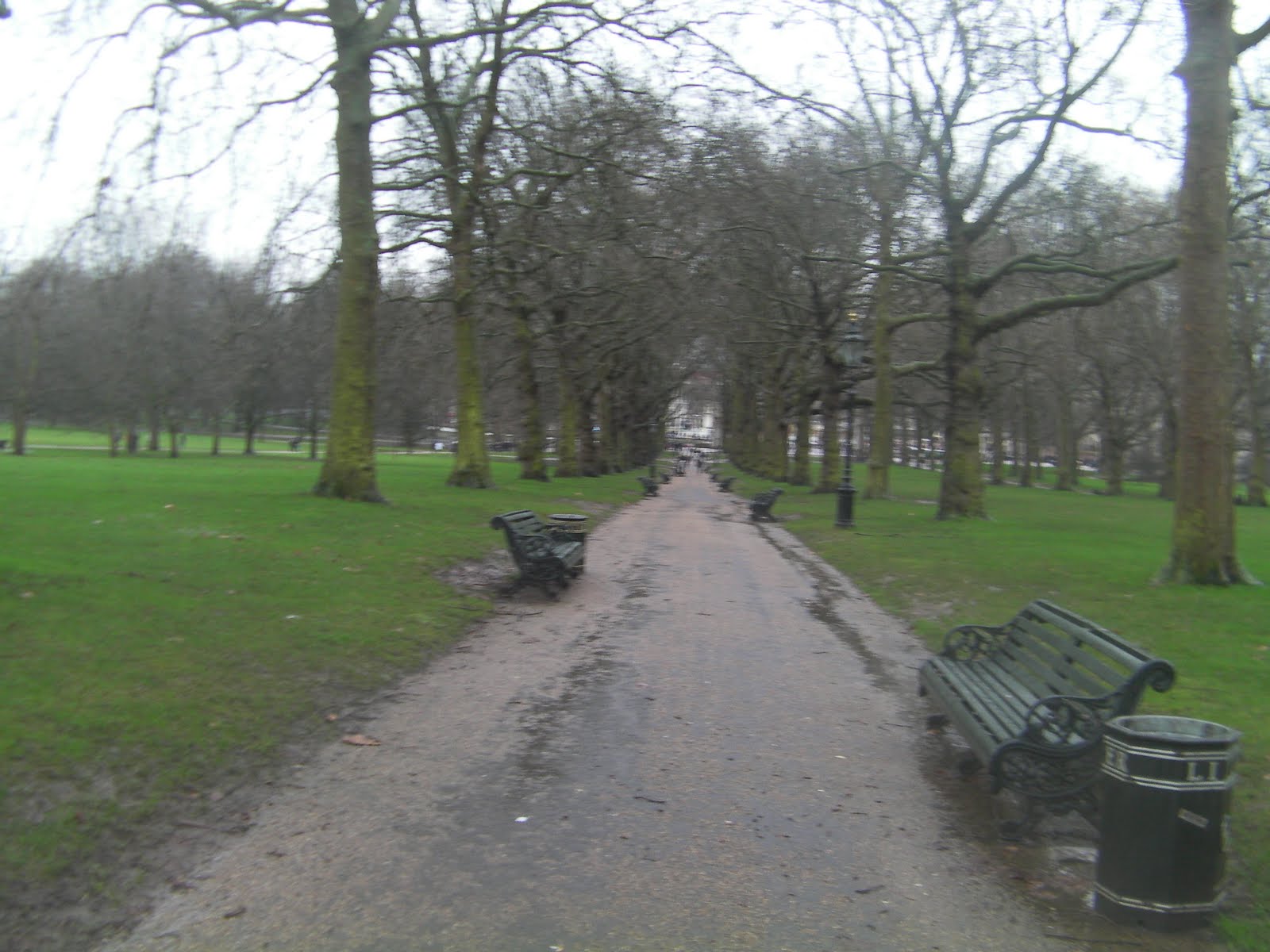
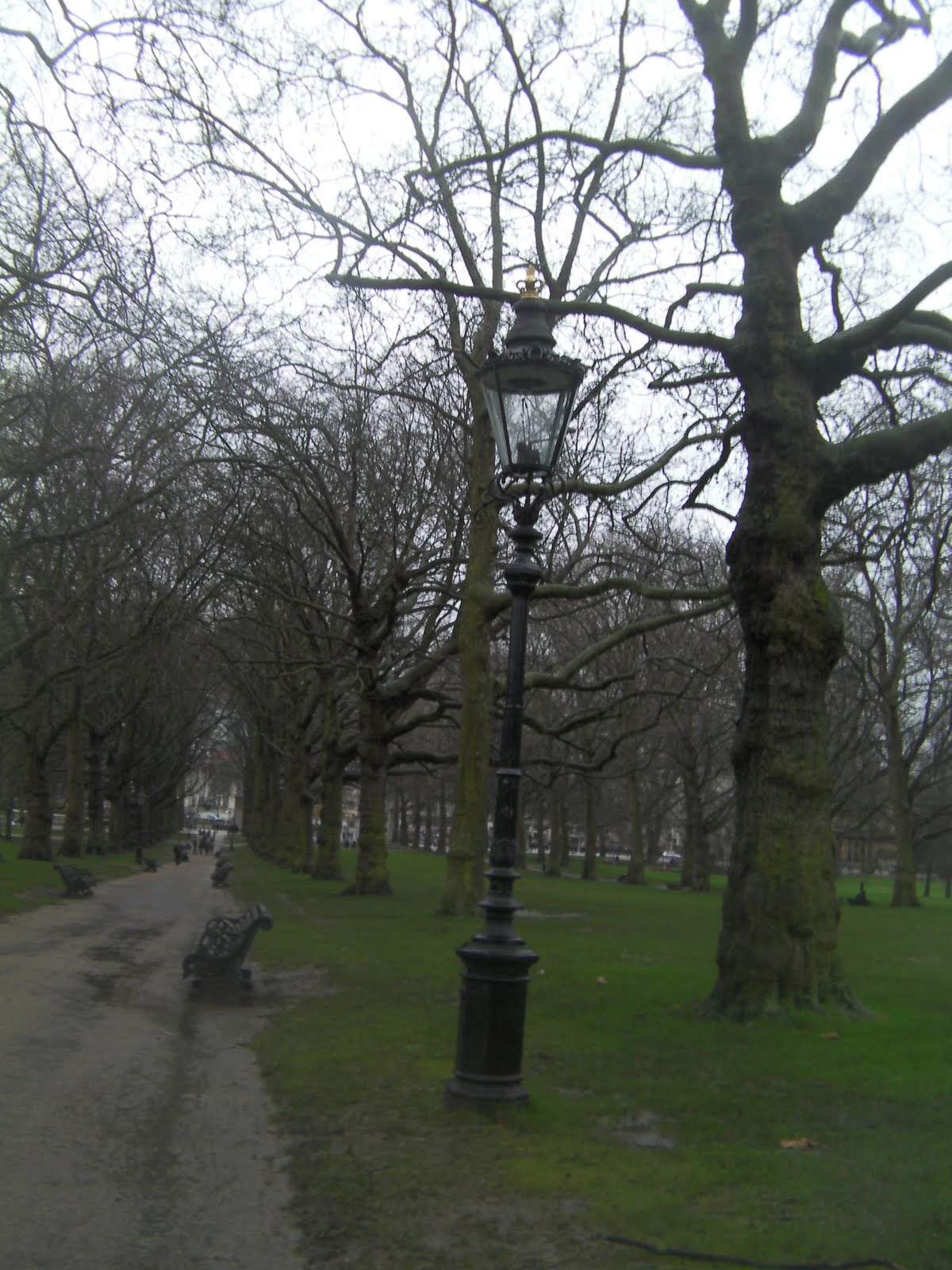
We began Day Three as we had Day One and Day Two, at Caffe Nero. One of the handful of things the Hubby and I actually have in common is that we both turn our faces against breakfast. Give us a coffee and two cigs each and we’re good to go. Our first destination was Buckingham Palace, via Green Park. This picture, taken as we entered the Park will demonstrate what a dreary day it was.
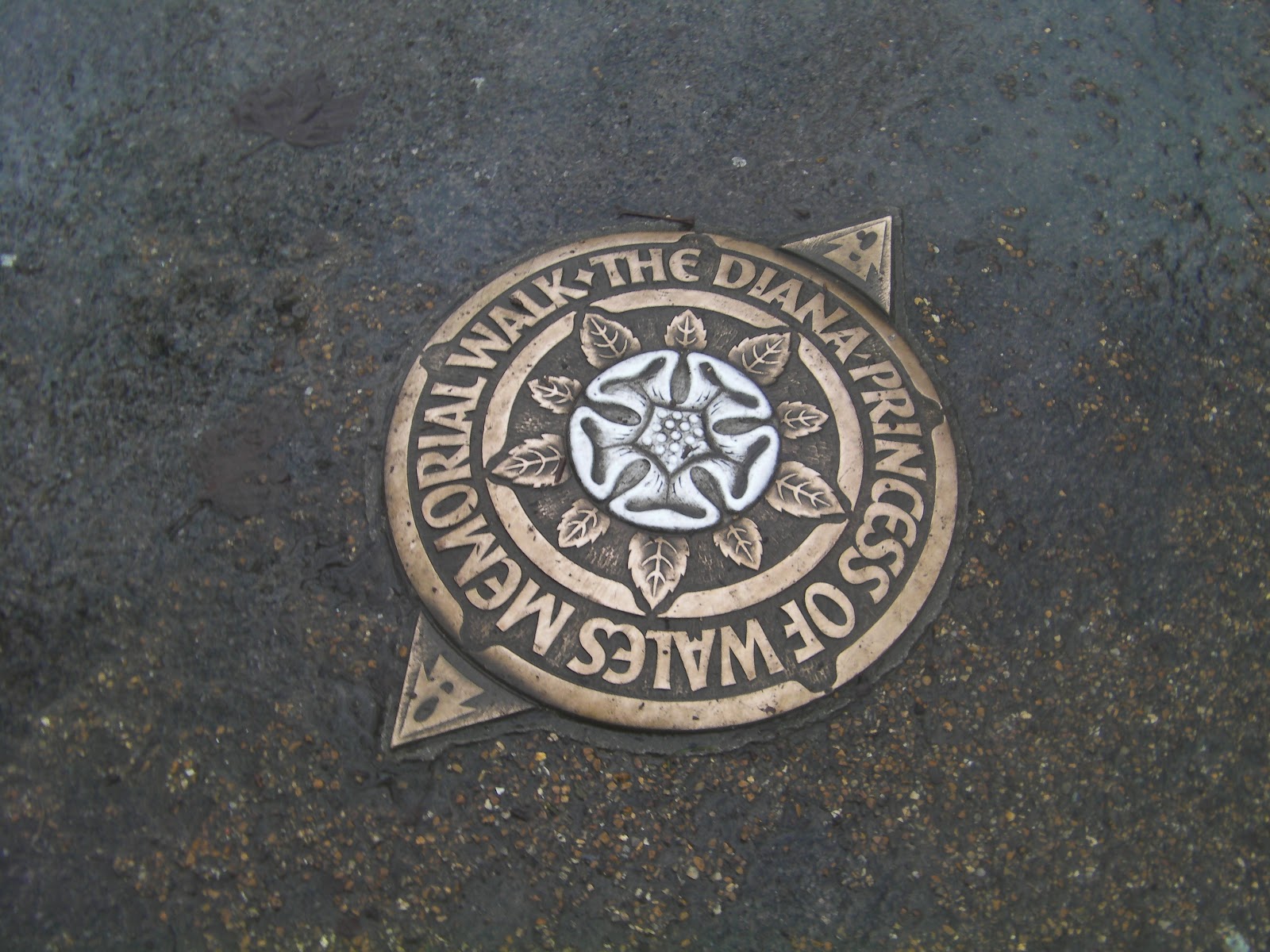
No sooner had we started towards the Palace then we came across this plaque for the Princess of Wales Memorial Walk. As you can see, I stopped to take a photo. 

“This is the Princess Diana Memorial Walk,” I said.
“Yes . . . I can see that.”
“It winds through four London parks and takes in sites associated with her.”
“Uh huh.” At least he didn’t say my good man.
I looked around at our surroundings. “Green Park.” I sighed. “It was originally a burial site for lepers. Later, they had entertainments here, like ballonists and fireworks.” He doesn’t care! I reminded myself. I can’t help myself! I rejoined. “Handel’s Music For The Royal Fireworks was written specifically for a display here.The Earls of Bath and Bristol fought a duel here.”
“Uh huh.”
Leaving Hubby to his own thoughts (one can only guess) I began taking random photos of the park. The example below is a particular favorite of mine.

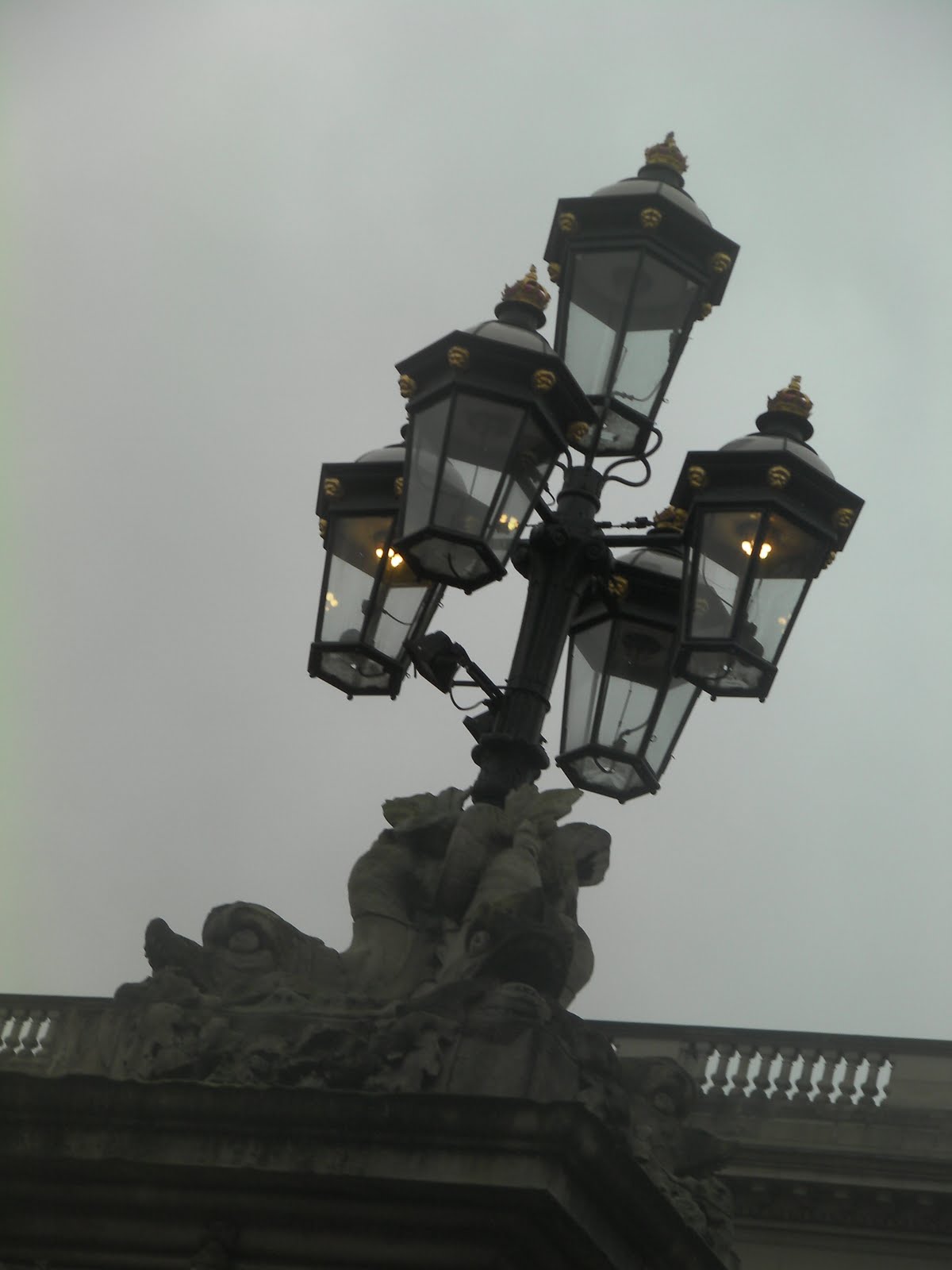
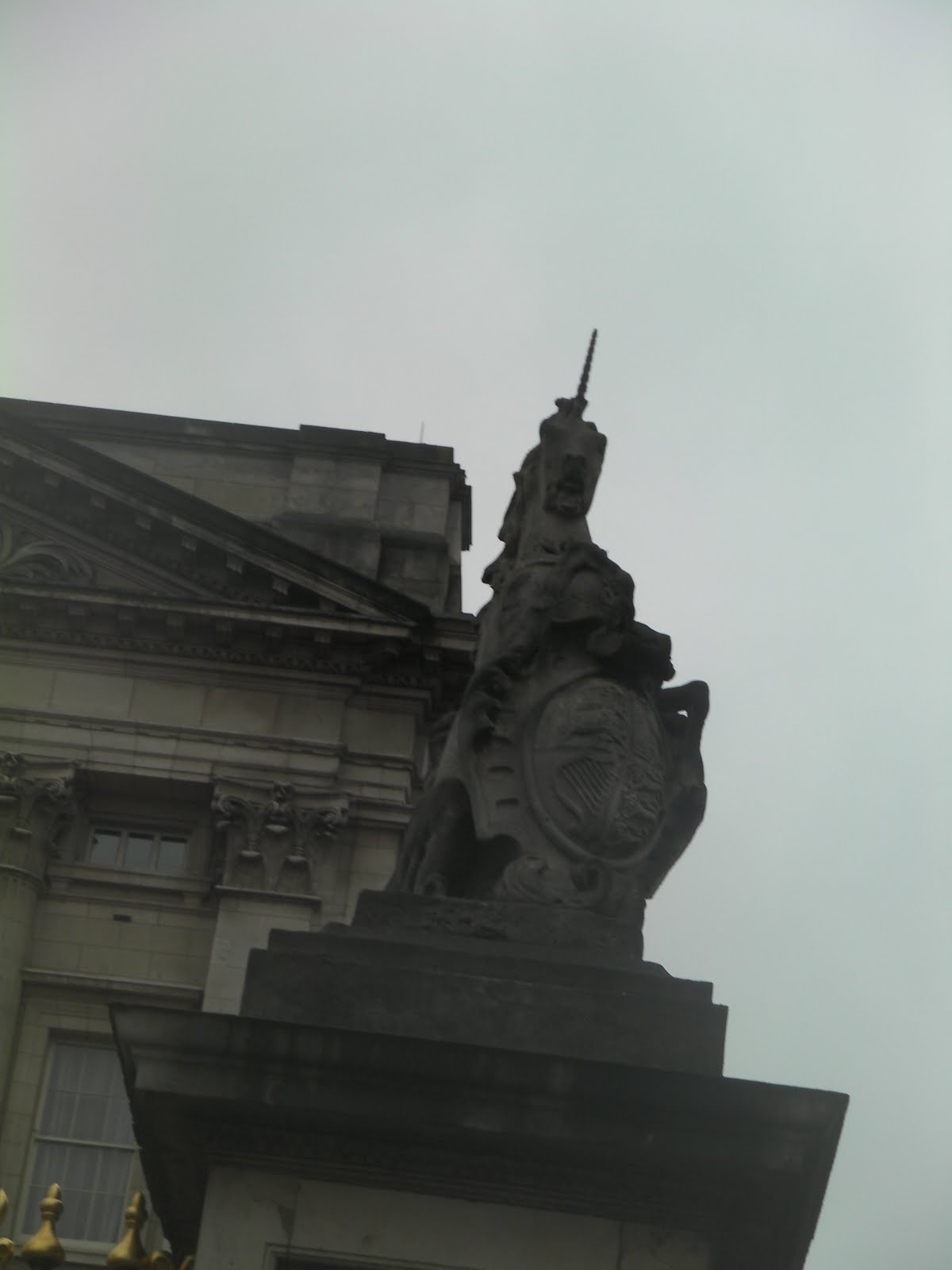
Before long, we had reached the Palace. There was only an abbreviated changing of the guard, as we were there on an off day and they really just trotted by on their way to the barracks. We missed most of the pomp and all of the circumstance, but it didn’t matter. We were at Buck House and I took a few more photos to add to the hundred I’ve already taken of the environs.

Finally, we gazed through the gates at the Palace.

“We were inside there last time,” I sighed.
“Yeah. That was great.”
“You enjoyed it?”
“Sure! Who wouldn’t? It was great. The best part was when you told that guide who the guy in the picture was.”
What actually happened was that during the course of our evening champagne tour of the Palace, the guide showed our group around the throne room, but totally ignored a huge, full length portrait of a robed figure. As she walked away I approached her. “Excuse me,” said I, pointing at the painting. “Isn’t that a Wellesley?” Our guide seemed taken aback. “Why, yes. Yes it is.”
“Isn’t it Richard Wellesley, the Duke of Wellington’s eldest brother?”
“I’m amazed that you know that,” the guide had replied.
“Let me get this straight,” I said to Hubby now. “You hate it when I go on about British history to you, but you like it when I point things out to others?”
“Yeah. I love it. The look on their faces is priceless.”
Go figure.
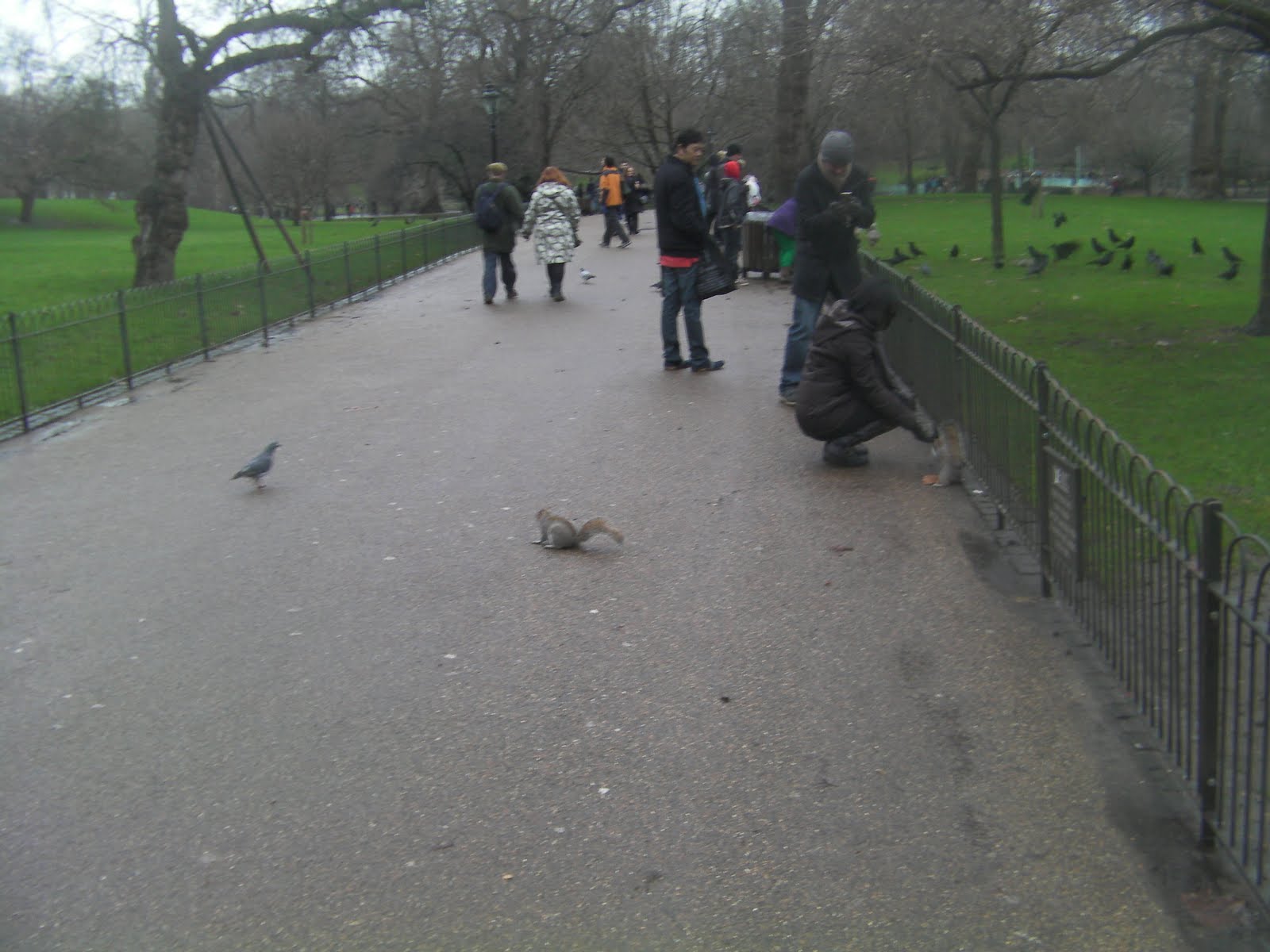
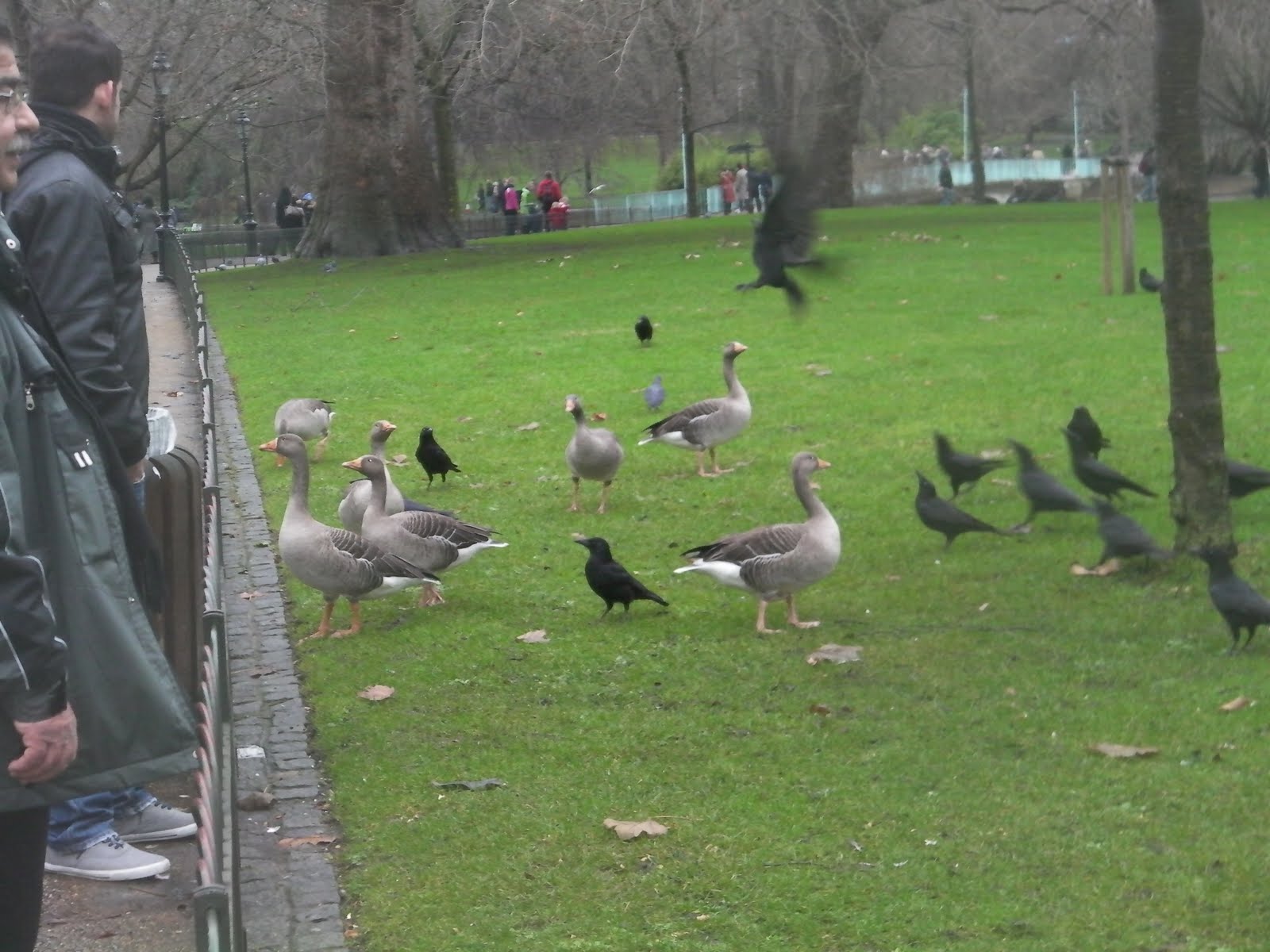
We moved on and walked through St. James’s Park on our way to Horse Guards and came upon a gaggle of friendly geese, birds and squirrels, all of whom charmed the Hubby, who stopped to admire them and suddenly didn’t mind the cold.

“I wish we had some bread,” said Hubby. “Why didn’t we bring bread?”

If the fowl were friendly, the squirrels were even more so.

“Look. They’re going right up to people. We should have brought some bread with us.”
Hubby went on in this manner for quite some time, inexplicably entranced with London wildlife. Eventually, he began making noises meant to draw the squirrels nearer. “C’mere squirrel. Come on. Click, click, click. “Here boy . . .  here boy . . . . that’s it, good boy . . . .  hey, hey, HEY!”

“Did you see that? He attacked me!”
“He didn’t attack you! What did you expect with all that clicking and here boying?”
“It’s not funny.”
“It’s hysterical. You jumped about three feet.” Now I have to tell you that I didn’t take the last picture, I stole it off the web. Apparently, the St. James’s Park squirrels are known for this sort of behaviour. Oh, if only I’d had my own camera at the ready . . . . But I swear to you, the squirrel climbed up Hubby’s foot and began to make its way up his leg until he did a version of the St. Vitus Dance and dislodged it. Reader, it was priceless.
“Just imagine if we’d brought bread with us,” I said through gasps of laughter.
“Very funny.”
“We should come back tomorrow with some croissants. Maybe you can get one of them to go for your neck.”
“You’re a regular riot, Alice.”
Once we’d collected ourselves, we left the park and soon found ourselves at the Duke of York’s Column.

“That’s the Duke of York’s Column.”
“Uh uh. Are we anywhere near where you’re taking me yet? Where are we going again?”
“Horse Guards. Where the Duke of York had his offices. And more importantly, where Artie had his. He was married to Freddie.”
“Artie was married to Freddie?”
“No! The Duke of York. But he had a mistress, Mary Anne Clarke, and there was a huge scandal when it came out that she was selling army commissions.”
“The Duke of York had a mistress and a scandal and they gave him a column?”
“Freddie lived at Oatlands. We’re going there.”
“Now?
“No! Oatlands is near Windsor. We’re going to Horse Guards now.”
“What’s at Horse Guards, anyway?”
“Horses. And Guards. Come on, you’re going to love it.”
“Riiight.”
Part Two Comi
ng Soon . . . . .

The Secrets of Bloxley Bottom, Episode 1: Widow at the Window

 June, 1832

Aurelia Gammersgill sat near the window in her parlor and pushed aside the lace curtain. Hilltop House was situated at the top of the village of Bloxley Bottom and afforded her an unobstructed view of all that transpired upon the road that sloped gently upwards towards her doorstep before it took a sharp turn westward. Aurelia required that her chair be placed in the path of the window’s natural light in order to attend to her needlework. The fact that this placement of her chair also afforded Aurelia an unimpeded view upon the village’s inhabitants and their daily business was secondary. Or so she told herself. Whilst Aurelia sat here, however, she rarely missed seeing who was to-ing and fro-ing, who went into the bakery or who led horses to the blacksmith at the bottom of the road or who entered the Crowing Cock Inn.
Aurelia rarely observed much excitement. Most mornings found a small bustle of activity in and out of the bakery. Mr. Turner’s cinnamon-laced buns fed many a village household, not to mention anyone who happened to drop in at the Inn’s coffee room. And when the nearby shop received a new shipment of goods, word spread throughout the village in a trice. Many were the times Aurelia and Millicent had snatched up their bonnets in order to be amongst the early visitors to the yard goods counter or to inspect a newly arrived collection of colorful ribbon spools.

The road that wound its way through the village and past Aurelia’s home was tree-shaded and bordered by flower-laden gardens and white-washed cottages along its upper reaches. The goose girl and her brother drove their flock to the green every morning, complicating the flow of carts and wagons in front of the blacksmith shop. The twice daily arrival of the coach from Canterbury on its way to Walmer and Deal brought the mail. If there were letters for Aurelia or Millicent, someone from the Crowing Cock Inn could be counted upon to deliver them within an hour of their arrival, though Millicent often sent their kitchen-girl to fetch the post if she were expecting a package. Millicent spent a great deal of her time and a fair share of her meager resources ordering goods from near and far, although the farther the better, and she relished receiving parcels in the mail. Whether they contained soap, confections or fabric notions, the contents of the parcels were more often than not a surprise to Millicent, who would have forgotten placing her orders by the time they had arrived.

This bright morning, Aurelia noted a lone horseman coming towards the bend in the road and she watched as he touched his hat to the various people who stood in the shop doorways. Long before she was able to make out his face, Aurelia knew it was the Duke, no doubt on his way to visit the dowager baroness, whose house stood less than a quarter mile west. Ah, the most excellent Duke of Wellington. How fortunate they were in their little village of Boxley Bottom to have him visit so often. Aurelia herself had taken tea in his presence several times when he’d arrived at Lady Louisa’s unexpectedly. Such a fine, erect figure of a man, and so courteous to everyone. It made her heart flutter to think she knew this national hero, the very man who had led the army at Waterloo. Let’s see, she thought. That would have been sixteen, no seventeen, years ago next month.
 
Down the hill, the Duke stopped to speak to someone and Aurelia’s thoughts drifted back to the year 1815. Her husband had still been alive and representing clients in Crawley, just south of London. But he already suffered ill health. Two years later, she’d been left alone, long before she had ever expected to be widowed, especially without much in the way of means. Why he had not made provisions for her … she’d never understood. It had been necessary for Aurelia to sell their home and to withdraw to rented rooms in Tunbridge Wells where she lived for several years, enduring a long string of inelegant dishes – her landlady, Mrs. Scarcely, had lived up to her name, serving greasy mutton and limp cabbage for Sunday dinner.
How fortunate that she and Millicent had been able to combine their resources and find this comfortable home together, with a lovely church and unexpectedly agreeable company nearby. Millicent had her precious silver and Aurelia her fine china, which gave their little gatherings a particularly elegant touch. They were both happy with their quiet lives, gardening and working on silk-embroidered hangings for the church or for others in the village. Yes, Millicent was a worthy woman, and she always meant well, even if she more often than not spoke more than she ought. There were some who might consider Millicent a good natured gossip, though Aurelia would never say as much.
 
The Duke’s horse was moving along again, the Duke on his way to the Dower House to see the Dowager Baroness Bloxley. Lady Louisa lived along the road to Bloxley Park and the Hall itself. She had an imperious manner sometimes, Aurelia mused, but she was an earl’s daughter and probably had moved in more exalted circles when she was young, certainly more exalted than Bloxley Bottom’s collection of residents. But her loss was Aurelia’s and Millicent’s gain. They visited Lady Louisa at least once a week, when she had her Afternoons. Which reminded Aurelia that she and Millicent would be visiting the vicar and his wife today. She hoped there would be no disagreements over the upcoming rose festival among the ladies of the parish. Oftentimes, it seemed to Aurelia as though Mrs. Miriam Newton, the vicar’s wife, was wont to find amusement in the little contretemps that errupted among the ladies. My, Aurelia chastened herself, but that was an uncharitable thought. Quite
unworthy indeed.
A much safer topic of conversation might be receipts for seed cake. She tucked this thought away in the hopes of being able to call it forward should a diversion be needed. The endless variations  of seed cake receipts were always good for a comfortable chat, and rarely led to controversy. Aurelia reminded herself to pick some newly blooming early lavender, the French variety for which Millicent had sent away. One hesitated to admit the French could outgrow the English when it came to such a basic plant as lavender, but perhaps their milder climate in southern France caused improvements. A superior variety would have nothing to do with the contentious nature of the French people whatsoever.
The Duke was almost at the top of the hill. After he visited Lady Louisa, Aurelia was certain he would continue on to Bloxley Park in order to discuss important matters with the baron. Not that Aurelia was able to imagine what these might be, as men did have their little ways of arranging things to their own satisfaction. Whatever his goal today, the Duke was a welcome visitor to Bloxley Bottom.


Our Valentine Gift to You: A Blovel

A Warm Welcome to Bloxley Bottom

We are a small village, a distillation of hundreds of similar hamlets throughout the realm.  And similarly, we in Bloxley Bottom have our fair share of swells and ne’er do-wells, our virtuous and our sinners. Over the next weeks, you will meet some of our residents and learn our stories, from the outlandish to the exquisite. No doubt you will like some of us more than others – we shall leave that choice to your individual discretion. There is, after all, no accounting for taste
.
Briefly, Baron Bloxley and his family lead the community, along with the vicar of All Saints Church, Mr. Newton and his wife. But truth to tell, the reigning sovereign of the neighborhood is the baron’s mama, Lady Louisa, dowager baroness Bloxley, daughter of the earl of Kenley.  But wait, we are getting ahead of ourselves.

Our fictional Bloxley Bottom is a few miles inland from the channel in eastern Kent, a short ride from the town of Deal and Walmer Castle, the latter presided over by the Lord Warden of the Cinque Ports, none other than His Grace the Duke of Wellington himself, a frequent visitor to our fair village.  We are eight miles north of Dover and a two dozen east of Canterbury, perfectly placed in the midst of verdant fields and lush orchards, the best of the earth’s bounty at our fingertips.  We boast a small but fine inn, an efficient blacksmith, a few shops with the latest goods from London bazaars, and a full complement of curious characters of all sorts.

In essence, Bloxley Bottom is a happy place – at least until you pierce its placid exterior. Look beneath the surface and you shall soon uncover The Secrets of Bloxley Bottom.  Starting tomorrow.

*a serial novel, in episodes

A Couple In England – Day Two – Part Five

After tearing ourselves away from the Rolls Royce dealership in Berekeley Square, we caught a cab and were soon passing the historic Coach and Horses pub. As we approached the back of the Royal Academy I noticed a long line and asked the driver what was on at the RA that had people lining up as far as the eye could see. “It’s not the RA,” he told me, “They’re all waiting to get into Abercrombie and Fitch.”
Abercrombie and Fitch!? “We’ve got them in every mall in America.”
“Well, this is the only one in London and it just might be the only one in the UK. Next time you’re coming over, you should bring boxes of their stuff with you and sell it on the street. You’d make a mint.”
Not a bad idea.

Our destination was Ye Olde Chesire Cheese in Fleet Street. You may recall from a previous post that on a past trip over, Hubby and I had twice tried to eat there and had found it closed each time. I was determined that he should see it. Why this should be, since the man could care less about British, not to say London, history I can’t say. However, as we pulled up this time, we could see that it was, indeed open. Huzza!

We went into the alley, where the entrance stands.

And through the door to the entry hall.
Directly to the right is a bar room.

I’ll tell you right now that I did not take these pictures, as when we were there it was so crowded that none of these architectural details would have been visible. Not only was it crowded, but there was no host or reception point at all. I flagged down a harried looking waitress in the front room and asked about a table and was told that it would be at least forty-five minutes before a table in her section would be free. There was no waiting list to put one’s name down upon, one should just wander from room to room and look for a free table.
Turning away from her, my mind worked furiously for a way to put this information into more positive terms before passing it on to Hubby.
“What did she say? Did you put our name down? How long is the wait?” he asked in the very next moment. Truly, I had nothing else so I reluctantly went with the truth.
“Forty five minutes, no list, we just have to walk around until we find a free table.”
“Oh, great. With this crowd?”
“Come on, we’ll go look for a table and you can see the place properly. Dr. Johnson used to come here.” Shut up, you idiot. Now is not the time for Dr. Johnson. “And Dickens. Dickens used to come here, too.”
“What? I can’t hear you with all this noise!”
“I said let’s look in this back room here.” Nothing. Not a seat in sight. “Okay, we can try downstairs.”
“What?”
“Watch your head. The ceiling is really low in the stairwell. Really, watch your . . . . . . “
“Christ, I almost hit my head! Who in their right mind makes a ceiling this low?”
Not a free table in sight here either. Not a free stool at the bar. Not an employee who looked as though they gave a toss one way or another whether we stayed or not. The rooms themselves are quite small and, crowded as they were that night, they seemed to shrink as the noise level continued to rise.
“How badly do you want to eat here?” the Hubby yelled into my ear.
“It’s not so much that I’m set on the food,” I replied. “I really wanted you to see the place.”
“I’ve seen it. Can we go now?” Needless to say, we left. And started up Fleet Street back towards Piccadilly. We hadn’t walked very far before I was compelled to enter an alleyway off to our right.
“What are you doing? What’s in there?”
“Come and see. It’s Dr. Johnson’s house.”

If you’ve never been to Gough Square, where the House stands, it’s terrifically atmospheric and even more so at dusk.
I stared round at our surroundings for a few moments. “When a man is tired of London, a man is tired is life, for there is in London all that life can afford.”
“My good man.”
Back on Fleet Street, we walked a bit more and passed the Courts before the Hubby asked the question of the hour. “Where are we going to eat?”

“How hungry are you?”
“I can eat.”
“Yeah, but do you have to eat right now? Or can you wait a bit?”
“How long a bit?”
“I’m thinking we could take a cab back to Burger and Lobster.”
“My girl. I’m thinking I love you.”

So back we went to Clarges Street.

Where I showed Hubby the extensive menu. Everything comes with chips and a salad and everything is twenty pounds. Unless you want to upsize your lobster, but I’m getting ahead of myself . . . . 

There were no empty tables at Burger and Lobster, either, but there were two empty seats at the bar. We bellied up, ordered cocktails and waited for our table. And waited. And ordered another round. And chatted with the barman. And drank. And waited some more. Hubby, surprisingly, was uncomplaining. It may have been the convivial atmosphere. Or the three drinks. Reader, a fine time was had by all.

We were finally shown to a table and when we both ordered the lobster, our server asked if we wanted anything larger than the standard pound and a quarter crustacean. Hubby and I both opted for two pounders.

Yes, dinner tasted as delicious as it looked. And we were each served a complimentary dessert due to our long wait. Meal over, we put our coats and scarves back on and ventured out into the brisk night and walked literally around the corner to our hotel. The perfect end to a truly perfect day. Yes, at long last, Day Two is finally over. You’ve been real troopers putting up with my wanderings thus far and I thank you for your patience.
Day Three Coming Soon . . . . . .