A Couple In England – Day Three – Part Three

After leaving Horse Guards, I aimed the Hubby and myself back towards Trafalgar Square.
“Didn’t we just come this way?”
“We did. Now we’re going the other side of it.”
“Where are we going?” Hubby asked.
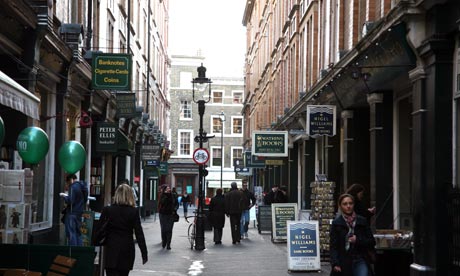
“Cecil Court.”
“What’s that?”
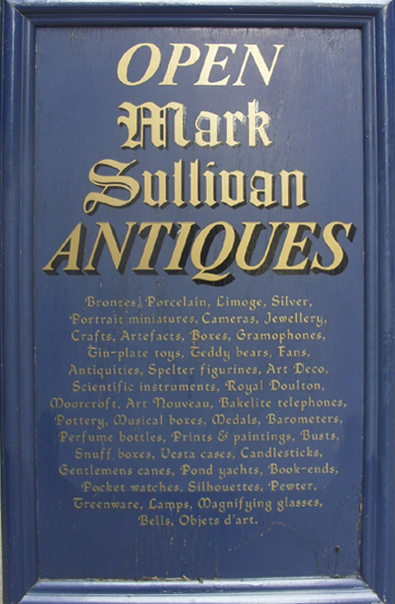
“It’s where my antiques dealer is. Remember we went there the last time we were in London?”
“Oh, jeez, the place where you guys talk for hours about the Duke of Wellington?”
“Not hours, surely.”
“And where you buy more Wellington stuff? Are you going to buy more Wellington stuff this time? When are you going to stop buying Wellington stuff?”
“When they pry my cold, dead fingers away from my credit card.”
“Honest to God, Hon, it’s like we live in a museum as it is.”
I didn’t have a comeback for that. What could I have said? We don’t live in a museum? We do. And, honest to God, there’s barely any wall space left.
“Look, I promise not to buy any more Wellington stuff unless it’s really outstanding. Okay?”
I took us down St. Martin’s Lane and from there it was just a short walk to the turning for Cecil Court, a pedestrian thoroughfare lined with book, print and antique shops.
Now, if I had any sense in my head, or if I were the crafty sort, I wouldn’t share the name of my favourite antique dealer with you, let alone his exact location, but I trust that you and I are such good mates by now that, should you visit the shop, you’ll content yourself with buying things associated with William IV or Lord Nelson, or even Queen Victoria, and leave all the Wellington bits and bobs for me.  

The shop is just the right size for browsing and it’s absolutely crammed, floor to ceiling, with items from the Georgian period to the early 1900’s. I can, and have, spent hours in the shop. Mark is very personable and always pours me a drink before encouraging me to light up. We sip, smoke and have an old fashioned chin wag as the time flies by. We discuss Florida, Wellington items that we both missed out on, Wellington items that one or the other of us haven’t missed out on, dogs, restaurants, etc., etc.
On this particular day, Mark wasn’t there himself, but my good mate and Mark’s partner Dave was. That’s Dave in the picture below, in the white shirt.
“The Wellington Woman!” Dave greeted me. “How’s your daughter? Is she with you?”  Dave’s Boston Terrier came out from behind the counter to greet me and we spent a few minutes catching up on the past two years. It was about this time that the Hubby sidled towards the door and quietly let himself out. Then, as always, Dave threw out some Wellington trivia in his ongoing attempts to stump me.
“Publish and be damned.”
I rolled my eyes at him. “Really? That’s the best you have? Harriet Wilson, that slut.”
“By God, I think my leg’s gone,” he said.
I sighed. “Henry Paget, after being shot in the leg at Waterloo. We just saw Paget’s leg at Horse Guards, as a matter of fact.”
“No! It was the Marquess of Angelsey,” Dave cried with delight.
“No. It wasn’t either. It was just plain, old Henry Paget. He wasn’t created Marquess of Angelsey until a few days afterward. The same Henry Paget who had, years earlier, run off with the wife of Wellington’s brother.” Why did this story sound so familiar?
“I didn’t know that. Really?”
“Why would I lie?”
Dave stared off into space for a few moments, his mind working. Finally, he said, “Sparrow hawks, ma’am.” 
“To Queen Victoria. Great Exhibition. 1851.”
“I give up,” Dave conceded. “Honestly, I can’t believe how much you know about the Duke of Wellington. You should do something with that knowledge. You could make money at it.”
“Like what?” Why did this suggestion sound so familiar?
“Like give talks. People would pay money to listen to you.”
“Alas, not enough people to make a living at it. I can’t see a Wellington lecture filling Albert Hall, can you? And there’d be even less people in America who would be interested in the Duke of Wellington, or who’d even know who he was.”
“You’re probably right. Pity, though.”
We were both silent for a time, contemplating the prospects of a traveling Wellington show. Finally, I said, “So, what have you got for me?”
“Ah, not much, I’m afraid. Wellington items are a bit thin on the ground just now.”
“Well, it would be hard to beat that figurine I bought from you last time, in any case.”
“Yeah, that’s right. Staffordshire, wasn’t it? That was a beauty.” Again, we were both silent, this time contemplating my acquisition of the figurine below.

“Didn’t you also buy a pot lid?”
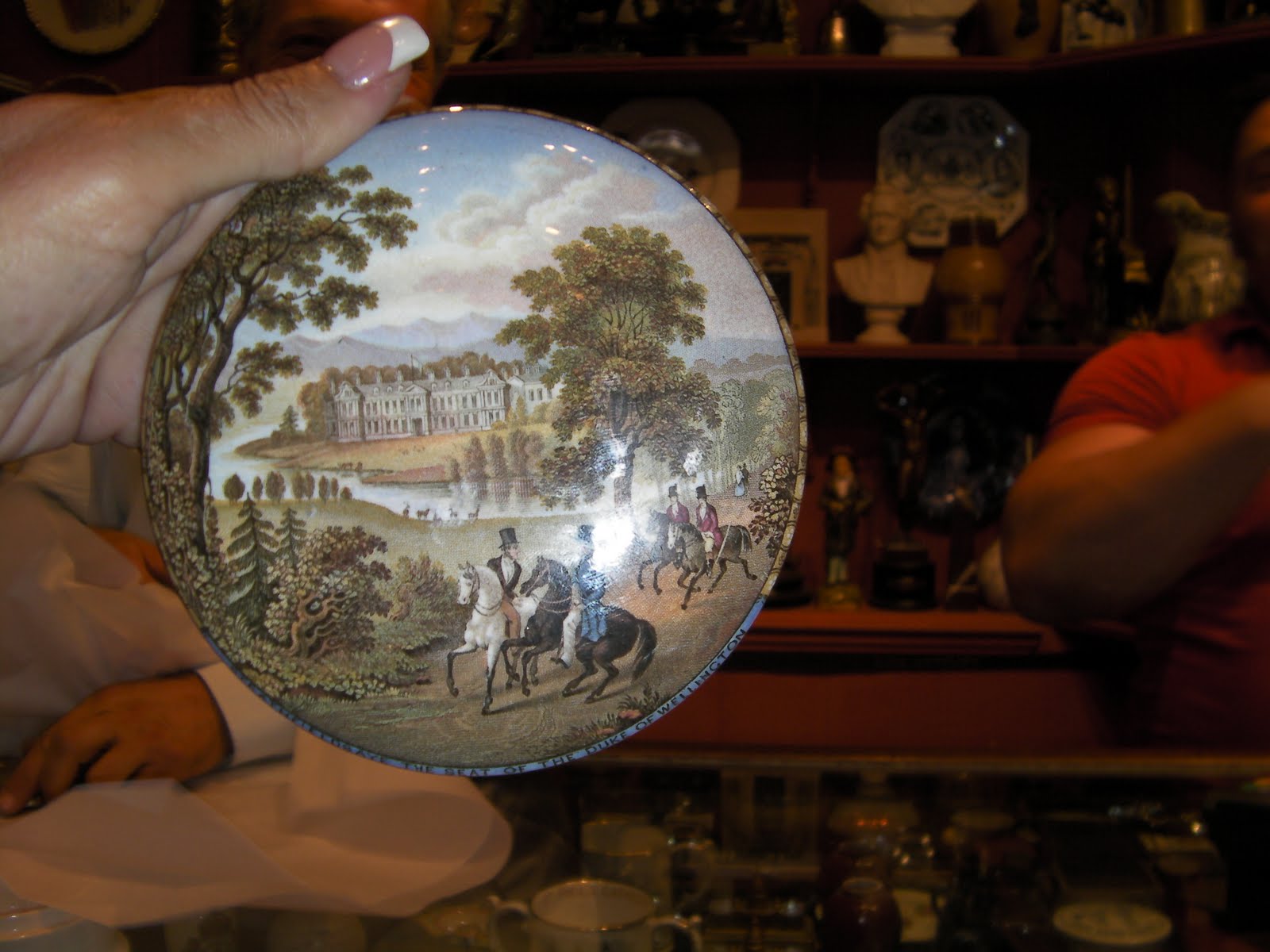
“I did. The Duke riding at Stratfield Saye.” You can see me holding it, in the very same shop two years ago, below.

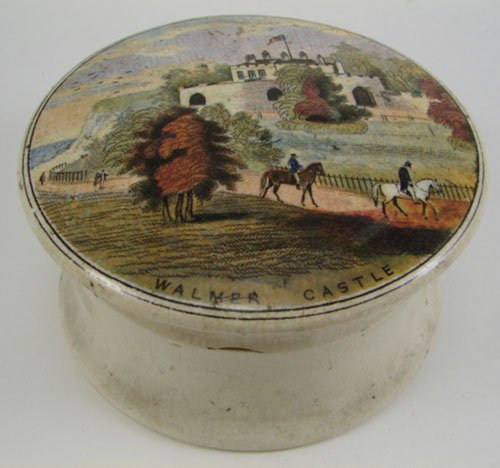
“I just remembered, I’ve got one very similar to it, but at Walmer Castle.” Dave found the lid and handed it to me. “Very like the one you bought, with the Duke riding his horse in the foreground.”
“He was Lord of the Cinque Ports, which is why he spent time at Walmer Castle,” Dave said.
“Hhhmmm. It was his favorite residence. He lived there with Charles Arbuthnot. They’d walk the battlements together. In fact, Wellington died there.”
“Yeah, that’s right. He did.”
“Sold. What else have you got?” Okay. The Walmer pot lid wasn’t what I’d term outstanding, but it certainly was beautiful. And besides, it rounds out the collection.
“I’ve got a brass profile of the Duke. Here it is.”
“Have one.”
“There are a couple of bronze commemorative medallions,” Dave offered.
I peered into the case. “Too like the ones I already have.”
“I’m afraid that’s all I have.”
This was deflating news. I had hoped to find something magnificent whilst in London, on a par with the figurine. It was a bit like charging off to Waterloo only the find that the battle had taken place the day before. “I’ll browse for a bit.” There was an Artie-fact in the shop – I could feel it.. I took my time and peered at cigarette cases and vinagarettes, figurines and a William IV coronation jug. Mourning rings, snuff boxes and a spy glass. Scanning to the right, my eye fell upon a small, coloured portrait.
“I found the Duke of Wellington,” I told Dave.
“Huh? Where?” I pointed. “So it is!”
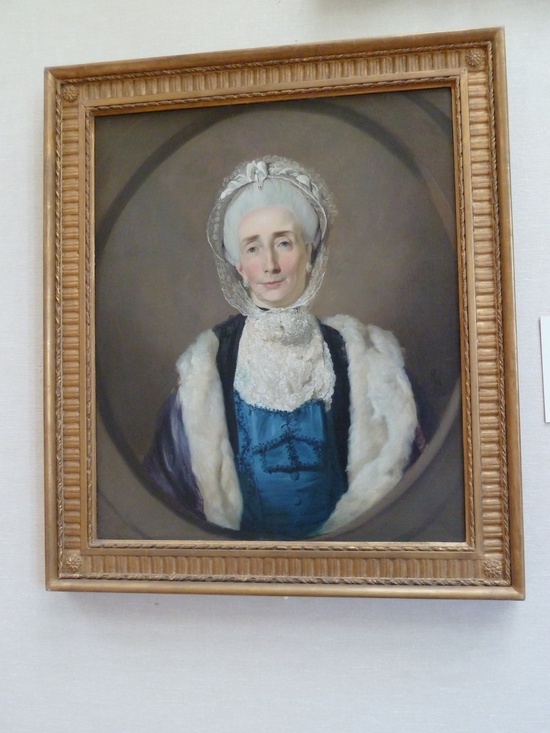
I will leave the portrait and it’s history for another post. Suffice it to say that I bought it and Dave was able to carefully wrap both pieces so that I could pack them in my suitcase and later carry them on the plane with me. I walked out of the shop and found Hubby lurking in Cecil Court.
“Want to see what I got?”
He looked at the smallish bag in my hand. “No. I’ll wait till we get home. At least it’s not another full length portrait. I’m hungry.”
“Let’s go back to the hotel and have Afternoon Tea,” I suggested.
“Tea? Who drinks tea? And I said I was hungry.”
I sighed. “Afternoon tea is a meal. It comes with food.”
“Steak food?”
“No! Tea food. Sandwiches.”
“Oh, a sandwich. That sounds good. I could go for a sub. Yeah, a nice, big hero sandwich would really hit the spot!”
Part Four Coming Soon!

Beau Brummell's London Townhouse For Sale

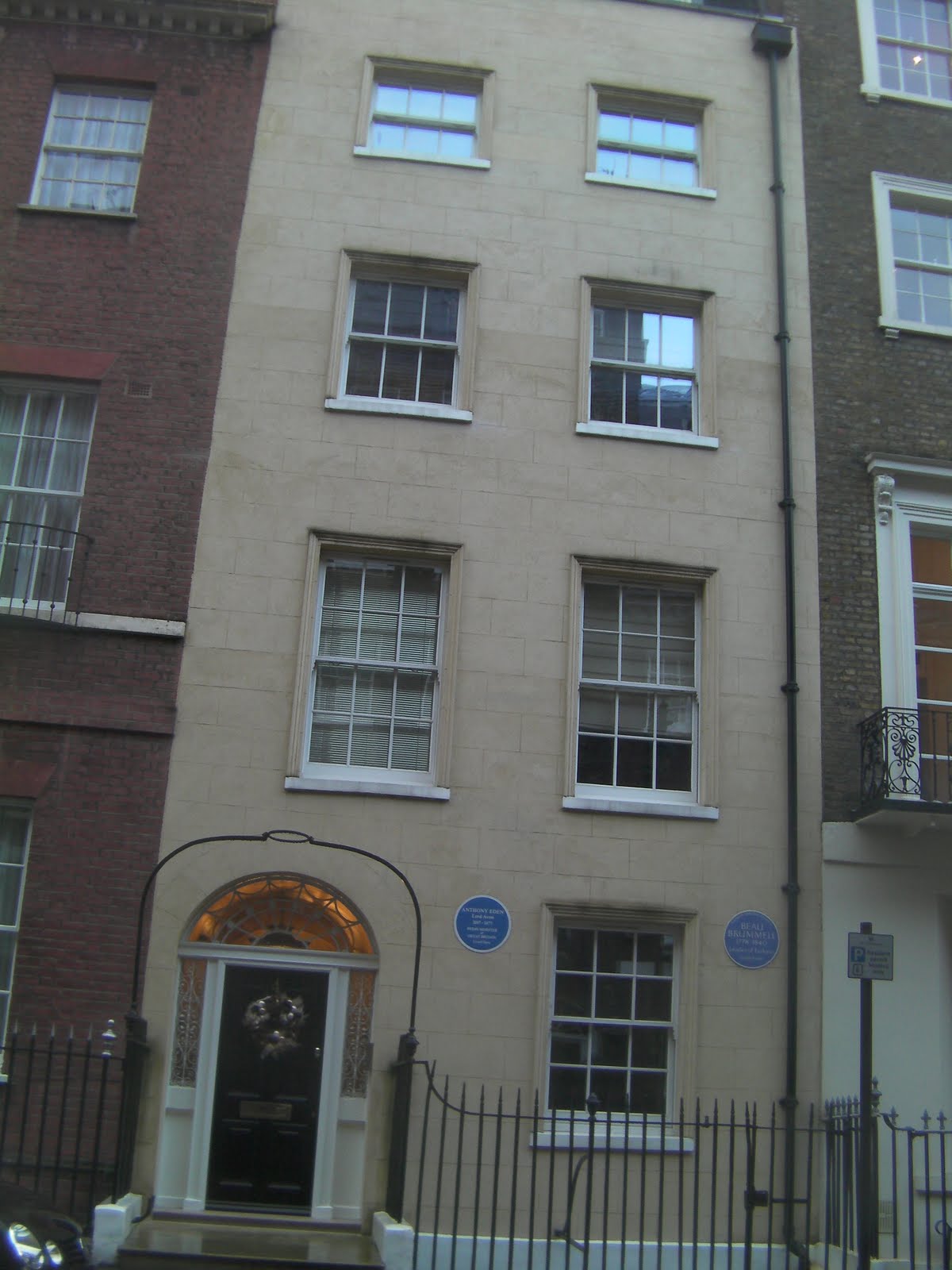
After reading my “Couple In England” post on my outing in Mayfair and my stroll to Beau Brummell’s London townhouse in Chesterfield Street, author Rosemary Stevens just informed me that it has been on the market for nearly a year, with an asking price of nearly nine million pounds. Which firmly places it out of my price range, alas. Rosemary suggested that we all pool our money in order to buy it. A grand idea, but not practical when you figure out that we’d need at least five hundred some odd people to go in on it aside from ourselves. Not only would the crowd of us not fit in the house, but if we time shared the place, we’d each only get a half day each year. Sigh. Here’s the listing. Read it and weep. I know I did.

The Secrets of Bloxley Bottom, Episode 3: Monty Mulls It Over

Billy Green barely caught a glimpse of the Duke in the village road before he ran out back in order to find his boots. He needed to run across the fields and though he’d rather go barefooted, he didn’t dare. If he stumbled, he’d not get to Mr. Monty fast like he’d promised. Once booted, Billy threaded his way through the buildings behind the inn and dashed across the village green, then through the copse that bordered the river. When he reached the bridge he glanced back at the road and saw the Duke’s riderless horse being walked around behind the Dower House. It was another field or two to cover before he reached Mr. Monty’s and he kept up a fast pace, gulping huge breaths as he ran. Mr. Monty had promised him a shilling for news of the Duke, practically a fortune. And Billy wanted a shilling of his own. He knew just where he’d hide it.
But in truth he would have performed the errand for nothing. He’d do anything for Mr. Monty. For Mr. Monty or for Mrs. Cubbins, the cook at the Dower House who fed him cakes and let him finish the soup too, even take some for his sisters. At the cottage, his ma did little more than holler at him to do his chores, but Mr. Monty patted his shoulder and called him Billy-boy. And Mr. Monty was one of the few adults Billy had known to put aside whatever it was that he was in the middle of in order to listen to him. And when he spoke to him, Mr. Monty looked Billy right in the eyes. A rare thing, Billy reckoned, in the world of adults. And Mr. Monty was generous with the dosh. Today’s coins wouldn’t be the first Billy had earned. Mr. Monty had a shed full of old clobber, tables and mirrors and vases and suchlike he wanted polished before the swells came to look over the lot.
Mr. Monty’s house was in sight now. Billy picked up his pace and ran into the kitchen yard to look for Stanton, Mr. Monty’s man. He yanked a rope that rang a bell above his head and sank onto the grass below it, gasping for breath.
A quarter hour later, Montague Twydall cantered across the field towards the Dower House on his bay cob. Tall, trim and tricked out in his usual fashionable attire, Monty looked for all the world like the personification of a romantic hero. With his black hair and military air, Monty could have had any lady he fancied. It was a great pity, believed the local mamas, that Monty fancied none of them. Whilst he enjoyed a bit of horizontal exercise as much as the next man, Montague Twydall had long ago decided that he did not want a female permanently under his roof. He hadn’t the time. Nor the patience. A woman around the house, nattering on unceasingly about her relations, her rounds of visits and her modiste would be nothing but a burden to him. He’d rather return to active military service, a thing he’d thoroughly detested. And, truth be told, if Monty were to worry himself over the latest fashions, hats and fripperies, he was more likely to worry about them as they applied to himself, rather than to someone else.
Just now, however, Monty’s head was full of alternative approaches to the Duke about the items for which he wanted to be paid in good English sterling. Monty was low on ready money and a solid sale to the Duke of either item, or both, would set him up a treat. He had to be careful in how he represented the robe to the Duke. Or anyone else, for that matter. The story that it had belonged to Joséphine de Beauharnais could not be proven, even though the velvet and ermine robe had the initials JB entwined in gold embroidery. For all Monty knew, it could have been the property of one Jenny Brown. His French agent suggested he pawn it off as a Napoleonic relic and play upon a possible connection to Joséphine, the first Empress of the French. The connection could either help or hinder his chances of selling it to the Duke, who hadn’t seemed to mind collecting Napoleonic relics in the shape of the defeated Emperor’s cast off mistresses, many of whom later went on to boast of their having being the mistress of both Bonaparte and Wellington. Which is the reason why he thought the Duke might also be interested in the pearls that had supposedly belonged to the famous contralto, Madam Grassini.
Monty chuckled to himself as he thought about the amorous rumours which had followed Wellington round Paris. He of all people had no reason to doubt them. He’d been in Paris only briefly whilst Wellington had been head wallah in the City, but Monty had seen firsthand how all the beauties of the French capital had swarmed the Duke. It had even been reported that Wellington was the better lover. How so, Monty could hardly imagine. The man had been constantly at his desk whilst in Paris, writing order after order, letter after letter, dispatch after dispatch. How had he found the time for such conquests? To Monty’s mind, a proper seduction called for a long, lingering evening of wine, supper and many sweet nothings whispered into shell-like ears. He wondered how Wellington had managed to seduce such experienced courtesans whilst visitors, both civilian and military, paraded through his rooms. If Wellington had had time for any seduction at all, he’d no doubt have suffered constant interruptions and been kept busy hopping off the couch in order to take up his pen and make notations to his voluminous correspondence. Monty was unable to picture any of the knowing ladies he’d met in Paris being willing to put up with that degree of romance interruptus, Wellington or no Wellington.
At the Dower House, Monty handed his mount over to a stable boy and realized that he’d allowed the Duke’s amorous adventures to keep him from fashioning the sort of opening gambit this proposed sale would require.

Not far down the road, Elizabeth, Baroness Bloxley, found it difficult to restrain herself from twirling about the morning room at Bloxley Hall. Instead, she sat silently in her chair, pressing the just-delivered letter to her heart and allowing herself a small smile. A shiver tickled her spine. The earl couldn’t have been more flattering in his praise of her illustrations. He wanted those she’d submitted – and more – for his book on Kent wildflowers. How absolutely, thrillingly perfect!

Now, when she was 44 years old, she’d been offered another chance to live her dreams of becoming a professional artist. A dutiful life and years of conforming to the ideals her mother had tried to instill in her were made worthwhile by this letter. After her marriage, Elizabeth had naturally given up her attempt to become a portrait painter, turned instead to motherhood and resigned herself to only occasionally executing watercolour landscapes. Now, at last, success. Recognition. Fulfillment.
Taking up her pen, Elizabeth copied the names of the first three wildflowers the earl wanted from her. They were probably blooming now, he’d written, so there was no time to lose in obtaining the specimens. The earl had used the three Latin names given by botanists to these flowers, but she knew two of them by their common names, the bluebell and the violet. They would be easy to acquire, as both were common to her own home park.
For a moment her heart dropped when she read the third name. What in the world was Symphytum officinale? She would have to look it up. She could most easily do that when Lionel was not in his study or the adjoining library. She did not know what he was doing there, but this was not the moment she wanted to tell him about her drawings for the earl. In the meantime, she would savor her secret. And she would take her drawing materials to the garden with a lightness of step she had not felt for ages.

A Couple In England – Day Three -Part Two

Leaving the Duke of York’s Column, we headed towards Trafalgar Square and on towards Horse Guards.

“Why is it that wherever we go in London, we’re always passing either Big Ben or Apsley House?”
 “Because London, old London, is not really that big. The City of London was known as the Square Mile. Strictly speaking, our hotel in Mayfair is without the City.”
“Without the City what?”
Outside the City. As far as the time periods and people I’m interested in go, the most important bits of London are bounded on the east by the Tower, in the west by Knightsbridge, to the north by Bayswater Road and to the south by Southwark.”
“But why do you keep going to the same places every time you come to London? How many times have you been to Horse Guards?”
“Practically every time I’ve been in London.”
“That’s nuts. Why do you do it?”
“For the same reason that I keep returning to Apsley House. I’m hoping that one day I’ll see the Duke of Wellington. The first Duke of Wellington. I keep going to St. James’s Street because I’m hoping to spot Brummell walking into White’s. And I go to the Burlington Arcade because I want to one day find my carriage and coachman waiting there for me. I can’t actually go back to 19th century London, so I return to the scenes of the crimes, so to speak, and imagine what once was. Plus, while I do the rounds of the same places, I’m always looking at other areas surrounding them, too. Each time I explore some new aspect of the area.”
“Your ghost is going to haunt London when you die.”
“One can but hope.”
We walked down Whitehall and past the Clarence Pub, where Victoria and I have been known to  raise a pint together, and were soon at Horse Guards.

The Household Calvary on duty are an impressive sight and there are always tourists surrounding the mounted guards and taking pictures. On this particular day, the crowds were huge – one could barely navigate the sidewalk for all the people pressing in to see the guards.

“Are they allowed to get that close? Look, the horse doesn’t like it, he’s tossing his head. Hey, they’re touching the horse. Are they allowed to do that?
“I don’t think there’s a rule that you can’t get that close, but I’ve never seen the guards being that crowded before.”
“Why don’t they back off? It’s crazy.” No sooner had Hubby voiced these words than the mounted guard slowly, but deliberately, backed his horse further into the archway. Still looking straight ahead, we watched as he raised his right arm and began pushing a button on the interior wall. It was as contained as a cry for help could be. 
“Did you see that?” Hubby asked.
“Yeah. I didn’t even know they had panic buttons in there. Come on, let’s get out of this crowd.”
“Are you nuts? I’m not leaving until I see who comes to rescue him.”
So we waited. And waited. And waited. Reader – no one came to his rescue.
“I can’t believe no one is coming,” Hubby said, disappointed.
“No doubt they have cameras watching. Maybe whomever is manning them looked at the situation and didn’t deem it enough of an emergency to send the guards. Come on; no one is coming so let’s go.”
We walked through the courtyard and into the archway that leads to the back parade ground.

There is always a guard stationed in the arch, near the entrance to what was once the Duke of Wellington’s office.
“This is where they had the beach vollyeball during the Olympics,” I told Hubby when we came out into the rear yard.
“Uh huh.”
“You know, everyone goes to the Palace to see the changing of the guard, but if you come here any day at 4 p.m. you can see the daily inspection parade. Then you don’t have to fight the crowds. Although it’s not the same, is it?”
“Uh huh. Why are we standing here? It’s freezing.”
Sigh. “I’m just taking it all in, communing with the history. Look up there, that’s the window to Wellington’s office.”
“Uh huh.”
“Let’s go inside.”
“Inside where? What’s this?”
“The Household Calvary Museum.”
“What’s in there?”
“Household Calvary stuff!”

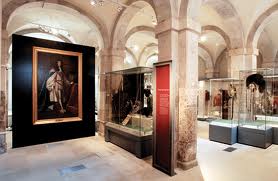
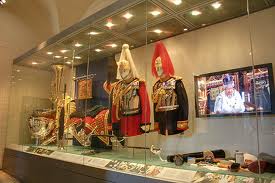
The Museum traces the history of the Household Calvary from the 1600’s to present day and, once Hubby got a look a the uniforms, arms, saddles, etc., he got into the spirit of the thing.
The Calvary’s stable is adjacent to the Museum and there’s a portion of the Museum that features a glass partition, through which visitors can see the horses in their stalls. It so happened that there was a guide on duty in the viewing room.
“Excuse me,” I said, approaching him. “Can you tell me if Sefton is here?” Sefton, you may recall, was the Calvary horse who was injured but survived the 1982 IRA bomb in Hyde Park.
He gave me a sad smile and a pitying look. “Sefton is dead, Madam.”
“The original Sefton is dead, yes. But in his honour there is always a horse named Sefton in the regiment. I just wondered if he was stabled here.”
He seemed somewhat taken aback. “I didn’t know that. And I don’t know much about the individual horses kept here. There’s a bit about Sefton in the museum, however, towards the end. You may be interested.”
“No doubt. Thank you.”
“Thank you, Madam.”
“I love it when you do that!”
“I didn’t do anything. I just asked a question.”
“I love it when you tell them stuff they didn’t know and they give you that `just who the Hell are you?’ look.”
“Stop it.”
“You should get a job here.”
“At Horse Guards?”
“Somewhere in England, at a museum or a castle or something.”
God, are you listening?
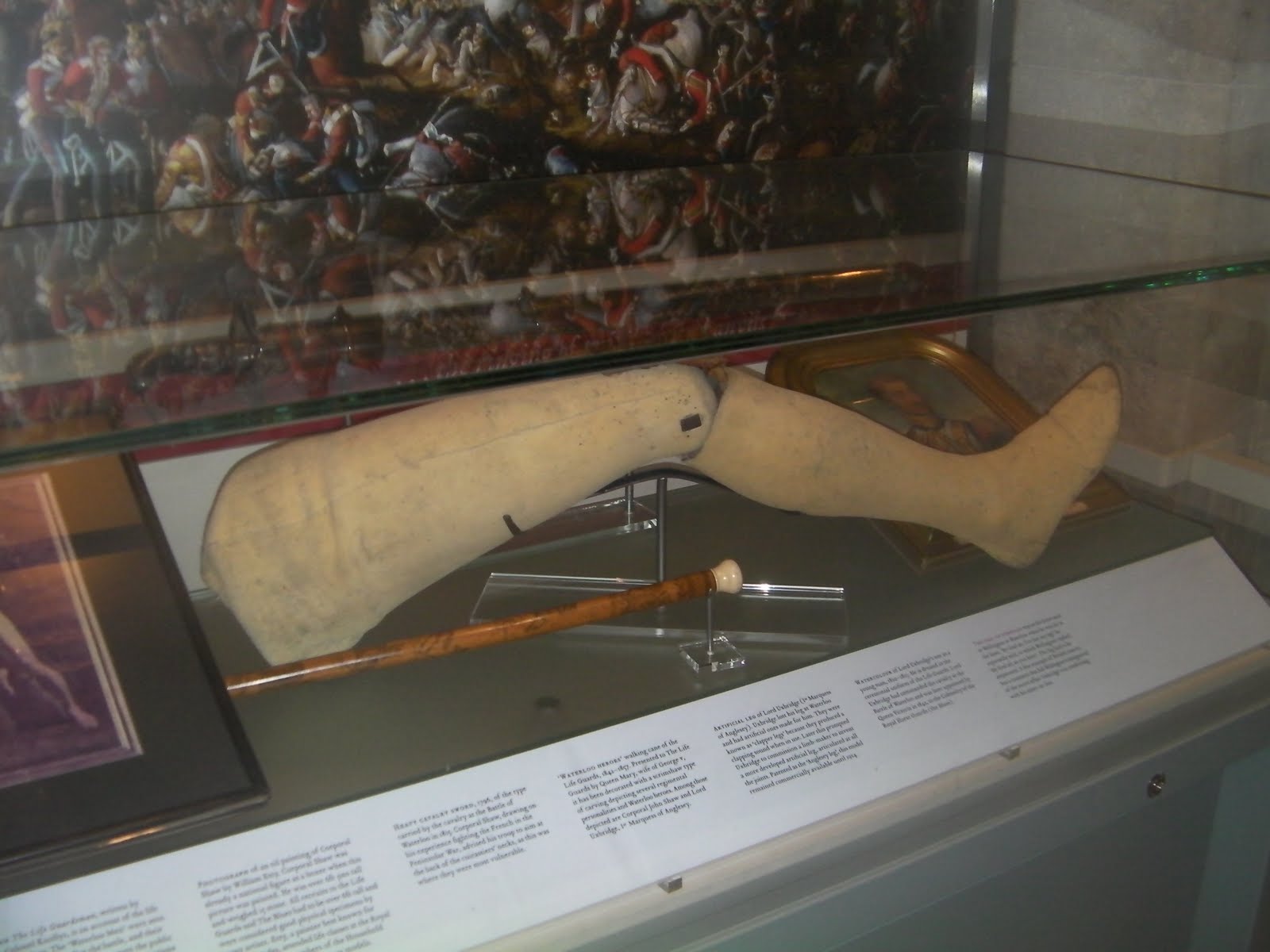
We spent the next half hour looking at the various displays, with a particular focus on Waterloo relics, like the pistol ball that wounded Sir Robert Hill and, in my opinion the best of the lot, the Marquess of Angelsey’s artificial leg. You may recall my previous post on Paget’s leg. If not, you can find it here.

“Look, Paget’s leg!”
“Who?”
“Henry Paget. Afterwards the Marquess of Angelsey. He ran off with the wife of Wellington’s brother, Henry. Henry suffered a sort of mental breakdown and was unable to care for his children, who went to live with Artie and Kitty for a time. Later, at Waterloo, it turned out that Artie had to put up with having Paget on his staff. When the fighting was over, Artie and Paget were both on their horses, talking, when one of the last shots of the battle was fired and hit Paget, nearly taking his leg off. He had to have it amputated shortly afterwards.”
“Maybe Artie shot him. Who could blame him?”
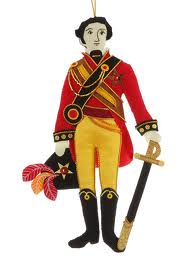
Who, indeed? We finished our visit to Horse Guards in the gift shop, where I bought the Christmas ornament below –
  
“I’ll just take this,” I said, pushing the ornament towards the clerk at the till. “Everyone should have the Duke of Wellington on their Christmas tree.”
“Yes, they should,” said the clerk. “Although you are the first person who’s recognized it as being the Duke. Everyone else seems to think that it’s Prince Albert.”
Hubby put his lips to my ear and whispered, “That’s my girl!”
Part Three Coming Soon . . . . .

Parade's End Comes to the US


The five-part miniseries Parade’s End, starring Benedict Cumberbatch, will be shown on HBO on February 26, 27 and 28, 2013.

Set in the World War I era, the HBO-BBC series was adapted by renowned playwright Tom Stoppard from four novels by Ford Maddox Ford. Rebecca Hall, Adelaide Clemens, Rupert Everett, Miranda Richardson, Jane McTeer and other well-known actors play the family and friends of Christopher and Sylvia Tietjens.

The series was broadcast last summer in the UK and earned critical kudos for all aspects of the script, acting, and production directed by Susanna White.

Tom Stoppard
 
This is Sir Thomas Stoppard’s first television play in thirty years.  His success with original drama and adaptations for films is legendary.  Speaking for myself (Victoria here), I love the way his plays always have multiple levels of meaning.  Arcadia is my absolute favorite. But the choice for second place among his works would be impossible, e.g. Rosencrantz and Guildenstern are Dead (play and film), Shakespeare in Love (film), etc. etc.

Ford Maddox Ford (1873–1939 wrote novels, poetry, and criticism; he edited several journals and was a well-known member of influential literary circles in the 1920’s.  He is probably best remembered for his 1915 novel The Good Soldier.

For more information, the trailer for the series, and interviews with participants, click here.


The series will be available on HBO On Demand in many markets — or you can have a copy for yourself!