The Secrets of Bloxley Bottom, Episode 8: Prudence Meets the Artist

Tournell pocketed his charcoals and held up his drawing to catch the light filtering through the windows of the taproom of the Crowing Cock Inn. Not bad, if he did say so himself.  In the center of the page, he’d drawn three men at a table, based on the men who’d been seated across from him a half an hour ago.  On the left he’d drawn, from memory, a lithe young girl holding a platter of ham. She closely resembled Polly, though he didn’t have the arms and hand quite right. Polly had a more graceful bearing than this figure.
     Working quickly, as he hadn’t known how long the men intended to stay, and therefore unwittingly pose for him, Tournell had drawn in the details of the fireplace behind the men, the pictures that hung upon the wall, all in an effort to capture the feeling of the place, the verisimilitude that would give a painting character. Paintings of  homey and rural scenes were at present proving most popular and were no doubt bringing ample funds to the coffers of their artists.
     There were many directions an artist might go these days. He wondered about his future and how best to secure his success.  He was good at portraits. If he did the Bloxley daughters well, and the painting captured the interest of attendees at the Royal Academy next spring – If. If. If.
    Last night he and Monty had dined here, and he vowed to do more sketches, but not of females, as Monty intended.  On a Sunday night, the inn had been quiet. Only the proprietress and the little maid Polly were about, so he’d returned this morning to try again.  But he kept getting distracted by other ideas for paintings taken from everyday life. Polly would be perfect in a rural scene. And she could be a pretty fresh face among the roses or posed with a bowl of milk just as she looked now.
 
      He grabbed another piece of paper and pulled out his charcoals again, trying first to capture what he remembered of the shape of Polly’s face, her full cheeks and  dimpled chin. Her eyes were bright and as blue as the summer sky, a blue that reminded him of his mother’s Sunday dress. How could he mix that color, luminous and deep? It would take several layers of paint, but his pots of paint were far away at Monty’s, and he had no way of getting there at the moment. 
Mrs. Winston came into the tap room, another lady he yearned to paint. Next to the face he was trying to make into a likeness of Polly, he sketched in a few lines to outline Mrs. Winston. Another good-looking woman in a sort of paradise of beautiful females. As she rearranged a shelf of bottles across the room, he took note of her lifted arms, reaching high over her head, the look of her heels and feet up on her tip toes. Ah, those feet, those legs in their cotton stockings. The human foot, now there was a subject for his pencils.  Infinite variety of shapes. Long toes. Stubby toes. Gracefully arched feet or broad, flat feet. And upwards to the ankles, so fine or so plump.
“Mrs. Winston,” a voice called from the serving pantry. Tournell knew all about the rooms behind the tap room, back of the house, they would have called it in a theater. He needed settings for his pictures, minutiae that would provide the kind of reality patrons wanted. He had an eye for detail.
The voice belonged to another of the village’s pretty young women, les belle jeune filles. This was Prudence, the vicar’s daughter, another he’d love to paint. She had a long graceful neck and a fine figure.
“I’ve brought the eggs, and your man is storing them in the larder.  Is there anything else I can do for you?”
Mrs. Winston met Prudence halfway across the room and Tournell again sketched a few lines to show the two women standing together.
“Then I’ll be going now, Mrs. Winston.  And deliver again on Wednesday.”
Suddenly Tournell perked up and looked up from his papers and charcoal.
“Miss Newton, are you going to the rectory?”
“Yes, sir, I have finished my deliveries.”
“I would appreciate a lift to Major Monty’s – is that on your return route?”  He knew she would go past the estate Monty leased. “You could drop me a
t the roadside, if you would not mind.”
Prudence Newton’s gray-blue eyes settled on him. She knew her mother would not approve. She’d often been warned not to provide a ride to anyone in the  donkey cart. But she knew that Tournell was to paint the Bloxley sisters, and she was curious about it. How did one arrange a painting? It might be nice to have a little sketch of herself, something to give her parents.
“You are welcome to accompany me,” Prudence said in her most careful accent, the voice that Lady Louisa had taught her for years to use in polite company. She knew Tournell the artist did not qualify as a proper companion, but he knew how the quality  spoke.
Driving the cart up the hill from the Inn with the artist beside her, Prudence wondered how to broach the subject of her portrait, not that she expected him to paint one without being paid handsomely for his efforts. But a sketch would be so very nice.  She could ask their man of all work to craft a little frame for it and present it to her mother on her birthday. But how to ask?
Tournell was contemplating almost the exact subject from the other point of view. How could he ask this pretty girl, who spoke with the voice of a young lady, to sit for him?
Thus they proceeded in silence, until the dog Spot made his appearance, but the donkey was immune to Spot’s “Arp.”
Mon Dieu,” Tournell muttered. “The first beast in Bloxley Bottom I don’t have the faintest intention of drawing. What hideousness!”
Prudence laughed, glad at last the silence was broken. “Do you make little drawings besides your big paintings?”
Oui. Of course.  Inside he was ecstatic. He didn’t have to say a word as it sounded like she was volunteering to pose for him. “Would you like a portrait of yourself, perhaps? A young lady as lovely as yourself should be captured in her prime.”
“I would like to have you make a picture of me for my mama’s birthday, a sketch perhaps, not a proper painting, but there’s no question of my being able to afford your fees for even a simple a sketch, Monsieur Tournell. ”
Tournell took a moment to consider his words, “I can do that for you. In place of my usual fee, you might allow me to sketch you for my own purposes? I do life studies for various compositions and often use them later on. Perhaps you can sit for me today?”
“You mean now?”
Oui, if you have a spare hour.”
Prudence thought for a moment. Her parents would begin to worry if she was not back by 3 pm.  “Yes, sir, I have an hour or two.”
The donkey plodded around the corner past Hilltop House.
From the window, through the lace curtain, Aurelia Gammersgill watched the cart and its occupants. She pursed her lips in disapproval. That Frenchman. With the rector’s daughter. Aurelia shook her head in genuine dismay.
“Millicent, you won’t believe what I just saw,” she called to her house-mate.  
 

The Wellington Connection: Hedsor House


Director Dustin Hoffman’s movie Quartet is garnering great reviews and stands as another in the “later life” genre of film that’s become all the rage with people of a certain age. The fabulous and star studded cast includes the beloved Dame Maggie Smith, Billy Connelly, Pauline Collins, Tom Courtenay and Sheridan Smith as residents of stately Beecham House, a retirement home for impoverished singers and musicians.


Not having seen the film yet, I plan on doing so this weekend, if only to see Dame Maggie, Billy Connelly (who, as a stand-up comic, is simply hysterical) and the much missed Pauline Collins. Sarah, where have you been?


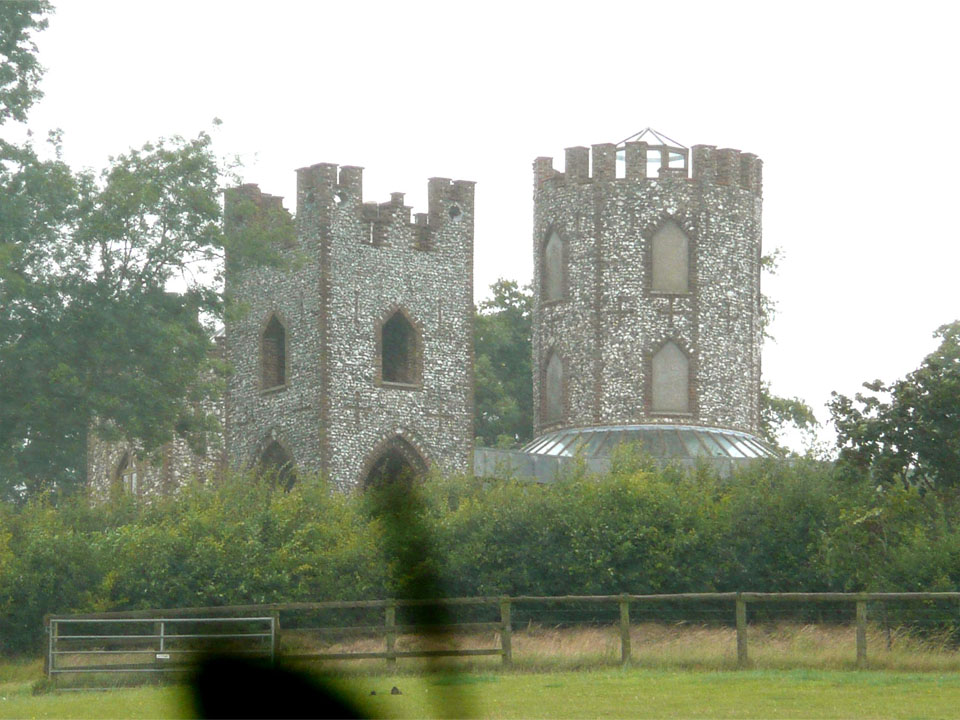
What, you may ask, does any of this have to do with the Duke of Welllington? Well, another of the film’s stars is Hedsor House, which acts in Quartet as the fictional Beecham House, visible in the background of the photo below.


Hedsor House stands in the village of Hedsor, in Taplow, Buckinghamshire and dates back to the 12th century. In the 18th century, Hedsor House was occupied by Princess Augusta, Dowager Princess of Wales, mother of King George III and founder of Kew Gardens.
 
In 1764, the house was purchased by William Irby, 1st Baron Boston, who also acquired the grounds, consisting of eighty-five acres overlooking the Thames.


The House was badly damaged by fire in 1795 and a new house was completed in 1868, unusually modeled on the Italian villa style but with a domed hall rather than an open courtyard. Queen Victoria was a frequent visitor and Baron Boston built the Hedsor Folly, also called Lord Boston’s Folly, to commemorate the victory at the Battle of Waterloo. Or perhaps he built it to commemorate King George III’s brief recovery from madness. Both theories are in circulation.


Please leave a comment if you’ve actually seen either Quartet or the Folly and let us know what you thought of either of them. Or both.

A Couple In England – Day Four – Part Two

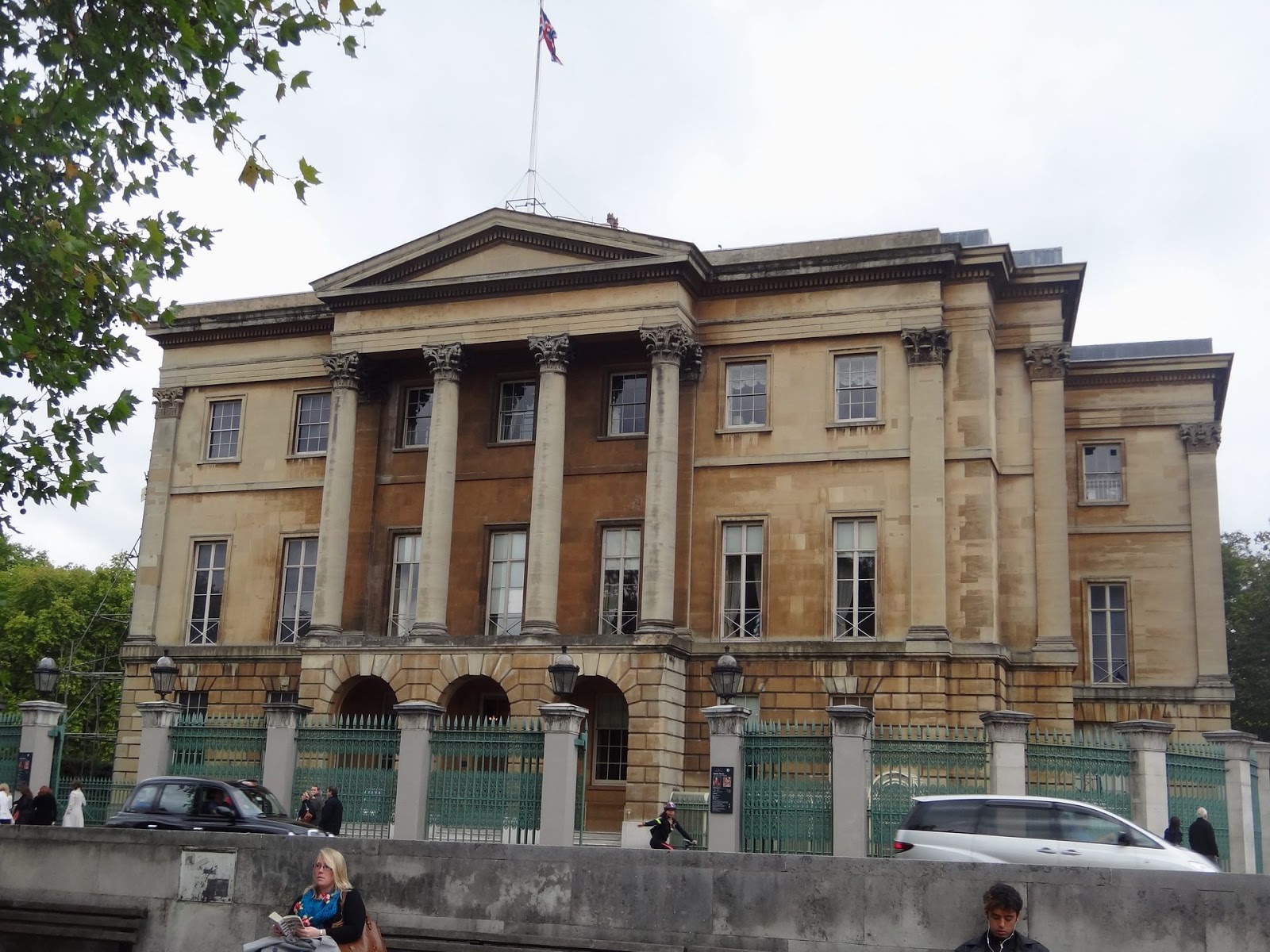
Finally . . . . Apsley House. The Holy of Holies. Honestly, every time I visit I expect the Heavens to part and the angels to sing. Sadly, that’s yet to happen.

“Look, Apsley House!”
“Again,” replied Hubby, barely containing his enthusiasm.
“Yeah, but this time it’s open and we’re going in.”
“Yipppeeee.”

“Wait, come this way. I want to show you something.”
“Oh, fer Pete’s sake. It’s raining. Can’t we just go in?”
“No! You have to see this sign first. Victoria and I love it. Come on.”

Above is a picture of the sign I wanted Hubby to see, taken by myself whilst with Victoria on a previous visit. I cannot tell you how crestfallen I was when I saw, in it’s place, a simple placard that read “Private.” I didn’t take a photo of it because Hubby was impatient and it was raining, but now I could just kick myself. Can  you believe they replaced this sign? Do you think they had to replace it because Victoria and I posted it all over the internet? Hhhhmmmm.
“Okay. Let’s go inside.”
“Thank you.”

“Wait! Wait!”
Now what?”
“See those rings on the steps? That’s for when they roll out the red carpet. After the carpet is down, they put the rails through those rings to keep it in place.”
“Yeah, right. The red carpet,” scoffed Hubby. Then he looked me in the eye. “You’re not kidding, are you?”
“Nope.”
I opened the door and in we went (cue chorus of angels). Now, when you enter Apsley House, you find yourself in a large hall. To the left is the reception desk and till and behind it, on the wall, is a huge portrait of the Duke, at least ten feet tall.
Eyeing it now, Hubby said, “Oh, Jeez. Don’t get any ideas.”
“Hi, Honey, I’m home,” I replied. I approached the desk and paid for two entry tickets.
“Would you like audio guides?” the nice man asked us.
“No.”
“Yes, please. Two,” I answered, giving Hubby the stink eye. The nice man gave us a brief overview on how to use them and Hubby assured me that he could handle it.
 
“See that guy behind the counter?” I asked Hubby in a whisper as we walked away.
 
“Yeah?”
 
“He knows who the Duke of Wellington is. So does everyone else here. I’m not the only person in the world who knows who Artie is.”
 
Hubby rolled his eyes as I led him to the first room on the left. This was called the Museum Room in 1853, when the house first opened to the public and as far as I know, it’s still the Museum Room, although back then it was in the room that is now the entrance hall. In the spirit of full disclosure, I should let you know that I didn’t take any of the pictures in the rest of this blog post. I didn’t think photos were allowed, so I swiped these off the internet. There are links to the original posting where I could find them.

 
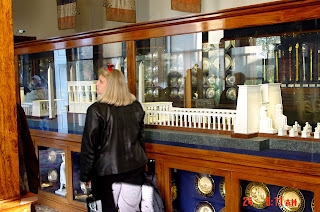
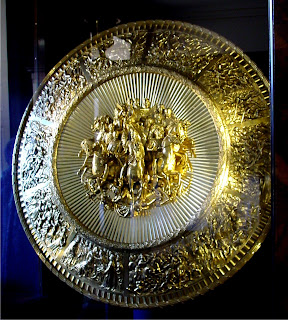
The Museum Room contains porcelain, gold and silver gifts given to Wellington by grateful monarchs and countries. In addition, you’ll find his swords and staffs of office and the Waterloo Shield, presented to Wellington by the Merchants and Bankers of the City of London.

Hubby and I chris-crossed the room as we punched in buttons on our audio guides that matched the numbers on various items.

When we had finished looking at all the swag, I directed Hubby to the staircase.
 
“What in the Hell is that?”

 I sighed. “Hideous, no? It’s Canova’s statue of Napoleon. Napoleon commissioned it, but by the time it was done, his tastes had changed and he consigned it to the Louvre. In 1816, after Waterloo, the British government bought it and King George IV presented it as a gift to Wellington.”
 
“He must have been thrilled.”
 
“Well, he could hardly refuse a gift from the King, so he had to stick it here, as it was the only place in the house big enough to hold it. They had to reinforce the floor.”

I started up the staircase. Whenever I go up or down these stairs, I always do so slowly, with my hand on the banister. I try to imagine Wellington and the Duchess using these same stairs, their hands where mine are now. And all the past visitors to this house – Mrs. Arbuthnot and Lady Shelley. George IV. Lady Burgeresh. The Marquess of Angelsey. Lady Jersey. The Waterloo officers and their . . . .

 
“Jeez, can you go any slower? What’s with you?”
 
Sigh. “I’m taking it all in.”

“Stairs? You’re taking in stairs?”


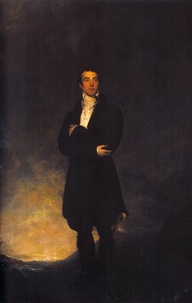
This full length portrait hangs on the landing at the top of the stairs.

I stopped to admire it. “I don’t have this one.”

 
If looks could kill . . . . . . I deviated from the prescribed tour at this point and dragged Hubby through a back hallway, called the Slip Passage, and into the State Dining Room.
 
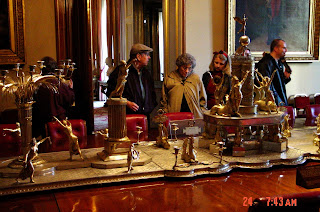
“This is where Wellington held the Waterloo Banquet every year on the anniversary of the battle. Wellington would invite all the officers who’d fought with him, and George IV, who only thought he’d fought with him. And that silver centerpiece was given to Wellington by the Portuguese to commemorate Wellington’s victories in the Peninsular Wars. It’s the one I touched and set off the alarms.”
 
“What?”

“Yeah. I was here by myself and I was looking at the centerpiece and it appeared to be covered in a layer of dust. I couldn’t believe they’d allow it to get into that condition. I was a bit insulted, to tell you the truth.”
 
“Of course you were.”
 
“So all I did was swipe a fingertip across it to see if it really was dusty and the alarm went off.”
 
“A real alarm?”
 
“Yes. A real alarm. Whaaa! Whaaa! Whaaa! The whole bit.”
 

‘What did you do?”
 
“What could I do? I was pretty well trapped. I went around the table and stood in front of the portrait of Prinny in a kilt as though I were admiring it. Then a guy in a suit came in and gave me a stare and I turned around and gave him a stare back and then he left and pretty soon the alarm stopped.”
 
“He didn’t say anything to you?”
 
“Not a word. I found out that the centerpiece had soon after been removed for a thorough refurbishment, but still, they shouldn’t have left it covered in dust.”
 
“My good man.”

We moved on to the next room, the Striped Drawing Room.


“Wellington used this room as a place where his guests could relax either before or after dinner. There used to be card and game tables set up here from time to time. The portraits are all of people who served with him. Look, here’s Henry Paget.”


“Who?”
 
“Henry Paget, the Marquess of Angelsey, Lord Uxbridge. The guy who ran away with Artie’s sister-in-law. The one who’s artificial leg we saw at Horse Guards.”
 
“Ah, him again.”
 
We sat on the striped couch in the middle of the room and I began to key numbers into my audio guide.
 
“Hey, Hon.”
 
“Hhhhmmmm?”
 
Hon!”
 
“What?”
 
“Artie,” Hubby said, pointing to the portrait hanging on the wall before us. “I know that guy.”
 
“You should. You walk by him ten times a day. The painting is by Sir Thomas Lawrence.”
 
“What number is it?” Hubby punched the numbers in and listened to his audio guide. He actually looked interested.


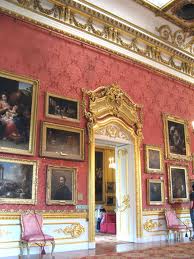
After a time, we moved on to the Waterloo Gallery, which houses the Spanish Royal Collection of artwork.
 
“Most of these paintings were found rolled up in Joseph Bonaparte’s baggage carriage after the Battle of Vitoria in 1813,” I told Hubby. “Wellington had them framed and hung them here. Then, one day a visitor to this room was looking at the pictures and realized that they were all from the Spanish Royal Collection, which Bonaparte had looted and taken as the spoils of war.”
 
“So it was stolen art?”
 
“Yes.”
 
“What did Artie do?”
 
“He wrote to King Ferdinand of Spain, told him how he’d come by the paintings and told the King that of course he’d return them post haste. He asked the King to give him directions on how he was to best return them. Did the King want to send someone over to get them? Should he, Wellington, arrange for their return as he thought fit? The King wrote back and told Artie to keep the paintings with his thanks for all he’d done for Spain and the free world. Or words to that effect.”
 
“Hhhmmm.”
 
“See these two torcheres?”
 
“The two what?”
 
“The pillars with the candelabras on the top.”
 
“Yeah?”
 
“Tsar Nicholas gave them to Wellington.”
 

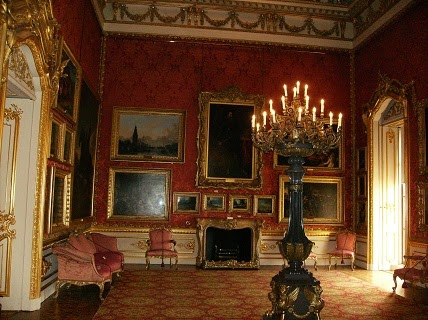
“Originally, this room was hung in yellow damask. Wellington’s good friend, Mrs. Arbuthnot, helped him with Wyatt’s redesign of the house and she and Artie argued over these walls a good deal, but in the end Wellington won.”
 
“Well, yeah. It was his house. Why aren’t they yellow now?”
 
“Wellington’s son, the second Duke, had them changed.”
 
“Because of Mrs. Arbuthnot?”
 
“No. She’d died in 1834. He didn’t become the Duke until 1852. Times had changed, tastes had changed, that’s all. Wellington designed a heating system that’s hidden in the ceiling,” I said, prompting us both to look up.
 
“And see those windows? Wellington designed them so that mirrors hidden in recesses in the wall could be pulled over them at night. When he gave evening entertainments, the mirrors reflected the candlelight throughout the room.”
 
“Hunh.”
 
I walked over to one of the windows and peered out at Hyde Park. “I was here once with Brooke and we were looking out this window when we saw a whole regiment of soldiers out there doing drills in their dress uniforms. After we’d left the house, we went around into the Park and Brooke asked one of the soldiers what they were doing. Without missing a beat, he told her, ‘We’re male strippers and we’re practicing our routine.'”
 
“Come on.”
 
“I swear. You should have seen her face. Then he told her what they were really doing, which was practicing for some official do that was to take place in a few days time.”
 
“Only you could have such crazy stories about Apsley House.”
 
I waved a hand at him. “That’s nothing. The last time I was here with Victoria we watched as hundreds of naked bike riders rode past.”
 
“Get out.”
 
“Fact. It was the annual Naked Bike Run, or some such thing.”
 
“Naked?”
 
“As the day they were born.”
 
“Men or women?”
 
“Both.”
 
“Bicycles or motorcycles?”
 
“Bicycles.”
 
“Ouch.”
 
“See? I told you that Apsley House was fun and you wouldn’t believe me.”


 We went out this door and into the Yellow Drawing Room.
 
“That’s an original Adam’s fireplace,” I said.
 
“Who’s Adams?”
 
“Never mind.”
 
We moved on to the Portico Drawing Room

“See this painting here? It’s Charles Arbuthnot.”

“Husband to the interfering Mrs. Arbuthnot?”
“Harriet, yes. After she died, he lived with Wellington, both here and at Walmer Castle. They were both widowers, as well as great friends, so the arrangement worked for both of them. Arbuthnot died in this house. So did Kitty, Wellington’s wife, come to think of it.”
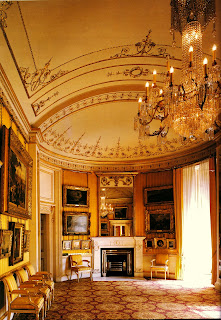
We went through to the Piccadilly Drawing Room, probably so called because the windows look out over Constitution Hill and Piccadilly.
“This is my favorite room in the house. I love the proportions of it. The Adams ceiling and how it mirrors the curve of the end wall. The moulding detail. The picture rails. And the view. I always stand at this window to admire the view,” I said, looking out at Wellington’s statue and the Arch beyond. I stood this way for several minutes and then decided that I’d tried Hubby’s patience long enough.
 
“Come on. Let’s go down to the basement.”
 
“The basement? We’re not going to set of any alarms, are we?”
 
No, it’s part of the museum. The most personal part.”
 
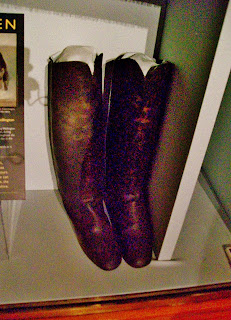
Once we’d gotten downstairs, I showed Hubby the displays that include Copenhagen’s saddle blanket, Wellington’s medals, his traveling cases and, naturally, a pair of his boots.
 
Finally, we approached a display case dealing with Wellington’s death and State funeral.
 
“Look,” I said, pointing at a shelf in the case. 
 
“Who’s that?”
 
“Wellington. It’s a death mask. It was taken soon after he died.”
 
“It doesn’t look like Wellington.”
 
“Sure it does. Wellington was in his eighties when he died. The Thomas Lawrence portrait was far in the past by that time.”


“You ready to go?” I asked at long last.
 
“Yeah. What’s next?”
&n
bsp;
“Our three hour rock and roll tour. Three whole hours without mention of the Duke of Wellington.”
 
“I gotta admit, Hon, Apsley House wasn’t as bad as I thought it was going to be. It was pretty interesting.”
 
With Herculean effort, I refrained from saying told you so.
 
 You can take a short video tour of Apsley House here.
 
Part Three Coming Soon!

The Secrets of Bloxley Bottom, Episode 7: Misses and Near Misses

 
Prudence Newton glanced up from her prayer-book as Mrs. Aurelia Gammersgill bustled down the aisle to her usual place in the third pew.  Prudence stifled a grin. With those frills and trimmings on her bonnet, Mrs. Gammersgill looked more than usual like a placid sheep ready for shearing.  In contrast, Mrs. Millicent Oldstead-Parker, who followed close upon her heels, cast a foxy and appraising look upon the congregation as she went, her sharp eyes missing nothing.
The two ladies were no sooner settled than Mr. Neville Newton stood at the pulpit and began to speak. Prudence bowed her head in a show of piety, though the assembled congregation would have been surprised if they could have read her thoughts. She sat beside her mother in the rearmost pew of All Saints church as her father’s voice droned on. She was careful not to let her chin droop to her chest, as many parishoners were liable to do.  
At age seventeen, Prudence Newton was at present dissatisfied with her life and most especially dissatisfied with her parents expectations for her. As their only child, they expected a great deal of Prudence. Most annoyingly, they took for granted that she would marry a clergyman and post haste provide them with many grandchildren for the pair of them to dote upon.  
As much as she loved her parents, Prudence knew that she was bound to disappoint them in this regard, for Prudence had ambitions for herself beyond the boundaries of Bloxley Bottom. She did not want to be a clergyman’s wife like her mother, subject to the constant scrutiny of the parishioners. Was her sponge cake as good as Mrs. Noseywood’s? Did she sing off-key in the chorale? Did her share of the altar cloth embroidery seem a little crooked? Surely there was more to life than that.
 
For the time being, Prudence carried out her household duties without complaint. She tended her hens and gathered their eggs carefully. Making her delivery rounds through the village was at present her only escape from her mother’s phantom illnesses and the vague symptoms that necessitated Prudence’s attention throughout each day.   
 
Lady Louisa had played a large part in allowing Prudence to hope for more. For several years now, the dowager baroness insisted upon Prudence’s weekly visits to the dower house, where Lady Louisa and Miss Anne tutored Prudence in social niceties and graces. They groomed her for a life beyond the confines of a rectory and Prudence was an eager pupil.
Prudence glanced now at the Bloxley sisters, Lady Louisa’s own granddaughters, sitting up there in the very front pew, looking as pampered and petted as a pair of spoiled lap dogs.  Daphne and Valeria hadn’t a care in the world. Their family would make certain that they married well.
How it rankled when Daphne offered to give Prudence that little-worn rose-tinted silk dress with the delicate lace trim.  Prudence blushed to recall her eager acceptance of the gift and how she admired the gown.  But she had never worn it, for she had never received an invitation to the sort of engagement that would merit its elegance.   
How could life be so unfair?


            ››

Later that afternoon, the Bloxley sisters sat in Daphne’s bedchamber.
“What is one supposed to do while posing for a portrait? Must you sit very still?” The Honourable Daphne Bloxley wrinkled her nose and grimaced into the mirror above her dressing table. “I am not very pleased with Papa for arranging this caper.”
“Why ever not? I want to be painted. To be immortalized,” her younger sister Valeria declared dramatically. “Someday when I am old like Grandmama, I will be happy to remember how pretty I once was. Grandmama loves to stand in front of her portrait in the dining room.”
 “Perhaps she is thinking about the days when she was young,” said Daphne.
 “She also believes that she is still a great beauty. I think she is really quite vain.”
 
“Of course she is! She says even though Mama is also very pretty in her own way, we are fortunate to have inherited our looks from her side of the family.”
 “She didn’t say that! I do not believe it,” Valeria protested.
“She did. She told Mama directly. And Mama told me.” Daphne took up a brush and swept it through her long hair.
“Oh, what did she say?”
 “I shouldn’t tell you.”
“Yes, you must. I have to know. Please, Daff.
 
“I am not sure I should.”
“Do tell. Please, Daff.  You cannot tell me part and not all of it.”
 Daphne turned away from the mirror to face her sister. “Mama says that Grandmama married Grandpapa against the wishes of her father, the Earl of Grassington. He thought she should marry at least a man of his own status, and not a mere baron.”
 “But wasn’t Grandpapa very rich?”
“I think so, but her father thought she should catch herself a duke.”
 “Oh, that would be very easy, I suppose. All those young unmarried dukes crowding up the streets…”
“Well, there were probably some. Even today, there’s Devonshire. He never has married, you know.”
“So set your cap at him next year, Daff.”
 “Ha! He’s far too old for me.”
 “I don’t think so. Not really. Is that all she said?”
“No. She told Mama that Papa could have married a wealthier heiress than Mama. But that she, Grandmama I mean, was happy that Papa had married for love, because that is what she had done. She loved Lord Bloxley and she married him despite her own father’s objections to the match.”
 
Valeria covered her open mouth with her hand. “Oh, Daphne, how long have you known about this? Why didn’t you tell me right away? It is so very romantic. “
 
“It was all well and good for Grandmama and Papa to each marry for love. It didn’t require their sacrificing anything in order to do so, after all.”
 
“I want to marry for love, Daff. Don’t you?”
 
Daphne turned back to the mirror and picked up her hair brush. “Well, I wouldn’t marry for love alone. Not if it meant that I had to change my present circumstances. Or reduce my dress allowance.”
 
“Daphne! You’re a fiend.”
 
“No. Simply practical, sister dear. Something you should learn to be, else you’ll find yourself married to the first handsome face you see and living on love and air alone.”
 
“I shan’t,” Valeria sighed as she lay across her sister’s bed. “I shall be deliriously happy with my handsome husband and our fifteen children. And you will be their spinster aunt living on crumbs in our attic, all because you scoffed at love and held out for a wealthy suitor who never materialized.”
 
“In your attic?” Daphne laid down her brush, rose from the stool and came across to the bed.
 
“Hhmmm. That’s where bitter people live. In attics. And your hair will have turned grey with unhappiness and you’ll be all bent over and you’ll spend your days counting your guineas like a miser.”
 
“If I have guineas to count then I shan’t be very poor, shall I?” Daphne sat beside her sister on the bed. “If I had guineas to count, I wouldn’t be living in your attic.”
 
“I’ll lock you in the attic. So that you can’t contaminate my children with your bitterness. My handsome husband will hide the key so that you can never escape.”
 
Daphne arched a brow at her sister. “Will he?”
 
Valeria nodded. “Oh, yes, he will. And he’ll . . . . . no, Daff, no!”
 
“Yes, Val, yes! Tickling is what we bitter old crones do best. Right in the armpits!”


Federal Furniture

Recently, I met writer pals Diane Gaston and Julie Halperson at the National Gallery of Art in Washington D.C. We had a lot of catching up to do, but we also managed to view some outstanding art. We saw the exhibition “Pre-Raphaelites: Victorian Art and Design,” which was organized by the NGA and the Tate Britain. It is showing until May, 2013, so if you have a chance to get to Washington, don’t miss it — a blog piece is coming soon..

Picture

We also enjoyed browsing the collection of American furniture from the early nineteenth century. The exhibit “Masterpieces of American Furniture from the Kaufman Collection 1700-1830” has been on view since last autumn. Shown in my picture is a Grecian couch, attributed to John Finlay (1777-1851) and Hugh Finlay (1781-1831), created in Baltimore 1810-1830, of walnut and cherry paint and gold leaf. Above it hangs a set of botanical prints and a Girandole mirror, New York 1810-1825, white pine, wire, gesso and gold leaf, glass.
The Federal Period in American history corresponds roughly to the extended regency, from about 1789 when the Constitution was adopted to 1828 or so, when Andrew Jackson was elected as the seventh president — the first who was not associated with the Revolution and a founding father, though in John Quincy Adam’s case, he was the son of a founding father.


Picture

The Gaming table is possibly by Thomas Seymour (1771-1848), Boston, 1815-1820, mahogany and mahogany veneers, various marbles, ormolu (gilded brass), leather and baize (woven cloth). Early America had some superb craftsman who turned out furniture that rivaled the best from England and the continent. 

Linda H. Kaufman and her late husband, George M., collected American furniture and paintings for  many years, promising the collection to the National Gallery as their first permanent display of federal period furniture.


Picture

The Center Table has a frame made by Anthony Querville (1789-1856) a former Frenchman, in Philadelphia 1827-1830. The frame is made of mahogany and mahogany veneers, brass and gold leaf with a top imported from Italy made of various marbles and semi-precious stones.

Picture

The sideboard was made and labeled by William Mills and Simeon Deming (active 1793-1798), New York; mahogany with mahogany, satinwood, and curly maple veneers and light wood inlays; brass. This sideboard was once owned by Oliver Woolcott jr. (1760-1835), Comptroller and Secretary of the Treasury under George Washington. The looking glass was made in New York 1790-1815 of white pine, iron wire, gesso and gold leaf, glass and paint. The platter is from China, 1800-1820, of hard paste porcelain. A pair of decanters was made in Bristol, England, 1800-1810, of blue glass with gilt. The pair of wine coolers is Chinese, 1720-1740, of hard paste porcelain. The two knife boxes are American, 1785-1895, of mahogany and mahogany veneers with wood inlay and silver. The side chairs are from New York, 1775-1899, of mahogany.


America furniture styles in this period corresponded with British and continental publications such as Thomas Chippendale’s Gentleman and Cabinet-Makers Director (London, 1754)  and/or traveling experts, artists, and craftsmen.

The dining table below is attributed to John Townsend, of Newport, RI; It is a three-part table, 1795-1899, mahogany and light wood inlay, 71×436 inches.


Picture

For more information and more details, click here

Many thanks to the generosity of the Kaufmans!!