ONCE AGAIN WEDNESDAY – Mr. Phillip's' Auction Offices – Part One

Mention of venerable London auction houses invariably brings to mind Christie’s, in King Street. But there was another auction firm who held some of the most anticipated, and most unique, auctions in the City. The London firm of auctioneers known as Phillips and Son of 73, New Bond Street, was founded by Harry Phillips in 1796. Phillips died in October of 1839 at his house at Worthing, age 73, and was succeeded by his son, who, with his son, son-in-law, and Mr. Frederick Neale, carried on the business of fine art and general auctioneers. Amongst some of the more important art sales by this firm were: The Beckford Collection at Fonthill Abbey, Sir Simon Clarke’s engravings; a thirty-days’ sale of engravings from Paris; the Duke of Buckingham’s engravings, in 1830; Duke of Lucca’s Collection, in 1841; the Count de Morny’s Collection, in 1848; Lady Blessington’s property, in 1849; Lord Northwick’s pictures, in 1859; the Marquis of Hastings’ pictures, books, and engravings, in 1869; Sir Charles Rushout’s pictures and engravings in 1880, including a small collection of about one hundred examples by Bartolozzi (many duplicates) in a folio, which sold for 225 guineas. Another lot in the same sale, containing ninety-eight prints by Bartolozzi and school, sold for 174 guineas.

A book titled Art Sales of 1891 sheds some light on what the going rates for auction houses of that day were – The commissions charged are 7 per cent, on pictures, plate, jewels, porcelain, wine and effects, sculpture, and modern drawings, and 12 per cent, on engravings, books, manuscripts, sketches, coins, medals, antique gems, and old drawings, 5 per cent, being charged on unsold or bought-in lots under £100, and 2 percent, exceeding that sum. For furniture at private houses or in the country the charge is 10 per cent. There is no charge for making valuations for probate if the property is subsequently sold by auction. To secure a day at Messrs. Christie’s, application must be made some months beforehand, and Saturdays in the season are allotted only to exceptionally fine collections.

Still, many of those who had their property sold by auction were in no position to balk at the terms, as they were either badly in hock to creditors or deceased, as evidenced by the following piece which ran in The Gentleman’s Magazine 1805 – Mr. Phillip Auction-room, New Bond-street, was crowded with nobility and persons of distinction. After the sale of several choice lots of china, statues, and Mr. Phillips stated the conditions of sale of the elegant house and furniture, in Hill-street, Berkeley-square, belonging to Mr. Robert Heathcote. The auctioneer referred to the printed particulars, which were in the hands of the company, for the minute description of this elegant mansion, held under a lease from Earl Berkeley, for an unexpired term of 30 years, at a ground rent of 11 l. 7 s. 6d.; and, he stated, that the cost to Mr. Heathcote had been as follows: For the lease, £6000. to Mr. Cundy, the architect, whose taste and judgment had been so conspicuously displayed in the new arrangement and fitting-up of the house, and particularly in the erection of the new and superb library . . . After stating, that every article in Mr. Heathcote’s house at present, except plate, jewels, linen, books, pictures, wines, china, glass-ware, and apparel, would go to the purchaser, the biddings commenced with 1, 000 guineas, on which several advances we’re made from different parts of the room, till they got up to £10,000, when the contest lay entirely between two gentlemen, who were rather tardy in their advances of 50 and 100 guineas at a time, till at length it was knocked down to P. Phillips, esq.

Another entry reads –

Furniture Of Napoleon—On Wednesday a sale by auction of the property of the late Sir Hudson Lowe, including some portion of the furniture which was in the possession of the Emperor Napoleon at St. Helena, took place at the auction rooms of Mr. Phillips, by order of the executors of Sir Hudson Lowe. These consisted of about twenty lots, and among them were a large mahogany frame indulging chair, banded with ebony, on castors, from the Emperor’s study, 15/. 5s.; a small circular mahogany pillar and claw table, on which Napoleon burnt pastiles, 61. 6s.; a six-foot pedestal library table, formed of mahogany and yew tree, on which table he almost always wrote, 18. 18s.; an ebonied arm chair, with cane seat and back, formed of common materials (there was a hole in the cane seat which had been caused by being constantly used, and it was stated by some brokers in the room not to be worth 1s. 6.) From the chair being light it was carried about by the Emperor when he took his walks M Longwood. It was bought for £6.

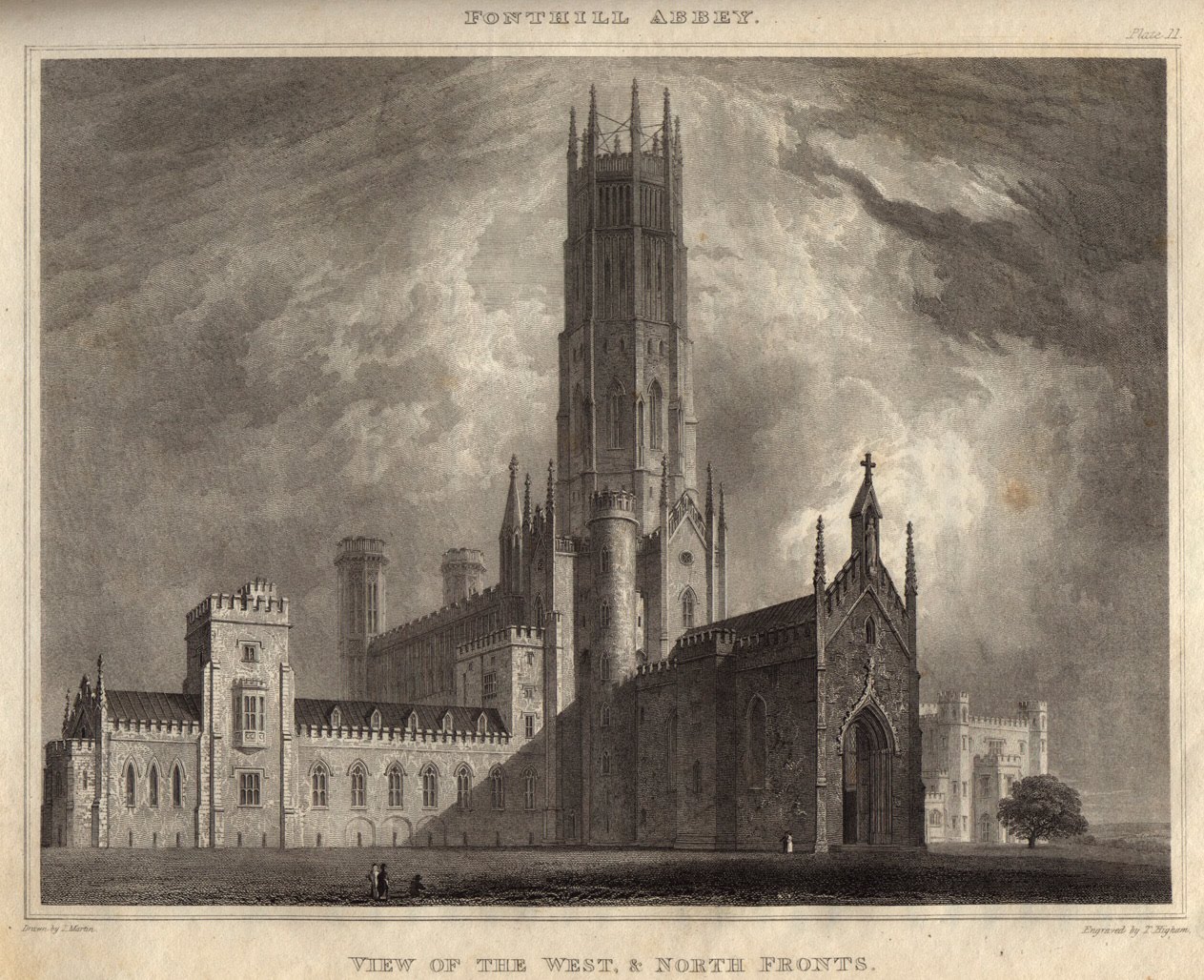
One sale that was the destined to be the auction of the year, if not the decade, was that of Fonthill Abbey, owned by William Beckford, the author of Vathek. Beckford had commissioned architect James Wyatt to design the Abbey and very few people were invited inside whilst Beckford resided there. For a complete look at both Beckford and the auction we turn to The Mirror of Literature, Amusement, and Instruction –

THE LATE WILLIAM BECKFORD. From the newspapers we learn that the author of “Vathek” is no more. He died last week at Bath, where he had erected a singular edifice, in some respects a miniature of his former abode, the far-famed Fonthill Abbey.

Beckford squandered his money in the most reckless manner, and at his bidding Fonthill arose, one of the wonders of the world. He bought Gibbon’s library, and left it locked up at Lausanne, and the reason he gave for the purchase was that he might have some books to read when he happened to visit that town. It was not the splendour of Fonthill Abbey —though that was great—nor the value of its contents—though on these immense sums had been expended—that fixed public attention on Fonthill Abbey, so much as the habits of the proprietor, exaggerated, and, in all probability, misrepresented, by report. He was said to see no company, to allow no approach— but to live in almost regal state. Though he had servants fitting his opulence, his favourite was understood to be a dwarf, called Pero. Mr. Beckford was described to be violent. He would speak harshly, or more than speak, to a
servant or a villager that came in his way, but, soon relenting, it was his care nobly to recompense the party he had outraged. It was shrewdly suspected that some of those who experienced the throb of his impetuous anger had artfully put themselves in the way of it, for the sake of the healing donation which was likely to follow.

He certainly lived in seclusion for a number of years, and objected to the abbey being shown to the curious. It was even said, George IV, when Prince of Wales, had intimated a wish to visit it, which had been met by something like a refusal. Be this as it may, it got wind among the public that the residence of Mr. Beckford was “a sealed book;” and when, in 1822, the news burst on the town that the abbey and all its contents were about to be on public view, preparatory to a sale by auction, every one was anxious to see the Palace of Wonders. It was likened to throwing open the blue-room of Bluebeard.
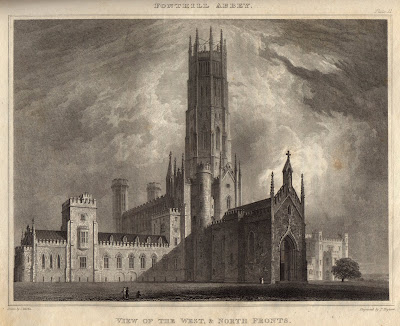
It is not surprising that so eccentric a man excited the popular wonder, and that when in consequence of the depreciation of his West India property he decided to sell Fonthill via an auction conducted by Mssrs. Christie, the public excitement was intense: Fonthill, which had been talked about by the whole nation but only seen by a very few. This was in 1822. Seven thousand two hundred catalogues were sold at a guinea each to those who wished to see the place. However, it was not disposed of by Mr. Christie at public auction, but sold en masse to Mr. John Farquhar for £330,000. Beckford reserved, however, some of his choicest books, pictures, and curiosities.

The whole property had been bought by the late Mr. H. Phillips for a Mr. Farquhar, a Scotsman, of very penurious habits, who had mode a vast fortune in India, but who continued to dress and to live in the meanest style. He bought this palace and park, not because, like old Scrooge, a dream had induced him to rush from grinding parsimony to openhearted benevolence, but because it appeared a good opportunity for increasing his store, aided by the experience and talent of the Bond-street auctioneer. It is true he took up his abode in it for a time, but he bought it not to inhabit, but to sell, and accordingly it was announced in the following year that the whole, as the phrase is, was to be brought to the hammer. The ensuing sale occupied thirty-seven days.

Mr. Beckford’s library was very extensive, yet, among the countless ranges of books which he possessed, he had so extraordinary a memory, that he could at once indicate the shelf, and the part of the shelf, on which any particular volume might he found. This was proved, to the utter amazement of the new proprietor of Fonthill. In many of the works, notes had been made, in the handwriting of Mr. Beckford: the books which contained them were intended to be withdrawn, but, by accident, some escaped discovery; they were discovered by the prying gentlemen of the press, and the memoranda found in several of the books appeared in the newspapers. They were eagerly sought after at the sale, though frequently they presented but quotations from the books: occasionally, however, they expressed opinions, and some of them were of a most singular nature. High prices were given for these, and some, it was understood, were purchased for Mr. Beckford at twenty times the price which the holder had given for them at the sale. His thoughts were often expressed with great force. In one instance, speaking of human nature, he powerfully marked his sense of the humanising power of letters. He pointed to the mind of man as wretched in its native state — as ” blood-raw, till cooked by education.”

With the money he received from Mr. Farquhar, Beckford purchased annuities and land near Bath. He united two houses in the Royal Crescent by a flying gallery extending over the road, and his dwelling became one vast library. In 1810 Beckford’s second daughter, Susanna Euphemia, married Alexander, Marquis of Douglas, who succeeded his father as 10th Duke of Hamilton, and to her he left all his property. Beckford died at Bath on May 2, 1844, aged 84. Most of Fonthill Abbey collapsed under the weight of its poorly-built tower the night of 21 December 1825.

This link will bring you to the catalogue for the Fonthill Abbey Library of 20,000 books

Also in 1822, on 9 February, Phillips auctioned the contents of Bradenburgh House upon the death of the Queen. Phillips’s royal connections continued, as evidenced by this piece from the Annual Register of  1831 – Sale Of His Late Majesty’s Coronation Robes.— A portion of his late Majesty’s costly and splendid wardrobe destined for public sale, including the magnificent coronation robes and other costumes, was sold by auction, by Mr. Phillips, at his rooms in New Bond Street. There were 120 lots disposed of, out of which we subjoin the principal in the order in which they were put up :— No. 13. An elegant yellow and silver sash of the Royal Hanoverian Guelphie Order, 3/. 8.— 17. A pair of fine kid-trousers, of ample dimensions, and lined with white satin, was sold for 12.v.— 35. The coronation ruff, formed of superb Mechlin-lace, 2/.—50. The costly Highland costume worn by our late Sovereign at Dalkeith Palace, the seat of his Grace the Duke of Buccleugh, in the summer of 1822, was knocked down at 40/.— 52. The sumptuous crimson-velvet coronation mantle, with silver star, embroidered with gold, on appropriate devices, and which cost originally, accordiug to the statement of the auctioneer, upwards of 500/., was knocked down at 47 guineas.—53. A crimson coat to suit with the above, 14/. – 55. A magnificent gold body-dress and trousers, 26 guineas.—67- An extraordinary large white aigrette plume, brought from Paris by the Earl of Fife, in April, 1815, and presented by his lordship to the late King, was sold for 15/.—87. A richly embroidered silver tissue coronation waistcoat and trunk hose, 13/.—95. The splendid purple velvet coronation mantle, sumptuously embroidered with gold, of which it was said to contain 200 ounces. It was knocked down at 55/., although it was stated to have cost his late Majesty 300/.—96. An elegant and costly green velvet mantle, lined with ermine of the finest quality; presented by the Emp
eror Alexander to his late Majesty, which cost upwards of 1,000 guineas, was knocked down at 125/.

Part Two, featuring the Blessington/D’Orsay Auction, coming soon . . . . .

Originally published August 2010

ON THE SHELF: IN TEARING HASTE

You would think that after having read the massive The Mitfords: Letters Between Six Sisters I’d have gotten my fill of all things Mitford, but not so. In fact, the book only fueled my passion for the Sisters, so I went directly afterwards to reading In Tearing Haste: Letters Between Deborah Devonshire and Patrick Leigh Fermor. Here’s a brief synopsis:
From Amazon BooksIn the spring of 1956, Deborah, Duchess of Devonshire, youngest of the six legendary Mitford sisters, invited the writer and war hero Patrick Leigh Fermor to visit Lismore Castle, the Devonshires’ house in Ireland. The halcyon visit sparked a deep friendship and a lifelong exchange of highly entertaining correspondence. When something caught their interest and they knew the other would be amused, they sent off a letter—there are glimpses of President Kennedy’s inauguration, weekends at Sandringham, filming with Errol Flynn, the wedding of Prince Charles and Camilla Parker-Bowles, and, above all, life at Chatsworth, the great house that Debo spent much of her life restoring, and of Paddy in the house that he and his wife designed and built on the southernmost peninsula of Greece.

Deborah (Mitford), Duchess of Devonshire

Of course, this description does nothing to impart the flavour of the letters themselves, or their authors. Here are a few extracts:

Deborah to Paddy – 14 July 1975

“Darling (Paddy) Whack,
   No news, except bumpkin stuff. The Council of the Royal Smithfield Club – top farmers and butchers from all over the British Isles, every accent from Devon to Aberdeen via Wales & Norfolk – met here on Thurs. Fifty of them. So the only room I could think of was the nursery, and there they sat good as gold on hard chairs. I offered the rocking horse, but they eschewed it, ditto high chairs and Snakes and Ladders.
   I really love those men, and it’s my last year as president. I shall miss it and them.
   Then they had lunch, then the wives were let in (so typical of England that they had to hang about till lunch was over) and of course they wanted to see the house. I said ‘I’ll meet you at the end of the tour.’ The first butcher was out in six minutes. I reminded him of Art Buchwald’s lovely article on How to do the Louvre in Six Minutes – but he’d never heard of Art Buchwald or the Louvre so I chucked it and took him to see some cattle, which he had heard of. A really good fellow.”

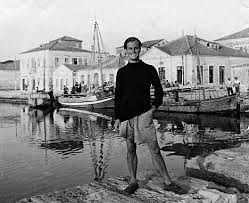
Patrick Leigh Fermor

   While Deborah’s heart was always in her home and with her country pursuits, she often had to leave Chastsworth in order to attend to her duties as the Duchess of Devonshire, many of which brought her into contact with Royals and other members of the nobility:

Deborah to Paddy – 18 January 1980

“Darling Paddy –
   . . . . . . Last night I went to AN OPERA. The second in my life. It was a plan of Andrew’s (Duke of Devonshire) in aid of the Putney Hosp for Incurables and good Cake (the Queen Mother) came and turned it into a gala. One forgets between seeing her what a star she is and what incredible and wicked charm she has got. The Swiss conductor panicked and struck up `God Save The Queen’ when she was still walking round the back to get to her box and I heard her say Oh God and she flew the last few steps dropping her old white fox cape and didn’t turn round to see what would happen to it.
   She does a wonderful sort of super shooting-lunch dinner, brought from Clarence House and handed round by her beautiful footmen in royal kit, between the acts, the cheeriest thing. We were a bit stumped though because when she’d gone home we had to go to the Savoy and have a second grand dinner with the organisers. It was a bit of a test forcing down sole after Cake’s richest choc mousse. It’s tough at the top, I can tell you . . . .”

Paddy to Deborah – 23 October 1995

“Darling Debo –
   . . . . . Ages ago, I went to a party given by Brig. West. Everyone was tightish. Daph(ne Fielding), still Bath, was curled up in a ball next to a chair where Duff C(ooper) was sitting, covered in medals and decorations. Daph was wearing a tiara, as they’d all been to a Court ball. Daph was so rapt in talk and laughter that she didn’t even notice or pause when Henry (Bath), on the point of buzzing off with Virginia, said, `I think I’d better take that,’ neatly uncoiled the bauble from Daph’s hair, and slipped it into the pocket in the tail of his tail coat, and walked away. Daph was amazed a bit later by its absence, until we reassured her. I thought for a moment that it might have been later on the same night when I came and collected you from a ball at the Savoy and took you on to another in Chelsea – whose? – a lovely evening.
   No more for the moment.
   Lots of love – Paddy
   Was the ball at the Savoy given by someone called Christie-Miller? A yearly event? One year, they say, David Cecil was hastening to it along the Strand, when a tart stopped him and said, `Woud you like to come home with me, dear?’ and he answered, ‘I can’t possibly. I’m going to the Christie-Millers.'”

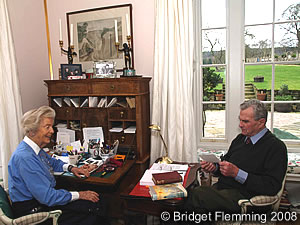
Deborah and Patrick 

Who knew that the tails of tail coats had pockets? More importantly, these breezy, entertaining and endearing letters serve to lend an insight
into the lives and hearts of their authors. Whether it’s Deborah’s slightly wicked sense of humour or Paddy’s love of and descriptions of travel, there is something for everyone here. A must read for fans of all things Mitford.

ONCE AGAIN WEDNESDAY: The Witty Lord Alvanley

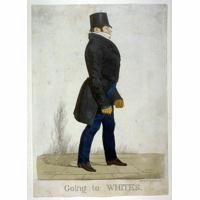
There were so many un-witty imitators of dandyism in the days of the Prince Regent that the appearance of Lord Alvanley with his delicate manner and exquisite style always caused a quiet sensation. To Lord Alvanley was awarded the reputation of being able to say as smart a thing as even Richard Brinsley Sheridan could rap out, whose repartee on all occasions was equal to any need. Captain Gronow alleges that Lord Alvanley had the talk of the day completely under his control, and was the arbiter of the school for scandal in all the St. James’s district. A bon mot attributed to him gave rise to the belief that Solomon caused the downfall and disappearance of Beau Brummell; for on some friends of the prince of dandies observing that if he had remained in London something might have been done for him by his old associates, Alvanley replied, “he has done quite right to be off; it was Solomon’s judgment.” The real point of this remark is that one of Brummell’s chief creditors was a gentleman of the Jewish persuasion whose name by chance happened to be Solomon.

The success of Lord Alvanley’s casual observations, which were evidently delivered as though he were not conscious of what the effect would be, was due to their cynical aptitude. For example, Sir Lumley Skeffington, who had been a considerable lion in his day and whose spectacle “The Sleeping Beauty” attracted much attention when it was produced at the Theatre Royal, Covent Garden, excited Alvanley’s wit. Sir Lumley, after having met with many misadventures and a “seclusion in the Bench,” hoped that by gay attire and a general jauntiness he would be able to get back into fashionable life once more. But his old friends were not very kindly disposed towards him once his stint in debtor’s prison had been completed. Observing this, Alvanley, being asked on one occasion who that smart looking individual was, answered, “it is a second edition of the ‘Sleeping Beauty,’ bound in calf; richly gilt and illustrated by many cuts.”

Alvanley used to say that Brummell was the only dandelion that flourished year after year in the hot-bed of the fashionable world: he had taken root. Lions were generally annual, but Brummell was perennial, and he quoted a letter from Walter Scott : ” If you are celebrated for writing verses, or for slicing cucumbers, for being two feet taller, or two feet less, than any other biped, for acting plays when you should be whipped at school, or for attending schools and institutions when you should be preparing for your grave, your notoriety becomes a talisman, an “open sesame,” which gives way to everything till you are voted a bore, and discarded for a new plaything.”

Lord Alvanley had one very great advantage over all the wits of the Regency. He had travelled in France and Russia and had the command of languages. He was equally at home in French society and Russian as he was at the Court of the King of England. We have it on record that he was one of the best examples of a man who combined a genial wit with the utmost good-nature. The slight lisp became irresistible and added zest to his piquant sayings. He was what we should term in these days a jolly man, because as he grew old he also grew rotund. And he excelled in all manly exercises, was an ardent rider to hounds, and was plucky to the core. He has been described as having the happy face of one of the happy friars, whose portraits are always a joy to look upon. He had, of course, his peculiarities, and one of them was that he would have an apricot tart on the sideboard the whole year round, no matter if apricots were not in season, and he always invited eight people to dinner, when, as can be understood, they feasted of the best. Yet this good-humoured epicure was once in a risky affair.

It happened that Lord Alvanley made some strong allusions to O’Connell in the House of Lords, which resulted in a duel on Wimbledon Common. Morgan O’Connell said he would take his father’s place, and did so. Alvanley’s second was Colonel George Dawson Damer, while Colonel Hodges acted for Morgan O’Connell. It appears that several shots were fired without effect, and the seconds then interfered and put a stop to any further hostilities. On their way home in a hackney coach, Alvanley said, “What a clumsy fellow O’Connell must be, to miss such a fat fellow as I am. He ought to practise at a haystack to get his hand in.” When the carriage drove up to Alvanley’s door, he gave the coachman a sovereign. The man was profuse in his thanks, and said: “It’s a great deal for only having taken your lordship to Wimbledon.” “No, my good man,” said Alvanley, ” I give it to you, not for taking me, but for bringing me back.”

One of the greatest charms of Alvanley’s manner was its easy naturalness. He was an excellent classical scholar, a good speaker, and whatever he undertook to do he succeeded in. He preserved his wit and good-humour to the last; notwithstanding the gout, from which he suffered. He died “quite agreeably,” as he said to friends at his bedside, in 1849.

Originally published April 2010

A TALE OF TWO PALACES BY GUEST BLOGGER AMANDA MCCABE


One of the best perks of writing historical mysteries is the research!  I am a library junkie, and love spending time digging through dusty old books in search of just the right historical detail.  (Of course, this also means sometimes it’s hard for me to stop researching and actually, y’know, use the research in writing!).  Travel is also a fun way to immerse myself in a period, to imagine how my characters might have actually lived in Elizabethan times.  Murder at Fontainebleau uses a sense of place even more than other stories I’ve written.  We glimpse two palaces in the story, one the is long demolished and one that still exists to be toured, and they were a perfect example of the differences between English and French life in the 16th century, which Kate Haywood discovers for herself when she’s sent to Fontainebleau on a mission for Queen Elizabeth….

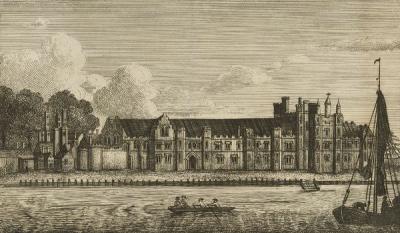
The English palace, Greenwich (above), was originally built in 1433 by Humphrey, Duke of Gloucester, a brother of Henry V. It was a convenient spot for a castle, 5 miles from London and Thames-side, and was popular with subsequent rulers, especially Henry VIII. His father, Henry VII, remodeled the place extensively between 1498-1504 (after dispatching the previous occupant, Dowager Queen Elizabeth, to a convent). The new design was after the trendy “Burgundian” model, with the facade refaced in red Burgundian brick. Though the royal apartments were still in the “donjon” style (i.e. stacked rooms atop rooms), there were no moats or fortifications. It was built around 3 courtyards, with the royal apartments overlooking the river and many fabulous gardens and mazes, fountains and lawns.
At the east side of the palace lay the chapel; to the west the privy kitchen. Next door was the church of he Observant Friars of St. Francis, built in 1482 and connected to the palace by a gallery. This was the favorite church of Katherine of Aragon, who wanted one day to be buried there (of course, that didn’t turn out quite as she planned…)
Though there are paintings and drawings of the exterior, not much is known of the interior decorations. The Great Hall was said to have roof timbers painted with yellow ochre, and the floors were wood, usually oak (some painted to look like marble). The ceilings were flat, with moulded fretwork and lavish gilding, embellished with badges and heraldic devices (often Katherine’s pomegranates and Henry’s roses). The furniture was probably typical of the era, carved dark wood chairs (often an X-frame design) and tables, benches and trunks. Wool or velvet rugs were on the floors of the royal apartments only, but they could also be found on tables, cupboards, and walls. Elaborate tiered buffets showed off gold and silver plate, and treasures like an gold salt cellar engraved with the initials “K and H” and enameled with red roses.
It was a royal residence through the reign of Charles I (1625-49), but under the Commonwealth the state apartments were made into stables, and the palace decayed. In 1662, Charles II demolished most of the remains and built a new palace on the site (this later became the Royal Naval College), and landscaped Greenwich Park. The Tudor Great Hall survived until 1866, and the chapel (used for storage) until the late 19th century. Apart from the undercroft (built by James I in 1606) and one of Henry VIII’s reservoir buildings of 1515, nothing of the original survives.


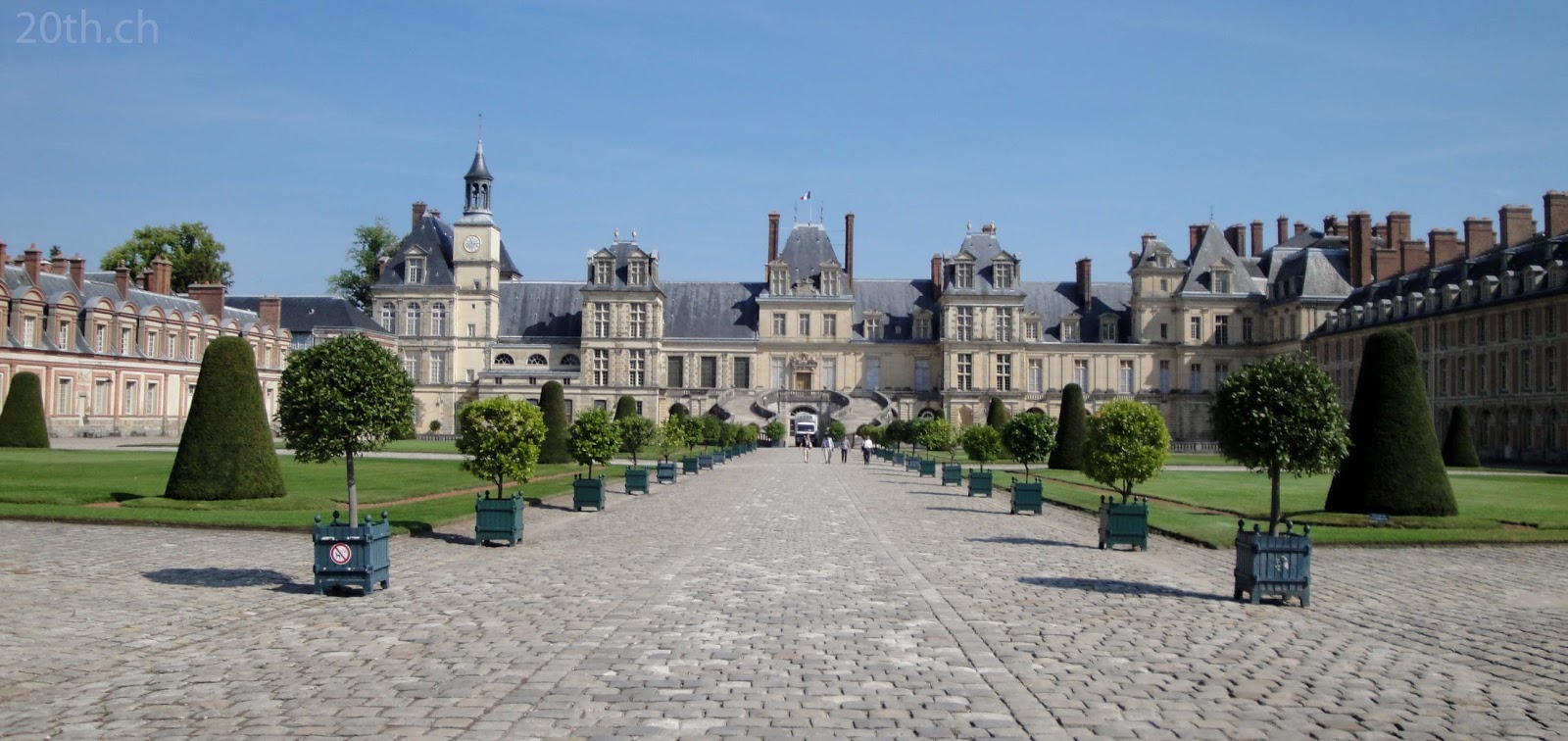
Fontainebleau (above), on the other hand, can be seen in much the state Francois I left it in. On February 24, 1525 there was the battle of Pavia, the worst French defeat since Agincourt. Many nobles were dead, and king was the prisoner of the Holy Roman Emperor in Madrid. He was released in May, but only at the price of exchanging his sons (Dauphin Francois and Henri, duc d’Orleans) for his own freedom. In May 1526, Francois created the League of Cognac with Venice, Florence, the Papacy, the Sforzas of Milan, and Henry VIII to “ensure the security of Christendom and the establishment of a true and lasting peace.” (Ha!!) This led to the visit of the delegation in 1527, seeking a treaty of alliance with England and the betrothal of Princess Mary and the duc d’Orleans.
After his return from Madrid, Francois was not idle. Aside from plotting alliances, he started decorating. Having finished Chambord, he turned to Fontainebleau, which he loved for its 17,000 hectares of fine hunting land. All that remained of the original 12th century castle was a single tower. Francois built new ballrooms,

galleries, and a chapel, and called in Italian artists like Fiorentino, Primaticcio, and Vignola to decorate them in lavish style (some of their work can still be seen in the frescoes of the Gallery of Francois I and the bedchamber of the king’s mistress the duchesse d’Etampes). The marble halls were filled with artworks, gold and silver ornaments, and fine tapestries. Unlike Greenwich, this palace was high and light, filled with sunlight that sparkled on the giltwork.
I know it’s hard to comment on a research-type post, but I’m curious–after reading about both palaces, which would you prefer to live in? (I’m torn, but I lean toward Fontainebleau, just because I was so awestruck when I visited!). Where would you like to see a book set?

For more behind-the-scenes history tidbits, and info on the KateHaywood Elizabethan Mysteries, please visit me at this link.

A TOUR GUIDE IN ENGLAND – DAY 1

As some of you already know, I flew over to England at the beginning of May in order to firm up details for the 2017 tours to Great Britain that Number One London will soon be offering (watch this space!). Luckily, my old pal Diane Gaston (Perkins) was able to join me on my travels. I’d warned her ahead of time that I would be on a mission on the trip over; there were people I needed to meet and places I needed to be. We’d be traveling hither and yon across the country via British Rail. We’d be spending at most two nights in a city or town and then moving on. Places to go, people to see. I did warn her. She still said “yes!”
And I warned myself, as I usually do, not to plan anything for my first day in London. No plans, no commitments, just an entire, luxurious day in order to laze around and recover from east to west jetlag. I warned Diane that we weren’t going to plan anything, too. Again, she was on board with that. And then I saw online that Buckingham Palace was once again doing their unscheduled private, champagne evening tours of the Palace. Three nights only, the last night being that of the day we were to land. I called Diane and asked her whether we should forget the no plans thing and get tickets. She said “yes!”
Diane and I met at Heathrow and we drove into central London together. Below is one of the first signs we saw – fitting, no?
Before long we had reached our hotel, the St. James’s Court, below. Once we’d arrived in our room, I asked Diane if she were tired.
“Not really,” she answered. “Are you?”
“No. I’m actually okay. What do you feel like doing?”
“I don’t know. We could always just go out and walk around. Maybe go to Westminster Abbey.”
“Okay,” I agreed as I logged into my Facebook account. 
I read a post by Ian Fletcher, posted just moments before, saying that he was having lunch at The Admiralty in Trafalgar Square. 
“Ian’s in Trafalgar Square,” I told Diane. “Should I ask him to meet us? I mean, he’s only just down the street.”
“Yes!” said Diane. 
“I’ll ask him to meet us at the Palace.”
Some of you may already know that Diane and I are familiar with the Palace, having each been there several times previously and having taken lots of silly selfies there the last time we were together for the 2014 Duke of Wellington Tour. I sent Ian a reply to his Facebook post and asked him if he had time to meet us, setting in motion the following thread:
Kristine Hughes Patrone Walk down the Mall and meet us in front of Palace. Wear your spy trench coat in case we don’t recognize your dog ears.

Ian Fletcher I’ll walk that way for a few minutes. Brown leather jacket, Crockett and Jones bag but no dog ears…

Kristine Hughes Patrone K. We’re both in black. Witches of eastwick. I’m 2 streets away. Leave now?

Ian Fletcher I’m at St James’s Palace. See you by the front gate of Buckingham Palace…

Kristine Hughes Patrone Ok give us a few leaving now

Ian Fletcher No problem. I’m outside. HM has put the kettle on…

Delle Jacobs Damm I’m jealous, Kristine Hughes Patrone.

Author Delle Jacobs knows Ian because she’s been on his tours before. I actually already had plans to meet with Ian later in the week, as his company, Ian Fletcher Battlefield Tours, and Number One London will be joining forces on several of the 2017 tours. In fact, Delle is in the Peninsula with Ian as I write this, tracing Wellington’s path, from Torres Verdes to Oporto to Madrid. 
So off Diane and I trotted, quickly covering the three blocks between our hotel and the Palace, where we found Ian waiting patiently by the iconic gates. Kisses all around and then the crucial question – booze or tea? In the end, we all agreed on tea (!?) and so walked back to our hotel, where we ordered three pots full, along with scones, cream and jam. 
The next few hours passed in a flurry of conversation that covered everything from future tours to Wellington to battlefields to world travels to Jermyn Street, men’s clothing and oysters. The hours flew past until Ian realized he had to be getting home and Diane and I realized that we were due at the Palace by 6 p.m. for our tour. Check, please!
And so Diane and I flew upstairs to our room in order to freshen up before, once again, making our way to the Palace. 
Of course the tour of the Palace was fabulous, it’s always fabulous, but photos weren’t allowed. I did find a few interior shots of the Palace online, see below, but of course they don’t compare to all that Diane and I saw that night. You can find a previous post I wrote about touring the Palace here
At the end of our Palace tour, Diane and I returned to our hotel room, below,  and so ended our first day in England. Stay tuned for more posts regarding our journey through England on behalf of Number One London Tours!