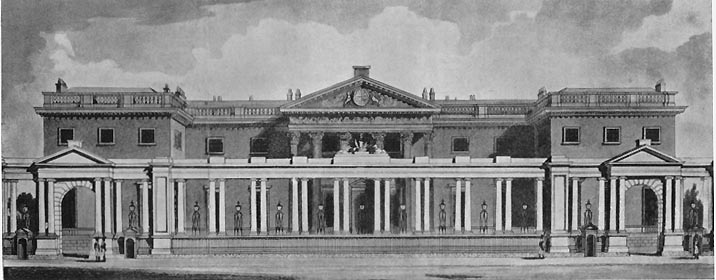
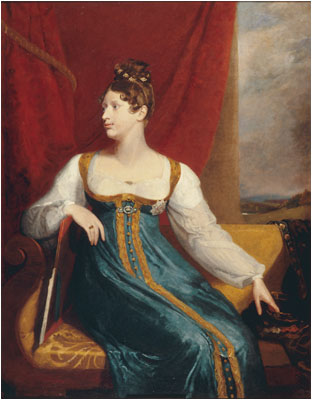
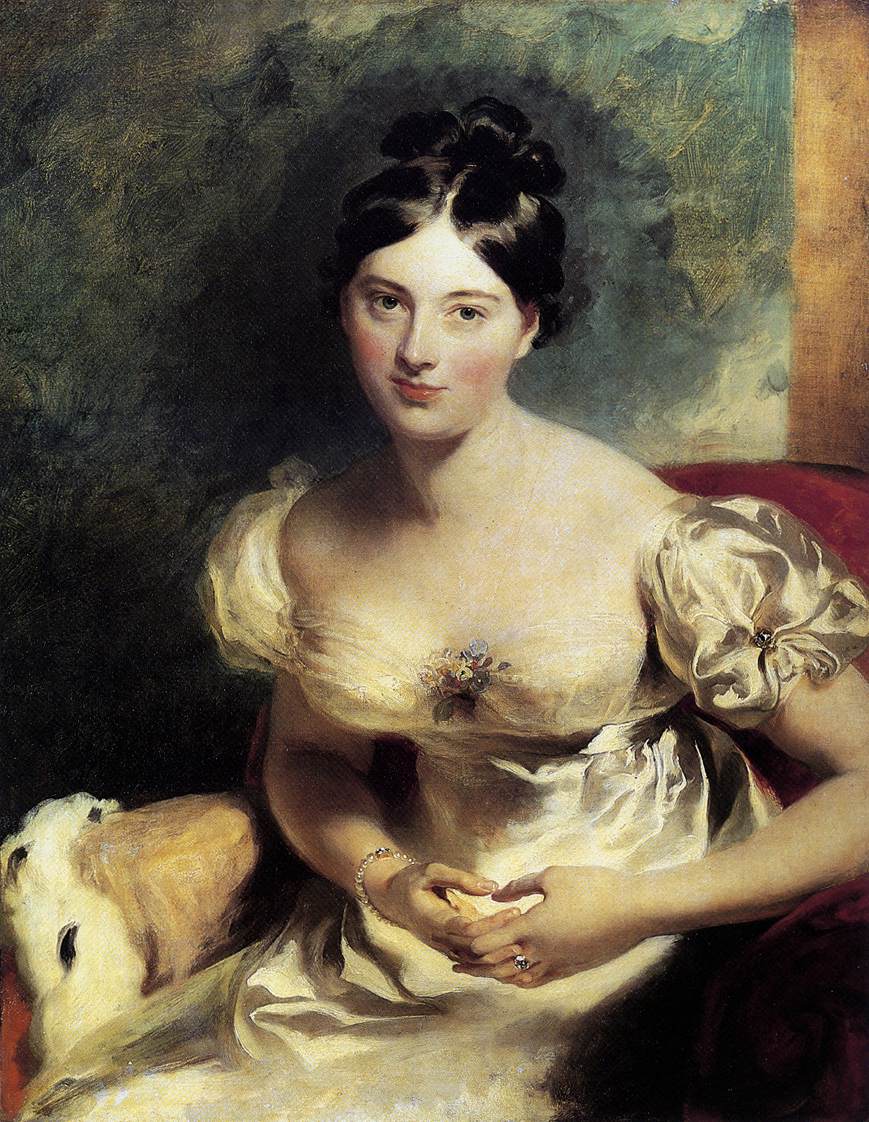
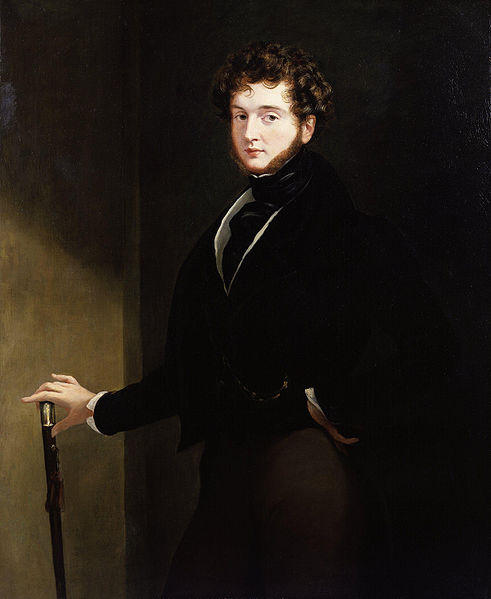
As we have seen in the previous post on this topic, Phillips’s royal connections were impressive, but one of the Phillips auctions that has gone into the annals of London social history is that of the contents of Gore House and the belongings of its occupants, Lady Blessington (at right) and Count D’Orsay. The Times of Monday May 7,1849 tells the story. On page sixteen at the head of the fourth column are two advertisements, in the first of which Mr. Phillips of 73 New Bond Street offers for sale by auction ‘ the improved lease of the capital mansion ‘ known as Gore House’ (a full description of the property follows); in the second ‘Mr. Phillips begs ‘to announce that he is honoured with instructions from the Right Hon. the Countess of Blessington (retiring to the continent) to submit to ‘ sale by auction, this day May 7, and 12 subsequent days, at 1 precisely each day, the splendid ‘ Furniture, costly jewels, and recherche Property ‘ contained in the above mansion,’ and so forth, and so forth, to the extent of some eighteen or twenty lines.
During the three days prior to the sale ‘twenty ‘thousand persons’ are said to have visited the house; the estimate seems large. Thackeray wrote Mrs. Brookfield that he had ‘just come away from a dismal sight; Gore House ‘full of snobs looking at the furniture.’ There were present a number of ‘odious bombazine ‘ women’ whom he particularly hated. Also brutes who kept their hats on in the kind old drawingroom ; ‘ I longed to knock some of them off, and ‘say, ” Sir, be civil in a lady’s room.”‘ A French valet who had been left in charge, and with whom Thackeray talked a little, saw tears in the great novelist’s eyes. Thackeray confessed to Mrs. Brookfield that his heart so melted toward the poor man that he had to give him a pound; the heart in question was always melting, and the purse was invariably affected.
In his Literary Life and Correspondence of the Countess of Blessington, Richard Robert Madden, a close friend of the Count and Countess, provides the following description of the sale:
In April, 1849, the clamours and importunate demands of Lady Blessington’s creditors harassed her, and made it evident that an inevitable crash was coming. She had given bills to her bankers, and her bond likewise, for various advances, in anticipation of her jointure, to an amount approaching to £1500. Immediately after the sale, the bankers acknowledged having received from Mr. Phillips, the auctioneer, by her order, the sum of £1500, leaving a balance only, in their hands, to her credit, of £11. She had the necessity of renewing bills frequently as they became due, and on the 24th of April, 1849, she had to renew a bill of hers, to a Mr. M , for a very large amount, which would fall due on the 30th of the following month of May; four days only before ” the great debt of all debts” was to be paid by her.

In the spring of 1849, the long-menaced break-up of the establishment of Gore House took place. Numerous creditors, bill discounters, money lenders, jewellers, lace venders, tax collectors, gas company agents, all persons having claims to urge, pressed them at this period simultaneously. An execution for a debt of £4000 was at length put in by a house largely engaged in the silk, lace, India shawls and fancy jewellery business. Some arrangements were made, a life insurance was effected, but it became necessary to determine on a sale of the whole of the effects for the interest of all the creditors. Several of the friends of Lady Blessington urged on her pecuniary assistance, which would have prevented the necessity of breaking up the establishment. But she declined all offers of this kind. The fact was, that Lady Blessington was sick at heart, worn down with cares and anxieties, wearied out.
In the spring of 1849, the long-menaced break-up of the establishment of Gore House took place. Numerous creditors, bill discounters, money lenders, jewellers, lace venders, tax collectors, gas company agents, all persons having claims to urge, pressed them at this period simultaneously. An execution for a debt of £4000 was at length put in by a house largely engaged in the silk, lace, India shawls and fancy jewellery business. Some arrangements were made, a life insurance was effected, but it became necessary to determine on a sale of the whole of the effects for the interest of all the creditors. Several of the friends of Lady Blessington urged on her pecuniary assistance, which would have prevented the necessity of breaking up the establishment. But she declined all offers of this kind. The fact was, that Lady Blessington was sick at heart, worn down with cares and anxieties, wearied out.
For about two years previous to the break-up at Gore House, Lady Blessington lived in the constant apprehension of executions being put in, and unceasing precautions in the admission of persons had to be taken both at the outer gate and hall door entrance. For a considerable period too, Count D’Orsay had been in continual danger of arrest, and was obliged to confine himself to the house and grounds, except on Sundays, and in the dusk of the evening on other days. All those precautions were, however, at length baffled by the ingenuity of a sheriff’s officer, who effected an entrance in a disguise, the ludicrousness of which had some of the characteristics of farce, which contrasted strangely and painfully with the denouement of a very serious drama.
Lady Blessington was no sooner informed, by a confidential servant, of the fact of the entrance of a sheriff’s officer, and an execution being laid on her property, than she immediately desired the messenger to proceed to the Count’s room, and tell him that he must immediately prepare to leave England, as there would be no safety for him, once the fact was known of the execution having been levied. The Count was at first incredulous—bah ! after bah ! followed each sentence of the account given him of the entrance of the sheriff’s officer. At length, after seeing Lady Blessington, the necessity for his immediate departure became apparent. The following morning, with a single portmanteau, attended by his valet, he set out for Paris, and thus ended the London life of Count D’Orsay.
The public sale of the precious articles of a boudoir, the bijouterie and beautiful objects of art of the salons of a lady of fashion, awakens many reminiscences identified with the vicissitudes in the fortunes of former owners, and the fate of those to whom these precious things belonged. Lady
Blessington, in her ” Idler in France,” alludes to the influence of such lugubrious feelings, when she went the round of the curiosity shops on the Quai D’Orsay, and made a purchase of an amber vase of rare beauty, said to have belonged to the Empress Josephine.
” When I see the beautiful objects collected together in these shops, I often think of their probable histories, and of those to whom they belonged. Each seems to identify itself with the former owner, and conjures up in my mind a little romance.” Vases of exquisite workmanship, chased gold etuis enriched with oriental agate and brilliants that had once probably belonged to some grandes dames of the Court: pendules of gilded bronze, one with a motto in diamonds on the back—’ vous me faites oublier les heures’—a nuptial gift: a flacon of most delicate workmanship, and other articles of bijouterie bright and beautiful as when they left the hands of the jeweller ; the gages d’amour arc scattered all around. But the givers and receivers, where are they? Mouldering in the grave, long years ago.
” Through how many hands may these objects have passed since death snatched away the persons for whom they were originally designed. And here they are, in the ignoble custody of some avaricious vender, who having obtained them at the sale of some departed amateur for less than their first cost, now expects to extort more than double the value of them. …” And so will it be when I am gone,” as Moore’s beautiful song says; the rare and beautiful bijouteries which I have collected with such pains, and looked on with such pleasure, will probably be scattered abroad, and find their restingplaces not in gilded salons, but in the dingy coffers of the wily brocanteurs, whose exorbitant demands will preclude their finding purchasers.”
The property of Lady Blessington offered for sale was thus eloquently described in the catalogue, composed by that eminent author of auctioneering advertisements, Mr. Phillips:
” Costly and elegant effects, comprising all the magnificent furniture, rare porcelain, sculpture in marble, bronzes, and an assemblage of objects of art and decoration, a casket of valuable jewellery and bijouterie, services of rich chased silver and silver gilt plate, a superbly fitted silver dressing case, collection of ancient and modern pictures, including many portraits of distinguished persons, valuable original drawings and fine engravings, framed and in the portfolio, the extensive and interesting library of books, comprising upwards of 5000 volumes, expensive table services of china and rich cut glass, and an infinity of valuable and useful effects, the property of the Right Hon. the Countess of Blessington, retiring to the Continent.”
On the 10th of May, 1849, I visited Gore House for the last time. The auction was going on. There was a large assemblage of people of fashion. Every room was thronged; the well known library saloon, in which the conversaziones took place, was crowded, but not with guests. The arm-chair in which the lady of the mansion was wont to sit, was occupied by a stout coarse gentleman of the Jewish persuasion, busily engaged in examining a marble hand extended on a book—the fingers of which were modelled from a cast of those of the absent mistress of the establishment. People as they passed through the room poked the furniture, pulled about the precious objects of art, and ornaments of various kinds, that lay on the table. And some made jests and ribald jokes on the scene they witnessed.
It was a relief to leave that room: I went into another, the dining room, where I had frequently enjoyed, ” in goodly company,” the elegant hospitality of one who was indeed a ” most kind hostess.” I saw an individual among the crowd of gazers there, who looked thoughtful and even sad. I remembered his features. I had dined with the gentleman more than once in that room. He was a humourist, a facetious man—one of the editors of “Punch,” but he had a heart, with all his customary drollery and penchant for fun and raillery. I accosted him, and said, ” We have met here under different circumstances.” Some observations were made by the gentleman, which shewed he felt how very different indeed they were. I took my leave of Mr. Albert Smith, thinking better of the class of facetious persons who are expected to amuse society on set occasions, as well as to make sport for the public at fixed periods, than ever I did before.
In another apartment, where the pictures were being sold, portraits by Lawrence, sketches by Landseer and Maclise, innumerable likenesses of Lady Blessington, by various artists ; several of the Count D’Orsay, representing him driving, riding out on horseback, sporting, and at work in his studio; his own collection of portraits of all the frequenters of note or mark in society of the Villa Belvedere, the Palazza Negrone, the Hotel Ney, Seamore Place, and Gore House, in quick succession, were brought to the hammer. One whom I had known in most of those mansions, my old friend, Dr. Quin, I met in this apartment.
This was the most signal ruin of an establishment of a person of high rank I ever witnessed. Nothing of value was saved from the wreck, with the exception of the portrait of Lady Blessington, by Chalon, and one or two other pictures. Here was a total smash, a crash on a grand scale of ruin, a compulsory sale in the house of a noble lady, a sweeping clearance of all its treasures. To the honour of Lady Blessington be it mentioned, she saved nothing, with the few exceptions I have referred to, from the wreck. She might have preserved her pictures, objects of virtu, bijouterie, etc. of considerable value; but she said all she possessed should go to her creditors.
There have been very exaggerated accounts of the produce of the sale of the effects and furniture of Lady Blessington at Gore House. I am able to state on authority, that the gross amount of the sale was £13,385, and the net sum realised was £11,985 4s. When it is considered that the furniture of this splendid mansion was of the most costly description, that the effects comprised a very valuable library consisting of several thousand volumes, bijouterie, ormolu candelabras and chandeliers, porcelain and china ornaments, vases of exquisite workmanship, a number of pictures by first-rate modern artists, the amount produced by the sale will appear by no means large.
The portrait of Lady Blessington, by Lawrence, which cost originally only £80, I saw sold for £336. It was purchased for the Marquis of Hertford. The portrait of Lord Blessington, by the same artist, was purchased by Mr. Fuller for £68 5s. Landseer’s celebrated picture of a spaniel sold for £150 10s. Landseer’s sketch of Miss Power was sold for £57 10s. Lawrence’s pictures of Mrs. Inchbald were sold for £4 8 6s.

The admirable portrait of the Duke of Wellington, by Count D’Orsay, was purchased for £189, for the Marquis of Hertford. This picture was D’Orsay’s chef-d’œuvre. The Duke, I was informed by the Count, spoke of this portrait as the one he would wish to be remembered by in future years. He used frequently, when it was in progress, to come of a morning, in full dress, to Gore House, to give the artist a sitting. If there was a crease or a fold in any part of the dress which he did not like, he would insist on its being altered. To use D’Orsay’s words, the Duke was so hard to be pleased, i
t was most difficult to make a good portrait of him. When he consented to have any thing done for him, he would have it done in the best way possible.
The sale of the pictures, plate, and jewels did not a little towards cancelling Lady Blessington’s debts. Her portrait by Lawrence and that of Wellington by D’Orsay were bought by the Marquis of Hertford and may be viewed by the curious, the one in the Wallace Collection, the other in the National Portrait Gallery. Everything was scattered and the house was put for a time to inglorious uses, being turned into a restaurant run by famed chef, Soyer, during the Great Exhibition of 1851. Later it was entirely swept away. Now the Albert Memorial Hall occupies a part of the site.