ONCE AGAIN WEDNESDAY: Mary Anne Clark by Jo Manning – Part Four

Mrs M.A.Clarke, as drawn & engraved by C.Williams, published Feb 25, 1809
by S.W.Fores, 50 Piccadilly

In the above print, titled “Committee of Inquiry” (available for £180 @Grosvenor Prints in Hampton, Middlesex), the descriptive text from Grosvenor Prints has Mrs. Clarke “standing in the lobby of the House of Commons, a section of which is seen through the partly open door: the corner of three tiers of empty benches and the gallery, with a strip of the Speaker’s chair, showing his right elbow.” Mrs. Clarke wears a blue pelisse over a simple white dress; on her head rests a straw bonnet with a lace veil. With her left hand she raises the hat’s veil from her face. The very, very large object on her right hand is a fur muff. Again, as per the description, “She is elegant, alluring, and assured.”
But where was Mary Anne Clarke during the period of the trial and through 1813, when, under the terms of her annuity from the Duke of York, she had to leave England for the Continent?
In her questioning at the 1809 trial she stated that she was a widow living in “Loughton Lodge, in the county of Essex.” So, apparently – or, according to her – her husband, Joseph Clarke, the philandering drunkard, is deceased. But was she actually living where she said she was? The truth and Mary Anne Clarke were never friends, so some skepticism is in order.
According to an article by one Richard Morris in the March/April 2008 newsletter of the Loughton Historical Society, there are some doubts as to her residence in the area at all, though Morris, covering his bases, does write at the end of his piece:
“I am, however, convinced that there must be some truth in the story, if only because of Daphne du Maurier’s relationship to Mary Anne Clarke, her reputation as a novelist, the research she did for her book, and the many references in it to Loughton and Loughton Lodge.”
Bless the man, to have such faith in an author’s research! But we know from what Du Maurier said in the preface to her novel Mary Anne that she relied on someone’s “notes” and on the library research of two others. Dicey. So, here’s the dubious part:
“There are in total nine references to Loughton in [the] novel, and one refers to Mary Anne Clarke looking out of the window at Loughton Lodge: ‘at the neat box-garden, the gravel drive, the trim smug Essex landscape’. This can only considered as author’s licence as Loughton Lodge stands on top of Woodbury Hill with its front facing what is now Steeds Way…in 1809 [it] would have given clear views over the Roding Valley and beyond, and the rear which overlooks an attractive part of the Forest.”
The reference in the last line is to Epping Forest, a considerable parcel of wooded area. Hard to overlook.
Morris goes on to say that he can find no specific evidence of Mary Anne Clarke’s time in Loughton, even though a local street – in acknowledgement of her supposed time in the town — was changed from Mutton Row to York Hill in 1850. When Mary Anne was supposedly in residence at Loughton Lodge, though, it belonged to a family named Shiers. True, she could have been a lodger at the Lodge, but lodging in someone else’s digs was never Mary Anne’s style.
And what of this Loughton Lodge today? Turned into an old folks’ home after World War II, it was subsequently divided into two separate houses. I have not been able to find an image of it, either as it was then, or as it is today. Nor was I able to verify that “a blue plaque” was affixed to the building in April of 2009.

In 1811, wherever Mary Anne was, she did one other thing for posterity, that is, she commissioned the Irish-born sculptor Lawrence Gahagan to sculpt a marble bust of her (now in London’s National Portrait Gallery). It’s very beautiful.

Mary Anne Clarke rises from the open petals of a sunflower. She’s thought to represent Clytie, the abandoned lover of the sun god, Helios, changed into a sunflower so that she could follow her perfidious lover’s progress across the sky each day

So, we come to the question… Do all old English courtesans die impoverished – and disgraced — in France? Grace Dalrymple Elliott died there, in the village of Meudon, and, if not in poverty, close to it; Dorothy Jordan definitely died in awful poverty in Saint-Cloud; Mary Robinson didn’t die in France – she died at home, in England — but she died as poor as it was possible to be; likewise Emma Hamilton, who met her sad demise in Calais.
And then there’s Mary Anne Clarke. Yes, she died in France – after extensive travels through Italy and Belgium — in Boulogne-sur-Mer, but decidedly not in poverty. That generous annuity from the Duke of York saw her through, as it did her daughter Ellen Clarke Busson du Maurier, who raised her family on it.
The irony – there’s always the irony – is that poor Ellen Clarke (said to be as unattractive as her mother was beautiful, with sallow skin and sharp features) apparently was under the illusion for years that she was the by-blow of the Duke of York, but though she was probably not the daughter of her mother’s husband Joseph Clarke, neither could she have been the daughter of Frederick. Her mother – though she certainly knew many men intimately between Clarke and Frederick – did not meet the Duke of York until Ellen was at least six years old. Her biological father is a mystery.
Ellen, so unlike her mother in every way – save perhaps for the sharpness of her tongue — married the inventor Louis-Mathurin Busson du Maurier, a charming, talented dreamer (said to have a beautiful singing voice) who never amounted to anything and was prone, as were others in his family, to depression. His so-called inventions were laughable and he was forever in debt. Although it appeared to have been a love-match, it was disastrous. Ellen had to borrow from her mother and her sister-in-law Louise all her married life. When she came into the annuity in 1852 – either in whole or in part — upon the death of Mary Anne Clarke, she still found it difficult to make ends meet, as her children seemed to have a hard time making decent livings.

George Du Maurier, author of Trilby

Late in his life, however, her eldest child, and her favorite, George Du Maurier, became a successful cartoonist for Punch and other political publications of the day, and, at age sixty, he wrote a bestselling novel, Trilby, inspired by his experiences as an art student in Paris. His son, Gerald Du Maurier, the well-known actor-manager, was the father of Daphne Du Maurier. (There is a marked resemblance in the image above between George and Daphne. Look at their noses.)

Gerald Du Maurier, respected actor-manager and father of Daphne Du Maurier, by Augustus John

Quite a legacy, this of the Busson du Mauriers and the Clarkes. It was a spirited one, for sure, thanks largely to Mary Anne. Daphne Du Maurier, whose attitude towards her ancestor I find somewhat ambivalent, summed up this legacy in The Du Mauriers:
“The pleasant, sweet-natured, melancholy Bussons of Sarthe had not such fortitude. These fighting qualities were bequeathed…by a woman, a woman without morals, without honour, without virtue, a woman who had known exactly what she wanted at fifteen years of age, and, gutter-born and gutter-bred, treading on sensibility and courtesy with her exquisite feet, had achieved it laughing – her thumb to her nose.”
As for the blog post by Kristine comparing Sarah Ferguson, Duchess of York, to Mary Anne Clarke? Mary Anne could have taught her a thing or two, methinks. Yes, Mary Anne was as greedy as they come, but she was a whole lot smarter and a good deal more conniving. The greed and love of luxury ultimately brought her down – as, indeed, it appears to have brought down this 21st century Duchess – but, while Mary Anne was down, dear readers, she was never really out. The spunky baggage was a survivor, as so many of her courtesan sisters were not. A dreadful woman, but one has to admire her survival skills. I think that, in the end, her great-great-grand-daughter surely did.
Her last words to her son and daughter-in-law were said to be, “It is high time we had another party.”

The novelist Daphne Du Maurier as a young woman

The End


Originally published on October 28, 2010
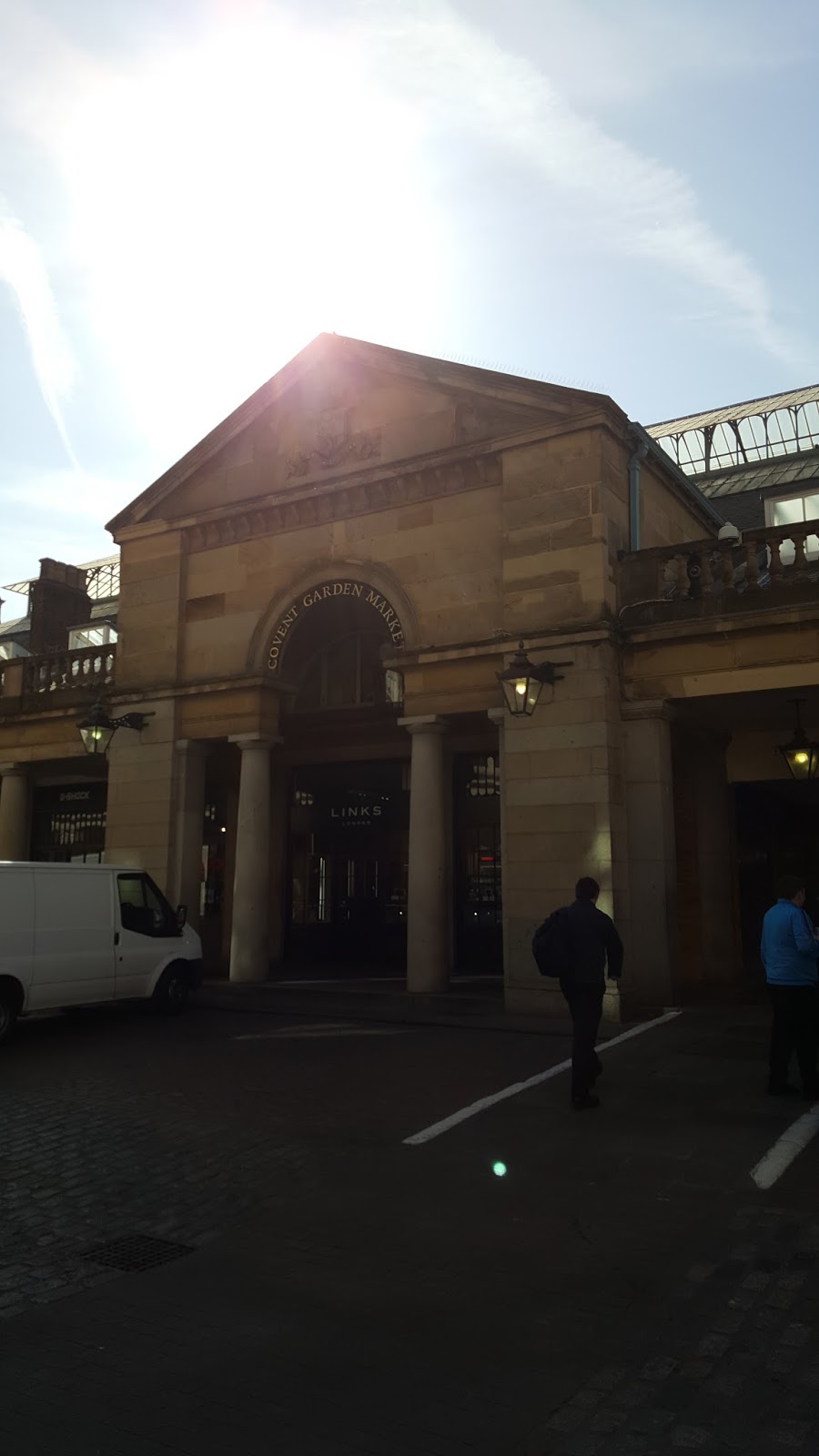
 

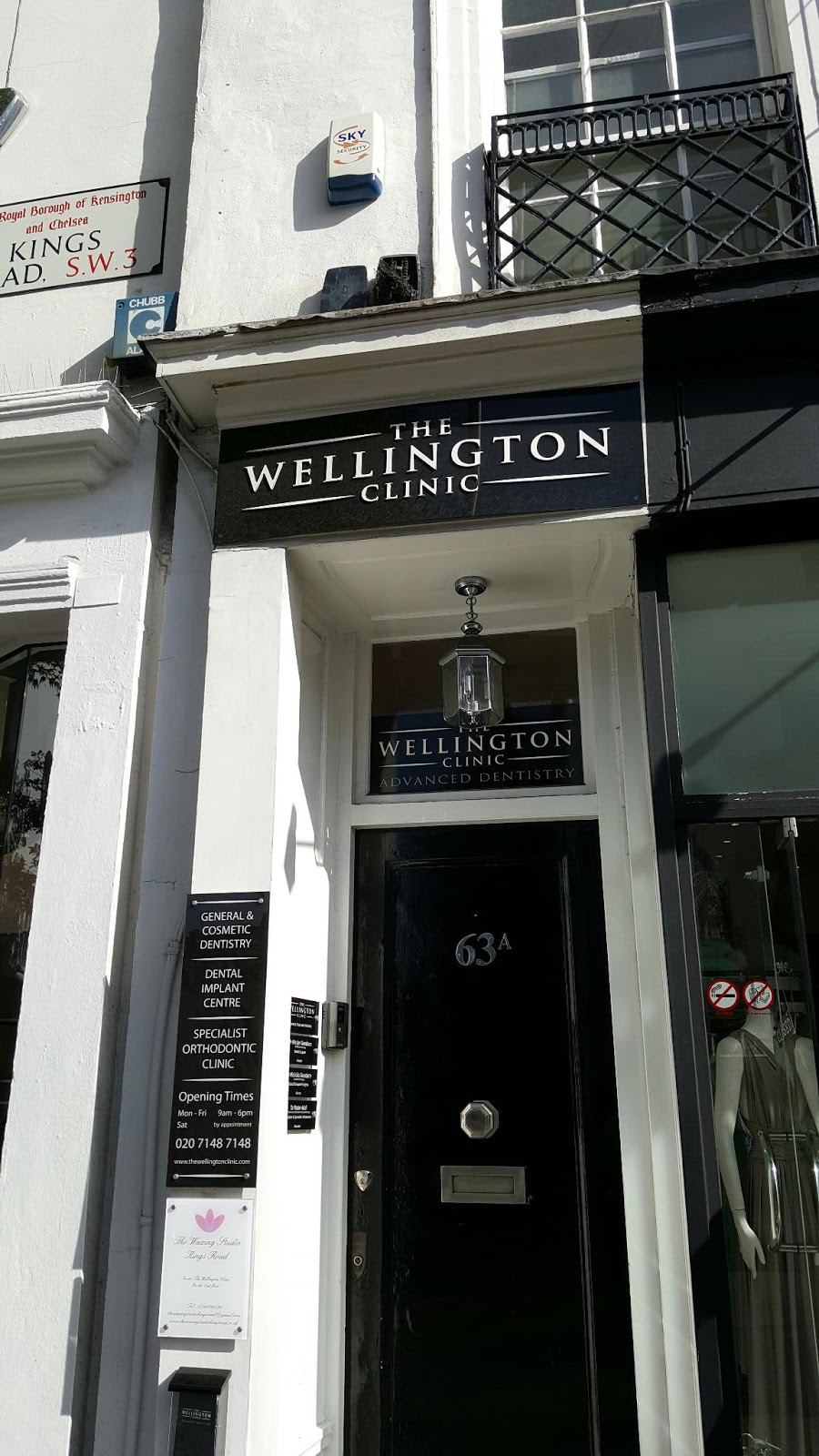
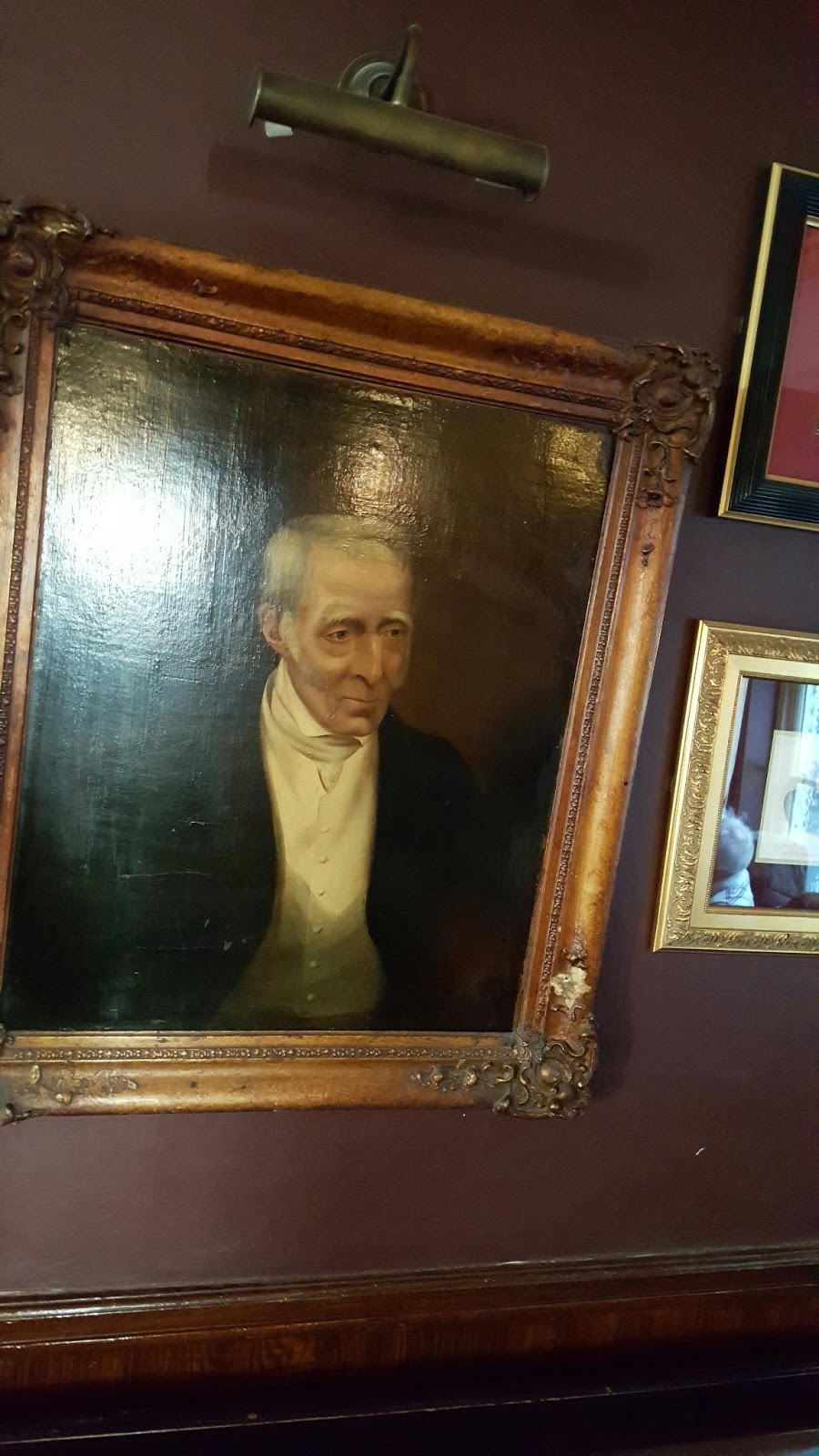
A TOUR GUIDE IN ENGLAND: RANDOM WELLINGTONS SEEN ALONG THE WAY

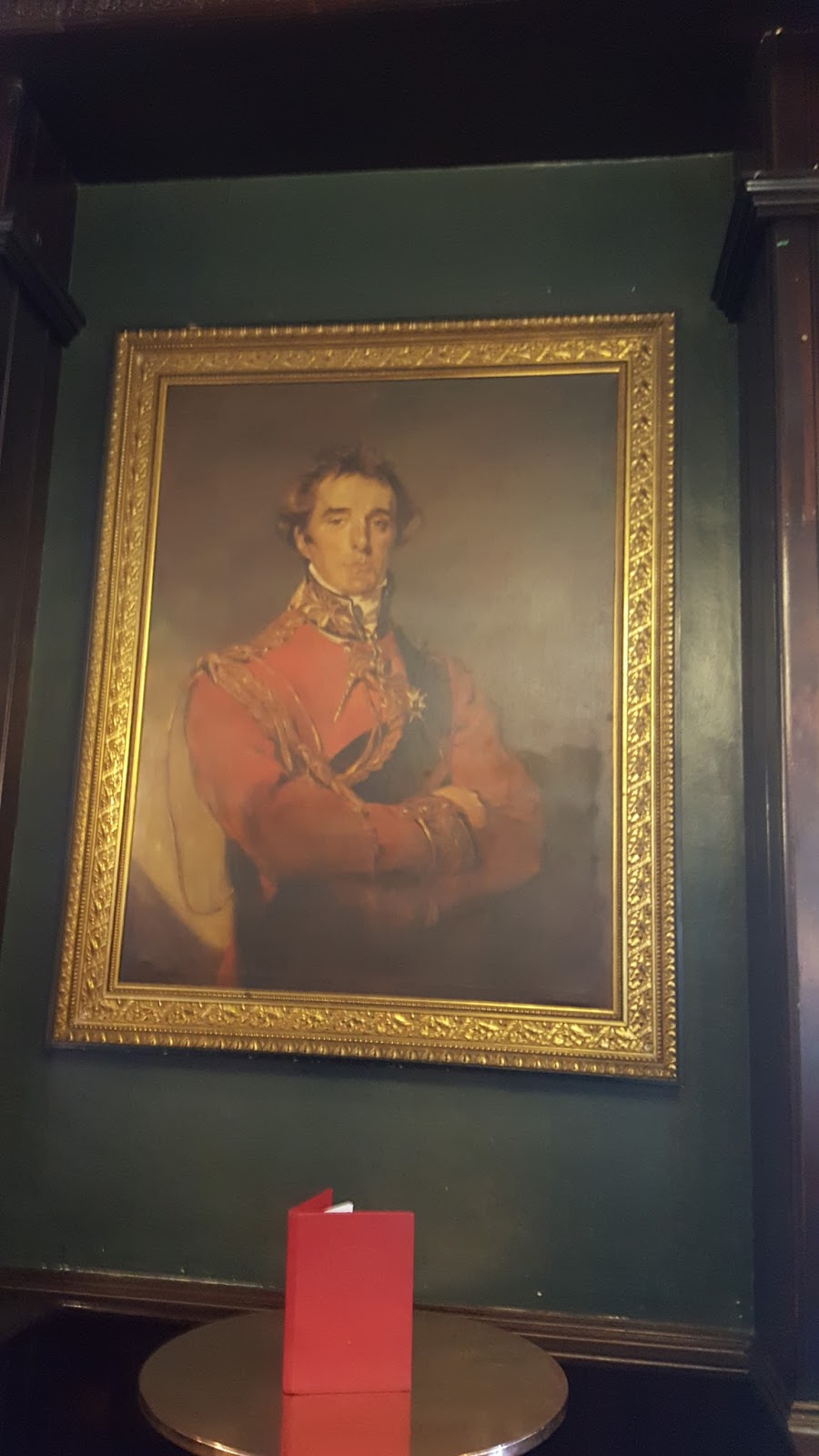
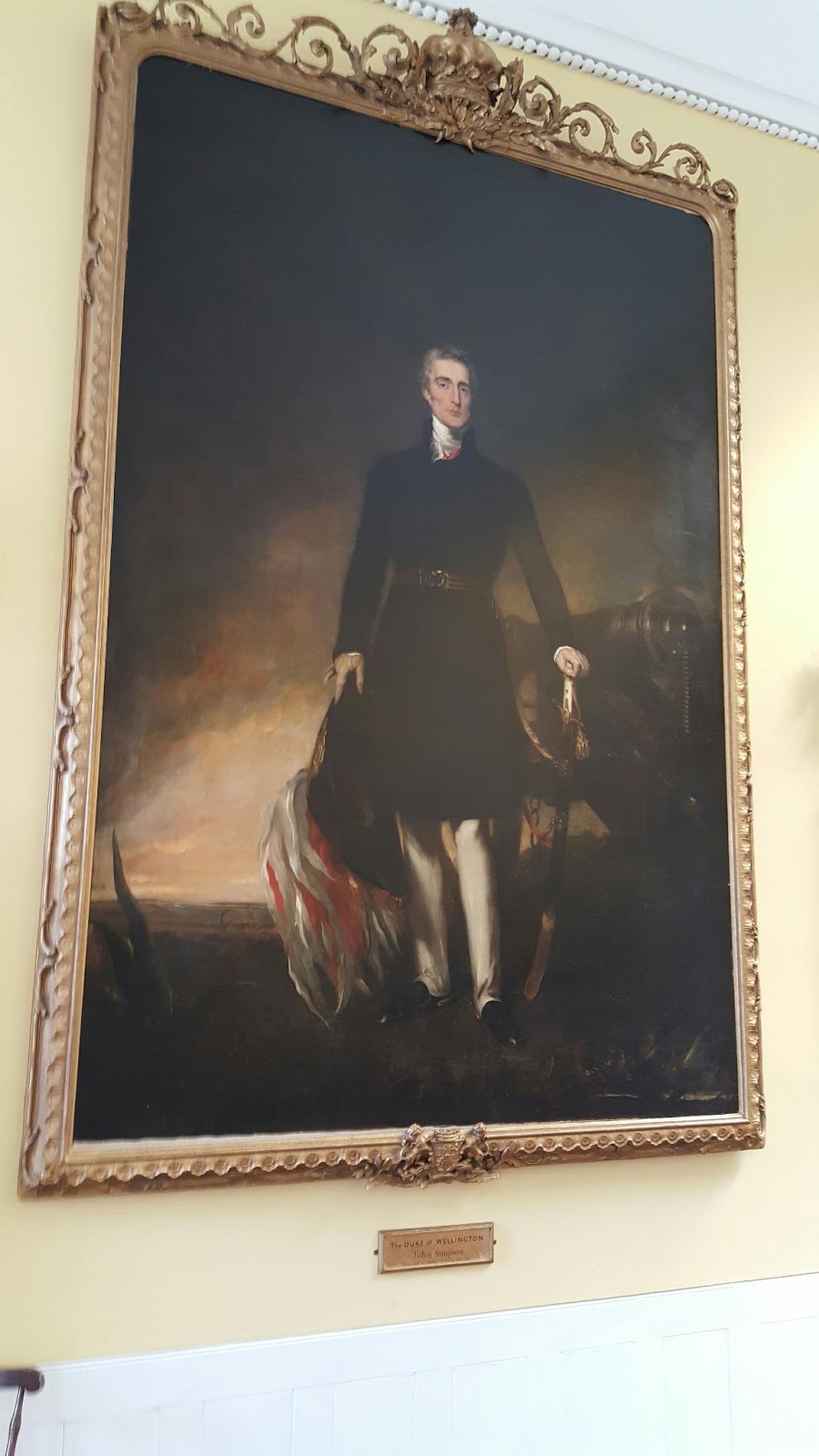
Most people think that Victoria, Diane and I go out of way when in England to find all things Wellington, but it’s just not so. Oh, sometimes we do, like when I visit my antiques dealer in London or when we go to places like Apsley House and Walmer Castle, but you’d be surprised how many random Wellington’s there are to be found in England. Here are just a few examples, most of which were randomly happened upon. 
Above, my favourite antique dealer, Mark Sullivan, holding my latest Artie-fact
Above and below, National Portrait Gallery
Above Royal Chelsea Hospital
Above, the Duke of Wellington Pub, Sloane Square
Above and below, the Wellington Pub, Strand
Above Somerset House
Above, Preston Manor, Brighton
Above lobby, Royal Horseguards Hotel

Above, moored on the Thames
Above, Apsley House

CAN YOU TELL YOUR CROAKER FROM YOUR FATOR? BY LOUISE ALLEN

Can You Tell Your Croaker From Your Fator or Your Papler from Your Fromenty?
If you write or read about the Georgian and Regency era sooner or later you are going to come across examples of the rich culture of slang, cant and lingo used by the underworld, sportsmen and the gentlemen who patronised both.
Slang and cant were a source of fascination to ‘polite society’ from the 1770s onwards and, as the century drew to a close and the new morality and better crime fighting threatened the violent and colourful Georgian underworld, scholars, dictionary-makers and the curious began to collect those worlds and phrases together.
Francis Grose (1731-1791) is perhaps the best known of these dictionary-makers, although by no means the first. He produced the first edition of his Classical Dictionary of the Vulgar Tongue in 1785. A second edition appeared in 1788 and a third in 1796, five years after his death.
Grose was the son of a Swiss jeweller, although he was born in Middlesex. He received a classical education and inherited a comfortable income of which he was exceedingly careless. He was very fat (described by the Dictionary of National Biography as ‘a sort of antiquarian Falstaff’) and must have made a noticeable figure when he ventured with his servant Batch into the slums and rookeries and hells of London, notebook in hand.
 Grose used existing dictionaries extensively, some dating as far back as 1608, as well as his own observations, to produce his collection of ‘Buckish Slang and Pickpocket Eloquence.’
After his death The Lexicon Balatronicum appeared in 1811. Based on the second edition of Grose it had about three hundred additional definitions.
In 1823 Pierce Egan, the sporting journalist and author of the famous Life In London (1821) produced what he called a third edition of Grose’s Vulgar Tongue using the Lexicon as his basis, although he did not acknowledge it, reprinting instead the frontispieces to Grose’s first and second editions. This version brings in many of Egan’s trademark sporting terms and phrases and also draws on a number of contemporary sources.
John Badcock, another sporting writer and a less-successful competitor of Egan’s, produced Slang: A Dictionary of the Turf, The Ring, The Chase, The Pit, of Bon-Ton and the Varieties of Life… in 1823 under the nom de plume of John Bee. His introduction includes a vitriolic attack on Egan and his text includes a wider variety of sources.
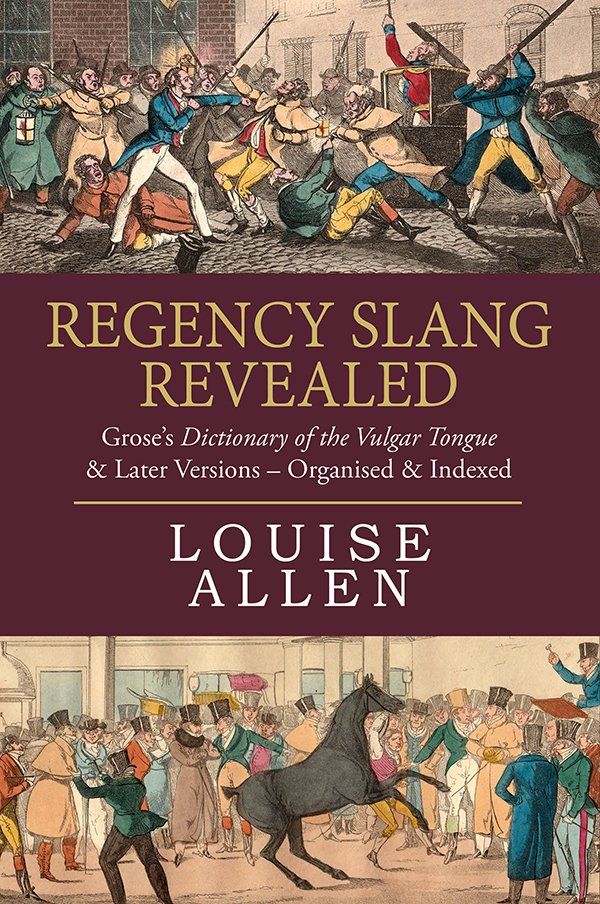
As a writer about the period I had often dipped into one or other of these, but had been frustrated because they are not indexed, being simply arranged in alphabetical order of the words or phrases defined. Eventually I began to group the definitions together by theme and then index them and that became the basis for my Regency Slang Revealed: Grose’s Dictionary of the Vulgar Tongue and Later Versions – Organised and Indexed.
Not surprisingly, crime and punishment feature large in the terms collected – 28 terms for conning someone, over 30 for various aspects of picking pockets and 27 for being hanged. Drink and drunkenness are also major themes and the section on food reveals a preoccupation with roasting pigs’ heads!
Terms relating to sex and prostitution are, unsurprisingly, common, including some for ‘lascivious practices which will not bear explanation.’
Besides the categories above and a variety of topics such as insults, money-lending and boxing, there are a wealth of delightful discoveries to be found – a cherry-coloured cat is black; a moon-curser is a link boy (who gets less trade when the moon is full); the House of Lords is the House of Noodles; to be in good health is to be in plump currant and rain is dog soup.
Armed with any of the dictionaries you could order a meal or a snack in some low area of London (if you hadn’t had your pocket picked first.) If all you can afford is ‘buster and beeswax’ or bread and cheese, it will taste better if it has been toasted to make a ‘Welsh rabbit’ or, failing the cheese, you may have to make do with a ‘scratch platter’ or ‘tailor’s ragout’ of bread and sliced cucumbers slopped in vinegar.
And the terms in the title? Both faytors and croackers were fortune tellers, papler is milk pottage and frumenty is wheat boiled to a jelly. Delicious!

You can discover more on my website and on my blog, Jane Austen’s London
Louise Allen

A TOUR GUIDE IN ENGLAND: DAY 3 – PART 5

If you’ll recall, the last post in this series ended with Diane and I finally making it 
through Trafalgar Square in a cab on our way to the theatre district. 
Leaving the cab in Charing Cross Road, we cut through Cecil Court to St. Martin’s Lane
and we came out at the London Coliseum, where we had tickets to see 
Glenn Close in Sunset Boulevard, the musical. 
I knew that this limited run of Andrew Lloyd Webber’s musical was a reprisal of the role Glenn Close had played to acclaim on Broadway in 1994. Still, as we waited for the curtain to go up, I couldn’t help but to think `this is either going to be really good or really bad.` I love the original black and white film of Sunset Boulevard starring Gloria Swanson and William Holden. I couldn’t imagine that it could be done any better. And a muscial in the bargain?
Reader, it was really good. No, it was fabulous. Glenn Close was Norma Desmond. 
Don’t take my word for it – watch her performance here.
After standing through several curtain calls, Diane and I left the theatre and walked 
up the street for an Italian dinner at Giovanni’s, located in Goodwin’s Court which, as we left the restaurant after a delicious meal, proved tres atmospheric at night. 
And so back to the hotel and bed. Diane and I were exhausted, as it had been a long day. 
In fact, it had turned out to be a Five Part day. Can you imagine?
Day Four Coming Soon!

ONCE AGAIN WEDNESDAY: Mary Anne Clark by Jo Manning – Part Three

The Duke of York set Mary Anne up in lavish accommodations in a mini-palace at 18 Gloucester Place, and by 1805, as his official mistress, she was entertaining, as one source put it, “sumptuously”. She was said to have had twenty servants, which included a housekeeper, five/six maids, two butlers, six or more other male servants (probably footmen and coachmen), and three/four chefs. She had two coaches and at least ten horses. There was also “an elegant mansion at Weybridge” for her sole use.
‘The York-minuet’ (Frederica Charlotte Ulrica Catherina, Duchess of York; Frederick, Duke of York and Albany) by James Gillray (1791)
The prince was married. He was the first of King George II’s children to get married. He’d wed his cousin, Princess Frederica of Prussia, a woman noted for her extremely tiny feet, in 1791. Frederica was petite, very short, not at all attractive, and said to have bad teeth. The duke was no prize himself, described as “a giant of a man…with [a] great bluff red face…bulging eyes…ponderous belly [and a] prominent nose.” Even more detailed is this from another source: “a red, blotched face…a great paunch…a purple, bulbous nose”.
Though Frederica, known as Freddie, was lively, praised for her “neatness”, and considered to be a sensible woman, the couple did not mesh and the marriage was not a success. They lived apart, she at Oatlands Park in Surrey, with eighteen dogs; she had many friends, among them the famous Beau Brummell. (Romance novelist Rosemary Stevens, a few years back, played with Freddie and the Beau’s relationship in a series of mysteries with Brummell as a kind of Regency Sherlock Holmes. Check them out, they’re fun to read!)
At Gloucester Place, Mary Anne Clarke was said to have eaten off exquisite china plates that once belonged to the family of the Duc de Bern, and to drink from crystal wine glasses that had cost upwards of “two guineas a-piece.” (A guinea is a pound plus a shilling.) How much did all this cost to maintain? Mary Anne was never one to stay within a budget, as her past so well illustrates. Her talent – or one of them, at any rate – lay in extravagance.
According to Mary Anne, she received from £1,000 to £1,200 annually from the Duke of York, in monthly allotments, for the maintenance of this enormous household. (Bear in mind that, at that time, one pound was worth seventy to eighty times what it is worth today.) This is at odds with the statement of the Chancellor of the Exchequer at the 1809 trial that she was actually paid £6,000 yearly. Mary Anne countered that her payments from the Duke were irregularly doled out. (It is interesting to note here that the royal brothers received many complaints from their ladybirds over the years that payments were not always forthcoming; this has been documented by the experiences of Mary Robinson and Grace Dalrymple Elliott, among others.)
So, to supplement her income, the avaricious, luxury-loving Mary Anne Clarke hit upon a scheme. She would take the lists of army men up for promotions that were sent to her lover and add the names of soldiers who would pay her for the surreptitious promotions. Only a few each time, added at the very end of the lists to which she was privy, thanks to Frederick — who carelessly kept them lying around — so as not to arouse suspicion. But she got much too greedy…and she was caught. By 1809, the jig was up.
The Bishop And His Clarke Or A Peep Into Paradise… The Duke of York, Commander-in-Chief of the army (and titular Bishop of Osnabruck, as per this reference) being solicited by Mary Anne Clarke to obtain promotions for her paying clients and friends. The caricature is by Rowlandson, printed by Tegg, 1809.
In January 1809, a little-known Welsh MP, Colonel Gwyllym Lloyd Wardle, alleged in the House of Commons that Frederick, as Duke of York — the “spare” after his brother the heir to the throne — and Commander-in-Chief of the Army, “had sanctioned, facilitated, and personally profited from the illicit trafficking in army commissions that his former mistress, Mary Anne Clarke, had engaged in while under his ‘protection’.” (The Duke of York Affair, Philip Harling, The Historical Journal, 39, 4 (1996), page 963.)
Captain Gronow, in his gossipy memoirs, states that Wardle got wind of Mary Anne’s dealings owing to becoming “intimately acquainted with her… [and was] so great a personal favourite that …he wormed out all her secret history, of which he availed himself to obtain a fleeting popularity.” Interesting, but, as with anything Gronow says, one has to have the salt shaker handy.
The modern Circe or a sequel to the petticoat”, caricature of Mary Anne Clarke by Isaac Cruikshank, 15 March 1809. Her lover Frederick, Duke of York resigned from his post at the head of the British Army ten days after the caricature’s publication.
Nevertheless, the charge was sensational, leading to not one but three trials from 1809 to 1813. The first one was the major trial; the subsequent ones were libel suits brought against Mary Anne Clarke and some pamphleteers. Eight specific – and serious — cases of selling commissions were brought out in the 1809 trial, and are examined minutely in the AAIM, for those who want the sordid (and fascinating) details, but, briefly, it came down to Mary Anne Clarke letting it be known that she would use her influence over the duke to secure commissions and preferments, whether deserved by the petitioners or not, and if this was done with the full knowledge and/or encouragement of the Duke of York. The prices for her intervention into this Army business ranged from £2,600 for promotion to Major to £400 for a mere Ensign. (In the drawing above of the Bishop and his Clarke, the army lists are shown pinned to the almost-conjugal bed shared by Frederick and Mary Anne.) The caricaturists had a field day!
As noted in the caption above, Prince Frederick was forced to resign as Commander-in-Chief of the Army owing to the scandal, but he was reinstated shortly after he was found to be innocent of all the charges brought against him. Another widely circulated caricature was this, attributed to C. Williams and showing Mary Anne with the infamous promotion list in her hand standing before the “York Commission Warehouse”:
Colored etching, published 1809, shortly after Colonel Wardle had exposed the army commissions scandal in the House of Commons, this satire shows Mrs Clarke with a price list for the sale of commissions. On the right is her intermediary, Domenico Corri, a music master; above him hangs upside down the Duke of York’s portrait. Mary Anne is saying that she has bargains for sale but they have to be taken advantage of now because her partnership is dissolving!
The manner in which Mary Anne carried on at the trial was said to have been a tour de force worthy of any seasoned stage performance; her quick wit parried and thrust all questions sent her way and impressed spectators. But her reputation – such as it was – was forever ruined. The Duke of York was able to come back; she wasn’t. It was not a good thing to be identified from thence forward as a friend of Mary Anne Clarke’s; she became a pariah, shunned by the society she in which she’d once played such a large part.
Gillray got into the act, too:
Pandora Opening Her Box, colored aquatint by James Gillray, published by Hannah Humphrey, 1809
After the trial, undaunted, Mary Anne let it be known that she intended to publish Frederick’s love letters. Like his brother George in the case of his mistress Mary Robinson, Frederick had been indiscreet. The boys made too many negative remarks about their family members, the royal family. Sir Herbert Taylor was engaged to enter into negotiations with Mary Anne’s lawyers for the purchase of the letters and the destruction of all other papers still in her hands.
Mary Anne received an enormous annuity – on top of an immediate £7,000 cash settlement — her son George’s schooling and subsequent Army commission was paid for, and the annuity would pass on to Ellen Clarke, Mary Anne’s daughter, at her death. (Similar to the arrangement with Mary Robinson and the Prince of Wales, but Mary and her daughter got nothing in comparison with the monies paid out to Mary Anne Clarke.)
The terms of the annuity also insisted that Mary Anne quit England and reside on the Continent. She was not to publish anything about the royal family, nor was she to say anything that could be deemed disrespectful about them. Though, much later, she once attempted to break the terms of the arrangement, having been approached by a publisher who promised her many thousands of pounds, her lawyers persuaded her to keep the fat bird in her hand rather than seek ephemeral birds in the bush.
The MP who made the initial allegations against the Duke of York, Colonel Wardle, did bring suit against Mary Anne and two pamphleteers for libel – her name was attached to one of the pamphlets – but they were all acquitted. In 1813, however, Mary Anne again went too far and was once again sued, this time for libel of a powerful politician; she was unable to talk her way out of the predicament – the evidence was too strong against her – and she was convicted, spending nine months in prison, supposedly in solitary confinement.
Part Four Coming Soon!

Originally published on October 26, 2010