Occasionally, life treats us to rare gifts: a perfect summer’s day, a hug when you’re needing it most, an excellent pinot noir. If you’re like me, perhaps one of life’s greatest treats is the discovery of a new author. I’m always looking for them and recently I found a blog called My Porch, which I’ve added to the “Amusing Blogs” section found in the righthand sidebar of this blog. Written by a young man named Thomas who lives in Washington, D.C., it is a testament to his reading stamina, which beats my own with a very big stick. I enjoy his `voice’ and his book reviews, but My Porch also boasts a long list of links to yet more book sites, many with a British bent. One can troll them for hours. Which one did until, finally, it dawned on me that Victoria and I might do a post on favorite authors, with healthy backlists, that could then be our gift to you. So here goes. One disclaimer before we continue – you won’t find any romantic fiction here, not because we don’t read it but because many of its authors are friends and once one begins naming friends one inevitably leaves someone out and then one finds oneself in the soup, so to speak. So. . . here are a few of my favorites, in no particular order, beginning with a category of books I term gentle reads. Victoria’s picks in the same category will follow in Part Two. We sincerely hope you find a new author or two amongst them.
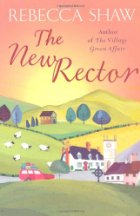
Rebecca Shaw has written two cozy village series, the Barleybridge novels and the Turnham Malpas books. The Barleybridge series consists of three titles that deal with the lives and clients in a rural veterinary clinic. More prolific, the Turnham Malpas books, which number 15 titles, are set in a small village and opens with
The New Rector. Here’s the blurb:
When Peter Harris arrives in Turnham Malpas as the new rector, he finds the village people welcoming but set in their ways. Yet despite his own weaknesses and the sadness of his childless wife, he comforts and advises his new parishioners, growing more and more involved with the rural way of life. Then the whole village is rocked by a spiteful trick that goes terribly wrong, and a gruesome murder that points to a killer in its midst. Now, more than ever, Peter’s pastoral role is crucial – and yet he is wrestling with his own private hell that may still wreck his own life. Don’t be turned off by the fact that the central character, at least in this title, is a member of the clergy. Shaw’s books are rather like an adult version of the Miss Read books, more on which later. Peter’s arrival in the village sets the stage for our introduction to a cast of quirky and mostly
loveable characters who reappear in succeeding novels. Most storylines do not deal with the church, but do include forays into middle aged love, greed, scandals, char women, shop owners, the gentry, the downtrodden and a few chuckles. Here’s the blurb for another title in the series, Village Matters: Times are changing in Turnham Malpas …Brash Craddock Fitch up at the Big House seems determined to make his mark on the village – and the village is determined to put him in his place. Sir Ralph is having trouble adjusting to his more modest status and timid Muriel to her exalted one while a change of fortune surprises Jimmy Glover too. It’s all Jimbo Charter-Plackett, fount of all gossip, can do to keep up. But these concerns are eclipsed by tragedy when Flick, Jimbo’s daughter, is knocked down by the unpopular barman Alan. And before the shock of the accident has passed, a bitter dispute springs up that could affect the entire village … Enough drama and 21st century situations happen in each title to keep them from being overtly quaint, while Shaw’s characters and the dilemmas they find themselves in are firmly rooted in village life. You’ll find her website here. 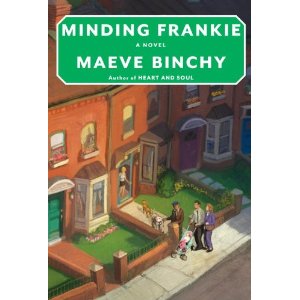
What can one say about
Maeve Binchy except “read her?” Binchy is a master at characterization and story telling and each new title is, indeed, a long anticipated treat. Speaking of which, her latest,
Minding Frankie, is due out on March 1. Here’s the blurb:
Maeve Binchy is back with a tale of joy, heartbreak and hope, about a motherless girl collectively raised by a close-knit Dublin community. When Noel learns that his terminally ill former flame is pregnant with his child, he agrees to take guardianship of the baby girl once she’s born. But as a single father battling demons of his own, Noel can’t do it alone. Fortunately, he has a competent, caring network of friends, family and neighbors: Lisa, his unlucky-in-love classmate, who moves in with him to help him care for little Frankie around the clock; his American cousin, Emily, always there with a pep talk; the newly retired Dr. Hat, with more time on his hands than he knows what to do with; Dr. Declan and Fiona and their baby son, Frankie’s first friend; and many eager babysitters, including old friends Signora and Aidan and Frankie’s doting grandparents, Josie and Charles. But not everyone is pleased with the unconventional arrangement, especially a nosy social worker, Moira, who is convinced that Frankie would be better off in a foster home. Now it’s up to Noel to persuade her that everyone in town has something special to offer when it comes to minding Frankie. I’ve already pre-ordered this title on my Nook.

Author Marion Chesney is now busy churning out tiles in both the Agatha Raisin and Hamish MacBeth series. If you’ve never read them, by all means do. You’ll find all the titles, and everything you need to know about them, on her
website. Both are a series of cozy village mysteries, one set in the Cotswolds, the other in the Highlands of Scotland. Recurring characters and subplots, the standard cozy mystery fare, are both to be found. What isn’t to be found, from one who has read them all, is anyth
ing new. After about the 15th book in each series, one gets to feel that they are simply reading the same book over and over again. And Hamish and Agatha’s character flaws seriously begin to grind on one’s nerves. Still, if you haven’t read them before, you’re in for a treat. What I really wish is that M.C. Beaton would give these books a rest and go back to what she does (did) best and that’s writing Regency comedies as Marion Chesney. Yes, technically her books can be considered Regency romances, but I loved them for their plot lines and humour. And they were written in various series, so that you could settle in with a particular family and get to know all the members. These included the
House for the Seasons, Travelling Matchmaker and
Poor Relation series. You’ll find a
complete bibliography here. Marion, I know you’re raking in the cash with Agatha and Hamish, but please consider returning to the 19th century.

Beverley Nichols was the sort of man once euphamistically known as a “perennial bachelor.” He was also a writer who managed to write between bouts of gardening, house renovations, visits from instrusive neighbors and caring for cats. Many of his books are about gardening and/or cats, neither subject known for its excitement value. There are no car chases, sexual adventures or titillation of any sort, but what these books do contain is Nichols’s voice, which is at times fond, ironic, exasperated, plaintive or just plain pleased with itself. His first gardening book,
Down the Garden Path, was illustrated — as were many of his books — by Rex Whistler. It was a bestseller running to 32 editions and has been in print almost continuously since 1932. It was also the first of his trilogy about Allways, his Tudor thatched cottage in Glatton, Cambridgeshire. A later trilogy written between 1951 and 1956 documents his travails renovating Merry Hall (Meadowstream), a Georgian manor house in Agates Lane, Ashtead, Surrey, where Nichols lived from 1946 to 1956. These books often feature his gifted but laconic gardener “Oldfield”. Nichols’s final trilogy is referred to as “The Sudbrook Trilogy” (1963–1969) and concerns his late 18th-century attached cottage at Ham, (near Richmond), Surrey. Sometimes Nichols waxes poetical about his endeavors – “To dig one’s own spade into one’s own earth! Has life anything better to offer than this?” At other times, he’s just plain funny – “I was brought up surrounded by junk. It was no fault of my mother’s, who had an exquisite, natural taste; it was merely a question of money. We had a large house, a quantity of hideous inherited furniture, and an abundance of positively frightening pictures. We had to put up with them.” Here’s a link to
his website, where you’ll find more excerpts from his books and you’ll find blurbs and more about Nichols’s
titles here.
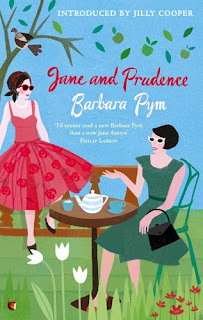
Barbara Pym is known for her novels that include village vignettes and snaps of social satire. In a book review, The Times said: “In Jane and Prudence, one character ironically compares herself to Austen’s matchmaking heroine Emma Woodhouse – and turns out to be no better at finding a husband for her protégée than Emma was. This is Jane Cleveland, a vicar’s wife, now in her forties, who hopes to see her best friend Prudence Bates – a sophisticated bachelor girl with a tendency to fall for unsuitable men – happily settled like herself. So she invites her to the village where her husband Nicholas is vicar, and introduces her to Fabian Driver, a handsome and eligible widower. But Prudence has an unlikely rival for Fabian’s affections in mousy-looking Jessie Morrow, a lady’s companion determined to escape her role as a spinster.” For an article on Pym’s writing, click here. You’ll find the site for the U.S. Pym Society here. There’s also a (hard to find) Barbara Pym Cookbook, featuring recipes mentioned throughout her books.

Born in 1913, Dora Jesse Saint began writing under the name Miss Read in 1955 and has charmed us ever since with her books set in both the fictional Fairacre and Thrush Green. The blurb for the first Thrush Green, titled the same, runs – “
It’s the May Day holiday, and a fair has come to the village of Thrush Green. The residents of Thrush Green all have their own views about the fair. For young Paul, just recovered from an illness, it is a joy to be allowed out to play at the fair; for Ruth, who returned to the soothing tranquillity of Thrush Green nursing a broken heart, the fair is a welcome distraction from her own problems. And for Dr Lovell, the fair brings an unexpected new patient. Then there is Mrs Curdle, the long-standing matriarch of the fair. For her, this year’s visit to Thrush Green awakens mixed feelings, and a difficulty she doesn’t want to face… Full of Miss Read’s inimitable charm and humour, Thrush Green is a wonderful introduction to this bestselling series.” While written in the 1950’s, 60’s and 70’s, Miss Read’s books read as though they hark back an even earlier time when life was simpler and time ticked by more slowly. The crisis encountered by the villagers in Thrush Green are more personal than global and are often solved by their being shared. Still, Miss Read uses insight to draw simple but richly felt characters with whom we instantly identify and for whom we care immensely. As we do for those characters who live in Fairacre “. . .
a village of cottages, a church and the school – and at the heart of the school, its head mistress, Miss Read. Through her discerning eye, we meet the villagers of Fairacre and see their trials and tribulations, from the irascible school cleaner Mrs Pringle, to the young school children, with their scraped knees, hopeful faces and inevitable mischief. Miss Read takes us through the school year, beginning with the Christmas term, when the bitterly cold weather challenges the school’s ancient heating system, right through to the hot summer day when school is over for another year. Full of Miss Read’s unique, acerbic wit, and wry observations.” These are books to savor and to read, and re-read, whenever the world we currently
live in seems a bit too complicated for our liking. Miss Read retired from writing in 1996 and was made a Member of the Order of the British Empire in 1998. As far as I can make out, she is still alive. Hurrah! Why, I wonder, is there no
Miss Read Society? You can find a complete bibliography of her
books here.
There is an Angela Thirkell Society and you can find them here. In fact, our very own Victoria is a card carrying member and did a post on the Society that you’ll find here. Barsetshire is a fictional county created by Anthony Trollope, which is featured in the series of novels known as the “Chronicles of Barsetshire” and where the county town and cathedral town is Barchester. Trollope’s books have been made into various mini-series, namely The Way We Live Now and The Pallisers. I’ve just downloaded the first book in the Barsetshire series, The Warden, and will then move on to The Barsetshire Chronicles, also made into a mini-series. Barsetshire was also used as the setting for a series of 29 novels by Angela Thirkell, written from 1930 to 1961. Thirkell’s stories blend social satire with romance. In Part Two, Victoria will tell you about Thirkell’s books – and more.
Part Two Coming Soon!