The Jubliee Flotilla – LIVE UPDATES

The Queen is onboard – click link for more photos

SCROLL DOWN FOR REAL TIME UPDATES

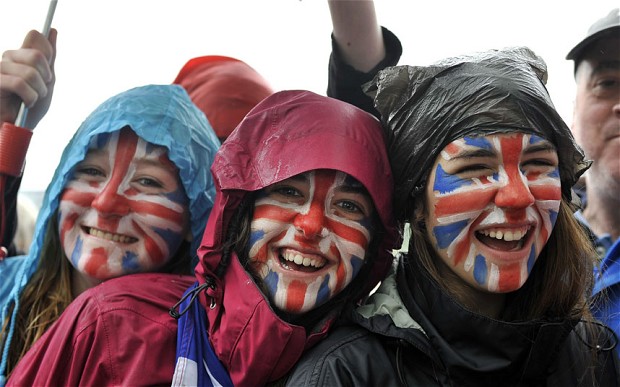
Crowds line the Thames – see the pictures
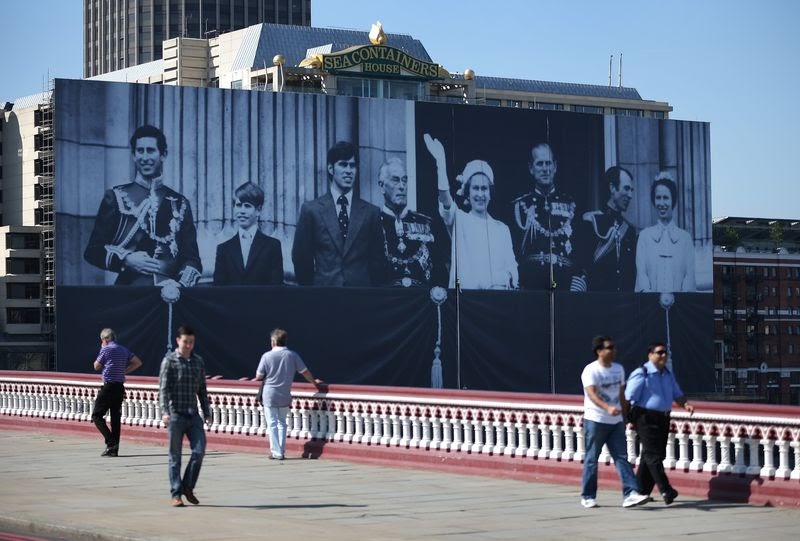
Royal Family photo lines the Shore

More about The Shard, the River’s newest landmark
Click here for the Flotilla Musical Programme
Read more about the Dunkirk Little Ships
Rooftop Semiphore Message to the Queen – What Are They Saying?
The St. Paul’s Cathedral Website
The history of Tower Bridge
Listen to the Opening Fanfare of the Royal Marine Trumpeters
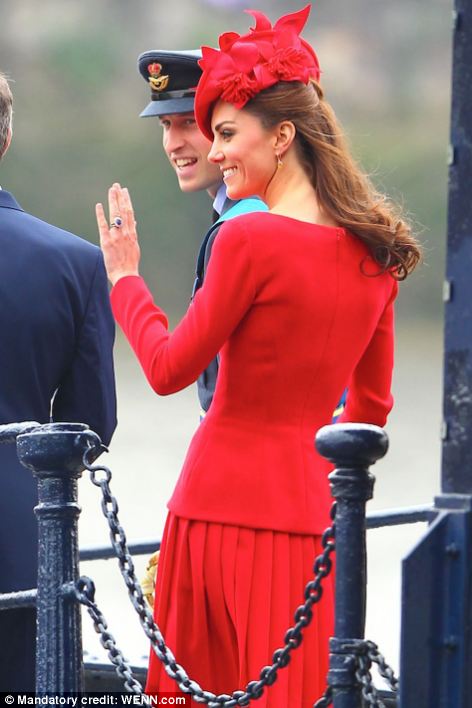
The Middleton’s enjoy the festivities aboard steamer
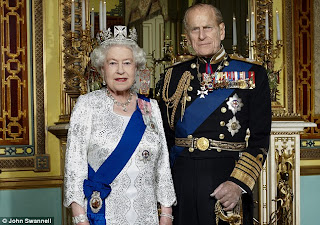
What the Royals are saying about the festivities
More about the Sailing Ship Tenacious

The London Philharmonic’s New Water Music for the Diamond Jubilee

Did I just hear the BBC commentator say that Lock Hatters
made Lord Nelson’s hat for the Battle of Waterloo!?

All about narrowboats

More about Paul Weston’s Maxime

Update: Weather forces cancellation of Royal Navy Flyby

Oh, God, this jaunty turn around in front the the Royal Barge is hysterical!

Rule Britannia!

Fireworks! Tower Bridge! Whistles! Crying!

Flotilla crowd one million strong

God Save the Queen

Be There! At the Queen's Jubilee

Victoria here, barely recovered from the news that a friend’s husband has secured a spot for her to observe the Thames Pageant aboard one of the boats on the river.  I had to retreat to the fainting couch to recover from my envy.  I hope she takes really good pictures.  And I am happy for you Molly, I really am.  Really.

I will be at home, in the U. S. upper midwest, watching as much as I can find on television.  In case you are going to be looking too,  I am eager to share the good news that BBC America will do live coverage on Sunday and Tuesday.  I have made snarky remarks about the US version of the Beeb (which must be a cash cow for them) because as much as I am eager to watch BBC America, it seems like all they run are shows of that nasty chef, the very noisy Top Gear and (forever) Dr. No.   Where is good old Alan Titmarch?  Or those two ladies who clean the houses?  Or some reruns of their wonderful dramas? Whoops, here I go again. 

BBC America will carry coverage of the Diamond Jubilee on Sunday, June 3, and Tuesday, June 5.

For more information:  http://www.bbcamerica.com/diamond-jubilee/

Sunday June 3, 2012:

Beginning at 5:30 am EDT: Previously presented programs include William and Harry: The Brother Princes; and All the Queen’s Horses, et. al.

8:30 am EDT, The Queen’s Diamond Jubilee: Thames Pageant

1:00 pm EDT Memories of a Queen

2:00 pm EDT Britain’s Royal Weddings

4:00 pm EDT William and Kate: A Fairytale Romance

5:30 pm EDT Prince William and Prince Harry: Into the Future

6:30 pm EDT William and Harry: The Brother Princes

8:000 pm EDT The Diamond Queen

11:00 EDT The Diamond Queen

Some programs repeated until 4:30 am EDT Monday

Tuesday, June 5, 2012:

4:15 am EDT The Queens Jubilee Service of Thanksgiving and Royal Procession Part One

6:00 am EDT The Queens Jubilee Service of Thanksgiving and Royal Procession Part Two

8:30 am EDT The Queens Jubilee Service of Thanksgiving and Royal Procession Part Three

Coverage of the Tuesday evening concert can be found on ABC stations.

Tuesday, June 5, 9 pm EDT Concert for The Queen: A Diamond Jubilee Celebration

ABC has the exclusive American broadcast rights to Concert for The Queen: A Diamond Jubilee Celebration, which features Sir Elton John, Sir Paul McCartney, Sir Tom Jones, Annie Lennox, Kylie Minogue, Stevie Wonder and young recording sensation Jessie J.  Katie Couric will take viewers backstage for a unique view of the festivities, including interviews with the concert’s biggest stars.

ABC’s “Good Morning America” will broadcast Live from London June 4 and 5 mornings.

Expect coverage also from CBS, NBC, CNN and MSNBC all weekend, particularly on morning and evening news programs.
 
CBS has a couple of websites showing their coverage of events leading up to the Jubilee – click here

For full coverage, depend upon the official Diamond Jubilee site.

So, while I know you will BE THERE, Molly, I just might see more if it from over here.  At least I can comfort myself with that thought.


Kristine and I hope all of Number One London’s dear readers enjoy the upcoming events as much as we plan to do.  God save the Queen. Long may she reign! 


The Milwaukee Symphony Goes British

Imagine my delight when I looked at the program for the MSO’s weekend of May 26 — Music from the British Isles with conductor Christopher Warren-Green.

Just returned from a widely-praised concert in NYC’s Carnegie Hall, the MSO performed works by William Walton, Max Bruch (though German by birth, he was the conductor of the Liverpool Symphony) and Ralph Vaughan Williams.

Here is the link to an audio version of the MSO’s performance in New York, via WQXR.

For the series of concerts of British music, the guest conductor was Christopher Warren-Green, who is the music director of the Charlotte, NC Symphony and the director of the London Chamber Orchestra, among many other celebrated duties, including for royal events, particularly at the royal wedding in 2011.

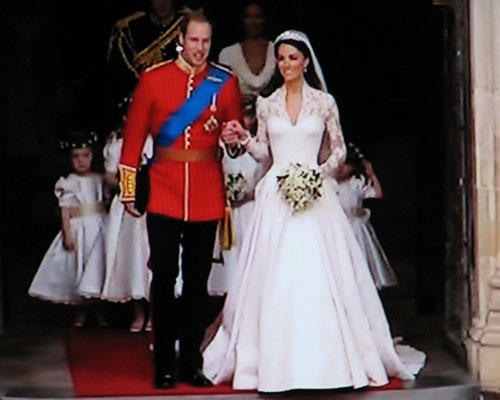
The Recessional piece was the first on the program of the MSO concert, the Crown Imperial Coronation March by William Walton.  Here is a link to the PBS television excerpt of the wedding processional featuring the Walton Coronation march played by the London Chamber Orchestra conducted by Christopher Warren-Green, about a minute, 20 seconds in, and continuing until the couple left Westminster Abbey.    (You can download the entire Royal Wedding Music CD from iTunes.)

Sir William Turner Walton OM (1902-1983) wrote for films and classical orchestra, opera and ballet.  According to the Wikipedia entry, “(Sir Edward) Elgar having died in 1934, the authorities turned to Walton to compose a march in the Elgarian tradition for the coronation of George VI in 1937. His Crown Imperial was an immediate success with the public, but disappointed those of Walton’s admirers who thought of him as an avant garde composer.”  All Anglophiles will recognize it immediately, very  much in the tradition of Elgar’s Pomp and Circumstance, music meant for a glorious occasion.

Next on the program was Max Bruch’s Scottish Fantasy for Violin and Orchestra, Opus 46. The soloist was Jennifer Frautschi, a rising young talent who has performed with major orchestras throughout the U.S. and Europe.  She plays a loaned 1722 Stradivarius known as the ex-Cadiz.   The Milwaukee Journal Sentinel review stated, “Frautschi brought sterling techniques and a pure, focused sound to the piece, playing with tremendous depth of expression. She gave clear character and meaning to Bruch’s setting of Scottish tunes, never lapsing into caricature.”  Click here to read the entire concert review.

Max Bruch (1838-1920) spent most of his career in  his native Germany but served as director of the Liverpool Symphony from 1880-1883.  In a Munich library, he discovered some Scottish folk tunes transcribed and he used some of them, along with tunes from Robert Burns songs, for this virtuosic fantasy. 

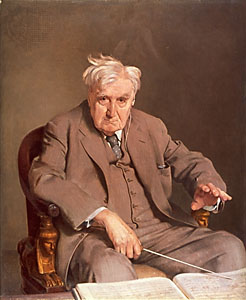
The final selection was the Symphony #5 in D major by Ralph Vaughan Williams (1872-1958).  In his pre-concert talk, Marquette University’s Jason Ladd said Vaughan Williams knew both of the other composers on the program quite well.  Max Bruch was one of his teachers and he visited with William Walton at his Italian island retreat of Ischia.

Vaighan Williams served in the ambulance corps in WWI and his experiences greatly influenced his music.  His fifth symphony was written between 1938 and 1943, but unllike some of his earlier works, it was not war-like in nature.  Instead, Ladd called it “meditative, comforting, and serene,” as if  anticipating the coming peace. 

To me, the concert was a complete delight, a little familiar music and two pieces relatively new to me, all three very satisfying, perhaps even nourishing.    Thanks Mr. Warren-Green, Ms. Frautschi, and the MSO.

Period Properties For Sale

Guide Price Of £350,000 – The Boatswain’s House, also known as Dockyard Cottage, is an elegant late Georgian style house, circa 1826, which is now in need of restoration. It is part of an exciting project to give new life to an historic group of buildings which fall within an area of World Monument Fund Watch List Status and in a rapidly improving Conservation Area. The property lies within the historic Royal Dockyard and is Listed Grade II.

Restoration is already well underway on many of of the historic houses which formed the officers’ accommodation in the early 19th century Royal Dockyard. The rebuilding of the naval base between 1813 and 1826 brought together some of the country’s most eminent engineers and architets of the time, Edward Holls and George Ledwell Taylor, architects, and John Rennie the Elder and Sir John Rennie the Younger, engineers. The entire scheme was built in one phase. It remained an important strategic naval base until the Royal Navy withdrew in 1960. After years of undercertainty, the historic residential quarters are to be preserved, following a campaign fought by the Spitalfields Historic Building Trust. With the support and enthusiasm of a number of private investors work is well underway and their poineering spirit and determination are already transforming the area.

The Boatswain’s House is an elegant symmetrical double fronted house with walled garden to the rear. The interior is a double-depth plan with a central hall and fine staircse. The decorative detail in the principal rooms is not elaborate but was designed to relfect the status and importance of its original occupant. The accommodation is arranged on lower ground, ground and two upper floors, the rooms, which include a double reception room, are well proportioned and although the restoration will require a future owner to plan a kitchen and bathrooms the house offers considerable scope with a total of about 3,016 sq.ft. Once the renovation is complete the property would potentially provide a hall, double reception room, dining room, study, 4 or 5 bedrooms, 2 or 3 bathrooms, large kitchen, 2 cloakrooms and 3 lower ground floor rooms. For further details, contact Jackson-Stops and Staff.

Offers in Excess of £400,000 – FIRST TIME TO THE MARKET FOR 400 YEARS. A one off opportunity acquire a charming thatched cottage in need of updating and offered with no forward chain. Ashley Lodge, a former Gate House to Somerley House, is a delightful thatched cottage located on the edge of Ringwood with access and views of the Ringwood Forest.

Although the late owner of the cottage believed it to date back to 1482, whilst writing this we have only been able to access public records dating back to the early 1800’s. A map of the Somerley Estate dated 1810, headed as in possession of Henry Baring, has what looks to be a small building on the edge of the estate. Sale particulars dated 23rd May 1811 include “Two handsome Entrance Lodgers from the Ringwood and Harbridge Roads”. Documents show Henry Bearing selling the Somerley Estate to the Normanton’s in the 1820’s when “The Lodge” and “Somerley Lodge” appear upon documents and is assumed to be Ashley Lodge.

Census records show a Charles Shave aged 3 living at “Somerley Lodge” in 1841with parents William and Martha Brown and William and Caroline Shave during 1881. The Cottage is known to some locals as “Shave’s Lodge” which is believed to originate from the name of these residents.

Numerous postcards illustrating the circular iconic lodge in the early 1900’s were produced by a local printing company who were located within the shop currently occupied by W H Smith. Heavy snow during April 1908 gave the printers an excellent opportunity of creating further picturesque postcards.

The late owner, Brian Spence inherited Ashley Lodge from his parents, Mr and Mrs Batstone, who are believed to have bought the lodge from Lord Normanton in 1962. Mr Batstone, an architect and army officer, extended the one bedroom cottage which is believed to have housed a lady with eight children who may have worked for the Somerley Estate. The property is now being sold, for the first time in 50 years on the open market by the family of the late Mr Brian Spence. No doubt further information relating to Ashley Lodge and its previous tenants will unfold. For further info, click here.

 
The Pavilion, Hampton Court Palace – £8,950,000 – Situated on the historic Barge Walk between The Thames and Hampton Court Palace, the property enjoys views of the adjoining 560 acres of the Palace Home Park and river. The Pavilion is offered in superb condition and is now being sold with planning permission and listed building consent (March 2011) to erect a second Pavilion and two summer houses within the wonderful 2 acres of gardens and to reinstate the original vista from The Palace to the site. Further details and a number of computer generated images are shown in the comprehensive brochure as well as being available upon request. The Pavilion is the one remaining of four originally built on the site under the guidance of Sir Christopher Wren and was completed in 1702 for William III surrounding the largest formal garden, including a bowling green at the time. This is a very special property of both architectural and historic interest.                        

Miss Benn Dines with Jane Austen

The Jane Austen House Museum, Chawton

On May 25, 1811, Miss Mary Benn dined at Chawton Cottage with Jane Austen, and — one assumes — her mother Mrs. Cassandra Austen and their co-resident, Martha Lloyd. 

We learn this in Jane Austen’s letter of Wednesday, 29 May 1811, to her sister Cassandra who was staying at Godmersham, the Kent home of their brother Edward Austen and his children.  This letter is filled with rambling accounts of family and friends — from seedlings to disinheritances. 

Syringa (Lilac)

Jane tells her sister that the Pinks and Sweet Williams are blooming and the Syringas coming out.  She relates family news, upcoming journeys  and that very day a second encounter with Miss Benn  over their tea table.

Miss Benn is a poor spinster who lives in reduced circumstances in Chawton; though we know little about her, she is mentioned in Jane Austen’s letters more than a dozen times in the few years between the Austen’s arrival in Chawton and Miss Benn’s death at age 46 in early January, 1816.  Some biographers have speculated that her extreme poverty caused the Austens to invite her for meals frequently.  In her 1997 biography Jane Austen: A Life, Claire Tomalin  writes, “‘Poor Miss Benn’ appears very much oftener in Jane’s letters than their few better-off neighbours; she was not very interesting, but then nor were they” (p.210)

In January 1813, Jane Austen reported from Chawton to her sister in Steventon that “I have got my own darling Child from London…” meaning a copy of the three-volume first edition of Pride and Prejudice, Austen’s second published novel.  In the letter of Friday, 29 January 1813, Jane tells Cassandra that she had read half of the first volume to Miss Benn, who was “amused, poor soul.” Miss Benn “seemed to admire Elizabeth.”

In her next letter, Austen writes that her mother had read further in the novel to Miss Benn.  Austen did not care for “my Mother’s too rapid way of getting on…Upon the whole however I am quite vain enough and well satisfied enough.–The work is rather too light and bright and sparkling…” — an opinion that generations of readers would deny, finding precisely the correct light, bright and sparkling qualities in the novel.

Mary Benn was the sister of Reverend John Benn (1766-1875) who presided over the parish of Farringdon, nearby Chawton in rural Hampshire.  Mr. Benn and his wife had as dozen children, which probably meant they could not do much to help Miss Benn.

Nevertheless, Miss Benn has found her place in the eternal pantheon of Jane Austen fans.  I am sure she would be surprised even to be mentioned in the year 2012, two hundred years after that dinner in Chawton.

I was alerted to this less-than-earth-shattering meal in my weekly perusal of  A Year with Jane Austen: A Calendar for 2012, the production of JASNA-WI.  Events from Jane Austen’s life and/or events in her novels fill almost every day of this wonderful calendar, accompanied by appealing color reproductions of the 1898 illustrations for editions of Austen’s novels by artist C. E. Brock.

These calendars are still available — and you have half of 2012 left to enjoy one.  Go to the JASNA-WI website  here and click on Merchandise.