Christie's – The Exceptional Sale

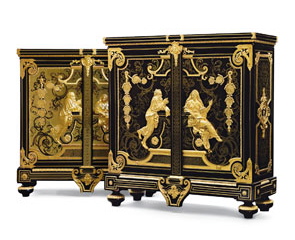
“Brand Cabinet,” ca 1743. Est: £800,000-1,200,000. Photo: Christie’s Images.

The Exceptional Sale, taking place on 5 July in King Street, London, is Christie’s premier auction for the decorative arts. This exclusive annual sale includes the finest works of art in a variety of categories, from furniture and sculpture, to porcelain, silver and clocks. It is carefully curated to include only the very best examples.

From the Christie’s Press Release:

In 2008 Christie’s launched a unique sale platform for the very best decorative arts; The Exceptional Furniture Sale saw 10 masterpiece works realise a total of £10.3 million. Building on the success of this sale and The Exceptional Sale held in 2011, Christie’s is pleased to announce details of The Exceptional Sale 2012 which will take place on the evening of 5 July. Comprising 48 lots, the sale presents three centuries of decorative arts, from the first quarter of the 16th century to the first quarter of the 19th century. Featuring the finest examples of furniture, silver, sculpture, clocks and porcelain – including recent discoveries and previously unknown examples – the sale exemplifies the very best of European decorative arts. It is expected to realise a total in excess of £13 million. Robert Copley, Deputy Chairman Christie’s UK, International Head of Furniture and Decorative Arts states: ‘With The Exceptional Sale Christie’s celebrates excellence in furniture and the decorative arts. The attributes of this carefully curated auction are provenance, rarity, design, and craftsmanship. From exquisite furniture by André-Charles Boulle and Thomas Chippendale to the magnificent Leinster silver dinner-service; from a rare maiolica plate by Nicola da Urbino to a newly discovered marble group by Jan van Delen; from glittering Chinese clocks and ormolu-mounted porcelain to the finest examples of Italian pietre dure, The Exceptional Sale offers collectors an opportunity to acquire the very best.’


The exceptional Brand Cabinet (above), a George II ivory-mounted padouk medal-cabinet, circa 1743 (estimate: £800,000-1,200,000), was made for the wealthy young Dilettante Thomas Brand, who like many English milordi went on The Grand Tour, arriving in Rome in 1738. It is here that he probably purchased the ivory plaques that depict figures from Classical mythology such as Leda and the Swan. A couple of years later, Brand’s contemporary and ‘intimate friend’ Horace Walpole also made the Tour. On his return he designed a cabinet to house his precious ‘enamels and miniatures’. No doubt inspired by William Kent, his cabinet and Brand’s are both made of padouk and are attributed to William Hallett of Great Newport Street, in Covent Garden. Walpole’s cabinet subsequently hung in the Tribune at Strawberry Hill and is now in the Victoria and Albert Museum, while Brand’s cabinet remained at the family house, The Hoo, in Hertfordshire until it was first sold at Christie’s in 1938.

The Ogden Mills ‘Armoires à Six Medailles’ (above) are lavishly decorated with spectacular gilt-bronze mounts that fuse seamlessly with the scrolling foliate pattern of the sumptuous ground of brass and tortoiseshell première and contre-partie marquetry (estimate: £1,000,000–1,500,000). The Louis XIV armoire in contre partie is attributed to André-Charles Boulle, while the late Louis XVI in première partie is by Delorme. They are decorated to the doors with trails of medals celebrating the Life of Louis XIV as well as the figures of Aspasia and Socrates. Conceived initially with shelves to house collections of precious medals this series of armoires proved so successful it remained in production in Boulle’s workshop throughout the first half of the 18th century and was subsequently continued by Boulle’s followers.

To view the sale catalogue online, visit the Christie’s link here.

The Spirit of Chartwell

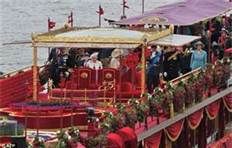
Do you recognize this vessel, The Spirit of Chartwell?

How about now? Yes, the Spirit of Chartwell was kitted out in all it’s regal glory as the Queen’s Jubilee Barge during the recent Thames Pageant. She is the only cruise vessel capable of navigating both the upper courses of the Thames and the open sea. She has two lounges, open-air viewing areas and a unique third floor dining room, complete with an elevating roof. The Spirit of Chartwell can easily accommodate up to 36 passengers in 18 comfortable guest cabins across two decks. The ship was designed to evoke the timeless grandeur of the 1929 Cote d’Azur Pullman railway carriage complete with artefacts from the original train and great ocean liners of yesteryear.

The ‘Spirit of Chartwell’s’ pièce de résistance is the George Bradshaw Lounge/Restaurant together with the adjoining Somerset Maugham Piano Bar resplendent in rich mahogany finishes, motif studded hardwood flooring, sculptured tables, Lalique glass inlaid panelling and intricate marquetry.

Nice to know that we commoners can also book a day cruise aboard the Spirit of Chartwell. Their Sunday Glory cruise allows guests to spend a lazy Sunday afternoon onboard with Sunday lunch and High Tea being served onboard while you sail along the Thames and take in London’s iconic landmarks at a cost of £120 per guest at a’ Riviera’ Armchair Table Setting for up to six guests.

The Memories of London package provides a circle cruise from Cadogan Pier at Chelsea, sailing first towards the Thames Barrier then upstream past London’s iconic landmarks before returning to Canary Wharf. Calls are made at Greenwich and Tate Britain with optional overnight State Cabin accommodation. Included in the fare, which begins at £220, are a Captain’s Welcome Champagne Reception, three course luncheon, high tea buffet and five gala course dinner.

If you’re looking for a longer cruise, as part of Ace Cultural Cruises, the Spirit of Chartwall embarks on a six day London and River Thames cruise that takes in Greeenwich, Rochester, Chartwell, Cliveden House and Blenheim Palace. Full details can be accessed at the company website, available here.

Click here to watch video of the Royal Family boarding the Spirit of Chartwell for the Thames Jubilee Pageant.

Keep Calm and Carry On: Words for Posterity

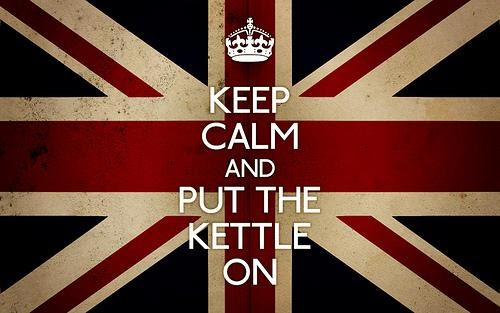
This famous poster, put out by the British government in 1939 to encourage the traditional stuff upper lip of the British people in the face of Nazi aggression, has had multiple second lives as the inspiration for many new designs.  Regular readers of this blog know we sometimes post versions in the sidebars.  And if you follow either of us on Pinterest — or just about anybody else there — you will see many versions.  Here are a few of our favorites.

Many of the signs reflect a real philosophy of life — or not!  There are many collages of the images too.

And lots of products carry a version of the logo.

And finally a few “farther-out” faves”:

Napoleon Invades Russia, June 24, 1812

Napoleon in His Study, 1812
Jacques-Louis David (1748-1825)
National Gallery of Art, Washington D.C.

Another bicentenary is here, though its connection to Britain is not quite direct.  However, the failure of Napoleon’s Russian invasion and the destruction of a large part of his army contributed to his ultimate defeat(s) by the allied nations led by Great Britain.

With the benefit of hindsight, historians have spent two hundred years pointing out the deficiencies in Napoleon’s goals, strategies and execution.  I have to admit most of my knowledge about Napoleon’s  Russian campaign was learned in Tolstoy’s War and Peace, published in 1869.

And since it is incredibly long (though also brilliant), I skimmed (or skipped) large sections.  So my limited knowledge is, perhaps,  more attributible to the 1956 film of War and Peace.  I love that movie, starring Audrey Hepburn as Natasha, Mel Ferrar as Prince Andrei, and Henry Fonda as Count Pierre Bezukhov.

War and Peace, directed by King Vidor
There have been other non-novel versions of Tolstoy’s sprawling masterpiece, including an opera by Sergei Prokofiev, composed during World War II.  I remember the 1956 film with great affection.  In order to cover most of the story, however, it lasts about three and a half hours.

War and Peace, Metropolitan Opera production 2002

As everyone knows, Napoleon’s campaign in Russia was a total disaster.  Numbers vary but about half a million soldiers of the Grand Armee marched into Russia and only a fraction returned by the end of 1812. Well before the Russian campaign, Arthur Wellesley, later named first Duke of Wellington, began to turn the tide in the Peninsular War, invading Spain from Portugal in January, 1812.  Wellington and the allies won the Battle of Salamanca, June 17-22, 1812.  French Marshall Soult and his defeated troops fought on but slowly withdrew into France.

Battle of Salamanca, June 17-22, 1812

On June 24th, having heard nothing about the British and Allied victory in Spain, Napoleon’s troops crossed the river Niemen into what is now Lithuania, then Russian Poland.  The Russians, greatly outnumbered, usually retreated or conducted brief skirmishes instead of standing and fighting as Napoleon’s enemies usually did.  In doing so, the Russians drew the French deeper and deeper into their sparsely populated regions, completely fouling up supply lines for the rapidly moving French.  By mid-October, the French encircled Moscow, the capital.  The Russians evacuated the city — and it burned, whether set afire by the fleeing citizens or by the invading troops no one can know.  Probably both.

Napoleon’s Retreat from Russia
by Alfred Northen (1828-1876)
On the long retreat in the frigid weather through land already stripped of all provisions, constantly harrassed by Russian troops and Cossack raiders, the French troops simply starved or froze.  Supplies and artillery were abandoned. The horses also died or were consumed. By mid-December, when the last of the French left Russia, up to 380,000 men had been lost with almost 100,000 captured.  It had been a national disaster for France and a personal catastrophe for Napoleon.

London Walks

If you are lucky enought to be in London this season, be sure to take advantage of one of the city’s best bargains: London Walks.  Here is their website with their daily schedules.

Though I am missing out on London this year, I’ve visited at least once almost every year for the last 25 or so, and I never tire of tagging along with the London Walks guides.  Not a single disappointment —  and I’ve been on quite a few of them at least twice.

There are many operators of walking tours and many may be excellent, but with London Walk, you can be confident you have an experienced and entertaining guide.  Among the most popular walks (and operated by many it seems) is a night-time venture through the alleys of the East End in the footseps of Jack the Ripper.  Note: you won’t find him! I found the LW guide a fount of knowledge about the criminal, the victims, the crimes and the locale, with all sorts of facts included about the residents and architecture of the area, now largely gentrified.  I didn’t want a sideshow kind of tour — and it wasn’t.  But be careful of copycat tour operators.

Bodecia on Westminster Bridge
One of my favorites (well, they  all are!) was a recent one: Old Westminster. I had told myself that since I’d visited Westminster Abbey, watched a debate in the House of Commons and walked across Westminister Bridge in the past, I really didn’t need this tour.  Was I wrong or WHAT?  I learned so much!  And that is exactly what happens on all the tours.

Little Venice

Also highly recommended: the Little Venice walk through a neighborhood not far from Paddington Station. You’ll see lovely homes and a fascinating church with a monument to actress Sarah Siddons. St. Mary on Paddington Green is, for Regency lovers, more like churches looked in those days, before the Victorians tarted them up with fancy new stained glass and other gee-gaws.

St. Mary Paddington Green, completed 1791

One of the Walks I have taken at least three times is Legal and Illegal London or the Inns of Court.  You will learn all about the British legal system, the difference between solicitors and barristers, and how the law is taught and practiced while walking around the delightful buildings and gardens of the City.

Gray’s Inn

 And you will visit the Temple Church, full of fascinating lore, dating from the 12th century, but with many renovations, including repairs after the Blitz.

Temple Church

On the walk Secret London, you find out why there is a camel on the banks of the Thames and secrets of sculptor Sir Edwin Landseer’s lion paws in Trafalgar Square.

You’ll find walks geared to fans of Harry Potter, the Beatles, Charles Dickens, Shakespeare and many more clever approaches to seeing the great city.  There are some special opportunities to visit Olympic sites too.  Each Walk takes about two hours (don’t forget to visit the loo before starting out).
Most days of the week London Walks runs Explorer Days, to such not-to-be-missed- sights such as Stonehenge and Salisbury Cathedral, Canterbury, Bath, Oxford and many many more, all accessible by train.  These cost a little more, but if you don’t drive in England, it is a convenient way to see a bit of the countryside as well major cities.

The Roman  Baths, Bath

Another special set of walks visit pubs in the evening, a boon to those of us who sometimes visit solo and enjoy a bit of company with our  pints (or I suggest half paints as you will visit several pubs and time is short at each one).  Here is one of my favorite London pubs, though I can’t remember which walk features it.

Blackfriars Pub

I hope this has convinced you to try out some of the London Walks on your next visit.  You won’t be sorry.

If you, like me, have to stay home this year, you might send for London Stories, pub
lished by London Walks, and written by David Tucker and the Guides.  It’s a good armchair companion.  It’s available on their website and elsewhere.