An Aside: Traveling in Germany

Victoria here.  My husband and I had a fabulous vacation in Europe this summer, and though I can’t pretend to duplicate Kristine’s hilarious adventures in England, I will attempt to interest you in a few of my own explorations. 

Vicky and Ed in Potsdam, at the Palace (one of many)


Like Kristine’s hubby, mine is tolerant of my obsessions with all things English, and equally long-suffering when it comes to being dragged around to historic sites, stately homes, and even pet cemeteries.  And a little like Kristine’s Greg, my Ed suffered a bit of a malady, if only some burst blisters.  It was tough going for him by the end of our journey.

I will not go into detail on the entire trip, but to begin with, we had our first trip to Prague in the Czech Republic.  The city is lovely and has a fascinating history.  Perhaps my favorite spot was the Klementinum, part of a large complex once a monastery and church, now mostly a study center and concert venue.

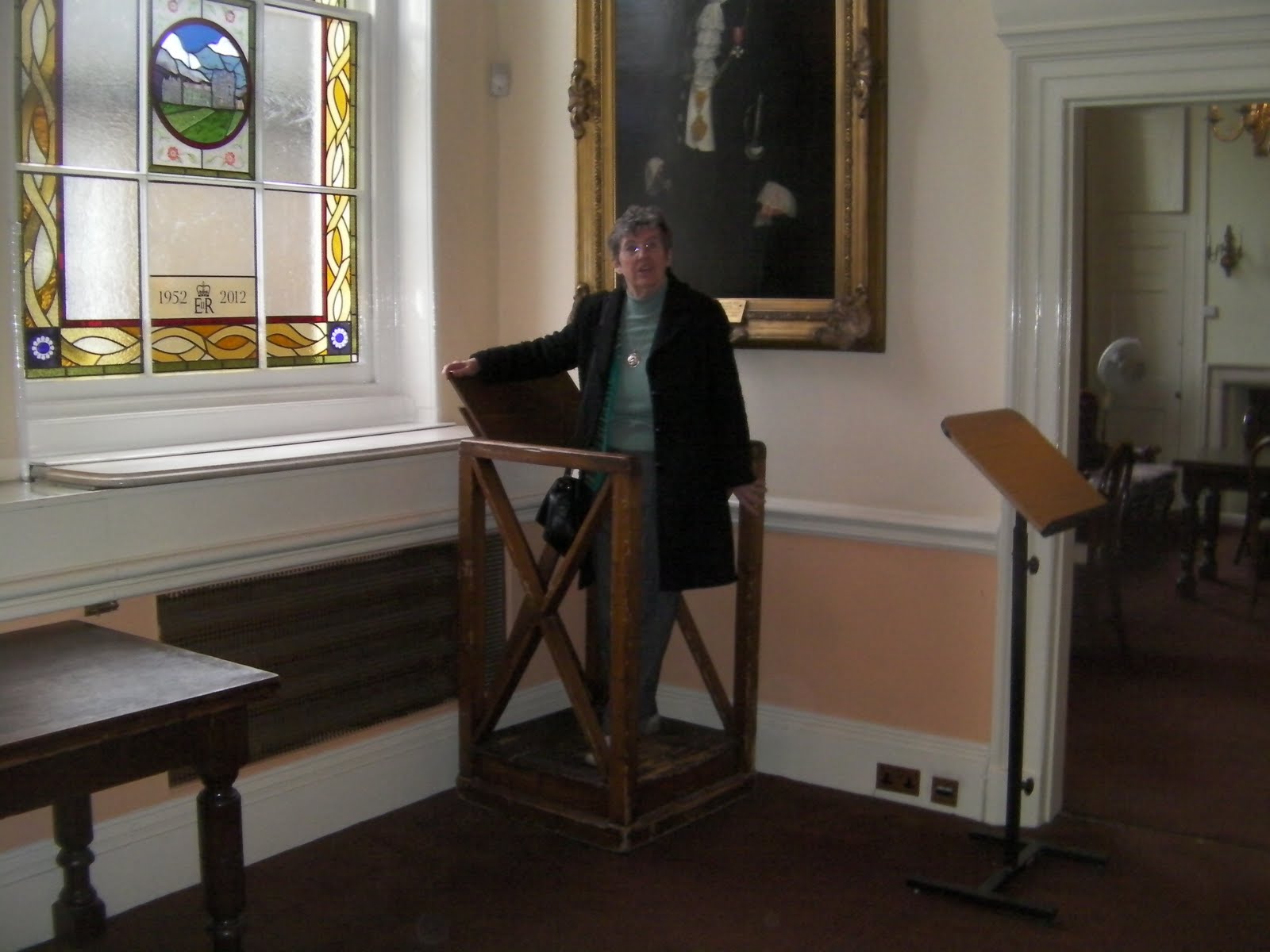
The Mirror Chapel
 
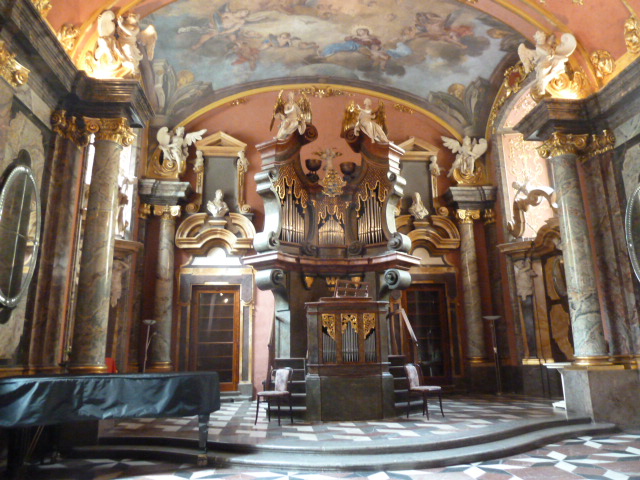
I have to lift the photo below from the web, as they did not allow cameras near the library.  It is a breath-taking sight and it made me yearn to study there.  The guide said it is open to researchers…but I didn’t see a soul.


Klementinum Baroque Library Hall


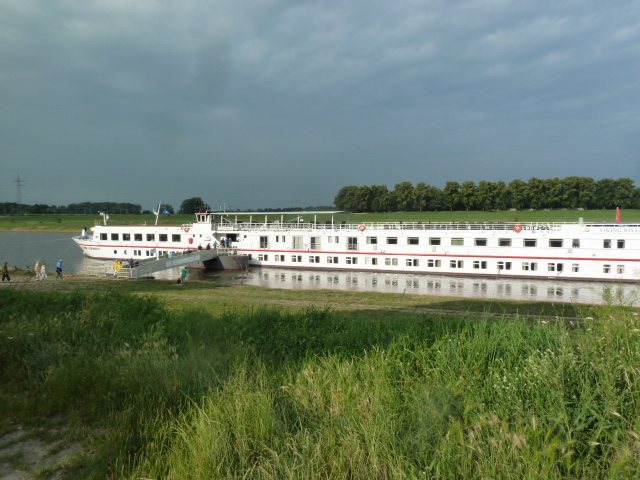
After a few days in Prague, we cruised the Elbe River on the MV Clara Schumann, part of the Viking Cruise Lines.  A fabulous trip, with perfect weather, though we did see the traces of and some damage from the Central European floods of early June.

Clara Schumann
 
 
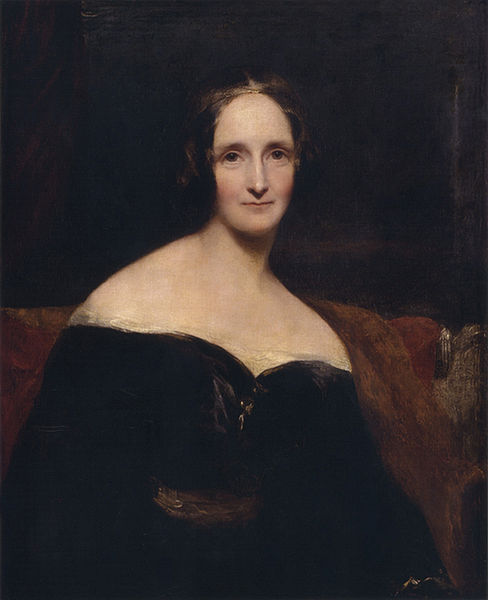
We were surprised when one of our stops was to visit the beautiful scenic area of the Bohemian Mountains which straddle the Czech Republic/German border, called variously Bohemian Switzerland and Saxon Switzerland. I was completely taken by surprise at the two adjoining national parks. This dramatic scenery was much beloved by the early Romantics, including writers, poets, composers and artists from all over.  Among the English visitors was Mary Godwin Shelley (1797-1851), of Frankenstein fame. 


Mary Shelley by Richard Rothwell (1800-1868), NPG


She wrote of the area in Rambles in Germany and Italy (1844):

“Immediately on quitting the village the portals of the mountains opened before us, and we plunged into their recesses.  It is difficult to describe the peculiarity of this region; it differs so much from every other…In Saxony, the impression is as if the tops of the hills were the outer circumference of the globe, strangely fissured and worn away by the action of water…The mystic imagination of the Germans has indeed peopled this region with gnome and kobold, who watch over hidden treasure…”


                “…The precipices are broken into a thousand fantastic shapes and forced into rough columns, pillars, and peaks numberless; with huge caverns, mighty portals, and towering archways; the whole clothed with pines, verdant with a luxuriant growth of various shrubs; and but that for the most part the long drought has silenced them, resonant with waterfalls.”


 Another famous Romantic who visited the area was the English painter J. M. W. Turner.  He sketched the scenery and his work is in the Tate Britain.  Here is one example, viewing the river Elbe from above:.


Below, two of my photos, from a similar vantage point.
 

The well-known German artist of the sublime Casper David Friedrich (1774-1840) left us this atmospheric painting which also expresses the Romantic mood of the region.

Wanderer Above the Sea of Fog, Kunsthalle Hamburg


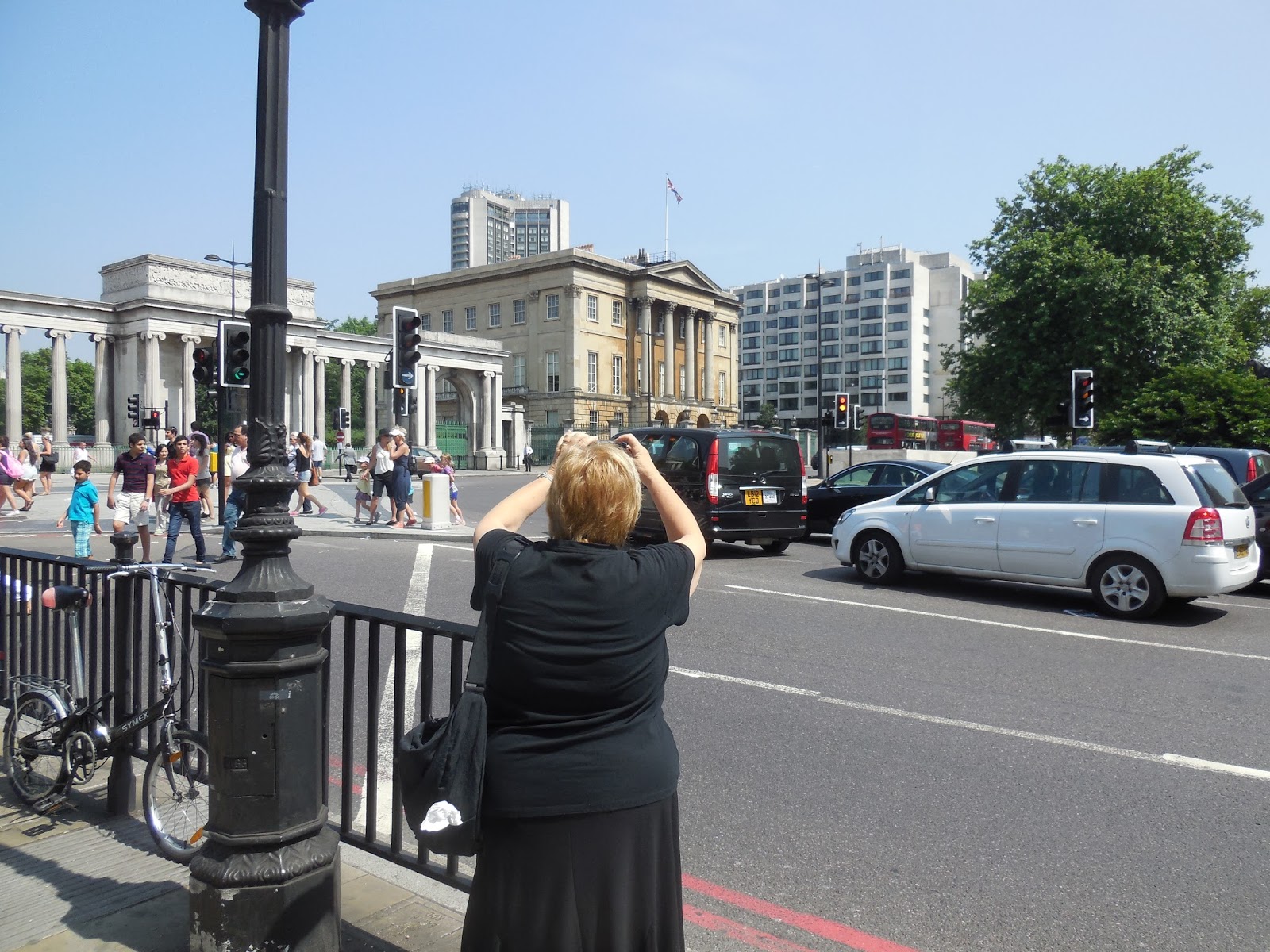
We next visited Dresden and had a few more British-related stops while in Germany.  More about those to come soon.  And also coming up, my busy (frantic?) week in England.  Below, I wait for a break in the traffic to photograph Apsley House in London.


At Auction – Christie's London

On July 2, Christie’s London held an Old Masters & British Paintings Evening Sale. Here are the results for a few of the fabulous items that were on the block.

 
 Milkmaids in St James’s Park, Westminster Abbey beyond
Price Realized
£217,875 ($331,388)


Sir Thomas Lawrence, P.R.A. (Bristol 1769-1830 London)
Portrait of Emily, Lady Berkeley, half-length, in a white dress with a blue sash
Price Realized
£901,875  ($1,371,752)

George Romney, R.A. (Dalton-in-Furness, Lancashire 1734-1802 Kendal, Cumbria)
Portrait of Elizabeth Ramus (1751-1848), daughter of Nicholas Ramus and subsequently wife of Baron de Nougal
Price Realized
£541,875   ($824,192)


 Here are a few results Christie’s The Exceptional Sale – July 4th


THE MARQUESS OF ANGLESEY’S CANDELABRA A PAIR OF GEORGE III SILVER TWO-LIGHT CANDELABRA
MARK OF JOHN WAKELIN AND WILLIAM TAYLOR, LONDON, 1792
Price Realized
£817,875    ($1,246,442)


A GEORGE III CARVED GILTWOOD AND CREAM-PAINTED FOUR-POST BED
CIRCA 1760 – 65, EXTENDED IN THE REGENCY. LORD CURZON’S FOUR-POST BED ACQUIRED FOR KEDLESTON HALL
Price Realized
£109,875   ($167,450)


And from the July 12 Cabinet of Curiosities Sale 

 
A DUTCH CARVED WOOD TOBACCO BOX
CIRCA 1800
Price Realized
£2,375  ($3,598)

And finally, from Bonham’s, rather than Christie’s


 AAAaaaaarrrrgggghhhhhhh!

Why didn’t I know about this!? Je suis desolate.

The foiled cabochon garnet, within a blue enamel surround, inscribed ‘Waterloo 1815’, to reeded shoulders, in closed-b
ack setting, mounted in gold, ring size M
Sold for £1,375 inc. premium


A Couple In England: Day 9 – Part Two

Upon leaving Oatlands, Hester, Hubby and myself set off for Hampton Court Palace. I had never been before and therefore felt that I should rectify that. Now I’ll come clean and tell you that I have relatively no interest in British history prior to roughly 1750. Henry VIII interests me not at all and anything earlier than that is off my historical radar. I have two great friends who write Scottish medieval romances – Sue Ellen Welfonder and the late Arnette Lamb. I’ve posed the same question to them both – why? What is remotely romantic about unwashed men with unkempt beards who wear skirts and sport dirt under their fingernails? Neither have ever given me a reason that satisfied.

Now don’t get me wrong, in the typical course of things I’m up for visiting medieval, Tudor and Restoration sites, but I’m more interested in their history and occupants during the Georgian, Regency and Victorian eras. So when I went to Hampton Court Palace, my mission was to find Grace and Favour Apartment No. 9, where the Duke of Wellington’s sister, Lady Anne, once lived. I mentioned this to Hester and Hubby when we arrived at the Palace.

Hester said: “Well, we’ll do our best to track it down. There must be someone here who knows where it is.”

Hubby said: “Why?”

An ice skating rink had been set up near the entrance, so we stopped for a few minutes to watch the skaters.

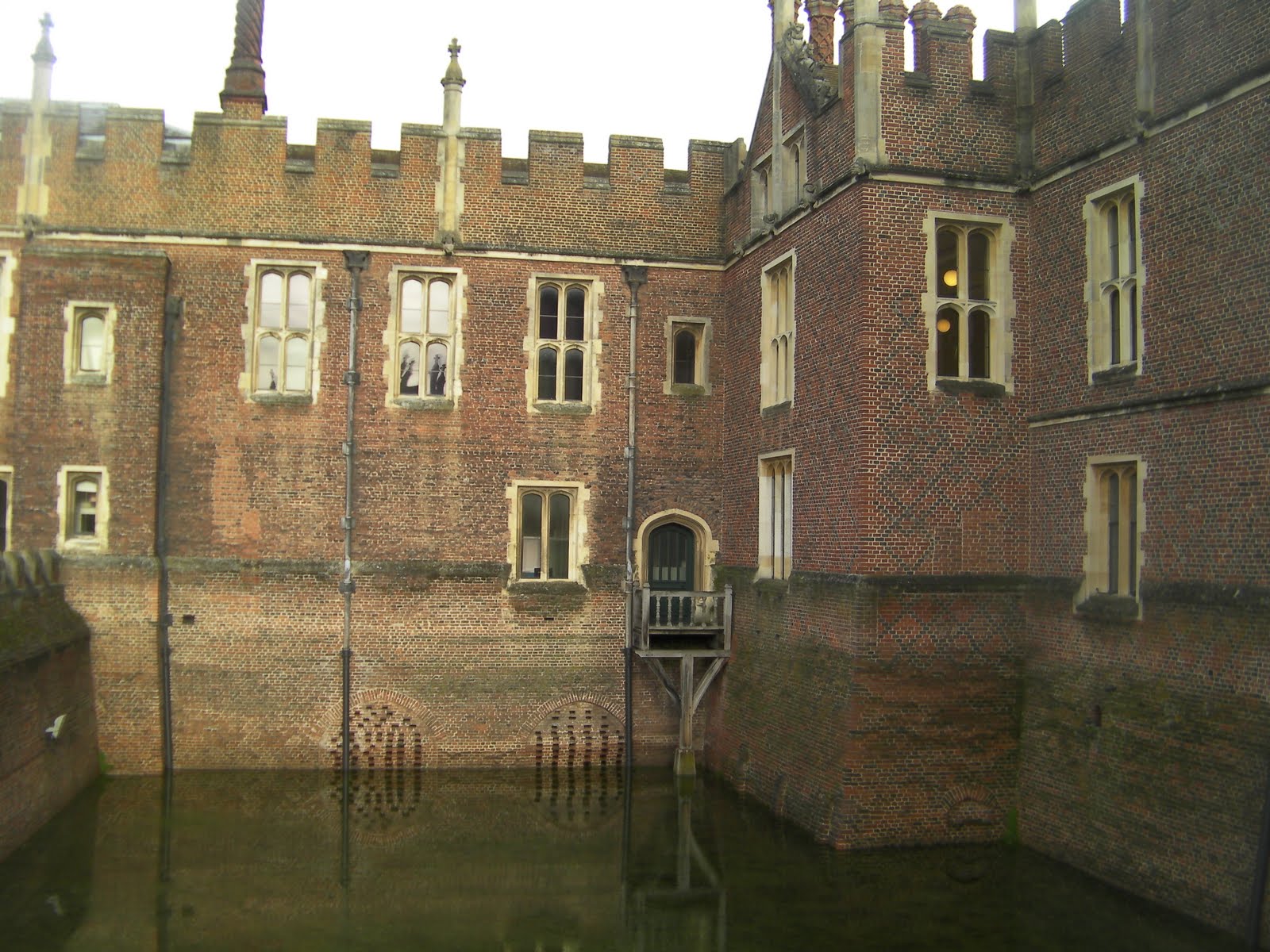
And then we passed over the moat on our way through the entrance.

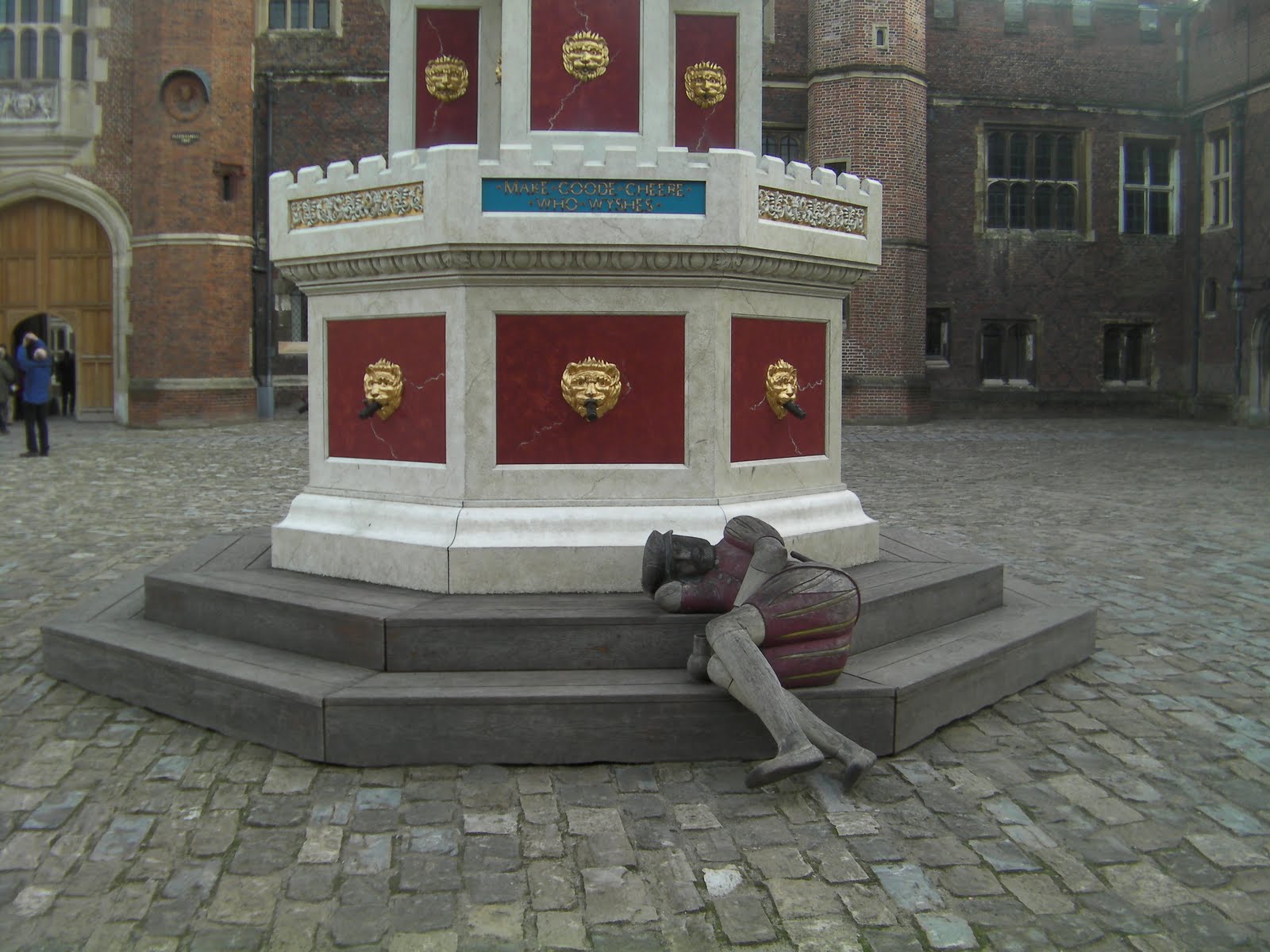
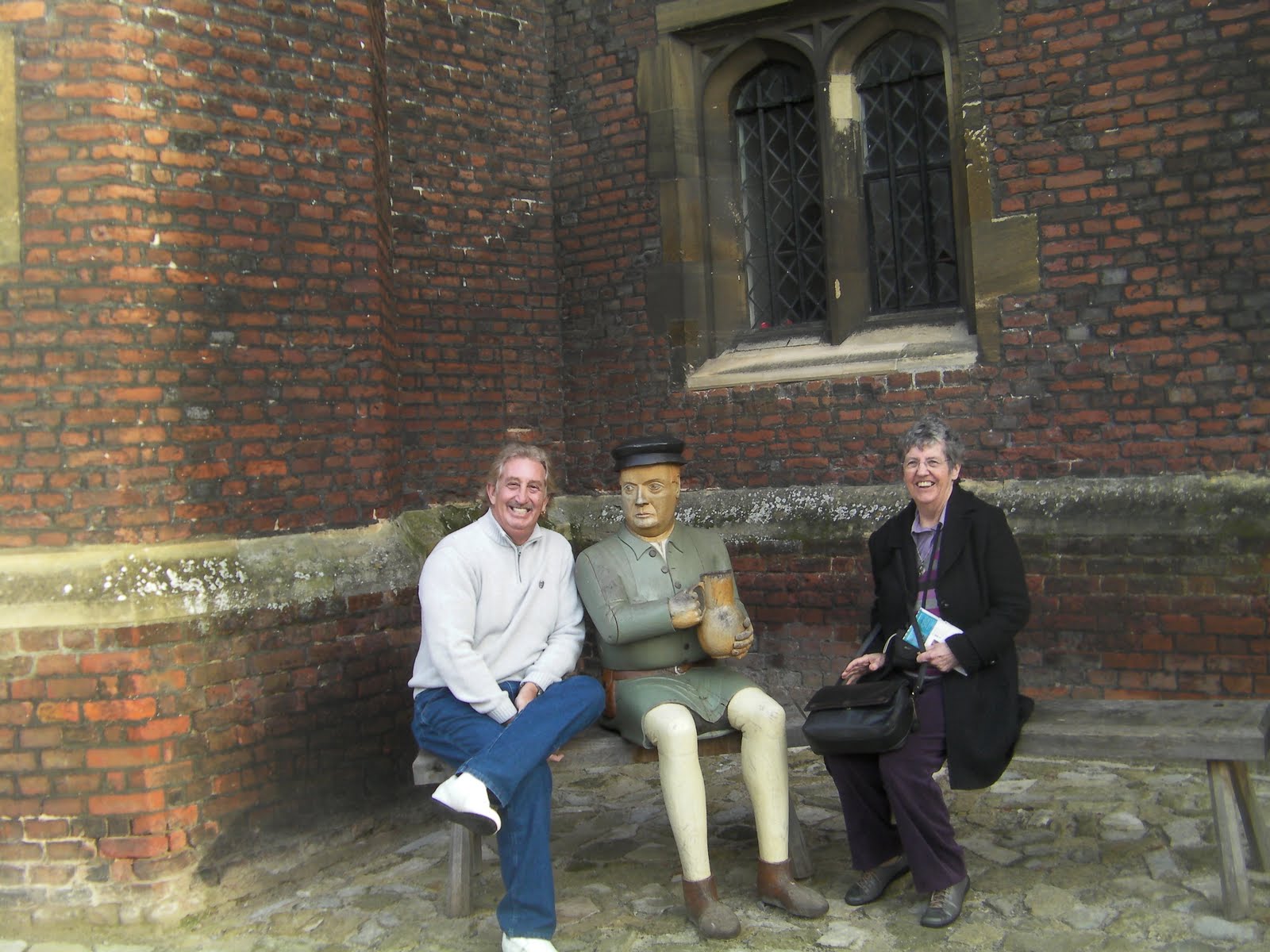
And found ourselves in a courtyard, where we couldn’t help but notice the painted wooden figures scattered about. The one below seems to be napping.


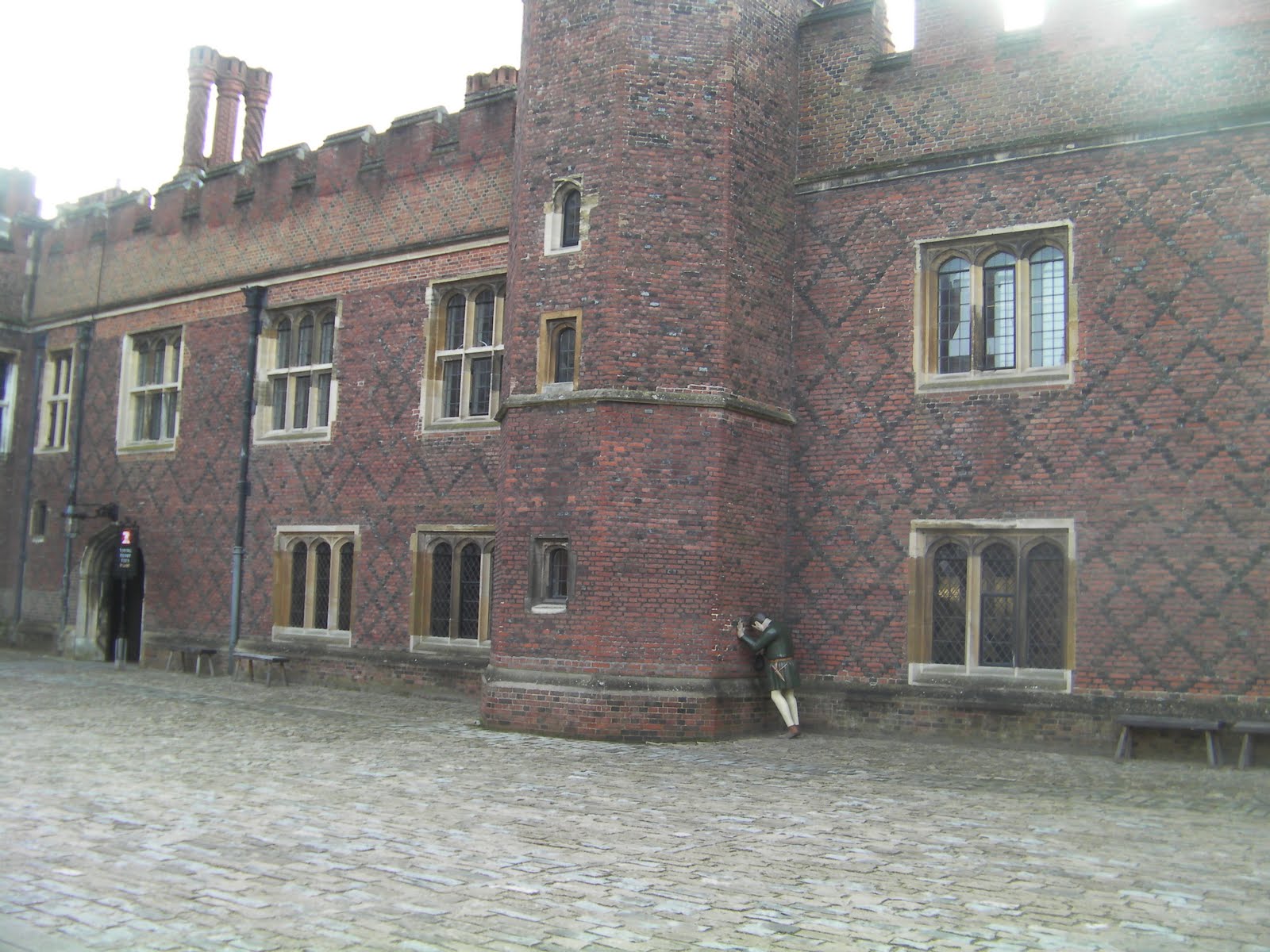
While this one looks to be hiding

And the figure above made room for Hester and Hubby to sit beside him. Too bad there wasn’t actually anything to drink in the jug he was holding. If you know the story behind these figures, do let me know. A Google search has turned up nothing so far.

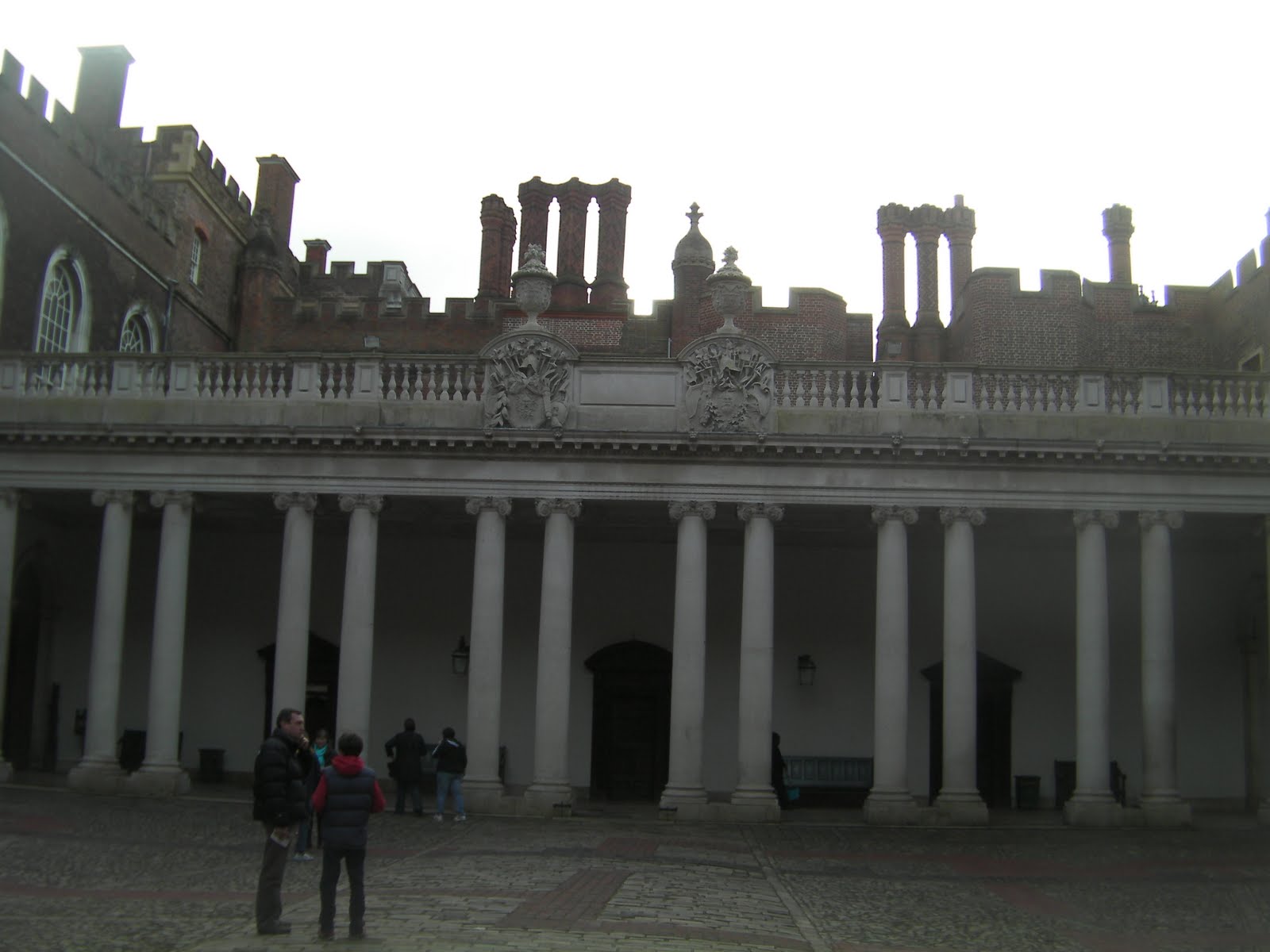
After taking note of the interesting chimney pots above, we crossed over the courtyard and into the visitor’s centre, where we paid our entry fee and Hester asked the nice lady on duty if she knew the location of Apartment 9. She said she didn’t, but that we should ask one of the Warders inside.

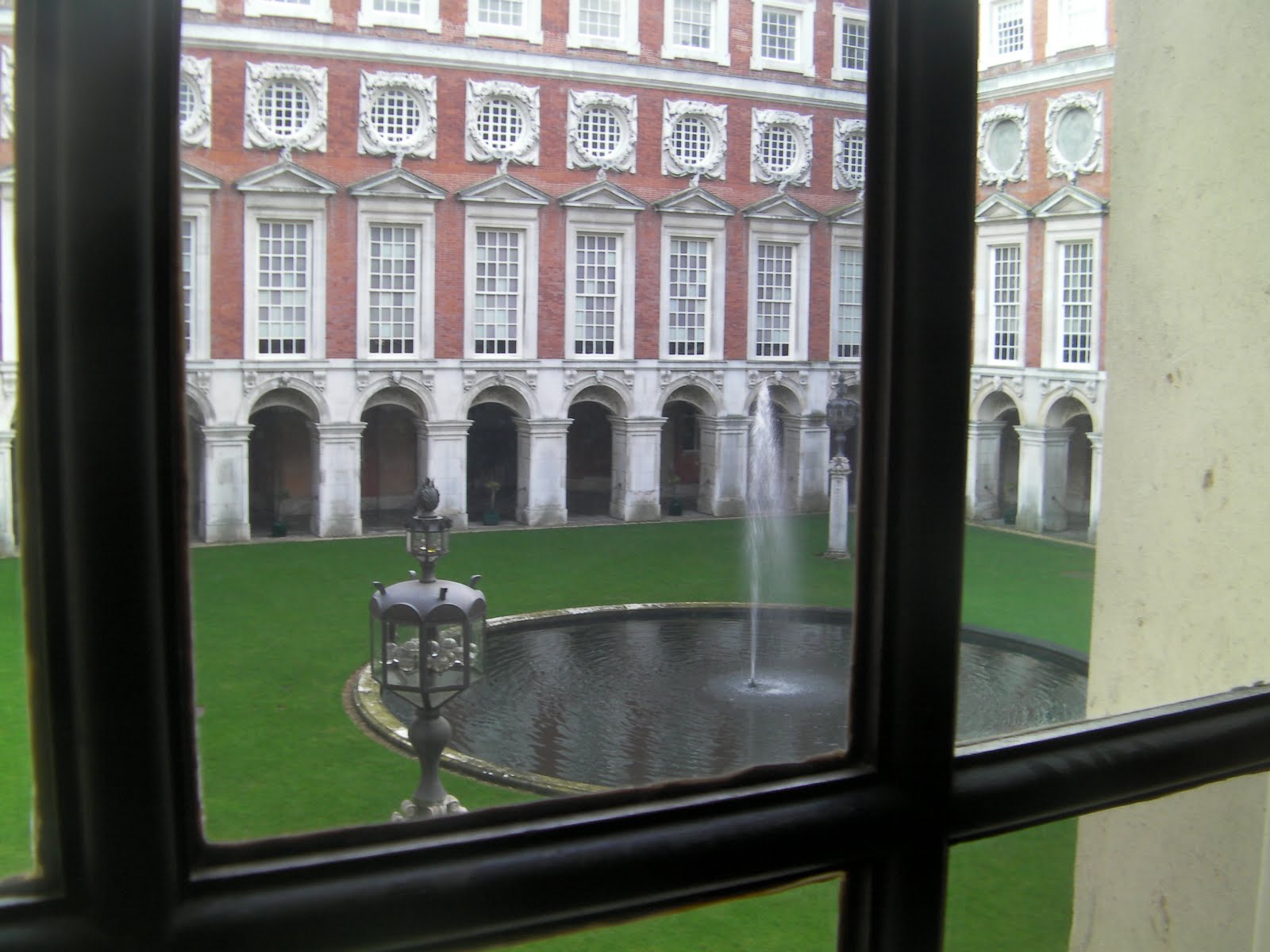
We traversed many a hallway and staircase and peeked out many a window before finding our first Warder. Upon Hester’s asking him about Apartment 9, once home to the sister of the Duke of Wellington, this Warder said, “Ah, you’ll be wanting Ian. He’ll know. That’s his time period. I believe he’s in the Georgian Rooms.”

We thanked him and moved on – before realizing that we hadn’t asked where the Georgian Rooms are. So we traversed more halls and large, empty rooms.

By this time, Hubby was decidedly fading.

“Oh, dear,” said Hester, after getting a good look at his pale and clammy face. “Maybe you should sit down,” she suggested.

“If there was a chair in sight, I’d take you up on that,” Hubby replied. .

Finally, we found another Warder.

“Ian?” we all asked in hopeful unison.

“No, sorry. Ian’s in the Georgian Rooms.”

“You wouldn’t know where Apartment 9 is, by any chance?”

“Apartment 9?”

“Yes, the grace and favour apartment where the Duke of Wellington’s sister lived.”

“Sorry. Ian’s your man. He’ll know. That’s his time period.”

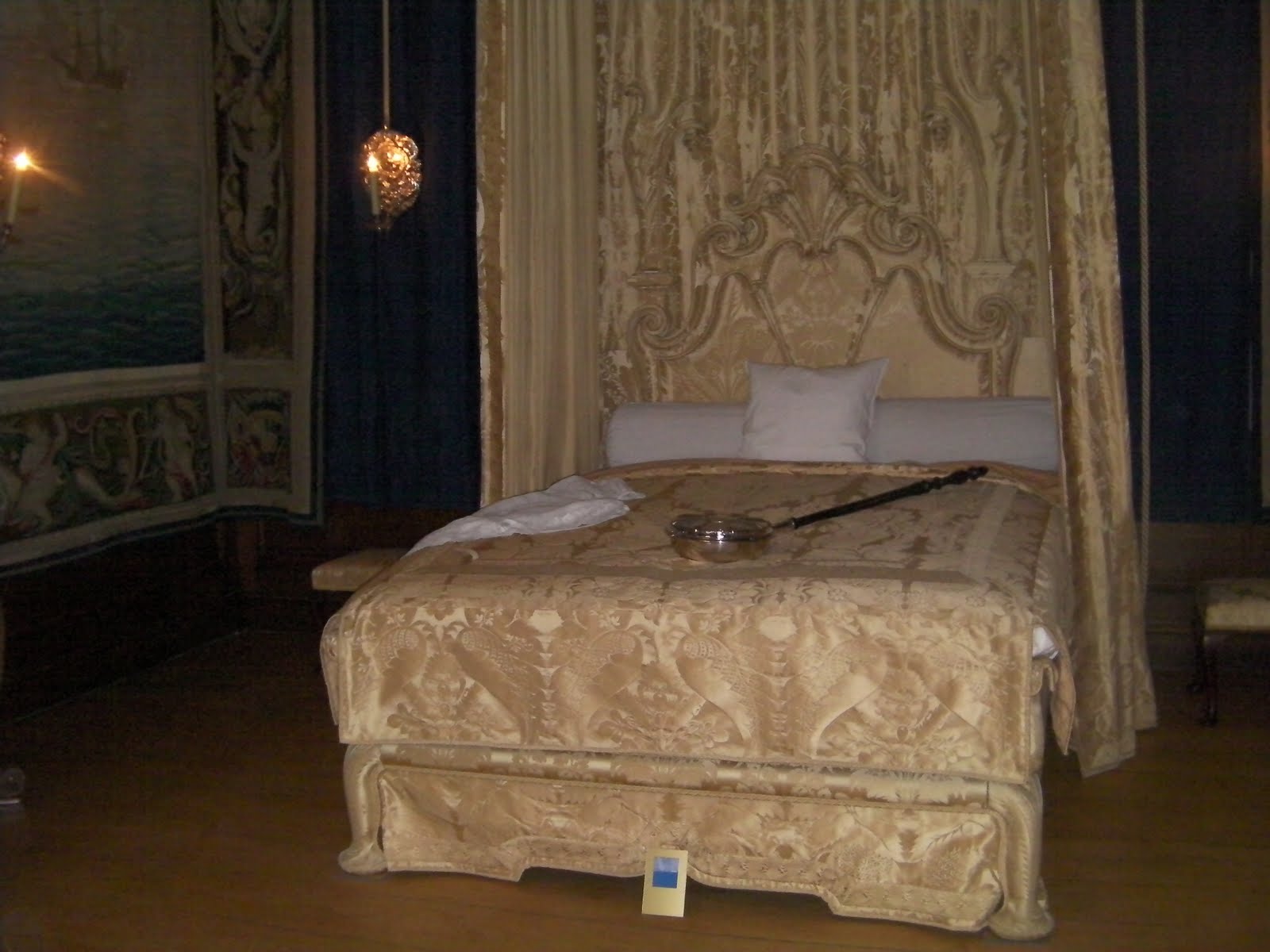
We climbed up another set of stone stairs, with Hubby flagging behind us. Finally we arrived a room that actually had furniture in it. And a bed. I had to physically restrain Hubby from lying down upon it. And there was another Warder.

“Ian?” This one shook his head and pointed down a long and empty corridor. Sigh.

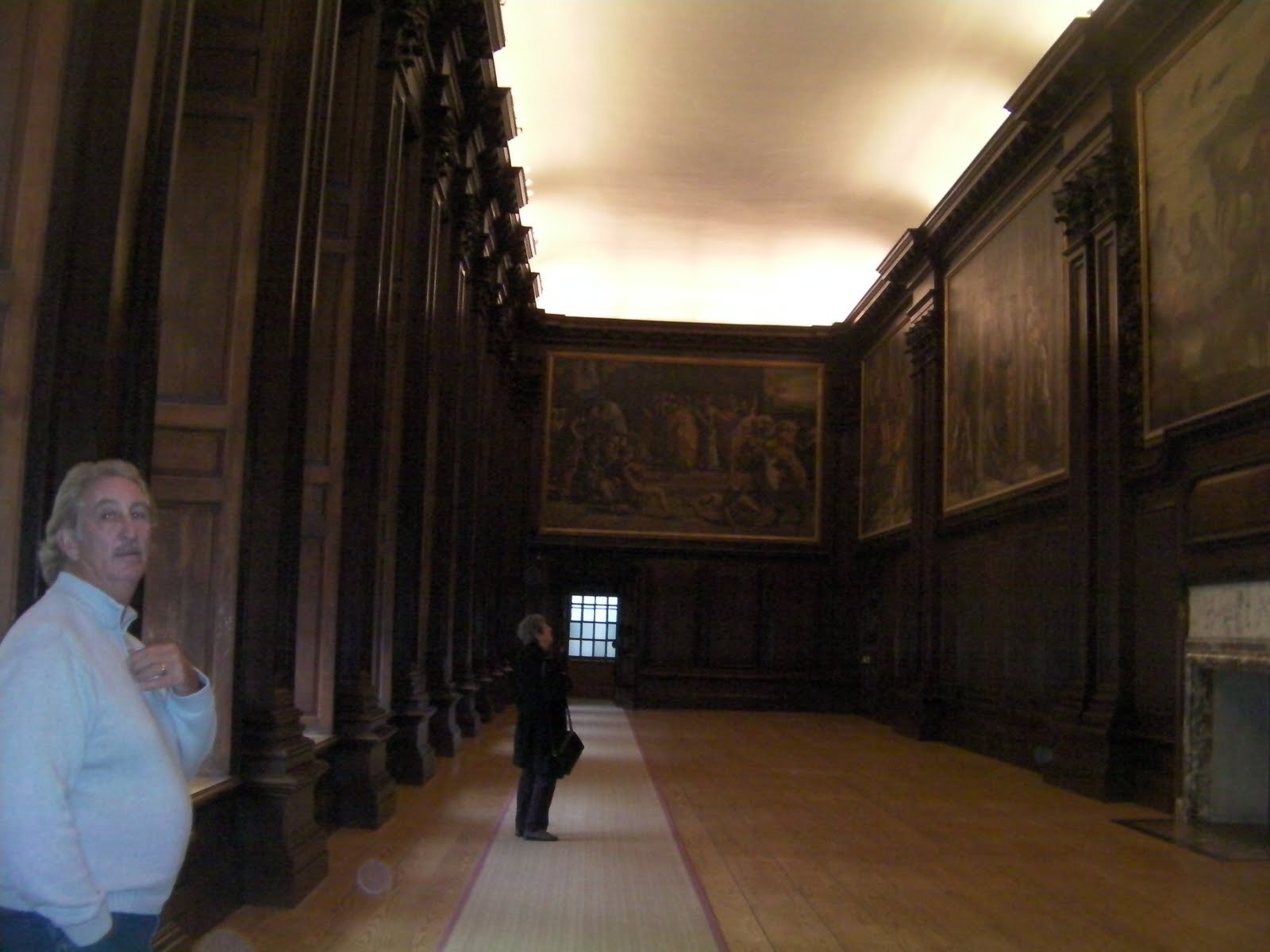
Down the hallway we all trudged until it opened into a panelled and painting lined room. In it stood another Warder.

“Ian?”

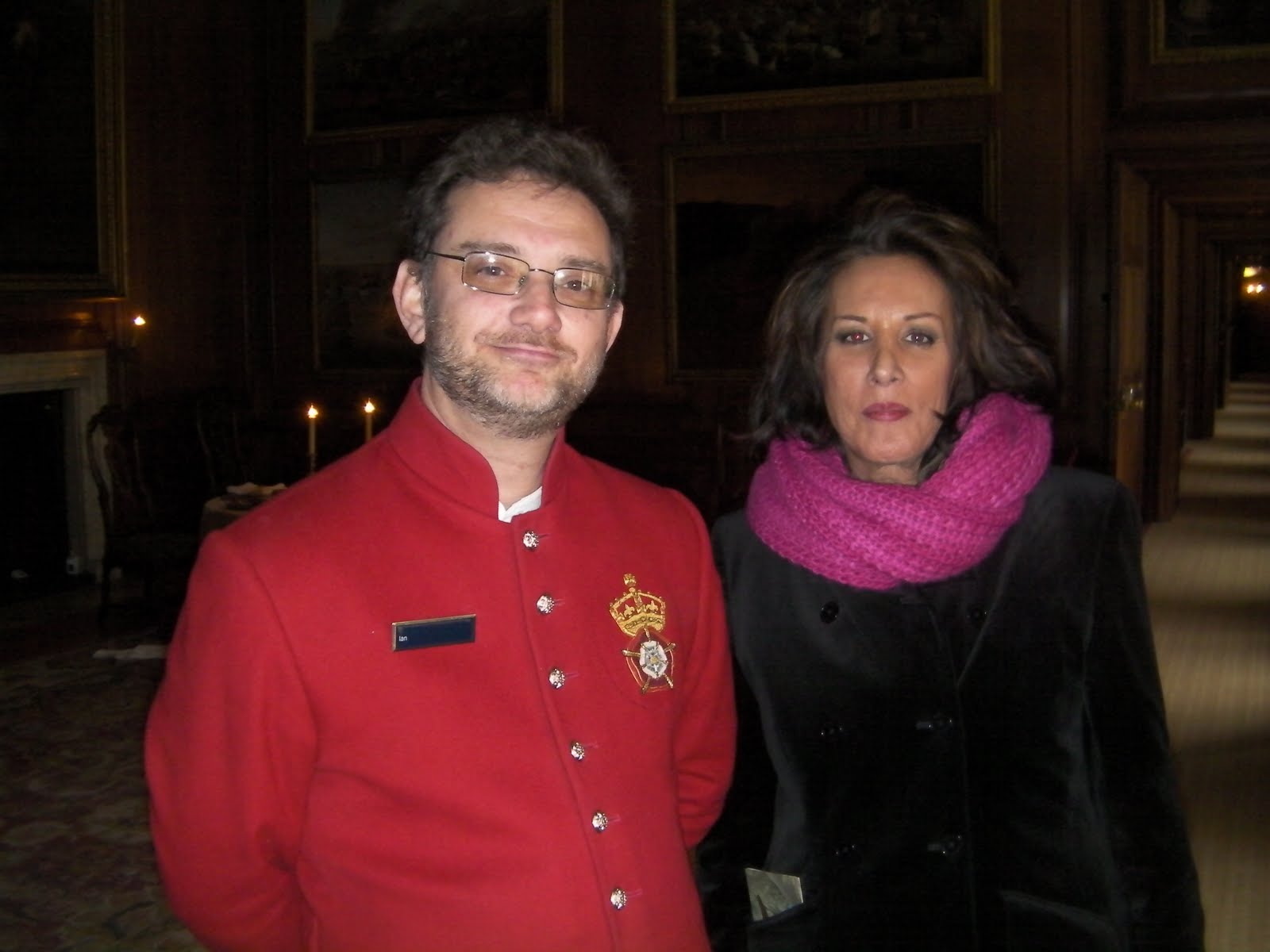
“Yes?”

Hester and I could have kissed him. Hubby collapsed onto a wide window ledge.

We told Ian all about our search for him and how we’d traipsed high and low searching for him, as we’d been told that he’d know all about the Duke of Wellington, Lady Anne and Apartment 9.

“Apartment 9? That’s a new one on me. Lady Anne, you say?”

“Wellington’s sister.”

“I could look it up in the archives, of course, but that wouldn’t do you much good today.”

We exchanged email addresses and Ian, Hester and I began discussing the Regency and early Victorian history of Hampton Court. Turns out that Ian was, indeed, a font of knowledge. I can’t tell you off hand all we discussed, but the conversation didn’t flag for a moment and it went on for ages. After a while, I thought to check on Hubby.

Oh, dear. There he was, poor man, looking for all the world like something out the Night of the Living Dead and sitting patiently by whilst Hester and I jawed with Ian. As we turned to go, Ian said, “I’ll email you about Apartment 9. But in the meantime perhaps you’d like to see where Wellington’s mother lived?”

“Wellington’s mother? Lady Mornington?”

“Yes,” Ian nodded.

“Lived here, at Hampton Court?”

“Yes,” Ian nodded. “Didn’t you know?”

Apparently not.

So off we went, following a map that Ian was kind enough to draw for us.

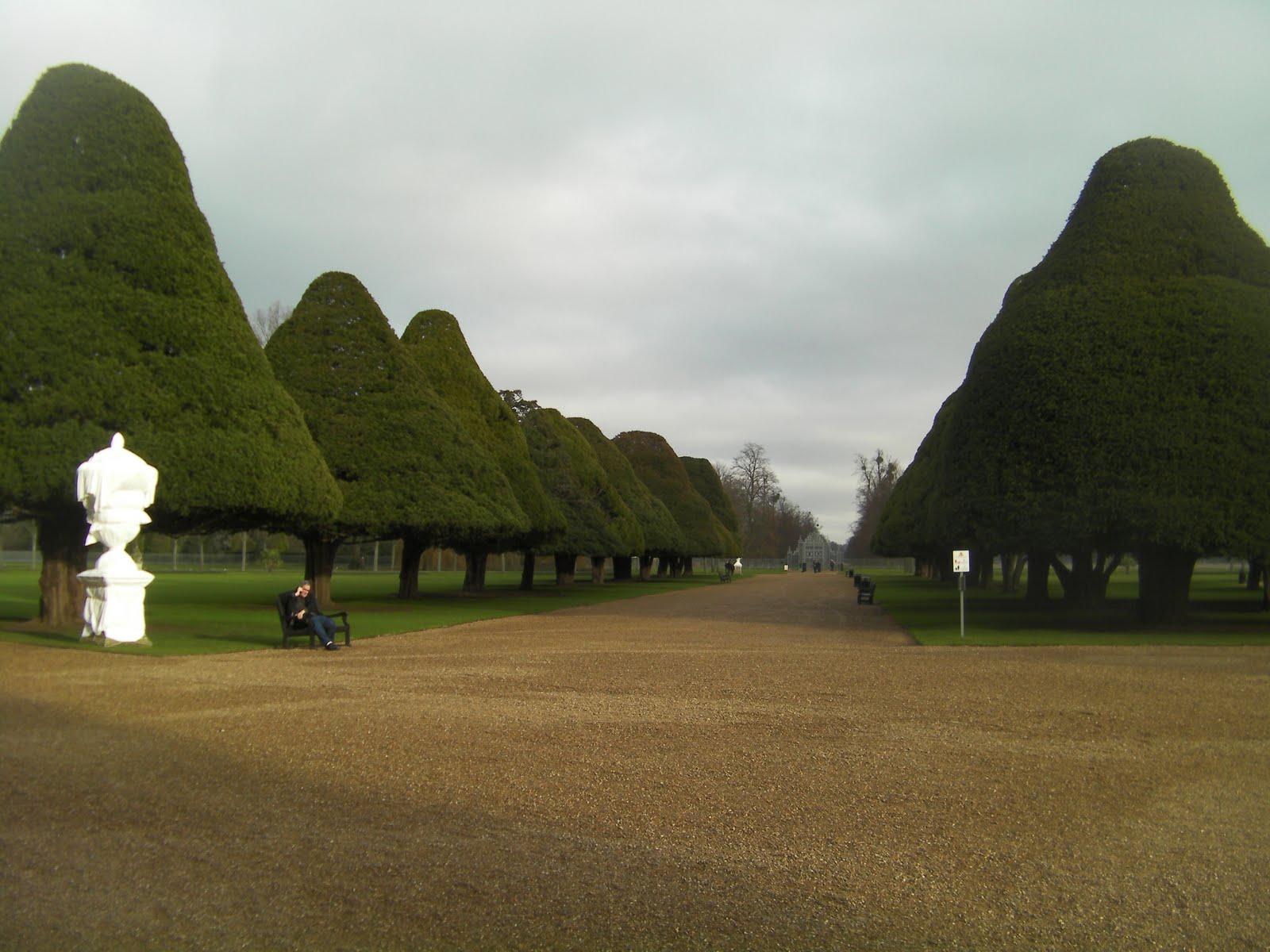
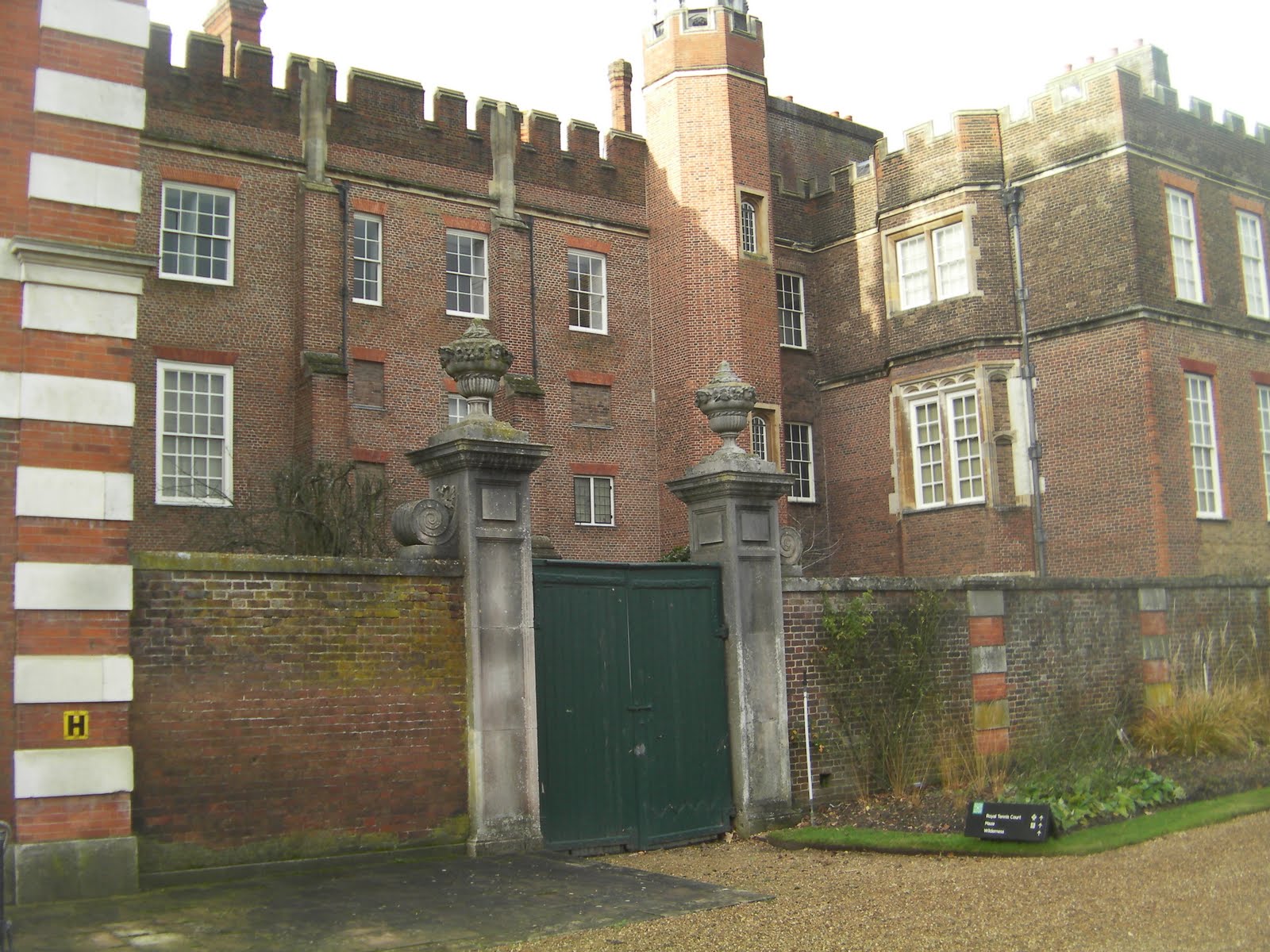
We walked the gravel paths and marveled at the sculpted trees until, miracle or miracles, we found the entrance to the apartment where Lady Mornington once lived, pictured below, exactly as described to us by Ian. Apparently, Lady Mornington kept a garden of some note behind these green gates. I contented myself with the fact that we’d at least found the spot and took pity upon Hubby by suggesting that we head back to Windsor, and our hotel room.

As we turned to go, I said to Hester, “Thank you for bringing us to see Hampton Court. And don’t forget we’ve got the tour of the kitchens at Windsor Castle tomorrow.”

“Oooh, I’m looking forward to that,” she replied.

“Kitchens? A tour of kitchens? I don’t have to go, do I?” asked Hubby.

“Well, I’ve got you a ticket.”

“Hon, in case you haven’t noticed, I’m dying here.”

“And you’ve been such a good sport today,” Hester encouraged him. Looking at me sideways, she continued, “Perhaps he’d be better off in bed.”

“Well, of course you could stay in bed, but it’s the royal kitchens. They aren’t open all the time, you know, it’s a special tour.”

“I’ll make the sacrifice.”

The Pet Cemetery at Oatlands Park

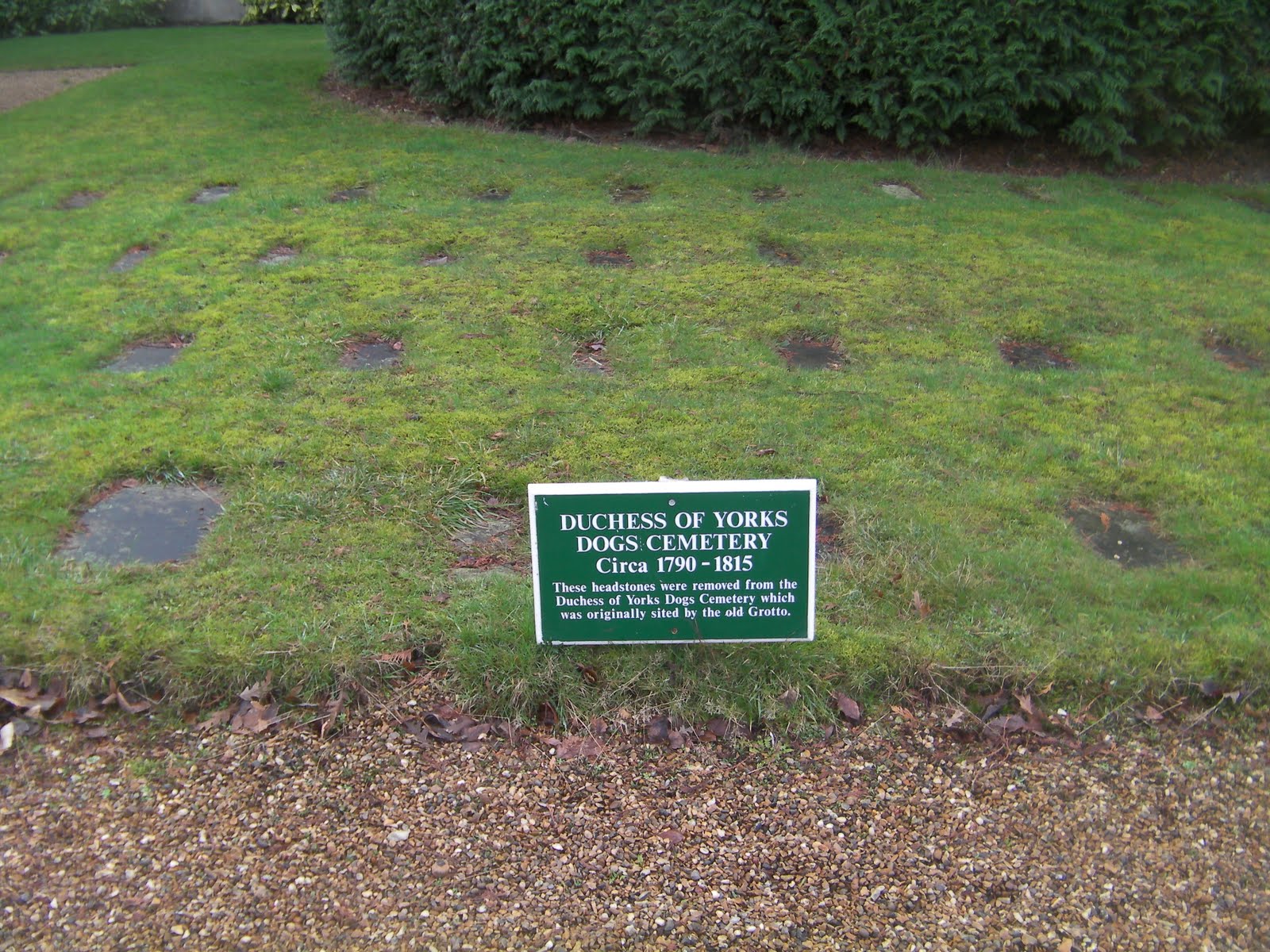
In an effort to get to the bottom of the indecipherable tablets I saw on the graves in the Duchess of York’s pet cemetery at Oatland’s Park, I’ve been going through my old notes and found a magazine article from the late 1800’s that gives a fairly detailed report of the place. No wonder I thought I’d seen proper headstones on the graves – they are pictured in this same article from The Ludgate Monthly from 1897. I was not imagining things. The photo above shows what the pet cemetery looks like today. Follow this link for pictures of the original markers and the full story.

Question 1: I’d wager anything that there is not a single bone beneath any of these markers. If the graves have been moved from their original location and the headstones replaced, if in short nothing remains of the original cemetery, why go to the effort of erecting a poor facsimile of the cemetery and saying that it still exists?

Question 2: Why does this deception bother me so much?

Question 3: What’s worse than finding out there’s no Easter Bunny?

A Pinterest Post: The Steiff Titantic Bear

Once again I’m reporting on the story behind a photo I’ve found on Pinterest, this time the subject is a Steiff Titanic Bear. On April 14th 1912 the passenger liner Titanic was sailing towards New York on her maiden transatlantic voyage when she struck an iceberg off the Grand Banks of Newfoundland, Canada, and sank with the loss of 1,513 lives. The whole of England was plunged into mourning and Steiff responded by producing black mohair bears to mourn the disaster. Within weeks they were displayed in shop windows throughout London and sold out very quickly. The bears’ eyes were backed with red felt so that they looked as though they’d been crying. Only 1,214 black mourning bears of this type were made.

The bear above sold in 2001 at Christie’s, London, for £12,925, the description read as follows: A rare Steiff black teddy bear with pronounced clipped muzzle, large black boot button eyes with red felt backing, black stitched nose, mouth and claws, swivel head, jointed elongated limbs with cream felt pads and hump –16in. (40.5cm.) high, circa 1912

On the 100th anniversary of the Titanic tragedy last year, Steiff produced three commemorative bears to mark the event.


Othello Teddy Bear Titanic Replica wears a slightly curly black mohair coat with red discs behind his eyes.  This Steiff replica is an exact copy of an original “Mourning Bear” from 1912.  Only 494 of these bears were produced in 1912, and therefore, they are greatly prized today.  Othello Teddy Bear Titanic Replica was produced as a Steiff Limited Edition of 1912 pieces.


Polar the Titanic Bear is made of snow white alpaca and wears a whimsical sailor suit.  The original bear was almost lost at sea during his owner’s rescue from the Titanic, but was rescued by a sailor and returned to the little boy who owned him.  Polar the Titanic Bear was a Steiff Limited Edition of 1500 pieces. Further background on this particular bear was found on the Bearly A Memory website:  Daisy Spedden and her husband Frederick were a wealthy couple with a passion for travel. In early 1912, the Spedden family sailed from New York to Algiers and then on to the French Riviera. Returning through Paris, the family boarded the train for Cherbourg; there they took a small boat out to the huge Titanic. On the night of the disaster, Polar, a beloved Steiff bear purchased at FAO Schwarz, was tucked under his master’s arm as the Speddens were lowered down the side of the Titanic into a lifeboat. After the sinking, the survivors were swung up the side of the rescue ship. But Polar found himself forgotten in the empty lifeboat… until a sailor rescued him and returned him to his joyous master, Douglas. Steiff brings this true story to life with “Polar, The Titanic Bear”, a magnificent interpretation of the original bear. Polar is made of snow white genuine mohair and wears a detailed sailor suit. He’s every bit as charming as the original, which survived the tragedy 100 years ago, based on the popular book.
 
The story is continued on a website called Enchanted Titanic:There was also a young boy travelling with his family on the Titanic. His name was Douglas Spedden. He had been given a Steiff Polar Bear a year earlier and had carried it with him throughout his travels with his parents. When the Titanic went down, he and his family went into lifeboat #3 and were picked up by the Carpathia and were returned to New York where they lived. In 1913, his mother wrote a book about the bears travels and adventures. It was called “My Story” and was told through the eyes of his beloved Polar Bear. On August 6th, 1915, Douglas Spedden was struck and killed by a car at his summer home in Maine. This was one of the first recorded car fatalities in the state. The book was put away in a trunk and was not discovered until 1982. In November of 1994, the book entitled Polar, the Titanic Be
ar
was published and released.

 
Centenary Titanic Ted is a replica of the original “Mourning Bear” reintroduced exclusively for both the US and UK markets by Steiff.  This incredible teddy bear has red discs behind his show button eyes (just like the original)  to represent tear-stained eyes.  This Titanic Commemorative bear is from a limited edition of 1912 pieces.