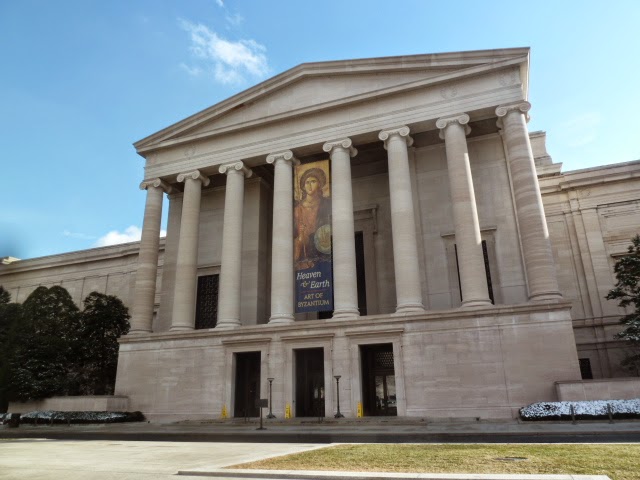
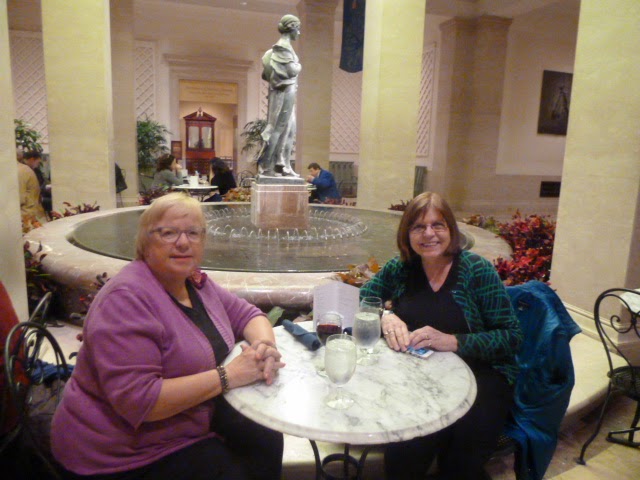
Victoria here. In 2013, I was delighted to have the opportunity to explore the newly installed collection of early American furniture in D.C.’s National Gallery of Art (the post is here). A few weeks ago, I went back for another visit. Historical fiction writer Diane Gaston and I love browsing through the galleries — almost as much as we enjoy our luncheon in the charming Garden Café. In the distant background is the Gallery of the Kaufman Collection, which had to wait until we were well nourished.
Vicky and Diane
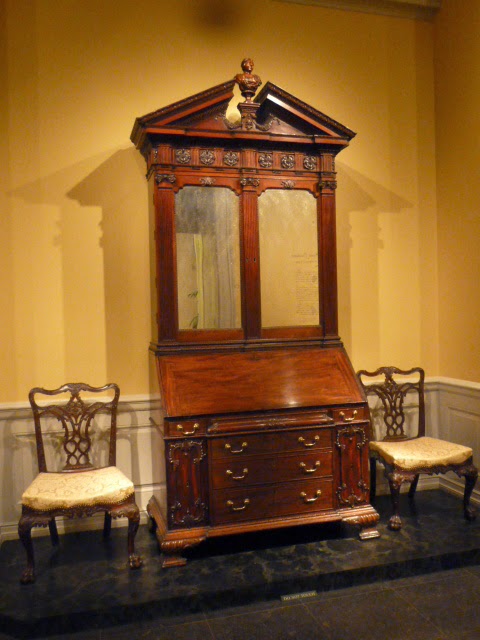
Desk and Bookcase, Pair of Sidechairs
Philadelphia, 1755-1771, Mahogany Glass, Brass
Philadelphia was the leading city of pre-revolutionary America. Colonial furniture makers followed the pattern books of leading English designers such as Thomas Chippendale. Many immigrant craftsmen came to the colonies, and fine imported goods arrived to serve the tastes and growing wealth of leading families. At the top of the desk is a mahogany bust “believed” to be of Catherine Macaulay (1731-1791), a renowned historian and author who “was a great supporter of American liberty.” (from the gallery label)
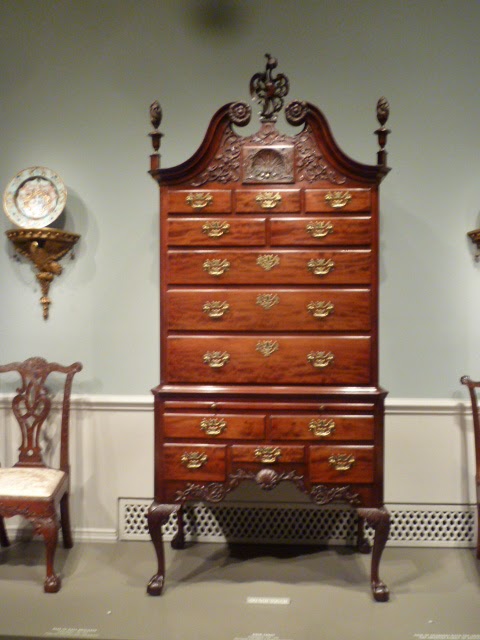
High Chest, Philadelphia 1750-65
Mahogany and sabicu (a hardwood imported from the West Indies); brass
Makers of furniture in various cities of colonial America had their own versions of the English models, with a variety of distinctive characteristics and decoration that enables experts to immediately identify the city of origin of many pieces.
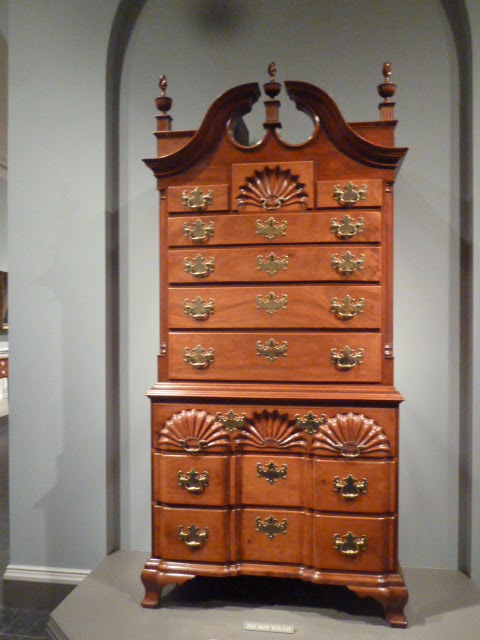
Chest-in-Chest, Providence, 1775-85
Mahogany and Brass
The Providence style is similar to the characteristics of the Newport style. Here is the major difference: the “convex shells on the top drawer of the lower case are carved from the solid drawer front, rather than separately carved and applied. The original owner of this chest was the Providence merchant John Brown (1736-1893) who founded Brown University with his three brothers.”
Ann Barry, 1803-05 by Gilbert Stuart (American, 1755-1828)
Oil on Canvas
Pair of Covered Vases, Jingdozhen, China 1790-1810’=
Hard-paste porcelain
Card Table, signed ad dated by Robert McGuffin (1779/80-after 1863)
Philadelphia 1807
Satinwood and veneers
After the Revolutionary War, styles gradually evolved into what Americans call the Federal Style, based on the increased use of ancient Greek and Roman designs by Europeans. The somewhat simpler lines of the furniture are more neo-classical than rococo.
Knife Box, one of a pair
American 1785-1815
mahogany and veneers with wood inlay; silver
The photo above is included for the special enjoyment of Kristine Hughes. Victoria and Diane are well acquainted with Kristine’s admiration for the myriad knife boxes she finds on her travels.
Side Chair, designed by Benjamin Henry Latrobe (1764-1820)
decorated by George Bridport (1783-1819)
Philadelphia 1808
Poplar and Maple, gesso, paint, and gold leaf; cane seat
Worktable, Boston 1815-1825Rosewood and veneers; bras; ormolu
Used for sewing and needlework
National Gallery of Art West Building
Until next year!!
DOWNTON ABBEY
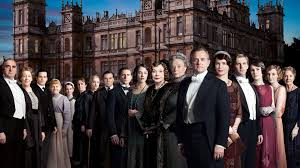
When we visit Highclere Castle on Thursday, September 11, 2014, we will probably be thinking more of Downton Abbey, the PBS Masterpiece series, than of the sumptuous home of the Earls of Carnarvon. Victoria here, as eager to see the Castle/Abbey as anyone. I truly believe that a large part of the credit for DA’s success in America is due to the setting at Highclere Castle: The grounds, the enormous house designed in the most extravagant of Victorian neo-Gothic style, the magnificent interiors of the family’s drawing rooms and bedchambers, the stark simplicity and dullness of the servants’ world below stairs. The contrasts could not be more vivid.
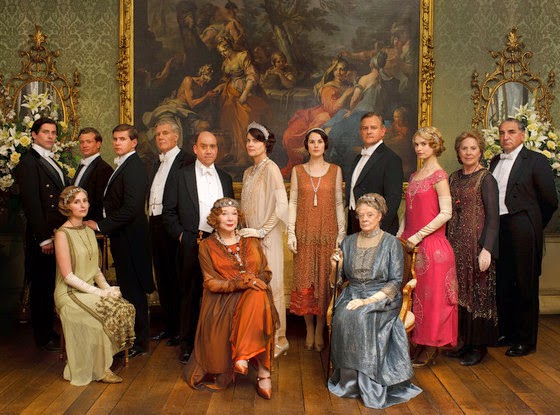
Downton Abbey, PBS Masterpiece
The Crawley family, headed by Robert, Earl of Grantham (High Bonneville), live at the fictional Downton Abbey, filmed at Highclere Castle, the home of the Earls of Carnarvon. Most of the upstairs scenes are filmed in the rooms of the Abbey or on the grounds. The servants quarters have been recreated as they would have been in 1900 to 1930 at studies on nearby Ealing, West London. In this 4-minute video, creator and writer Julian Fellowes takes you through Highclere. Click here.
Another look at Highclere as Downton Abbey is an 8-minute fragment of the program Countrywise visit. Click here
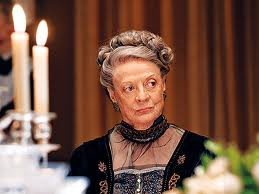
As almost every one knows, Downton Abbey has been a phenomenal success with audiences in Britain and North America, and elsewhere. The four years of the series have won numerous awards for its creator, Julian Fellowes, for its costumes and settings, and for the actors, some of whom have become “household names.” Probably taking first place would be Violet, Dowager Countess of Grantham, whose pithy comments delight audiences on both sides of the Atlantic. Click here to see some favorite moments.
The Inimitable Maggie Smith As Violet, Dowager Lady Grantham
We’ve seen four seasons of Downton Abbey now, and all the episodes are available on DVD and from PBS and other sources. The fifth season is in production and will be seen in the U.K. in the autumn and on PBS Masterpiece in early 2015.
©Nick Briggs/Carnival Film and Television Limited 2013 for MASTERPIECE
Click here for a 13-minute video on the making of Downton Abbey, featuring many of the actors as well as the executive producer, writer, and historical advisor among others.
Although we’ve all seen the fourth season, you might enjoy the preview, a tease of just 90 seconds, put out before it played. Click here.
So to stand in Highclere Castle yourself, come along with us on The Duke of Wellington Tour. September 4-14, 2014. All the details are here.
See you in London!
Oval Gold Pendant surrounded by seed pearls.ca 1830
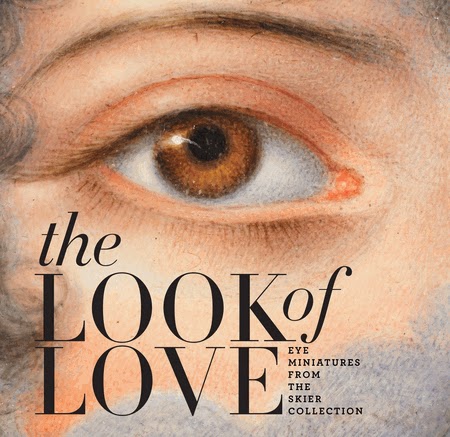
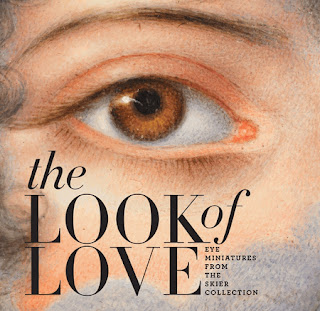
The Look of Love: Eye Miniatures from the Skier Collection
The exhibition opens May 15, 2014, and runs through August 24, at the Minneapolis Institute of Arts
Click here for their website.
Gold Oval brooch and pendant surrounded by split pearls, ca. 1835-40
Here at Number One London, we have a close and affectionate feeling for this wonderful and unique exhibition. Our frequent guest blogger Jo Manning wrote some very special stories for the catalogue.
Here is Jo’s blog about the original opening at the Birmingham Museum of Art in March, 2012.
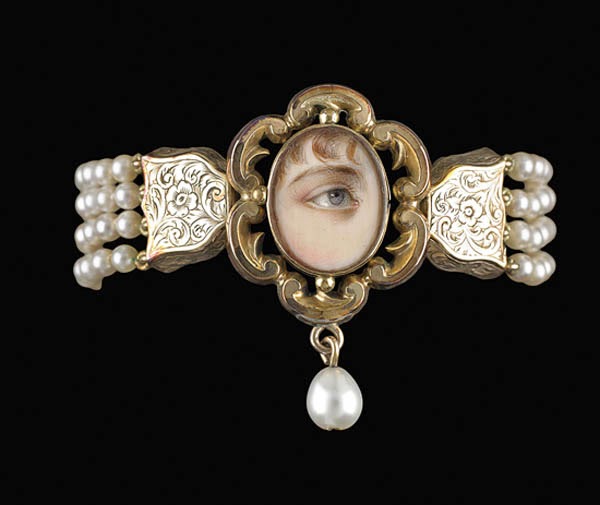
Bracelet surmounted with miniature in gold surround with drop pearl;
plaited hairwork on reverse; gray right eye. n.d.
Jo attended the opening at the Look of Love Exhibitions’ second venue in Georgia, and wrote about it here.
Rose gold octagonal pendant surrounded by blue enamel with half pearls. Brown left eye.
The Look of Love exhibition was also shown at the Winterthur Museum in Delaware. September 21, 2013 – January 5, 2044. Click here for more information.
Gold oval brooch surrounded by foil-backed red pastes, ca. 1790. Blue left eye
surrounded by curls. Attributed to Richard Cosway.
Here’s hoping you have had an opportunity to see this outstanding collections of treasures!
All photos, ©Birmingham Museum of Art, Sean Pathasema, photographer
By Guest Blogger Greg Roberts
 |
|
William Wellesley-Pole (1763-1845)
|
Historians have always been particularly nasty about Arthur Wellesley’s older brother William Wellesley-Pole. He has been variously described as ‘opportunistic and not a little devious’; ‘the worst type of hanger-on’; and harshest of all: ‘a nonentity’. To cap it all his obituary in The Times is still considered one of the most savage ever printed:
[He] was simply angry- angry at all times with every person and about everything.; his sharp, shrill, loud voice grating on the ear…an undignified ineffective speaker, an indiscreet politician…advancing in years without improving in reputation.
Over the years I have presented papers at various venues including the Wellington Congress intended to overturn this somewhat biased and inaccurate assessment of Wellesley-Pole. In any other family he would have been feted, but Wellesley-Pole was dwarfed by the achievements of his other brothers; Richard, Governor General of India (1797-1805); and Arthur, perhaps Britain’s greatest military general. But we should remember that Wellesley-Pole was responsible for the silver coinage introduced in 1817 which remained in circulation until 1971 – and this was just one of several enduring achievements in his own right. Far from being a ‘nonentity’ Wellesley-Pole was actually a very loyal and trustworthy brother, content to stay out of the limelight, and blessed with the one gift that eluded all the Wellesley clan: a long and happy marriage.
The one thing that historians cannot ignore is the role that Wellesley-Pole played in the creation of ‘Wellington’. This is revealed in the Raglan MS at Gwent Archives, containing correspondence between Wellesley-Pole and Arthur covering a decade from 1807. This very important primary source is often used to illustrate Arthur’s unvarnished opinions about the performance of government, progress of the war, and the conduct of his family during these momentous years. Yet the many letters FROM Wellesley-Pole TO Arthur are scarcely ever acknowledged even though these contain an equally rich vein of personal insight. It is almost as if Wellesley-Pole is considered persona non-gratis – even in his own archives.
But by reading both sides of the Raglan MS it becomes clear that, from his position at the heart of government, Wellesley-Pole acted as Arthur’s ‘remote-secretary’. His services ranged from provision of tea and other home comforts, through to supplying a new sword or replacement horses. He relayed the latest news, gathered opinions, and soothed often fractious relations between the Cabinet and the Peninsular Army. Hence, following Arthur’s victory at Talavera in 1809 Wellesley-Pole was asked to find a suitable title for his feted brother. He was reluctant to be saddled with such an important responsibility, but King would not wait, and an immediate decision was required. So Wellesley-Pole took up his pen and wrote to Arthur:
After ransacking the peerage… I at last determined upon Viscount Wellington of Talavera and of Wellington, and Baron Douro of Welleslie in the County of Somerset. Wellington is a town not far from Welleslie, and no person has chosen the title. I trust that you will not think there is anything unpleasant or trifling in the name of Wellington, but [in the] circumstances… I could not easily have done better. I own I feel in rather an embarrassing situation for it is impossible for me to know whether I have acted as you would have had me…but you should have explained to me your wishes before ever you left England, in case of such an event.
In the anxious days awaiting a reply from the Peninsular, Wellesley-Pole’s nerves would hardly have been soothed when Arthur’s wife Kitty declared ‘Wellington I do not like for it recalls nothing. However, it is done & I suppose it could not be avoided.’ The fact Wellesley-Pole did not consult Kitty says a lot about the role of women in society at that time, for it seems odd that she was presented with a fait accompli, and literally had to live with Wellesley-Pole’s decision for the rest of her life.
Eventually and to Wellesley-Pole’s immense relief
his choice of title met with unqualified approval from Arthur:
My opinion is that you have done exactly what you ought to have done… You have chosen most fortunately, and I am very much obliged to you. I could not have been better off for a name if we had discussed the subject twenty times
It’s a shame to see how lazily generations of historians have negatively pigeon-holed Wellesley-Pole, when denying his close relationship with Wellington must surely prevent a fuller understanding of this great military genius. Even the creation of ‘Wellington’ is too often considered an egotistical act on Wellesley-Pole’s when a quick perusal of the relevant letters can easily demonstrate that Wellesley-Pole had no choice but to stand proxy, and that his motives were honourable as he tried to balance the needs of government with the wishes of his beloved brother.
If you would like to know more about the Wellesley-Pole family, please check out my blog www.wickedwilliam.com at which I will be doing a series of posts devoted to Wellington’s relationship with Wellesley-Pole’s children: Mary Bagot, ‘Wicked William’ Long-Wellesley, Priscilla Burghersh & Emily Raglan. This quartet each played very significant but wildly differing roles in the life and times of the Duke of Wellington.
You can follow Greg Roberts on Twitter: @geggly @Mary_Bagot

.JPG)
.JPG)
.JPG)