THE DUKE OF WELLINGTON TOUR — VIDEO HIGHLIGHTS – WINDSOR CASTLE

The Duke of Wellington Tour will visit Windsor Castle on Friday, September 12, 2014.  It is a place of superlatives! In the words of the website, “Windsor Castle is the oldest and largest inhabited castle in the world. It has been the family home of British kings and queens for almost 1,000 years. It is an official residence of Her Majesty The Queen, whose standard flies from the Round Tower when she is in residence.”
Here is a 3.5 minute official video introduction.
For a quick visit to the Royal Kitchen, click here.
For a 6.5 minute musical visit to Queen Mary’s Dollhouse, click here.
This is a 9-minute recap of the April 1991 visit of Polish President Lech Walesa, with good views of the informal and formal parts of the dinner, from the 1992 BBC documentary “Elizabeth R”.

We hope to get a glimpse of the latest display at Windsor Castle, an exhibit of private documents from the Royal Archives.  Here is a newspaper story about it .  (Non-Video, sorry)
Here is a 55-minute video excerpt from Windsor Castle: A Royal Year. Well worth the time!

Join us for this visit to Windsor Castle as part of 

The Wellington Tour

JOIN US IN  ENGLAND

JOIN US AND HAVE THE TIME OF YOUR LIFE!

VICTORIA VISITS HAMPTON, IN MARYLAND

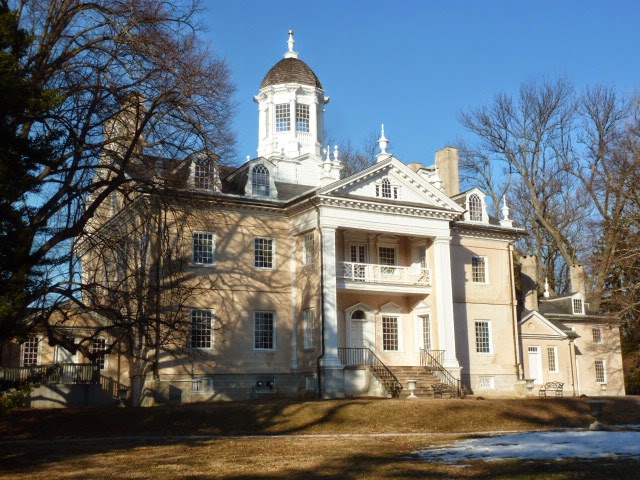
Hampton is a mansion built in 1794, at the time the largest private home in the young United States.  It is now operated by the National Park Service and you can read about the property on their website here.


The land in the colony of Maryland was granted  to a cousin of Lord Baltimore, from whose family it was purchased in 1745 by Colonel Charles Ridgely. He eventually owned more than 11,000 acres of land, on which an ironworks was established in 1760 by his son Charles Jr.  During the American Revolutionary War, Captain Charles Ridgely Jr. (1733-1790) supported the patriots, supplying a variety of arms, ammunition, guns, and more to the troops.  The agricultural land was worked by tenant farmers, indentured servants and slaves.   
 
 
Still a little snow in February when I visited
Farm buildings and quarters for slaves and indentured servants
 
  
demolished
 
 
Captain Ridgely also owned a merchant fleet and he developed grand plans to build a mansion, sometimes said to have been modeled after Castle Howard in Yorkshire.  Captain Ridgely died before the house was finished; most of the land, business interests and the mansion went to his nephew Charles Ridgely Carnan Ridgely (1760-1829), who finished the house and made it into the largest and most magnificent residence in the USA. He presided over a property that included ironworks, extensive grain fields, cattle, racehorses, marble quarries, millworks, and mercantile  interests.  He became Governor of the State of  Maryland in 1815.
 
 
Over the drawing room fireplace is a portrait of Charles Ridgely Carnan
 
 
Much of the magnificence of the interior is also attributed to Eliza Ridgely (1803-67), third mistress of Hampton.  She was the daughter of wealthy Baltimore wine merchant Nicolas Ridgely, said to be no relation of the various Charleses of Hampton.  Eliza married Charles Carnan Ridgely II (1790-1867); she was a heiress herself and traveled extensively, collecting wherever she went. She was the mother of five children.
 
 
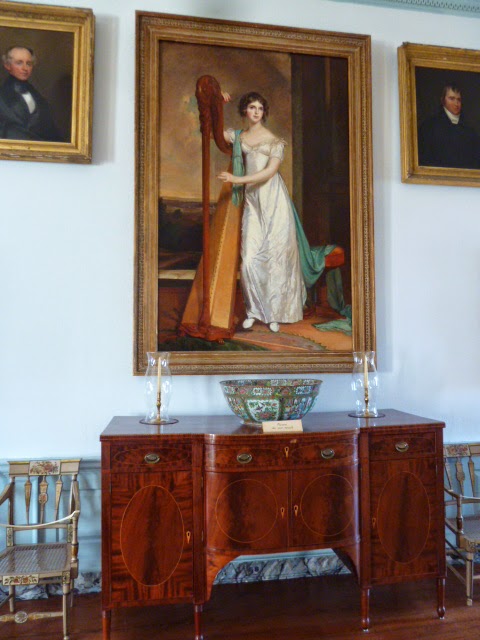
Thomas Sully, Lady With a Harp (Eliza Ridgely), 1818
National Gallery of Art, Washington, D. C.
 

Sully (1783-1872)  painted Eliza at age fifteen. She was an accomplished harpist.  The painting hung at Hampton until 1945. After it came to the National Gallery, donors and officials became more interested in the fate of Hampton, which was sold to philanthropist Ailsa Mellon Bruce. She gave the property to the National Park Service in 1948.  A copy of the painting hangs at Hampton.

The Hall of Hampton mansion

Another view of the Hall
 
 
The ground floor reception rooms and dining rooms are decorated in styles popular when the house was in its heyday from the early 1800’s well into the Victorian period.


Vi
ctorian Parlor
 
 
Tea Table
 
 
Dining Room
 
Ready for bedtime
 
 
Child’s bedchamber
 
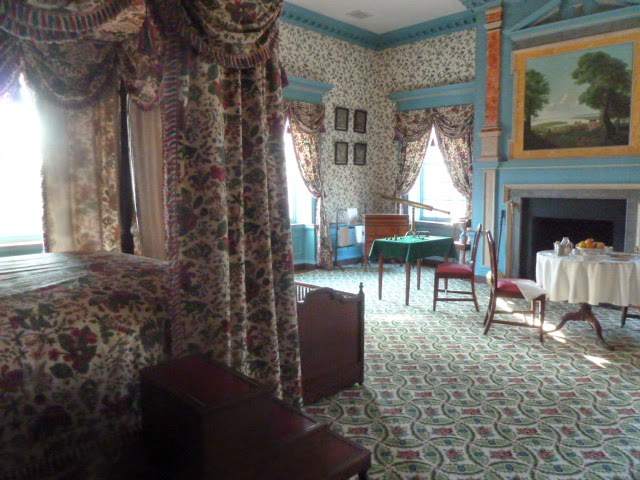
Bedchamber

  Eliza, as well as many other owners, spent a great deal of time developing the pleasure grounds, a bowling green, the park and gardens. orchards, and kitchen gardens.

Orangerie, replacing one destroyed by fire


Hampton Mansion

 
This panel explains the original layout of the estate, now much reduced in size.
 
The Park Service presents many educational programs throughout the year focusing on the mansion’s history, the lives of the servants and slaves, the food and cooking demonstrations, and gardening.


DANDIES IN THE MALL

From the Journal of Mrs. Arbuthnot, May 26, 1821


      I took a long ride into the country with Mr. Arbuthnot and the Duke of Wellington. The ladies and dandies have taken to ride in the Mall in St. James’s Park in such numbers as to be quite a nuisance. Yesterday I am sure there must have been above 100, and in that narrow road it is really dangerous. I have therefore taken to ride into the country, and we went today over the Vauxhall Bridge, by Brixton and Tooting round to Wandsworth and home by Chelsea, a beautiful ride thro’ a pretty part of Surrey, all looking right and happy, altho’ we are told every day that we are ruined and starving . . . . . 


THE DUKE OF WELLINGTON TOUR – VIDEO HIGHLIGHTS – PART 11

BASILDON PARK


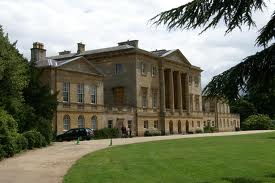
Basildon Park


After leaving Stratfield Saye, our group will travel to nearby Basildon Park for a private tour of this stately home.
From their website:

Basildon Park, a Georgian mansion surrounded by parkland, was loving rescued by Lord and Lady Iliffe in the mid 1950s. The house you see today is a re-creation and restoration of the 18th-century mansion. They restored the elegant interior and scoured the country salvaging 18th-century architectural fixtures and fittings. Lord and Lady Iliffe filled their comfortable new home with fine paintings, fabrics and furniture, which can still be enjoyed by you today. Make the most of your visit by treating yourself to a cream tea, experience the nostalgia of our 1950s kitchen, or stretch your legs following one of our waymarked trails through the 400 acres of historic parkland.

Basildon Park was originally built for Sir Francis Sykes and you can read the entire history of Sykes, his waning fortunes and the history of the house here. The Regency history of Basildon Park is interesting and I quote from Wikipedia as follows:
“On Sir Francis Sykes’ death, Basildon was inherited by his son, Sir Francis Sykes (2nd Baronet) who died a few weeks later. The house then passed to his grandson, the five-year old Sir Francis (3rd Baronet). By this time, the Sykes fortune was almost spent and Basildon was already mortgaged. The family finances suffered further as a result of the 3rd Baronet’s association with the extravagant Prince Regent. Aged just 14, he entertained the Prince at Basildon. As a result of the Prince’s occupation of the North side of the second floor, where the best bedrooms are located, for many years afterwards this range of rooms were known as `The Regent’s Side’ as opposed to the family’s less formal rooms on the South side of the floor. From the late 1820s, Sykes was suffering serious financial problems, and in 1829, the estate was placed on the market. The house was not quickly sold, as Sykes refused to accept any price less than £100,000. During this period, the house was often let. However, Sykes and his family were in residence between 1834 and 1835 when the future Prime Minister Benjamin Disraeli was a house-guest at Basildon. Disraeli, who was the lover of Sykes’ wife Henrietta, immortalised her along with some descriptions of Basildon and its rooms in his novel, Henrietta Temple: A Love Story. Another romantic attachment of Lady Sykes was to result in her husband being immortalised in a novel, this time in a less flattering light. Lady Sykes had been conducting an affair with the painter Daniel Maclise. Her husband publicly denounced Maclise, causing an unacceptable high society scandal. As a result, Charles Dickens, a friend of Maclise, then writing Oliver Twist, based his villainous and cruel character Bill Sikes on Sir Francis.”
Basildon Park’s literary connections did not end with Disraeli and Dickens – the house was used as the setting for Netherfield Park during the filming of  the 2005 version of Jane Austen’s Pride and Prejudice. You can watch a short video about the filming at Basildon Park here. The house was used as a set for another Keira Knightley film, The Duchess, in 2008. 
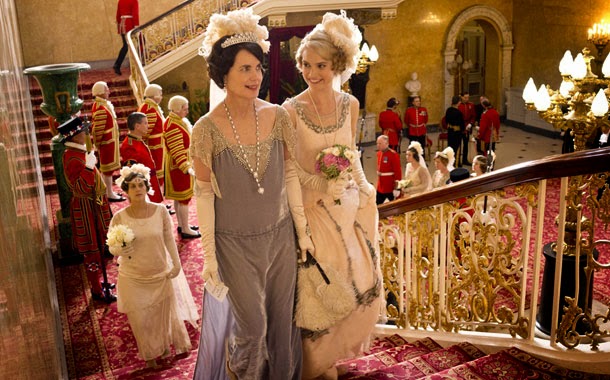
Downton Abbey Basildon Park
The interiors of Basildon Park were most recently used as the Crawley family’s London residence, Grantham House, and the elegant Georgian mansion was at the heart of the unfolding story as the family prepared for Rose’s coming out ball in the capital. Basildon Park played host to all of the much loved regular characters from the show as well as Shirley MacLaine who reprises her role as Martha Levinson and Paul Giamatti who joins the cast as Cora’s playboy brother, Harold. The episode was part of Downton Abbey’s 2013 Christmas special. You can watch a video of which rooms were used in the filming and short clips from the Special here. 
You can take a half hour video tour of Basildon Park, it’s interiors and learn about it’s history and occupants here. 
FIND COMPLETE ITINERARY FOR 

LOVE, LIFE, AND LAUGHTER: A TREASURE RETURNS

Image Credit: British Film Institute via Silent London

By Guest Blogger Spencer Blohm

One of the many things that most of us don’t give up on from our childhood is that tiny sliver of hope that we’ll somehow find hidden treasure. It may not be as extravagant as finding a secret passageway in your living room to a tunnel of gold, but most of us can’t deny that little rush when they think they may have found something of value (after all, Antiques Roadshow has made an entire series about it).

            The Dutch film institute, known as EYE, had that feeling when they started unpacking the shipment of films earlier this year that they had originally received in November of 2012. The package consisted of leftover film cans from an older building in a rural Dutch town that had briefly been used as a cinema in the late 20’s. In the package, they discovered one of the BFI’s most sought after films: Love, Life, and Laughter. The 1923 silent film, directed by George Pearson, is a landmark find for the BFI, who had assumed that this film, like so many other silents, was destroyed or recycled following the bank crisis of 1924 (which put many studios out of business).

            The film stars the enigmatic Betty Balfour, the most famous British actress of the silent film era, and is generally regarded as the British equivalent to the United States’ Mary Pickford. Love, Life and Laughter is the film which launched Balfour’s career and was just one of a series of critically and commercially successful collaborations between Balfour and Pearson. It’s a particularly significant find for Pearson fans too, since it is only the second film of his that the BFI possesses a complete version of.

In the film, Balfour plays Tip Toes, a down on her luck chorus girl who yearns to be center stage. She befriends a young writer in a similar situation to her own (played by Harry Jonas), and the two agree to meet up two years later in order to see if either of them made it big. The film, naturally, wouldn’t have been such a hot commodity if it wasn’t regarded as a cinematic masterpiece, with Balfour receiving much praise. Adding to its allure is the fact that it is somewhat of an anomaly being a full length film, since it was produced during a short period where studios decided to expand the length of their silent films.

The BFI is hoping to receive a copy from EYE, so that they can translate the Dutch intertitles and screen it for audiences within the next year. This discovery is the ultimate lost treasure for film buffs all around the world, not just in Britain, and shows that perhaps we shouldn’t give up on those childhood wishes after all.


About the Author: Spencer Blohm is a freelance entertainment, film, and pop culture blogger for DirectTelevisionSpecials.org. Despite multiple attempts, he’s never been able to find hidden treasures or films in either of his grandparent’s attics. He lives and works in Chicago, where he can often be found scouring flea markets looking for a big find.